
仁爱版七年级英语上册Unit3知识点总结
Unit3 Getting Together Topic1 基本句型 1. Excuse me,could you please tell me your name? Sure,my name is Jane. 2. Could you help me with it? No problem. 3. Does he speak some Chinese? Yes,he does./No,he doesn`t.He speaks English. 4. What does he say in the letter? 5. Jane,Sally and I are good friends. 6. We often help each other. 7. Many students in our class like English a lot,but I like it a little. 8. What about you,Sam? No,I don`t like English at all. 词组 9. pen pal 10. help sb.with sth. 11. a lot 12. not...at all 13. each other 14. a little 15. very much 16. a lot of 17. every day
人称代词和一般现在时 人称代词代表人或事物,它有人称、单复数、主格和宾格的变化。 第一人称 第二人称 第三人称 主格 I / we you / you he/she/it/they 宾格 me / us you / you him/her/it/them 1.人称代词的主格和宾格。 (1)主格的人称代词作句子中的主语。 e.g.We are good friends. 我们是好朋友。 It is my cat. 它是我的猫。 (2)宾格的人称代词作动词或介词的宾语。 e.g.We all like her very much. 我们都非常喜欢她。 Please help me with Chinese. 请帮助我学习汉语。 2.实义动词的一般现在时。 实义动词表示动作或状态,在句中能单独作谓语。在一般现在时中,一般用动词原形,但如果主语是第三人称单数,动词必须用第三人称单数形式。 e.g.I want to visit the Great Wall.我想游览长城。 He helps me study English.他帮助我学英语。 实义动词在一般现在时中用助动词do(第三人称单数用does)构成否定句、疑问句;其答语也用do(does)。 e.g.—Do you come from the U.S.A.?你来自美国吗? —Yes, I do.是的,我是。/No,I don’t.不,我不是。 —Does he live in England?他住在英国吗? —Yes, he does.是的,他是。 /No, he doesn’t.不,他不是。 What does she say in the letter?她在信里说了什么? Unit 3-topic2 基本句型 1、Kangkang,what does your mother do ? She is a teacher. 2、Maria shows a photo of her family to Kangkang. 3、Where does she work? She works in a hospital. 4、My father works on a farm. 5、She teaches English in a school. 6、She likes to play with Kitty. 1.名词所有格 名词所有格的形式有两种,凡表示有生命的名词(人和动物)通常加“’s”来构成所有格,作定语,放在被修饰的名词之前。 e.g. Kate’steacher凯特的老师,my teacher’s brother我老师的兄弟,Lily’s cat 莉莉的猫,a boy’s ball 一个男孩的球,the dog’s name这条狗的名字。 表示无生命事物的名词所有格时,则用由of引出的介词短语来构成,也作定语。 e.g. a pictureof a classroom 一幅教室的图画,a door of the room 房间的一扇门。 有时,有生命的名词也可用of结构来表示所有格。 e.g. What is the name of her cat? = What is her cat’s name?她的猫叫什么名字? 注意以s结尾的名词其后只能加’表示所有格。 e.g. Teachers’Day 教师节 另外,若要表示分别所有,则需在每一个名词后均加’s。 e.g. Jane’s and Linda’s fathers简的爸爸和琳达的爸爸 如果表示共同所有,只需在最后一个名词后加’s。 e.g. Lucy and Lily’sfather 露西和莉莉的爸爸 2.职业 What does he do?他是干什么的? 这是询问职业的一个特殊疑问句,其答语要用职业名称。还可以这样表达:What’she?/ What is his job? e.g. (1)—What does she do? 她是干什么的? —She is a doctor. 她是医生。 (2)—What is yourfather? 你父亲是干什么的? —He is a farmer. 他是农民。 (3)—What do they do?/What are they? 他们是干什么的? —They are workers. 他们是工人。 3.构词法 最常见的构词法有派生、合成和转化。 (1)派生 在一个单词前面或后面加上一个词缀构成新词。如: teach—teacher;act—actor; write—rewrite (2)合成 由两个或两个以上的词合成一个新词。如: class+room classroom, grand+father grandfather, fifty+five fity-five. (3)转化 一个单词由一种词类转换为另一种词类。如: 动词转化为名词work(v.工作)—work(n.)著作 4.可数名词变复数的不规则变化 (1) man, woman以及它们的合成词都是把中间的a变为e。 e.g. man — men,woman — women, salesman —salesmen (2) oo变为ee。 e.g. foot —feet, tooth — teeth (3) mouse —mice, child — children (4)单复数同形。 e.g. a Chinese —two Chinese a sheep — two sheep a deer — two deer (5)集体名词总是复数。 e.g. people,clothes, family(指全家人),class(指全班同学)。 集体名词作主语时,谓语动词要与其保持一致。 e.g. Jim’sfamily are on the sofa. 吉姆一家(坐)在沙发上。 His clothes areon the bed.他的衣服在床上。 Unit 3-topic3 1、Help yourselves/yourself(to some fish)! 2、Would you like some eggs,Maria? Yes,please./No,thanks. 3、What would you like to drink? Apple juice,please. 4、What do you usually have for breakfast,Michael? I usually have milk and bread for breakfast. 5、May I take your order,sir? Fish with vegetables and rice,please. 6、Would you like something to drink? Yes.A glass of apple juice,please. 7、May I help you,sir? 8、Why not have some fish and eggs? Good idea. 9、They are all kind to me. 10、I`m very glad to be here. 1. 名词和数 (1)可数名词 可以用数目来计数的名词叫可数名词。可数名词一般有单数和复数两种形式。 (2)不可数名词 有些名词不能用具体的数字来表示,我们称其为不可数名词,如rice, milk, meat, water, tea等,不能在其前面直接加数词或a/an,也不能在词尾加s或es,但some和any可直接放在其前面。 e.g. some bread 一些面包, some coffee 一些咖啡,any water 一些水 如需同数词连用,可用表示量的名词表示。即:数词+表示量的名词+ of +不可数名词。 e.g. a cup of tea一杯茶,two glasses ofmilk两杯牛奶, three pieces of bread 三片面包 2. 动词have表示“吃”,“喝”的意思。 e.g. have some rice 吃米饭, have dinner 吃饭, have tea 喝茶 What do you want to have? 你想吃/喝点什么? meal 饭,餐 Breakfast 早餐 Lunch 午餐 Supper 晚餐 Brunch 早午并餐 Dinner 正餐
3. would like表示“要,想要”,相当于want,但比want语气更委婉。它的结构通常是would likesth.想要某物。would like(sb.) to do sth.想(让某人)做某事。 e.g. I would like some apples. 我想要些苹果。 I would like to go there. 我想去那儿。 Would you like...? 你想要……吗?表示客气地提出请求或建议。 肯定回答:Yes, please. /Sure. 否定回答:No, thanks. /thank you. Would you like to do sth.?你想去做某事吗?也表示向对方提出请求或建议等。
仁爱版七年级上册英语-Unit2:Topic3单词汇总+知识梳理
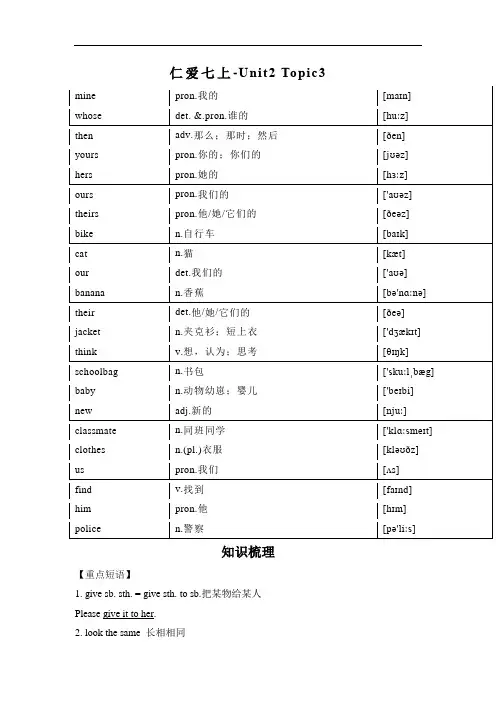
仁爱七上-Unit2 Topic3知识梳理【重点短语】1. give sb. sth. = give sth. to sb.把某物给某人Please give it to her.2. look the same 长相相同look different 长相不同,看起来不一样3. look like 看起来像He looks like his father. = He and his father look the same.4. next to 在……旁边The boy next to me is my good friend.5. in +颜色穿着……颜色的衣服in +a/an +颜色+衣服穿着……颜色的……The boy in a yellow T-shirt and gray pants is my good friend.6. (1) both两者都(be动词之后,实义动词之前)They both have brown hair and black eyes.They are both office workers.(2)all 三者或三者以上都They are all kind to me.7. 数字+(形状、大小)+颜色+n.two big red applesShe has short blond hair.【重点句型】1. Who is your favorite actor?2. We are in the same school, but we are in different grades.3. What do/does +主语+look like? ……长得怎么样?---What does he look like?--- He is not very tall but very strong.4. We don’t look the same, but we are good friends.We look the same, but we are in different clothes.5. ---What color is/are +主语?---It’s/ They’re +颜色.---What color is her hair?---It’s blond.6. This is my cap. = This cap is mine.Is this your cap? = Is this cap yours?---Whose cap is this? = Whose is this cap?--- It’s Sally’s.---Whose are these bananas?--- They’re their bananas/ theirs.7. His pants are blue and mine are white.(mine=my pants)My T-shirt is green and his is brown.(his=his T-shirt)8. I have small eyes, but he has big ones.(ones指代eyes)My jacket is blue and white. That one is blue. (one指代jacket)【重点语法】1. 动词原形和动词第三人称单数形式(1)主语是第三人称单数形式(he、she、it;单一的人;单一的名字;单一的事物),动词要用单三形式。
仁爱版英语七年级上册 Unit 1 topic3 知识归纳
Unit 1Topic 3old/How old课文原句:So, how old are you, Alan?讲解:how old问年龄。
问年龄的两种方式可以互用:How old is ...? = What's sb's age?-How old is your grandfather?-He is 60 years old.old adj. 意为“旧的,陈旧的”,其反义词为new新的。
The story is very old.这个故事十分古老。
年老的,年迈的,其反义词为young年轻的。
Everyone grows old.每个人都会变老。
相识很久的,旧交的。
Bob is an old friend of mine.Bob是我的一位老朋友。
另有常见搭配,如the old days以前,旧日的时光。
与old相关的词汇:elder adj. 前辈的,年纪较长的,常用于兄弟姐妹之间的年龄比较,在句中只用作定语,不作表语。
Did you see her elder sister yesterday?你昨天见到了她的姐姐吗?elderly adj. 年老的;渐老的(委婉用法),其后常跟名词。
2 Spell课文原句:-What's this in English?-It's a map.-Spell it, please.-M-A-P.讲解:spell,实义动词,意为“拼写”。
常用的三种句型:1. How do you spell…?2. 祈使句:Spell it, please.3. Can you spell it please?grade/class1. class n. 班级;课如:-Which class are you in this year?-Class Three.—今年你在哪个班?—三班。
I have a history class at 9 o'clock.我9点钟有历史课。
仁爱版七年级英语单词词汇表(全)
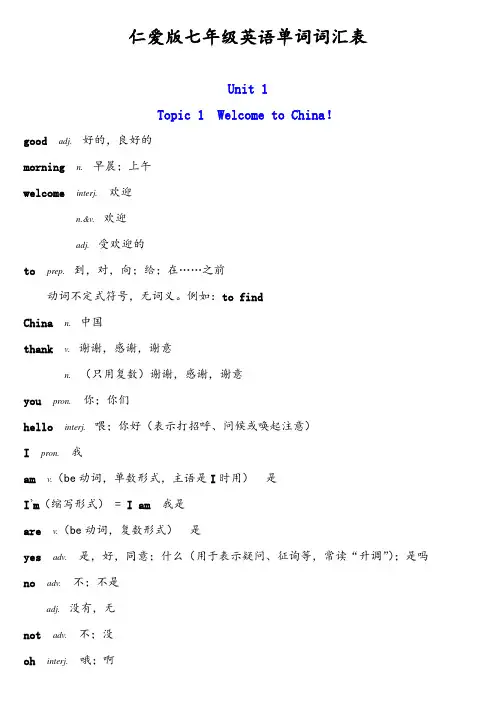
仁爱版七年级英语单词词汇表Unit 1Topic 1 Welcome to China!good adj. 好的,良好的morning n. 早晨;上午welcome interj.欢迎n.&v. 欢迎adj. 受欢迎的to prep. 到,对,向;给;在……之前动词不定式符号,无词义。
例如:to findChina n. 中国thank v. 谢谢,感谢,谢意n. (只用复数)谢谢,感谢,谢意you pron.你;你们hello interj. 喂;你好(表示打招呼、问候或唤起注意)I pron.我am v.(be动词,单数形式,主语是I时用)是I’m(缩写形式) = I am我是are v.(be动词,复数形式)是yes adv.是,好,同意;什么(用于表示疑问、征询等,常读“升调”);是吗no adv.不;不是adj. 没有,无not adv.不;没oh interj.哦;啊nice adj.令人愉快的;好的,漂亮的meet v.相识,结识;遇见,见到too adv.也,还;又;太,过分;很,非常hi interj.喂;你好(表示打招呼、问候或唤起注意)Miss n.(用于对女教师的称呼);女士;小姐(对未婚女性的称呼)this pron.&adj.这;这个is v.(be动词,单数形式,第三人称单数现在式)是Mr.(缩写形式) = mister n.先生(用于男子姓氏或姓名前)see v.看见,看到;明白,领会;拜会my pron.我的(形容词性物主代词)mom n.妈妈teacher n.老师,教师,教员how adv.怎样,如何;多少;多么do aux.(助动词)构成否定句、疑问句的助动词,无词义v.做;干;行动afternoon n.下午;午后fine adj.(身体)健康的;美好的;晴朗的goodbye interj.再见,再会bye interj. 再见evening n.傍晚,晚上and conj.和;又;而OK adj.&adv.(口语)好,对,不错later adv.以后;后来adj. 晚些的,迟些的Topic 2 Where are you from ?excuse v.原谅;宽恕me pron.我(宾格)excuse me劳驾,请原谅(尤其是引起陌生人的注意)what pron.什么;怎么样your pron.你的;你们的(形容词性物主代词)name n.名字,姓名,名称where adv.在哪里;往哪里from prep.来自;从;从……起be from来自Canada n. 加拿大the art.(定冠词)这(那)个;这(那)些the U.S.A. = the United States of America n. 美国;美利坚合众国she pron.她he pron.他isn’t(缩写形式) = is notJapan n.日本we pron.我们England n. 英格兰who pron.谁they pron.他/她/它们;人们aren’t(缩写形式) = are notthen adv.那么(通常用于句首或句尾);那时;当时;然后Cuba n. 古巴zero num.&n.零one num.一pron.(用来代替单数的人或物)一(个,只……)two num.二three num.三four num.四five num.五six num.六seven num.七eight num.八nine num.九ten num.十telephone n.电话(机)v. 打电话number n.号码;数,数字;数量it pron.它Topic 3 What class are you in ?eleven num.十一twelve num.十二thirteen num. 十三fourteen num.十四fifteen num.十五sixteen num. 十六seventeen num.十七eighteen num.十八nineteen num.十九twenty num.二十year n.年old adj.……岁的;老的;旧的year(s) old……岁How old…?……多少岁?class n.班级;课;同一个班的学生in prep.在……里(内;上);用……prep.穿着,戴着adv.在家;在内,向内grade n. 年级age n.年龄;时代that pron.& adj.那;那个English n.英语adj. 英国的;英国人的;英语的in English用英语(表达)an(不定冠词,后接以元音开头的名词) art.一(个;件……)eraser(rubber)n. 橡皮擦;黑板擦a(不定冠词,后接以辅音开头的名词)art.一(个;件……)map n. 地图spell v. 拼写can v.(情态动词)可能;能够;可以please interj.请v. 使人高兴,使人满意pencil n.铅笔double adj.双的;两倍的n. 两个;双toy n.玩具;玩物wow interj. 呀;哇(表示赞叹或惊奇)desk n.书桌,写字台p en n. 钢笔,笔ruler n. 尺子,直尺book n. 书;本子car n. 小汽车,轿车orange n.橘子,橙子;橘汁;橘色adj. 橙色的,橘色的egg n.蛋;卵blackboard n.黑板these pron.& adj. 这些those pron.& adj.那些schoolbag n.书包cake n.蛋糕;糕点;饼bus n.公共汽车box n.盒子;箱子now adv.现在school n.学校Beijing Ren’ai International School北京仁爱国际学校her pron. 她的(形容词性物主代词)pron.她(宾格)v. 打电话his pron. 他的(形容词性物主代词)pron.他的(名词性物主代词)same adj.同样的,同一的n. 同样的事but conj.但是,可是friend n.朋友ID number 身份证号码junior adj. 初级的;年少的high adj.高的;高度的junior high school初中(美国等国家12至14岁的孩子上的学校)Unit 2Topic 1 I have a small nose . guess v.猜have v.有;吃,喝has v.有(have的第三人称单数现在式)small adj.小的;少的nose n.鼻子big adj.大的eye n.眼睛know v. 知道;了解,认识;懂得right adj.对的,正确的;右边的n. 右边;权利head n.头;头脑(像);才智;首脑face n.脸v.面向,面对hair n.头发ear n.耳朵mouth [复数形式(pl.):mouths]n. 嘴neck n. 颈,脖子round adj.圆的;球形的long adj.长的;远的wide adj.宽的,宽阔的girl n.女孩boy n.男孩short adj.短的;矮的favorite adj.最喜爱的n.特别喜欢的人(或物)movie n.(尤美)电影star n. 明星;星星,恒星Chinese adj.中国的;中国人的;汉语的n. 汉语;中国人does v.(动词do的第三人称单数现在式)doesn’t = does notagain adv.再,又,再一次look v.看,瞧;观看;看起来n.(pl.)相貌;样子arm n.胳膊;臂;支架hand n.手v.递,给;交付,交上leg n. 腿;腿脚;支柱foot[复数形式(pl.):feet] n. 脚,足;英尺come v. 来,来到come from出生(于);来自student n.学生sister n.姐;妹different adj.不同的,有差异的knife[复数形式(pl.):knives] n.小刀;匕首;刀片don’t(缩写形式) = do notTopic 2 What does she look like ?both pron.两者,双方black adj.黑色的n.黑色blond adj.金黄色的;浅色的blue adj.蓝色的n.蓝色color(也写作:colour)n.颜色v.给……着色,涂色pink n.粉色adj. 粉红色的red adj.红色的n.红色purple adj.紫色的n.紫色brown adj.棕色的;褐色的n.棕色;褐色white adj.白色的n.白色gray adj.灰色的,灰白色的n.灰色green adj.绿色的,青的n.绿色yellow adj.黄色的n.黄色here adv.在这里;这里;向这里give v. 给;递给;付出;给予give…to…把……给……letter n.信;字母sorry adj.对不起,抱歉;难过的like prep.像;跟……一样n. 喜欢,喜爱look like 看起来像tall adj. 高的will v.(情态动词)将,会(表示将来);愿意,要I’ll(缩写形式) = I will我会young adj.年轻的man[复数形式(pl.):men] n.成年男人;人;人类woman[复数形式(pl.):women] n.妇女;女人snowman[复数形式(pl.):snowmen] n.雪人T-shirt n. T恤(衫)shoe n.鞋cap n.(无檐的或仅在前面有檐的)帽子coat n.外套,大衣;涂层skirt n. (女式)短裙pants(也作trousers)(只有复数形式)n.(pl.)长裤;连衣裙dress n.女服;连衣裙v. 穿衣,穿着at prep.在;在(几点钟);在(某处)look at看着photo n.照片strong adj.强壮的;坚固的;影响力大的cool adj.酷;凉爽的,凉的Topic 3 Whose jacket is this ?mine(名词性物主代词)pron.我的whose pron.谁的bike n.自行车cat n.猫hers(名词性物主代词)pron.她的our(形容词性物主代词)pron.我们的ours(名词性物主代词)pron.我们的banana n.香蕉their(形容词性物主代词)pron.他/她/它们的theirs(名词性物主代词)pron.他/她/它们的yours(名词性物主代词)pron.你的;你们的baby n. 婴儿;幼畜bag n.书包;提袋;袋子shirt n.衬衫(尤指男式)jacket n.夹克衫,短上衣think v.想,认为;考虑new adj.新的;新鲜的classmate n.同班同学clothes n.(复数pl.)衣服find v.找到;发现;感到help v.帮助,帮忙n.帮助,帮忙us(宾格)pron.我们him(宾格)pron. 他Unit 3Topic 1 Do you like English ?could v.(情态动词)(表示许可或请求)可以……;行(can的过去式),可以tell v.告诉;讲述;吩咐sure adv.当然,(口语)的确,一定adj.确信的,肯定的pen pal = penfriend n.笔友speak v.讲,说;谈话;发言some adj.一些,若干;有些;某一pron.若干,一些poor adj.不好的,差的;贫穷的;可怜的with prep.关于;有;带有;和;以;用help sb. with sth.帮助某人做某事problem n.问题,难题pet n.宠物often adv. 经常,常常want v.想,想要;需要live v.居住;生活;活着say v.说,讲visit v.参观;访问;拜访n.参观;访问;拜访great adj.伟大的;好极了;美妙的wall n.墙the Great Wall长城many adj.许多的pron.许多人(或物)lot n.许多,好些a lot很,非常;许多all pron.所有;全部,全体;一切not … at all(注意:not与at all是分开的)一点也不,根本不so conj.因此,所以adv.如此,这么;非常;同样study v.学习;研究n.书房each other互相,彼此little adv. 一点儿;稍许adj. 小的a little 一点点them(宾格)pron. 他/她/它们very adv.非常,很much adv.非常,更加,很very much非常,很home n.家adv.到家;回家at home在家its(形容词性物主代词)pron. 它的(名词性物主代词)pron.它的dog n.狗any adj.(用于否定句、疑问句等)一些;什么;任何的pron.(无论)哪一个,哪些of prep.(表示所属、数量、其中)……的Topic 2 What does your mother do ?kid n.(口语)小孩子v.开玩笑glad adj.高兴的;乐意的seat n.座位,座have a seat 就座,坐下mother n.母亲father n.父亲doctor n.医生,大夫;博士parent n.父亲(或母亲)office n.办公室worker n.工人;工作者driver n.司机,驾驶员farmer n.农民cook n.炊事员,厨师v.烹调,煮,烧;做饭nurse n.护士;保育员work v. 工作;(机器、器官等)运转n.工作,劳动hospital n.医院on prep.在……上;关于farm n. 农场;农庄on a farm在农场drive v.驾驶,开(车);驱赶family n.家庭(包括父母和子女);家族aunt n.婶母;伯母;姨母;舅母;姑母uncle n.叔;伯;舅;姨父;姑父brother n.兄,弟sofa n.长沙发grandparent n.祖父(母);外祖父(母)cousin n.堂(表)姐妹;堂(表)兄弟daughter n.女儿tree n.树family tree家谱son n.儿子happy adj.快乐的,幸福的;高兴的teach v.教书,教only adv.仅仅,只有cute adj.逗人喜爱的;机灵的;有吸引力的after prep. 在……之后;在……后面conj.在……以后look after照看,照顾Topic 3 What would you like to drink ?yourself[复数形式(pl.):yourselves] pron.你自己help oneself(to)请随便吃点/喝点(……)would v.(情态动词)打算,想要;(will的过去式)将会fish n.鱼肉;鱼v.钓鱼;捕鱼chicken n.鸡肉;鸡about prep.关于,对于adv.大约;到处,四处What about…?……怎么样?……好不好?rice n.米饭;稻米all right行了,好吧drink v.喝n.饮料juice n.果汁;果汁饮料milk n.牛奶for prep.对……来说;为了;向……,往……;适合……;因为……;对于……idea n.主意,想法,意见good idea好主意water n.水vegetable n.蔬菜bread n.面包hamburger n.汉堡包usually adv.通常地,一般地breakfast n.早餐,早饭lunch n.午餐,午饭supper n.晚餐,晚饭;夜宵food n.食物,食品may v.(情态动词)可以;也许,可能take v.拿;拿走;乘坐;花费;服用;携带order n.菜单;订货单;顺序v.订购;点菜take one’s order记下顾客点的饭菜sir n.先生something pron.某事(物);某东西glass n.(玻璃)杯a glass of一杯wait v.等,等候moment n.片刻;瞬间wait a moment等一会儿let v.让well interj.嗯;好吧,那么;哎呀adj.好的;健康的adv.好;令人满意eat v.吃out adv.不在里面,在(到)外面eat out下馆子,出去吃饭dinner n.正餐,宴会have dinner吃饭why adv.为什么Why not…?(提出建议)为什么不……?Here you are . 给你。
仁爱英语七年级上册Unit3-topic1复习
• 但是我只是有点喜欢。
• but I like it a little.
•
我们是好朋友,我们互相帮助。
• We are good friends and we help each other.
• she wants to visit Beijing. • She lives in England. • He works in a hospital. • She teaches in a high school. • She likes to play with Kitty.
• 了解很多关于 know a lot about
• 住在英国
live in England
词组
• 我们班的许多学生 many students in our class
• 一点点喜欢
like ... a little
• 一点也不喜欢 not like ... at all
• 不是很好
not very good
A. very
B. much
C. at all
D. little
8.I like the little cat a lot but she likes
it ____. B
A. a lot
B. a little
C. lot
D. much
9.Sally often helps me study English. And
可以这样说
My pen pel speaks English, but he knows a lot
about China.
. 10. 你想询问对方的国籍是不是美国,你可以这样问: Are you from America_? 11.当别人问你可不可以帮他做一件事情的时候 你可以这样
仁爱英语七年级上册知识点归纳完整版
仁爱英语七年级上册知识点归纳完整版一、短语:come from 出生于;来自in 用表达look like 看起来像give sth. to sb. 把某物给某人look at 看着help sb. with sth. 帮助某人做某事a little 一点点each other 互相a lot 非常,更加,很much 非常,更加,很have a seat 坐下,就座look after 照顾,照看next time 下一次try on 试穿good idea 好主意such as 比如,例如wait a moment 稍候,等一会儿family tree 家谱look the same 看起来一样have a picnic 去野餐go fishing 去钓鱼go shopping 去购物do shopping 购物take one's order 记下顾客点的菜fly a kite 放风筝different looks 不同的相貌have breakfast 吃早餐have lunch 吃午饭have supper 吃晚饭have dinner 吃饭all right 好的on one's way home 在某人回家的路上find one's way home 找到回家的路a glass of 一玻璃杯a bottle of 一瓶a pair of 一双have fun 玩得开心think of 认为speak to sb. 对某人说call sb. back 回拨电话给某人get up 起床eat out 下馆子,出去吃饭go home 回家go to school 去上学help oneself to sth. 随便吃喝些什么be free 有空have no time 没时间over there 在那儿think about 考虑on a farm 在农场help sb. with sth. 帮助某人某事at night 在夜晚on Sunday 在星期天go out 出去go for a picnic 去野餐on Sunday morning 在星期天早晨at six o'clock 在六点钟be from 出生于;来自go to the zoo 去动物园Welcome to China 欢迎到中国来Don't worry 别担忧 in the same grade 在同一个年级in different classes 在不同的班级telephone number 电话号码junior high school 初中You're welcome 别客气Thank you 谢谢你 Can I help you 我能帮你什么忙吗Here you are 给你Here it is 它在这Here we are 我们到了 be afraid 恐怕,害怕in different clothes 不同的衣服be in blue 蓝色衣服be in a red T-shirt 红色T恤be in black pants 黑色裤子help sb. do sth. 助某人做某事want to do sth. 要做某事like to do sth. 欢做某事would like to do sth. 要做某事Are you kidding 是开玩笑吧Thank you all the same 是要谢谢你a bag of一袋That's right没错That's all right不用谢没关系 how many多少how much多少 too heavy太重this Sunday这个星期日forget to do sth.忘记去做某事See you later再见 's up怎么啦's wrong with you你怎么啦 have to 不得不carry water提水sing a song唱歌be in在家be out在外面ask sb. to do sth.要求某人做某事want sb. to do sth.想要某人去做某事would like sb. to do sth.想要某人去做某事at my home在我家What time is it几点了half past seven七点半a quarter to eight差一刻八点It's time to do sth.该做某事的时候了; What's the time几点了thank sb. for sth.因为某事而感谢某人thank sb. for doing sth.感谢某人做了某事 at the zoo在动物园二、知识点:Unit 11、Good morning/ afternoon / evening 早上/下午/晚上好 Good night 晚安2 、glad / nice to meet / see you 见到你很高兴回答也一样3、welcome to + 地点欢迎来到答:Thank you 或者 Thanks4、let’s + V原让我们做5、 stand up 起立 sit down 坐下6、this is 这是…… 用于介绍第三者的用语7、How do you do 你好回答也是:How do you do 8、 How are you 你好吗 Fine ,thank you .and you 很好;谢谢;你呢I’m OK / I’m fine , too . 我也很好;9、 see you = see you later = see you soon = good-bye 再见10、 excuse me 打扰一下;请问11、I’m = my name is 我是……12、 be from = come from 来自13、 in English 用英语14、 Can you spell it Yes / No 你能拼写它吗能/不能15、That’s OK / That’s all right / You’re welcome / Not at all 不用谢16、…… years old ……岁17、 telephone number 电话号码number 号码 ID number 身份证18、 the same 相同的反义词是different 不同的例: We are in the same grade, but we are in different classes. 句型:19、What is your name 你的名字是什么20、Where +be + 主语 + from 某人来自于哪里回答:主语+be+地点例: Where are you fromI am from quanzhou.21、How old + be + 主语某人几岁回答:主语 + be + 数字例:How old are you I’m forteen.22、What is your telephone number 你的电话号码是多少回答:My telephone number is或者It’s 注意:读出号码的时候要逐个读出;23、What class / grade +be + 主语 + in 某人在哪一个班级/年级例:what class are you in I am in Class Five. 注意:Class 和 Five 需要大写what grade are you in I am in Grade Seven. 注意: Glass 和 Seven 需要大写 24、What’s this/ that in English 这是什么回答:It’s a/an + 单数名词. 这是…… What’ re these/ those in English 这些是什么回答:They’re + 复数名词这些是……25、How do you spell it 你怎么拼写它 E-R-A-S-E-R, eraser. 注意拼读方法Unit 2 1、 sb + has/ have an /a + adj + 五官 === sb’s 五官 is / are + adj 描述长相例:Lily has a small nose. = Lily’s nose is small. 2、 I know = I see 我明白了 3、That’s right 那是对的 4、look the same look like 看起来相像look different 看起来不同例: Jim and Lilei look the same.== Jim looks like Lilei. . 5、 look at + n 看某物 look for +n 寻找某人/某物 look after +n 照顾某人 6、 both 两者都…… all 三者或者三者以上都Both 和all 位于 be 动词或情态动词后,位于行为动词前;例: We are both students. We both have black eyes. We can both speak English. 注意: 7、 give sth to sb = give sb sth 把某物给某人;注意:如果 sth 是 it 或 them,只能用前者注意 ,只能用前者8、 have different looks == look different 有着不同的长相看起来不相像have the same look. ==look the same 有着相同的长相看起来很相像 9、over there 在那边 come in 请进 go out 出去 10、 in + 颜色或 in a/an/the +颜色 + 衣服表示穿着……颜色的衣服常常接在名词的后面,表示穿颜色衣服的…… 如 the girl in red is my sister.11、 too + adj 太……12、 pants 和shoes 做主语,谓语动词用复数;但 a pair of pants/ shoes 作主语时,谓语动词用单数形式例: His shoes are black. A pair of shoes is under the bed. 13、 in the morning/ afternoom/ evening 在早上/下午/晚上 at night 在晚上 14、 go shopping = go to the shop 去购物类似的有 go swimming go fishing go skating 等等帮助某人做某事注意:sb 用代词时必须用宾格 15、 help sb. to do sth == help sb with sth 16、 high school 中学 17、 play +球类 play the 乐器 18、 think of 认为,想 think about 考虑 I think + 从句我认为……例: I think he you are right.否定式常否定主句,但翻译时要否定后面的从句例:I don’t think he can come. 我认为他不会来了.不能说:我不认为他会来19、What do/does + 主语 + look like 询问人的长相例: What does your English teacher look like 20、What’s and ……加……是什么回答:It’s例:What’s red and yellow It’s orange. What’s two and five It’s seven. 21、Whose + 东西 + is this/ that Whose + 东西 +are these/ those 这/这些是谁的……例:Whose coat is this It is mine. Whose shoes are these They are hers.22、Who is the letter from 这封信来自于谁It’s f rom Lily. 它来自于莉莉;23、What color be + 东西回答:It’s +颜色或者They’er + 颜色例:What color is your dress It’s black.Unit 31、Could you please…… 后接动词原形你愿意做某事吗我能做某事吗 MayI …… 后接动词原形2、 the English corner 英语角3、 live in + 地点住在某地 live with + 人和某人住在一起4、 What does he say in the letter 他在信里说了些什么 What does he say on the phone 在电话里说了些什么5、 a lot = very much 放在句末,修饰动词,非常……not at all 一点也不……例: I like the boy a lot/ very much.I don’t like the boy at all.. 6、 each other 相互,彼此例: S tudents often talk to each other in class. 7、 do sth with sb 和某人一起做某事 8、 No problem 没问题9、 speak + 语言说某种语言 speak English speak Chinese 10、 the Great Wall 长城 11、 come/go to + 地点去某地但 home 、 here 、 there 这些是副词,前面不能加 to例:go home / come here / go there go to do sth 去做某事例: They go to play basketball. 12、 like doing sth 喜欢做某事 like to do sth 想要做某事 13、It’s + adj +to sb 对某人来说是……的 14、 help sb with sth =help sb to do sth 帮助某人某事 15、 be at home = be in 在家 go home 回家 get home 到家in one’s home 在某人的家里 16、 have a seat / take a seat / sit down 请坐下 17、office worker 办公室职员 cook 厨师cooker 炊具 18、 on a farm 在农场上on the sofa 在沙发上 19、 a photo of one’s family 某人的全家照 Family Tree 家谱首字母都大写 20、 in a hospital 在医院纯属地点概念 in hospital 因病住院例:He is ill in hospital. 他生病住院 He is in a hospital.他在医院里不一定是因为生病来到医院 21、 look after sb = take care of sb 照顾某人22、 teach sb sth = teach sth to sb 教某人某东西 teach sb to do sth 教某人做某事23、help oneself to sth. 请随便吃…… help yourself/ yourselves to fish24、I’d like sth = I would like sth. 我想要……25、 Would like to do sth = want to do sth 想要做某事26、 Would you like something to eat drink 你想要一些吃喝的东西吗 to eat 或 to drink 修饰 something,作为后置定语; 27、 Here you are . 给你 Here we are. 我们到了28、What about …… == Howabout …… ……怎么样后接代词或名词,还可以接动名词即What about doing sth29、 all right 好的30、a cup of tea 一杯茶 two cups of tea 两杯茶31、 milk for me 我要牛奶32、Why not ……后接动词原形 = Why don’t you …… 后接动词原形为什么不做某事呢回答:Good idea 好主意;33、 May I take your order 可以点菜了吗34、 wait a moment = just a moment 等一下,请稍侯 wait for sb 等待某人35、 Can I help you = May I help you = What can I do for you 需点什么帮忙吗36、 eat out 出去吃饭37、 let sb do sth 让某人做某事38、 have dinner/ breakfast/lunch/supper 吃正/早/午/晚餐39、 a kind of 一种…… all kinds of 各种各样的……40、be friendly/kind to sb 对某人友好41、 such as 例如例:I like fruits, such as oranges,bananas and apples42、 be glad to do sth例: I am glad to meet you, I am glad to be here.. 句型:43、What do/does + 主语+ do == What +be+ 主语. == What’s one’s job 回答:主语 + be + 职业.例如: What does your father do = What is your father = What’s your father’s job He is a teacher.Unit 41、 try on 试穿……2、 we/I will take it 我们/我买下了这里的 take 相当于 buy3、 buy sth for sb = buy sb sth给某人买某物; 4、I’m just looking 我只是看看; 5、 three hundred and sixty-five 365 百位数和十位数之间加and , 十位数和个位数之间加”-“6、 a pair of 一对/一双……7、 running shoes 跑鞋8、 Are you kidding 你开玩笑吧;9、 think about 考虑;10、 thank you all the same 仍然谢谢你;11、 Is that all 就这么多吗That’s all. 就这么多吧 I12、 I think so. 我认为是这样的. I don’t think so.我认为不是这样的. 13、当把东西给某人时可以说: Here you are 或 Here be + 东西或 Here it is.14、Don’t worry.别担心① worry about + 宾语如:Do you worry about your leesson ②Worried 烦恼的 be worried about +宾语如:She is worried about her mother.15. a few +可数名词肯定一点,一些;;few + 可数名词:否定几乎没有 alittle +不可数名词肯定一点,一些;;little + + 不可数名词:否定几乎没有16、 be free = have time 有空的;反义词:be busy = have no time Are you free tomorrow == Do you have time tomorrow17、在某一天使用介词 on , 在某个时刻用 at 如:On Sunday at a half past six 当 this 接时间,不用介词, this Sunday18、What’s up = what’s wrong = What’s the matter 什么事19、 forget to do sth. 忘记去做某事事还没做 forget doing sth 忘记曾做过某事事已做完20、 tell sb about sth. 告诉某人某事tell sb sth = tell sth to sb 把某事告诉某人 ask/tell sb to do sth 叫某人做某事 ask/tell sb not to do sth 叫某人不要做某事21、电话用语:①Who’s this 你是哪位②Is this ……你是……吗③This is ……speaking 我是…… ④May I speak to……我可以找……吗 22、go for sth = go to do sth 去做某事如: go for class = go to have class.23、It’s fun 真是有趣的事24、 call sb = give sb a call 打电话给某人 call sb back 给某人回电话25、I’m afrai d /sorry that + 从句恐怕……/ 对不起,……26、I have no time = I don’t have any time 我没有时间 no = not any27、 be not in = be not at home = be out 出去了,不在家;28、 sing a song / sing some songs 唱歌; fly a kite 放风筝;draw picture 画画 play sports 做运动; watch TV 看电视 read books 看书 read newspaper 看报纸29、 let sb do sth 后接动词原形让某人做某事30、时间读法有顺读法和逆读法:顺读法eleven thirty-six 表示 11:36 逆读法分钟数小于等于 30 分用 past , 分钟数大于 30 分用 to,如 five past ten 表示 10:05; five to ten 表示 9:55,half past six 表示 6:30 , a querter to six 表示 5:4531、 show sth to sb = show sb sth 把……拿给某人看;作为名词表示演出,表演32、祈使句的否定句,直接在句首加上Don't 就可以了33、have to ……后接动词原形不得不……34.、It’s time for sth/ doing sth It’s time to do sth 该到做……的时候了It’s time for sb to do sth 是某人做某事的时候了35、 next time 下一次 next week 下个星期 the next day 第二天;36、next to…… = near…… 在……旁边37、 get up 起床 go to bed 上床睡觉;get sb up 叫某人起床38、do one’s homework 做作业;39、 have a picnic 野餐;have class 上课 have a meeting 开会 have a party 举办聚会 have dinner/ breakfast/lunch/supper 吃正/早/午/晚餐 have +东西吃/喝……have a good time =enjoy oneself 玩得很愉快 have sb to do sth 让某人做某事 have to do sth 不得不……40、on the weekday 在周末;41、lot of = lots of = many =much 许多的,大量的42、 in the sun 在阳光下;43、sb like best = sb’s favorite + 种类is / are …… 谁最喜欢…… 44、on one’s way to 在某人去……的路上;on one’s w ay home 在某人回家的路上45、 Here we are. 我们到了46、It’s very kind of you 你真是太好了;47、 thanks / thank you for + n /v-ing 为……而感谢你;48、 in the tree 在树上外物附着 on the tree 在树上树上本身长出的东西 In the wall 在墙里如 window on the wall 在墙上49、 What do you think of = How do you like 你认为……怎么样例:What do you think of your English teacher= How do you like your English teacher 50、 How much be + 主语回答:It’s / They’re + 价钱. How much is your English book 问价格还可以用what’s the price of …… 为什么不做某事呢 51、Why not ……后接动词原形= Why don’t you …… 后接动词原形回答:Good idea 好主意;52、 What time is it == What is the time 回答:It’s +时间考点归纳:1、英文中常用的问候语及其回答:-Hello. -Hello.—Hi. —Hi—Good morning. —Good morning.—Good afternoon. —Good afternoon. —Good evening. —Good evening. —Good night. —Good night.—How do you do —How do you do—How are you —Fine, thank you.注意:对“How do you do” 和“How are you” 两句话的回答不要弄混淆; 2、sorry “对不起” 用于引出某一过错; Excuse me. “对不起” 用于引起对方的注意;例如:I’m sorry I can’t speak English. Excuse me, is this your backpack3、be late for ... 做……迟到 be late for school/ class/ work/ the meeting 上学/上课/上班/开会迟到注意: late 的副词仍为 late, 不能写成 lately.例如:请不要晚到学校; Please don’t arrive lately for school. × Please don’t arrive late for school. √ 4、见到某人很高兴的几种表达:Nice to meet you. = Happy/ Glad/ Pleased to meet you.5、What’s this in English =What’s the English for this 这个用英语怎么说用什么语言,介词用in: “in + 语言”.例如: in English 用英语 in Chinese 用汉语 in Japanese 用日语注意:用钢笔:in ink = in pen = witha pen 让我们学英语;6、Let’s learn English. 让我们学英语;L et’s = let us 让我们Let’s do sth. = Why not do sth. = What/How about doing sth.如:Let’s learn English. = Why not learn English = What/How about learning English注意:let sb. do .. 中的 sb.即使是第三人称单数后面的动词仍用原形例如:Let her sing an English song.7、learn from 向……学习 learn to do sth. 学做……例如:Let us learn fromLei Feng. Lucy learns to play the guitar.8、对颜色提问的两种方法: Whatcolor … = What’s the color of … 例如: What color is your coat = What’s the color of your coatcolor 着色 color sth. + 颜色,例如: I want to color it red.color 是可数名词例如:I don’t like these colors.9、对姓名的几种提问及回答:What’s your name = May I have/know your nameMy name is … = I’m…10、call + sb. + at + … “给某人打电话”11、感谢你:Thanks. = Thank you. √ Thank. × Thanks you. × Thanks for + sth./doing sth. 为……而感谢你;例如:Thanks for your help. =Thanks for helping me.12、take, bring, carry 和 get 的区别:1take “带走”,从近处带到远处例如:Please take these books to your home after school.2 bring “带来”,从远处带来例如:Please bring me some cakes.3c arry “带”,无方向性,指移动较重、较大的东西,有“负重”的含义例如:The bag is too heavy for me. Can you carry it for me 4 get “去拿来”,相当于 go and bring例如:Can I get you something to drink 12、need 需要1 need + V原……” 例如:She need some cakes.2 need to do sth. “需要做……”例如:She needs to speak English often.13、There be 句型在某处有什么例如: There is a clock on the wall. There be 句型的就近原则:若有两个或两个以上的主语是,谓语常与靠近它的那个主语一致;例如:There is a book, two pens and some cups on the desk.There are two pens, some cups and a book on the desk.注意:There be与 have 的区别在于:have 表示某人或某物拥有什么;而There be 表示在什么地方存在什么; 14、want to do sth. “想要做……”例如:He wants to join the reading club.15、like v. 喜欢用法:like sth. / sb. 喜欢…like doing sth. 喜欢做…like to do sth. 想做…like sb. to do sth. 想要某人做…would like to do sth.想做… be like 像…look/sound like 看/听起来像…注意:like doing sth. 喜欢做…长期的喜好,习惯like to do sth. 想做…短期的,具体的某一次活动16、构词法:在动词后面加-er 或-or,将动词变为人的名词例如: sing-singer wait-waiter work-workerteach-teacher speak-speakervisit-visitor加-r: write-writer drive-driver双写尾字母: run-runnerswim-swimmer shop-shopper注意: cook烹调— cook 厨师-cooker 厨房用具17、a lot of = lots of 可以用来修饰可数名词和不可数名词;Jim drank a lot of/lots of beer. I have a lot of/lots of things to do. a lot 作状语,表示程度、数量或频率;例如:Thanks a lot. I know a lot about it.19、for 就……而言例如:I have some bread for supper.20、have/eat + 三餐“吃早/中/晚饭” 例如:I usually have lunch at home.21、对价格提问:How much …=What’s the price of …例如: How much is this sweater = What’s the price of this sweater 22、in + 颜色例如: She is in red. = She is in a red coat.\23、on, in, at 与时间状语连用: on + 具体某一天例如:I will do some shopping on Sunday.in + 时间段例如: in the morning / afternoon / eveningat + 几点例如:Our class is at 8:00注意:如果时间状语前面有这些词:this, that, next, tomorrow等, 则不用介词;例如: See you next time.24、对年龄的提问:How old are you What’s your age May I know/have your age 答:I’m ... years old. 注意:表达年龄的几个同义句: Tom is 15. =Tom is 15 years old. =Tom isa 15-year-old boy. =Tom is a boy of 15.25、think +句子例如:I think you are right.注意: think 的否定转移例如:I don’t think it is right.26、like ... best = favorite+…最喜欢…例如:Jack likes red best. =Jack’s favorite color is red.27、too/also/either的区别:too 用于句末例如: Tom is from America. Lucy is from America, too. also 用于句中be 动词后,行为动词前例如: Tom is from America. Lucy is also from America. either 用于否定句中例如:Tom isn’t from America. Lucy isn’t from America, either.28、speak/ say/ talk/ tell 的区别:speak+语言讲某种语言例如:She can speak Chinese. I can speak a little English. say 强调说话的内容例如:Let me say “Thanks” to you. talk 强调交谈:talk to/with ….和……交谈talk about … 谈论……tell 强调“告诉”:tell sb. sth. = tell sth. to sb.注意:say 还有“写着”的意思,例如:Look There is a card. It says “CLOSED”. 29、be good to 对…… 友好= be friendly/kind to…30、help oneself 随便吃……在使用时要注意反身代词的单复数;例如:Jim, help yourself, please. Help yourselves, boys. help sb. = give sb. a hand 帮助……help sb. with sth. 帮助某人做某事例如:Can you help kids with swimming 你能帮助孩子学游泳吗31、动词+介词构成的动词短语,其宾语是名词的时候,可放在动词与介词之间,也可以放在介词的后面例如: call sb. back = call back sb. 给……回电话 try sth on. = try on sth. 试穿……注意:如果宾语是代词 it 或 them 则只能放在中间例如:try it/them on.32、allof 全部,所有三者以上; bothand 两者都……放在助动词、情态动词、be 动词之后,行为动词之前例如:We are all students, we all work hard.My parents are both office workers.= Both my father and mother are office workers.All of the girls look nice.33、be from = come from…来自…… 注意:动词的变化: She’s from China. = She comes fromChina.She isn’t from England. = She doesn’t come from England.常见的错误: Where is he come from Where does he from国籍的几种表达方法: Tom 是个美国人;Tom is American. Tom is an American. Tom is an American boy. Tom is from America. Tom comes from America.售货员招呼顾客:① May I help you ② Can I help you③ What can I do for you ④ What would you like顾客常用语: ① No, thanks. I’m just looking . ② I’m looking for ... . ③ I’d like to have/buy ... . ④ Can you show me ...⑤ Could I have a look at ...询问顾客想买东西的特征: ① What kind would you like② What color would you like ③ What color would you like顾客询问价格: ① How much is itare they②What’s the pr ice of ...顾客决定要买:I’ll take/have itthem. 付钱: Here’s the money.。
仁爱版七年级英语上册知识点总结
仁爱版七年级英语上册知识点总结英语七年级上册知识点归纳Unit 1 Making New Friends. 一.重点短语1.Good morning/ afternoon / evening! 早上/下午/晚上好!Good night: 晚安(晚上告别)!2.Glad / Nice to meet / see you ! 见到你很高兴(回答也一样)3.Welcome to + 地点: 欢迎来到…… (回答:Thank you 或者Thanks)4.let’s + do(动词原形):让我们做……5.stand up: 起立sit down: 坐下6.单数: this is----- 这是…… (用于介绍第三者的用语)复数:these are----- 这些是7.How do you do ?你好(回答也是:How do you do ? )8.How are you ? 你好吗?Fine ,thank you/thanks .And you ? 很好,谢谢;你呢?I’m OK / I’m fine , too .我也很好。
9.See you = See you later = See you soon = good-bye 再见10.excuse me 打扰一下;请问11.做自我介绍:I’m -----= my name is ---- 我是……12. be from = come from: 来自13. in English: 用英语表示14.Can you spell it ? Yes / No. 你能拼写它吗?能/不能How do you spell it? M-A-P, map.你怎样拼写它?15.That’s OK / That’s all right / You’re welcome / Not at all!不用谢16.……years old:……岁如:I’m twelve years old.17. telephone number:电话号码QQ number:QQ号码ID number:身份证18.the same: 相同的反义词是different: 不同的例: We are in the same grade, but we are in different classes.二.重点句型:1. What is your name ? 你的名字是什么?2. Where +be +主语+ from? 某人来自于哪里?(回答:主语+be+地点)eg:Where are you from? I am from China.3. How old + be + 主语?某人几岁?(回答:主语+ be + 数字)例:How old are you ? I’m twelve.4.What is your telephone number? 你的电话号码是多少?回答:My telephone number is--或者It’s -- 注意:读出号码的时候要逐个读出。
仁爱英语七年级上册Unit3Topic1SectionA
______________________________________________________
______________________________________________________ ______________________________________________________
A. with B. and C. to ( ) 5.Do you come from the U.S.A. ? No, I ____ from Canada. A. comes B. am C. be
Writing
Write a passage with “name, from, not very good, help her/him with……”
cuse me, could you please tell...? Sure. ... e from...? No,.... ... Canada. Oh, ...pen pal.... ...can...Chinese. ...like...? Jane: Yes,... But ... not verygood....help...with...? Li: No problem.
Listen to the passage and fill in the blanks.
I’m Li Wei. My Chinese I often help my friends
is very good. with Chinese.
I like English very much. But my English is not very good. I want to have a pen pal. Could you help me with it?
(完整版)仁爱英语七年级上册unit1topic3知识总结
Unit1.Topic3. What class are in?一.核心词汇eleven twelve thirteen fourteen fifteen sixteen seventeen eighteen nineteen twenty year old class in grade age that English an/a eraser map spell can please pencil apple double toy desk pen ruler book car orange egg blackboard these those schoolbag cake bus box now school her phone his same but friend high二.常用词组year(s) old how old in English phone number in the same class good friends ID number junior high school三.重点句子What’s this/that in English?It’s a/anIs this/that a/an…..?Yes, it is/No, it isn’t.What are these/those?They’re……….Are these/those….?Yes, they are./No,they aren’t.四.交际用语How old are you? I’m twelve, too.What class/grade are you in? I’m in…..Who’s that? That’s Nancy.How old is she? She is fourteen.What class/grade is she in? She’s in……….How do you spell it? E-R-A-S-E-R,eraser.Can you spell it,please?Yes, M-A-P, map.Thank you. That’s OK./ You’re welcome.五.语法精粹指示代词:this/that/these/those的用法This is a book.Who’s that?These are eggs.What are those?名词复数They are books.a 与an 的区别It’s a map. It’s an eraser.六.其他元音字母Ii. Oo Uu在重读开音节和闭音节中的读音。
仁爱版英语七年级上册Unit3 Topic3 【语法精讲】可数名词和不可数名词
语法精讲:可数名词和不可数名词一、可数名词与不可数名词的区别普通名词所表示的人或事物是可以按个数计算的,这类名词叫可数名词。
可数名词分为个体名词(表示某类人或事物中的个体,如worker, farmer, desk, factory等)和集体名词(表示作为一个整体来看的一群人或一些事物,如people, family 等)。
如果普通名词所表示的事物是不能按个数来计算的,这类名词就叫不可数名词。
不可数名词分为物质名词(表示无法分为个体的物质,如meat, rice, water, milk, orange 等)和抽象名词(表示动作、状态、情况、品质等抽象概念,如work, homework, time, health, friendship等)。
二、关于可数名词可数名词有单数和复数两种形式。
指一个人或一件事物时,用单数形式;指两个或多个人或事物时用复数形式。
名词由单数形式变成复数形式的规则如下:1. 一般的名词词尾直接加-s 。
如:book → books room → roomshouse → houses day → days2. 以s,ss, ch,sh, x 结尾的名词,在词尾加-es 。
如:bus → buses glass → glasseswatch → watchesdish → dishes box → boxes3. 以"辅音字母+y"结尾的名词,要先将y改为i再加-es。
如:city → cities body → bodiesfactory → factories等等。
4. 以f 或fe 结尾的名词,要将f或fe改为v再加-es。
如:half → halves leaf → leavesk nife → knives wife → wives5. 特例[悄悄话:特例常常考,要记住。
]①child → children②man → men woman → womenpoliceman → policemen(规律:man → men)③tomato → tomatoespotato → potatoes[悄悄话:初中英语以o 结尾的名词变复数时只有这两个词加-es,其余的当然加-s喽!如:photo → photos ]④ foot → feet tooth → teeth[悄悄话:oo变成ee。
仁爱英语七年级上册单词表汇总(unit3)
仁爱英语七年级上册单词表汇总(unit3)浠佺埍鑻辫涓冨勾绾т笂鍐屽崟璇嶈〃姹囨€伙紙unit3锛?unit3 鍏?117 涓崟璇?fish[f瑟蕛]n. 楸硷紱楸艰倝chicken['t蕛瑟k蓹n]n. 楦¤倝;楦?about[蓹'ba蕣t]ad. 澶х害锛涘埌澶勶紱鍥涘rice[ra瑟s]n. 绋荤背锛涚背楗?drink[dr瑟艐k]n. 楗枡juice[d蕭u:s]n. 鏋滄眮锛涙灉姹侀ギ鏂?milk[m瑟lk]n. 鐗涘ザidea[ai'di蓹]n. 涓绘剰锛涙兂娉曪紱鎰忚water['w 蓴:t蓹]n. 姘?bread[bred]n. 闈㈠寘hamburger['h忙mb蓽:锟斤拷蓹(r)]n. 姹夊牎鍖?usually['ju:蕭蕣蓹l瑟]adv. 閫氬父鍦帮紝涓€鑸殑breakfast['brekf蓹st]n. 鏃╅锛屾棭楗?lunch[l蕦nt蕛]n. 鍗堥锛屽崍楗?supper['s蕦p蓹]n. 鏅氶锛屾櫄楗紱澶滃food[fu:d]n. 椋熺墿锛岄鍝?may[me瑟]modal v. 鍙互锛涗篃璁革紝take[te瑟k]v. 鎷匡紱鎷胯蛋锛涗箻鍧愶紱鏈嶇敤锛涜姳good idea[锟斤拷蕣d a瑟'd瑟蓹]濂戒富鎰?order['蓴:d蓹]n. 鑿滃崟锛涜璐у崟锛涢『搴?sir[s蓹:]n. 鍏堢敓something['s蕦m胃瑟艐]pron. 鏌愪簨锛堢墿锛夛紱鏌愪笢瑗?glass[锟斤拷l锟斤拷:s]n. 锛堢幓鐠冿級鏉?wait[we瑟t]v. 绛夛紝绛夊€?moment['m蓹um蓹nt]n. 鐗囧埢锛岀灛闂?let[let]v. 璁?well[wel]interj.鍡紱濂藉惂锛岄偅涔堬紱could[kud]modal v. (琛ㄧず璁稿彲鎴?eat[i:t]v. 鍚?tell[tel]vt. 鍛婅瘔锛涜杩帮紱鍚╁拹out[aut]adv.涓嶅湪閲岃竟锛屽湪锛堝埌锛夊闈?sure[蕛蕣r:]adj. 纭俊鐨勶紝鑲畾鐨?pen pal[pen p忙l]n. 绗斿弸speak[spi:k]v. 璇达紝璁诧紱璋堣瘽锛涘彂瑷€some[s蕦m]adj. 涓€浜涳紝鑻ュ共锛涙湁浜涳紱鏌?poor[pu蓹]a. 涓嶅ソ鐨勶紱宸殑锛涜传绌风殑锛涘彲with[wi冒]prep. 鐢紱鏈夛紱甯︽湁锛涘拰锛?help sb with sth甯姪鏌愪汉鍋氭煇浜?problem['pr蓴bl蓹m]n. 闂锛涢毦棰?pet[pet]n. 瀹犵墿often['蓲fn]adv. 缁忓父锛屽父甯?want[w蓲nt]v. 鎯筹紝鎯宠锛涢渶瑕?live[l瑟v]v. 鐢熸椿锛涘眳浣忥紱娲荤潃say[se瑟]v. 璇达紝璁?visit['v瑟z瑟t]v.鍙傝锛岃闂紝鎷滆great[锟斤拷re瑟t]adj. 浼熷ぇ鐨勶紱濂芥瀬浜嗭紱缇庡wall[w蓴:l]n. 澧?the Great Wall闀垮煄many['men瑟]pron. 璁稿浜?鎴栫墿) lot[l蓴t]n. 璁稿锛屽ソ浜?a lot[蓹l蓲t]寰堬紱闈炲父锛涜澶?all[蓴:l]pron. 鎵€鏈夛紱鍏ㄩ儴锛涘叏浣擄紱not ... at all涓€鐐逛篃涓嶏紝鏍规湰涓?so[s蓹蕣]adv. 濡傛锛岃繖涔堬紱闈炲父锛涘悓study['st蕦d瑟]v. 瀛︿範锛涚爺绌?each other[i:t蕛'蕦冒蓹]浜掔浉锛屽郊姝?little['l瑟tl]adj. 灏忕殑 a litle涓€鐐圭偣them[冒em]pron. 浠?濂?瀹冧滑(瀹炬牸very['ver瑟]adv. 寰堬紝闈炲父much[m蕦t蕛]adv. 闈炲父锛涙洿鍔狅紱寰?very much['ver瑟m蕦t蕛]闈炲父锛涘緢home[h蓹蕣m]n. 瀹?at home[忙t h蓹蕣m]鍦ㄥits[瑟ts]pron. 瀹冪殑(褰㈠璇嶆€х墿涓?dog[d蓲锟斤拷]n. 鐙?any['en瑟]pron. (鏃犺)鍝竴涓紱鍝?of[蓹v]prep. 锛堣〃绀烘墍灞炪€佹暟閲忋€?kid[k瑟d]n. 锛堝彛璇級灏忓瀛?glad[gl忙d]adj. 楂樺叴鐨勶紱涔愭剰鐨?seat[si:t]n. 搴т綅锛屽骇have a seat灏卞骇锛屽潗涓?mother['m蕦冒蓹]n. 姣嶄翰father['f锟斤拷:冒蓹]n. 鐖朵翰doctor['d蓲kt蓹]n. 鍖荤敓锛屽ぇ澶紱鍗氬+parent['pe蓹r蓹nt]n. 鐖朵翰锛堟垨姣嶄翰锛?office['蓴fis]n. 鍔炲叕瀹?worker['w蓽:k蓹]n. 宸ヤ汉锛涘伐浣滆€?driver['dra瑟v蓹]n. 鍙告満锛岄┚椹跺憳farmer['f锟斤拷:m蓹(r)]n. 鍐滄皯cook[k蕣k]n. 鐐婁簨鍛橈紝鍘ㄥ笀nurse[n蓽:s]n. 鎶ゅ+锛涗繚鑲插憳work[w蓽:k]n. 宸ヤ綔锛屽姵鍔?hospital['h锟斤拷:sp瑟tl]n. 鍖婚櫌on[蓲n]prep. 鍦? . . 涓婏紱farm[f锟斤拷:m]n. 鍐滃満锛涘啘搴?on a farm鍦ㄥ啘鍦?drive[dra瑟v]v. 椹鹃┒锛屽紑(杞?锛涢┍璧?family['f忙m瑟l瑟]n. 瀹跺涵锛堝寘鎷埗姣嶅拰瀛愬コ锛夛紱aunt[锟斤拷:nt]n. 浼瘝锛涜垍姣嶏紱濠舵瘝锛涘姣嶏紱uncle['蕦艐k蓹l]n. 鍙旓紱浼紱鑸咃紱濮戝か锛涘Ж鐖?brother['br蕦冒蓹]n. 鍏勶紱寮?sofa['s蓹蕣f蓹]n. 闀挎矙鍙?grandparent['锟斤拷r忙npe蓹r蓹nt]n. 绁栫埗(姣?锛涘绁栫埗(姣? cousin['k蕦z蓹n]n. 鍫?琛?鍏勫紵锛涘爞(琛?濮?daughter['d蓴:t蓹]n. 濂冲効tree[tri:]n. 鏍?family tree 瀹惰氨son[s蕦n]n. 鍎垮瓙happy['h忙p瑟]adj. 骞哥鐨勶紱蹇箰鐨勶紱楂樺叴teach[ti:t蕛]v. 鏁欎功锛屾暀only['蓹蕣nl瑟]adv. 浠呬粎锛屽彧鏈?cute[kju:t]adj. 閫椾汉鍠滅埍鐨勶紝鏈虹伒鐨勶紝look after[luk '锟斤拷:ft蓹]鐓х湅锛岀収椤?after['锟斤拷:ft蓹]prep. 鍦ㄢ€︿箣鍚?鍦?.. yourself[j蓴:'self]pron. 浣犺嚜宸?help yourself[help j蓴:'self]闅忎究鍚冪偣/鍠濈偣锛?.....锛?would[wud]v. 鎵撶畻锛屾兂瑕?will鐨勮繃kind[ka瑟nd]n. 绉嶏紱绫?such as[s蕦t蕛忙z]渚嬪锛岃濡?..涔嬬被鐨?be[bi:]v.鍦紱鏄?wait a moment绛変竴浼氬効a glass of[蓹锟斤拷l锟斤拷:s 蓴v]涓€鏉?take one's order璁颁笅椤惧鐐圭殑楗彍order['蓴:d蓹]n. 椤哄簭锛涜璐у崟锛涜彍鍗?allright[蓴:l ra瑟t]琛屼簡锛屽ソ鍚?What about...?...鎬庝箞鏍凤紵...濂戒笉濂斤紵。