
牛津译林版七年级上册英语Unit1知识点和考点汇总(20200708185916)
牛津译林版七年级英语上册UNIT1知识点汇总
Unit 1 This is me
Ⅰ考点一览
考点题源
Good morning/ afternoon/ evening good night
good night
e-dog冠词用法an apple
an umbrella and a raincoat
enjoyenjoy drawing
be good atis your cousin good at
want to be good at
flyMy mother often flies kites with me
Mike often flies kites near the Qinhuai river
My cousin Judy with his friends sometimes flies a kite
考察be动词一般现在时的一般疑问句形式Is she in the classroom
单词一hobbymy hobbies are
单词二ageat the age of
Ⅱ考点讲解
1.Good morning/ afternoon/ evening 早上好/ 下午好/ 晚上好
(1)本知识点的基本意义属于打招呼的礼貌用语。
(2)本知识点的核心考察考察good night在情景中的使用。需注意其与good
evening的区别,good evening是指晚上刚见面的时候说的,一个美好夜晚的开始,
而夜晚结束了,比如睡觉前,则应该是good night,晚安的意思。
【南京一中】28.-Tom, it's ten o'clock. It's time to go to bed.
— _______________.
A.Good morning B.Good afternoon C.Good evening D.Good night
答案D
【玄外】19. — Jack, it is 11:00 p.m.. It is time to go to bed now.
— OK,________,dad.
A. good evening B. good nightC. good morning D. good afternoon
答案B
2.I love e-dogs.
(1)e-dog的核心考点考察其之前的冠词,是a还是an?主要是根据其后面的第一个
单词的第一个音素是元音还是辅音,如果是元音,用an;如果是辅音,用a。还有一个较
为简便的方法,即如果开头字母为a,e,i,那么用an;如果开头字母为o,一般用an,
只在后面的第一个单词为one时,才用a,如a 100-meter race;如果开头字母为u,在u发
字母本身音的情况下,用a,如a useful book,其他情况下用an。
(2)拓展知识点单个字母之前冠词的选择问题。直接说明简便的方法为一句口
诀:Mr Li has one fox.其中的每个字母前都加an,共13个,有一个重复,因此为12个。
那么字母之前加a的共有14个,为什么呢?
【南京一中】l9.-There is _____ apple on the table. Do you want to have it?
A.an B.a C.the D.不填
答案A
【玄外】16.— Tom, it’s raining outside. Remember to take____umbrella or ______raincoat
with you
— OK, mum.
A. a; aB. a; anC. an; aD. an; an
答案C
3.love/ like/ enjoy reading 喜爱读书
(1)enjoy的基本含义做及物动词,后面可以加名词、代词或动词ing作为宾语,意思
为享受...的乐趣;喜欢。
(2)enjoy的核心考点考察enjoy后面加动词ing的形式,为非谓语动词的考察
【2016-2017 三文】( )25.Li Hua likes music very much. He enjoys to his
favorite songs at weekends.
A hear B hearing C listen D listening
答案D
46.【汇文】Amy enjoys _______(draw) and she puts her pictures on the bedroom wall.
答案:drawing
4.He is good at Maths.
(1)be good at的基本含义be good at的意思是擅长于
(2)be good at的核心考点一结合本单元语法考察其一般疑问句形式。
(3)be good at的核心考点二结合want to do考察其原形形式。
47.【汇文】_______(be) your cousin good at ball games?
答案:Is
【江北】24. She is in the Reading Club now because she wants to ___________ reading.
A. be good at B. is good at C. do good to D. be bad for
答案A
5.Listen to the music. It’s nice.
(1)listen的基本含义做不及物动词,后面不可以直接接宾语,意思是听。
如果要加宾语,必须要加上介词to。
(2)listen的核心考点考察特殊疑问词的用法,对于音乐、电视等不可数名词的数量
的提问,用how much,如how much TV do you watch a week?
【2016-2017 联合体玄外】22.-music do you every week?
-Over an hour.
A.How long;listen to B.How much; listen
C.How long; listen D.How much; listen to
答案D
6.These students often fly kites
(1)fly的基本考点做及物动词,意思是放...,固定搭配放风筝。
(2)fly的核心考点考察其三单形式。fly的三单形式属于不符合直接加s变三单的情
况,而是去y变i加es,所以设为了考点。
56.【玄外】My father often (fly)kites with me at the weekend.
答案:flies
48.【汇文】Mike often _______(fly) a kite near the Qinhuai river in spring.
答案:flies
【江北】61. My cousin Judy with his friends sometimes ▲ (fly) a kite in the park.
答案:flies
Unit+1+知识要点梳理总结 牛津译林版七年级英语上册
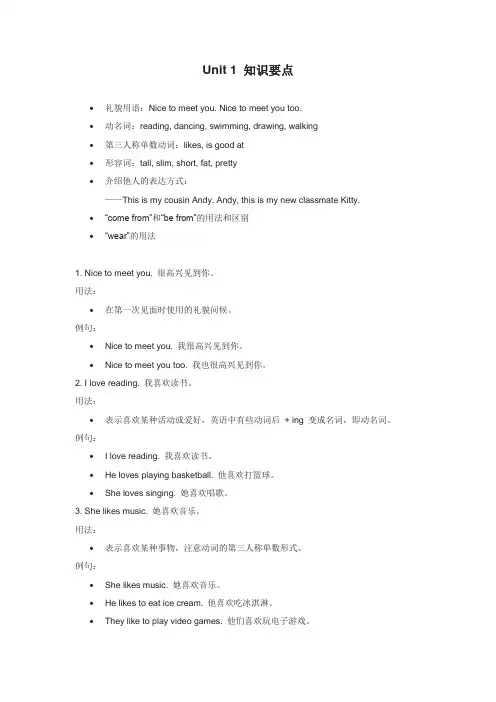
Unit 1 知识要点•礼貌用语:Nice to meet you. Nice to meet you too.•动名词:reading, dancing, swimming, drawing, walking•第三人称单数动词:likes, is good at•形容词:tall, slim, short, fat, pretty•介绍他人的表达方式:——This is my cousin Andy. Andy, this is my new classmate Kitty.•“come from”和“be from”的用法和区别•“wear”的用法1. Nice to meet you. 很高兴见到你。
用法:•在第一次见面时使用的礼貌问候。
例句:•Nice to meet you. 我很高兴见到你。
•Nice to meet you too. 我也很高兴见到你。
2. I love reading. 我喜欢读书。
用法:•表示喜欢某种活动或爱好,英语中有些动词后+ ing 变成名词,即动名词。
例句:•I love reading. 我喜欢读书。
•He loves playing basketball. 他喜欢打篮球。
•She loves singing. 她喜欢唱歌。
3. She likes music. 她喜欢音乐。
用法:•表示喜欢某种事物,注意动词的第三人称单数形式。
例句:•She likes music. 她喜欢音乐。
•He likes to eat ice cream. 他喜欢吃冰淇淋。
•They like to play video games. 他们喜欢玩电子游戏。
4. He is good at Maths. 他数学很好。
用法:•表示擅长某方面。
例句:•He is good at Maths. 他数学很好。
•She is good at dancing. 她跳舞很厉害。
•They are good at playing football. 他们踢足球很厉害。
(完整版)新译林版七年级上册英语全册知识点归纳总结

(完整版)新译林版七年级上册英语全册知识点归纳总结新译林版七年级上册英语全册知识点归纳总结Unit one⼀、词汇知识点整理:look after \ take care of 照顾 ;表⽰look 的短语:look after照顾look at 看…; look for 寻找look like 看起来像… on the first day 在第⼀天Class One, Grade Seven (先说班级,再说年级,且⼤写)。
play football 踢⾜球 after school 放学后be\come from 来⾃be good at \do well in 擅长fly kites 放风筝go home 回家listen to music 听⾳乐play a game 玩游戏wear glasses 戴眼镜at school 在学校all the lessons 所有的课程 talk about 谈论over there 那⾥ a lot of hobbies 许多爱好⼆、结构⽤法:love\like doing sth 喜欢做某事let’s +动词原形让我们I am\My name is 我叫welcome to +地点欢迎来到This is 这是be good at \do well in doing 擅长做in Class…Grade…在⼏年级⼏班be from = come from + 地点, 意思是“来⾃某地”。
He is from Nanjing. P8 他来⾃南京。
live with…in…和谁住在哪⾥live with sb 和某⼈住⼀起;live in+ 城市名,住在某地;live on the ground floor 住在⼀楼(⽤介词on)I’m…year old. 我⼏岁了。
year(s) old ,……岁,如果数词⼤于1,year 要⽤复数years. 问年龄要⽤How old “⼏岁”提问。
Unit1知识点梳理2023-2024学年牛津译林版英语七年级上册
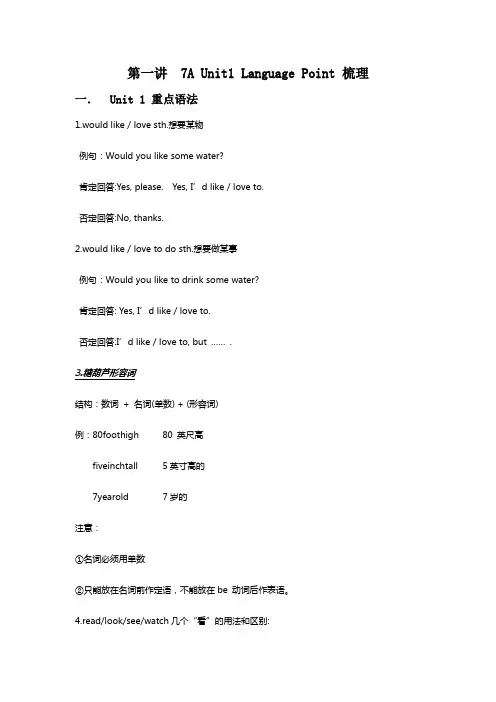
第一讲 7A Unit1 Language Point 梳理一.Unit 1 重点语法1.would like / love sth.想要某物例句:Would you like some water?肯定回答:Yes, please. Yes, I’d like / love to.否定回答:No, thanks.2.would like / love to do sth.想要做某事例句:Would you like to drink some water?肯定回答: Yes, I’d like / love to.否定回答:I’d like / love to, but …… .3.糖葫芦形容词结构:数词+ 名词(单数) + (形容词)例:80foothigh 80 英尺高fiveinchtall 5英寸高的7yearold 7岁的注意:①名词必须用单数②只能放在名词前作定语,不能放在be 动词后作表语。
4.read/look/see/watch几个“看”的用法和区别:look 强调看的动作①系动词。
译作看起来,后接形容词。
She looks happy.②不及物动词。
译作看,词组:look at…,用副词修饰。
Tom looked at me angrily.see 及物动词,译作看到,无进行时态,强调看的结果。
watch 及物动词,译作观看,注视。
强调观看正在进行中的,发生变化的活动过程,常用于看电视、看球赛、看演出等。
read 及物动词,译作阅读。
强调看文字内容的东西,常用于看书、看报纸、看杂志等。
5.疑问代词what、which、who 及疑问副词how、when 、where可以和动词不定式连用。
what to do 做什么which to do 做哪个who to do 如何做how to do 谁做when to do 什么时候做where to do 在哪里做6.“疑问词+ to do” 结构经常放在know,learn,see ,ask等动词后做宾语。
牛津译林版七年级上册英语Unit1知识点总结
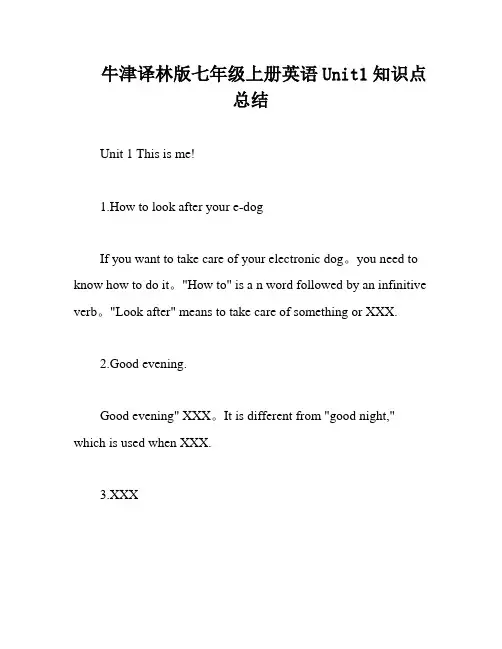
牛津译林版七年级上册英语Unit1知识点总结Unit 1 This is me!1.How to look after your e-dogIf you want to take care of your electronic dog。
you need to know how to do it。
"How to" is a n word followed by an infinitive verb。
"Look after" means to take care of something or XXX.2.Good evening.Good evening" XXX。
It is different from "good night," which is used when XXX.3.XXXIf you enjoy playing football after school。
you can say that you love it。
"Love/like doing something" XXX。
while "love/like to do something" emphasizes a one-time n.For example。
"She loves watching TV。
but today she loves to listen to music." "Love" can be used as a verb to mean "like" or "enjoy," as in "He loves his parents" or "She loves music." It can also be used as a noun to mean "n" or "beloved," as in "a mother's love for her children" or "fall in love with XXX."nally。
(完整版)新译林版七年级上册英语全册知识点归纳总结

新译林版七年级上册英语全册知识点归纳总结Unit one一、词汇知识点整理:look after \ take care of 照顾 ;表示look 的短语:look after照顾 look at 看…; look for 寻找 look like 看起来像…on the first day 在第一天 Class One, Grade Seven (先说班级,再说年级,且大写)。
play football 踢足球 after school 放学后be\come from 来自 be good at \do well in 擅长fly kites 放风筝 go home 回家listen to music 听音乐 play a game 玩游戏 wear glasses 戴眼镜 at school 在学校all the lessons 所有的课程 talk about 谈论 over there 那里 a lot of hobbies 许多爱好二、结构用法:love\like doing sth 喜欢做某事let’s +动词原形 让我们I am\My name is 我叫welcome to +地点 欢迎来到This is 这是be good at \do well in doing 擅长做in Class…Grade… 在几年级几班be from = come from + 地点, 意思是“来自某地"。
He is from Nanjing. P8 他来自南京。
live with…in…和谁住在哪里live with sb 和某人住一起;live in+ 城市名,住在某地; live on the ground floor 住在一楼(用介词on)I'm …year old。
我几岁了。
year(s) old ,……岁,如果数词大于1, year 要用复数years。
问年龄要用How old “几岁”提问。
牛津译林版七年级上册英语Unit1知识点汇总
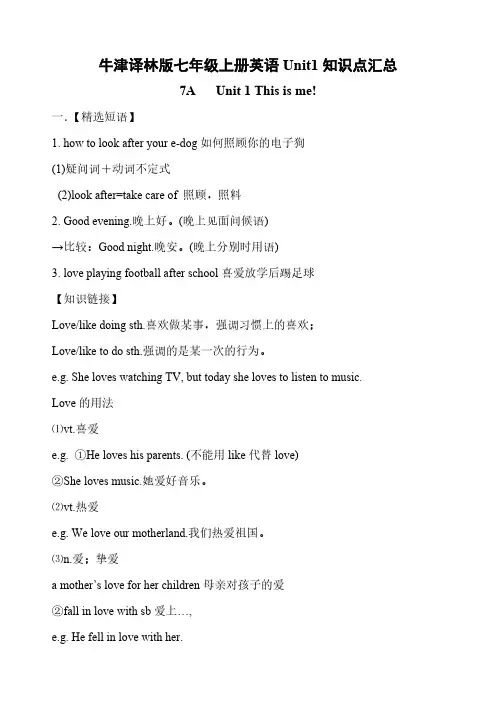
牛津译林版七年级上册英语Unit1知识点汇总7A Unit 1 This is me!一.【精选短语】1. how to look after your e-dog如何照顾你的电子狗(1)疑问词+动词不定式(2)look after=take care of 照顾,照料2. Good evening.晚上好。
(晚上见面问候语)→比较:Good night.晚安。
(晚上分别时用语)3. love playing football after school喜爱放学后踢足球【知识链接】Love/like doing sth.喜欢做某事,强调习惯上的喜欢;Love/like to do sth.强调的是某一次的行为。
e.g. She loves watching TV, but today she loves to listen to music. Love的用法⑴vt.喜爱e.g. ①He loves his parents. (不能用like代替love)②She loves music.她爱好音乐。
⑵vt.热爱e.g. We love our motherland.我们热爱祖国。
⑶n.爱;挚爱a mother’s love for her children母亲对孩子的爱②fall in love with sb爱上…,e.g. He fell in love with her.③我们可在书信的结尾处看到例如Love Mary这样的署名,意思是With my love, Mary,一方面表示情感,一方面表示道别。
【用法拓展】lovely美丽的;可爱的e.g. lovely hair秀发,a lovely girl美丽的少女4. be good at sth/doing sth=do well in sth/doing sth擅长;在某方面表现好【知识链接】⑴He is good at telling funny jokes.⑵She always does well in English.5. wear glasses戴眼镜→ wear后接服装、装饰品等,表示“穿、戴”。
牛津译林版七年级英语上册Unit1知识汇总
Unit1知识梳理Unit 1 This is me!短语归纳:1.look after take care of 照顾2.on the first day 在第一天3.Class 1,Grade 7 七年级1班4.play football 踢足球5.after school 放学后6.become from 来自7.be good at do well in 擅长8.fly kite s 放风筝9.go home 回家10.listen to music 听音乐11.play a game 玩游戏12.wear glasses 戴眼镜13.at school 在学校14.all the lessons 所有的课程15.talk about 谈论16.over there 那里17.a lot of hobbies 许多爱好用法集萃:1.lovelike doing sth 喜欢做某事2.let’s +动词原形让我们……3.I amMy name is 我叫……4.welcome to +地点欢迎来到……5.This is...... 这是……6.be good at do well in doing 擅长做某事7.in Class…Grade…在几年级几班8.live with…in…和……住在……9.I’m …year old. 我……岁了。
10.I have…hair.我留着……头发典句背诵:1.What’s your name?你叫什么名字?2.Nice to meet you! 很高兴见到你。
3.I love reading. 我喜欢阅读4.Now let’s meet our ne w classmates. 现在让我们认识下我们的新同学。
5.I often play football after school.放学后我经常踢足球。
6.She is tall and slim. 她个头很高,身材苗条。
牛津译林版七年级英语上册 Unit1 知识点归纳课件 (共62张PPT)
Language points
1.I love e-dogs.我喜欢电子狗。
love sth/doing sth =like sth/doing sth
2.How to look after your e-dog?怎样照顾你的电子狗
1). how to do sth 如何做某事 疑问词+to do where to go/what to do
回答:How
How are you ?
do you do?
How do you do?(初次见面问候)
Good morning.
Good afternoon.
Good evening.
Nice to meet/see you!
Glad to meet/see you!
• 1.你叫什么名字? • 2.我的名字是… • 3.我的主人 • 4.读书 • 5.早上好 • 6.下午好 • 7.晚上好 • 8.很高兴见到你 • 9.照看
• __________________________
•__________________________
• get to know sb. … 。
• 认识一下我的表哥安迪(Andy): __________________________
你叫什么名字?
• 这是What引导的特殊疑问句,用来询问姓名,为 了礼貌起见,常在末尾加上”please”;答语的 句型为: My name is….或者 I am…,意为“我 是…”。
Welcome to Class1,Grade7!
.welcome v. 欢迎,如: “Welcome to +某地” 欢迎你到某地来,”你” 经常被省略,如果要加上则要这么翻译:“You are welcome to…”, 如:Welcome to Beijing. 欢迎来到北京。You are welcome. 不用谢。 欢迎大家来到我的学校。 ____Welcome______ ____to____my school. 欢迎到家 Welcome to home
牛津译林版英语七年级上册Unit 1知识点梳理课件
购物
大扫除
做饭
do some reading do some washing do some sightseeing
看书
洗东西
去观光
1. ______ is a good hobby.
A. Read
B. Reads
C. To read
D. Reading
2. Tom has many books, he often ______ books at weekends.
________floors________ her.
A. in, three, above
B. on, third, below
C. in, three, below
D. on, three, above
3. —Where is my baseball?
—It’s ________ the table, _________the floor.
单词讲解
8.over 在…之上;强调在…的正上方,垂直无接触的正上方。
不强调正上方 over的反义词--under ; above的反义词--below
1. There is an old bridge _____ the river.
A. above
B. in
C. over
D. on
2. Kitty lives________ the ground floor and Sandy lives
3.reading 阅读;swimming 游泳;dancing 舞蹈。 这些词的词性是什么? 那动名词是名词还是动词呢???
另外:do some reading=read some books
类似do some doing结构的短语还有:
牛津译林版英语七上第一单元知识点归纳
第一单元知识点归纳7A牛津英语dog’s master1. this e- 2. my instruction book 3. look after your things / look at your things 4. make friends with sb.5. introduce A to B6. Good morning / afternoon / evening / night / day /7. live in a flat in Beijing live on the floor8. be (very) clever at Maths / be (very) good at Maths9. in the school basketball team= a member of the school basketball team / He is called Xiao Ma 10. We call him Xiao Ma 11. come from England = be from England 时间be born at / on / in + / 地点12. be born in + 13. like playing football at school 14. have(=wear) long black hair in a ponytail / have(=wear) black hair in (two) bunches 15. love listening to music 16. look at the three profiles of my classmates 17. work hard / study hard a funny e-pet / 18. a funny girl 19. a 12-year-old boy = a boy of 12 years old 20. wear glasses / wear a pair of sunglasses 21. enjoy playing computer games 22. polite and helpful 23. make some notes about… / make some mistakes 24. How well do the students know each other? 25. know the boy / get to know the boy 26. It\'s time for sth. / It\'s time to do sth. / It\'s time for sb. to do sth. 27. I wear football boots when I play football. 28. play tennis with a tennis racket 29. take my dogfor a walk every day / waik the dog every day 30. walk home = go home on foot 31. take a bus to school = go to school by bus 32. Here are some pictures of my family. 33. I hope you and your family are well. 34. My football team is the best in the world. 35. go running for half an hour every day 36. a teacher of English = an English teacher 37. light brown curly hair 38. talk with people in English 39. know some Chinese words such as "nihao" and "xiexie" 40. help him with his English 41. teach us English 42. can\'t speak any Chinese / Please say it in English。