
2020年春牛津译林版英语八年级下册— Unit1知识点梳理
Unit 1 Past and present1.1 Comic strip & Welcome to the unit1:past and present(1)pastn. 过去,以前;in the past 在过去adj. 过去的,以前的;in the past few years 在过去的几年里prep. 经过walk past the post office走过邮局In the past, there was no underground in Nanjing.Let’s not make the past mistakes.When I walk past the post office, I see a bird flying over the tree.(2)presentadj.现在的; 目前的; 出席的n.现在; 礼物; at present 现在;a present for you=a gift for you给你的礼物vt.介绍; 出现; 提出; 赠送;Everyone can be present ed a present at present.2:You’ve changed, Eddie. You used to share food with me.你变了。
你以前跟我分享食物的。
(1)change: vt./vi. 改变,变更; change into变成n.变化,改变; change(s) to ...的变化Great changes to Nanjing have taken place.(2)use n.用途; 使用能力; 运用头脑(或身体)的能力;vt.用,使用; 行使,①used to (do sth.) “过去常常(做某事)” 批注:否定形式:didn’t use to / usedn’t to②get/be used to(doing sth. )“习惯于(做某事)He used to go fishing every Saturday. But since he changed his job, he’s barely(几乎不) had a chance. He thinks he’ll never be used to this busy lifestyle.useful adj. 有用的;useless adj. 无用的3:I first lived in the northern part of the town with my parents.Beijing is in the northern part of China.批注:注意in the north与in the northern part of 的同义句转换。
例如:Beijing is in the north of China.=Beijing is in the northern part of China.4:When I got married in 1965, my wife and I moved two blocks away and we’ve lived in this area since then.当我1965结婚的时候,我的妻子和我搬到了两个街区之外,从那之后我一直住在那个地方。
(1)marry: vt.& vi.(使)结婚; 娶; 嫁; 结合; marry sb 与某人结婚marry A to B 把A嫁给Badj. married 已婚的; 短语:A and B get married /A get(s) married to Bn marriage 婚姻Some young couples got married on that day.(2)move: vt.& vi.移动,搬动; 使感动move away 搬走move into 搬进move out of 搬出...Every year millions of people moved into the city while millions of people moved away.5:Now the government has turned part of the town centre into a new park.turn into 进入,拐进;(使)成为,(使)进入turn... into把...变成I saw him turn into the library.How can you turn a bottle of water into a bottle of orange juice?turn on开turn off 关turn up 调高;开大(音量、煤气等) turn down 调低;关小(音量、煤气、灯火等)turn over把……翻过来turn back 往回走turn left 向左转turn right 向右转6:There was once a steel factory near the Sunshine River.阳光河附近曾经有一个钢铁厂。
once: adv.曾经=used toThere was once a shopping centre here.=There used to be a shopping centre here.n.一次,一回; = one timeI am used to doing exercise once a week.7:They often put the waste into the river.他们经常把垃圾放到河里。
put sth into 把……放进,使进入Please put the food into the fridge.put away 拿走,储存…备用put back放回;向后移put down写下;记下put on 穿上put off 延期;推迟put out 熄灭;关熄;扑灭put up 举起;抬起;张贴8:Later the government realized the problem and took action to improve the situation.后来政府意识到这个问题并采取行动去改善这种情况。
(1)realize v. 意识到;实现=come trueMy dream comes true.=I realize my dream.(2)improve v 提高;改善;改进n. improvement 提高,改进;improve living standard提高生活水平;iprove your English;改善你的英语;Do you know how to improve your memory?9: Now the river is much cleaner. 现在河流干净了很多。
此处的much 用于修饰形容词比较级。
类似的用法还有:much; still; even; far; a little; a bit;a lot;--How do you feel today? --Even worse.10: Well, in some ways it is.(P9)好的,在某种程度上它是。
短语in some ways 在某些方面,在某种程度上In some ways, I do agree with you.1. in many ways 在许多方面;用许多方法;in this way用这种方法;2. on one’s way to表示“在某人去……的路上”;(home/here/there这几个词前不需要加to)3. by the way表示“顺便说/问一句”;4. all the way表示“全程;一直”;5. in a way在某一点上,在某种程度上6. in the way 挡道in the way of sb挡在某人路上11:It has become impossible for us to see each other as often as before.对我们来说像以前一样的经常见面已经变得不可能了。
(1)此处的it是形式主语,真正的主语是后面的不定式to see each other.常用句型:It is +adj+ for sb to do sth. 对某人来说做某事是怎样的。
It is dangerous for us to go out alone at night.(2)as often as before 像以前一样的经常as ... as 像一样。
12:Now I feel a bit lonelyfrom time to time. 现在我经常会感到有点孤单。
(1)lonely: adj.孤独的,孤单的; 寂寞的; 荒凉的feel lonelyalone adv. 单独,独自=by oneself=on one’s own1.Our teacher asks us to finish the task alone.=Our teacher asks us to finish the task by ourselves.=Our teacher asks us to finish the task on our own.2. My grandma lives alone, so she feels lonely sometimes.(2)time: n 时间; 次数;时代(常用复数)at the same time 同时in time及时;适时on time 按时,准时;按时all the time 始终,一直at a time 一次;每次;在某时from time to time 不时,有时for the first time 首次;第一次1.2 Reading1. I've just eaten it.just adv. 意为“刚才”常与完成时连用。
just now 意为“刚才”,相当于“a moment ago”通常与一般过去时连用。
I went to the library just now. 我刚才去了图书馆。
2. You used to share food with me!used to do sth. 意为“过去经常做某事,以前常常做某事”,表示过去的习惯。
本身已是过去时态,没有人称和数的变化,暗含现在已不再如此。
它的否定形式有两种:didn’t use to/used not toHis parents used to live in the countryside. 他的父母过去住在乡下。
牛津译林版八年级下册英语 Unit 1-Unit 4 期中重难点语法知识点复习提纲(全面!)

牛津译林版八年级下册英语Unit 1-Unit 4 期中重难点语法知识点复习提纲Unit 11.just ①副词,意为“刚刚,刚才”,通常与现在完成时连用。
① 副词,意为“正好,恰好;仅仅,只是”,起加强语气的作用。
① just now,意为“刚才,刚刚”,相当于a moment ago,用于一般过去时态的句子中。
2.change ①不及物动词,意为“变化”。
change into 意为“变成”。
① 及物动词,意为“交换;改变;换乘”。
① 可数或不可数名词,意为“改变,变化,转变”。
① 不可数名词时,意为“零钱”。
ed to意为“曾经,过去常常”,暗含“现在不再”之意,后接动词原形。
①used to结构在变为否定形式时有两种变法:一:used not to do sth.;二:didn’t use to do sth.。
①used to结构在变为一般疑问句时也有两种形式:一:Used+主语+to do sth.?,二:Did+主语+use to do sth.?”。
①含有used to 结构的句子在变为反意疑问句时,构成肯定的疑问可用did或used,构成否定的疑问可用didn’t或usedn’t。
4.kind① 形容词,意为“友好的;亲切的”。
be kind to 意为“对……友好”。
① 可数名词,意为“种类”。
5.交通方式常用的表达方法①by+表示交通工具的名词,表示泛指乘某种交通工具,在句中作状语。
by sea/water/ship乘船/由水路by air/plane乘飞机by underground/land/train/bus乘地铁/经陆路/乘火车/乘公共汽车①in/on+冠词/形容词性物主代词+表示工具的名词,在句中作状语。
① take+a/the+表示交通工具的名词,在句中作谓语。
① on foot“步行”,是介词短语,在句中作状语。
6.too many,too much 与much tootoo many:意为“太多的”,中心词是many,其后接可数名词复数。
Unit1重点词组牛津译林版英语八年级下册
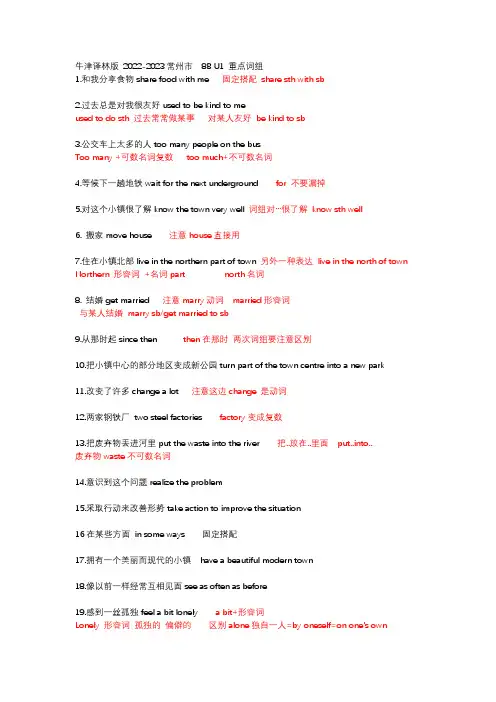
牛津译林版2022-2023常州市8B U1 重点词组1.和我分享食物share food with me 固定搭配share sth with sb2.过去总是对我很友好used to be kind to meused to do sth 过去常常做某事对某人友好be kind to sb3.公交车上太多的人too many people on the busToo many +可数名词复数too much+不可数名词4.等候下一趟地铁wait for the next underground for 不要漏掉5.对这个小镇很了解know the town very well词组对…很了解know sth well6. 搬家move house 注意house直接用7.住在小镇北部live in the northern part of town 另外一种表达live in the north of town Northern 形容词+名词part north名词8. 结婚get married 注意marry动词married形容词与某人结婚marry sb/get married to sb9.从那时起since then then在那时两次词组要注意区别10.把小镇中心的部分地区变成新公园turn part of the town centre into a new park11.改变了许多change a lot 注意这边change 是动词12.两家钢铁厂two steel factories factory变成复数13.把废弃物丢进河里put the waste into the river 把..放在..里面put..into..废弃物waste不可数名词14.意识到这个问题realize the problem15.采取行动来改善形势take action to improve the situation16在某些方面in some ways 固定搭配17.拥有一个美丽而现代的小镇have a beautiful modern town18.像以前一样经常互相见面see as often as before19.感到一丝孤独feel a bit lonely a bit+形容词Lonely 形容词孤独的偏僻的区别alone独自一人=by oneself=on one’s own20.偶尔,有时from time to time =sometimes21.告诉我关于你采访他的情况tell me about your interview with him注意interview这里是名词动词interview 词组采访某人interview sb/have an interview with sb22.关于过去一个世纪北京的变化about the changes in Beijing over the past century注意change这边是名词复数23.北京的过去与现在Beijing's past and present ‘s表示的不要忘记24. 自从周一起since Monday 25.干净而新鲜的空气clean and fresh air26.生活条件living conditions Condition条件是可数名词情形是不可数名词27.乘坐公交车进出小镇travel to and from the town by bus 词组很重要28.另一个巨大的变化another big change 29.从美国回来return from the USA30.和她父母一起去国外go abroad with her parents这里abroad是副词,前面不能用介词31.上小学be at primary school 介词是at32.互相保持联系keep in touch with each other 固定搭配33.主要通过电子邮件交流mainly communicate by email34.使交流容易得多make communication much easier35.迅速习惯生活的变化get used to the change of life quickly习惯于be/get used to sth/doing36.独自乘公交车上学go to school by bus on one's own37.在大片的空地上in large open spaces在介词用in,space这里是空地可数名词,空间不可数38.在某人的闲暇时间in one's free time39.拥有自己的小汽车have one's own car(s) 这里own自己的是形容词40. 享受舒适的生活enjoy a comfortable life 过上…的生活live/enjoy a ….life。
牛津译林版八年级英语下册词组归纳(分单元全册)
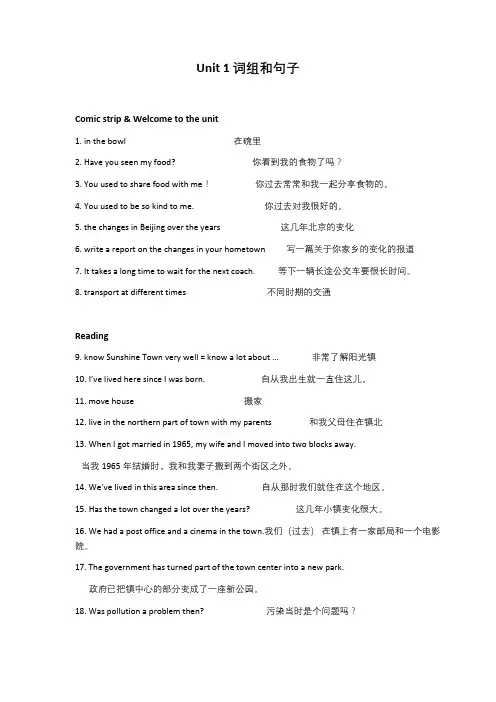
Unit 1 词组和句子Comic strip & Welcome to the unit1. in the bowl 在碗里2. Have you seen my food? 你看到我的食物了吗?3. You used to share food with me!你过去常常和我一起分享食物的。
4. You used to be so kind to me. 你过去对我很好的。
5. the changes in Beijing over the years 这几年北京的变化6. write a report on the changes in your hometown 写一篇关于你家乡的变化的报道7. It takes a long time to wait for the next coach. 等下一辆长途公交车要很长时间。
8. transport at different times 不同时期的交通Reading9. know Sunshine Town very well = know a lot about …非常了解阳光镇10. I’ve lived here since I was born. 自从我出生就一直住这儿。
11. move house 搬家12. live in the northern part of town with my parents 和我父母住在镇北13. When I got married in 1965, my wife and I moved into two blocks away.当我1965年结婚时,我和我妻子搬到两个街区之外。
14. We’ve lived in this area since then. 自从那时我们就住在这个地区。
15. Has the town changed a lot over the years? 这几年小镇变化很大。
牛津译林版八年级英语下册Unit1重点短语、句子默写汇总

❖牛津译林版八年级英语下册Unit1重点短语、句子默写汇总❖重点短语1.在碗里2.饿了3.过去常常做某事4.与我分享食物5.对某人友善6.非常了解7.在小镇的北部8.结婚9.多年前10.一个邮局11.在镇中心12.一个钢铁厂13.把垃圾倒入河里14.意识到这个问题15.采取措施16.更加干净17.在某些方面18.一个漂亮的现代城镇19.我的大部分老朋友20.搬走了21.和以前一样频繁22.打牌23.下中国象棋24.感到有点儿孤独25.有时26.新鲜的空气27.乘公交旅行28.从美国回来29.和她的父母出国30. 彼此保持联系30.用邮件交流31.使交流更加容易32.广阔的(地方)33.在他们空闲时间有他们自己的车❖佳句背诵1.I it.我刚刚吃了它。
(P6)2.It took a long time the next one.等下一班车需要很长时间。
(P7)3.I here since I was born.自从我出生我就住在这儿。
(P8)4.Have you ever ? 你曾经搬过家吗?(P8)5.Has the town over the years? 这个小镇在过去的几年中变化了很多吗?(P8)6.We had a post office and a cinema years ago.几年前在镇中心,我们有一个邮局和一个电影院。
(P8)7.The government part of the town centre a new park政府已经把镇中心的部分地方改建为一个公园。
(P8)8.There was near the Sunshine River.在阳光河边曾经有个钢铁厂。
(P9)ter the government realized the problem andthe situation.后来政府意识到这个问题并采取措施改善情况。
(P9)10.It has become impossible for us to see each other像以前一样频繁见面已经变得不可能了。
2020牛津译林版八年级英语下册Unit 1 重点单词、短语、句子专练(含答案)

牛津8年级下册Unit 1 重点单词、短语、句子专练一、根据句意及汉语提示完成句子1.John has changed ten jobs (在……期间) the past three years.2.My uncle doesn’t seem to understand the gravity(严重性) of the (情况).3.There will be an (采访) with Mr Brown after the news.4.I didn’t (意识到) the importance of environmental protection when I was young.5. That’s a bad habit of learning. (即使这样), it is never too late for you to overcome it.二、单项选择( )1.It was raining __________ we got there.A.while B.whenC.as D.as soon as( )2.This kind of computer looks __________ and sells __________ in this shop.A.nice;good B.nice;wellC.well;well D.good;nice( )13.Mr. Li ______ to Shanghai. He will be back in two weeks.A.goesB.goC.wentD.has gone( )4.—______ you ______ any films recently, Sandy? —No, I haven’t.A.Did; seeB.Will; seeC.Have; sawD.Have; seen( )5. James ____ the White Tower Park if it_________ tomorrow.A. are going to, isn’t rainyB. are going to, doesn’t rainC. is going to, won’t rainD. is going to, isn’t rainy( )6.________ number of the students in Class 3________forty-eight.A.The;is B.A;areC.A;is D.The;are( )7.There are about five__________ young trees on the hill.A.hundred B.hundredsC.hundred of D.hundreds of( )8.—_______have you known each other? —Since we were in our childhood.A.How far B.How oftenC.How long D.How soon( )9.My grandfather lives in a village________,but he never feels_________.A.alone;alone B.lonely;aloneC.lonely;lonely D.alone;lonely( )10.This is the most beautiful park I have __________visited.A.ever B.notC. never D.yet三、用动词的正确形式填空1. That's a large city in____________ (north) China.2. They can ask their_____________(marry) friends.3. The level of _____________ (pollute) in the river was falling.4. All his efforts were_____________(waste).5. It is ___________ (possible) for me to climb such a high mountain.6. The_____________(interview) went well.7. I have seen him _________________ (recent).8. His pain is ____________ (past) now.9. I thought her____________ (last) book was one of her best.10. Our products have entered the markets ______________ ( abroad).四、根据句意及首字母提示完成单词。
牛津译林版英语八年级下册Unit1第5-6课时知识总结(27张)

短暂性动词(buy, die, join, come,go ,leave, join ……)不能直接与for /since连用。要改变动词。
begin----- be on buy---- have come/arrive/reach/get to----- be in finish---- be over leave ---- be away
10. abroad adv.在(到)国外(in or to a foreign country)
了解一些高频的搭配:
go abroad for further study 出国深造
be abroad
在国外
study abroad
留学
live abroad
住在国外
travel abroad
出国旅游
例句翻译:我们的生活条件近几年提高了不少。 Our living conditions have improved a lot over the years.
情况良好(身体好) in good condition 健康不佳(身体不好) out of condition
8. return vi. 返回
简略答语
Yes, 主语+have/has.(肯定)
No, 主语+haven't/hasn't.(否定)
用 表示过去开始的动作或 法 状态已经结束,但是对
现在有影响。这种用法
一 常与already, just, yet,
ever, never, times (次数) 等连用.
现在完成时的时间副词和时间 短语: * 以already, just和yet为标志 * 以ever和never为标志 * 以动作发生的次数为标志 * 以so far(到目前为止)为标志
牛津译林版 八年级英语下册Unit1 知识点背诵与默写
8下 Unit 1词组、句型及语法复习提纲背诵单一、词组或短语二、重点句子及句型:1. ----Eddie,have you seen my food ? ----Eddie,你见过我食物吗?----Yes. I’ve just eaten it. ----见过,我刚刚把它吃了。
2.He used to share food with me.他过去常常和我分享食物的。
3.You used to be so kind to me.你以前对我那么好。
4.It took a long time to wait for the next bus.要花很长时间才能等到下班汽车。
5.I’ve lived there since I was born.自从我出生起,我就一直住在这儿。
6.Have you ever moved house? 你曾经搬过家吗?7.We’ve lived in this area since then.从那以后,我们就一直住在这个地区。
8.Has the town changed a lot over the years?城镇在过去的几年里变化大吗?9.It has become impossible for us to see each other as often as before.我们要像以前一样经常见面是不可能的。
10.Anyway,it’s good to see the amazing changes in the town.无论如何,看到城镇惊人的变化是好的。
11.China has changed a lot. = Great changes have taken place in China.= There have been great changes in China.中国发生了巨大的变化。
12.When did you last see each other?你们上一次是在什么时候见面的?13..Now, the place has turned into a park.现在,那个地方已经成了一个公园。
2020牛津译林版八年级下册Unit1Pastandpresent1
Past and present教学目标1.认识和了解现在完成时的构成和用法。
2.了解过去分词的构成。
重点现在完成时与一般过去时的联系与区别。
难点现在完成时与一般过去时的联系与区别。
教法及教具教学过程教学内容个案调整教师主导活动学生主体活动Step1 PresentationS2: For four years.T: Yeah, E ddie has lived with Millie for four years.(板书)Step2 While-taskTask 1Let the students know th at the sentences on the boardall include the present perfect tense.Tell the students: We use the simple past tense to talk aboutwhat happened at a definite time in the pas t, like “Eddiewas born four years ago”.We use the present perfect tense to talk about things thatstarted in the past and still have some connection with thepresent, like ‘Ed die has lived with Millie since he wasbo rn’. ‘Eddie has l ived with M illie for four years.’Task 2We make positive and negative sentences using the presentperfect tense like this.subject have/ has+ (not)pastparticipleI/You/We/They have (not) moved.He/She/It has (not) moved.We form the present perfect tense by adding ‘have’or “ha s” before a past participle.e.g. have/has + seen/ done/ su ng/, etc.Ta sk 3Tell the student how to write the past participle of verbs.Read ,write andremember.1) We add ‘-ed’ to regular verbs. (板书SeePage13)2) We form the irregular verbs differently. We do not add‘-ed’. Ask the students to look at the table of irregular verbs on Page 121. Ask the students to remember the past participle of irregular verbs.动词原形动词过去式动词过去分词• A B B bring brought brought• A B C do did done• A A A let let let• A B A come came come• A A B beat beat beaten Task 4 (A1)H ere is a short exercise for students to fin ish. Ask thestudents to complete the table with the correct past participle on page 10. And then wo rk out the rule.Task 5 (A2)After the short exercise, ask the students to complete the sentences using the present perfect. Help them to complete.Ask them not to forget the verb ‘have’/ ‘has’.Present the Present perfect tense briefly.Subject + have/has+ past participleTask 6Teach the students how to ask and answer questions using the present perfect tense.Task7 Chat time (A3)Millie and Sandy are talking about a film a bout Hong Kong.Complete their conversation using the correct forms of the verbs in brackets.Step3 Post-taskI. 分清一般过去时与现在完成时I cleaned the blackboard half an hour ago(只说明“擦”和其发生的时间)I have cleaned the blackboard.(说明现在黑板是干净的)板书设计教学札记。
牛津译林版八年级全册语法知识点总结
8A语法Unit 1 Friends形容词比较级和最高级的变化规则1.规则变化:(1)一般形容词+er +est (shorter, smaller, smallest )(2)以e 结尾的形容词+r +st (nicer, larger, largest)(3)以辅音字母加y 结尾的形容词变y 为i 再+er, est (busier, busiest; heavier, heaviest)(4)以重读闭音节结尾的形容词双写辅音字母+er, est 熟记:大(big)热(hot)天,一个穿红(red)衣浑身湿(wet)透的伤感(sad)胖(fat)子想要变得又瘦(thin)又苗条(slim)2.不规则变化(1)good(well)-better-best(2) many(much)-more-most(3)ill(bad, badly)-worse-worst(4) far-farther (further)-farthest (furthest)(5) little-less-least(6) few-fewer-fewest3.多音节的形容词比较级和最高级在词前加more , mostdelicious-more delicious-the most delicious popular-more popular-the most popular注意: 1 形容词的最高级前必须有the, 而副词的最高级前the 可省略2.比较级前常用a bit, a little, much, a lot, even, far 等词表示程度.3.形容词比较级用来比较两者(人或事)句中常有than; 形容词最高级用来比较三者或三者以上(人或事), 句中常有in 或of 短语表示比较范围.4. as+adj.+as (和------一样------) / not as/so +adj.+ as (不如------,不及------)Unit 2 School life一、比较事物的数量1.many (修饰可数名词)/much (修饰不可数名词)----more ----mostmore + 可数名词复数/ 不可数名词+ than ……比……数量多e.g. I have more friends than you.2.few (修饰可数名词) ----fewer----fewestlittle (修饰不可数名词)----less----leastfewer +可数名词复数+ than ……比……数量少e.g. There are fewer boys than girls in our class.less + 不可数名词+than ……比……数量少e.g. I spend less money on food than my sister.3.the fewest +可数名词复数在……中最少He has the fewest books.4.the least +不可数名词在……中最少She has the least money of us.5.the most + 可数名词复数/ 不可数名词最多Daniel has the most money.二、副词的比较级和最高级(构成方法及用法与形容词基本相同)1.一般在词尾直接加er或est,例如,hard-harder-hardest fast-faster-fastest loud-louder-loudest2、部分双音节词和多音节词分别在原级前加more构成比较级和most构成最高级,例如:slowly-more slowly-most slowly clearly-more clearly-most clearlycarefully-more carefully-most carefully3、副词比较级和最高级的不规则变化well-better-best badly-worse-worstfar-farther/further-farthest/furthestUnit 3 A day out一、as…as的用法表示A与B在某一方面程度相同或不同时用形容词/副词原级。
Units 1-8重要短语归纳2022-2023学年牛津译林版英语八年级下册
Unit 1 Past and presentWelcome to the unit1. past and present 过去和现在2. in the bowl 在碗里3. an hour ago 一小时前4. —Have you seen my food? 你见过我的食物吗?—Yes, I’ve just eaten it. 是的,我刚把它吃了。
5. used to share food with me 过去常常和我分享食物6. be so kind to me 对我那么好7. transport at different times 不同时代的交通工具8. by bike/ bus/ underground/ car/ taxi/ coach/ train/ plane骑自行车/乘公交车/地铁/汽车/出租车/长途汽车/火车/飞机9. Why didn’t you take a bus? 你为什么不乘公交车呢?10. too many people 太多人11. It took a long time to wait for the next bus. 花费很长时间等到下一班公交车。
12. It’s easy and fast (to go to school by bus). (乘公交车去上学)既简便又快捷。
Reading1. I’ve lived here since I was born. 我自出生就住在这里。
2. move house 搬家3. in the northern part of town 在城镇的北部4. get married 结婚5. move two blocks away 搬离两个街区6. We’ve lived in this area since then. 从那时起我们就住在这个地区了。
7. over the years 在这几年中8. turn part of the town centre into a new park 将镇中心的部分变为一个新公园9. a steel factory 一个钢厂10. put the waste into the river 将废物投入河中11. realize the problem 意识到这个问题12. take action to improve the situation 采取措施改善情况13. in some ways 在某种程度上14. move away 搬离15. know little about… 对……知道很少know nothing about…对……一无所知16. It has become impossible for us to see each other as often as before.我们已经不可能像以前那样经常见到彼此了。