
仁爱版九年级英语上册Unit4Topic1SectionA教案
Unit 4 Amazing Science Topic 1 When was it invented? Section A Ⅰ. Material analysis 本课是九年级第四单元第一话题的第一课时。主活动是1a和2。1a 通过Kangkang 和Jane 谈论火箭模型,引入本课的语法:一般过去时的被动语态。1b 是检查学生听1a的效果,1c则是检查学生阅读理解的能力。2重点操练be made of,be made from和be used for。3a 以听的形式让学生加深对2a的句型和1a的语法的理解。3b 让学生能够把本课的句型和语法正确地说出来。总之,本课把句型和语法充分地融合到听、读、说当中。 Ⅱ. Teaching aims 1. Knowledge aims: 掌握本课的重点词汇和短语,初步学习一般过去时的被动语态。 2. Skill aims: 能够在听、说、读、写中正确运用一般过去时的被动语态。 3. Emotional aims: (optional) 鼓励学生要勤思考、有理想、争做未来的发明家。 4. Culture awareness: (optional) 了解其他国家的科技发明。 Ⅲ. The key points and difficult points 1. Key points: Words and phrases: lock, metal, be made of, be made from, be made in, be used for, be allowed to do sth. Sentences:What’s it made of? It’s made from wood. What’s it used for? It’s used for locking the door. I wish I could go into space some day. I hope your dream will come true. Grammar: was/were +pp 2. Difficult points: be made of和be made from的用法辨析。 I wish I could go into space some day. It’s used for writing on . Ⅳ. Learning strategies 通过温习一般现在时的被动语态知一般过去时的被动语态,实现从一般现在时的被动语态到一般过去时的被动语态的转换。 通过联系生活实践,来区分be made of和be made from。 在交流中,重在表意,不要担心出错。 Ⅴ. Teaching aids 有关新词的图片/实物(如:数码相机,锁)/录音机/小黑板/PPT。 Ⅵ. Teaching procedures Stage (time period) Interaction patterns Teacher activity Student activity Remarks
1 Revision & lead-in (10mins) Class activity Group work Step 1: Let the Ss change the sentences in Group A into present passive voice. T: Look at these sentences and try to change them into passive voice. T: xxx, do you want to try the first one? T: Wonderful! The second one? Example: Group A People speak English around the world. The monkeys eat the bananas. Water washes away the earth. The chemical factory pollutes the river. ... Step 2: Present the sentences in Group B and encourage the Ss to discuss in groups and change them into passive voice, too. T: You have done very well. Now look at Change the present active voice into passive voice. S1: English is spoken by people around the world. S2: The bananas are eaten by the monkey. S3:.. Change the past active voice into passive voice. 通过复习一般现在时的被动语态来过渡到一般过去时的被动语态。以旧引新、比较学习能让学生更快地掌握新知识。 一定要把学生说出的被动语态的句子板书出来,为后面的教学作准备。 Group work this group of sentences. Again, you change them into passive voice, but this time, you will discuss in groups first. T:Any volunteers? T: Which group has different opinions? T: That’s nice. How about Sentence Two? T: Perfect! Example : Group B A P.E teacher in the USA invented basketball in the nineteenth century. The worker cut down the trees yesterday. I made this model plane. Mr. Wang punished him. The cat ate the fish. ... Step 3: Let the Ss observe the two groups of sentences and try to find the differences between them. Move to past S1: Basketball is invented by a P.E teacher in the USA in the nineteenth century. S2: Basketball was invented by a P.E teacher in the USA in the nineteenth century. S3: The trees were cut down by the workers yesterday. S4: This model plane was made by me. S5: He was punished by Mr. Wang. S6: The fish was eaten by the cat. Observe the two groups of
如果学生能正确地表述过去时的被动语态,老师直接板书,如果不能,老师要引导学生总结出来。 passive voice. T: Observe the two groups of sentences in your group and find out the differences between them. T: Hi, class, have you found anything different? T: Your group is wonderful today. Anything else? T: Great! Can you guess what we call the sentences in Group B? T: Yes. You made it. Could you tell me the structure of it? sentences and try to find the differences between them.
S1: Group A is in present tense while Group B is in past tense. S2: We use “is” or “are” in group A, but we use “was” or “were” in Group B. S3: 过去时的被动语态。
S4: was / were + pp
2 Pre-listening (4mins) Class activity Step 1: Use pictures, real objects or PPT to teach: rocket, satellite, spaceship, metal. T: Look at the picture. What’s it? Learn the new words. Ss: It’s a rocket. Ss:.. 这几个单词需要老师引导才能学习。 Individual work Step 2: Let the Ss read the statements in 1b and guess the meaning of be made of. T: Now, read the statements in 1b and try to guess the meaning of be made of . T: Who knows the meaning of be made of? Hands up, please! T: Almost right, but not exactly. Anyone else? T: Good boy! You got it! Read the statements in 1b and guess the meaning of be made of. S1: 被...制成 S2: 由...制成 3 While-listening (2mins) Individual work Let the Ss listen to 1a and do 1b. T: Now, listen to 1a and do 1b. We will check the answers after listening. T: Has everybody got the answers? T: Yes! You please. T: Next one? T:... Listen to 1a and do 1b. S1: No.1 is F S2: No.2 is F S3:... S4:...
仁爱英语九年级上册Unit1 Topic2 SectionA---Section D 教案新部编本
教师学科教案[ 20 – 20 学年度第__学期]任教学科:_____________任教年级:_____________任教老师:_____________xx市实验学校仁爱英语九年级上册Unit1 Topic2 SectionA---SectionD 教案Section AThe main activities are 1a, 2 and 3a. 本课重点活动是1a, 2和3a。
Ⅰ. Teaching aims and demands 教学目标1. Master some new words and useful expressions:probably, European, population, take place, because of, policy, neither, recent2. Go on studying the present perfect with “just, already, yet, ever, never”:(1) I have just called you.(2) Have you found him yet?(3) Have you ever been to France?(4) I’ve never been there before, …(5) But great changes have already taken place in China recently.3. Talk about the changes of economy and population in China.4. Let the students know that they should cherish the happy life now. Ⅱ. Teaching aids 教具录音机/多媒体课件/两张全家福照片(旧与新)/小黑板/超市购物图Ⅲ. Five-finger Teaching Plan 五指教学方案Step 1 Review 第一步复习(时间:12分钟)(教师出示一张超市购物图,通过询问学生是否曾去购物,引入本课话题。
仁爱英语九年级上册第一单元Topic 1SectionA(共30张PPT)
Jane
Kangkang
an English summer school
Maria
Place
India
Mount Huang
Cuba
Name
Rita
Jane Mount Huang
Kangkang
Maria
Plcae
India
an English summer school
Cuba
Maria has gone to Cuba. Kangkang been an to English summer Rita Jane hasto been been to Mount India. Huang. school. Example: has
hometown has become her _________ more and more _________ beautiful it is beautiful but there were people too many _______ to improve _______ his English and she will be back tomorrow ________
Jane
Kangkang
Maria
Cuba to be a _____ volunteer
1. What did Rita do in her hometown? 2. How does she feel about her hometown? 3. Why couldn't Jane take photos in Mount
Maria:
Have you seen her this morning?
Michael: Oh, she _________ has gone to the library. Maria: I will go and find her. By the way, where is Kangkang? Michael: He _________ has gone to the library, too. Let’s go and find them.
仁爱版九年级英语上册Unit1TheChangingWorldTopic1SectionA教学设计
(二)教学设想
1.创设情境:利用多媒体资源,展示世界变化的图片和视频,激发学生的学习兴趣,引导学生关注环境保护和科技进步。
2.互动式教学:通过小组合作、角色扮演等活动,让学生在实践中运用所学知识,提高语言表达能力。同时,教师应及时给予反馈和指导,帮助学生克服难点。
2.学生分享在本节课中的收获和感悟,以及在世界变化话题讨论中的体会。
3.教师强调情感态度与价值观的培养,鼓励学生在日常生活中关注环境保护,积极应对世界变化。
4.布置课后作业,要求学生运用所学知识,进行课后拓展,巩固学习成果。
五、作业布置
为了巩固本节课的学习成果,提高学生的英语综合运用能力,特布置以下作业:
1.教师设计丰富多样的练习题,如选择题、填空题、翻译题等,让学生巩固所学知识。
2.针对学生的不同水平,设计不同难度的练习题,使每个学生都能得到有效的训练。
3.教师及时批改并反馈练习结果,针对学生存在的问题,进行针对性的辅导。
(五)总结归纳
1.教师引导学生回顾本节课所学内容,总结词汇、语法、句型的重点和难点。
4.提高学生的听说能力,能够听懂并参与有关世界变化的话题讨论,提高学生的英语语言表达能力。
(二)过程与方法
1.通过小组合作、讨论、分享等方式,引导学生关注世界的变化,培养学生的合作意识和团队精神。
2.利用多媒体教学资源,如图片、视频等,创设情境,激发学生的学习兴趣,提高学生的学习积极性。
3.引导学生运所学知识进行观察、思考、分析,培养学生的思辨能力和问题解决能力。
5.完成课后练习册中与本节课相关的练习题,巩固词汇和语法知识。
6.学生自主收集关于世界变化的英文新闻或文章,进行阅读分析,并摘录其中的精彩句子和表达,以拓宽自己的知识面。
仁爱英语九年级上册Unit1 Topic 1 SectionA
▪ Rita: I went to many places near my home in India. In one place I saw children working for a cruel boss. I felt sorry for them. Where have you been, Jane?
3. I felt sorry for them. 我同情他们。 Be/ feel sorry for sb. 怜悯(同情)…… 如:
He decided to help Jane as he felt sorry for her.
他同情简的遭遇,决定帮助她。
〔拓展〕feel sorry for oneself 感觉不幸,自我怜悯 如:
我和我的父母去过黄山。”两句话中含有
的have/ has gone to some place与have/ has been to some place该如何区别?
▪ 这是一个很重要的问题。Have/ has gone to some place表示去了某地,有可能就在某地或者是 在去某地的路上,总之不在说话的现场。如:
Stop feeling sorry for yourself and think about other people for a change.
别老觉得自己委屈了,也替别人想一想吧。
4. By the way, where’s Maria? 顺便问一问,玛丽亚在哪儿?
▪ by the way 顺便说 如: ▪ By the way, I have good news to tell you. ▪ 顺便说一声,我有好消息要告诉你。 ▪ 〔拓展〕(1)the way to…去……的路 如: ▪ I know the way to the hospital. 我知道去
Unit 4Topic1 SectionC 教案 仁爱版九年级英语上册
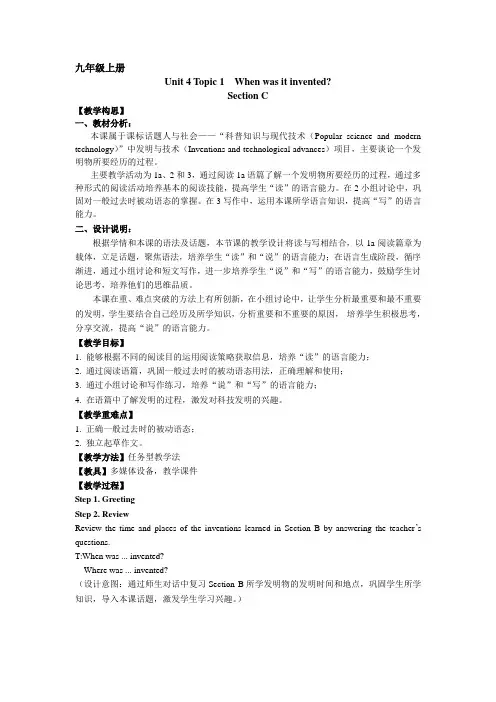
九年级上册Unit 4 Topic 1 When was it invented?Section C【教学构思】一、教材分析:本课属于课标话题人与社会——“科普知识与现代技术(Popular science and modern technology)”中发明与技术(Inventions and technological advances)项目,主要谈论一个发明物所要经历的过程。
主要教学活动为1a、2和3,通过阅读1a语篇了解一个发明物所要经历的过程,通过多种形式的阅读活动培养基本的阅读技能,提高学生“读”的语言能力。
在2小组讨论中,巩固对一般过去时被动语态的掌握。
在3写作中,运用本课所学语言知识,提高“写”的语言能力。
二、设计说明:根据学情和本课的语法及话题,本节课的教学设计将读与写相结合,以1a阅读篇章为载体,立足话题,聚焦语法,培养学生“读”和“说”的语言能力;在语言生成阶段,循序渐进,通过小组讨论和短文写作,进一步培养学生“说”和“写”的语言能力,鼓励学生讨论思考,培养他们的思维品质。
本课在重、难点突破的方法上有所创新,在小组讨论中,让学生分析最重要和最不重要的发明,学生要结合自己经历及所学知识,分析重要和不重要的原因,培养学生积极思考,分享交流,提高“说”的语言能力。
【教学目标】1. 能够根据不同的阅读目的运用阅读策略获取信息,培养“读”的语言能力;2. 通过阅读语篇,巩固一般过去时的被动语态用法,正确理解和使用;3. 通过小组讨论和写作练习,培养“说”和“写”的语言能力;4. 在语篇中了解发明的过程,激发对科技发明的兴趣。
【教学重难点】1. 正确一般过去时的被动语态;2. 独立起草作文。
【教学方法】任务型教学法【教具】多媒体设备,教学课件【教学过程】Step 1. GreetingStep 2. ReviewReview the time and places of the inventions learned in Section B by answering the teacher’s questions.T:When was ... invented?Where was ... invented?(设计意图:通过师生对话中复习Section B所学发明物的发明时间和地点,巩固学生所学知识,导入本课话题,激发学生学习兴趣。
(仁爱版)九年级英语上册全套教案

Unit 1 The Changinging WorldTopic 1 Our country has developed rapidly.Section AThe main activity is 1a. 本课重点活动是1a。
Ⅰ. Teaching aims and demands 教学目标1. Learn some new words and a phrase:proper, by the way, bell, grandpa, chairwoman, grandson2. Learn a useful sentence: There goes the bell.3. Learn the present perfect tense:(1)Rita, you have just come back from your hometown.(2)—Where have you been, Jane?—I have been to Mount Huang with my parents.(3)—By the way, where ’s Maria?—She has gone to Cuba to be a volunteer ⋯4. Talk about the children ’s vacation experiences.Ⅱ. Teaching aids 教具录音机/小黑板/学生的旅游纪念照/图片/幻灯片Ⅲ. Five-finger Teaching PlanStep 1 Review分生词。
现部通过教师询问学生的暑期活动,导入话题,呈T: Listen! The bell is ringing. Let ’s begin our教cl师a s解s!释(The bell is ringing 等于There goes the bell,板书b ell,要求学生掌握。
)bellT: Nice to see you again. Did you enjoy your summer holiday?Ss: Yes.T: Hi, S1, where did you go during your summer holiday?S1: I went to ⋯T: S2, did you go to your grandpa ’s home?S2: Yes. (板书g randpa,要求学生掌握。
仁爱版九年级英语上册U4T1SD优质教案
SectionDⅠ.Materialanalysis本课是九年级第四单元第一话题的第四课时。
主活动是1a和Project。
1a通过介绍古今人们如何定位来继续学习一般过去时的被动语态,同时让学生初步接触并理解现在完成时的被动语态和含情态动词的被动语态。
语法和功能部分则让学生通过填空来归纳总结过去时的被动语态和一些常用的功能句。
Project部分则体现了“在做中学”的理念。
让学生用英语来介绍自己的发明,无疑会巩固本话题的语言知识并进一步培养和提高学生“用英语做事情”的能力。
Ⅱ.Teachingaims1.Knowledgeaims:掌握本课的重点词汇和短语,归纳总结一般过去时的被动语态。
2.Skillaims:能够理解其他形式的被动语态。
如:现在完成时的被动语态和情态动词的被动语态。
能够在听、说、读、写活动中正确地运用被动语态。
Ⅲ.Thekeypointsanddifficultpoints1.Keypoints:Wordsandphrases:mark,explorer,system,man-made,findout,aslongas,beusedtodosth.Sentences:Thismethodworkedwellatnightaslongastheweatherwasgoodandthestarscouldbeseen .Today,theproblemhasbeensolvedbytheGlobalPositioningSystem. Itcanalsobeusedtostudytheshapeoftheearth.Grammar:was/were+pp2.Difficultpoints:TheGPSisagreatinventionthathelpsusexploreourplanetanddiscoverwhereweare.Ⅳ.Learningstrategies通过语法和功能部分的归纳总结来内化所学的语言知识。
仁爱英语九年级教案语法点
Unit 1 Topic 1 Section A.P1.1. The Changing World "变化中的世界" changing是现在分词,作world的定语。
e.g. a sleeping boy一个在睡觉的男孩P1.2. Rita,you have just come back from your home town. 丽塔,你刚从老家回来。
此句是现在完成时,表示在说话之前已发生或完成的动作对现在造成的影响或结果。
其结构是"助动词have/has+动词的过去分词"。
动词的过去分词的构成:规则变化跟动词的过去式一样,不规则变化见课本后面的附表。
e.g. I have finished that work. 我已经完成了那项工作。
She has bought a new bike. 她买了一辆新自行车。
拓展( 1 ) 否定句:主语+ haven't/hasn’t+动词的过去分词+其他如: He hasn't seen this film. 他没看过这部电影。
They haven't been to the Great Wall. 他们没去过长城。
( 2 ) 一般疑问句: Have/Has +主语+动词的过去分词+其他? 如:Have you cleaned the classroom? 你打扫教室了吗?Has your mother finished cooking? 你妈妈做好饭了吗?( 3 ) 特殊疑问句:特殊疑问词+ have/has +主语+动词的过去分词+其他?如:What has happened? 发生了什么事? Where has he gone?他去哪儿了?P1.3 -Where have you been,Jane? 简,你去哪里了?-I have been to Mount Huang with my parents. 我和父母去了黄山。
仁爱科普版 英语 九年级上册 Unit 1 Topic 1 Section A
Jane
Mount _H_u_a_n_g___ with her p_a_r_e_n_t_s___ has been to
Kangkang
an English s_u_m__m__e_r school
it is beautiful but there were too many _p_e_o_p_le___
A: Where has Jane gone? I can’t find her.
B: She has gone to the library.
A: Where have Maria and her mother gone? I can’t find them.
B: They have gone to the shop.
Find the sentences with Present Perfect Tense.
You have just come back from your hometown. Great changes have taken place there and my hometown has become more and more beautiful. I have been to Mount Huang with my parents. Oh, she has gone to the library.
现在完成时: have/has + 过去分词
Act it out 三人一组,进行表演
(After a long holiday, Kangkang is happy to see his friends.)
Look, listen and say.
Key phrases and expressions:
仁爱版九年级英语上册全套教案全册
Unit 1 The Changinging WorldTopic 1 Our country has developed rapidly.Section AThe main activity is 1a. 本课重点活动是1a。
Ⅰ. Teaching aims and demands 教学目标1. Learn some new words and a phrase:proper, by the way, bell, grandpa, chairwoman, grandson2. Learn a useful sentence: There goes the bell.3. Learn the present perfect tense:(1)Rita, you have just come back from your hometown.(2)—Where have you been, Jane?—I have been to Mount Huang with my parents.(3)—By the way, where’s Maria?—She has gone to Cuba to be a volunteer…4. Talk about the children’s vacation experiences.Ⅱ. Teaching aids 教具录音机/小黑板/学生的旅游纪念照/图片/幻灯片Ⅲ. Five-finger Teaching PlanStep 1 Review通过教师询问学生的暑期活动,导入话题,呈现部分生词。
T: Listen! The bell is ringing. Let’s begin our class! (教师解释The bell is ringing等于There goes ,板书bell,要求学生掌握。
)bellT: Nice to see you again. Did you enjoy your summer holiday?Ss: Yes.T: Hi, S1, where did you go during your summer holiday?S1: I went to …T: S2, did you go to your grandpa’s home?(板书grandpa,要求学生掌握。