
广州版英语七年级上册unit 4 知识点
七年级上 Unit 4 Seasons(上海牛津版) Part one 单词及短语 单词: foot__ __int n. 脚印;足迹 p__ddle n. 水坑 k__ck v. 踢 ev__ __ything pron. 所有事物;一切 p__cn__c n. 野餐 dr___ adj. 干的;干燥的 sp___nd v. 花(时间);度过 rel__t__ve n. 亲戚;亲属 d__ __ing prep. 在……期间 grandpar__nt n. 祖父母;外祖父母 p___ck__t n. 小包装纸袋 t__ __n n. 镇
Australia n. 澳大利亚 →___________(形容词) wet adj. 湿的 →___________(反义词) blow v. 吹 →___________(过去式) trip n. 旅行 →___________(同义词) shine v. 照耀 →___________(过去式) snowy adj. 下雪多的 →___________(名词) brightly adv. 明亮地 →___________(形容词) →___________(名词)
短语: take a _______ 去旅行 go on a ______ 去野餐 make _________ 堆雪人 fly _______ 放风筝 go ___________去游泳 ______ a picnic 野餐 go to the ___________ 去海边 spend time ______somebody 和某人一起度过 ______ the winter holidays 在寒假期间 ______ married 结婚 during the_________ 在白天
Part two课文内容精析 1. In spring, the weather starts to get warm.在春天,天气开始变暖。 (1) in spring在春天, 介词in表示时间,用于早晨、上午、晚上,星期,月份,季节,年份等“一段时间”的前面。 (2) start意为“_______”,同义词为_______。两者均可接to do sth.或doing sth.,表示“开始做某事”。 2. The weather starts to get cool. get 作连系动词,意为“________”,后常接形容词作表语 。 get 还可作实义动词,意为 “__________” get a letter from sb.= hear from sb.收到某人来信
1) The wind is __________ stronger and strong. 2) I want to __________ a teacher. 3) When she saw me, her face __________ red. 4) The boy is __________ thinner. 5) Eggs soon__________ bad in hot weather.
3. The wind blows gently. blow(过去式为_______)动词,意为“_____”。 gently是副词(形容词为gentle),意为“______地”,修饰动词blow, The sun shines brightly.阳光明媚。
4. It often rains. 这里的it指代“天气”,此外还可指代距离,时间等。 often时间副词,一般置于行为动词之______,be动词或助动词之_____。
get 表示进入或变为某种状态 常接形容词表天气warm,cold等
become 多用于书面语中,强调的是由一种状态变为另一种 常接名词,如teacher,artist等
turn 强调的是变得和以前完全不一样, 多接颜色,green,red,yellow等
grow 指的是渐渐地变成,强调变化的过程 多接形容词,old , strong等
go 多用来表示进入某种状态,多接令人不悦的形容词 多接形容词bad, mad, hungry, wrong等
I __________go to school by bike.我经常骑自行车上学。 He is ________ late for school.他经常上课迟到。
5. Everything turns green. everything______代词,意为“所有事物,一切”,在句中可作主语、宾语或表语。 everything作主语时,谓语动词用__________数形式。 Everything is ready. Let’s go. 一切都准备好了,我们走吧。 Money isn’t everything. 金钱不是一切。
turn green变绿,此处turn也是_______动词,后面接__________词。 His hair _________ grey.他的头发变灰色了。
6. The Sun shines brightly.大阳明亮地照耀着。 shine动词,“照耀”,其现在分词为“_____________”,形容词为shiny“闪耀的,睛朗的,有光泽的”和shining“光亮的,华丽的”. The sun ______________ all day today. 今天整天阳光普照。 brightly,副词,意为“明亮的”,形容词为“___________”.
The windows are bright.窗户是明亮的。 It’s a bright sunny day today.今天是个艳阳天。
7. In autumn, everything changes. Leaves turn brown, red or yellow and start falling from the trees. 在秋天,一切都会变化。树叶变成棕色,红色或黄色并开始从树上飘落。 leaves是leaf“树叶”的复数形式。leave做动词,是“_____,_____”的意思。 leave for________ leave A for B 离开A地前往B地
8. It is nice to go on a picnic at this time of year because the weather is cool and dry.在每年这个时候去野餐是令人愉快的,因为天气凉爽、干燥。
at this time of year“在每年的这个时候”,注意year前不能加冠词或every, each等。 There is flower show_______ this time of year in the city.每年这个时候这个城市都会举办花展。
9. Winter is often cold and snowy.冬天经常寒冷多雪。 snowy形容词,意为“_____________”,是由名词snow加y构成的。 snow作不可数名词“雪”;作可数名词“一场雪”。
Children love to play ______ snow.孩子们喜欢玩雪。 It is______ _______ ________.这是一场大雪。 snow作动词,意为“下雪”。 It is snowing ___________.雪正下得很大
10. Children love winter because they love to play in the snow孩子们喜欢冬天,因为他们可以 在雪地里玩耍。
love to do sth.与like to do sth.意思和用法相同。 love to do sth= want to do sth. 强调一次具体的行为 love doing sth.强调习惯、爱好= like doing sth.= enjoy doing sth. in the snow 在雪地里
11. It is interesting to make snowmen.堆雪人是件有趣的事儿。 make a snowman堆雪人,复数形式是make_____________ Children enjoy _______________ in winter.孩子们喜欢在冬天里堆雪人。
12. People usually spend time with their relatives during the Spring Festival. 在春节期间,人们通常都是和亲戚一起度过。 (1)spend 动词“度过”, spend time ________ sb.意为“与某人一起度过时光” I usually spend my free time with my best friend, Tom. 此外,spend还有“花费,用(时间/金钱)”,其后常与介词in/on连用,主要用于以下句式: 人+spend+时间/金钱+ __________ sth. “某人花费多少时间/金钱在某事上” 人+ spend+时间/金钱+ (in)______________ sth. 表示“花费多少时间/金钱做某事” spend all day _________(write)一整天都在写作 spend money_____books花钱买书
(2)during介词,“在……期间” the Spring Festival= the Chinese New Year Don’t speak _________ the meal.吃饭时别说话。
Part three 【语法精讲】 形容词 形容词是表示人或事物的性质、状态。 一般置于它所修饰的名词之前作定语,或连系动词之后作表语。 本单元主要讲解形容词在句中作定语,表语和用在“It is +adj.+to do sth”句型中。
一、形容词的用法 1、形容词作定语 (1)大多数形容词作定语修饰名词时,其位置在被修饰的名词前,说明名词的品质或特征。 She is a tall girl.她是一个高个子女孩。 It’s a black and white.它是一只黑白色相间的猫。 He is a good teacher.他是一名好老师。 She is wearing a green coat.她穿着一件绿外套。
(2)但在以下情况下,形容词却放在它所修饰的名词之后。 当被修饰的词是不定代词somebody, someone, something, anybody, anyone, anything, nobody, nothing等复合不定代词的形容词,作定语时要后置。 I would like something cheap.我想要点便宜的东西。 There is nothing wrong with him.他没有错。 Is there anything new in that book?那本书里有什么新东西吗?
广州版七年级(上册)英文教材课文

七年级英语上(广州版)Unit 1 Making friendsReadingA letter from a penfrienfDear Li JieHi! Your name and address are in Penfriends magazine. I would like to be your penfriend. My name is Simon. My Chinese name is Li Peichun. I’m twelve years old. How old are you? I’m 163 cm. I have short black hair and brown eyes. Myhobby is playing chess.I live with my parents in the UK. They are from Beijing. My parents own a Chineserestaurant in Newcastle. We live in a house near our restaurant. I can speakChinese, but I cannot write it very well. I have a brother. His name is Edwin.He is 23. he works as an accountant in London. How many people are there in your family? What do they do?I’m in year 7 at Walker School. It is near my house, and I can walk to school.I like my school. The teachers are very friendly. I am keen on sports. I enjoyplaying rugby and badminton in winter, and tennis in summer. My best subject at school is maths. I want to be an engineer.Here is a photo of myself and some school friends. I am in the middle. Li Jie,please tell me all about yourself.Best wishesSimonB My school friendsB2 read Liu Mei’s letter to her penfriend, Kelly. Write down the names of the people in the photo.Dear KellyDo you like this photo of me with my school friends? I am in glasses. Can you see me ?On the right is Sally. She is British. She is my best friend at school. She isalways happy to help everyone. On the left is Li Jie. I play table tennis withher every afternoon.The boys stand behind us. Sun Fei wears glasses too. He is a painter. His paintings are very beautiful. He is also a basketball player on the school team. Our school team often wins the Middle School Championship in the city. Wang Gang is a verygood swimmer. He practises every morning and night. He wants to be one of thebest swimmers in the world. He is the boy next to. Chen Yu. Chen Yu is the tallest boy in the class. He is good at tennis. His favourite tennis player is RogerFederer. Li Ming is the boy on the right. He is not very good at sports, but heis very friendly to everyone round him. We all like him a lot.LoveLiu MeiUNIT 2 Our daily lifeReading A1WHIZZ-KID CHENG NACheng Na, 15, is one of the top students in Guangzhou. She writes computer games and all of her family work in her business. She is still at school!6 a.m.I get up at six o’clock, wash and put on my school uniform. I have breakfastwith my parents. Every morning we discuss business at breakfast7:30 a.m.Every day, my driver drives me to school in my own car. I something make phone calls to clients on the way to school.8 a.m. 上午8点I start school. I enjoy seeing my school friends. I usually get A grades inall my subjects.12:30p.m.About twice a week my driver picks me up from school. I go and have lunch witha client. Then I come back to school.4:15 p.m.After school I usually go to a club. On Fridays we have Computer Club meeting.On Mondays and Thursdays I play basketball. Once a week I have piano lessons.I do my homework for an hour or two before dinner.7 p.m.I always have dinner with my parents. We discuss our business. Then I go tomy office and continue working on my games. I usually go to bed at 11 p.m.B2Zhen Hui students at a middle school in Guangzhou. Every day, she wakes upat six o’clock in the morning. She quickly brushes her teeth and washes herface. Then she reads English for half an hour, she has breakfast at seven o’clock. She usually has two pieces of bread and a glass of milk.After breakfast, Zhen Hui goes to school. She lives near school and alwayswalks there. She usually gets to school at eight o’clock, and usually has six lessons. Zhen Hui loves English very much, and always gets an A. she usuallygets a B in her other subjects.After school, Zhen Hui usually walks home at four o’clock in the afternoon.Her favourite sport is table tennis. She plays table tennis with her classmates at school once a week.Zhen Hui often has an early dinner. She begins to do her homework at six o’clock and completes it in one or two hours. She usually goes to bed at nineo’clock.Unit 3 TroublesReading A2An exciting thing happened to Liu Wei on 28 September.Friday, 28 SeptemberToday my father and I waited for the ferry. Suddenly, two women a nd a man began arguing. The man held out a bag and showed it to the women. There was nothingin it .Everyone looked at the three people, my father went up and asked one of thewomen, “is something wrong?”.“He stole my p urse,” said the woman. “we were in the bookshop and three young men were behind us. Then I couldn’t find my purse. The other two men ran away, and we followed this man here.”Then the gates opened. The man hurried aboard, and the two women went afterhim.“wait,” said my father. “ let’s take the next ferry.” Then he hurried to an ice cream shop, picked up the phone and quickly called 110.“I want to report a theft . A man stole a purse from a Woman. He has a greenshirt and a blue bag , he’s on the No.3 Ferry now. it left a few minutes ago.Please meet it on the other side of the river.”We took the next ferry. When we got off, we saw six policemen standing aroundthe man. He was in handcuffs.“well done, dad ,” I said. “you are so great !”B2When Chen Yu work up, it was already six o’clock. “Oh no !” he said. Last night he stayed up late to work on his science project, but he did not complete it. It was due today. Chen Yu was worried. The science teacher was sure to beangry with him.Chen Yu put on his clothes quickly and run out of the door. It was cold outside. He rode his bike quickly to keep warm. He thought carefully about his project ---he wanted finish it this morning. Suddenly, he saw an old lady fall overand hurt her leg. It was Mrs Li. She lived next door to Chen Yu.“what should I do?” wondered Chen Yu. “I want to help her but I do not have time. I have to complete the project before school.”“She should not walk tound on her own in this cold weather without her walking stick,” thought Chen Yu, but he felt guilty not to stop and help her.Suddenly, he had an idea. He rode quickly to the telephone booth on the sideof the road and called an ambulance. Five minutes later, an ambulance pickedup Mrs Li, and Chen Yu got on his bike and happily rode to school.Unit 4 HobbiesReadingA2Patrick Moore studied the stars all his life. Here is an article about his hobby.Patrick MooreWhen I was about eight, I got a book about stars. That was the beginning ofmy life’s work. When I was young, I did not use to have much money. I couldnot buy expensive things. But I had my eyes. I used to go outside every nightto look at the stars.There are billions of stars in the sky---but you can only see about 3000 withyour own eyes.Get a map of the stars and begin to find your way through the sky. In different seasons, you can see different groups of stars. The shapes of these groups never change. It is easy to learn the name of each group. When you know these, youmay start to look at the stars inside each group. Not all stars are the same.Some a re big, and some are small. Some l ook white, some look red and some look blue.Sometimes, you may see a star move. However, if you see it move from one group to another, then it is not a star but a planet. You are able to see Venus andJupiter easily. They are both very bright. It is easy to see Mars, too. It looks red. You will soon begin to learn more and more about the stars. Then you will want to find out even more about them.B Taking photographsB2A photographer can have a very interesting life. Norman Parkinson was afamous photographer. He liked travelling to interesting places and takingphotographs. It was his hobby as well as his jop.Taking photographs is a favourite hobby of many people all over the world. Itcan help us remember things. We all love to take photographs of each other,especially when we travel to new places. We also like to have a photograph ofeverybody in the group together. When we want to be in the picture, we needto ask someone to take the photograph for us.Having photographs is important because people and places always changes. Itis very sad, for example, if children cannot look at photographs of theirparents or grandparents. What did Grandfather look like? Where did he use tolive? If we do not have photographs, children may not know the answers to these questions. Photographs help us know and understand our history.This picture is more than fifty years old .Guangzhou later held the ChineseExport Commodities Fair in this building. Do you think the old picture helpus remember life in the past?Unit 5 EncyclopaediaReadingA2DINOSAURSDinosaurs lived on earth more than sixty million years before human beings.They lived everywhere. Some dinosaurs were as small as chickens. Others wereae big as ten elephants. Some dinosaurs could even fly.Many dinosaurs were gentle and ate plants. Others were dangerous and ateDinosaurs all died out suddenly. Nobody knows the reason.However, people can learn about the lives of dinosaurs from fossils of theirskeletons, eggs and footprints. (see Earth History)DISNEY, WALTDisneyland is a famous park in the USA. Its founder was Walt Disney (1901~1966). He is famous for his cartoon characters such as Mickey Mouse, Donald duck, Goofy and Snow White.Disney was born in the USA. After leaving school, he sold newspapers anddelivered letters. At the same time, he studied art at night. Finally, he gota job drawing cartoons for films.Sometimes a mouse sat on Walt’s desk when he was at work. He drew the mouseand put it in a cartoon. This became Disney’s most famous cartoon character —Mickey Mouse. Mickey soon became a star and Disney became rich and famous.(see Cartoons)B3Jean Champollion (1790~1832) was very good at languages. He learnt twelelanguages in his life. When h e was 18, he began teaching history at university.He was younger than many of his students!Jean was very interested in ancient Egypt and in 1821 he began to study theRosetta Stone. A group of soldiers found this stone at Rosetta when Jean wasstill a young boy. It was under the sand for hundreds of years before they dug it up. There was a lot of strange writing on the stone. The writing was in three languages. One of the languages was ancient Egyptian. No one could read it at that time. But Jean worked out its secret.Ancient Egyptian was not a language with letters and words like English. Itwas full of signs. According to many experts, these signs showed things andideas. Jean did not completely agree. He thought some of them showed sounds.He found fifteen signs of this kind in his study of the Rosetta Stone .Today,it is possible to understand ancient Egyptian from 4000 years ago because ofJean’s discovery.Unit 6 Beyond time and space (Ⅰ)ReadingA2Captain King often tells his friends stories of his adventures. This is oneof them.Towards evening we landed on an unknown planet. Lam, our pilot, brought us down gently in a valley. We left the ship and saw a cave. We went into the cave.It was someone’s home and everything inside was huge!“Let’s get out of here,” Peters, our navigator, said. “this is the homeof a monster.”“Maybe it’s a friendly monster,” I said. “we’ll wait.”Suddenly, a door opened and some a nimals jumped out. They looked like kangaroos. Behind them was a huge monster. The kangaroos shouted, “good night, Gork.”Then they jumped away.Then Gork saw us. He gave a roar, “Aliens! Aliens in my cave. How d id you get in here?”I thought fast, and said quietly, “Good evening, Mr Gork. My name is Nobodyand …”Gork roared again, “you’re aliens and we kill all aliens in this valley.Tomorrow morning, you are going to die! All of you.” Then he pressed a button on the wall. Steel bars rose suddenly from the ground around us and closed over our heads.“well, Captain,” lam asked, “why did you name yourself ‘Nobody’?”“I have a plan and ‘Nobody’ is part of it,” I replied. “You’ll see.”I turned to Gork and said, “ We come in peace, Mr Gork.”Gork said, “You come in peace, but tomorrow you’ll be in pieces.”Peters turned towards me, and his voice shook. “We’re all going to die, sir.”“No, We’re not,” I said. “ we’re all going to live, Peters! Trust me!”B2Kelly always wanted to be a scientist. She was interested in maths and physics. She hoped to work in space one day. “I will discover something important inthe future,” she often told herself.Every evening, Kelly went out with her dog to look at the stars. One night,she saw a strange, coloured light moving across the sky.“It’s can’t be a star,” she thought. “It’s too bright. It must be a spaceship! I’m going to see it!”She walked quickly towards the light.“The people in the spaceship will want to talk to me. Can they speak ourlanguage? Will I be able to understand them? Are they lost?”The spaceship landed a few metres in front of Kelly and the door slowly opened. Suddenly, Kelly’s dog ran towards the spaceship. Kelly cried. “this can’t be true !” two huge dogs stood at the door of the spaceship. The visitorsfrom space were dogs! They said a few words to Kelly’s dog. Kelly’s dog looked at Kelly and then turned and rain into the spaceship. Then the spaceship wasgone.Unit 7 Beyond time and space (Ⅱ)A2After his dinner, Gork fell asleep on his bed right away.“Listen, everyone,” I said. “Here’s my plan. We’ll use this small powerful laser torch to get out of the cage. First, I’ll melt the bars and then….”Peters interrupted me, “ I know, Captain. Then you’ll use the torch to kill Gork.”“NO,” I said. “ if we kill him, we won’t be able to open the huge door”.I melthed the bars on the cage and we all, got out of the cage. I went up tothe bed, beside Gork’s head. I should, “Gork, this is Nobody!”Gork work up. I aimed the torch at his eye and the laser beam hit the eye.Gork roared, “ My eye! I can’t see!” the noise brought his kangaroo fiends to his door. They opened it, and asked, “ what’s wrong, Gork?”Gork shouted, “ Nobody attacked me. Nobody hurt my eye.”The kangaroos laughed and said, “ Nobody attacked you. You just had a bad dream! Let’s go back to bed. Good night, Gork.”My crew and I secretly climbed into the huge kangaroos’ pockets and they carried us out.A few seconds later, we all jumped out to freedom.“then, what happened to Gork?” asked someone.“Gork? I don’t know. Maybe he’s still in his cave and looking for Nobody.”Everyone laughed.B2In 1897, H G W ells wrote a science fiction book about spaceships coming to Earth. Its name w as The War of the Worlds. The book was still very popular in the 1930s. on 30 October, 1938, a man named Orson Wells put out a radio programme fromthe book. The programme was different from the book in one important way: inthe programme the actors talked like reporters and it sounded like a news report to the listeners.The actors said, “ space peopie from the planrt Mars are going to attack Earth. Huge things like snakes will come o ut of spaceships and kill people and people’s guns cannot hurt any of them,” when people heard this, they were very afraid. Some even left their homes and tried to hide.Orson Wells waited 40 minutes and later he told the listeners the truth. However, many listeners really believed the news report. They were afraid at first and then they became angry.In fact, 30 October is the day before a famous holiday in the USA a nd some other vountries. On this holiday, people play jokes on other people. The holiday is Halloween.。
广州沪教牛津版(2024版新教材)七年级英语上册期末总复习语法100题(含答案)

2024版新教材广州沪教牛津版七年级英语上册期末总复习语法100题Unit 1特殊疑问句Unit 2一般现在时Unit 3形容词Unit 4 there be句型Unit 5 一般将来时Unit 6 条件状语从句Unit 7 一般过去时Unit 8 人称代词单项选择1.There is _________ picture on the wall.A. /B. aC. anD. the2.I do my homework _________ 7:00 every day.A. inB. onC. atD. under3.Please give the book _________ your friend.A. toB. forC. betweenD. at4.Tom will go to visit Macao _________.A. last weekB. yesterdayC. next weekD. usually5.My brother is lazy. He never _________ my mother _________ housework.A. helps…withB. help… withC. helps…doesD. help…doing6.It rained heavily yesterday. I _________ wet and had a bad cold.A. gotB. getC. getsD. getting7._________ Janet and Mike are ten years old.A. AllB. BothC. TwoD. And8.— _________ were you born?— I was born in Guangzhou.A. WhenB. WhoC. WhatD. Where9.There _________ a talk about American country music in our school tonight.A. will haveB. going to haveC. is going to hasD. will be10.There are _________ on the table.A. two milkB. two bottles of milkC. much milkD. two bottles of milks11.— Simon, I’m going to Shanghai with my parents tomorrow.— _________!A. Have funB. Best wishesC. Never mindD. All right12._________ is important for us to listen to our teacher carefully in class.A. ThatB. ItC. ThisD. As13.— Do you _________ walk to school?— _________. I live too far away.A. often; NeverB. usually; OftenC. seldom; AlwaysD. always; Usually14.We are in the same class. _________ classroom is very nice.A. UsB. MyC. OursD. Our15.We all love _________ table tennis, and we _________ a good time playing it yesterday.A. playing, haveB. to play, havingC. playing, hadD. play, had 16.— Hi Linda. Are you writing _________ Tom?— Yes. I _________ him yesterday.A. to; heard outB. to; heard fromC. with; hear fromD. from; hear out17.He always watch TV _________ his family after dinner.A. underB. withC. byD. without18.If you _________ free, please come here tomorrow.A. wasB. will beC. wereD. are19.We are _________ in the _________ film.A. interested, interestingB. interesting, interestingC. interested, interested.D. interesting, interested20.Here is my schoolbag. Two _________ and a ruler are _________ it.A. pencils, aboveB. homework, underC. Paper, onD. books, in21.— How often do you send an email to your cousin?— _________.A. Last weekB. For a monthC. Once a monthD. Next week22.— Look! Whose books are over there?— I think they are ________.A. theyB. theirsC. themD. their 23.________ stamps is educational.A. CollectingB. CollectsC. CollectedD. Collect 24.The night before the trip, I was ________ that I couldn’t sleep.A. so excitingB. very excitingC. so excitedD. very excited 25.Yesterday I had a piece of beef, vegetables and ________ for dinner.A. some riceB. a few riceC. a little ricesD. a rice 26.— ________ do you go to the library?— Once a week.A. How soonB. How farC. How longD. How often 27.There ________ a swimming pool and a big garden in the hotel.A. areB. isC. haveD. has28.If it ________ tomorrow, we ________ hiking.A. not rain, will goB. won’t rain, goC. doesn’t rain, will goD. doesn’t rain, go29.________ kind of you to help others.A. ItB. It’sC. ItsD. They re 30.— I get a chance to go to Shanghai.— That’s ________.A. amazeB. amazingC. amazedD. amazingly 31.I spend two hours ________ some reading every day.A. doB. on doingC. in doingD. did32.I don’t like this dress. Can you show me ________ one?A. otherB. the otherC. othersD. another 33.He ________ up early to read English every day.A. getB. gotC. will getD. gets 34.He left his hometown and ________ went back again. He missed it very much.A. neverB. usuallyC. oftenD. always35.When she left ________ school, she got a job as ________ air-hostess.A. a; theB. /; theC. /; anD. the; the36.The teacher as well as three students ________ here half an hour ago.A. wasB. isC. wereD. are37.There are many English-Chinese dictionaries, but which one ________ you?A. is belonging toB. is belonged toC. belongs toD. belongs38.It was raining hard. You ________ go out.A. had better notB. had better not toC. hadn’t betterD. had better to not39.— ________ do you have your hair cut?— Once a month.A. How manyB. How muchC. How longD. How often 40.We have ________ homework this holiday, and I feel ________ tired to do any exercise.A. too much; too muchB. much too; too muchC. much too; much tooD. too much; much too41.________ is one of my father’s hobbies.A. Collecting stampB. Collect stampC. Collecting stampsD. Collect stamps 42.— Can I help you?— I’d like ________ for my twin sons.A. two pair of shoesB. two pairs of shoeC. two pair of shoeD. two pairs of shoes43.— I think our English teacher is working hard. He teaches us ________.— Yes, but he hasn’t come today. He doesn’t feel ________.A. good; wellB. good; goodC. well; goodD. well; well 44.— What do you think of Harbin and Qingdao in winter?— I think Harbin is ________ than Qingdao.A. interestingB. the most interestingC. much interestingD. much more interesting45.Several years ago, ________ people knew his name, but now he is a celebrity.A. fewB. littleC. manyD. some46.Mr. Li praised me for my fluent spoken English. However, ________ has ever told me ________ before.A. nobody; thatB. somebody; thatC. somebody; thisD. nobody; this47.They ________ about eight hundred English words since 3 months ago.A. learnedB. have learnedC. were learnD. had learned48.________ it is today!A. What fine weatherB. What a fine weatherC. How fine weathersD. How a fine weather49.If you ________ carefully, you ________ the report well.A. will listen; will be understoodB. will listen; understandC. listen; will understandD. listen; understand50.The mother asked her son ________.A. what did he do the day beforeB. where did he find his lost bookC. what time he got up that morningD. that if he had finished homework51.This classroom is ________ more than 50 students.A. enough large holdB. enough large to holdC. large enough holdD. large enough to hold52.My brother ________ while he ________ his bicycle and hut himself.A. fell; was ridingB. fell; were ridingC. had fallen; rodeD. had fallen; was riding53.— I usually get up at 6 in the morning.— ________.A. So I do.B. So do I.C. So am I.D. So I am..54.— Shall we go to the sea this weekend?— No, I’d like ________ at home and do some reading.A. stayingB. stayC. stayedD. to stay55.— ________ water do you want?— Just a little, thanks.A. How manyB. How muchC. How longD. How often56.— Do you know that CBA player, Jones?— Oh, I don’t know him. I ________ watch basketball matches.A. alwaysB. sometimesC. oftenD. seldom57.Look! There ________ a big tree and some flowers in the garden.A. isB. areC. haveD. has58.He always ________ a good time at school.A. hadB. will haveC. hasD. have59.The Earth provides ________ with air, water and food. It’s our home.A. ourB. oursC. weD. us60.— It’s important ________ students to learn English.—I think so.A. toB. ofC. withD. for61.Get up early ________ you can have more time to have breakfast.A. ifB. butC. so thatD. or62.You ________ a lot if you ________ carefully in class!A. will learn; listenB. learn; will listenC. will learn; will listenD. learn; listen63.I’m not sure about the meaning of the words. I will look them ________ in the dictionary.A. forB. upC. atD. over64.— ________ he ________ to travel to Guangzhou next month?— Yes he is.A. Will; goingB. Is; goingC. Does; goD. Is; go65.— It’s Sally’s dog. But I don’t know ________ name.— I know. It’s called Teddy.A. itB. itsC. it isD. one’s66.— ________ does Tony get to school?— By bus.A. WhyB. WhenC. HowD. Where67.I am thirsty. Can you give me ________?A. a waterB. some watersC. a bottle of waterD. many water68.John will have a birthday party ________ Monday morning.A. onB. inC. atD. for69.I ________ back home next Sunday. How about you?A. wasB. amC. am going to beD. go70.Those _________ usually go to work _________ underground. They all like the Green Travel.A. Germans, byB. Germany, takeC. German, byD. Germany, by 71.— _________ does Leo _________ to see a film?— Once a week. He is a super movie fan.A. How long, goB. How often, goC. How long, goesD. How often, goes 72.After school, I play _________ guitar for half _________ hour every afternoon.A. the, anB. /, anC. the, /D. a, /73.Could you please give me _________ to write down the message?A. a paperB. some papersC. a piece of paperD. some pieces of papers74.Adam _________ the star. He wants to be a scientist in the future.A. will be interested in studyB. be interested in studyingC. has interested in studyD. is interested in studying75.There _________ a football match next week. I am so excited about it.A. will haveB. areC. is going to beD. is76.When Mike finds a new word in the articles, he always _________ in the dictionary.A. looks up itB. looks it upC. looks for itD. looks it for77.— How was your sports meeting?— Great! Our class _________ the football match and won the first prize.A. joinB. watchedC. took part inD. light up78.— There are so many bags outside. Which is _________ school bag?— The red one is _________.A. your, youB. my, mineC. my, yourD. your, mine79.Mr. Li usually _________ his free time _________ the kids English for free.A. spends, to teachB. spends, teachingC. takes, to teachD. take, teaching80.Nowadays, only _________ students still go lo classes at the weekend.A. a fewB. a littleC. muchD. lot of 81.Would you please show me _________ skirt? I don’t like the colour of this skirt.A. otherB. the otherC. anotherD. others 82.— Look at the black cloud. It is going to __________.— What a pity! We can’t play outside. I don’t like the _________ day.A. raining, rainyB. rain, rainingC. rainy, rainD. rain, rainy 83.Mr Li is writing a book on _________ animals _________ Earth.A. to protect, inB. protecting, onC. protects, inD. protected, on 84.Why are you laughing? Is there _________ on the Internet?A. something interestingB. interesting somethingC. anything interestingD. interesting anything85.It’s fun ________ sometimes, because we don’t need to cook at home.A. eat outB. eats outC. to eat outD. eating out 86.— __________ will his film last?— For about two hours.A. How soonB. How longC. How farD. How often 87.— Where _________ you _________?— Australia.A. are, come fromB. do, fromC. do, come fromD. are, come88.Nothing will make me _________ my mind.A. to changeB. changingC. changeD. changed 89.It’s dangerous ______ us ______ in the river.A. of; to swimB. for; swimmingC. of; swimmingD. for; to swim 90.Look! There is ______ water in my bottle, so I need to get some now.A. littleB. fewC. a littleD. a few 91.— I would like to visit Hong Kong, Beijing and Shanghai.— _________ would you like to visit?A. Where elseB. When elseC. What elseD. How else92.The students ________ to the Summer Palace if it ________ tomorrow.A. will go; won’t rainB. will go; doesn’t rainC. goes; won’t rainD. goes; doesn’t rain93.— It’s getting dark. The ________ in the room is poor.— Let’s turn on all the ________ to ________ it up.A. lights; lights; lightB. light; light; lightC. light; lights; lightD. lights; light; light94.—I’m afraid we can’t work out the math problem _________ the teacher helps us.—That’s true. It’s too difficult.A. ifB. unlessC. becauseD. as soon as 95.— I get a chance to go to Shanghai.— That’s ________!A. amazeB. amazingC. amazedD. amazingly 96.He works much harder than before ________ he can catch up with his classmates.A. becauseB. in order toC. butD. so that 97.The cake is ________ delicious ________ I want one more.A. so; asB. such; asC. such; thatD. so; that98.If it ________ snow tomorrow, we will play outside.A. isn’tB. doesn’tC. won’tD. will 99.Hearing the ________ news, the girl was very ________.A. excited, excitingB. exciting, excitedC. exciting, excitingD. excited, excited100._________ a higher mark, he studies ________.A. To get; hardlyB. Getting; hardC. Getting; hardlyD. To get; hard语法100题参考答案1.B2.C3.A4.C5.A6.A7.B8.D9.D10.B 11.A12.B13.A14.D15.C16.B17.B18.D19.A20.D 21.C22.B23.A24.C25.A26.D27.B28.C29.A30.B 31.C32.D33.D34.A35.C36.A37.C38.A39.D40.D 41.C42.D43.D44.D45.A46.A47.B48.A49.C50.C 51.D52.A53.B54.D55.B56.D57.A58.C59.D60.D 61.C62.A63.B64.B65.B66.C67.C68.A69.C70.A 71.B72.A73.C74.D75.C76.B77.C78.D79.B80.A 81.C82.D83.B84.C85.C86.B87.C88.C89.C90.A 91.A92.B93.C94.B95.B96.D97.D98.B99.B100.D。
广州市初中英语七年级上册Unit 4经典练习卷(含解析)

一、选择题1.-What do you think of working as a doctor?- It 's a good job to help people keep___________.A.busy B.strict C.healthy D.generous C解析:C【详解】句意:——你认为作为一名医生的工作怎么样?——帮助人们保持健康是一份好工作。
A. busy忙的;B. strict严格的;C. healthy健康的;D. generous慷慨的。
根据前面What do you think of working as a doctor?可知医生的工作,帮助人们保持健康。
根据题意,故选C。
2.Can you _______ the dictionary to me?A.bring B.take C.need D.know A解析:A【详解】句意“你能把字典带给我吗?”。
A.带来;B.带走;C.需要;D.知道。
且根据句意可知,表示“带来”,bring sth to sb,故选A。
3.Jack is at work. Please _______ his ID card to him.A.take B.bring C.carry D.need A解析:A【解析】【详解】句意“杰克在上班,请把他的身份证带给他”。
A.带走(强调往外带);B.带来(强调往里带);C.携带(无方向性);D.需要。
根据Jack is at work可知,要往外带,且根据take sth to sb可知,故选A。
4._______ alarm clock and _______ pen are on the computer desk.A.An; a B.A; an C.A; a D.An; an A解析:A【详解】句意“一个闹钟和一支钢笔在电脑桌上”。
alarm以元音因素开头,用an,pen以辅音音素开头,用a,故选A。
广州七年级沪教版英语上册必背重点句型汇总
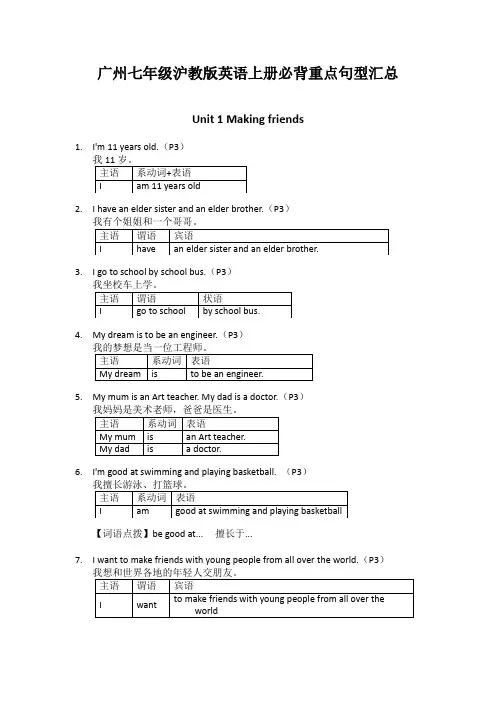
广州七年级沪教版英语上册必背重点句型汇总Unit 1 Making friends1.I'm 11 years old.(P3)2.I have an elder sister and an elder brother.(P3)3.I go to school by school bus.(P3)4.My dream is to be an engineer.(P3)5.My mum is an Art teacher. My dad is a doctor.(P3)6.I'm good at swimming and playing basketball. (P3)【词语点拨】be good at...擅长于...7.I want to make friends with young people from all over the world.(P3)【词语点拨】make friends with sb与某人交朋友all over the world世界各地8.I like my school because the teachers are all very friendly.(P3)9.What subject do you like best?(P4)10.I got an email from a boy called Bruce(P8)我收到一封叫布鲁斯的男孩的邮件。
【词语点拨】a boy called Bruce 一个叫布鲁斯的男孩Unit 2 Daily life【词语点拨】Love doing喜欢做…2.My school is close to my home, so I always go to school on foot.(P17)3.Lunch is from 11:50 am. to 12:30 am.(P17)【词语点拨】From…to….从…到…4.We have our morning break at 9:50 a.m.(P17)我们是早上9点50分课间休息。
七年级英语上册《Unit4》课件(共28张PPT)
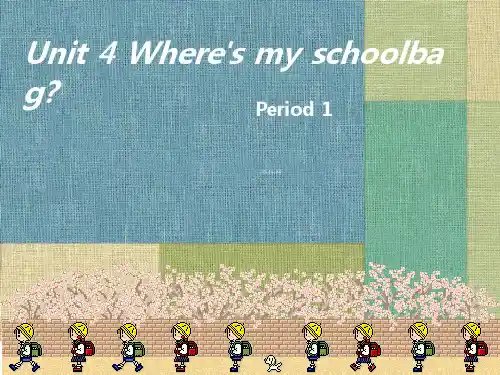
I’m Jerry.
Where’s Jerry?
zxxkw
It’s in the box.
in 在...里面
Where is Jerry? It’s _o_n___ the box.
on 在...上面
Where is Jerry ? It’s _u_n_d_e_rthe box.
under 在...下面
• Where is my baseball? • It's under the desk.
• Where are my books? • They are in the bookcase.
• 1. 今天z所xxkw 学单词,每个抄写4遍; • 2. 完成《原创》Unit 4 的第一课时。
[weə]
1a
Match the words with the things in the picture.
1. table _b_ 2. bed _e_ 3. bookcase _h_ 4. sofa __g_ 5. chair _d_ 6. schoolbag _a_ 7. books __f 8. keys _c_
in on under Show your left hand !
This is my study(书房).
New words
bed bookcase table chair desk sofa furniture
Sentences
• Where is my schoolbag? • It's on the desk.
同时我会说123然后你应该快速站起来并大声说出该东西所对应的单词
Unit 4 Where's my schoolba g?
广州初中英语教材-沪教牛津新版-全册单词
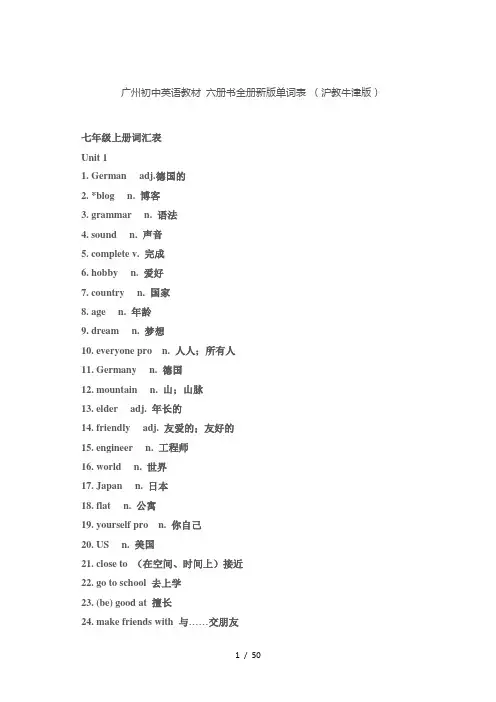
广州初中英语教材六册书全册新版单词表(沪教牛津版)七年级上册词汇表Unit 11. German adj.德国的2. *blog n. 博客3. grammar n. 语法4. sound n. 声音5. complete v. 完成6. hobby n. 爱好7. country n. 国家8. age n. 年龄9. dream n. 梦想10. everyone pro n. 人人;所有人11. Germany n. 德国12. mountain n. 山;山脉13. elder adj. 年长的14. friendly adj. 友爱的;友好的15. engineer n. 工程师16. world n. 世界17. Japan n. 日本18. flat n. 公寓19. yourself pro n. 你自己20. US n. 美国21. close to (在空间、时间上)接近22. go to school 去上学23. (be) good at 擅长24. make friends with 与……交朋友25. all over 遍及26. ‘d like to=would like to 愿意Unit 21. daily n. 每日的;日常的2. article n. 文章3. never adv. 从不4. table tennis n. 乒乓球5. ride v. 骑;驾驶6. usually adv. 通常地7. so conj. 因此;所以8. seldom adv. 不常;很少9. geography n. 地理10. break n. 休息11. bell n. 钟;铃12. ring v. (使)发出钟声;响起钟声13. end v. 结束;终止14. band n. 乐队15. practice n. 练习16. together adv. 在一起17. market n. 集市;市场18. guitar n. 吉他19. grade n. 年级20. junior high school 初级中学21. on foot 步行22. take part in 参加23. have a good time 过得愉快24. go to bed 去睡觉25. get up 起床Unit 31. Earth n. 地球2. quiz n. 知识竞赛;小测验3. pattern n. 模式;形式4. protect v. 保护5. report n. 报告6. part n. 部分7. land n. 陆地8. field n. 田地;田野9. large adj.大的10. provide v. 提供11. pollution n. 污染12. burn v. 燃烧13. energy n. 能量;能源14. pollute v. 污染15. into prep. 到……里面;进入16. ground n. 地面17. kill v. 杀死18. must v. 必须19. important adj. 重要的.20. fact n. 事实21. kilometre n. 公里;千M22. own adj. 自己的23. catch v. 捕捉24. few adj. 不多;很少25. away. adv. 去别处;朝另一个方向26. problem n. 问题;难题27. provide ... with ... 为……提供……28. put ... into ... 把……倒入……29. throw away 扔掉Unit 41. Australia n. 澳大利亚2. footprint n. 脚印;足迹3. wet adj.湿的4. *puddle n. 水坑5. kick v. 踢6. town n. 镇7. blow v. 吹8. everything pro n. 所有事物;一切9. trip n. 旅行10. shine v. 照耀11. brightly adv. 明亮地12. picnic n. 野餐13. dry adj.干的;干燥的14. snowy adj.下雪多的15. spend v. 花(时间);度过16. relative n. 亲戚;亲属17. during prep. 在……期间18. grandparent n. 祖父(母);外祖父(母)19. *packet n.小包装纸袋20. take a trip 去旅行21. go on a picnic 去野餐22. make snowmen 堆雪人23. fly kite 放风筝24. go swimming 去游泳25. have a picnic 野餐Unit 51. diary n. 日记;日记簿2. space n. 太空3. spaceship n. 宇宙飞船4. spacesuit n. 宇航服;航天服5. nervous adj. 紧张的6. leave v. 离开7. *gravity n. 中立;地球引力8. able adj. 能;能够9. *float v. 漂浮;浮动10. tie v. 系;捆;绑11. ourselves pro n. 我们自己12. without prep. 没有;缺乏13. weak adj. 虚弱的;无力的14. breathe v. 呼吸15. if conj. 如果16. camera n. 照相机17. work v. 运转;运行18. garden n. 花园19. rock n. 岩石20. postcard n. 明信片21. machine n. 机器22. return v. 返回23. more than 多于24. (be) able to 能够25. have to 不得不;必须26. so that 以便27. take photos 拍照28. as ... as ... 像……一样;如同29. that is 也就是说;即30. such as 例如Unit 61. Asia n. 亚洲2. guide n. 手册;指南3. area n. 地域;地区4. traditional adj. 传统的5. modern adj. 现代的;近代的;现代化的6. sightseeing n. 观光;游览7. centre n. 中心点;中心8. *fountain n. 喷泉9. building n. 建筑10. just adv. 正好;恰好11. across prep. 在……对面;在……对过12. light v. 照亮;使明亮13. direction n. 方向14. natural adj. 自然的;天然的15. beauty n. 美;美丽16. bridge n. 桥17. pond n. 吃糖18. *snack n. 小吃19. outside prep. 在……外面20. dumpling n. 饺子;汤团21. *temple n. 庙;寺22. travel guide 旅游手册23. place of interest 名胜24. in the centre of 在……的中心25. light up 点亮;照亮26. in the north-west of 在……的西北部Unit 71. fair n. 展览会;展销会2. *photography n. 摄影3. rocket n. 火箭4. *solar adj.太阳的5. power n. 能;能量6. attend v. 参加7. teach v. 教;讲授8. *launch v. 发射9. disappear v. 消失;消散10. surprised adj. 吃惊的;感到惊讶的11. another det. 又一;另一(事物或人)12. amazing adj. 令人大为惊奇的13. skill n. 技术14. boring adj.令人厌倦(或厌烦)的;乏味的15. headline n. 大字标题16. information n. 消息;资料17. ant n. 蚂蚁18. butterfly n. 蝴蝶19. bee n. 蜜蜂20. recent adj. 近来的;新近的21. learn about 学习22. all the way 一路上;自始至终23. of course 当然24. remote control 遥控器25. look up (在词典或参考书中)查阅,查检Unit 81. unusual adj. 与众不同的;不寻常的2. interview n.&v. 采访3. model n. 模型4. stamp n. 邮票5. doorbell n. 门铃6. front adj. 前面的7. silver adj. 银色的;银白色的8. push v. 按;掀;摁9. soon adv. 不久10. grandson n. 孙子;外孙11. granddaughter n. 孙女;外孙女12. newspaper n. 报纸13. inside adv. 向里面14. everywhere adv. 处处;到处;各个地方15. follow v. 跟随16. hardly adv. 几乎不;几乎没有17. space n. 空间18. free adj. 空闲的19. should modal v. 应该20. sentence n. 句子21. magazine n. 杂志22. something pro n. 某事;某物23. really adv. (强调观点等)确实;的确24. anything pro n. 任何东西;任何事物25. ago adv. 以前26. UK n. 英国27. over adv. 以上;大于;多于28. living room 客厅;起居室29. (be) bad for 对……有害的30. (be) interested in 对……感兴趣31. work of art (回话、雕塑等)艺术作品七年级下册词汇表Unit 11. person n. 人2. cheerful adj. 快乐的;高兴地3. hard-working adj. 工作努力的;勤勉的4. patient adj. 耐心的5. smart adj. 聪明的;机敏的6. probably adv. 很可能7. forget v. (过去式forgot)忘记8. smell n. 气味9. care n. 照顾;照料10. miss v. 想念;怀念11. joke n. 玩笑12. laugh v. 笑13. remain v. 仍然是;保持不变14. strict adj. 严格的;严厉的15. encourage v. 鼓励16. support n. 支持17. successful adj. 获得成功的18. member n. 成员19. paragraph n. 段落20. as well 除……之外;也21. take care of 照顾;照料22. tell jokes 讲笑话23. make fun of 嘲弄;取笑24. (be) strict about 对……要求严格25. give up 放弃26. go to work 上班27. all day and all night 夜以继日Unit 21. France n. 法国2. French adj. 法国的3. flag n. 旗帜4. wine n. 葡萄酒5. tick v. 标记号;打上钩6. possible adj. 可能的7. Europe n. 欧洲8. store n. (大型)百货商店9. *vineyard n. 葡萄园10. excellent adj. 优秀的11. south n. 南部;南方12. lie v. (过去式lay)位于;坐落在13. coast n. 海岸;海滨14. perfect adj. 完美的15. prefer adj. 更喜欢16. ski v. 滑雪17. tower n. 塔18. finish v. 完成19. lift n. 电梯;升降机20. step n. 台阶21. stairs n.[pl.] 楼梯22. receiver n. 接受者23. date n. 日期24. greeting n. 问候25. address n. 地址26. (be) famous for 以……而闻名27. department store 百货商店28. prefer to 更喜欢29. go on holiday 去度假30. go sightseeing 去观光Unit 31. blind adj. 瞎的;失明的2. radio n. 无线电广播3. programme n. 节目4. helpful adj. 有用的;有帮助的5. *rescue n. 营救6. mean v. (过去式meant)表示……的意思7. *receptionist n. 接待员8. allow v. 允许进入(豁出去、通过)9. pet n. 宠物10. anywhere adv. 任何地方11. apologize v. 道歉12. lead v. (过去式led)带领13. bark v. (狗)吠叫14. wake v. (过去式woke)醒来15. towel n. 毛巾16. bottom n. 底部17. finally adv. 终于;最后18. airport n. 机场19. appear v. 出现20. act v. 扮演(喜剧、电影中的角色)21. climb v. 攀登;攀爬22. dark adj. 黑暗的23. nothing pro n. 没有什么;没有一件东西24. arrive at 到大25. by oneself 独自26. lead (sb.) to 带着(某人)到……27. fall asleep 入睡28. wake up 醒来29. get down 蹲下;趴下30. fire engine 消防车Unit 41. save v. 征求2. pine n. 松树3. discuss n. 讨论4. branch n. 树枝5. *root n. 根6. fight v. (过去式fought)与……作斗争7. against prep. 反对8. example n. 例子9. harmful adj. 有害的10. gas n. 气体11. produce v. 产生;生产12. oxygen n. 氧气13. major adj. 主要的14. convenient adj. 方便的15. furniture n. 家具16. imagine v. 想象;设想17. disease n. 疾病18. dig v. (过去式dug)挖19. hole n. 洞20. carry n. 搬;扛;背21. *container n. 容器22. take in 吸收23. come from 来自24. for example 例如25. in fact (补充细节)确切地说26. look around 环顾四周27. (be) made of 由……职称28. millions of 大量的;数以百万计的29. (be) good for 对……有用;有好处Unit 51. drop n. 滴v. 掉下;落下2. journey n. 旅行;旅程3. quantity n. 数量4. experiment n. 实验;实验5. fresh adj. 淡的;无盐的6. salt n. 盐7. on adv. (表示已连接、处于工作状态或使用中)8. voice n. 嗓音、说话声9. reservoir n. 水库10. add n. 增加;添加11. chemical n. 化学品12. through prep. 通过;穿过13. pipe n. 管道14. valuable adj. 宝贵的;很有用的15. bit n. 有点;一点16. bank n. 银行17. change n. 找给的零钱;找头18. return v. 归还19. *vapour n. 蒸汽;雾气20. form v. 形成;构成21. *stir v. 搅拌22. continue v. 继续23. *crystal n. 结晶(体)24. turn off 关掉25. add ... to ... 把……加入……26. a bit 一点27. part of ……的一部分28. pocket money (父母给孩子的)零花钱29. (be) made up of 由……组成30. dry up 干涸Unit 61. electricity n. 电2. conversation n. 谈话3. *identity v. 确认;认出4. rule n. 规则5. anyone pro n. 任何人6. reply v. 回答7. foolish adj. 愚蠢的8. wire n. 电线9. connect v. (使)连接10. *cable n. 电缆11. moment n. 瞬间;片刻12. battery n. 电池13. cooker n. 厨灶;炉具14. fridge n. 冰箱15. *bulb n. 电灯泡16. lock v. (用锁)锁上17. test v. 测试18. tidy v. 使整洁;使整齐19. touch v. 触摸;碰20. a packet of 一袋21. in a way 在某种程度上22. (be) connected to 连接到23. power station 发电站24. washing machine 洗衣机25. switch off 关(电灯、机器等)26. tidy up 收拾妥;整理好27. air conditioner 空调Unit 71. poem n. 诗歌2. ordinary adj. 普通的;平凡的3. feeling n. 感觉;情感4. order n. 命令5. advice n. 建议6. aloud adv. 大声地;高声地7. group n. 组;群8. agree v. 同意9. disagree v. 不同意10. *rhyme n. 押韵词11. complete adj. 完整的;整个的12. well n. 井;水井13. shower n. 淋浴14. *site n. 建筑工地15. narrow adj. 狭窄的16. height n. 高度17. superman n. 超人18. seller n. 卖者;卖方19. smile v.& n. 微笑20. rush v. 迅速移动21. crowd n. 人群22. (not) at all 一点也(不);完全(不)23. (be) worried about 为……担忧24. newspaper stand 报摊25. rush out 冲出去26. a crowd of 一群Unit 81. career n. 视野2. planet n. 行星3. satellite n. 卫星4. *velvet n. 天鹅绒5. diamond n. 钻石6. shoot v. (过去式shot)(朝某个方向)射,冲,飞驰7. host v. 主持8. knowledge n. 知识9. lively adj. 生动的10. last v. 持续11. *actually adv. 事实上12. anybody pro n. 任何人13. achieve v. (凭长期努力)达到(某目标、地位、标准)14. sail v. 驾驶帆船航行15. decide v. 决定16. train v. 训练;接受训练17. alone adv. 独自18. in the future 将来19. used to 曾经20. go outside 外出21. look like 看起来像……22. more and more 越来越多23. grow up 长大24. go sailing 去进行帆船运动八年级上册词汇表Unit 11. *encyclopaedia n.百科全书2. human adj.人的3. dinosaur n.恐龙4. *Italian n.意大利人5. inventor n.发明家6. musician n.音乐家7. scientist n.科学家8. born n.出生9. countryside n.乡村10. intelligence n.才智11. *artistic adj.有艺术天赋的12. ability n.才能,能力13. perhaps adv.可能,大概14. invention n.发明15. notebook n.笔记本16. Include v.包括17. even ad v.甚至18. however adv.然而19. suddenly adv.突然20. nobody pron.没有人21. *fossil n.化石22. win v.赢23. dollar n.元24. in the countryside 在乡村25. human being 人26. die out 灭绝27. find out 了解28. go for a walk 去散步Unit 22. instruction n.指标3. check v.检查4. gram n.克5. son n.儿子6. chess n.国际象棋7. India n.印度8. wise adj.充满智慧的9. challenge v.向(某人)挑战10. promise v.许诺11. prize n.奖赏12. grain n.谷粒13. chessboard n.象棋棋盘14. double v.(使)加倍15. amount n.数量16. rest n.剩余部分17. gold n.金子18. instead adv.代替19. realize v.认识到20. copy v.抄写21. correctly adv.正确地22. traffic n.交通23. accident n.(交通)事故24. A long time ago 很久以前25. Challenge….to…向(某人)挑战26. And so on 等等27. Copy down 抄写Unit 31. order n.订货3. monitor n.显示器4. speaker n.扬声器5. main unit n.主机6. keyboard n.键盘7. mouse n.鼠标8. type v.打字9. brain n.脑10. control v.控制11. expensive adj.昂贵的12. tiny adj.绩效的13. depend v.依靠14. *calculate v.计算15. speed n.速度16. operate v.操作17. railway n.铁路系统18. company n.公司19. price n.价格20. total n.总额21. inch n.英寸22. sell v.出售23. popular adj.受喜爱的24. work as 从事…….工作25. (be)unaware of 没注意到。
广州版英语7B Unit 4 词汇和句型
7A下Unit 4 词汇和句型49中王然A词汇一.重点词汇原文重现1. Save the trees.2. Listen to a radio programme about pine trees.3. They take in harmful gases from the air and produce oxygen for us to breath.4. They are the major fighter against air pollution.5. I know trees also make our lives more convenient.6. Many of the things in our daily lives come from trees. For example, paper and pencils.8. I can’t imagine a world without trees.9. In groups, discuss why trees are important.二.找出划线部分发音不同的单词1. A. against B. gas C. carry D. imagine2. A. pine B. wine C. dig D. climb3. A. hole B. oxygen C. radio D joke4. A. disease B. discuss C. person D. coast5. A. carry B. finally C. fly D. library三.首字母填空1. Everyone should do something to s________ our environment.2. There is a p________ tree in front his house.3. Miss Li asked us to d__________ the problem after class.4. The boy holds a small b_______ of a tree in his hand.5. The brave soldiers will f_________ to death for their country.6. Most of us were a________ the plan of swimming in the river.7. His great job set a good e___________ to us.8. Smoking is h_________ to our health.9. G______ has hardly any weight.10. How to deal with the rubbish is our m_______ problem.11. The factory p________ lots of noise.12. It’s c__________ to travel by plane when you’re going somewhere far away.13. I can’t i_________ a country without law (法律).14. She got a dangerous heart d_________.15. We will d_______ some h_______ before we plant the trees.16. The box is too heavy for him to c__________.四.用单词适当形式填空1. When he was a kid, he always __________ (fight) with his classmates.2. The villagers ________(dig) 1000 holes for planting trees last year. Now they are _______ (dig) more holes to plant more trees.3. These ________ (gas) are _________ (harm) to our bodies.4. He cut some _________ (branch) of the tree to make fire.5. Nowadays travelling is ___________ (convenient) than before.6. We won’t stop _________ (search) for the missing child.B.短语与句型一.重点短语与句型:1. They keep the air cool and clean.2. They take in harmful gases from the air.3. I know trees also make our lives more convenient.4. Tea also comes from the leaves of trees.5. In fact we get a lot more from trees.6. Look around this room. A lot of furniture is made of wood.7. But we cut down millions of trees every year.8. We should stop doing this if we don’t want a world without trees.9. However, people are destroying the area by cutting down many of the trees.10. We must do our best to protect the Amazon rainforest.二.介词填空1. Doctors help him fight ________ his disease.2. Can you tell what is the dress made _________ ?3. Trees provide useful things with us ________ many ways.4. _______ fact, he didn’t have any money in his pocket.5. We can do many things for our mother. _______ example, buy her a Mother’s Day card or help her with the housework.6. The man looked _________ to make sure no one is watching him.7. Doing sports is good ________ your health.8. Trees can take __________ harmful air and produce oxygen _______ people to breathe.9. Millions ________ people died in the war.10. Jim earns money for school ________ selling newspapers.三.句型转换1. The desk is made of wood. (划线部分提问)______ _______ the desk _______ _________?2. David is from Africa. (同义转换)David ______ _______ Africa.3. The police are looking around the room to find useful evidences. (改为一般疑问句)_______ the police _______ ________ the room to find useful evidences?4. It is raining heavily, so we can’t go out. (同义转换)We can’t go out ______ _______ the heavy rain.四.完成句子1. 少许的糖可以让你的菜肴美味。
牛津英语广州版七年级上册原文Unit4
Unit4ReadingAMy life's work — studying starsWhen I was about eight,I got a book about stars.That was the beginning of my life's work.When I was young,I did not use to have much money.I could not buy expensivethings,but I had my eyes.I used to go outside every night to look at the stars.There are billions ofstars in the sky —but you can only see about 3,000 with your own eyes.Get a map of the stars and begin to find your way throughthe sky.In different seasons,you can see different groups of stars.The shapes of these groups never change.It is easy to learn the name of each group.When you know these,you may start to look at the stars inside each group.Not all stars are the same.Some are big,and some are small.Some look white,some look red and some look blue.Sometimes,you may see a star move.However,if you see it move from one group to another,then it is not a star but a planet.You are able to see Venus and Jupiter easily.They are both very bright.It is easy to see Mars,too.It looks red.You will soon begin to learn more and more about the stars.Then you will want to find out even more about them.Taking photographsA photographer can have a very interesting life.Norman Parkinson was a famous English photographer.He liked travelling to interestingplaces and taking photographs.It was his hobby as well as his job.Taking photographs is a favourite hobby of many people all over the world.It can help us rememberthings.We all love to take photographs of each other,especiallywhen we travel to new places.We also like to have a photograph of everybody in the group together.When we want to be in the picture,we need to ask someone to take the photograph for us.Having photographs is important because people and places always change.It is very sad,for example,if children cannot look at photographs of their parents or grandparents.What did Grandfather look like? Where did he use to live? If we do not have photographs,children may not know the answers to these questions.Photographs help us know and understand our history.This picture is more than fifty years old.Guangzhou later held the Chinese Export Commodities Fair in this building.Do you think the old picture helps us remember life in the past?What are your hobbies?CHEN YU I collectstamps.I have about 1,500 stamps from all over the world.Ben gives me American ones and I get British ones from Sally.Six weeks ago,a boy from Holland gave me some stamps from his country.In my stamp album,I usually put the stamps from each country together.I also collect stamps with sports on them.I put these on a special page.Collecting stamps is fun and interesting.ZHEN HUI Fishing is fun,too.Fishing takes you to beautiful places.You can catch fish in small rivers,big lakes or the sea.You can go with friends or,if you like,you can go alone.You can make a lot of new friends when you go fishing.You can catch fish with just a net,or with a long piece of string,a hook and some bread.Everybody gets excited when someone catches a big fish.Catching fish is great fun,but eating them is even better!W ANG GANG Making models is my favourite hobby.I have made a few model planes.At the weekend,I fly my planes at a park near my home.If they crash,I have to mend them.I like mending things.It teaches me a lot about real planes.MP BHello,everyone.Welcome to the "Sports Report".This is Dai Fang speaking to you near the long jump,at Guangzhou Sports Centre.Zhang Yue is going to take his second jump.The second jump is always an important one.Will this be better than his first jump —only 7.59 metres? That is his worstjump this year! Zhang Yue is the best in Guangzhou at the long jump,but he does not look happy today.And now he is beginning his second jump.He always has a long,slow run at the beginning.Oh,no! The second jump is worse than his first one —only 7.43 metres long.(Ten minutes later)Now Zhang Yue takes his third and last jump.He starts to run.This is a faster beginning than the first and second jumps... and Zhang Yue is flying! This looks a good jump,better than the first,and is it the best? This jump looks very,very long.Yes,7.79 metres! That's a very long jump! Zhang Y ue looks very,very happy!。
unit4讲义英语七年级上册
2. ________ n. 杯子 4. ________ v. aux. 将;愿意(用以提出建议或邀请) 6. ________ n. 色拉(凉拌生菜) 8. cereal n. ________ 10. ________ n. 饼干 112. ________ n. 巧克力 14. ________ pron. 一切事物 16. ________ n. 葡萄
9. 你有了你清单上的所有东西。 You have ________ on your list.
10. 我可以把它写下来。 I can ________ ________ ________.
11. 做得好,妈妈。 ________ ________,Mum.
1. 李明带着杰克去早市。 Li Ming ________ Jack ________ the morning market.
精讲讲义
课程性质:正式课 学生姓名:
授课内容 授课日期及时段
年 级: 初一 辅导科目:英 语
课 时 数: 2 学科教师:
Unit 4
2021 年 11 月日 教学内容
一、 核心单词
1. ________ n. 糖 3. ________ n. 餐馆 5. ________ num. 十五 7. ________ adj. 美味的,可口的 9. ________ n. 肉 11. ________ adj. 满的,充足的 13. ________ n. 工作 15. ________ n. 梨 17. ________ n. 西瓜 19. ________ n. 市场 21. ________ n. 牛肉 23. ________ n. 菜单 25. ________ num. 十四 27. ________ n. 问题;难题 29. ________ n. 饺子(常用复数形式) 31. ________ num. 二十 33. ________ n. 冰箱 35. ________ n. 三明治 37. ________ adv. 离开(某处);在(某距离)处
(完整word版)新目标英语七年级上册unit4知识点.doc
Unit 4 Where’ s myschoolbag?1.table 指用餐会或消遣所用的桌子 ,无抽,方形或者形 desk是、公所用的桌子,一般附有抽。
at a/the table 在桌子旁at table 在餐(在吃)2.in prep 在 ......里/上1) in the tree 外来的事物在上筝on the tree 上出来的果梨子2) in the picture/newspaper 在片 /上片或者的内容3)表示 in+年,月,世,年代,早上,下午,晚上等4)表示地点 in+地名5) 用某种言in Englishe on 催促人快走 /做,快点儿1)表求鼓励等来吧,行吧2) 用于体育等合鼓励加油3) 用于挑或者激怒方来吧,好吧,吧4) 用于招呼人,来,来4. know 知道了解I know him. 我了解他。
I don ’ t know我.不知道。
5.tidyn.椅子的背罩a. 整的 ,整的,有条不紊的,精的be tidy keep tidya tidy+nv. 弄整 ,收拾tidy sth up 使某物整tidy up收拾,整理6.everywhere adv ,到=everyplace。
在句中作状,在否定句中是不完全否定。
7.always adv 是,始,永常用在一般在中,表示率8.ask,answer 回答ask for 要求求ask sb for sth 向某人要某物ask sb for help 向某人求助ask sb to do sth 要求某人做某事ask sb not to do sth 要求某人不做某事9. take 拿走,到take ⋯ to ⋯把⋯⋯到⋯⋯去指把某物从目前的地方到另外的地方Please take these books to the classroom. 把些到教室去。
bring 拿来,来。
bring ⋯ to ⋯把⋯⋯到⋯⋯来指把某物从的地方到目前的地方Bring your homework to school, please. 把你的作到学校。