
一年级下册英语教案-Unit 5Food I like牛津上海版2
Unit 5 Food I like
教案
1教学目标
1. 语言知识目标:
在故事情景中,初步感知四个事物单词:biscuit, jelly, sweet, ice cream 2. 语言技能目标:
在故事情景中,初步运用句子Do you like …? 及其回答进行交际。
3. 情感态度目标:
感受食物的美味,进一步体验分享的快乐。
2学情分析
经过一个半学期的英语学习,一年级的孩子们的英语学习习惯已经基本形成,英语学习的兴趣浓厚。
他们活泼好动,表现欲望强,自我控制能力有待提高
3重点难点
教学重点:
词汇:biscuit, jelly, sweet, ice cream.
句子:Do you lik e …? Yes, I like …. / No.
难点: Taste the ….
4教学过程
活动1【讲授】
Step 1 Warming up
let’s chant
Free talk
Step 2 lead in
1. Show Peppa’s fam ily, say: Today they are happy, do you know why? Let’s watch the Video. Then play the vi deo about peppa’s birthd ay.
2. Pupil answer it’s peppa’s birthday. Teacher says: The family prepare some food for Peppa. Let’s look what are they?2
3. play the PPT, pupils look and listen.
Step 3 Presentation
listen to the first paragraph, then learn the dialogue.
Practice the sentence: Taste the cake, please. One by one.2
Then teacher makes up an example with 3 pupils to act out the dialogue. Next, pupils practice in groups about 1 minute. After that, teacher chooses 2 groups to act out.
listen and learn the second dialogue and the new word sweet pair by pair: Do you like sweets? No.
listen and learn the third dialogue and the new word jelly pair by pair:
Do you like jelly? No.
listen and learn the fourth dialogue and the new word biscuit pair by pair:2
Do you like biscuits? No.
listen and learn the third dialogue and the new word ice cream
Pupils read the ice cream one by one. Then teacher make up an example to rope play the dialogue, then pupils practice the dialogue in groups, choose 2 groups to act out.
Step 4 practice
Teacher and 3 pupils to act out the whole story, then pupils practice the whole dialogue and then act it out.
Step 5 Summary
Read the new words on the board.
Step 6 Homework
Read unit 5 for 5 times. Tell the food you know in English to your parents.
板书设计:
Unit 5 Food I like
--- Peppa’s birthday
Do you like _____?
Yes, I like _____. / No.
再构文本
Peppa’s birthday
Peppa: Wow! Cake!
George: Happy birthday!
Peppa: Thank you. Taste the cake, please.
三人: Thank you!
George: Do you like sweets?
Peppa: No.
George: Do you like jelly?
Peppa: No.
Mum: Do you like biscuits?
Peppa: No.
Dad: Do you like ice cream?
Peppa: Yes. I like ice cream.
“师”之概念,大体是从先秦时期的“师长、师傅、先生”而来。
其中“师傅”更早则意指春秋时国君的老师。
《说文解字》中有注曰:“师教人以道者之称也”。
“师”之含义,现在泛指从事教育工作或是传授知识技术也或是某方面有特长值得学习者。
“老师”的原意并非由“老”而形容“师”。
“老”在旧语义中也是一种尊称,隐喻年长且学识渊博者。
“老”“师”连用最初见于《史记》,有“荀卿最为老师”之说法。
慢慢“老师”之说也不再有年龄的限制,老少皆可适用。
只是司马迁笔下的“老师”当然不是今日意义上的“教师”,其只是“老”和“师”的复合构词,所表达的含义多指对知识渊博者的一种尊称,虽能从其身上学以“道”,但其不一定是知识的传播者。
今天看来,“教师”的必要条件不光是拥有知识,更重于传播知识。
George: I like ice cream, too.
教师范读的是阅读教学中不可缺少的部分,我常采用范读,让幼儿学习、模仿。
如领读,我读一句,让幼儿读一句,边读边记;第二通读,我大声读,我大声读,幼儿小声读,边学边仿;第三赏读,我借用录
好配朗读磁带,一边放录音,一边幼儿反复倾听,在反复倾听中体验、品味。
Dad: Here you are.
Peppa &George: Thank you! Yummy! Yummy!。
二年级下英语Unit5 My favourite food 第三课时牛津上海版

words:
nice 好吃的 yummy 美味的
sweet 甜的 sour 酸的
tasty 美味的 salty 咸的
hot 热的
cold 冷的
sentences:
What do you like?
I like...
1,读 Let's act 内容三遍给 爸爸妈妈听 2,背Unit 5给爸爸妈妈听 3,画Unit 5 的思维导图
B 1, 别人问你是否喜欢跳舞,你回答:----
A Yes, I like singing. B Yes, I like dancing.
B 2, 想知道朋友喜欢吃什么,你问---
A What do you like doing? B What do you like eating?
B 3, 别人问你绵羊喜欢吃什么, 你说---
What does Kitty's mother like? What does Kitty's brother like?
If you are Kitty, What food do you like?
I like
形容味道怎么样的ቤተ መጻሕፍቲ ባይዱ词:
nice 好吃的 yummy 美味的
sweet 甜的 sour 酸的
A They like eating meat. B They like eating grass.
Read and choose
--Look at the salad. It's yummy.
D B--I don't like eating meat. I like fish. A--I can see the red carrots on the plate. C--This is chicken. It's yellow. It's nice.
上海版新牛津英语5B教案M2U1
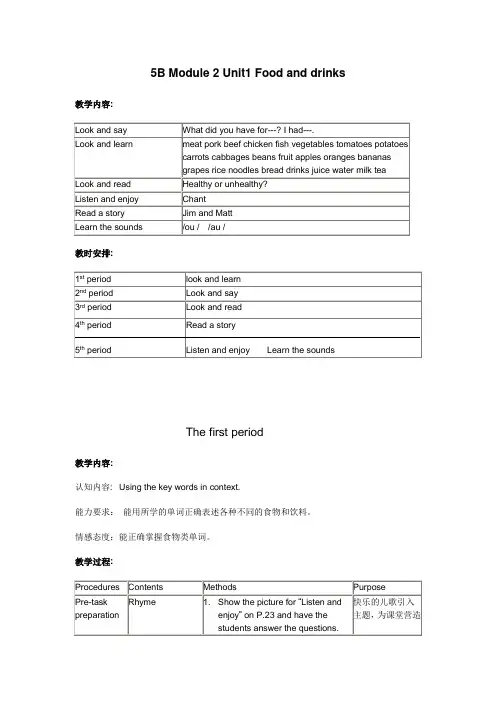
5B Module 2 Unit1 Food and drinks 教学内容:教时安排:The first period教学内容:认知内容: Using the key words in context.能力要求:能用所学的单词正确表述各种不同的食物和饮料。
情感态度:能正确掌握食物类单词。
教学过程:The second period教学内容:认知内容: 1. Using the key words and phrases in context.2. Using the simple past tense to talk about past events.3. Using wh-questions to find out specific information.能力要求:学会用所学的句型表达一日三餐的饮食。
情感态度:通过学生之间相互交流,了解同学间一日三餐的饮食情况。
教学过程:The third period教学内容:认知内容: 1. Using the simple past tense to describe habitual actions.2. Using the simple present tense to describe present states.3. Using determiners to express indefinite quantities.能力要求: 学会正确表述健康的生活习惯。
情感态度: 通过学习,培养学生之间相互交流的能力,同时让学生养成健康的生活习惯。
教学过程:The fourth period教学内容:认知内容: 1. Using the simple present tense to describe present states.2. Using the simple past tense to describe habitual actions. 能力要求:学会用所学的句型进行表述, 培养学生的语言表达能力。
Module1Unit3Tasteandsmell(教学设计)牛津上海版(试用本)英语一年级下册

6. 能够在实际语境中运用所学的词汇和知识,如在角色扮演、实验操作和小组讨论中,能够灵活运用描述食物味道和气味的词汇。
7. 能够通过自主学习和复习,巩固所学知识,能够在课后进行有效的复习和练习。
5. 请用英语写出以下句子的意思:The cake is very sweet. The coffee has a strong aroma.
答案:The cake tastes very sweet. The coffee smells very strong.
九.板书设计
- 老师向学生们展示各种食物的图片,如苹果、柠檬、巧克力等,并提问:“你们闻过这些食物的味道吗?”引导学生分享自己的感官体验。
2. 当堂检测
为了检验大家对本节课内容的理解和掌握程度,我将进行当堂检测。请大家在纸上写下以下问题的答案:
1. 请用英语写出五种不同的食物味道,并给出相应的词汇。
2. 请用英语写出五种不同的食物气味,并给出相应的词汇。
3. 请用英语描述以下食物的味道和气味:柠檬、辣椒、咖啡、巧克力、玫瑰花。
4. 请谈谈你最喜欢的食物,并描述一下它的味道和气味。
3.成果分享:每个小组将选择一名代表来分享他们的讨论成果。这些成果将被记录在黑板上或投影仪上,以便全班都能看到。
五、总结回顾
今天的学习,我们了解了描述食物味道和气味的词汇的基本概念、重要性和应用。同时,我们也通过实践活动和小组讨论加深了对这些词汇的理解。我希望大家能够掌握这些知识点,并在日常生活中灵活运用。最后,如果有任何疑问或不明白的地方,请随时向我提问。
为了突破这些难点,教师可以采取以下教学方法:
(人教版新起点)2020年英语一年级下册:Unit 4《Food》单元教案
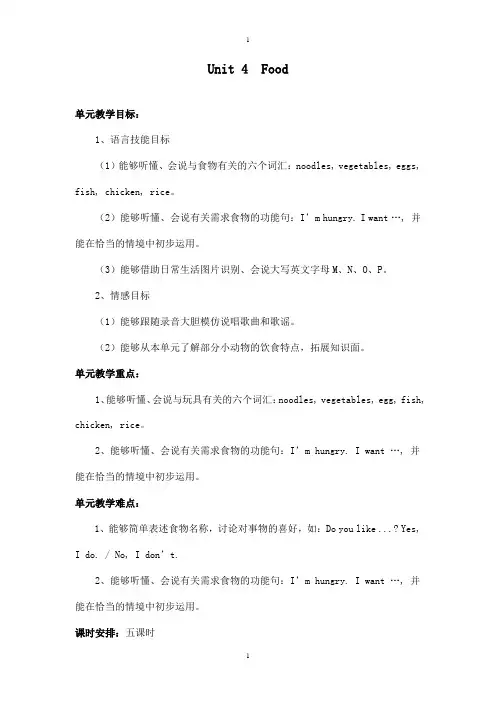
Unit 4 Food单元教学目标:1、语言技能目标(1)能够听懂、会说与食物有关的六个词汇:noodles, vegetables, eggs, fish, chicken, rice。
(2)能够听懂、会说有关需求食物的功能句:I’m hungry. I want …, 并能在恰当的情境中初步运用。
(3)能够借助日常生活图片识别、会说大写英文字母M、N、O、P。
2、情感目标(1)能够跟随录音大胆模仿说唱歌曲和歌谣。
(2)能够从本单元了解部分小动物的饮食特点,拓展知识面。
单元教学重点:1、能够听懂、会说与玩具有关的六个词汇:noodles, vegetables, egg, fish, chicken, rice。
2、能够听懂、会说有关需求食物的功能句:I’m hungry. I want …, 并能在恰当的情境中初步运用。
单元教学难点:1、能够简单表述食物名称,讨论对事物的喜好,如:Do you like ...? Yes,I do. / No, I don’t.2、能够听懂、会说有关需求食物的功能句:I’m hungry. I want …, 并能在恰当的情境中初步运用。
课时安排:五课时第一课时教学目标:1、能够听懂、会说与食物有关的六个词汇:noodles, vegetables, egg, fish, chicken, rice。
2、学生能将读音和图形联系起来。
教学准备:单词卡片,光盘教学重难点:1、学习6个食物单词的读音和图形。
2、noodles, vegetables的读音。
教学时间:年月日教学过程:一、Warm-up1、复习水果单词教师出示水果篮,里面装满以下玩具水果或水果图片:apple,banana, pear, orange, 教师提问:What fruit can you see? 学生回答。
2、谈话活动基于上一活动,教师提问:Do you like apples? 学生回答:Yes, I do. / No, I don’t.二、Presentation1、教师呈现本课食物图片,边呈现边说:I like fruits. But I also like eating them. 引导学生观察图片,初步感知新语言。
上海版牛津小学一年级英语精品教案

上海版牛津小学一年级英语精品教案Oxford English Book 1A Unit 1 the first period 一. 教学说明1. 今天是小朋友进入小学的第一节英语课,所有的学生都表现出对英语的极大的好奇。
作为一名英语教师,要通过充满知识和乐趣的课堂将孩子们的好奇转换成对英语学习持久的兴趣和热情。
2. 班级中的孩子来自不同的环境,有着完全不同的知识基础和认知能力。
教师应主动地去了解学生,这对今后的教学工作十分重要。
二. 教学内容 1. 认知内容:能听懂会说Good morning. -How do you do? -How are you?-Fine, thank you. -Hello! 等问候语。
2. 能力要求:学会用-Good morning. -How do you do? -How are you?-Fine, thank you. -Hello! 来问候和交流。
3. 情感态度:通过学生对本课问候句子的学习,培养学生讲文明的良好习惯。
并鼓励学生用这些问候语与新同学交朋友,增进新生之间的了解和友谊。
三. 教学步骤Procedures Contents Methods Purpose Pre-task preparation warmer Enjoy the song of page 6. 歌曲缓解了小朋友第一次上课的紧张心理。
让他们对这首歌曲旋律歌词有初步感知。
While-task procedure 1. Introduction Good morning. How do you do? 1. T: I am Frieda. I am your teacher. This is my friend, Cici.(T takes out a puppet.) 2. Use the puppet to elicit the greetings. 玩偶玩偶的出现既吸引了小朋友的注意力,又便于新授对话的引出和示范。
二年级下册英语教案-ThingsIlikedoing|牛津上海版
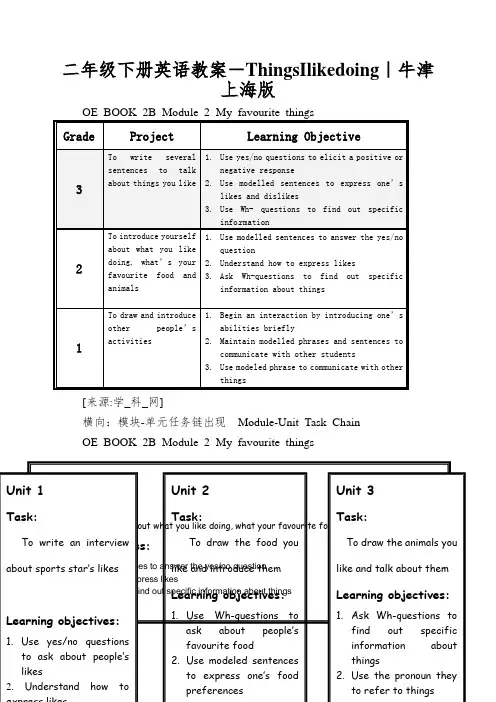
二年级下册英语教案-ThingsIlikedoing|牛津上海版OE BOOK 2B Module 2 My favourite thingsGrade Project Learning Objective3 To write severalsentences to talkabout things you likee yes/no questions to elicit a positive ornegative responsee modelled sentences to express one’slikes and dislikese Wh- questions to find out specificinfo rmation2 To introduce yourselfabout what you likedoing, what’s yourfavourite food andanimalse modelled sentences to answer the yes/noquestion2.Understand how to express likes3.Ask Wh-questions to find out specificinformation about things1To draw and introduceother people’sactivities1.Begin an interaction by introducing one’sabilities briefly2.Maintain modelled phrases and sentences tocommunicate with other studentse modeled phrase to communicate with otherthings[来源:学_科_网]横向:模块-单元任务链出现Module-Unit Task Chain OE BOOK 2B Module 2 My favourite thingsLearning objectives:1. Use yes/no questions to ask about people ’s likes2. Understand how to express likesPeriod 1 Period 2Sub-taskTo mime the rhyme and write a new one To write a short dialogue with the desk mate Sub-learningobjectives 1. To spell and write the words of activities 2. To understand how toexpress likes 1. To write and recite the words of activities 2. Use yes/no questions to ask about people ’s likesCore contents Key words: run skate hop skip ride Key patterns:Do you like (doing)…?Yes. /No. I like (doing)…各课时教案 Lesson planTopic: ActivitiesPeriod: 1Sub-task: To mime the rhyme and write a new oneBackground analyses:Students have known some activities like run, skip a rope. They can read the words and in this period they will spell and write these wor ds. They used the sentence “ I can …” to talk about people ’s activiti es. And in this period ,they will use the sentence “ I like doing ” to tal k about the activities.Objectives:1. To spell and write the words of activities2. To understand how to express likesDifficulties:To spell and write the words of activitiesAids:PPT, picturesProcedures Contents Methods PurposesPre-task preparations Meet the sportsstarsEnjoy the pictures of Li Naand Liu Xiang1.Li Na is a tennisplayer and Liu Xiang isa field sports player.Let’s learn more aboutthem2.Elicit : activitiesWhile-task procedures Li Na:I like skipping.I like hopping.I like running.Li u XiangI like running.I like skating.I like riding abicycle.* What else she like doing?1. Enjoy the introductionof Li Na.I’m Li Na.I like hopping.I like skipping.I like running..2. Listen to the text one byone and repeat.3. I like hopping.+ Read the sentence+ Make a magic: hop-hopping+ One finger : write withthe finger+ Say and do: I likehopping.4. I like skipping+ Read the sentence+ Make a magic+ Say and do+ Choose and write: findthe pieces of hop andT ask Li Na“Whatdo you likedoing?”请同学组织单词hop p ing让学生把 e 拿掉,感受那个去掉 e的过程skipping , write ping+Read, hop, hop, hophopping, hopping, hoppingI like hopping (clap,clap,clap)Skip, skipping, I like skipping.+ Be a little teacher 4.I like running.+ Read it+ Read and spell “ running”+ Choose the piece and read+ Read the text 1I’m Li Na. …1.Enjoy the text22.Repeat the sentences3.Spell and writeskate skatingride riding4.Try to say:Skate, Skating, I likeskating.(clap,clap,clap)Ride, riding, I likeriding a bicycle.(clap,clap,clap)Post-task activities 1. Enjoy the rhyme2. Look and write3. AssignmentRead the rhyme1. Listen to the rhym e2. Fill in the blanks, , withme.I likefluently with your deskmate(clap,clap,clap)3.Look at the picture andwrite another one4. Show timeOn the blackboard:M2U1 Things I like doinghopping. hopI like skipping. skiprunning. runskating. skateriding a bicycle. ride a bicycle各课时教案Lesson planTopic: ActivitiesPeriod:2Sub-task: To write a short dialogue with the desk mateBackground analyses:In this period, students maintain to le arn the words of activitie s, They should write and remember in heart. And use the modelled sente nces “Do you like doing…?”to get the specific information.Objectives:1. To write and recite the words of activities2. Use yes/no questions to ask about people’s likesDifficulties:Remember the words in heartAids:Procedures Contents Methods PurposesPre-task preparations 1.Revision period12. Elicit the1. Read the rhyme you write, , withme.通过复习学生仿照写的儿歌自然的从第一课时过渡到第student from 二(4) I like(clap,clap,clap)Read the whole rhyme2. T: Our school has manysports stars too.Elicit Huang Junqiang 二课时T show 含有所有新授动名词的儿歌While-task procedures 1. Introduce thegirlDo you like hopping?Do you like running?Do you like skating?Do you like ?The whole dialogue* Listen and enjoyHello. Everyone.I’m Huang Junqiang.I like jumping.I like dancing.I like playing with theball.* (Ask and answer) I want tomake friends with HuangJunqiang, do you want to gowith me?)1.Listen: I can askT: Do you like hopping?*: Yes. I like hopping.2.Read the dialoguetogether.3.Look and fill in theblanksA: Do you like running ?B: No. I like skipping.4.Read the dialogue by boysand girls5.Fill in the blanksA: Do you like skating?B: . I like skating.6.Read the dialogue inpairs7.Finish the dialogue and最后总结Huang Junqianglikes hopping.在句子旁出示图片,请学生填空Huang Junqianglikes skipping.老师提示学生依照答句填空Huang Junqianglikes skating.请学生依照上下文填空talkA: Do you like riding a bicycle?B: . I like playing.8.Show the dialogueA:Do you li ke hopping? B: Yes. I like hopping. A: Do you like running? B: No. I like skipping. A: Do you like skating? B:Yes. I like skating. A: Do you like ridinga bicycle?B: No, I like playing. 9.Listen and fill in the blanksPost-task activities 1.Act Hu angJunqiang andintroduce self2. Make a shortdialogue3. AssignmentTry to sayI like ….Huang Junqianglikes ….We are friends.1.Act Huang JunqiangI’m Huang Junqiang.I like hopping.I like skipping.I like skating.2. Huang Junqiang ask MissZhuA: Hi, Miss Zhu.Do you like….?B: . I like…..A: Do you like….?B: . I like…..A: Do you like….?B: . I like…..3. Pair workOne act Huang Junqiang andfill in dialogue A。
三年级下册英语教案-unit2 Tastes 沪教牛津版
Unit 2 Tastes1. 学习关于味道的词汇:sweet, sour;2. 学习句型How is…? 来询问食物的味道;3. 能用What is it?的句型询问物体是什么;4. 通过学习,让学生学会合作,学会如何询问食物的味道。
1.拼写默写单词、句型、语音部分。
Let’s sing4. It’s a lemon.听说询问他人物体是什么以及味道是怎么样的。
故事The ice cream1. taste v. 品尝;尝起来n. 味觉【例句】The ice cream tastes good.【互动】I really like the taste of lollipops.【联想方式】ta他(拼音)+ st石头(拼音)+e鹅【记忆方法】他用石头打死鹅后品尝味道2. how adv.怎么;怎么样;如何【例句】How are you?【互动】How is the weather today?【联想方式】h椅子+o蛋+w皇冠【记忆方法】研究怎样将椅子上的蛋壳做成皇冠6.lemon n. 柠檬;柠檬黄色7.orange n. 橙子;柑橘;橙色adj.橙色的【例句】Would you like a cup of orange juice?【互动】Oranges are rich in vitamin C.【联想方式】o蛋+rang让(拼音)+e鹅【记忆方法】吃了鸡蛋让鹅变成了橙色8. 8.ice cream 冰淇淋【例句】Most children like eating ice cream.【互动】I like to eat ice cream. What about you?【联想方式】ice冰(熟词)+cream奶油(熟词)【记忆方法】冰奶油是冰淇淋一、选择题() 1. ---Have some more bananas?---Yes, it ____ good.A.tasteB.tastedC. tastes() 2. --- ______ ?---It’s sweet.A. How is itB. How are youC. How() 3. --- ______ apples are there?--- Two.A. HowB. How muchC. How many二、连线。
二年级下英语课件-Unit5 My favourite food 第二课时 牛津上海版
1,Let's play 的翻卡片游戏, 与你的好朋友玩一玩 2,Let's chant 的内容唱给爸 爸妈妈听 3,预习22页
பைடு நூலகம்
Hello. Welcome
to English class.
小学英语--二年级--上海牛津版
Module 2 My favourite things
5 My favourite food
Period 2
-- Ann
fish
chicken salad
monkey cat hippo lion dog
1,河马喜欢吃草,你说:
The hippos like eating grass. T
2,想知道Kitty 是否喜欢跑步,你问Kitty:
Do you like hopping? F
3,想知道朋友喜欢吃什么,你问朋友:
What do you like playing? F
4,告诉朋友,你喜欢吃米饭,你说:
What food do you like?
I like chicken. I like rice.
What food do you like?
I like noodles. I like fish.
I like chicken. I like rice. I like eating. Chicken and rice
I like eating noodles. F
What do you like eating? Do you like eating meat? Let's go eating pizzas together. May I have a banana, please? I like fish very much.
Module3Unit2Rules(教案)牛津上海版(试用本)英语二年级下册
Teaching Plan for Oxford English (Shanghai Edition)2BM3U2 Rules学情分析:二年级的学生基本形成了较为良好的学习习惯,对于学习充满了热情,大部分学生在课堂上能够积极思考、发言,且声音响亮,也愿意积极主动地参与小组讨论。
他们好奇心强、活泼好动,善于模仿,特别喜欢表演故事中的人物。
通过快两年的英语学习,学生们已经具备了基本的听说、拼写的能力,能进行简短的对话与交流。
在学习本单元内容之前,他们已经了解了不少颜色类词汇;能感受生活中的相关事物,如: giraffe, elephant, zebra, ice cream, hamburger等;也能运用to be, can句型以及I like eating….; I like…..等进行分享与交流。
模块教学任务分析:2BM3的学习主题是Things around us(我身边的事物),分别围绕The four seasons(四季)、Rules(规则)以及My clothes(我的衣服)这三个与孩子生活息息相关的主题而展开。
本模块涉及到的内容都是学生周围发生的事物,都是学生想知道的、想通过学习加以表达与描述的。
其中,涉及了四季名称与气候特点、出行交通安全以及四季常用的服饰等。
期望通过这三个单元的学习,能初步感知、操练与运用常见的身边事物类词汇,能进行简单的喜好分享。
在此过程中,感受不同的事物特点,学会观察,安全出行,积累一定的生活经验。
此外,学习部分辅音字母在单词中的发音。
单元教学任务分析:2BM3U2的单元主题是Rules(规则)。
通过单元学习,能听、说、拼读与运用核心词汇,如:stop、wait、go等;能感知、运用Look at…/ It’s…/ Let’s…等句型来描述交通出行与安全情况;通过基本的交通规则学习,注意安全出行。
此外,学习字母Mm, Nn在单词中的发音。
单元教学设计思考:第一课时,以非洲肯尼亚草原小女孩Lorna(小女孩不懂城市交通规则)来到Safe Town这个城市为背景,感知、学习与运用“The light is red. Red says stop! You can’t go. The light is yellow. Yellow says wait!You can’t go.The light is green. Green says go! You can go.” 等相关内容,最后,Lorna借助学到的规则成为了路跑冠军,由此,让学生初步感受遵守交通规则的重要性。
牛津上海版二年级下英语Unit4ThingsIlikedoing第一课时课件
17
Does Tom and Alice like running?
No, he likes hopping.
No, she likes riding my bicycle.
18
Read the book
— Do you like running? — Yes, I like running. — No. I like skating. — No. I like hopping. — No. I like riding my bicycle.
hop box lot dog frog fox
11
Read the words
sing dance read skip write hop ride play skate paint run
12
Find the rules
I like riding my bicycle.
I like hopping.
paint read
draw dance
skip
3
Free talk
Can you sing? Yes. Do you like singing? Yes. I like singing.
4
Can you dance? Yes. Do you like dYaens.ciInlgik?e dancing.
8
sk-a-te skate t-a-ke take c-a-ke cake l-a-ke lake f-a-ce face g-a-me game
9
Can you hop? Yes. Do you like hopping? Yes. I like hopping.