
仁爱英语七年级上册Unit-2知识点总结
仁爱英语七年级上册Unit-2知识点总结 1 / 8 Unit 2 1. 某人 + has/ have ( an /a ) + adj + 五官 = 某人的 + 五官 is / are + adj (描述长相) 例:She has a small nose. = Her nose is small.
He has big eyes. = His eyes are big. 2. I know = I see 我明白了 3. That’s right. = You’re right. 对了 4. look the same 看起来像
反义词:look different 看起来不同 例: Jim and Li Lei look the same.== Jim looks like Li Lei. . 5. look at + n. 看某物 look for +n. 寻找某人/某物 look after +n. 照顾某人 6. both 两者都…… all 三者或者三者以上都…… both 和 all位于 be动词或情态动词后,位于行为动词前。 例: We are both students. We both have black eyes.
We can both speak English. 7. give sth. to sb. = give sb. sth. 把某物给某人;
(注意:如果sth是it或them,只能用give sth. to sb. ) 8. have different looks = look different 有着不同的长相 (看起来不相像) have the same look. =look the same 有着相同的长相 (看起来很相像) 9. over there 在那边 come in 请进 go out 出去 10. in + 颜色 或 in a/an/the +颜色 + 衣服 表示穿着……颜色的衣服
如 The girl in red is my sister. 穿着红色衣服的女孩是我的妹妹。 11. too + adj 太…… 12. pants 和 shoes 做主语,谓语动词用复数;但a pair of pants/ shoes作主语时,谓语动词用单数形式 例: His shoes are black. 仁爱英语七年级上册Unit-2知识点总结 2 / 8 A pair of shoes is under the bed. 13. go shopping = go to the shop 去购物
类似的有 go swimming; go fishing; go skating 等等 14. help sb. ( to ) do sth == help sb with sth 帮助某人做某事
注意:sb 用代词时必须用宾格 15. play +球类 play the + 乐器 16. think of 认为,想 think about 考虑
I think + 从句 我认为…… I think you are right. 否定式常否定主句,但翻译时要否定后面的从句 例:I don’t think he can come. 我认为他不会来了.(不能说:我不认为他会来)
句型: 1. What do/does + 主语 + look like ? 询问人的长相 例: What does she look like ? 2. What’s ... and ...? ……加……是什么?(回答:It’s ------) 例:--What’s red and yellow?
--It’s orange. --What’s two and five? --It’s seven. 3. Whose + 东西 + is this/ that ? = Whose + is this/that +东西?
这......是谁的……?(回答:It’s+名词性物主代词/形容词性物主代词+名词) Whose + 东西 +are these/ those ? = Whose + are these/those +东西? 这些/那些......是谁的……?(回答:They are +名词性物主代词/形容词性物主代词+名词)例: --Whose coat is this ? = Whose is this coat ? 仁爱英语七年级上册Unit-2知识点总结 3 / 8 -- It is mine/my coat. --Whose shoes are these ? = Whose are these shoes ? --They are hers/her shoes. 4. Who is the letter from? 这封信来自于谁?
It’s from Lily. 它来自于莉莉。 5. What color be + 东西? (回答:It’s +颜色 或者 They’er + 颜色) 例:--What color is your dress?
--It’s black.
人称 数 格 数
单数 复数 主格 宾格 主格 宾格
第一人称 I me we us 第二人称 you you you you 仁爱英语七年级上册Unit-2知识点总结 4 / 8 第三人称 he him they them she her
it it
单数 复数 第一人称 第二人称 第三人称 第一人称 第二人称 第三人称 我的 你的 他/她/它的 我们的 你们的 他(她,它)们的) 形容词性物主代词 my your his/her/its our your their
名词性物主代词 mine yours his/hers/its ours yours theirs 仁爱英语七年级上册Unit-2知识点总结
5 / 8 Unit3 1. Could you (please)+动词原形 你愿意做某事吗? May I +动词原形 我能做某事吗? 2. the English corner 英语角 3. live in + 地点 住在某地 live with + 人 和某人住在一起 4. What does he say in the letter? 他在信里说了些什么? What does he say on the phone? 他在电话里说了些什么? 5. a lot = very much 放在句末,修饰动词,非常…… 例: I like the boy a lot/ very much.
not at all 一点也不…… 例: I don’t like the boy at all. 6. each other 相互,彼此 students often talk to each other in class. 7. do sth with sb 和某人一起做某事 8. No problem 没问题 9. speak + 语言 说某种语言 speak English speak Chinese 10. the Great Wall 长城 11. come/go to + 地点 去某地
注意:home 、 here 、 there 这些是副词,前面不能加to 例:go home / come here / go there go to do sth 去做某事 例: They go to play basketball. 12. like doing sth 喜欢做某事 like to do sth 想要做某事 13. It’s + adj +to sb 对某人来说是……的 仁爱英语七年级上册Unit-2知识点总结 6 / 8 14. help sb with sth =help sb (to) do sth 帮助某人某事 15. be at home = be in 在家 go home 回家
get home到家 in one’s home 在某人的家里 16. have a seat / take a seat / sit down 请坐下 17. office worker 办公室职员 cook 厨师 cooker厨具 18. on a farm 在农场上 on the sofa 在沙发上 19. a photo of one’s family 某人的全家照 Family Tree 家谱 (首字母都大写) 20. in a hospital 在医院(纯属地点概念) in hospital 因病住院 例:He is ill in hospital. 他生病住院
He is in a hospital.他在医院里 (不一定是因为生病来到医院) 21. look after sb = take care of sb 照顾某人 22. teach sb sth = teach sth to sb 教某人某东西 teach sb to do sth 教某人做某事 23. help oneself ( to sth. ) 请随便(吃……)
例:help yourself/ yourselves (to fish) 24. I’d like sth = I would like sth. 我想要…… 25. Would like to do sth = want to do sth 想要做某事 26. Would you like something to eat (drink)?
你想要一些吃(喝)的东西吗? 27. Here you are . 给你 Here we are. 我们到了
Unit2语法知识课件仁爱版七年级英语上册

--- 语法知识精讲
---动词原形和动词第三人称单数形式
动词 v( verb. )---表动作
I often play football. We go home on foot. You have a pet dog. He loves pigs. She usually plays games at home. It doesn’t eat potatoes. They always watch TV at home.
名词所有格
① 用于人或其他表示有生命的名词后
② of 表示所属关系,用于没有生命的物体 如:a map of China; a photo of my family
① 用于人或其他表示有生命的名词后: • 单数或不以s结尾的复数+’s
如:Jane’s book;Women’s Day
• 以s结尾的复数+’
2.We have lunch at school. 一般疑问句:__D_o__y_o_u__h_a_v_e_l_u_n_c_h_a_t__s_c_h_o_o_l?____________
肯定回答:______Y_e_s_,_w__e_d__o_.________________________
表示所属关系
物主代词
形容词性物主代词 名词性物主代词
名词所有格
有生命 无生命
第一人称 单数 复数
第二人称 单数 复数
形容词性 物主代词
my
our
your your
第三人称
单数 复数
his her their its
his
名词性物 主代词
mine ours
仁爱版七年级上册英语-Unit1:Topic2单词汇总+知识梳理
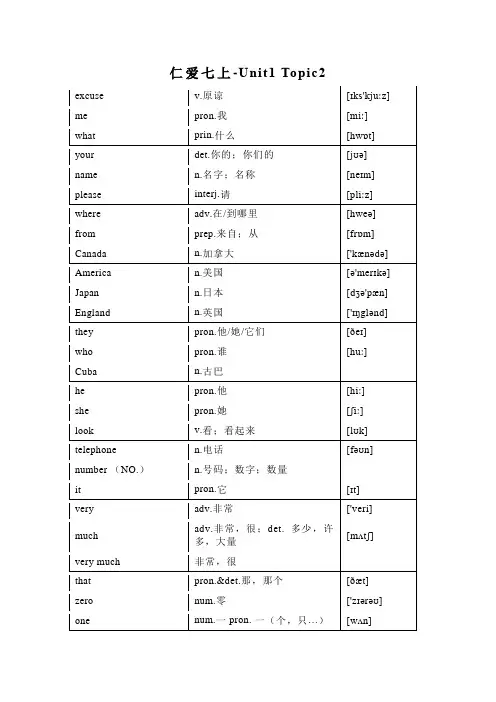
仁爱七上-Unit1 Topic2知识梳理【重点短语】1. good morning/ afternoon / evening 早上/下午/晚上好2. glad / nice to meet / see you 见到你很高兴3. welcome to + 地点欢迎来到……4. let’s + v让我们做……5. stand up 起立6. sit down 坐下7. this is... 这是……8. thanks = thank you 谢谢9. see you = see you later = goodbye 再见10. ID number 身份证号码11. be from=come from 来自12. in English 用英语【重要句型】1. ---What’s your name? ---My name is Sally.2. ---Where are you from? ---I’m from China.---Where do you come from? ---I come from China.3. ---Where is he/ she from? ---He/She is from Japan.4. ---What’s this/ that in English? --- It’s a/ an…5. ---What’re these/ those in English? ---They’re…6. ---How do you spell it? ---E-R-A-S-E-R, eraser.7. ---Can you spell it? ---Yes, M-A-P, map.8. —How old are you/ is he/ are they?—I’m/ He is/ They are eleven.9. —What’s your telephone number?—It’s 4567967.10. —What class/ grade are you in?—I’m in Class Ten, Grade Seven.(注意大小写)11. Good morning/ afternoon/ evening.12. —Hello!/Hi! —Hello!/Hi!13. —Nice/Glad to see/meet you. —Nice/Glad to see/meet you, too.14. —Welcome to China/my home. —Thanks.15. —How do you do? —How do you do?16. —How are you? —Fine, thank you. And you? —I’m OK.17. —See you then/ later. —See you.18. —Goodbye. —Bye.19. —Thank you. —You’re welcome./That’s OK./Not at all.【重点语法】1. 元音字母:Aa Ee Ii Oo Uu包含有以下元音的字母:[e] Aa Hh Jj Kk[i:] Ee Bb Cc Dd Gg Pp Tt Vv[aɪ] Ii Yy[ju:] Uu Qq Ww[e] Ff Ll Mm Nn Ss Xx Zz2. 大小写句首字母,人名,地名,称呼语,专有名词,星期的首字母要大写,引人注意。
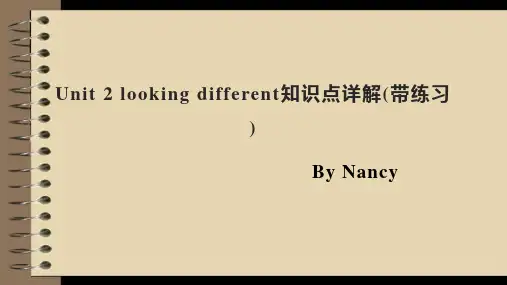
Unit 2 知识点详解(带练习)课件 2022-2023学年仁爱版英语七年级上册
●9.buy v. ●【考点】 ●① 买--bought过去式 ●② 固定搭配: buy sb sth= buy sth for sb为某人买某物
●10.other
●【考点】
●① pron.其他的 ●② other+名词复数=othersak English说英语 ●2.In the same class在相同的班级 ● 3.In different grades在不同年级 ●4. come from 来自
●3.1.right adj. ●【考点】① adj,正确的 ● ② n. 右边 adj.右边的---反义词 left左边,左边的 ● ③ n.权利,可数名词
●4.like v./prep.
●【考点】
●①v.喜欢
●②prep.像
● ③ 固定搭配:like doing 喜欢做某事
●
look like 看起来像
●7.want v. ●【考点】 ●①想要 ● ② 固定搭配 ●want to do想要做某事 ●want sth想要某物
●8.look v. ●【考点】 ●① 看起来 ●② 固定搭配:look like看起来像 ●look at...看... ●look after照顾 ●look for 寻找
C. Look at
D.a./ D.Look for
● 11.— You look nice in this dress.
● — ________.
● A. It’s right.
B. No, it isn’t.
C. Thank you. D. You’re welcome
● 12. I have a small nose. But he
●5.help sb. (to) do sth.帮助某人做某事 ● help sb with sth帮助某人某事 ●6.give sb. sth. = give sth. to sb.把某物给某人 ●7. look the same 长相相同
仁爱版七年级上册Unit1 Unit2重要句型
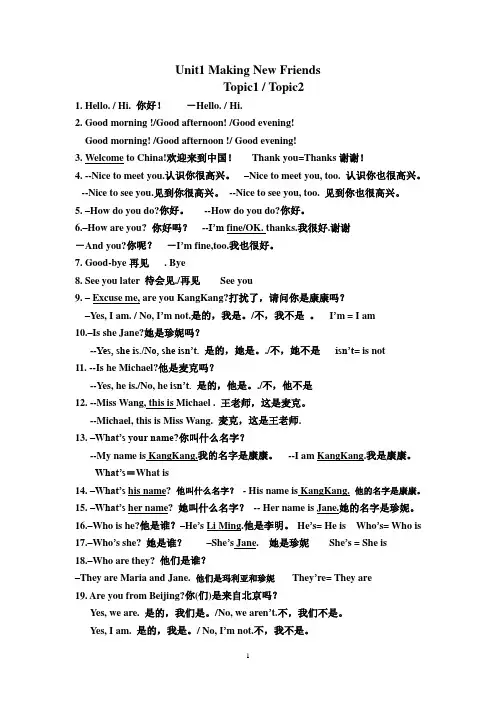
Unit1 Making New FriendsTopic1 / Topic21. Hello. / Hi. 你好!-Hello. / Hi.2. Good morning !/Good afternoon! /Good evening!Good morning! /Good afternoon !/ Good evening!3. Welcome to China!欢迎来到中国!Thank you=Thanks谢谢!4. --Nice to meet you.认识你很高兴。
–Nice to meet you, too. 认识你也很高兴。
--Nice to see you.见到你很高兴。
--Nice to see you, too. 见到你也很高兴。
5. –How do you do?你好。
--How do you do?你好。
6.–How are you? 你好吗?--I’m fine/OK. thanks.我很好.谢谢-And you?你呢?-I’m fine,too.我也很好。
7. Good-bye再见. Bye8. See you later 待会见./再见See you9. – Excuse me, are you KangKang?打扰了,请问你是康康吗?–Yes, I am. / No, I’m not.是的,我是。
/不,我不是。
I’m = I am10.–Is she Jane?她是珍妮吗?--Yes, she is./No, she isn’t.是的,她是。
./不,她不是isn’t= is not11. --Is he Michael?他是麦克吗?--Yes, he is./No, he i sn’t. 是的,他是。
./不,他不是12. --Miss Wang, this is Michael . 王老师,这是麦克。
--Michael, this is Miss Wang. 麦克,这是王老师.13. –What’s your name?你叫什么名字?--My name is KangKang.我的名字是康康。
仁爱英语七年级上册Unit2-topic1知识点讲解及随堂练习
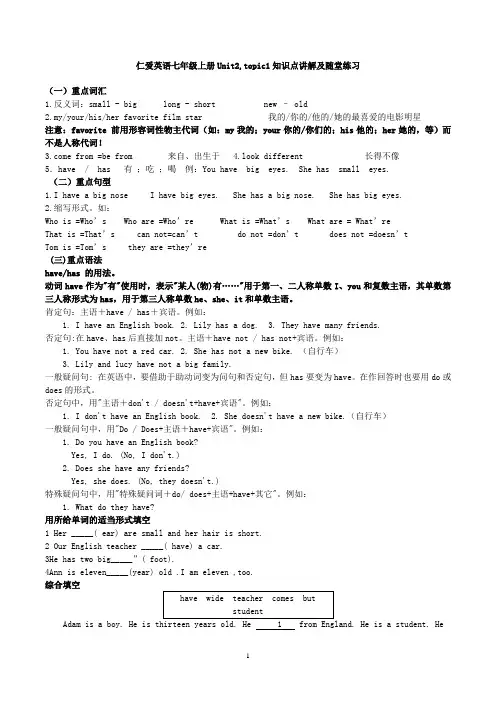
仁爱英语七年级上册Unit2,topic1知识点讲解及随堂练习(一)重点词汇1.反义词:small - big long - short new – old2.my/your/his/her favorite film star 我的/你的/他的/她的最喜爱的电影明星注意:favorite 前用形容词性物主代词(如:my我的;your你的/你们的;his他的;her她的,等)而不是人称代词!e from =be from 来自、出生于4.look different 长得不像5.have / has 有;吃;喝例:You have big eyes. She has small eyes.(二)重点句型1.I have a big nose I have big eyes. She has a big nose. She has big eyes.2.缩写形式。
如:Who is =Who’s Who are =Who’re What is =What’s What are = What’reThat is =That’s can not=can’t do not =don’t does not =doesn’tTom is =Tom’s they are =they’re(三)重点语法have/has 的用法。
动词have作为"有"使用时,表示"某人(物)有……"用于第一、二人称单数I、you和复数主语,其单数第三人称形式为has,用于第三人称单数he、she、it和单数主语。
肯定句:主语+have / has+宾语。
例如:1. I have an English book.2. Lily has a dog.3. They have many friends.否定句:在have、has后直接加not。
主语+have not / has not+宾语。
例如:1. You have not a red car.2. She has not a new bike. (自行车)3. Lily and lucy have not a big family.一般疑问句: 在英语中,要借助于助动词变为问句和否定句,但has要变为have。
仁爱版英语七年级上册unit2重点词汇和练习解析
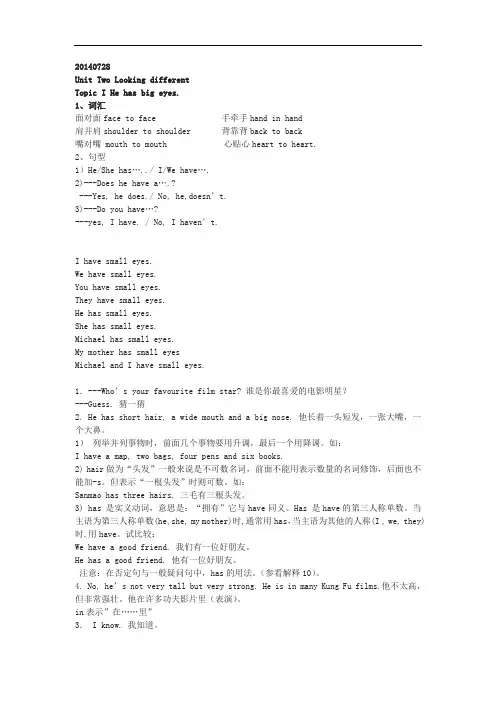
20140728Unit Two Looking differentTopic I He has big eyes.1、词汇面对面face to face 手牵手hand in hand肩并肩shoulder to shoulder 背靠背back to back嘴对嘴 mouth to mouth 心贴心heart to heart.2、句型1)He/She has…../ I/We have….2)---Does he have a….?---Yes, he does./ No, he,doesn’t.3)---Do you have…?---yes, I have. / No, I haven’t.I have small eyes.We have small eyes.You have small eyes.They have small eyes.He has small eyes.She has small eyes.Michael has small eyes.My mother has small eyesMichael and I have small eyes.1.---Who’s your favourite film star? 谁是你最喜爱的电影明星?---Guess. 猜一猜2. He has short hair, a wide mouth and a big nose. 他长着一头短发,一张大嘴,一个大鼻。
1)列举并列事物时,前面几个事物要用升调,最后一个用降调。
如:I have a map, two bags, four pens and six books.2) hair做为“头发”一般来说是不可数名词,前面不能用表示数量的名词修饰,后面也不能加-s。
但表示“一根头发”时则可数。
如:Sanmao has three hairs. 三毛有三根头发。
3) has 是实义动词,意思是:“拥有”它与have同义。
仁爱英语七年级上册Unit2topic2知识点讲解及随堂练习(无答案)
(一)知识点解说1.We both have black hair and black eyes我.都着黑、黑眼睛。
both pron.(与复数名用)意“两个,两个都”。
both 放在 be ,助或情后边,的前方。
如:We are both from Sichuan我.都来自四川。
They both work in Toronto. 他都在多多市工作。
2. But you look the same.可是你看起来一。
We don’t have the same looks, but we are good friends!我没有同样的容颜,但我是好朋友!以上两句中出了look the same 与 the same looks两个短。
然是由三个同的成的两个短,可是因为它的地点不一样,意思就不一。
look the same中的 look 是,意思是“看起来⋯..”,而the same looks中的 look 名,常用复数,意思是表面,容颜,子”。
所以 look the same 意“看起来很像”,而 the same looks意“相似的容颜”【接】 look at 看⋯ ..; look like 看起来像。
如:Please look at the blackboard. 看黑板。
He looks like his father.他看起来像他的爸爸。
【拓展】 look the same的反是: look different.3.Please give this letter to Maria. 把封信。
give v give sth to sb 或 give sb sth把某物某人。
所以,此句也可改: Please give Maria this letter但.是当用代It(它), them(他 )取代某物,只好用于give it/them to sb 构中。
如:Please give it to him.把它他。
初中英语 仁爱版七年级上册Unit2Topic1知识点
Unit2 Topic 1Section A1.句子中为避免重复,经常用one来代替前文已经提及的或交谈双方已知的某个同类的人或物。
2.由助动词do构成的一般疑问句:Do+we/you/they+动词原形(have)...?肯定回答用Yes,we/I/they do. 否定回答用No,we/I/they don’t.3.have/has有:I/you/they/所有的复数人称+haveEg:(1)I have big eyes.(2)They have three apples.She/he/it/Maria/第三人称单数+hasEg:(1)She has a small mouth.(2)Sally has big hands.4.身体部位与形容词搭配:Special note:wide mouth/large mouth大嘴巴big mouth多嘴多舌Section B1.由助动词does构成的一般疑问句:Does+he/she/it/Maria/...+动词原形(have)...?肯定回答用Yes,he/she/it does. 否定回答用No,he/she/it doesn’t.2.总结:have/has的用法肯定句:(1)He/She/It(第三人称单数)+has...(2)I/You/We/They(非第三人称单数)+have一般疑问句:(1)Does+he/she/it(第三人称单数)+have...?肯定回答:Yes,she/he /it does. 否定回答:No,she/he/it doesn’t.(2)Do+you/they/we(非第三人称单数)+have...?肯定回答:Yes,I/we/they do. 否定回答:No,I/we/they don’t.Section Ce from=be from来自.... eg:We come from China.=We are from China.当主语是单数第三人称时,be动词用is,come用comesEg :She is from Beijing,China.=She comes from Beijing,China.2.当一个句子中出现多个名词并列时,书写时分别用逗号隔开,且最后两个用and连接。
仁爱版英语七年级上册知识点归纳总结(整理版)
仁爱版英语 上学期知识点汇总 ( 七年级上册 )(包括重点句型、短语、知识点详解和重点语法 )Unit 1 Making New Friends【重点短语】1.good morning/ afternoon / evening 早上 /下午 /晚上好2.glad / nice to meet / see you 见到你很高兴3.welcome to + 地点 欢迎来到 ……4.let ’ s + v 让我们做 ……5.stand up 起立6.sit down 坐下7.this is... 这是……8.thanks = thank you 谢谢9.see you = see you later = goodbye 再见10.ID number 身份证号码11.be from=come from 来自12.in English 用英语【重要句型】1.---What’ s your name? ---My name is Sally.2.---Where are you from? ---I ’ m from China.---Where do you come from? ---I come from China.3.---Where is he/ she from? ---He/She is from Japan.4.---What’s this/ that in English? --- It ’ s a/ an …5.---What’ re these/ those in English? ---They’re …6.---How do you spell it? ---E-R-A-S-E-R, eraser.7.---Can you spell it? ---Yes, M-A-P, map.8.—How old are you/ is he/ are they?— I ’ m/ He is/ They are eleven.9.—What’s your telephone number?— It ’ s 4567967.10.— What class / grade are you in?— I ’m in Class Ten, Grade Seven.(注意大小写)11.Good morning/ afternoon/ evening.12.— Hello!/Hi! —Hello!/Hi!13.— Nice/Glad to see/meet you. — Nice/Glad to see/meet you, too.14.— Welcome to China/my home. —Thanks.15.— How do you do? —How do you do?16.— How are you? — Fine, thank you. And you? — I ’m OK.17.— See you then/ later. —See you.18.— Goodbye. —Bye.19.— Thank you. —You’rewelcome. / That ’ s OK./Not at all.【重点语法】1.元音字母: Aa Ee Ii Oo Uu包含有以下元音的字母:[e] Aa Hh Jj Kk[i:] Ee Bb Cc Dd Gg Pp Tt Vv[aI] Ii Yy[ju:] Uu Qq Ww[e] Ff Ll Mm Nn Ss Xx Zz2.大小写句首字母,人名,地名,称呼语,专有名词,星期的首字母要大写,引人注意。
仁爱英语七年级上册unit2topic1知识点讲解及随堂练习复习过程.docx
(一)重点词汇1.反义词: small - big / large long - short black - white tall -short new –old2.my/your/his/her favorite film star我的/你的/他的/她的最喜爱的电影明星注意: favorite前用形容词性物主代词(如:my 我的; your 你的 /你们的; his 他的; her 她的,等)而不是人称代词!e from =be from来自、出生于4.look different长得不像5.in the same grade/school 在同一个年级 /学校in different grades/schools 在不同年级 /学校6.have / has有;吃;喝You have big eyes.你有一双大眼睛。
She has small eyes. 她有一双小眼睛。
7.long长的long hair长头发8.short短的short hair短头发9. big大的big nose大鼻子10. small小的small nose小鼻子11.round 圆的round face 圆圆的脸12.wide 宽的wide face 宽宽的脸13. we我们We have small mouths.我们都有小嘴巴。
(二)重点句型1.I have a big nose = My nose is big.I have big eyes. = My eyes are big.She has a big nose. = Her nose is big.She has big eyes. = Her eyes are big.2. Who’ s that boy?那个男孩是谁?这是由 Who 引导的特殊疑问句,询问某人的身份。
如: Who’s that girl over there?Who’ s 是 Who is 的写形式。