
高中英语语法知识点
高中英语知识点扫描大全最新 一、定语从句与强调句陷阱题详解 1. The factory was built in a secret place, around _________ high mountains. A. which was B. it was C. which were D. them were 【陷阱】容易误选A或B,将A、B中的 which 和 it 误认为是其后句子的主语。 【分析】最佳答案是C,around which were high mountains 是一个由“介词+which”引出的非限制性定语从句,而在该从句中,主语是 high mountains,around which 是表语,所以句子谓语应用复数were,而不是用单数 was。请做以下类例题目(答案均为C): (1) Yesterday we visited a modern hospital, around _________ some fruit shops. A. which is B. it is C. which are D. them are (2) The murder happened in an old building, beside _________ the city police station. A. which are B. it is C. which is D. them are (3) Next month we’ll move to a new building, next to _________ a nice restaurants where we can have Chinese food. A. which are B. it is C. which is D. them are 2. A man with a bleeding hand hurried in and asked, “Is there a hospital around _________ I can get some medicine for my wounded hand?” A. that B. which C. where D. what 【陷阱】容易误选 B,认为 around 是介词,选 which 用以代替前面的名词 hospital,在此用作介词 around 的宾语。 【分析】最佳答案为C。以上语法分析并不算错,但问题是,照此分析,此句的意思即为:有没有这样一个医院,我在它的附近可以买药治我的手伤?这样的语境显然有点不合情理,因为人们通常是在医院里面治伤,而不是在医院附近治伤。此题选 C 的理由是:句中的 around 不是介词,而是副词,意为“在附近”;其后的 where 引导定语从句用以修饰其前的地点名词 hospital,句意为:附近有没有一家医院,我可以去治我的手伤? 3. David is such a good boy _________ all the teachers like. A. that B. who C. as D. whom 【陷阱】此题容易误选A,许多同学一看到题干中的such,再联系到选项中的 that,便认为这是考查such … that …句式。况且,这样理解意思也还通顺。 【分析】最佳答案为C,不是A,因为在such … that … (如此……以至……)结构中,that 引导的是结果状语从句,并且 that 在从句中不充当句子成分,若在上句填入 such … that …,句末的动词 like 缺宾语。选C的理由如下:as 用作关系代词,用以引导定语从句,修饰其前的名词 boy,同时 as 在定语从句中用作动词 like 的宾语,句意为“所有老师都喜欢的一位好男孩”。有的同学可能还会问,假若选A,能否将其后的 that 视为引导定语从句的关系代词呢?不能,因为当先行词受到 such 的修饰时,其后的定语从句应用关系代词 as 来引导,而不用that。比较下面一题,答案为A,因为 like 后有自己的宾语 him: David is such a good boy _________ all the teachers like him. A. that B. who C. as D. whom 请再做以下试题(答案选D): It was not such a good dinner _________ she had promised us. A. like B. that C. which D. as 4. The buses, most of _________ were already full, were surrounded by an angry crowd. A. that B. it C. them D. which 【陷阱】容易误选 C,用 them 代指 the buses。 【分析】最佳答案是D。most of which were already full 为非限制性定语从句,修饰 the buses。类似地,以下各题也选D: (1) His house, for _________ he paid $10, 000, is now worth $50, 000. A. that B. it C. them D. which (2) Ashdown forest, through _________ we’ll be driving, isn’t a forest any longer. A. that B. it C. them D. which (3) This I did at nine o’clock, after _________ I sat reading the paper. A. that B. it C. them D. which 类似地,以下各题选 whom,不选 them: (4) George, with _________ I played tennis on Sundays, was a warm-hearted person. A. that B. him C. them D. whom (5) Her sons, both of _________ work abroad, will come back home this summer. A. that B. who C. them D. whom (6) I met the fruit-pickers, several of _________ were still university students. A. that B. who C. them D. whom 5. He had a lot of friends, only a few of _________ invited to his wedding. A. whom B. them C. which D. who 【陷阱】容易误选 A,认为这是非限制性定语从句。 【分析】最佳答案是B,这不是非限制性定语从句,而是一个独立主格结构,因为空格后的动词 invited 并不是一个完整的谓语,而是一个过去分词。当然,假若在 invited 前加上助动词 were,则是一个非限制性定语从句,答案便应选A。比较: (1) They put forward a lot of plans at the meeting, none of _________ carried out in their work. A. which B. them C. what D. that 答案选B,none of them carried out in their work 是独立主格结构,其中的 carried out 为过去分词。 (2) They put forward a lot of plans at the meeting, none of _________ were carried out in their work. A. which B. them C. what D. that 答案选A,none of them were carried out in their work 是非限制性定语从句,注意与上例比较句中多了一个助动词were。 (3) They put forward a lot of plans at the meeting, but none of _________ were carried out in their work. A. which B. them C. what D. that 答案选B,由于两句之间增加了一个并列连词but,使得该句成了一个并列句。 6. On Sundays there were a lot of children playing in the park, _________ parents seated together joking. A. their B. whose C. which D. that 【陷阱】容易误选B,认为这是非限制性定语从句。 【分析】最佳答案是A。与上面一题相似,their parents seated together joking 不是非限制性定语从句,而是一个独立主格结构,因为空格后的动词 seated 不是谓语,而是一个过去分词,因为 seat 作动词用时,是及物动词。比较以下相似题: (1) On Sundays there were a lot of children playing in the park, _________ parents were seated together joking. A. their B. whose C. which D. that 选B。whose parents were seated together joking 为非限制性定语从句,因为其后有完整的谓语 were seated。 (2) On Sundays there were a lot of children playing in the park, and _________ parents were seated together joking. A. their B. whose C. which D. that 选A。因为句中有并列连词and,整个句子为并列句。 (3) On Sundays there were a lot of children playing in the park, _________ parents sitting together joking. A. their B. whose C. which D. that 选A。their parents sitting together joking 为独立主格结构。 (4) On Sundays there were a lot of children playing in the park, _________ parents sat together joking. A. their B. whose C. which D. that 选B。whose parents sat together joking 为非限制性定语从句,因为句中有完整的谓语 sat。 (5) On Sundays there were a lot of children playing in the park, _________ parents were sitting together joking. A. their B. whose C. which D. that 选B。whose parents were sitting together joking 为非限制性定语从句,因为句中有完整的谓语 were sitting。 7. If the man is only interested in your looks, _________ just shows how shallow he is.
高中英语知识点归纳语法的基础知识
高中英语知识点归纳语法的基础知识英语语法在高中阶段是学习英语的基础,它是为了让学生能够正确地使用英语语言表达自己的思想和观点,首先我们得了解一些英语语法的基础知识。
下面是高中英语语法的基础知识的归纳总结。
主谓一致主谓一致是指主语和谓语在人称和数上保持一致。
一般情况下,主谓一致的基本规则是:1. 主语为单数时,谓语动词要用单数形式;2. 主语为第三人称单数时,谓语动词要用第三人称单数形式;3. 主语为复数时,谓语动词要用复数形式。
例如:Tom is a student.(正确)Tom are a student.(错误)时态时态是指动词所表示的发生的时间,一般有一般现在时、一般过去时、一般将来时等时态。
掌握时态的使用对于准确表达过去、现在和将来的概念非常重要。
以下是一些常见的时态:1. 一般现在时(Simple Present):表示经常性、习惯性或客观真理。
例如:She often goes to school by bike.2. 一般过去时(Simple Past):表示过去某个时间发生的动作或存在的状态。
例如:We watched a movie yesterday.3. 一般将来时(Simple Future):表示将来某个时间要发生的动作或存在的状态。
例如:I will visit my grandma next week.介词介词是连接名词、代词或其他词与其他成分的虚词,常用于表示时间、地点、方式、原因、目的等。
正确使用介词可以使句子更加准确地表达出要传达的意义。
以下是一些常见的介词及其用法:1. in:表示在某个地方或某个时间内。
例如:She is in the classroom.2. on:表示在某个物体的表面或某个具体的日期。
例如:The book is on the table.My birthday is on June 5th.从句从句是指一个句子中包含的完整的、能够独立表达意义的句子,它与主句之间通过一定的关联词或连接词相连。
高中英语语法重要知识点
高中英语语法重要知识点高中英语语法重要知识点一、不定冠词不定冠词a,an与one同源,表示微弱的一的概念,但并不强调数目,用来表示不确定的人或事物。
A用在辅音前,而不是辅音字母前;an用在元音前,而不是元音字母前。
a university in Asia1.表示同类中的任何一个A cat has nine lives.2.表示泛指的某人、某物I know a John Lennon,but not the famous one.3.表示数量的He has a daughter.4. 表示单位数量的每一I earn 10 dollars an hour.5.表示相同的The two birds are of a color.6. 用于集体名词前He grows up in a large family.7. 在某种情况下可用于抽象名词和物质名词前China has a long history.二、定冠词的用法1.表示特定的人或物2.表示地球、宇宙中独一无二的事物主要指各种天体及世界上比较有影响的物体。
The sun,the moon,the earth 3.表示地点、方向、时间、方式等 at the corner 在拐角处1) 在表示季节的名词前常不用冠词。
In spring 在春天2) 具体某年的某个季节,需用冠词。
In the summer of the year20083)用于序数词或形容词的最高级前 the first the second4)用于形容词前使其名词化 the rich the poor5)用于复数姓氏前,表示―夫妇‖或全家 The Smiths6)用于乐器名词前 Play the piano7)用于by+the+计量单位名词 By the pound1. 用于复数名词前复数名词泛指某类人或物时,其前通常用零冠词。
Students should obey the school rules. 学生应该遵守校规。
精选高中英语语法知识点复习—名词(解析版)
只修饰不可数名词
much, a little, a bit of, a great/good deal of, a great/large/small amount of
既可修饰可数名词又可修饰不可 the, one's, some, any, no, all, a lot of, lots of, plenty of, a large quantity
以辅音字母加 y 结尾的名词,
4
party-parties, family-families, story-stories, city-cities
变 y 为 i 加-es
以元音字母加 y 结尾的名词,
5
toy-toys, boy-boys,day-days, ray-rays, Henry-Henrys
es
变-f 和-fe 为 v 再 leaf-leaves, thief-thieves, knife-knives, wife-wives,wolf-wolves,
以-f 或-fe 加-es 3
结尾的词
half-halves
加-s
chief-chiefs, proof-proofs, roof-roofs
以元音字母加-o 结尾的名词加
7
radio-radios, bamboo-bamboos, zoo-zoos
-s
8 以-th 结尾的名词加-s
trut month-months, path-paths
2. 不规则可数名词复数:
改变名词中的元音字母或
1
man-men, woman-women, foot-feet, goose-geese, mouse-mice
或专有名词以 y 结尾的,加-s
高中英语语法独立主格结构知识点
高中英语语法独立主格结构知识点知识和能力是一点一点积累起来的,要注意有扎实的基础,要注意复习和巩固,不能急于求成。
下面小编给大家分享一些高中英语语法独立主格结构知识,希望能够帮助大家,欢迎阅读!高中英语语法独立主格结构知识1一、非谓语动词独立主格结构在独立主格结构中,非谓语动词和它前面的名词或代词存在着逻辑上的主谓关系。
Such an able man to help you,you will surely succeed sooner or later.有这么能干的人来帮你,你迟早一定会成功的。
(such an able man和to help you之间存在着主谓关系)=Since such an able man will help you, you will surely succeed sooner or later.He seating himself atthe desk, his mother began to tell him a story.他在书桌旁坐好后,他母亲开始给他讲故事。
(seating himself at the desk拥有了自己的逻辑主语he,注意是“主格”)=When he seated himself at the desk, his mother began to tell him a story.The key to the bike lost, he had to walk to school.由于丢了自行车钥匙,他只好步行去学校。
(lost的逻辑主语是the key,lost也可以用完成式having been lost)=Because the key to the bike had been lost, he had to walk to school.(一)不定式“独立主格结构”在“逻辑主语+动词不定式”结构中,动词不定式和它前面的名词或代词存在着逻辑上的主谓关系。
高中英语语法介词知识点大汇总,一篇让你全搞懂!
高中语法的难度加大,在考试中的比例也大大增加了,完型、阅读、写作都需要语法的熟练运用。
今天为大家整理了语法中介词的知识点,赶紧学起来哦!介词的英语全称为“preposition”是由“前缀pre-(在……前部)+position(位置)”构成的,所以又叫前置词。
一般放在名词、代词或动名词的前面。
介词是虚词,主要用来表示人、物、事件等与其他人、物、事件之间的关系,如空间位置、时间先后、因果关系、方式方法等。
介词与其宾语构成介词短语。
可作介词宾语的主要有名词、代词、动名词(或动名词短语)、名词性从句等。
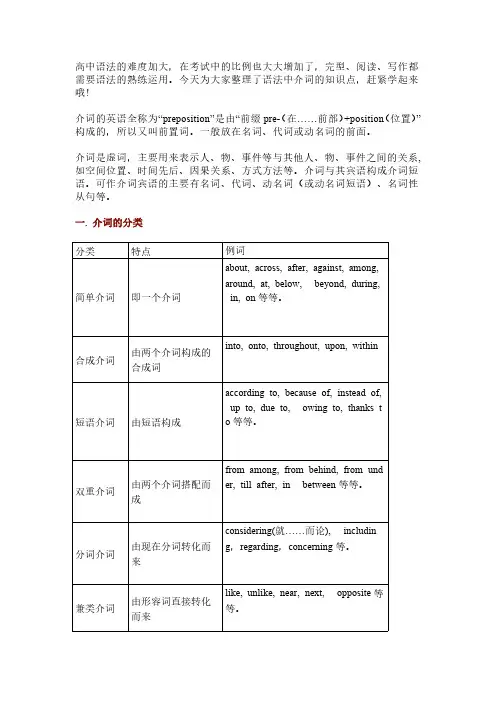
一.介词的分类分类特点例词简单介词即一个介词about,across,after,against,among, around,at,below,beyond,during, in,on等等。
合成介词由两个介词构成的合成词into,onto,throughout,upon,within短语介词由短语构成according to,because of,instead of, up to,due to,owing to,thanks t o等等。
双重介词由两个介词搭配而成from among,from behind,from under,till after,in between等等。
分词介词由现在分词转化而来considering(就……而论),including,regarding,concerning等。
兼类介词由形容词直接转化而来like,unlike,near,next,opposite等等。
二.介词短语的语法功能介词不能独立在句中做成份,介词后必须与名词、代词、或动名词构成介词短语在句中充当一个成分,表示人、物、事件等与其它人、物、事件等之间的关系。
介词短语的功能例句作定语They didn’t find the solution to the problem.作状语We have breakfast at seven.(表时间)They were late for the meeting because of the heavy rai n.(表原因)What do you mean by doing such a thing?(表方法)Nothing in the world could live without air or water.(表条件)作表语When I paid a visit to you yesterday,you were not at h ome.作宾语补足语I found the old building in a bad condition.三.表示相同或相似概念的介词(短语)的区别表示的概念介词(短语)区别例子时间inonatat在一个时间点上;in在一段时间之内;on在具体某一天或具体的上午、下午、晚上。
新版高中英语必修一的语法知识点与归纳总结

新版高中英语必修一的语法知识点与归纳总结
新版高中英语必修一的语法知识点主要包括:
1. 一般现在时:表示经常性或习惯性的动作、真理、客观事实等。
2. 现在进行时:表示正在进行的动作。
3. 一般过去时:表示过去某个时间发生的动作或存在的状态。
4. 过去进行时:表示过去某个时间正在进行的动作。
5. 一般将来时:表示将来某个时间会发生的动作。
6. 情态动词:包括can、could、may、might、must、shall、should、will、would、ought to等,用来表示能力、许可、可能性、必须性、义务等。
7. 被动语态:表示动作的承受者在句子中是主语。
8. 定语从句:用来修饰名词或代词的从句。
9. 状语从句:用来修饰动词、形容词、副词的从句。
10. 名词性从句:用来充当主语、宾语、表语、同位语的从句。
归纳总结:
1. 时态:一般现在时、现在进行时、一般过去时、过去进行时、一般将来时。
2. 情态动词:can、could、may、might、must、shall、should、will、would、ought to。
3. 被动语态:be + 过去分词。
4. 定语从句:关系代词who、whom、whose、which、that 引导。
5. 状语从句:时间状语从句、地点状语从句、原因状语从句、条件状语从句、结果状语从句等。
6. 名词性从句:主语从句、宾语从句、表语从句、同位语
从句。
这些是新版高中英语必修一的主要语法知识点和归纳总结,希望对你有帮助!。
高中英语语法知识点
完成时语法专项一实际意义现在完成时表示的是在过去某个时间开始并持续到现在的_____/______,或者过去的动作或状态对现在造成的______或_________。
1)现在完成时的"完成用法"现在完成时用来表示现在之前已发生过或完成的动作或状态,但其结果却和现在有联系,也就是说,动作或状态发生在过去但它的影响现在还存在.He has turned off the light.他已把灯关了。
(动作结束于过去,但说明的是现在的情况--灯现在不亮了。
)I have spent all of my money.(含义是:现在我没有钱花了.)Jane has laid the table.(含义是:现在桌子已经摆好了.)2)现在完成时的"未完成用法"指的是动作开始于过去某一时刻,一直延续到现在,或可能还要继续下去。
★这里主句的动词要用持续性动词。
常与for(+时间段),since(+时间点)since+ 一般过去时的句子连用. for(+时间段)= since(+时间点)★如果主句的动词不是持续性动词,要转化为持续性动词,才能和表示一段时间的状语”连用。
Mary has been ill for three days. (我病了,还可能要病几天.) =Mary has been ill since three days ago.二、现在完成时的结构1)肯定式:主语+ have / has + 过去分词2)否定式: 主语+ have / has + not + 过去分词3)一般疑问式Have / Has + 主语+ 过去分词4)特殊疑问式特殊疑问词+have/has+主语+过去分词三、现在完成时的时间状语现在完成时的标志词1.already(已经)2.just(刚刚,正好)3.ever(曾经)4.never(从来,也不;从不)5.yet(仍然)等连用。
6.for +时间段7.since +过去时间点”since+一般过去时的句子“It is + 一段时间+since一般过去时从句8. recently(近来)9.so far(到目前为止),10.in the past/“last + 一段时间”11. once(一次)12.twice(两次)13.three times(三次14.several times(几次)★练习:用since和for填空1) ______ two years 2) _______ two years ago 3) _______ last month4) ______ 1999 5) _______ yesterday 6) _______ 4 o’clock7) ______ 4 hours 8) _______ an hour ago9) _______ we were children 10) _____ lunch time 11) ____ she left here1. He has lived in Nanjing ________ the year before last.2. I’ve known him __________ we were children.3. Our teacher has studied Japanese _________ three years.4. She has been away from the city ___________ about ten years.5. It’s about ten years __________ she left the city.四、现在完成时态中already, yet, just, never, ever用法区别1、already意思是“已经”①通常用于陈述句中(放在have和has的后面)②也可用于疑问句,表示期望得到肯定的回答或表示惊异,此时already常放在句末。
高中英语语法独立主格结构知识点
高中英语语法独立主格结构知识点(经典版)编制人:__________________审核人:__________________审批人:__________________编制单位:__________________编制时间:____年____月____日序言下载提示:该文档是本店铺精心编制而成的,希望大家下载后,能够帮助大家解决实际问题。
文档下载后可定制修改,请根据实际需要进行调整和使用,谢谢!并且,本店铺为大家提供各种类型的经典范文,如演讲稿、总结报告、合同协议、方案大全、工作计划、学习计划、条据书信、致辞讲话、教学资料、作文大全、其他范文等等,想了解不同范文格式和写法,敬请关注!Download tips: This document is carefully compiled by this editor. I hope that after you download it, it can help you solve practical problems. The document can be customized and modified after downloading, please adjust and use it according to actual needs, thank you!In addition, this shop provides you with various types of classic sample essays, such as speech drafts, summary reports, contract agreements, project plans, work plans, study plans, letter letters, speeches, teaching materials, essays, other sample essays, etc. Want to know the format and writing of different sample essays, so stay tuned!高中英语语法独立主格结构知识点知识和能力是一点一点积累起来的,要注意有扎实的基础,要注意复习和巩固,不能急于求成。
高中英语:形容词与副词语法知识点
高中英语:形容词与副词语法知识点一、形容词、副词的等级(一)形容词/副词的比较级和最高级构成1.规则形容词级的构成大多数形容词、副词有三种形式: 原级、比较级和最高级。
原级用形容词/副词的原形。
它们的比较级和最高级规则变化如下表:2.不规则形容词的级的构成3.形容词、副词递减的比较等级的构成在形容词、副词前加less和least,表示“较不”和“最不”interesting有趣的 less interesting较无趣的 least interesting最无趣的important重要的 less important较不重要的 least important最不重要的有些形容詞可以加er及est或前面加上more / most來形成比較級和最高級polite –politer 或more polite –politest 或most polite ,这类词还有quiet,handsome,pleasant,common,exact.注意:下列双音节词比较级和最高级加er;est(1).无规律,死记住的词cruel,pleasant quiet civil exact stupid commom,dismal(阴沉的,忧郁的), devine(梦幻的) antique(古老的) grotesque(怪诞的)(2)-le以le为结尾的词idle,feeble, senile(衰老的), agile(灵巧的), nimble(灵活的,敏捷的). Humble(谦虚的,简陋的). Suble(阴暗的,貂皮的), able. Supple(柔顺的,灵活的).gentle.noble.. (3)-y以y为结尾的词lucky happy misty stormy,kingly, naughty, angry timely lively,healthy, heavy,busy,beastly...heavy,busy(4)重音在第二音节上chinese remote afraid alone alike apart polite severe intense obscureprofound(5)-er以ER为结尾的词tender sober clever bitter(6)-owyellow narrow shallow(浅的,表面的) hollow4.没有比较级和最高级的形容词、副词有些形容词由于其本身涵义一般不用来比较。
高一译林版英语语法知识点
高一译林版英语语法知识点介绍:在高中英语学习中,语法知识是一项基础且重要的内容。
掌握语法知识不仅可以帮助我们正确理解和运用英语,更可以提高我们的英语水平。
本文将为大家总结高一译林版英语的一些主要语法知识点。
一、时态与语态1. 现在时态现在时态可以表达当前的状态、经常性的行为和普遍性的真理。
例如:I go to school every day.(我每天去上学。
)2. 过去时态过去时态用于表示过去发生的动作或状态。
例如:He visited Paris last year.(他去年参观了巴黎。
)3. 将来时态将来时态用于表示将来某一时间要发生的情况。
例如:They will go camping next week.(他们下周要去野营。
)4. 语态主动语态和被动语态是英语中常用的两种语态。
例如:She cut the cake with a knife.(她用刀切蛋糕。
)(主动语态)The cake was cut by her with a knife.(蛋糕被她用刀切了。
)(被动语态)二、疑问句和否定句1. 一般疑问句一般疑问句用于询问某个事实是否属实,通常在句子前面加上助动词或系动词。
例如:Are you a student?(你是学生吗?)2. 特殊疑问句特殊疑问句用于询问事物的特定方面,通常以疑问词开头。
例如:What do you want for breakfast?(早餐你想要吃什么?)3. 否定句否定句用于表示否定的意思,通常在句子中加上否定词。
例如:I don't like swimming.(我不喜欢游泳。
)三、被动语态与动词的时态1. 一般现在时的被动语态一般现在时的被动语态由“be + 过去分词”构成。
例如:The book is written by him.(这本书是他写的。
)2. 一般过去时的被动语态一般过去时的被动语态由“was/were + 过去分词”构成。