
人教版五年级上册英语知识点总结
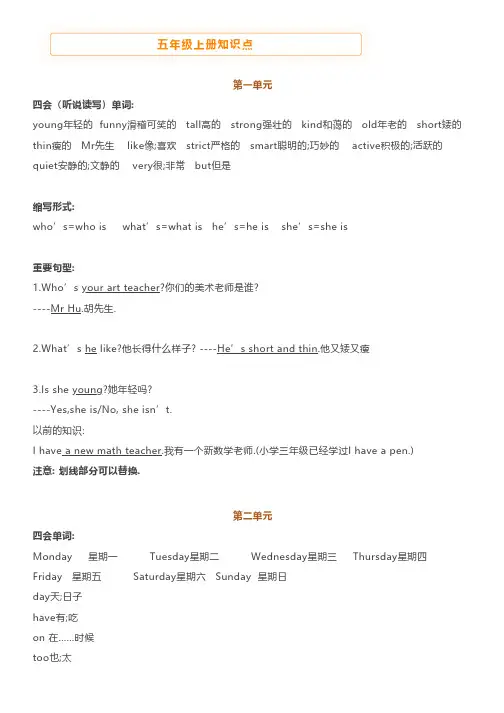
重点作文新 版 PEP 五 年 级 上 册 知 识 点 总 结Unit 1old 老的,年纪大的 young 年轻的,岁数不大的 funny 滑稽的,可笑的 kind 体贴的,慈祥的,宽容的strict 要求严格的,严厉的polite 有礼貌的,客气的 shy羞怯的,腼腆的,怕生的helpful 有用的,愿意帮忙的clever 聪明的,聪颖的 hard-working工作努力的,辛勤的music 音乐art 美术science 科学English 英语maths/math 数学Chinese 语文,中文sometimes 有时,间或robot 机器人 speak 会说,会讲(某种语言);用(某种语言)说话1. —Who’s your art teacher? 谁是你的美术老师? —Mr. Jones.琼斯老师。
2. —Is he young? 他年轻吗? —Yes, he is. 是的,他年轻。
—No, he isn’t. 不,他不年轻。
3. —What’s Wu Yifan like ? 吴一帆怎样? —He’s hard-working. 他很勤奋。
4. Ms Wang will be our new Chinese teacher. 王老师会成为我们的新语文老师。
5. He is very helpful at home . 他在家很能干。
6. Robin is short but strong. 罗宾个子矮,但是身体强壮。
7. He can speak Chinese and English . 他会说中文和英语。
8. He makes me finish my homework. 他让我写作业。
字母 y 在单词中的发音:1、双音节或多音节词末发[ i ]。
例:bab y happ y windy sunn y sorr y cand y man y famil y part y婴儿 开心的 有风的 晴朗的 对不起 糖果 许多 家庭 聚会课外补充:2、y 在单音节词末发[ ai ] 例:b y 乘坐 m y 我的 wh y 为什么cr y 哭 fl y 飞1、询问他人的外貌或性格:-What’s he/she like?- He/She is kind/…2、一般疑问句的问与答:—Is he/she…?—Yes, he/she is. —No, he/she isn’t.—Do you know…? —Yes, I do. —No, I don’t 3、be 动词的三种形式 am, is,are 与人称代词连用的用法: I + am,He, she, it ,人名、物名+ is We, you, they + are 4、Ms., Miss, Mr., Mrs.的区别: Ms. [miz](缩略词)(用于女子的姓氏或姓名前,不指明婚否)女士; Miss [mis](用于未婚女子的姓氏或姓名前,以示礼貌)小姐,女士; Mr. [mist ](mister 的缩略词)(用于男子的姓氏或姓名前)先生; Mrs. [misiz](用于已婚女子的姓氏或姓名前)太太;夫人。
5、and 和 but 的区别: and “和,与”,表并列关系 He is tall and thin . 他又高又瘦。
but “但是”,表转折关系He is short but strong . 他个子矮,但是身体强壮。
1、介绍自己、朋友或老师等熟悉的人物,如:My …teacher/friend/…。
思路导引(1) 开头:交代人物的身份 I have a/an…He/She is… (2) 中间:1)体貌 He/ She is tall/strong… He/She has …hair/eyes… 2)性格 He/She isstrict/kind…3)爱好 He/She likes playing pingi-pong/… 或He/She often read books/… on the weekend. (3) 结尾:评价人物或抒发对人物的情感 I like him/her very much.2、范文:(1)课本 P9 Read and write重点知识及语法 语 音 重点单词 识记口诀:我用 am, 你用 are, is 用于他、她、它,所有复数都用 are 。
重点句子重点作文o do have (2) My Chinese teacherI have a new Chinese teacher. She is Ms. Chen. She is tall and thin. She has big eyes and long black hair. She is kind and funny. Sometimes she is strict, too. She is hard-working. She likes reading. Her class is so much fun. We all like her.Unit 2Sunday (Sun.) 周日Monday (Mon.)周一Tuesday (Tue./Tues.)周二 Wednesday (Wed./Weds.) 周三Thursday (Thur./Thurs.)周四Friday (Fri.) 周五Saturday (Sat.) 周六weekend 周末(周六、日) wash my clothes 洗衣服watch TV 看电视 do homework 做作业 read books 看书play football 踢足球 on the weekend 在周末play sports/do sports 做体育运动 listen to music 听音乐 play ping-pong 打乒乓球1. —What do you on Thursday s ? 星期四你们上什么课?—I have math, English and music. 我们上数学、英语和音乐课。
2. —What do you on Thursdays, Grandpa? 爷爷,星期四你要做什么? —I have a cooking class with your grandma. 我和你奶奶去上烹饪课。
3. —Do you often read books in this park? 你经常在这个公园看书吗? —Yes, I do. 是的 —No, I don’t. 不是 4. Look at my picture. 看我的图片。
5. You look tired . 你看 起来很累。
6. You should play sports every day. 你应该每天做运动。
字母组合 ee, ea 在单词中的的发音:[ i: ] 例:f ee t b ee f m ee t s ee f ee d t ea r ea d ea t rep ea t 脚 牛肉 遇见 看见 喂养 茶 阅读 吃 重复注:1、ee 组合绝大部分发长音[ i: ],只有少部分发短音[ i ],如:coffee 咖啡2、ea 字母组合除了发[ i: ],还有可能发[ e ]等发音,如:bread 面包,或者发[ ei ],如:great 好极了1、询问做什么事/活动:—What do you do …? —I often play ping-pong… 询问星期几上什么课:—What do you have on…? —We have English class…2、一般疑问句的问与答:—Do you often read books? —Yes, I do . —No, I don’t.3、课外补充: n+具体某一天(年月日,星期),如:on Monday/Tuesday … +具体时刻(…点钟),如:at 12 o ’clock 在十二点整+大致时间(年月,早中晚),如:in 2014 在 2014 年 in the morning/afternoon/evening 4、play + 球类、棋类、娱乐活动,如:play football/ping-pong补充:play + the + 乐器(第四单元知识),如:play the pipa/piano/violin …1、描写一周的生活,如:My week思路导引(1) 开头:简单的自我介绍:My name’s…/ I’m…(2) 中间:1) 介绍周一至周五的情况,可以着重介绍自己最喜欢的那一天:I go to school from Monday to Friday. I like…because I have… 2)介绍自己周六、日的活动:I often watch TV/…on the weekend.(3) 结尾:This is my week. What about yours?2、范文: My week重点知识及语法 语 音 重点单词 in at 重点句子My name is Li Ming. I go to school from Monday to Friday. I like Tuesdays and Thursdays, because I have music and PE. I often do my homework and read books on Saturdays. I often play ping-pong on Sundays.重点作文Unit 3ice cream 冰淇淋 hamburger 汉堡包 tea 茶 sandwich 三文治 salad 沙拉 fresh 新鲜的,刚摘的 healthy 健康的 delicious 美味的;可口的hot 辣的;辛辣的sweet 含糖的;甜的 hungry 饿 的thirsty 渴的;口渴的favourite 特别喜爱的food 食 物 drink 喝 ; 饮 carrot 胡 萝 卜chicken 鸡肉 onion 洋葱 milk 牛奶 bread 面包 beef noodles 牛肉面 fish sandwich 鱼肉三明治 tomato soup 西红柿汤1. —What would you like to eat ?你想吃什么? —A sandwich, please. 请给我一个三明治。
—What would you like to 2. —What’s your favourite food? —Noodles. They are delicious. ? 你想喝什么? —I’d like some water. 我想喝点水。
人教版(PEP三年级起点)小学五年级英语上册知识点
五年级上册知识点短语:do homework 做作业watch TV 看电视read books 读书What about? ......怎么样?do housework 做家务play computer games 玩电脑游戏重点句型:1.What day is it today?今天星期几?—It’s Monday.星期一.2. What do we have on Mondays?星期一我们有什么课?—We have English,science,computer and P.E.我们有英语课,科学,计算机跟体育课.3.What do you do on Saturdays?星期六你干什么?(具体的某一天前用介词on,在具体的时间前,用介词at)—I often do my homework.我通常做家庭作业.4.What about you?你呢?—I do my homework,too.我也是做家庭作业.第三单元四会单词:eggplant 茄子fish 鱼green beans 青豆tofu 豆腐potato 土豆tomato 西红柿for 为;给lunch 中餐;午饭we 我们tasty 好吃的;可口的sweet 甜的sour 酸的fresh 新鲜的salty 咸的favourite 最喜爱的;特别喜爱的fruit 水果grape 葡萄缩写形式:they’re=they are don’t=do not重点句型:1.What would you like for lunch?你午餐想吃什么?-----I’d like some tomatoes and mutton.我想吃一些西红柿跟羊肉.2.What’s your favourite fruit?你最喜欢的水果是什么?------/I like apples.我喜欢苹果.3.I don’t like grapes.我不喜欢葡萄.4.Bananas are my favourite.我最喜欢香蕉.第四单元一. 单词:empty the trash倒垃圾cook the meals 做饭water the flowers浇花sweep the floor扫地clean the bedroom打扫卧室make the bed铺床set the table摆餐具wash the clothes洗衣服do the dishes洗碗碟put away the clothes收拾衣服can’t = cannot(不会;不能)use a computer(使用计算机)二. 句子:1. I’m helpful! I can sweep the floor。
人教版--五年级英语上册重点句型总结与练习
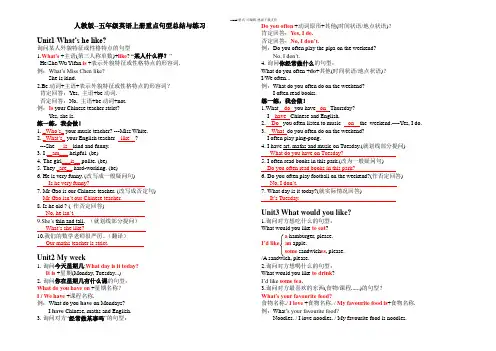
word格式-可编辑-感谢下载支持人教版--五年级英语上册重点句型总结与练习Unit1 What’s he like?询问某人外貌特征或性格特点的句型1.What’s +主语(第三人称单数)+like? “某人什么样?”He/She/Wu Yifan is +表示外貌特征或性格特点的形容词.例:What’s Miss Chen like?She is kind.2.Be动词+主语+表示外貌特征或性格特点的形容词?肯定回答:Yes, 主语+be动词.否定回答:No, 主语+be动词+not.例:Is your Chinese teacher strict?Yes, she is.练一练,我会做!1. _Who’s_ your music teacher? ---Miss White.2. _What’s_ your English teacher like ?---She is kind and funny.3.I __am___ helpful. (be)4.The girl___is__ polite. (be)5.They _are__ hard-working. (be)6. He is very funny. (改写成一般疑问句)Is he very funny?7. Mr Gao is our Chinese teacher. (改写成否定句)Mr Gao isn’t our Chinese teacher.8. Is he old ? ( 作否定回答)No, he isn’t.9.She’s thin and tall. (就划线部分提问)What’s she like?10.我们的数学老师很严厉。
(翻译)Our maths teacher is strict.Unit2 My week1.询问今天星期几:What day is it today?It is +星期(Monday, Tuesday...)2.询问你在星期几有什么课的句型:What do you have on +星期名称?I / We have +课程名称.例:What do you have on Mondays?I have Chinese, maths and English.3.询问对方“经常做某事吗”的句型:Do you often +动词原形+其他(时间状语/地点状语)?肯定回答:Yes, I do.否定回答:No, I don’t.例:Do you often play the pipa on the weekend?No, I don’t.4.询问你经常做什么的句型:What do you often +do+其他(时间状语/地点状语)?I/We often...例:What do you often do on the weekend?I often read books.练一练,我会做!1.What do you have on Thursday?I have Chinese and English.2. Do you often listen to music on the weekend.----Yes, I do.3. What do you often do on the weekend?I often play ping-pong.4.I have art, maths and music on Tuesday.(就划线部分提问)What do you have on Tuesday?5.I often read books in this park.(改为一般疑问句)Do you often read books in this park?6.Do you often play football on the weekend?(作否定回答)No, I don’t.7.What day is it today?(就实际情况回答)It’s Tuesday.Unit3 What would you like?1.询问对方想吃什么的句型:What would you like to eat?a hamburger, please.I’d like an apple.some sandwich es, please./A sandwich, please.2.询问对方想喝什么的句型:What would you like to drink?I’d like some tea.3.询问对方最喜欢的东西(食物/课程......)的句型?What’s your favourite food?食物名称./ I love +食物名称. / My favourite food is+食物名称. 例:Wha t’s your favourite food?Noodles. / I love noodles. / My favourite food is noodles.word格式-可编辑-感谢下载支持4.描述食物的味道的句型:主语+be动词+表示食物味道的形容词.例:It is sweet.The vegetables are healthy.They’re delicious.练一练,我会做!1.What would you like to eat ?I’d like a sandwich, please.2.What would you like to drink ?I’d like some water, please.3. It is hot.(be)4. The vegetables are delicious.(be)5. They are fresh.(be)6. I’d like some hamburgers .(hamburger)7. What is your favourite food?----Salad.Unit4 What can you do?1.询问对方会做什么的句型What can you do?I / We can +动词原形.例:What can you do for the party?I can play the piano.2. 询问对方“会做某事吗”的句型Can you + 动词原形+其他(时间状语/地点状语)?肯定回答:Yes, I/we can.否定回答:No, I/we can’t.例:Can you cook at home?Yes, I can.练一练,我会做!1.What can you do? I can swim .(swim)2.Can you cook ? No, I can’t .3.Can you cook ? Yes, I can.4.Can you wash your clothes at home?( 做否定回答)No, I can’t.5.I can sing English songs. (改为否定句)I can’t sing English songs.6.I can do some kung fu.(改为一般疑问句)Can you do any kung fu?7.I can play the erhu for the party.(就划线部分提问)What can you do for the party? Unit5 There is a big bed. Unit6 In a nature park1.询问某地有什么:What's in the room/park?回答“某处有某人”:There+be动词+某人/某物(+地点).(1)单数句:There+is +a/an+可数名词单数(+地点).例:There is a big bed in my room.改为否定句:There isn’t a big bed in my room.(2)复数句:There+are +(some/many/lots of...)可数名词复数(+地点).例:There are some tree s in the forest.改为否定句:There aren’t any trees in the forest.2.询问“某处有什么吗”的句型Be动词+there+某人/某物(+地点)?肯定回答:Yes, there+ be.否定回答:No, there+ be+not.单数句:Is there a/an +可数名词单数(+地点)?肯定回答:Yes, there is.否定回答:No, there isn’t.例:Is there an apple on the plate?No, there isn’t.复数句:Are there any +可数名词复数(+地点)?肯定回答:Yes,there are.否定回答:No, there aren’t.例:Are there any lakes in the nature park?Yes, there are.3. 询问物品在哪里: Where is+ 某种物品?It is+表示方位的介词+其他.例: Where is the ball?It is beside the dog.练一练,我会做!1.There is a tree beside the house.(be)2.There is an apple and an egg on the plate.(a/an)3.There are some hills in front of the house.(be)4.Are there any villages in the nature park?(some)----Yes, there are .5.Are there any buildings in the nature park?(building) ----No, there aren’t .6.What’s in the room? There is a big bed.7.Where is the desk? It’s in front of the chair.8.Is there a white mouse in the room?(作否定回答)No, there isn’t.9.There is a football behind the door.(改成否定句)There isn’t a football behind the door.word格式-可编辑-感谢下载支持10.The clock is beside the picture. (就划线部分提问)Where is the clock?11.There are many bottles on the desk.(改成单数句)There is a bottle on the desk.12.There are lots of plants in the garden.(改成一般疑问句)Are there lots of plants in the garden?13.There are some bikes in the house.(改成否定句)There aren’t any bikes in the house?14. There is a big photo above the computer.(就划线部分提问)What’s above thecomputer?。
五年级英语上册知识点总结
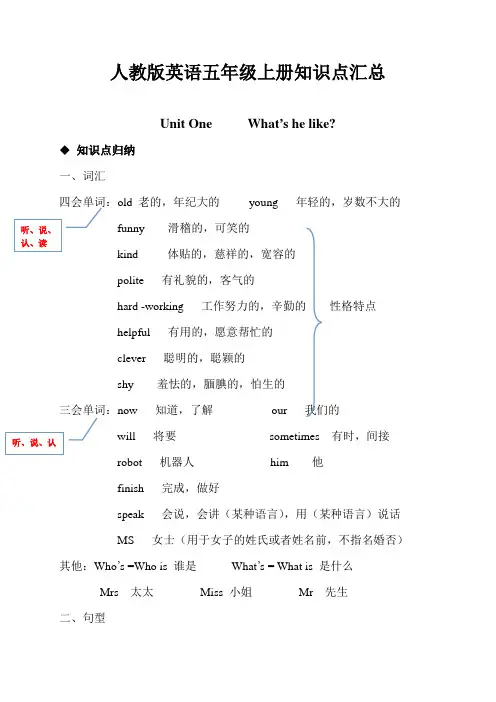
人教版英语五年级上册知识点汇总Unit One What ’s he like?知识点归纳 一、词汇四会单词:old 老的,年纪大的 young 年轻的,岁数不大的funny 滑稽的,可笑的 kind 体贴的,慈祥的,宽容的 polite 有礼貌的,客气的hard -working 工作努力的,辛勤的 性格特点 helpful 有用的,愿意帮忙的 clever 聪明的,聪颖的 shy 羞怯的,腼腆的,怕生的三会单词:now 知道,了解 our 我们的will 将要 sometimes 有时,间接 robot 机器人 him 他 finish 完成,做好speak 会说,会讲(某种语言),用(某种语言)说话 MS 女士(用于女子的姓氏或者姓名前,不指名婚否)其他:Who ’s =Who is 谁是 What ’s = What is 是什么 Mrs 太太 Miss 小姐 Mr 先生 二、句型1、询问人art 美术English 英语music 音乐——Who’s your maths 数学teacher?谁是你们的science 科学老师?PE 体育Chinese 语文——Mr Jones. 琼斯先生/ Miss Green. 格林小姐2、询问人的外貌特征/性格特点——What’s he/she like? 他/她这个人怎么样?——He/She is kind/ strict/old/tall…….3、——Is he/she young? 他/她年轻吗?——Yes,he /she is. 是的,他/她年轻。
No,he/she isn’t. 不,他/她不年轻。
4、以Do you 开头的句子的回答——Do you know Mr Young?——Yes,I do. 是的,我知道。
(肯定回答)No,I don’t. 不,我不知道。
(否定回答)5、Ms Wang will be our new Chinese teacher.王老师将成为我们的新语文老师。
人教精通版五年级英语上册各单元知识点汇总
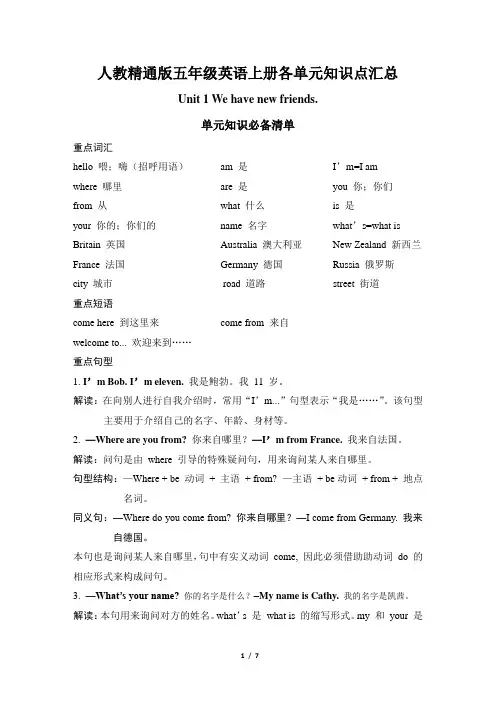
人教精通版五年级英语上册各单元知识点汇总Unit 1 We have new friends.单元知识必备清单重点词汇hello 喂;嗨(招呼用语)am 是I’m=I amwhere 哪里are 是you 你;你们from 从what 什么is 是your 你的;你们的name 名字what’s=what is Britain 英国Australia 澳大利亚New Zealand 新西兰France 法国Germany 德国Russia 俄罗斯city 城市road 道路street 街道重点短语come here 到这里来come from 来自welcome to... 欢迎来到……重点句型1. I’m Bob. I’m eleven. 我是鲍勃。
我11 岁。
解读:在向别人进行自我介绍时,常用“I’m...”句型表示“我是……”。
该句型主要用于介绍自己的名字、年龄、身材等。
2. —Where are you from? 你来自哪里?—I’m from France. 我来自法国。
解读:问句是由where 引导的特殊疑问句,用来询问某人来自哪里。
句型结构:—Where + be 动词+ 主语+ from? —主语+ be动词+ from + 地点名词。
同义句:—Where do you come from? 你来自哪里?—I come from Germany. 我来自德国。
本句也是询问某人来自哪里,句中有实义动词come, 因此必须借助助动词do 的相应形式来构成问句。
3.—What’s your name?你的名字是什么?—My name is Cathy.我的名字是凯茜。
解读:本句用来询问对方的姓名。
what’s 是what is 的缩写形式。
my 和your 是形容词性物主代词。
句型结构::—What’s your name? —My name is + 名字/ I’m + 名字.4. —Where do you live, Cathy?你住在哪里,凯茜?—I live in the Happy City. 我住在幸福城。
五年级英语上册期末知识点全汇总(人教版)
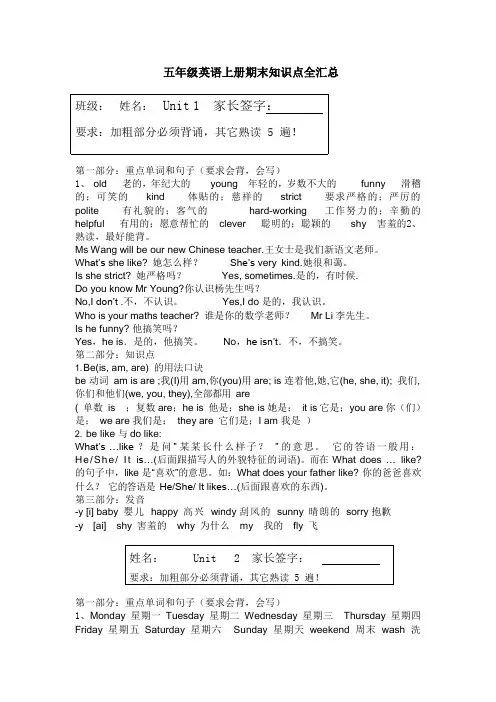
五年级英语上册期末知识点全汇总第一部分:重点单词和句子(要求会背,会写)1、old 老的,年纪大的young 年轻的,岁数不大的funny 滑稽的;可笑的kind 体贴的;慈祥的strict 要求严格的;严厉的polite 有礼貌的;客气的hard-working 工作努力的;辛勤的helpful 有用的;愿意帮忙的clever 聪明的;聪颖的shy 害羞的2、熟读,最好能背。
Ms Wang will be our new Chinese teacher.王女士是我们新语文老师。
What’s she like? 她怎么样?She’s very kind.她很和蔼。
Is she strict? 她严格吗?Yes, sometimes.是的,有时候.Do you know Mr Young?你认识杨先生吗?No,I don’t .不,不认识。
Yes,I do 是的,我认识。
Who is your maths teacher? 谁是你的数学老师?Mr Li 李先生。
Is he funny? 他搞笑吗?Yes,he is.是的,他搞笑。
No,he isn’t.不,不搞笑。
第二部分:知识点1. B e(is, am, are) 的用法口诀be 动词am is are ;我(I)用am,你(you)用are; is 连着他,她,它(he, she, it); 我们, 你们和他们(we, you, they),全部都用are( 单数is ;复数are;he is 他是;she is 她是;it is 它是;you are 你(们)是;we are 我们是;they are 它们是;I am 我是)2. be like 与do like:What’s …like ?是问” 某某长什么样子?” 的意思。
它的答语一般用:He/Sh e/ I t is…(后面跟描写人的外貌特征的词语)。
而在What does … like? 的句子中,like 是“喜欢”的意思。
人教版五年级英语上册知识点总结

人教版五年级英语上册知识点总结Unit 1: What’s he likeDialogue 1:A: Who is your English teacher?B: Mr。
Young.A: Is he young?B: No。
he isn't。
He's old.A: Is he funny?B: Yes。
he is.A: Great。
I like funny teachers.Dialogue 2:A: Hey。
Ms。
Young will be our new Chinese teacher. B: Really。
What's she like?A: She's kind.B: Is she strict?A: Yes。
sometimes.B: Do you know her?A: Yes。
she's my mother.B: Haha。
Cool!Sentence structure 1: (Asking about someone's subject teacher and answering)Who is your English teacher?Mr。
Young.Sentence structure 2: Confirming someone's physical or personality traits and answeringIs he young?No。
he isn't。
/ Yes。
he is.Sentence structure 3: Ms。
Young will be our new Chinese teacher.Sentence structure 4: Asking about someone's physical or personality traits and answeringWhat's he like?He is tall and strong。
人教版(PEP)小学英语五年级上册知识复习要点
人教版(PEP)小学英语五年级上册知识复习要点PEP英语五年级上册重点四会单词、词汇表Unit 1:young 年轻的 funny 滑稽可笑的 tall 高的 strong 强壮的kind 和蔼的、亲切的;old 年老的short矮的thin 瘦的Mr 先生like 像、喜欢strict 严格的smart 聪明的、巧妙的active 积极的、活跃的quiet 安静的、文静的very 很、非常but 但是Unit 2:Mondy 星期一Tuesday 星期二Wednesday 星期三Thursday 星期四Friday 星期五Saturday 星期六Sunday 星期天day 天have 有、吃on 在…..时候do homework 做作业watch TV 看电视read books 读书Unit 3:eggplant 茄子fish 鱼green beans 青豆tofu 豆腐potato 土豆tomato 西红柿for 为lunch 中餐we 我们tasty 好吃的sweet 甜的sour 酸的fresh 新鲜的salty 咸的favourite 最喜欢的 they’re=they are 他们是fruit 水果grape 葡萄Unit 4:cook the meals 做饭water the flowers 浇花sweep the floor 扫地clean the bedroom 打扫卧室make the bed 铺床set the table 摆饭桌wash the clothes 洗碗碟do the dishes 收拾衣服use a computer 使用计算机Unit 5:curtain 空调trash bin 垃圾箱closet 壁橱mirror 镜子end table 床头柜bedroom 卧室kitchen 厨房bathroom 卫生间living room 客厅in 在…里面on 在…上面under 在…下面near 在..旁边behind 在…后边clothes 衣服Unit 6:river 河流flower 花grass 草lake 湖泊forest 森林path 路park 公园picture 照片hourse 房子bridge 桥tree 树road 公路building 建筑物clean 干净的五年级上册重点四会句子1.谁是你的英语老师?Carter先生。
小学五年级人教版英语上册知识点总结
新版PEP 五年级上册知识点总结Un it 1old 老的,年纪大的 you ng 年轻的,岁数不大的 funny 滑稽的,可笑的kind 体贴的,慈祥的,宽容的 strict要求严格的,严厉的 polite 有礼貌的,客气的helpful 有用的,愿意帮忙的 clever聪明的,聪颖的hard-work ing 工作努力的,辛勤的music 音乐 art 美术 scie nee 科学Who' syour art teacher一Mr. Jones 琼斯老师。
2. — Is he you ng 他年轻吗—Yes, he is. 是的,他年轻。
一No, he isn ' t.不,他不年轻。
3. — What ' Wu Yifan like吴一帆怎样 一He ' s harWorking.他很勤奋。
4. Ms Wang will be our new Chinese teacher.王老师会成为我们的新语文老师。
5. He is very helpful at home. 他在家很能干。
6. Robi n is short but stron g. 罗宾个子矮,但是身体强壮。
7. He can speak Chin ese and En glish. 他会说中文和英语。
8. He makes me fin ish my homework.他让我写作业。
字母y 在单词中的发音:1、双音节或多音节词末发 [i ]。
例:baby happy windy_ sunny sorry candy many family party婴儿 开心的 有风的晴朗的对不起 糖果 许多 家庭 聚会 课外补充:2、y 在单音节词末发[ai ] 例:by 乘坐 my 我的 why 为什么 cry 哭 fly 飞重点知识及语法丨1、 询问他人的外貌或性格: -What ' he/she like - He/She is kind/…2、 一般疑问句的问与答: 一Js he/she • — Yes, he/she is. — No, he/she isn' t.—Do you know … —Yes, I do. — No, I don '3、be 动词的三种形式 am, is, are 与人称代词连用的用法: 1 + am,------------------------------------------------------------------------------------------------------ He, she, it ,人名、物名+ is 识记口诀:我用am,你用are, is 用于他、她、它,所有复数都用are 。
(完整)新人教版PEP五年级英语上册各单元知识点总结,推荐文档
新版PEP五年级上册知识点总结Unit 1 What’s he like?重点单词old 老的,年纪大的young 年轻的,岁数不大的funny 滑稽的,可笑的kind 体贴的,慈祥的,宽容的strict 要求严格的,严厉的polite 有礼貌的,客气的shy 羞怯的,腼腆的,怕生的helpful 有用的,愿意帮忙的clever 聪明的,聪颖的hard-working工作努力的,辛勤的music 音乐art 美术science 科学English 英语maths/math 数学Chinese 语文,中文sometimes 有时,间或robot 机器人speak 会说,会讲(某种语言);用(某种语言)说话重点句子1. —Who’s your art teacher? 谁是你的美术老师?—Mr. Jones.琼斯老师。
2. —Is he young? 他年轻吗?—Yes, he is. 是的,他年轻。
—No, he isn’t.不,他不年轻。
3. —What’s Wu Yifan like? 吴一帆怎样?—He’s hard-working. 他很勤奋。
4. Ms Wang will be our new Chinese teacher. 王老师会成为我们的新语文老师。
5. He is very helpful at home. 他在家很能干。
6. Robin is short but strong. 罗宾个子矮,但是身体强壮。
7. He can speak Chinese and English. 他会说中文和英语。
8. He makes me finish my homework. 他让我写作业。
语音字母y在单词中的发音:1、双音节或多音节词末发[ i ]。
例:bab y happ y windy sunn y sorr y cand y man y famil y part y婴儿开心的有风的晴朗的对不起糖果许多家庭聚会课外补充:2、y在单音节词末发[ ai ]例:b y 乘坐m y 我的wh y 为什么cr y 哭fl y 飞重点知识及语法-What’s he/she like? - He/She is kind/…2、一般疑问句的问与答:—Is he/she…?—Yes, he/she is.—No, he/she isn’t.—Do you know…? —Yes, I do.—No, I don’t3、be动词的三种形式am, is, are与人称代词连用的用法:I + am,He, she, it,人名、物名+ isWe, you, they + are4、Ms., Miss, Mr., Mrs.的区别:Ms. [miz](缩略词)(用于女子的姓氏或姓名前,不指明婚否)女士;Miss [mis](用于未婚女子的姓氏或姓名前,以示礼貌)小姐,女士;Mr. [mist](mister的缩略词)(用于男子的姓氏或姓名前)先生;Mrs. [misiz](用于已婚女子的姓氏或姓名前)太太;夫人。
英语五年级上册书人教版
人教版五年级上册英语知识点总结一、重点词汇解析1.old /əʊld/ 年老的;旧的-例句:My grandfather is old.(我的爷爷很老。
)/ This is an old book.(这是一本旧书。
)-用法:可用于形容人或物品的年龄或新旧程度。
2.young /jʌŋ/ 年轻的-例句:She is a young teacher.(她是一位年轻的老师。
)-用法:与“old”相对,常用来形容人。
3.funny /ˈfʌni/ 滑稽的;可笑的-例句:The clown is very funny.(这个小丑很滑稽。
)-用法:可形容人或事物有趣、引人发笑。
4.kind /kaɪnd/ 和蔼的;亲切的-例句:Our teacher is very kind.(我们的老师很和蔼。
)-用法:常用来形容人的性格。
5.strict /strɪkt/ 严格的-例句:Our math teacher is strict.(我们的数学老师很严格。
)-用法:形容人在要求或规则方面严格。
6.polite /pəˈlaɪt/ 有礼貌的-例句:He is a polite boy.(他是一个有礼貌的男孩。
)-用法:表示人的行为举止有礼貌。
7.hard-working /ˌhɑːd ˈwɜːkɪŋ/ 努力工作的;勤奋的-例句:She is a hard-working student.(她是一个勤奋的学生。
)-用法:形容人在工作或学习上努力。
8.helpful /ˈhelpfl/ 有用的;愿意帮忙的-例句:He is very helpful.(他很乐于助人。
)-用法:可形容人能够提供帮助。
二、重点短语1.be strict with... 对……严格-例句:My mother is strict with me.(我的妈妈对我很严格。
)2.be kind to... 对……和蔼-例句:Our teacher is kind to us.(我们的老师对我们很和蔼。