
英语时态种基本时态讲解
英语时态8种基本时态讲解 一.概念:英语中表示不同时间发生的动作或存在的状态,需用不同的动词形式表示,这种不同的动词形式称为时态。 二.种类:(基本时态) 一般现在时 一般过去时 现在进行时 过去进行时 一般将来时 过去将来时 现在完成时 过去完成时 三.用法: 1.一般现在时: 1)一般现在时表示经常发生或习惯性的动作或状态及客观现实和普遍真理。 一般现在时常以动词原形表示,但当主语是第三人称单数时,动词词尾加-s或-es。 2)句型结构:主语+V.(包括be动词)+宾语+… She is an engineer. He has breakfast at 6:00 every day. 3)注意: a)一般现在时通常与always , often , usually , every day , sometimes , once a week 等时间状语连用。 I always watch TV at 8:00 in the evening. They go home once a week. We usually do our homework at home. b)表客观现实或普遍真理。 The sun always rises in the east. The light travels faster than the sound. c)表永远性的动作或状态。 He lives in the country. 4)第三人称单数变化形式。 a)一般情况动词在词尾加-s . come---comes speak---speaks work---works live---lives b)以o, s, x, ch, sh结尾的单词在词后加-es. do---does go---goes finish---finishes brush---brushes fix---fixes pass---passes watch---watches c)以“辅音字母+y”结尾的单词变y为i加-es. Study---studies carry-carries cry---cries d)以“元音字母+y”结尾的单词直接加-s. play---plays stay---stays 例句:我们每天晚上九点做作业。 我在早上七点半起床。 他每天七点去上班。 我们经常下午打篮球。 他喜欢音乐。 地球围绕太阳转。 火车六点出发。 5)否定句和疑问句。 a)-----He is an engineer. -----He isn’t an engineer. -----Is he an engineer? -----Yes, he is ./ No, he isn’t. b)----We get up at 7:30 in the morning . -----We don’t get up at 7:30 in the morning . -----Do you get up at 7:30 in the morning ? -----Yes, we do. / No, we don’t. c)----He likes music. -----He doesn’t like music. -----Does he like music? -----Yes ,he does./ No, he doesn’t . 2.一般过去时 1)一般过去时表示发生在过去的动作或存在的状态,通常与表示过去的时间状语yesterday, last night ,some years ago, in 1990,in those days.等连用。 I was a student 6years ago. I went to Beijing last year. They saw a film last night . 2)句型结构:主语+V.过去时+宾语+… 例句:昨天他很忙。 去年他抽烟了。 两年前他去参军了。 他在1990年去世了。 3)否定句和疑问句。 a)----He was busy yesterday. -----He wasn’t busy. -----Was he busy? -----Yes, he was./ No, he wasn’t. b)----He smoked last year. -----He didn’t smoke last year. -----Did he smoke last year? -----Yes ,he did ./No ,he didn’t. c)----He joined the army in 1990. -----He didn’t joined the army in 1990. -----Did he join the army in 1990? -----Yes ,he did ./No ,he didn’t. 4)动词过去式变化规则。 a)一般情况下的词加-ed. work---worked call----called laugh----laughed Explain----explained finish----finished knock----knocked b)以不发音的字母e结尾的单词直接加-d . live----lived change----changed smoke----smoked die----died graduate----graduated drive----drove c)以“辅音字母+y”结尾的单词,变y为i加-ed. study----studied carry----carried cry----cried try----tried marry----married d)以“元音字母+y”结尾的单词直接加-ed. play----played stay----stayed e)以“一个元音字母+一个辅音字母”结尾的单词应先双写这个辅音字母然后再加-ed. stop----stopped plan----planned pat----patted f)动词不规则变化: do----did go----went come----came run----ran write----wrote begin----began drink----drank keep----kept leave----left sleep----slept make----made lie----lay dig----dug eat----ate know----knew cut----cut set----set let----let read----read hurt----hurt 例句:我前天拿走了这本书。 去年我买了一辆自行车。 每天晚上我听音乐。 她通常待在家里。 两天前我完成了这项工作。 复习: 1) I (be) a teacher 2 years ago. 2) He (be) a student now. 3) He (do) his homework at home every day. 4) They (join) the Party in 1998. 5) We (not eat) apples yesterday. 6) We (not play) basketball every day. 7) He (not go ) home once a week. 8) I am 16 years old. (划线部分提问) 9) I go to work at 8:00 every morning. (划线部分提问) 10) They joined the Party in 1990. (划线部分提问) 11) I went to Beijing last year. (划线部分提问) 3.一般将来时 1)表示将来发生的动作或存在的状态,常与表将来的时间状语tomorrow, the day after tomorrow, next Sunday, soon, in a few days等连用。 2)句型结构:主语+will/shall+V.原形+…(第一人称用shall) I shall go to Shanghai tomorrow. They will have a meeting next week. ----She will be 20 years old. ----Will she be 20 years old? ----Yes, she will./ No, she won’t . 3)主语+will/shall+V.原形+… be(am, is, are)going to They will have a meeting next Sunday. (will=are going to ) ----What will they do next Sunday ? ----When will they have a meeting? 4) be about to+V.原形 I am about to leave school. 不能与表示时间的副词连用。 They are about to set out.(√) They are about to set out soon.(×) 复习题: (do) his homework at school every day. (finish) their work yesterday. (visit) their farm next year. 4.我半小时后要吃午饭。 5.他将骑自行车去学校。 6.他们下周日将去买汽车。 4.过去将来时 1)过去将来时是立足于过去某时,从过去的观点看将要发生的动作或状态。主要用于宾语从句中。 2)基本结构:主语+would/should was/were going to +V.原形+…
英语中常见的八种基本时态
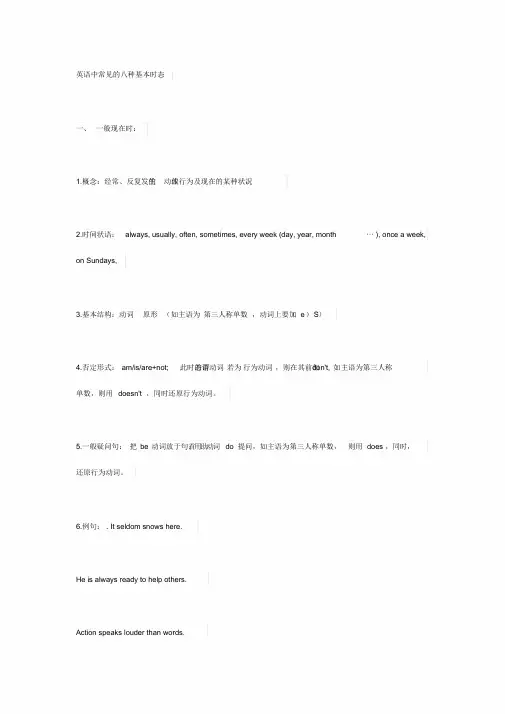
英语中常见的八种基本时态一、一般现在时:1.概念:经常、反复发生的动作或行为及现在的某种状况。
2.时间状语:always, usually, often, sometimes, every week (day, year, month ⋯), once a week, on Sundays,3.基本结构:动词原形(如主语为第三人称单数,动词上要加(e)S)4.否定形式:am/is/are+not; 此时态的谓语动词若为行为动词,则在其前加d on't, 如主语为第三人称单数,则用doesn't ,同时还原行为动词。
5.一般疑问句:把be 动词放于句首;用助动词do 提问,如主语为第三人称单数,则用does ,同时,还原行为动词。
6.例句:. It seldom snows here.He is always ready to help others.Action speaks louder than words.二、一般过去时:7.概念:过去某个时间里发生的动作或状态;过去习惯性、经常性的动作、行为。
8.时间状语:ago, yesterday, the day before yesterday, last week(year, night, month ⋯), in 1989, just now, at the age of 5, one day, long long ago, once upon a time, etc.9.基本结构:be 动词;行为动词10.否定形式:was/were+not; 在行为动词前加didn't ,同时还原行为动词。
11.一般疑问句:was 或were 放于句首;用助动词do 的过去式did 提问,同时还原行为动词。
12.例句:She often came to help us in those days.I didn't know you were so busy.三、现在进行时:1.概念:表示现阶段或说话时正在进行的动作及行为。
英语的16种基本时态
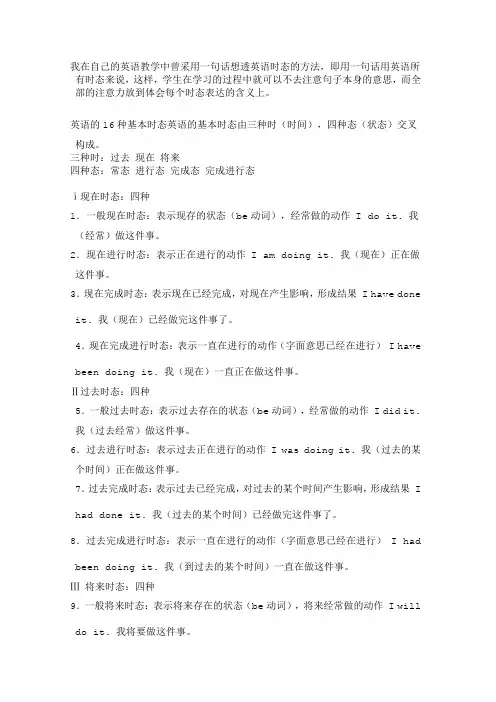
我在自己的英语教学中曾采用一句话想透英语时态的方法,即用一句话用英语所有时态来说,这样,学生在学习的过程中就可以不去注意句子本身的意思,而全部的注意力放到体会每个时态表达的含义上。
英语的16种基本时态英语的基本时态由三种时(时间),四种态(状态)交叉构成。
三种时:过去现在将来四种态:常态进行态完成态完成进行态ⅰ现在时态:四种1.一般现在时态:表示现存的状态(be动词),经常做的动作I do it. 我(经常)做这件事。
2.现在进行时态:表示正在进行的动作I am doing it. 我(现在)正在做这件事。
3.现在完成时态:表示现在已经完成,对现在产生影响,形成结果I have done it. 我(现在)已经做完这件事了。
4.现在完成进行时态:表示一直在进行的动作(字面意思已经在进行)I have been doing it. 我(现在)一直正在做这件事。
Ⅱ过去时态:四种5.一般过去时态:表示过去存在的状态(be动词),经常做的动作I did it. 我(过去经常)做这件事。
6.过去进行时态:表示过去正在进行的动作I was doing it. 我(过去的某个时间)正在做这件事。
7.过去完成时态:表示过去已经完成,对过去的某个时间产生影响,形成结果I had done it. 我(过去的某个时间)已经做完这件事了。
8.过去完成进行时态:表示一直在进行的动作(字面意思已经在进行)I had been doing it. 我(到过去的某个时间)一直在做这件事。
Ⅲ将来时态:四种9.一般将来时态:表示将来存在的状态(be动词),将来经常做的动作I will do it. 我将要做这件事。
10.将来进行时态:表示将来正在进行的动作I will be doing it. 我将要正在做这件事。
11.将来完成时态:表示到将来的某个时间已经完成,对那个时间产生影响,形成结果I will have done it. 我(到将来的某个时间)已经做完这件事了。
初中英语八种时态讲解(课堂PPT)

主语为第三人称单数,则用doesn't,同时
还原行为动词。
一般疑问句:①把be动词放于句首;②用
助动词do提问,如主语为第三人称单数,
则用does,同时,还原行为动词。
4
什么情况下用?
5
①表示经常或习惯性的动作或存 在的状态。②表示主语通常的能 力、兴趣爱好、和性格特征。③ 表示客观的事实或真理。④表示 按照时刻表或已经计划安排好的 将来行为。(只限于是go, come, leave, arrive, begin, start, take off, stop, be等表示开始或移动意义的
在的某种状况。
时间状语:
always, usually, often, sometimes, every week
(day, year, month…), once a week, on Sundays,
etc.
基本结构:①be动词;②行为动词
否定形式:①am/is/are+not;②此时态的谓
语动词若为行为动词,则在其前加don't,如
21
过去进行时
22
1.概念:表示过去某段时间或某一时 刻正在发生或进行的行为或动作。
2.时间状语:at this time yesterday, at that time或以when引导的谓语动词是 一般过去时的时间状语等。
3.基本结构 主语+was/were +doing + 其他
4.否定形式:主语+was/were + not +doing+其他
27
时间状语:Tomorrow, next day(week, month, year…),soon, in a few minutes, by…,the day after tomorrow, etc.
英语七种时态的结构

英语七种时态的结构英语中共有12种时态,以下是其中7种时态的结构:1.一般现在时(Simple Present Tense)肯定句:主语+ 动词原形(第三人称单数加-s或-es)否定句:主语+ do not / does not + 动词原形疑问句:Do / Does + 主语+ 动词原形?2.一般过去时(Simple Past Tense)肯定句:主语+ 动词过去式否定句:主语+ did not + 动词原形疑问句:Did + 主语+ 动词原形?3.现在进行时(Present Continuous Tense)肯定句:主语+ am / is / are + 现在分词否定句:主语+ am not / is not / are not + 现在分词疑问句:Am / Is / Are + 主语+ 现在分词?4.过去进行时(Past Continuous Tense)肯定句:主语+ was / were + 现在分词否定句:主语+ was not / were not + 现在分词疑问句:Was / Were + 主语+ 现在分词?5.现在完成时(Present Perfect Tense)肯定句:主语+ have / has + 过去分词否定句:主语+ have not / has not + 过去分词疑问句:Have / Has + 主语+ 过去分词?6.过去完成时(Past Perfect Tense)肯定句:主语+ had + 过去分词否定句:主语+ had not + 过去分词疑问句:Had + 主语+ 过去分词?7.将来进行时(Future Continuous Tense)肯定句:主语+ will be + 现在分词否定句:主语+ will not be + 现在分词疑问句:Will + 主语+ be + 现在分词?。
八种英语时态基本句型

八种英语时态基本句型英语时态是指表示动作或状态所发生的时间的一种语法形式。
正确使用英语时态可以让我们表达清晰、准确地传达信息。
常见的英语时态包括:一般现在时、一般过去时、一般将来时、现在进行时、过去进行时、过去将来时、现在完成时和过去完成时。
下面我们将详细介绍这八种英语时态的基本句型。
一、一般现在时:1. 肯定句:主语 + 动词原形 + 其他。
例句:I eat breakfast every morning.They play soccer on weekends.2. 否定句:主语 + do/does + not + 动词原形 + 其他。
例句:She does not watch TV in the evening.We do not like spicy food.3. 疑问句:Do/Does + 主语 + 动词原形 + 其他?例句:Do you drink coffee?Does he play basketball?二、一般过去时:1. 肯定句:主语 + 动词过去式 + 其他。
例句:She visited her grandparents last weekend.They watched a movie yesterday.2. 否定句:主语 + did not + 动词原形 + 其他。
例句:He did not go to the party.We did not see him at the park.3. 疑问句:Did + 主语 + 动词原形 + 其他?例句:Did you finish your homework?Did they play tennis this morning?三、一般将来时:1. 肯定句:主语 + will + 动词原形 + 其他。
例句:I will visit my friend tomorrow.They will have a party next month.2. 否定句:主语 + will not + 动词原形 + 其他。
英语时态16种基本时态结构
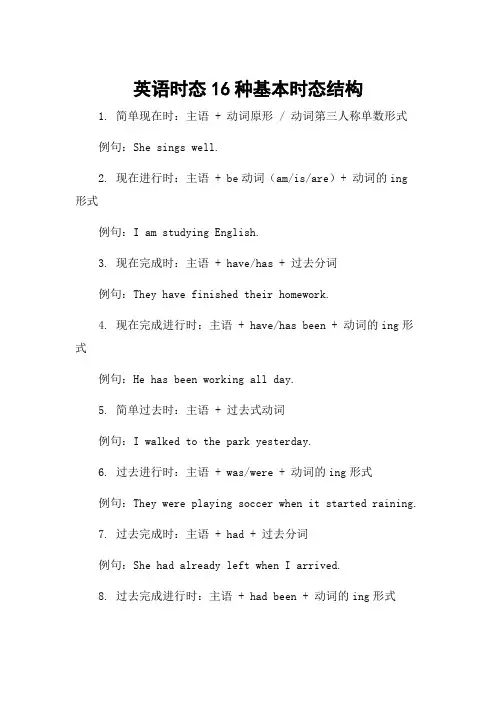
英语时态16种基本时态结构1. 简单现在时:主语 + 动词原形 / 动词第三人称单数形式例句:She sings well.2. 现在进行时:主语 + be动词(am/is/are)+ 动词的ing 形式例句:I am studying English.3. 现在完成时:主语 + have/has + 过去分词例句:They have finished their homework.4. 现在完成进行时:主语 + have/has been + 动词的ing形式例句:He has been working all day.5. 简单过去时:主语 + 过去式动词例句:I walked to the park yesterday.6. 过去进行时:主语 + was/were + 动词的ing形式例句:They were playing soccer when it started raining.7. 过去完成时:主语 + had + 过去分词例句:She had already left when I arrived.8. 过去完成进行时:主语 + had been + 动词的ing形式例句:We had been waiting for hours when the busfinally arrived.9. 一般将来时:主语 + will/shall + 动词原形例句:He will go shopping tomorrow.10. 将来进行时:主语 + will be + 动词的ing形式例句:We will be having dinner at 7 o'clock tomorrow.11. 将来完成时:主语 + will have + 过去分词例句:They will have finished the project by next week.12. 将来完成进行时:主语 + will have been + 动词的ing形式例句:I will have been studying for 5 hours by the time you come.13. 现在完成逻辑时:主语 + should/would + have + 过去分词例句:He should have called the police when he saw the accident.14. 过去完成逻辑时:主语 + should/would + have + 过去分词例句:They would have been late if they hadn't taken a taxi.15. 过去将来逻辑时:主语 + should/would + have + 过去分词例句:I thought he would have arrived by now.16. 过去将来完成逻辑时:主语 + should/would + have + 过去分词例句:She said she would have finished the report by tomorrow.。
英语16种时态-讲解
第2章动词的时态一.概念:时态是英语谓语动词的一种形式,表示动作发生的时间和所处的状态.英语中的时态是通过动词形式本身的变化来实现的.英语有16种时态,但中学阶段较常用的有十种:一般现在时,一般过去时,一般将来时,过去将来时,现在进行时,过去进行时,将来进行时,过去完成时,英在完成时和现在完成进行时.将来完成时1)构成will have done2)概念a. 状态完成:表示某事继续到将来某一时为止一直有的状态。
例如:They will have been married for 20 years by then. 到那时他们结婚将有二十年了。
b. 动作完成:表示将来某一时或另一个将来的动作之前,已经完成的动作或获得的经验。
例如:You will have reached Shanghai by this time tomorrow. 明天此时,你已经到达上海了现在进行时现在进行时的基本用法:a. 表示现在(指说话人说话时)正在发生的事情。
例如:We are waiting for you. 我们正在等你。
b. 习惯进行:表示长期的或重复性的动作,说话时动作未必正在进行。
例如:Mr. Green is writing another novel. 他在写另一部小说。
(说话时并未在写,只处于写作的状态。
)c. 表示渐变,这样的动词有:get, grow, become, turn, run, go, begin等。
例如:The leaves are turning red. 叶子在变红。
It's getting warmer and warmer. 天越来越热了。
d. 与always, constantly, forever 等词连用,表示反复发生的动作或持续存在的状态,往往带有说话人的主观色彩。
例如:You are always changing your mind. 你老是改变主意。
过去进行时1)概念:表示过去某时正在进行的状态或动作。
高中英语16种时态用法详解
搞定高中英语16种时态用法详解,英语学习领先一大步~~高中英语时态(Tense)是表示行为、动作和状态在各种时间条件下的动词形式。
因此,当我们说时态结构的时候,指的是相应时态下的动词形式。
英语时态分为16种:一般现在、一般过去、一般将来、过去将来时,以及这四者的进行时、完成时和完成进行时。
下面是16种时态的谓语动词形式和具体用法,高考必考的是前10种时态,同学们需要重点掌握。
1.一般现在时(do/does; is/am/are)①表示现在的情况、状态或特征。
例:He is a student.他是一个学生。
②表示经常性、习惯性动作。
例:He always helps others.他总是帮助别人。
③客观事实和普遍真理。
例:The earth moves the sun.地球绕着太阳转。
④表示一个按规定、计划或安排要发生的动作。
仅限于某些表示“来、去、动、停、开始、结束、继续”等的动词,可以与表示未来时间的状语搭配使用。
常见的用法是:飞机、火车、轮船、汽车等定期定点运行的交通方式。
例:The next train leaves at 3 o'clock this afternoon.下一趟火车今天下午3点开车。
⑤在时间、条件和让步状语从句中经常用一般现在(有时也用现在完成时)表示将的来事情。
(即:主将从现原则)例:I will call you as soon as I arrive at the airport.我一到机场就会给你打电话。
When you have finished the report, I will have waited for about 3 hours.等你完成这份报告的时候,我就已经等了将近3个小时了。
2. 现在进行时(am/is/are doing)①表示此时此刻正在发生的事情。
例:He is listning to the music now.他现在正在听音乐。
16种英语时态讲解-2013最新整理
五、现在进行时态
现在进行时的基本用法
用法3: 表示最近的将来一定的安排. 通常含有“计划 ”, “安排做”之意.
• I am taking a makeup test tomorrow.
• — what are you doing on Saturday night? — I’m doing some shopping with Jane.
19
四、一般将来时态
一般将来时的基本用法
用法2: 表示行动计划时用be going to do; 表示意愿时用will.
1) be going to 表示说话人对未来行动的计划或打算, 通常是事先 考虑并含有已经为这一行动作了某些准备的意思. 2) will 表示意愿,则表示在说话的时刻立即做出的决定, 表明将去 做某事, 并没有经过事先考虑, 更没有为这一活动做出事先准备 . • I have bought a computer and I’m going to learn the computer science. • Someone is knocking at the door. I’ll go and open it. • - I am thirsty. - I will make you a hot cup of tea.
5
1、什么叫实义动词?
实义动词,也叫行为动词,是指表示 有具体意思的动词, 能单独做谓语的动词。 如: like(喜欢), eat(吃), live(居住), have(有), run(跑) 等等。 实义动词占英语中动词的绝大多数。
6
动词的第三人称单数形式 规则 动词原形 第三人称单数形 式 helps swims guesses watches makes goes flies studies
英语16种时态讲解资料
一般
进行
完成
完成进 行
do & does am/is/are + doing have/has + done
过去
did
将来
will + do
过去将来
其它11种时态,是在这五种时态的基础上叠加而 来,即把谓语动词的第一部分时态叠加。
现在
一般
进行
完成
完成进 行
do & does am/is/are + doing have/has + done
过去将来进行时:将来进行时 + 一般过去时
will的一般过去时:
would
其它11种时态,是在这五种时态的基础上叠加而 来,即把谓语动词的第一部分时态叠加。
一般
进行
完成
完成进 行
现在 过去
do & does am/is/are + doing have/has + done have/has+
been+doin
过去
did
将来
will + do
过去将来
其它11种时态,是在这五种时态的基础上叠加而 来,即把谓语动词的第一部分时态叠加。
现在
一般
进行
完成
完成进 行
do & does am/is/are + doing have/has + done
过去
did
was/were + doing
将来
will + do
将来完成 将来完成进行
时
时
一般过去将 过去将来进行 过去将来 过去将来完成