
高中英语语法复习专题讲解
1 / 11 / 1 高中英语语法复习专题讲解-定语从句 一、考点聚焦 1、功能:相当于形容词,修饰名词或代词,在句中作定语 2、位置:定语从句置于被修饰词之后 Those who are willing to attend the party, sign here please.
3、先行词:被定语从句修饰的词称为先行词 (1)先行词一般是名词和不定代词,如:some-, any-, every-和no与-boy, -thing的合成词;或all、none、any、some、that、those等代词。数词也可以作先行词,人称代词也同样可作先行词。 (2)先行词与关系词是等量关系。必须注意两点: ①先行词在从句中作主语时,从句谓语动词的数由先行词而定。 This is the place which is worth visiting. ②关系词在从句句子中充当了成分,其意思就是先行词的意义,所以在从句中不能重复其意。 There are many places we can visit(them)in China.
4、关系词:引导定语从句的都称关系词 关系代词:who, whom, which, that, whose, as。 关系副词:when, where, why。that偶尔也作关系副词。
5、确定关系词的步骤 (1)先找关系词,看先行词指的是什么。 (2)看关系词在从句中所充当的成分。 6、在定语从句中,当先行词指物时,下列情况的关系词宜用that而不用which
(1)先行词被①形容词最高级 ②序数词 ③数词几种词修饰或被 ④only、any、few、little、no、all、one of等修饰时。 (2)先行词为all、much、little、none、few、one、something、anything等不定代词时。 (3)先行词中既有人又有物时。 He was looking pleasantly at te children and parcels that filled his bus.
(4)先行词在主句中作表语关系词在从句中作表语时。 The village is no longer the one that was 5 years ago. (5)当主句中含有疑问词which时。 Which are the books that you bought for me ? 1 / 11 / 1
7、宜用which而不用that的情况 (1)在非限制性定语从句中 (2)在关系词前有介词时 (3)当先行词本身是that时 (4)当关系词离先行词较远时
8、关系词who与that指人时,也有不同情况分别用不同的关系词 (1)当主句是there be句型时,关系词用who。 (2)先行词是为anyone、those、someone、everyone、one等词时,关系词用who。 (3)当主句是who作疑问词时,关系词用that。 Who is that girl that is standing by the window? (4)whom在从句中只作宾语,可被who取代。
9、whose作关系词既指人又指物,在从句中作定语。如: Do you know Mr.Smith whose story is very moving ? There is a room, whose window faces the river. There is a room, the window of which faces the river.
10、关系代词as,在从句中作主语、宾语和表语。 (1)先行词被such和the same修饰,或句型as many(much)中,从句都用as 引导。 Such books as you bought are useful. The school is just the same as it was 10 years age. 注意:区别①such … that … 引导的结果状语从句。They are such lovely children that we love them much.②the same … that … 引导定语从句。I want to use the same tool that you used just now.
(2)无先行词的定语从句用as和which引导。 区别:①意义上:as 含有“这点正如……一样”。②位置上:as 从句可置句首,也可在另处。 He didn’t pass the exam, as we had expected. There is lots of air in loose snow, which can keep the cold out. As is known, the earth is round, not flat.
11、关系副词when与where、why、that when 指时间 = in / at / on / during which where指地点 = in / at / from / which why指原因 = for which 1 / 11 / 1
当先行词为way、day、reason、time时,可用that作关系副词。(非正式场合) I don’t like the way that / in which / he talks. 当time作先行词时,关系词可以省掉。 This is the first time I have given you a lesson in French.
12、必须注意的问题 (1)关系词作主语时,从句中谓语的数。 (2)注意区别定语从句与强调句。
①定语从句中关系词作从句成分,复合句。 ②强调it无意义,that / who不是引导词。 ③强调it is / was和that / who后如果句子意思讲得通则是强调句,讲不通则不是。
It is the museum that / which we visited last year.(定语从句) It was in the hotel that we stayed last night.(强调句)
(3)定语从句与同位语从句的区别。 ①定语从句引导词被称为关系词,that充当主语、宾语、表语。有时可省略。 ②同位语从句引导词被叫做连词,that不能充当任何成分,不可省。 Word came that their army was defeated.(同位语) We expressed to them our wish that was the same as their.(定语)
(4)关系词在从句中省略的情况。 ①关系词作宾语,前无介词时。 ②关系词作表语。
(5)限制性定语从句与非限制性定语从句的翻译。 (6)关系词前有介词或复杂介词,关系词只能是which和whom。
(7)几个特殊的定语从句句型: ①He is the only one of the students who has got very good marks in the match.(句中one为先行词) He is one of the students who have got good marks in the match.(句中students为先行词)
②Is this place the one (that) we visited yesterday? Is this the place(that / which)we visited yesterday ? ③He stood at the window, from where he could see what was happening. ④It may rain, in which case the match will be put off. 1 / 11 / 1
二、精典名题导解 选择填空 1. The film brought the hours back to me _________ I was taken good care of in that faraway village. A.until B.that C.when D.where
2. ___________ is known to everybody, the noon travels around the earth once every month. A.It B.As C.That D.What
3. After living in Pairs for fifty years he returned to the small town ___________ he grew up as a child. A.which B.where C.that D.when
(后附解析) 1.解析:答案为C。本题考查分隔定语从句的关系词的选择。作好本题的关键是要能辨认出该定语从句的先行词the hours和关系词被介词短语to me所分隔。定语从句的先行词是表时间的名词hours, 并且关系词在从句中用作状语,故应选择表示时间的关系副词when。
2.解析:答案为B。本题考查as引导的非限制定语从句。as作“正如……”解时,引导的非限制性定语从句来修饰整个句子。当as在从句中作主语时,常用于下列短语:as is known、as is said、as is reported、as is announced等。要注意掌握作关系代词引导定语从句的用法。
3.解析:答案为B。本题考查限制性定语从句中关系词的选择。定语从句的先行词是表示地点的名词短语the small town, 且关系词不作定语从句中的主语和宾语而作地点状语,因此定语从句必须用关系副词where引导。要注意分清先行词在从句中充当的成分,然后选择适当的关系词。
高中英语语法专题:虚拟语气诗词趣味讲解课件

指导建构
1、如果你是湖水我乐意是堤岸环绕。
2、如果他们不吵架,他就不会死。
3、如果上天能够给我一个再来一次的机会, 我会对那个女孩子说三个字:我爱你。
4、如果你努力学习,你一定会取得好成绩。
指导建构
什么时候变虚拟条件句
所
以
虚
拟
条
件
句
里
说
的 都
一 是与客观事实相反,无论是现在或以前,都没发生过。
是
两情若是久长时又岂在朝朝暮暮。
“If Y is 1 and X is 1,what X and Y will be?” If love between both sides lasted forever,
why would they stay together day and night ?
指导建构
二 是你自个儿认为,这事儿现在、以后,都不太可能发生
假
的
指导建构
怎么变虚拟条件句
指导建构
条件句
虚拟语气----ቤተ መጻሕፍቲ ባይዱ现在的虚拟
Y=1 X=1Y+X=?
如果你是湖水我乐意是堤岸环绕 If you were the water in the lake,I would be pleased to be the dike surrounding you.
作业布置 QUESTION: If you were invisible(隐形的) for a day, what would you do?
高考质量提升是一项系统工程,涉及到多个方面、各个维度,关键是要抓住 重点、以点带面、全面突破,收到事半功倍的效果。
一、备考策略务必精准
高三备考的不同阶段,目标和任务各不相同,就像打仗一样,攻克不同的 山头有不同的打法,只有抓住要领,才能打赢主动仗。 一是细化“作战地图”
【语法讲解】高中英语--名词性从句专题讲解(详细)

Manypeoplebelievethatrobotswilldo most of our work.
whether/if引导的宾语从句
1)可用whether/if的情况
whether/if常放在ask, care, wonder, find out等后引导宾语从句。whether/if在从句中不作成分,但是有“是否”含义,不可省略。
It occurred to me that we should get in touch with the manager.
whether/if引导的主语从句
whether引导的主语从句即可以放在句首,也可以放在句末,但if引导的主语从句只能放在句末,前面需用it作形式主语。whether,if只起连句中不作成分,且不可省略。
Iaskedthem whether/if they would win the match.
Do you care whether/if you win?
2)只用whether不用if的情况
引导介词后的宾语从句时。
Itdepends on whether it will snow tomorrow.
Wedoubt whether he will keep his promise.
宾语从句前置,置于句首时。
Whetherthey can come here on time, we don’t know.
连接代词或连接副词引导的主语从句
1)连接代词what, who, whom, , whose, which , whatever, whoever, whichever等在从句中作主语、宾语、表语、定语,不可以省略。
江苏省苏州中学高中英语重点语法专题讲解

你看起来保养得很好。
You look well preserved. 3) 腌制,保存(食物) Ice helps to preserve food. 冰有助于保存食物。
You can preserve meat or fish in salt. 你可以用盐保存肉或鱼。 preserved fruit 蜜饯
By the 1920s, he had become an explorer, searching for… 到……时候 1. 等到医生到的时候,这位妇女已经生下了孩子。 By the time the doctor arrived, the woman had given birth. 2. 到现在为止,迈克在新学校里已经交了一些朋 友了。 Mike has made some friends in his new school by now. 3. 等你到那里的时候,天都将会黑了。 By the time you get there, it will be dark.
as well as 除……以外还……; 和……一样 也…… The teacher, as well as the students, wishes for a holiday. Not only…but also… Not only the teacher but also the students wish for a holiday. She sings and paints as well as playing the piano.
disturb v. 打扰,扰乱 打破清晨的宁静 disturb the early morning disturb the minds of the people 扰乱人心 disturb the papers 弄乱文件 disturb the peace 扰乱平静 请勿打扰。 Do not disturb. 她打乱了他出国的全部计划。 She has disturbed his plans for going abroad. 微风拂动水面。 A light wind disturbed the surface of the water.
专题三高中英语语法之时态语态专项讲解

专题三时态语态九种时态:一般现在时/一般过去时;现在进行时/过去进行时;一般将来时/过去将来时;现在完成时/现在完成进行时/过去完成时一、一般现在时:1. 结构:主语+do/doesdo/does的用法:1)助动词;2)实意动词:做;3)代指一切动词;4)放在动词之前,起强调作用,翻译为“确实”。
2.用法:1)经常发生的。
He usually waters flowers in his yard at 5p.m.2)客观真理、谚语。
The earth turns around the sun.Luck favors the prepared mind.3)时间表。
The train leaves at 8p.m..4)说明文。
Linyi has a population of more than one million.5)条件和时间状语从句中,有时候“主将从现”。
If it is fine tomorrow, I’ll hang out with my former friends.二、一般过去时:1.结构:主语+did2.用法:动作发生在过去。
常见的时间状语:ago、last month、in the past、the other day、in 2019等。
People lived a hard life in the past.A strong earthquake hit/struck Wenchuan on May 12th, 2008.三、现在进行时:1. 结构:am/is/are + doing2. 用法:1)现在正在发生。
The doctor is operating on a patient now.2)目前一段时间正在做的事,说话时不一定在进行。
I am directing a funny movie in Qingdao at present.3)表位置转移的动词常用进行时表将来。
高中英语语法名词性从句专题讲解
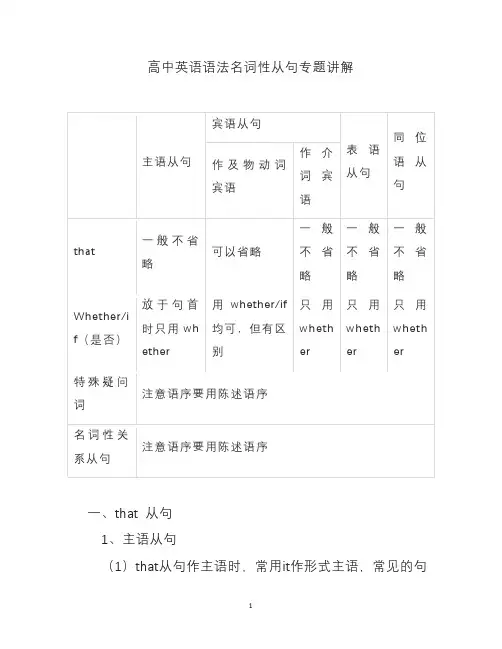
高中英语语法名词性从句专题讲解一、that 从句1、主语从句(1)that从句作主语时,常用it作形式主语,常见的句型有:It+be+形容词(obvious, true, natural,surprising,good,wonderful,funny,possible,likely,certain,prob able,etc.)+that从句It+be+名词词组(no wonder, an honor, a good thing, a pity, no surprise, etc.)+that从句It+be+过去分词(said, reported, thought, expected, decided, announced, arranged, etc.)+that从句(2)that可以省略,但that从句位于句首时,that不能省略。
2、宾语从句(1)常见的可以接that从句作宾语的动词有see, say, know, imagine, discover, believe, tell, show, think, consider, be sure, be afraid等。
在可以接复合宾语的动词之后,如think, make, consider等,可以用it作形式宾语。
(2)That从句一般不能充当介词宾语,偶尔可作except, in 的宾语。
3、表语从句(that不可省略)4、同位语从句连词that引导同位语从句时,应在某些抽象名词之后,如:fact, hope, desire, thought, suggestion, idea, news, problem, possibility等,对前面的名词起补充说明的作用,that在从句中不担当任何成分,不能省略。
二、whether/if从句1、在表语从句和同位语从句中只能用whether不能用if;当主语从句放于句首时,只能用whether不用if;当it作形式主语,主语从句放在句末时用whether或if均可;discuss后引导宾语从句时,必须用whether。
高中英语语法讲解【非谓语动词】

高中英语语法讲解【非谓语动词】【专题要点】非谓语动词和独立主格结构主要用法如下:1.动名词和动词不定式作主语、宾语;2.只跟动名词作宾语的动词或动词短语;3.只跟动词不定式作宾语的常见动词;4。
既可以跟动名词又可以跟动词不定式作宾语,且意义不同的动词或短语;5.不定式、现在分词、过去分词作宾语补足语的区别;6。
不定式、现在分词、过去分词作定语时的区别;7.不定式、现在分词、过去分词作状语时的区别;8.动名词的复合结构在句中作状语;9.there be 结构的两种非谓语形式;10。
独立主格结构在句中作状语;11。
with复合结构在句中作状语或定语.【教法指引】非谓语动词包括不定式、v—ing形式和过去分词,是高中英语学习的难点,也是高考考查的重点.高中英语非谓语动词是一个重要考点,教师在引导学生复习备考中要注意重点突出、训练得当,尤其是对以下要点的复习:1。
不定式、现在分词与过去分词的用法区别;2.非谓语动词的主动式与被动式;3。
非谓语动词完成式的用法;4.非谓语动词用作伴随状语;5。
非谓语动词用作目的状语;6。
非谓语动词用作结果状语;7.非谓语动词用作宾语补足语;8。
非谓语动词的逻辑主语问题;9。
非谓语动词用作主语的问题;10.“(be+)过去分词+介词"结构;11.动名词的复合结构和there be结构的非谓语动词形式。
对于独立主格结构的复习,教师必须要讲清它的构成方式和在句子中的作用以及与with复合结构和分词之间的辨析的关系。
【知识网络】非谓语动词主要包括不定式、动名词和现在分词。
为了区分这三种不同的非谓语动词的用法和含义,我们将分别从三种非谓语动词在句子中做主语、宾语、宾语补足语、定语、状语、表语以及一些特殊结构句型等角度来区分其用法和细微含义。
1.不定式和动名词作主语的区别(1)动名词作主语通常表示抽象动作;而不定式作主语表示具体动作。
Smoking is prohibited(禁止)here.这里禁止抽烟。
高中英语语法英语中的否定转移 及部分否定专题讲解
高中英语语法英语中的否定转移及部分否定专题讲解“I don’t think he is a good doctor.”翻译:我认为他不是个好医生。
I don’t think you will have any difficulty in finding the boy’s dormitory.翻译:我认为你找到男生宿舍不会有困难。
否定转移的主句动词在语义上可分为两类:A:表示看法的动词:be supposed to, believe, expect, imagine, suppose, think,fancy,guess,should say 等表示主观意见和猜想的动词在句中作谓语时,按习惯其宾语从句的否定通常转移到主句。
如:1. I didn’t think I have seen you before.2. She didn’t imagine that we would sayanything.B:表示感觉的动词:在seem,feel,taste,sound,appear,look like, feel as if, look as if, sound as if作联系动词的句子中,特别是seem,按习惯以它的否定来代替其他部分的否定。
例如:1. The baby doesn’t appear to be awake.2. It doesn’t look(看起来) like it’s(天不会)going to rain.3.English doesn't seem easy to learn. 英语好像不容易学。
4.It didn't seem during those years that there could be anyone else who might share my own peculiar tastes. 在那些年月里,似乎没有人会有我这样的特殊情趣。
类似的情况还有半助动词happen。
高中英语语法同位语从句专题讲解
高中英语语法同位语从句专题讲解1.同位语从句的相关知识同位语从句对于他所修饰的名词作进一步解释,说明名词的具体内容.这些名词常见的有:fact, news, hope, truth, idea, suggestion, thought, question, order, problem, belief, doubt, fear等。
引导同位语从句的连词通常有that和whether, what, why, how…等。
①如果同位语从句意义完整, 则用that引导。
that不充当任何成分, 只起连接作用。
如:The general gave the order ____ the soldiers should cross the river at once.将军下达了战士们立即过河的命令。
(the soldiers should cross the river at once是the order的全部内容, 且意义完整,因此应用that引导同位语从句)②如果同位语从句意义不完整,需增加“是否”的含义, 则应该用whether引导。
如:We’ll discuss the pr oblem ________ the sports meeting will be held on time. (填whether)我们将讨论运动会是否会如期举行的问题。
注意: if不能引导同位语从句。
③如果同位语从句意义不完整, 需增加“什么时候”、“什么地点”、“什么方式”等含义,应该用when, where, how等词引导。
如:I have no idea _____ Chaplin’s film will be on. (when)我不知道卓别林的电影什么时候放映。
I have no impression _____ he went home, perhaps by bike. (how)我记不清他是怎样回家的, 或许是骑自行车回去的。
高中英语倒装句专题讲解(共37张)
Not until his mother came back did he finish his homework.
c.“一…就…”句型的运用
Hardly/Scarcely …when … No sooner …than …
主句使用部分倒装, 且用过去完成时, 从 句用一般过去时。
1.I had no sooner set off than it began to rain. No sooner _h_a_d__I_s_e_t_o_f_f than it began to rain.
某人确实如此
e.g. Betty is a nice girl. So she is .
5. So/Such …that…引导状语从句, 当so、 such置于句首, 主句要部分倒装。
He spoke so loudly that even people in the next room could hear him.
Never will I forget the day when I joined the Youth League.
2). 在含有no的介词短语词组出现在句首时, 如 in no way, in no case, by no means, at no time, under no circumstances, under no condition, on no account 等表示‘决不’的词组。
通常是主语在前, 谓语在后。
Now come但th有e m时e谓n’语s 1的10全hu部rd或le者s. 一部 Out rush t分he(at通hl常ete是s.助动词或情态动 Up they ju词m)p.却提到主语的前面, 这种 So fast does Jo语h序n r叫un做th“a倒t h装e b”re。aks the school record.
高中语法专题解析动词的时态语态和语法功能
高中语法专题解析动词的时态语态和语法功能高中语法专题解析动词的时态、语态和语法功能动词是语言学中的重要组成部分,它能够表示动作、状态或存在,并具有一定的时态、语态和语法功能。
在本文中,我们将对高中语法中动词的时态、语态和语法功能进行详细解析。
一、动词的时态时态是动词的一个重要语法属性,它用来表示动作或状态发生的时间。
常见的动词时态包括过去时、现在时和将来时。
下面分别对这三种时态进行详细讲解。
1. 过去时:表示动作或状态在过去某个时间内发生或存在。
过去时的构成:(1)一般过去时:动词原形的基础上加上-ed或-d。
例如:walked(走过)、talked(谈论过)(2)过去进行时:be动词的过去形式+动词的ing形式。
例如:was/were walking(正在走)(3)过去完成时:have/has的过去式+动词的过去分词。
例如:had walked(已经走过)2. 现在时:表示动作或状态在现在时间内发生或存在。
现在时的构成:(1)一般现在时:动词原形。
例如:walk(走)、talk(谈论)(2)现在进行时:be动词的现在形式+动词的ing形式。
例如:am/is/are walking(正在走)(3)现在完成时:have/has+动词的过去分词。
例如:have walked(已经走过)3. 将来时:表示动作或状态将要发生。
将来时的构成:(1)一般将来时:will/shall+动词原形。
例如:will/shall walk(将要走)(2)将来进行时:will/shall+be动词的现在分词+动词的ing形式。
例如:will/shall be walking(将要正在走)(3)将来完成时:will/shall+have+动词的过去分词。
例如:will/shall have walked(将要已经走过)二、动词的语态语态是动词的一种形式,用来表示动作的主体与动作所涉及的对象之间的关系,常见的语态有主动语态和被动语态。