
牛津译林版-英语-九上-九上3单元 Teenage problems 知识精讲1
初中-英语-打印版
初中-英语-打印版 九年级英语Unit 3 Teenage problems (1)
一. 教学内容:
Unit 3 Teenage problems(1)
Main task:
Write a letter to your pen friend about how you deal with the problems of stress.
Tasks:
1. Use ‘wh’-words + to –infinitives.
2. Learn different types of sentences.
3. Distinguish different types of sentences.
二、重点、难点:
Comic Strips
1. Teenage problems. 青少年的问题。
Teenage, adj. “十来岁的”,主要指十三岁到十九岁这个年龄段的。
e.g. They are teenage children. 他们是十几岁的孩子
teenager, n. “十来岁的青少年”
e.g. He joined a club for teenagers. 他参加了一个青少年的俱乐部。
2. I’m getting fat. Look at my stomach. 我正在发胖,看我的肚子。
get 在这里是一个连系动词,与形容词一起构成系表结构。
e.g. He got tired after the long walk.
连系动词除be动外,还有感官动词:look, sound, smell, taste, feel,还有三个“变”,即:get, turn, become等
e.g. The cake tastes good.
What’s wrong? You look unhappy today.
3. Eating too much makes you unhealthy. 吃得太多使你不健康。
eating too much 动名词短语做主语
e.g. Running and swimming are good for you.
Welcome to the unit
1. I don’t have close friends. 我没有要好的朋友。
close adj. “亲密的”、“紧挨着的”
e.g. He is close to his brothers.
The two buildings are close to each other.
2. The TV is always on. 电视总是开着。
be on 开着的;进行中;常指电灯、电视等开着,反义词为“off”。
e.g. The light isn’t on. He can’t be inside.
The film has been on for half an hour. 电影已放映半小时了。
3. I always quarrel with my cousin. 我总是和我的堂妹吵架。
quarrel with sb. 与某人吵架
e.g. She quarrelled with me yesterday.
初中-英语-打印版
初中-英语-打印版 Reading
1. At the moment, painting is my favourite hobby. 目前,绘画是我最喜欢的爱好。
moment 意思是“瞬间、片刻”等,用法有很多。
e.g. A few moments later he heard footsteps. 过了一会儿,他听见了脚步声。
2. I know it is very important to work hard and hand in my homework on time, …
我知道努力学习并且按时交作业是很重要的,……
hand 是“交、递、给、提供”的意思。
hand in 意思是“交上、提交”。还有一个很近的词组是hand on,意思是“传下去、转交”。
e.g. Please watch this notice and hand it on. 请把这张通知看一下,并传阅。
3. Should I focus on my homework and give up my hobbies? 我是否应该把重点放在作业上,而放弃我的爱好?
focus 意思是“(使)聚集,(使注意力)集中于”。它既可以做及物动词,也可以做不及物动词。
e.g. He took the glass and focused the sun on some dried wood.
他拿出透镜,然后把太阳光聚焦在一些干木材上。
e.g. The meeting focused on the protection of wild animals.
会议集中讨论了野生动物保护问题。
4. Can you please teach me how to achieve a balance between the two?
你能否教我如何才能在两者之间获得平衡吗?
achieve 意思是“完成;做到;达到(目标)”
e.g. He will never achieve anything if he doesn’t work hard.
他如果不努力工作就永远不会有所成就。
achieve success 取得成功
balance 意思是“天平;平衡”,用法如下:
weigh sth. in a balance 用天平称某物
the balance of nature 生态平衡
5. I am Grade 9 student and I am crazy about football!
我是一个九年级学生,我是个足球迷!
crazy 本意是“疯狂的”,这里的意思是“狂热的、着迷的”,常与about 连用。
e.g. A crazy person set fire to the house. 一个疯子放火烧了房子。
She is crazy about dancing. 她对跳舞着迷。
6. I’d like your advice. 我想听听你的意见。
advice 意思是“意见;劝告”。常和某些动词搭配,如:give/offer advice 提出劝告; ask
for sb.’s advice征求某人的意见;take/follow/accept sb.’s advice 接受某人的意见。
7. We like staying out late to play football. 我们喜欢在外面踢足球踢到很晚。
stay out 意思是“呆在外面;呆在户外”,常用的固定词组还有“stay up”,意思是“不睡觉,熬夜”。
e.g. Children always like to stay out to play different games.
孩子们总是喜欢呆在外面玩各种游戏。
I felt very tired because I stayed up last night.
我觉得很累,因为我昨晚熬夜了。
8. I really don’t understand why they are so strict.
我真的不明白他们为什么对我如此严厉。 初中-英语-打印版
初中-英语-打印版 strict 在本句中的意思是“严格的”。be strict with sb 是“对某人要求严格”的意思。
e.g. They are very strict with their children. 他们对自己的孩子非常严格。
9. They would be most valuable. 它们将是最有价值的。
valuable 意思是“贵重的;有价值的”。如:
valuable articles 贵重物品
valuable information 重要信息
其根词是“value”,译为“益处;价值;估价”,用法如:
e.g. You’ll find this map of great value in helping you to get round London.
你将会发现这张地图对你游览伦敦大有帮助。
10. I hope I can offer you some useful suggestions. 我希望我能给你提供一些有用的建议。
offer意思是“(主动)给予;提出;拿出;出价;奉献”等,用法如下:
e.g. He offered his identity card at the entrance. 他在入口处出示了身份证。
We offered him the house for 10000 pounds. 这栋房子我们向他开价1万英镑。
They offer their lives to art. 他们把生命奉献给了艺术。
11. This will give you an idea of how much free time you have.
这能让你知道自己到底有多少空闲时间。
idea的本意是“想法;理解”。
e.g. He has a clear idea of his responsibility. 他清楚地知道自己的职责是什么。
come up with an idea 想出一个办法
have no idea 料想不到;毫无所知;不理解
12. I hope this piece of suggestion will be useful to you. 我希望这条建议能对你有用。
suggestion做“建议;方案”时是可数名词,可以加“s”,也可以在前面加“a”。在这里用a piece of suggestion表示“一条建议”是为了强调。
e.g. At your suggestion I bought the car. 在你的建议下,我买了那辆车。
Vocabulary
1. Although I know homework is important, I become angry when there is too much to do
because I will not have time for my hobbies.
尽管我知道功课很重要,但是当作业多得做不完时,我还是会很生气,因为我就没有时间去何做我的事情了。
这是一个多重从句,although 引导的是一个让步状语从句,when引导的是一个时间状语从句,because引导的是一个原因状语从句,主句是I become angry. 所以看见这种长句不要害怕,可以学着把各种修饰成分分开,最终找到主句,就能明白作者的本意了。
牛津译林版英语九上Unit 3《Teenage problems》(Grammar)教学设计

牛津译林版英语九上Unit 3《Teenage problems》(Grammar)教学设计
一. 教材分析
《牛津译林版英语九上Unit 3 Teenage problems》主要讨论青少年时期可能遇到的各种问题,如学习压力、与父母沟通、健康饮食等。本单元通过不同的话题帮助学生了解青少年阶段可能面临的挑战,并学会用英语表达这些问题。单元中包含了大量的词汇和表达方式,以及一些复杂的语法结构,如现在分词作状语等。
二. 学情分析
九年级的学生已经具备了一定的英语基础,能够理解和运用一些基本的英语表达方式和语法结构。然而,对于一些复杂的语法结构和词汇,他们可能还需要进一步的引导和帮助。此外,由于青少年阶段本身就是充满挑战和变化的,学生应该能将自己的人生经验和所学内容联系起来,提高他们的学习兴趣和参与度。
三. 教学目标
1. 学生能够掌握本单元中的重点词汇和表达方式,如“pressure”,
“communicate”, “healthy eating”等。
2. 学生能够正确运用现在分词作状语等语法结构。
3. 学生能够用英语讨论青少年时期可能遇到的问题,并给出相应的建议。
四. 教学重难点
1. 重点:本单元的重点词汇和表达方式,以及现在分词作状语的语法结构。
2. 难点:如何正确运用现在分词作状语,以及如何在讨论中运用所学词汇和表达方式。
五. 教学方法
1. 任务型教学法:通过不同的任务和活动,让学生在实际的语言环境中学习和运用英语。
2. 合作学习:鼓励学生之间的合作和交流,提高他们的语言表达能力和团队合作能力。
3. 引导式教学法:教师引导学生通过观察、思考和讨论,发现和理解语言规律。
六. 教学准备
1. 教材:牛津译林版英语九上Unit 3 Teenage problems。 2. 多媒体教学设备:用于展示PPT和视频材料。
3. 教学素材:与本单元主题相关的图片、视频等。
七. 教学过程
牛津译林版-英语-九上-9A 3单元 Teenage problems

初中-英语-打印版
初中-英语-打印版 9A Unit 3 Teenage problems(2)
第三单元 青少年问题
重点难点
21.I hope I cam offer you some useful suggestions.我希望我能够提供一些有用的建议给你。
▲offer 用作动词,意为“提供;”“为…提供机会,给予”常用短语“offer sb. sth或offer sth. For sb.”意思是“为某人提供某物”。如:
①I offered him a glass of wine.我敬了他一杯酒。
① will you offer the guests some coffee?请你给客人拿一些咖啡好吗?
② I﹐ve been offered a job in Japan.日本有份工作要聘请我去做。
③ The company has offered a high salary.公司提出高薪招聘。
④ She offered a reward for the return of her lost bracelet.她为寻回遗失的手镯提出以报酬答谢。
⑤ He offered §3,000 for the house.他提出了3000英镑买这间房子。
⑥ We offered him the house for $ 20,000.我们要他出20,0000美元买这间房子。
offer to do sth.的意思是“主动提出做某事。”如:
She offered to carry the box for her mother. 她主动提出要帮她母亲拿箱子。
We offered to leave. 我们表示要走了。
He offered to lend me his bike.他表示要把自行车借给我。
Never to teach fish to swim.莫班门弄斧。
牛津译林版九年级上册Unit3《Teenageproblems》(Task)说课稿
牛津译林版九年级上册Unit 3《Teenage problems》(Task)说课稿
一. 教材分析
《Teenage problems》是牛津译林版九年级上册Unit 3的一篇课文,主题是关于青少年问题的。通过描述青少年在成长过程中所面临的各种问题,如学习压力、与父母关系、朋友关系等,让学生了解并关注这一年龄段所特有的困惑和挑战。本节课的主要目标是让学生能够理解课文内容,掌握相关的语言知识,提高阅读理解能力。
二. 学情分析
九年级的学生已经具备了一定的英语基础,能够听、说、读、写一些简单的英语句子。但他们在阅读理解方面还存在一定的困难,特别是对于一些长篇的文章。因此,在教学过程中,我们需要关注学生的阅读理解能力,引导他们通过关键词、句子来理解文章的大意。
三. 说教学目标
1. 知识目标:让学生掌握课文中的关键词汇和句型,提高阅读理解能力。
2. 能力目标:培养学生通过关键词、句子来理解文章大意的技巧。
3. 情感目标:让学生认识到青少年时期所面临的问题,引导他们正确面对和处理这些问题。
四. 说教学重难点
1. 重点:课文的理解和相关的语言知识的掌握。
2. 难点:对于一些长篇的文章,学生如何通过关键词、句子来理解文章的大意。
五. 说教学方法与手段
1. 教学方法:采用任务型教学法,让学生在完成任务的过程中,提高阅读理解能力。
2. 教学手段:利用多媒体课件,为学生提供丰富的视觉、听觉材料,激发学生的学习兴趣。
六. 说教学过程
1. 导入:通过提问方式,引导学生谈论青少年时期所面临的问题,激发学生的学习兴趣。
2. 阅读理解:学生自主阅读课文,回答相关问题,教师给予指导。 3. 单词学习:学生通过课文,学习并掌握相关的词汇。
4. 句型练习:学生模仿课文中的句型,进行口语练习。
5. 小组讨论:学生分组讨论,分享自己面临的青少年问题,并尝试寻找解决办法。
6. 总结:教师引导学生总结课文内容,加深对文章主题的理解。
Unit3 Teenage problems必默知识点2022-2023学年牛津译林版英语九年级上册
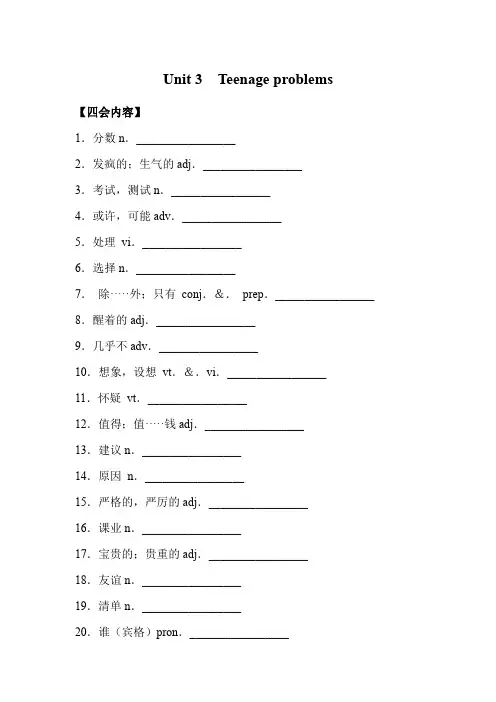
Unit 3 Teenage problems
【四会内容】
1.分数n._________________
2.发疯的;生气的adj._________________
3.考试,测试n._________________
4.或许,可能adv._________________
5.处理 vi._________________
6.选择n._________________
7. 除·····外;只有 conj.&. prep._________________
8.醒着的adj._________________
9.几乎不adv._________________
10.想象,设想 vt.&.vi._________________
11.怀疑 vt._________________
12.值得;值·····钱adj._________________
13.建议n._________________
14.原因 n._________________
15.严格的,严厉的adj._________________
16.课业n._________________
17.宝贵的;贵重的adj._________________
18.友谊n._________________
19.清单n._________________
20.谁(宾格)pron._________________ 21.安静,寂静;沉默n._________________
22.担心;令人担忧的事n._________________
23.方法n._________________
24.解决;解答 vt._________________
25.字典 n._________________
26.答复,回答n._________________
27.化学n._________________
28.进展,进步n._________________
2018九年级英语上册 Unit 3 Teenage problems讲义 (新版)牛津版

Unit 3 Teenage problems
重难点精讲
The TV is always on at my home.
句中的on是副词,意思是“在进行着或处于工作状态中”。
I have a lot of homework every day, and I have no choice but to do it.
句中的choice是“选择”的意思,have no choice but to是固定搭配,意思是“别无选择、只能……”。
题一:翻译:
1.你不能开着灯就出门。
2.我别无选择,只好接受这个事实。
3.I have no choice but______.
A. to give up B. giving up C. given up
I often doubt whether it is worth spending so much time on homework.
be worth (doing) sth.意思是“值得……”,后接V-ing或名词。
I dream of a long holiday so that I could have more time for my hobbies.
dream of/about (doing) sth.意思是“梦想、想象”。
so that
引导目的状语从句时,表示“以便、为了”从句中常使用can /could /may /might /will /would /should等情态动词或助动词。
题二:翻译:
1.这本书值得一读。
2.我一心想当一个老师。
3.我努力学习为了上一个好的高中。
What about choosing your hobby according to the time you have?
according to一般可以引出表示原因或参考等的状语。有“根据、按照”的意思。 2 Many students of our age have this problem.
2022牛津译林版九年级英语Unit 3重难点词组整理

天天向上独家原创
1 / 6 9A Unit3词组归纳
1. teenage problems少年问题 teenager(n)
2. eat too much吃得太多
v.+too much
too/so much+不可数名词:太多/如此多too/so many+可数名词复数太多如此多
much too+形容词 实在太
3. Why not eat less and exercise more?为什么不少吃多锻炼呢?
4. ask for advice on how to solve their problems征求如何解决他们问题的建议
5. The TV is always on at my home.我家里电视机总是开着。
6. almost drive me mad (madder-maddest)几乎使我受不了
7. get low/high/full marks in exams在考试中得低/高/满分
8. work all day整天工作
9. They don't have time for me.他们没有时间陪我。
10. feel sleepy in class (sleepier)在课堂上感到困倦
feel lonely感到孤独(lonelier)
fall asleep入睡,睡着
11. Perhaps you should manage your time betterand go to bed earlier.
或许你应该更好地管理你的时间,并早点上床睡觉
manage to do sth.设法做成某事(成功了) try to do sth.试着做某事(不一定成功) 天天向上独家原创
2 / 6 12. I don't know how I should deal with it.
=I don't know what I should do with it.我不知道我应该怎么处理它。( dealt-dealt)
牛津译林版英语九年级上册 9A Unit 3 单词知识点讲义
1 9A Unit3 单词知识点讲义 1.teenage adj. 青少年的
teenage problems/magazines 青少年问题/杂志
teenager n. 青少年 We are all teenagers .
in my teens 在我十多岁 2. mark n. 分数
get/achieve high/low/full marks 得高/低/满分
He got full marks in the English test. make a mark 标记
v. 做标记 The interesting places are marked in red.
那些有趣的地方被用红色做标记。
3. mad adj. 发疯的;
生气的 madder- maddest
go mad 发疯
drive sb mad 使人受不了 The noise almost drove me mad.
----What’s up? ---I can’t stand the noise outside .It’s
nearly__________me mad. A. keeping B. turning
C. causing D. driving madly adv. 发疯地
4. exam n. (examination) 考试,测试 fail (in) an exam 考试不及格
pass an exam 考试及格 take/have an exam 参加考试
5. perhaps-----maybe adv. 或许,可能
Perhaps/Maybe he will come tomorrow, but I’m not sure.
6. deal vi. 处理 deal----dealt----dealt
牛津译林版九年级英语上册Unit3全单元教案
2 总 课 题
9A Unit 3 Teenage problems 总课时 6 第 1 课时
课 题 Comic strip & Welcome to the unit 课 型 新授
教学目标 知识目标 1. Know the spelling of some words and usage of some phrases
2. Know the different meanings of ‘get’
能力目标 1. Talk about problems and their causes.
2. Think about one’s problems and how to deal with them
情感目标 Express problems and talk about solutions.
教学重点 Talk about problems and their causes.
教学难点 Express problems and talk about solutions.
课前预习 1. Preview the new words and phrases
2. Pre-learn Period 1: Comic strip & Welcome to the unit
教 学 过 程
Step1. Warm-up
1.Explain that most teenagers have problems. Tell them that if they ever need to talk about
their problems, they should talk to their teachers, friends or family. Tell them that having
a problem is nothing to be ashamed of ----- everyone has worries from time to time.
牛津译林版英语9A-Unit-3-知识点总结解析
牛津译林版英语9A-Unit-3-知识点总结解析
1 / 8 牛津英语9A Unit 3 Teenage problems
课文重点单词、短语、句型、语法及综合技能详解
一.Comic strips & Welcome to the unit
1. What’s wrong,Eddie?怎么了,埃迪
What’s wrong?相当于What’s the matter?/What’s the trouble?
若询问某人出了什么问题或有什么不顺心的事,可在其后加with sb.
--You look very sad,what’s wrong?你看起来很伤心,怎么了?
--My father is ill.我父亲生病了。
【拓展】What’s wrong?也可用于询问某物出了什么毛病,可在其后加with sth.
What’s wrong with the bus?
2. The TV is always on at my home。我家里的电视总是开着。
on此处为副词,意为“处于工作状态中;在进行中”
The radio is on;who’s listening?收音机正开着,谁在听?
The light is on,but no one is in the room.电灯开着,但房间里没有人。
3. The almost drives me mad. 几乎使我受不了。
drive sb. mad “使人受不了”,是固定短语。
The boring film drives me mad.这部无聊的电影使我受不了。
mad 形容词,“发疯的,生气的”,在句中可作定语或表语。be mad about意为“对…生气;对…痴迷”
He is a mad singer.他是一个疯狂的歌手。
My mother is mad about my low marks.我母亲对我的低分生气。
牛津译林版初中英语9aunit3teenageproblems语法知识点及相关习题
Unit 3 Teenage problems(B)
一. 教学内容:
9A Unit 3 Grammar
二. 教学目标:
1. To-infinitives 动词不定式
2. “wh〞 words + to-infinitive 疑问词+不定式动词
3. Sentence types 句子的四种类型
【具体教学进程】
〔一〕To-infinitives 动词不定式
Subject (主语)
To plant trees every year is necessary.
不定式作主语常能换成形式主语 “it〞.
To eat too much is unhealthy for you.
It is unhealthy for you to eat too much.
To learn English well is important.
It is important to learn English well.
咱们相信早上读英语是有帮忙的.
We believe it is helpful to read English in the morning.
Predictive (表语)
My dream is to be a great football player.
不定式作表语,说明主语的内容,性质,特点,能接不定式作表语的名词有: dream, plan, duty, aim, purpose,
job 等
1. 我的目的是帮忙你提高你的英语水平。
My purpose is to help you improve your English.
2. 赫本的妄图是成为一个成功的芭蕾舞者。
Hepburn’s dream was to become a successful ballet dancer.
Object (宾语)
不定式能够接在有些动词后作宾语, 如: hope, promise, plan, learn, decide, choose, prepare, agree,