
七年级下册英语课堂笔记每课2020,七年级英语下册知识点总结人教版
人教版英语 七年级下册 7单元知识点笔记
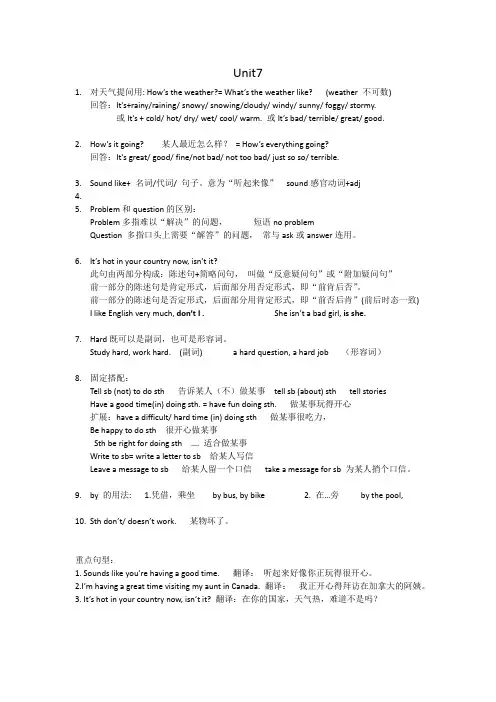
Unit7
1. 对天气提问用: How’s the weather?= What’s the weather like? (weather 不可数)
回答:It’s+rainy/raining/ snowy/ snowing/cloudy/ windy/ sunny/ foggy/ stormy.
或It’s + cold/ hot/ dry/ wet/ cool/ warm. 或It’s bad/ terrible/ great/ good.
2. How’s it going? 某人最近怎么样? = How’s everything going?
回答:It’s great/ good/ fine/not bad/ not too bad/ just so so/ terrible.
3. Sound like+ 名词/代词/ 句子。意为“听起来像” sound感官动词+adj
4.
5. Problem和question的区别:
Problem多指难以“解决”的问题, 短语no problem
Question 多指口头上需要“解答”的问题, 常与ask或answer连用。
6. It’s hot in your country now, isn’t it?
此句由两部分构成:陈述句+简略问句, 叫做“反意疑问句”或“附加疑问句”
前一部分的陈述句是肯定形式,后面部分用否定形式,即“前肯后否”。
前一部分的陈述句是否定形式,后面部分用肯定形式,即“前否后肯”(前后时态一致)
I like English very much, don’t I . She isn’t a bad girl, is she.
7. Hard既可以是副词,也可是形容词。
Study hard, work hard. (副词) a hard question, a hard job (形容词)
七年级英语下册unit2课堂笔记整理
七年级英语下册unit2课堂笔记整理
全文共6篇示例,供读者参考
篇1
Unit 2 - Festivals and Celebrations
This unit was all about different festivals and ways people
celebrate around the world. We learned about some major
holidays like Christmas, Diwali, and the Chinese New Year. But we
also discovered some interesting minor festivals I'd never heard
of before!
Christmas
We started off by talking about Christmas since it's a big
holiday most of us are familiar with. We discussed how it's
celebrated in the West - decorating trees, hanging stockings,
eating turkey dinners, leaving out milk and cookies for Santa, etc.
I thought it was interesting how the original Christmas
celebrations were a mix of ancient pagan winter festivals
combined with the Christian holiday celebrating the birth of
Jesus. Things like decorating trees, hanging mistletoe, and the legend of Santa Claus delivering presents actually started from
七年级下册英语第八单元的笔记人教版

七年级下册英语第八单元的笔记人教版
Unit 8 Is there a post office near here?
一、重点单词。
1. post.
n. 邮政;邮件。例如:I sent a post to my friend yesterday.(我昨天给我朋友寄了一封邮件。)
v. 邮寄。如:Please post this letter for me.(请帮我寄这封信。)
2. office.
n. 办公室。像:My father works in an office.(我爸爸在一个办公室工作。)
3. police.
n. 警察;警方。注意“police”是复数形式,单指一个警察是“policeman”或者“policewoman”。例如:The police are looking for the thief.(警方正在寻找小偷。)
4. hotel.
n. 旅馆;酒店。When we travel, we often stay in a hotel.(当我们旅行的时候,我们经常住在酒店里。)
5. restaurant.
n. 餐馆;饭店。I like to eat in a restaurant on weekends.(我喜欢在周末在餐馆吃饭。)
6. bank. n. 银行。People go to the bank to save or get money.(人们去银行存钱或者取钱。)
7. hospital.
n. 医院。If you are ill, you should go to the hospital.(如果你生病了,你应该去医院。)
8. street.
n. 大街;街道。There are many shops on this street.(这条街上有很多商店。)
9. pay.
v. 付费;支付。常见搭配“pay for sth.”,例如:I have to pay for my new
七年级下册英语重点笔记人教版

七年级下册英语重点笔记人教版
一、认识音标
在学习英语的过程中,掌握好音标是非常重要的。音标可以帮助我们正确地发音,提高听说能力,也能够帮助我们更准确地理解和记忆单词。七年级下册英语中,我们将学到更多的音标内容,包括元音音标和辅音音标。在掌握音标的过程中,我们不仅要注重形式化的记忆,更要注重实际的练习和应用。通过多听、多说、多读,加强对音标的理解和掌握。
二、学习重点词汇
在七年级下册英语课程中,我们将学习到更多的重点词汇。这些词汇不仅是我们课文的重点,也是我们日常交流中必不可少的词汇。我们要特别注重这些词汇的学习和掌握。可以通过单词卡、单词本等形式,进行多次的记忆和复习,也可以通过与同学、老师进行交流,巩固词汇的掌握。
三、掌握语法知识
七年级下册英语课程中,我们将学习更多的语法知识。比如进行时态、动词的用法、句子结构等内容。通过细致的学习和实际的练习,我们能够更好地掌握这些语法知识,提高自己的写作和表达能力。我们要注重语法知识的灵活运用,可以通过写作、口语练习等形式,提高语法知识的应用能力。
四、阅读理解能力
在七年级下册英语课程中,我们将接触到更多的阅读材料。这些材料不仅包括课文内容,还包括一些阅读理解题目。通过阅读的过程,我们能够了解更多的知识,提高自己的阅读理解能力。在阅读理解过程中,我们要注重细节的把握,提高对文章整体的理解能力。可以通过大量的阅读练习,积累更多的阅读经验,提高自己的阅读速度和理解能力。
五、写作能力的提高
在七年级下册英语课程中,我们将学习更多的写作知识。我们不仅要学会写句子、段落,还要学会写作文。通过写作的过程,我们可以提高自己的语言表达能力,增强自己的思维能力。在写作的过程中,我们要注重语言的丰富性和表达的准确性,通过多次的修改和润色,提高自己的写作水平。
总结回顾:
在七年级下册英语课程中,我们学习了更多的知识,提高了自己的英语能力。通过掌握音标、学习重点词汇、掌握语法知识、提高阅读理解能力和写作能力的提高,我们不仅能够更好地掌握英语知识,也能够提高自己的英语能力。在未来的学习中,我们要继续巩固所学知识,不断提高自己的英语能力,为将来更好的学习和生活打下坚实的基础。
人教版七年级下册英语Unit6笔记打印资料

Unit 6 I’m watching TV.
1.do one’s homework 做(某人的)家庭作业 (此处的do是“做”的意思)
He is doing his homework. We are doing our homework in the class now.
2. talk on the phone 通过电话交谈。Walk on my hand,go on a ropeway on TV/the radio/on
the computer/on the internet. He is talking to his mother on the phone.
3. watch, look, see , read 的大致区别:
(1)watch 观看,看 watch TV 看电视 watch a football game 看一场足球比赛 watch
the race on TV :通过电视看比赛(2)see 看见(看的结果)
I can see the bird in the tree.
(3)look 看(看的动作), 其后必须接介词at,再接宾语 Please look at the blackboard.
(4)read 阅读,读书,读报(book,newspaper,magazine)
Newspaper报纸可数,read a newspaper/read newspapers News消息,新闻,不可数。
listen to a CD:听一张CD唱片read a newspaper:读一份报纸 She is reading a story.
4. go to the movies 去看电影 =go to the cinema=see movies
(go+名词)go shopping go swimming go fishing go boating go+动词ing
七年级下册英语第七单元课堂笔记
七年级下册英语第七单元课堂笔记
一、重点单词。
1. rain.
作动词,“下雨”。例如:It often rains in spring here.(这儿春天经常下雨。)
作名词,“雨水”。We need some rain for the plants.(植物需要一些雨水。)
它的形容词形式是“rainy”,表示“多雨的;下雨的”。例如:a rainy day(一个下雨天)。
2. windy.
形容词,“多风的;有风的”。It's windy today. Let's fly a kite.(今天有风,我们放风筝吧。)这个单词是由名词“wind(风)”加“-y”构成的形容词,像这种构词法很常见哦,比如“sun sunny(阳光充足的)”“cloud cloudy(多云的)”。
3. cloudy.
形容词,“多云的;阴天的”。The sky is cloudy. Maybe it will rain soon.(天空是多云的,也许很快就要下雨了。)
4. sunny.
形容词,“晴朗的;阳光充足的”。We had a sunny day yesterday. We went
to the park.(我们昨天天气晴朗,我们去公园了。)
5. snow. 作动词,“下雪”。It snows a lot in winter in Harbin.(哈尔滨冬天经常下雪。)
作名词,“雪”。There is a lot of snow on the ground.(地上有很多雪。)它的形容词是“snowy(下雪的;多雪的)”,例如:a snowy winter(一个多雪的冬天)。
6. weather.
名词,“天气”。这个单词可重要啦。我们经常会问“What's the weather like
today?”(今天天气怎么样?)回答可以是“It's
sunny/rainy/windy/cloudy/snowy.”(天气是晴朗的/下雨的/有风的/多云的/下雪的。)
英语七年级下册人教版一般将来时和一般现在时两种时态笔记概念构成动词形式
英语七年级下册人教版一般将来时和一般现在时两种时态笔记概念构成动词形式
1.一般现在时
(1)结构:当主语是第三人称单数时,谓语动词用第三人称单数形式。
(2)动词的第三人称单数形式变化规则如下:
①直接加s。如:work-works。
②以“辅音字母+y”结尾的词,先变y为i,再加es。
如:carry-carries;cry-cries;try-tries;study一studies。
③以s,x,o,ch,sh结尾的词加es。
如:wash-washes;teach-teaches;go-goes;pass一passes;fix-fixes。
④特殊:have has;am/are is
(3)用法:
①表示习惯性的动作。常与seldom,often,usually,always,sometimes,today,every day,once a week,every five minutes,on Sundays等时间状语连用。如:
I go to school at seven every day.
我每天七点去上学。
②表示普遍真理和客观事实。如:
The earth goes around the sun.地球绕着太阳转。
③表示在现里所发生的一个动作。如:
Here comes the bus.公共汽车来了。
④在时间和条件状语从句中代替一般将来时。如:
I'll go shopping with my mother if sheis free tomorrow.如果明天我妈妈有空,我将和她去购物。
3.一般将来时
(1)结构:助动词shall/will+动词原形;be going to
+动词原形
(2)用法:
①表示将要发生的动作或状态,常用的时间状语有
later(on),soon,in a month(in+时间段),next time,from now on,tomorrow等。如: I shall be eighteen years old next year.
人教版英语 七年级下册 8单元知识点笔记
Unit8
1. 句型:某物在什么地方。 The sth +be+ 方位介词短语.
on the…在…之上/ under the…在…之下/ in the….在…里面 / out of the….在…外面
/ in front of the….在… 前面 /behind the….在… 后面
across from the….在… 对面 / next to the…挨着…../ near the…在…附近/
between the… and the….在….和….之间
2. 问某地在哪里常用句型:
1. Where is the …..?
2. Is there a ……near here?
3. How can I get to the….?
4. Could you tell me the way to the….?
5. Could you tell me how to get to the….?
3. 指路常用语:Go along…. Go down…. Walk along…. turn right turn left
at the first / second/ third/ fourth crossing
It’s on your right. / You can see…. on your right. / You can find… on your right.
4. . There be 句型, 就近原则。
There is a book and 2 pens. = There are 2 pens and a book.
变否定句:There is not a book and 2 pens. / There aren’t 2 pens and a book.
变一般疑问句:Is there a book and 2 pens? / Are there 2 pens and a book?
七年级下册英语笔记。
七年级下册英语笔记。
同学们!今天咱来聊聊七年级下册英语的那些笔记哈。这可是咱英语学习路上很重要的一部分哟,记好了,英语成绩那不得蹭蹭往上涨😉。
一、词汇部分。
七年级下册英语里有好多新单词呢。像“neighborhood”,读音是[ˈneɪbəhʊd] ,意思是“街区;街坊;附近;邻近地区”。咱可以造个句子哈,比如“My
neighborhood is very quiet.”(我住的街区很安静。) 它的近义词有“district” 。
还有“post office”,这个就简单啦,读音是[ˈpəʊst ɒfɪs] ,就是“邮局”的意思。造句可以是“I'm going to the post office to send a letter.”(我打算去邮局寄封信。)
“hospital”,读音[ˈhɒspɪtl] ,“医院”的意思。比如说“She is in
hospital now.”(她现在在医院里。) 它的近义词有“clinic”(诊所,不过规模一般比医院小哈)。
二、语法部分。
这学期的语法也有点小难度呢😉。
1. 一般现在时的用法。一般现在时常常用来表示经常发生的动作或者存在的状态。比如说“He often plays football on weekends.”(他经常在周末踢足球。)这里的“plays”就是一般现在时的第三人称单数形式。当主语是第三人称单数(he/she/it等)时,动词要加“s”或者“es” 。这个规则可得记牢哟,不然做题容易出错😉。
2. 方位介词的用法。像“in”“on”“at”这些方位介词在描述地点的时候用法不太一样哈。“in”一般用于大的地点,比如城市、国家等。比如说“He lives in Beijing.”(他住在北京。) “on”用于在某个表面上,比如“The book is on the
table.”(书在桌子上。) “at”用于小的地点,像具体的门牌号、车站等。比如“He is waiting at the bus stop.”(他在公交车站等车。)
七年级英语下册课堂笔记(7)
七年级英语下册课堂笔记(7)
七年级英语下册课堂笔记1.play chess 下象棋
2.join the chess/swimming/reading club
3.Sb. want to do sth. Sb. want sth.
4.Sb. be good at (doing) sth.
5.●complete the poster(海报)
6.●students/teachers/nurses wanted( 招聘)for--
want sb for+(机构)为(某机构)招聘---
7.talk to = tell
8.after school 放学后
9.●make a list 列⼀个清单
10.show(让---看/出⽰)sb .sth.
= show sth. to sb.
11.●do Chinese kung fu
12.play the + 西洋乐器/play + 民族乐器
3⽉27⽇课堂笔记
1.the description about sb./sth.关于---的描写
2.underline sth. 在---下⾯划线
3.speak+语⾔ (English/French/Japanese---)
V. 讲话;发⾔ Who spoke at the meeting?
speak to sb. 给某⼈打招呼
4.sb. can also do sth. also等副词⽤于情态动词/be动词等后⾯,⽤于⾏为动词前。I am also a student.I also like reading.
5.talk with sb. 和某⼈交谈
talk about 谈论/讨论
talk to 对---说
6.Sb. do sth., too.(句末,⽤逗号与主句隔开)
= Sb. also do sth.
7.an ad⼀则⼴告 title 标题
the title of---的标题
8.help for sb. help with sth.