
【人教版】英语七年级上册教案unit5单元语法
单元语法知识精讲
实义动词的一般现在时
1.定义
实义动词的一般现在时主要表示主语经常性的、习惯性的动作或行为。
2.常见标志词
every day(每天),usually(通常),often(常常),always(总是)等。
3.特点
实义动词随着主语的人称和数的变化而变化。
(1)当主语是第一、二人称或第三人称复数时,实义动词用原形。eg:
I have a baseball.我有一个棒球。
We have a nice classroom.我们有一个漂亮的教室。
They have many friends.他们有许多朋友。
I have an uncle and you have an aunt.我有一个叔叔,你有一个姑姑。
(2)当主语是第三人称单数时,实义动词用其第三人称单数形式。(一般在词尾加-s或-es)。eg:
He/She/Jack/Lily likes tennis.他/她/杰克/莉莉喜欢网球。
Mike plays basketball with his classmates after school every day.每天放学后迈克就和他的同学们打篮球。
4.句型结构
肯定句:主语+动词原形/动词三单+其他。
否定句:主语+don’t/doesn’t+动词原形+其他。
一般疑问句:Do/Does+主语+动词原形+其他?
肯定回答:Yes,主语+do/does.
否定回答:No,主语+don’t/doesn’t.
特殊疑问句:疑问词+do/does+主语+动词原形+其他?
【知识拓展】
实义动词变第三人称单数形式时的规则变化:
(1)一般情况,直接在词尾加-s。如:play→plays
(2)以s,x,ch,sh或o结尾的词要在词尾加-es。如:go→goes;watch→watches;do→does
(3)以“辅音字母+y”结尾的词要变y为i,再加-es。如:study→studies
此外,也有很多动词的第三人称单数形式变化并不规则,需要我们特殊记忆,如:have的第三人称单
数形式是has。eg:
Tom watches(watch) TV every night.汤姆每天晚上看电视。
Helen plays(play) baseball at school.海伦在学校打棒球。
Jack has(have) two soccer balls.杰克有两个足球。
单元语法强化训练
Ⅰ.请写出下列动词的第三人称单数形式。
1.go _________2.know ____________
3.take___________ 4.thank__________
5.study__________ 6.help ___________
7.watch ___________8.do ______________
9.have ___________10.buy ______________
11.see ___________12.be _____________
Ⅱ.用括号内所给动词的适当形式填空。
1.The girls__________ (watch)TV at home every day.
2.The picture of her family_________ (be)on the wall.
3.David ________(have)a great sports collection(收藏).
4.Does Han Mei_________ (have) a dresser(梳妆台)?
5.My grandfather __________(play) sports in the morning.
6.Where__________ (be)Lily’s parents?
7.Their CDs ___________(sound)relaxing.
8.__________(do)Tom know his family name?
9.I ______ have many friends.They (be)in the same class.
10.Our math teacher __________(go)to work(工作) by bus every day.
Ⅲ.按要求完成下列句子,每空一词。
1.I have a computer.(改为一般疑问句)
_____you ________ a computer?
2.His brother has a soccer ball.(改为否定句)
His brother_______ ______ a soccer ball.
3.Does he have a ping-pong ball?(作否定问答)
_______, _______ ______.
4.Her uncle has five basketballs.(改为一般疑问句)
________her uncle _______ five basketballs?
5.I do my homework every day after school.(改为否定句)
I _______ ______ my homework every day after school.
单元语法强化训练
Ⅰ.1.goes2.knows3.takes4.thanks5.studies6.helps7.watches8.does9.has10.buys11.seesis
Ⅱ.1.watch2.is3.has4.have5.plays6.are7.sound8.Does9.are10.goes
Ⅲ.1.Do;have2.doesn’t have3.No;he doesn’t4.Does;have5.don’t do
英语七年级上册Unit5单元语法清课件 人教新目标版

单元语法清语法精讲一般现在时中have的用法1.用法have意为“有”,强调某人拥有某物,用于一般现在时中有两种形式:have和has 。
当主语是第三人称单数时用has,其他人称用have。
eg:My friend has many toys.我朋友有很多玩具。
I have a new bag.我有一个新书包。
【助记口诀】动词have表示“有”,位置就在主语后。
“三单”主语用has,其他人称用have。
一般疑问句很好变,句首直接把do/does添。
否定句子也容易,don't/doesn't加在have/has前。
does/doesn't句中现,has要用have来替换。
2.句式句式肯定句否定句一般结构主语+have/has+其他.主语+don't/doesn't+have+其他.疑问句Do/Does+主语+have+其他?肯定答语:Yes,主语+do/does.否定答语:No,主语+don't/doesn't.特殊特殊疑问词+do/does+主语+have+其他?疑问句ꢀ【拓展】(1)当have/has后的名词被some修饰时,在否定句和疑问句中some要变为any。
eg:I have some friends.我有一些朋友。
→I don't have any friends.我没有任何朋友。
→Do you have any friends? 你有一些朋友吗?(2)辨析have/has与there be表示所属关系,即“某人或某物have/has I have a pen.我有一支钢笔。
有什么”表示存在关系,即“某地有某物There is a pen on the desk.there be”,遵循就近原则课桌上有一支钢笔。
语法精练一、用have的适当形式填空。
1.I _h_a_v_e____ a new friend.Does have2.________ Grace ________ a bag?Do haveꢀ3.________ they ________ a daughter? 4.She h_a_s_ꢀ_____ five baseballs.doesn't have5.She ________ (not) five baseballs.6.They h_a_v_e_____ a basketball.Does7.________ Lucy h_a_v_e_____ a sister?Does8.________ your brother ________ a soccer ball?have9.I _d_o_n_'_t__h_av(e n ot) a pencil box.have10.Lily and Mary ________ a room.二、单项选择。
人教版七年级英语上册教案:Unit5Grammar Focus
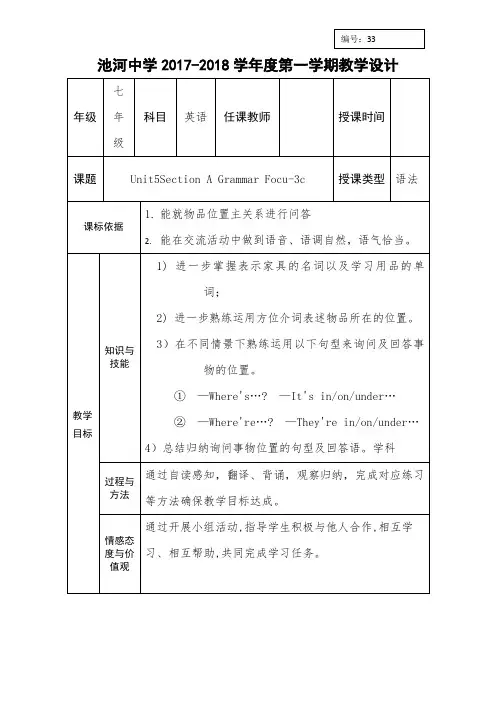
池河中学2017-2018学年度第一学期教学设计年级七年级科目英语任课教师授课时间课题Unit5Section A Grammar Focu-3c 授课类型语法课标依据1.能就物品位置主关系进行问答2.能在交流活动中做到语音、语调自然,语气恰当。
教学目标知识与技能1) 进一步掌握表示家具的名词以及学习用品的单词;2) 进一步熟练运用方位介词表述物品所在的位置。
3)在不同情景下熟练运用以下句型来询问及回答事物的位置。
①—Where's…? —It's in/on/under…②—Where're…? —They're in/on/under…4)总结归纳询问事物位置的句型及回答语。
学科过程与方法通过自读感知,翻译、背诵,观察归纳,完成对应练习等方法确保教学目标达成。
情感态度与价值观通过开展小组活动,指导学生积极与他人合作,相互学习、相互帮助,共同完成学习任务。
编号:33教学重点难点教学重点总结归纳谈论物品的位置所用的句型。
教学难点在不同情景下熟练运用以下句型来询问及回答事物的位置。
①—Where's…? —It's in/on/under…②—Where're…? —They're in/on/under…教学过程师生活动设计意图设计Step1.Revision and Lead inAsk and answer(通过句型操练复习所学的单词和句型)Step2.Grammar Focus1).阅读指导:询问事物的位置时可用特殊疑问词where引导的特殊疑问句来提问。
句型结构为: Where is…? It's in/on/under… (单数)Where are…? They're in/on/under(复数) 2).Point out the noteswhere的用法;on, in, under的用法;the的用法;名词的单复数。
七年级上册英语教案unit5
七年级上册英语教案unit5 就教学过程⽽⾔,英语教案要充分体现开放性和动态⽣成性,从⽽赋予课堂教学以灵活性和多元性品格。
⼩编整理了关于七年级上册英语教案unit 5,希望对⼤家有帮助! 七年级上册英语教案unit 5范⽂ Unit 5 Do you have a soccerball? 主备课⼈:冉宏⽂ 第1课时Section A 1a—2c 【学习⽬标】:1、掌握本节课的9个单词和2个短语 2、学会句型Do you have -----?以及其回答Yes,I do./No,I don't. 【学习重点】:学会就有关⼈与物所属关系进⾏问答的句⼦。
【教学⽤具】:A tape recorder 、 A tape 【学习过程】:⼀、⾃主学习(教师寄语:Where there is a will,there is a way.) 学习任务⼀: 熟练掌握本节课的9个词汇和2个短 语。
过程:(1)个⼈试读,组内相互纠正发⾳。
(2)教师领读,学⽣纠正⾃⼰的发⾳ (3)⾃⼰读并记住汉语意思,组内检查。
(4)⼩组竞赛,看谁记的快⽽多。
学习任务⼆:(1)认真观察1a的图画,将单词与图中物品搭配,⼩组讨论并核对答 (2)听录⾳,完成1b,⼩组核对答案 学习任务三: 熟练运⽤询问⼈与物所属关系的句型 Do you have ----?及回答 Yes,I do./No,I don't. 1、看图⽚1a,引⼊A:Do you have a pingpong ball? B:Yes,I do./No, I don't. 2、利⽤1a中物品来练习句型Do you have----?Yes,Ido.No, I don't. 3、⼩组竞赛看谁练的快⽽多。
⼆、合作共建(教师寄语:Many hands make light work. ) ⼩组讨论:Do you have a soccer ball?中的you能否替换为he? 三、系统总结(教师寄语:No man can do two things at once.) (1)这节课你学会了哪些表⽰球类的词。
【课件】Unit5Fun+Clubs+Section+B+教学设计人教版(2024)七年级英语上册+

B asic Information(基本信息)Topic 课题U5 Fun Clubssection B 1a-2bType(课型)读写课Subject 学科(版本)2024新人教版七上英语Period(课时) 1 Teacher(教师)学段、年级初中英语七年级上Teaching procedure(教学设计)Contents of teaching (教学内容)本课时的教学内容是包含了三篇文本阅读,三个俱乐部介绍了自己所在俱乐部招聘学员所需要的能力、招募的时间、地点、能在俱乐部获得怎样的提升,最后写明了联系方式。
在泛读、精读能力的培养中,拓展学生阅读文本,从而让学生进一步思考,你愿意加入哪个俱乐部,原因是什么。
写出邮件回信。
本课时在本单元中是一个难点、写作一直是学生的难点输出部分。
The analysis of the teachingmaterial (教材分析)该主题属于“人与自我”范畴下的“生活与学习”主题群,涉及子主题内容为“多彩、有意义的学校生活”。
本单元由四篇对话、一篇记叙文、一则广告三种不同类型的语篇组成。
理解含有情态动词can表示能力的表意功能,并能正确使用该结构表达自己能做的事情;能梳理和归纳情态动词的肯定句、否定句、疑问句及回答的用法。
完成一份关于班级同学能做或不能做的事情的简要报告,并且在班级进行汇报。
通过观察语篇形态认识广告类的应用文,理解三则广告俱乐部纳新的事实性信息;梳理、归纳出主题图和结构图,根据结构化图形口头完成广告播报;关联自身的个人信息,写一封俱乐部成员申请信,阐述自己想要加入俱乐部的优势,认识到参加这些活动的意义和价值,从而丰富自己的学校生活。
设计一份“创造自己的俱乐部”,设计一个你想在学校举办的俱乐部,制作海报进行新成员的纳新,并面试班级同学,为俱乐部找到新成员,参加班级“最受欢迎俱乐部”的评选。
并以评价量规规范周课程表的制作。
The nalysis of students 学情分析本单元中心主题为谈论能力,学生通过七年级英语的学习,已经有了一定的语言学习基础,积累了一定的词汇,而且该话题与学生的日常生活息息相关,容易激起学生的主动性与求知欲。
【课件】Unit5Section+A+(Grammar+Focus-3d)+课件人教版英语七年级上册

can 在一般疑问句中需 要借助助动词吗?
can 的疑问句不需要借 助助动词,直接将 can 提前,变为疑问语序。
Can you play ping-pong? Can he play the violin? Can they play chess? I can run fast, but I can’t swim.
Unit 5 Fun Clubs (Period 3)
Section A (Grammar Focus-3d)
news musical musical instrument exactly drum ability paint
n. 消息;新闻 adj. 音乐的;有音乐天赋的 乐器 adv. 正是如此;准确地 n. 鼓 n. 能力;才能 v. 用颜料画;在……上刷油漆 n. 油漆; 涂料
Pair work
A: What club do you want to join? B: I want to join … A: Can you …? B: Yes, I can. / No, I can’t. How
about you? A: I …
点击开始结束
climb more
v. 攀登;爬 adj. & pron. 更多(的)
Emma can sing well, but she can’t play any musical instruments.
can 随人称的变化 而变化吗?
can 没有人称的变化。 不管主语是什么人称,can 及其后面的动词不会变化。
3b Match the two parts to make sentences. Then make more
can 的否定形式是什么?
2022年人教版七年级英语上册教案全册Unit 5 Section B 2a-2c
5.After class, I play ping-pong with my classmates.
教学反思
1.大量的听说练习之后,学生需要输出所学的词汇、短语和句子。
2.通过本单元的学习,使学生学会分析文章的逻辑结构,比如本节课的报道列表,这样的训练对孩子逻辑思维条理性非常有益。
通过自由谈话,引导学生复习上节课的内容。
Step 2
Pre-reading
(PPT 5)
Work on 2a.
1.Ask Ss to find the sports words in the unitand write them in the correct column.
2.Call 2 Ss to write on the blackboard.
1. Ask Ss to read thesentencesfirst and check.
2. Call some Ss to give their answers.
3. Ss fill in the blanks after reading the survey.
此处是对2b的一个阅读输出。阅读2b之后,完成任务,通过练习使学生深度理解2b课文。提高学生的阅读分析能力。
Section B(2a-2c)
1. I don't have a soccer ball, but my brother Ala our friends.
3. I have two soccer balls, three volleyballs, four basketballs and five baseballs and bats....
Step 5
人教版七年级上册英语Unit5sectionB3a—教案知识点学案
Unit 5 section B3a—self --check【学习目标】1.掌握本节课的9个单词和4个短语。
2.学会写某人所拥有物品的短文。
【重点、难点】1.学会写某人所拥有物品的短文。
2.行为动词一般现在时的肯定句、否定句的结构,尤其第三人称单数形式的变化。
【导学指导】温故知新小组复习掌握本单元单词和短语,熟练掌握提建议的句型Let's--会正确运用Do you have…?Does he/she have…?来谈论物主关系。
自主互助学习要点核心解读1. Ed Smith has a great sports collection.Ed Smith 有丰富的体育用品收藏。
名词修饰名词:一般情况下变复数时,只有被修饰的名词变为复数形式,例如:apple tree -apple trees shoe shop -shoe shops如果修饰词为man, woman则两个名词都要变为复数形式,例如:woman doctor -women doctors man teacher -men teachers高分突破:1) 有的名词常以复数形式出现,例如:clothes shop -clothes shopssports center -sports centers2) 丰富的钢笔收藏:a great/big pen collection少的钢笔收藏: a small pen collection2. He only watches them on TV. 他只在电视上观看它们。
1) 看:watch, see, look, readwatch TV/ a movie/ a football game/ a match/ the news reportssee a movie/ an old friendlook at the picture/ that funny boyread the newspaper/ a map/ the menu/ an interesting story2) on TV 在电视上on the phone 在电话里on the computer 在电脑上3. I / We / They / You / The kids have 8 baseballs. 我/ 我们/ 他们/ 孩子们有8个棒球。
人教版七年级英语上册第五单元unit5doyouhaveasoccerball全英教案
人教版七年级英语上册第五单元Unit 5 Do you have a soccer ball全英文教案Period One(1a-2d)Teachingaims 1) Enable students to use “have”and “has”to talk about ownership. 2) Learn the general questions begin with “do,does”and understand the personal forms and numeros.Key points1) Read and write new letters . 2) The general questions beginwith “do,does.”Difficult points 1) Learn “does” general questions and its answers.2) The usage of “has”.Languagepoints Tennis ball,ping-pong bat,soccer ball,volleyball,basketball,baseball bat.---Do you have a baseball? Yes, I do./No, I don’t.---Does she/he have a tennis ball? Yes,she does./No,she doesn’t. Ability Learn to talk about the ownership.Teaching procedures:Step 1 Warming-up1. Greetings.2. Review the letters and language structures the Ss have learnedin Unit Four.Step 2 Presentation1. Show the students other objects. Teach the new words “soccerin theball, ping-pong ball, volleyball, tennis bat, ping-pong bat” same way. --- What’s this/ tha t?---It’s …2. Look at the words in 1a and match the words with the things inthe picture.3. Present the key structure.Present these questions and answers.(Point to a student who has a pencil box.)T: Do you have a pencil box?S1: Yes, I do. (Nod your head yes) / No, I don’t. (Shake your headno)T: (Ask S2) Does she have a pencil box?S2: (Help S2 answer) Yes, she does. / No, she doesn't.Step 3 PracticeGet Ss to finish 1a.1b,1c,2a,2b,2c.Step 4 Presentation(Show a soccer ball to class.)T: Let’s play soccer ball after class, OK?S1: OK.T: We often use the drill “Let’s…”to make a suggestion. If youwant to do it, you may say “OK. / That sounds good. / All right …”If you don’t want to do it, you may say “No, I don’t have a …”Step 5 Role-play1. Cindy and Helen want to play baseball. Now read the conversation and match the things with their right places.2. Read the conversation after the teacher and practice the conversation with your partner.3. Ask some pairs to act out the dialogue in front of the class.Homework1. Recite the new words and conversations we have learned.2. Finish Exercise 1.BriefsummaryUnit5 Do you have a soccer ball?Period Two(3a-3c)Teachingaims 1) Get Ss to use have and has to talk about ownership freely. 2) Further learn the general questions begin with “do,does”andunderstand the personal forms and numeros.Key points1) The general questions begin with “do,does.” 2)The usage ofpersonal forms and numeros.Difficult points 1) How to enable students to understand ang grasp the usage of personal forms and numeros.Languagepoints Great, play, That sounds good.---Does Bob have a soccer ball? Yes,he does./No,he doesn’t.Ability understand and grasp the usage of personal forms and numeros skilfully.Teaching procedure:Step 1 Warming-up1.Greeting the Ss. Check their homework. (Let some Ss reporttheir parents' sports collection)2. Let the Ss work in groups (each group has three Ss). Reviewthe sentence structures we learned.Step 2. Grammar Focus.Get Ss to read the sentences in the chart and drawa conclusion about how to use “do” and “does.”Step 3 Practice1. 3a. Write each word in the correct place in the chart.2. 3b. Ss complete the conversations with their partner.3. Check the answers with the class. (Let some pairs readthe conversation).4. Ss practice the conversation with their partner then act outthe dialogue.Step 4 Game (Remembering game)T: Look! This is Bob's room. He has many things. Look at thethings in his room for three minutes. Then close your booksand ask and answer questions with your partner.Step 5 Homework1. Recite the new words and conversations we have learned.2. Finish Exercise 2.BriefsummaryUnit5 Do you have a soccer ball?Period Three(Section B 1a-2c )Teachingaims 1)Get Ss to grasp the new words andphrases:interesting,fun,relaxing,boring,difficult.2)Get Ss to understand the survey results:Who has a soccer ball?Key points1) Talk about Ss’ likes and dislikes with description words.2)GetSs to find the answer to the questions after they read the essay.Difficult points How to enable students to understand and grasp the new words and phrases.Languagepoints Interesting, difficult, easy,relaxing,boring,fun,love sports,after class,watch TV.---Let’s play……----That sounds…..Ability Develop Ss’ primary reading abilities.Enable them to find the answer to the questions.Teaching procedure:Step 1 Warming-up1. Greet the Ss. Check the homework. (Let some pairs read out their conversation. Correct the mistakes they make)2. Review the chart of pronouns. (Show the chart on the screen)3. Let Ss look at the picture in 3a. Ask some pairs ask and answer about the picture.Step 2. Presentation1. (Show the picture which a boy is doing an interesting thing on the screen.) Learn the new words, interesting2.(Show other pictures on the screen) learn the new words: boring, fun, difficult, relaxing, easy, in the same way3. (Show some activity pictures on the screen) Learn the new phrases: "watch TV", "go to the same school", "love soccer", "after class" and "play sports"4. (Show some pictures of students on the screen)Learn the new words "student", "classmate"5. Let Ss read the new words and phrases and try to remember them.6. Read the words in 1a. (Point to the five words in 1a and ask students to repeat each one.)Correct the answers.Step 3 Listening1. Next we’ll listen to a conversation. Here are two boys in the conversation. What do they want to do? Listen.(Play the recording the first time.) (For the first time, students only listen.)2. Listen again and check the words you hear in 1a. (Play the recording again.), after that, get Ss to finish 1c.3. Check the answers.Step 4 Pair work1. T: Act out the conversation in 1c in pairs. You are Paul. Your partner is Paul's friend, Jenny. Talk about the activities in 1c.2. Let some pairs act out the conversation in front of the class. Step 5 Presentation1. (T holds basketball and another student holds a soccer ball)T: I have a basketball, but I don't have a soccer ball.He has a soccer ball, but he doesn't have a basketball.2. Write the sentence structure on the blackboard.形为动词have的否定句的构成:①第一人称/第二人称/第三人称复数人称+ don't + have + 某物②第三人称单数形式+ doesn't + have + 某物e.g.I don't have a watch.She doesn't have a tennis ball.Step6 Writing1. Find the sports words in the unit. Write them in the correct column.2. Make a report to your partner first.S1: I have a soccer ball, a volleyball, two tennis balls, three ping-pong bat…I don't have a basketball, a tennis bat, a baseball bat…3. Exchange the chart with your partner. Report your partner's sports collection.S2: He has a soccer ball, a volleyball, two tennis balls, three ping-pong bats…He doesn't have a basketball, a tennis bat, a baseball bat…Step7 Reading1. Our school magazine made a survey about sports collection. This is the survey result. Read the passage a nd answer the question:Who has a soccer ball?2. Ss read the passage q uickly and find the answer to thequestion.3. Check the answer. Let some students say their answer andsay why?4. Now let's work on 2c.Who do you think says these sentences? C heck (√) F forFrank, G for Gina or W for Wang Wei.Homework1. Review the new words we learn in this part.2. Finish Exercise3.BriefsummaryUnit5 Do you have a soccer ball?Period Four(Section B 3a-self check )Teachingaims 1)Go on learning the general questions beginning with Do or Does and the answers.2)Go on learning don’t or doesn’t in the negative sentences,understand the usage of but.Key points1)Consolidate the usage of have in the negative and generalquestions.2)Develop Ss’ abilities of writing.Difficult points Guide Ss to write with have in the negative and general questions.Languagepoints Does your mom have a baseball bat? Tom has a baseball, but he doesn’t have a baseball bat.Ability Get Ss to use have or has to write a short passage in the real situation. Teaching procedure:Step 1 Warming-up1. Greet the Ss. Check the homework. (show the chart on thescreen.)2. Review the sports words in the unit. Then let some Ss reportthe sports things they have and the things they don't have.Step 2. Writing1. Let's work on 3a. This is a survey chart. You have to writesome more questions about sports equipment in the chart. Usingthe sentence structure "Do you have a…?".2. Ss write three or more questions about sports equipment.Step 3 SurveyNow exchange books with your partner. Answer his or herquestions in 3a.You can only check (√) of the answers.Step 4 Writing1. Look at the information in 3a. Write about yourself and yourpartner with but.Ss read the first two sentences a nd try to write their own sentences according to 3a.2. 指导:①but是一个转折连词,表示意思上的转折,常用来连接两个句子。
人教版七年级英语上册Unit5教案
回答 Yes/No questions and short answers
达
love, like; 其他 : with,only, after
Words & 2.能正确使用下列常用表达 Usefer ball, tennis ball, watch TV, after class, play
computer games, play volleyball, play basketball,
1.本部分主要学习球类运动的单词 ,学习 have(has) 在一般现 在时中的用法 ,学习使用一般疑问句询问物品的所属关系并 Section 概述 作简略回答 ,还学习使用句型 Let’s….提建议 ,进行交际。 A 2.1a-1c 是 Section A 所学内容的基础。本部分首先通过主 题图片呈现本单元的基本词汇和句型。 本课时的主题以国外
A:Do you have a tennis ball, Jane?
B:Yes, I do./No, I don ’t.
A:Does he have a soccer ball?
B:Yes, he does./No, he doesn ’t.
三、能够正确使用形容词对事物发表基本看法 Adjectives
ping-pong
3.能够认读下列词汇 Non-curriculum words
bat,hey
学习策略 1.预测文章大意
人教版七年级上册英语讲义 Unit 5 Do you have a soccer ball
Unit5 Do you have a soccer ball?讲义一、【重点单词】do /du:/助动词,帮助构成一般现在时的否定句或疑问句,无意义;实义动词“做,干”have /hæv/有tennis /'tenɪs/网球ball /bɔ:l/球ping-pong乒乓球bat /bæt/球棒;球拍soccer /'sɑ:kər/,/'sɒkə/(英式)足球soccer ball(英式)足球volleyball /'vɒlɪbɔ:l/排球basketball /'bɑ:skɪtbɔ:l/篮球let /let/允许;让us /ʌs/ (we的宾格)我们let's = let us让我们(一起)go /ɡəʊ/去;走we /wi:/我们late /leɪt/迟到has /hæz/有(have的第三人称单数形式)get /ɡet/去取(或带来);得到great /ɡreɪt/美妙的;伟大的play /pleɪ/参加(比赛或运动);玩耍sound /saʊnd/听起来好像interesting /'ɪntrəstɪŋ/有趣的;使人快乐的;乐趣;快乐difficult /'dɪfɪkəlt/困难的relaxing /rɪ'læksɪŋ/轻松的;令人放松的watch /wɒʧ/注视;观看TV /,ti:'vi:/电视same /seɪm/相同的love /lʌv/爱;喜爱with /wɪð/和...在一起;带有;使用sport /spɔ:(r)t/体育运动them /ðem/ /ðəm/他(她、它)们only /'əʊnlɪ/只;仅like /laɪk/喜欢;喜爱easy /'i:zi/容易的;不费力的after /'ɑ:ftə/在...之后class /klɑ:s/班级;课classmate /'klɑ:smeɪt/同班同学二、【重点短语】1. have a volleyball 有一个排球2. play volleyball/tennis 打排球/网球3. have a ping-pong/table tennis 有一个乒乓球4. play ping-pong/table tennis 打乒乓球5. with our friends 和我们的朋友一起6. have a football/soccer ball 有一个足球7. play football/soccer 踢足球8. at school 在校,在上学9. play sports 做运动10. play computer games 玩电脑游戏11. watch TV 看电视12. in the same school 在同一所学校13. after class 下课后14. go to school 去上学三、【重点句型】1. —Do you have a ping-pong bat? 你有一个乒乓球拍吗?—No, I don’t. 不,我没有。