
人教版九年级英语Unit1语境法讲解单词及词组
repeat [rɪˈpi:t] v. 重复,重做 repeat out loud 大声重复
eg: I improve my pronunciation by listening to a tape and repeating out loud. Because you have known it, I won’t repeat it.
note [nəʊt] n. 笔记,记录/v. 注意,指出 notebook 笔记 本 take notes 做笔记
You'd better take notes in class.
eg: I learn grammar by taking notes. Did you note that she made eyes at you?
create [kriˈeɪt] v. 创造,创建
eg: You should create an interest in what they learn. He created a new language.
creation 创造力 n. creative 有创造力的 adj.
brain [breɪn] n. 大脑
pal [pæl] n. 朋友,伙伴
eg: I improve my writing by writing e-mails to my pen pals.
physics [ˈfɪzɪks] n. 物理, 物理学
eg: I am not good at physics and chemistry.
memorize 记忆,记住 pattern 模式,方式 pronounce 发音 increase 增加,增长 speed 速度 partner 搭档,同伴 born 出生,天生的 ability 能力,才能 create 创造,创建
brain 大脑 active 活跃的,积极的 attention 注意,关注 connect (使)连接;与……有联系 overnight 一夜之间,在夜间 review 回顾,复习 knowledge 知识,学问 lifelong 终身的,毕生的 wisely 明智地,聪明地
aloud侧重强调“出声地”,与动词call、cry、read连用。 loud和loudly侧重强调“大声地”含有喧闹意味儿。 而loud多用比较级 (loud也可作形容词)。
eg: Please read this text aloud. Please read this text loudly. Speak louder, I can’t hear you.
patient [ˈpeɪʃnt] adj. 有耐心的/n. 病人 eg: Well, be patient. It takes time.
be patient with sb 对某人有耐心 be patient to do sth 耐心做某事 be patient of sth 容忍某事
eg: The doctor is patient with her patients. You should learn to be patient of pain.
express v. 表达,表示 express oneself eg:You should learn to express yourself.
discover [dɪˈskʌvə(r)] v. 发现,发觉(原来客观存在但
人们还不知道的东西)
discovery n. 发现
eg: I discovered that listening to something interesting is the secret(秘密) to language learning.
pronounce V. 发音 [prəˈnaʊns] pronounce the new words 发音新单词
eg:I can't pronounce some new words.
sentence [ˈsentəns] n. 句子 sentence patterns 句型
eg: Try to guess a word’s meaning by reading the sentence before and after it. I also learned useful sentence like “It’s a piece of cake”.
invent意为“发明”,即发明以前客观上从未存在过的东西。
eg: Columbus discovered America.
Edison invented the light bulb(电灯泡).
secret [ˈsi:krət] n. 秘密,秘诀/adj. 秘密的,保密的 eg: I discovered that listening to something interesting
conversation [ˌkɒnvəˈseɪʃn] n. 交谈,谈话 eg: Role-play the conversation. have/hold a conversation (with sb) 与某人谈话 have conversations with sb eg: They are having a conversation:
memorize [ˈmeməraɪz] v. 记忆,记住
momorize sentence patterns 记句型
eg: It's difficult for me to memorize all English words. memory 记忆 n.
have a good /bad memory
Unit1 语境法讲解单词
textbook 教科书,课本 conversation 交谈,谈话 aloud 大声地,出声地 pronunciation 发音,读音 sentence 句子 patient 有耐心的,病人 expression 表情,表示,表达方秘密,秘诀,秘密的,保密的 look up 查阅,抬头看 grammar 语法 repeat 重复,重做 note 笔记,记录,注意,指出 pal 朋友,伙伴 physics 物理,物理学 chemistry 化学
textbook [ˈtekstbʊk] n. 教科书,课本
词组:read the textbook read textbooks.
eg: I study English by reading the textbook. This is an English textbook for Grade 9.
grammar [ˈgræmə(r)] n. 语法 English grammar
the importance of learning grammar
eg: I want to learn new words and more grammar so that I can have a better understanding of English movies.
is the secret to language learning. the secret to ….的秘诀 keep sth a secret 保密 ... keep one's secret 保守某人的秘密 It's a secret.
eg: I trust you will keep my secret.
ability [əˈbɪləti] n. 能力,才能
eg: Everyone is born with the ability to learn. have the ability to do sth 有能力做某事 eg: I have the ability to achieve my dream. disability 残疾 n.
反义词:decrease 减少
speed [spi:d] n. 速度
eg: I don’t know how to increase my reading speed.
at high /low speed 以高速、低速
at a/the speed of 以…..速度
eg: The car runs at a speed of 120km/h.
- How are you? - I am fine.
aloud [əˈlaʊd] adv. 大声地,出 声地
shout aloud 大声喊叫 cry aloud 大声哭泣 read aloud 大声朗读
eg: Do you learn English by reading aloud(朗读)?
辨析aloud, loud和loudly
pronunciation [prəˌnʌnsiˈeɪʃn] n. 发音,读音 get the pronunciation right使发音正确 eg: I was afraid to ask questions because of my poor pronunciation.
You can improve your pronunciation by reading aloud.
eg: If you are interested in something, your brain is more active.
“Super Brain” is a wonderful show.
active [ˈæktɪv] adj. 活跃的,积极的
partner [ˈpɑ:tnə(r)] n. 搭档,同伴 work with a partner eg: Please have a conversation with your
partner.
born [bɔ:n] v. 出生/adj. 天生的
eg: I was born in 1994. be born with 天生具有 eg: Everyone is born with the ability(能力) to learn.
人教版九年级unit1howcanwebecomegoodlearners知识点总结

掌握本单元33个单词、49个常用短语、17个重点句子、12个常考点。
by介词的功能及by短语的划线提问以及if、unless 等引导的状语从句,what引导的宾语从句,whether 引导的主语从句,that引导的定语从句重点短语1.by doing sth2.by working with a group通过同小组一起学习3.by making word cards通过制作单词卡片4.by listening to tapes通过听录音磁带5.by asking sb for help通过向某人求助6.by watching videos/ English programs通过看录像/英文节目7.by listening to a tape and repeating out loud通过听录音和大声重复朗读8.by having conversations with friends通过和朋友一起会话9.by taking notes, doing exercises and reading a lot通过记笔记、做大量的练习和阅读10.by writing e-mails to my pen pals通过给笔友写电子邮件11.by reading books and newspapers 通过读书看报12.by speaking English with my classmates 通过和同学讲英语13.by memorizing sentence patterns 通过记句型14.by doing grammar exercises 通过做语法练习15.by reading English books/magazines. 通过阅读英文书籍和杂志16.by writing in an English diary 通过写英文日记17.by using an English dictionary 通过用英语字典18.have conversations with sb同某人谈话19.too...to..太...而不能...---so…that…/ enough to do sth 的转换20.give a report作报告21.at first起初22.word by word逐词逐句地23.the secret to language learning 学习语言的秘诀24.be afraid to do sth害怕做某事=be afraid that+宾语从句be afraid of sth / doing sth 害怕…25.an English movie called Toy Story一部名叫《玩具故事》的英文电影26.fall in love with爱上...27.body language肢体语言28.as well也=too ;as well as 如同、和,连接主语时如同with(主谓一致要看前一主语,不能相加)29. a piece of cake小菜一碟;很容易的事30.It serves you right.活该,自作自受31.look up查阅;查找(主考点)32.so that以便;为了33.repeat out loud大声跟读34.sentence patterns句型35.spoken English英语口语36.make mistakes in doing sth 在...方面犯错by mistake 错误地mistake … for …把……误认为……37.the ability to do sth做某事的能力38.depend on视...而定;取决于;依靠39.pay attention to注意;关注40.connect...with... 把...和...连接或联系起来41.get bored感到厌烦42.try to do sth尽力做某事43.be stressed out焦虑不安的44.even if 即使45.think about 考虑;think of 想起;think over仔细考虑46.learn from 向……学习47.something new / interesting 新事物/有趣的东西48.be born with 天生具有49.Practice makes perfect.熟能生巧重点句子必背teacher spoke so quickly that I did not understand her most ofthe time.老师讲的如此快以致大部分时间我都理解不了她讲的。
人教版九年级英语上册Unit 1单词及重点短语(附例句)
人教版九年级英语上册Unit 1单词及重点短语(附例句)【人教版九上Unit 1单词】textbook n.教科书;课本There are 14 units in the ninth grade English textbook. 九年级的英语课本有14个单元conversation n.交谈;谈话My mother had a telephone conversation with my English teacher. 我妈妈和我的英语老师进行了一次电话交谈。
aloud adv.大声地;出声地You should read English aloud in the morning. 你应该在早上大声朗读英语。
pronunciation n. 发音;读音His pronunciation is bad.他的发音不好。
sentence n.句子My sister is too young to speak out a complete sentence. 我妹妹太小了,还不能说出一个完整的句子。
patient adj.有耐心的n.病人Doctors always take care of every patient patiently. 医生总是耐心地照顾每个病人。
She is patient with everything.她对一切都很有耐心。
expression n.表达(方式);表示There was an expression of joy on her face when she heard the exciting news.当她听到这个令人兴奋的消息时,脸上露出了喜悦的表情。
discover v.发现;发觉Scientists are working to discover a better way to fight air pollution. 科学家们正在努力寻找防治空气污染的更好方法。
Unit1(单元知识清单)九年级英语全一册系列(人教版)
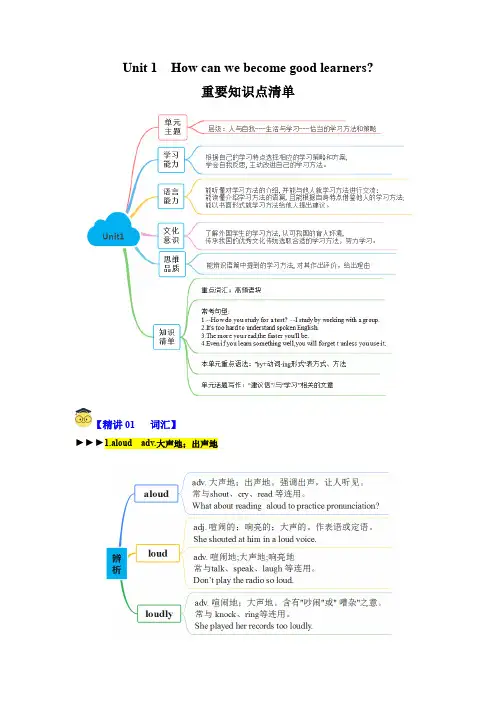
Unit 1 How can we become good learners?重要知识点清单【精讲01 词汇】►►►1.aloud adv.大声地;出声地►►►2. sound作连系动词,“听起来”,其后常跟形容词。
—Listen! What a beautiful sound! ——听!多么美妙的声音!—Yes. It sounds like a bird. ——是的。
它听起来像一只鸟。
【知识拓展】英语中常用的连系动词:一是(be),一感(feel),三保持(keep\remain\stay),二:……起来:(sound, look, smell, taste),三:好像(seem),变了:(get, turn, become)。
四:prove come true go hungry►►►常用结构:be afraid to do sth. 意为“害怕做某事”I am afraid to travel by plane. 我怕乘飞机旅行。
【知识拓展】—Excuse me, may I take the dogs with me, sir? —不好意思,先生,我可以携带狗吗?—It’s afraid not. Pets are not allowed in here. You can keep it in the Animal Center next door.—恐怕不行。
宠物不得进入这里。
你可以把它放在隔壁的动物中心。
►►►4. discoverdiscover是指“发现”原来就有而一直没被发现的东西(如电、煤、石油等矿藏及新星、星系或科学真理等)Scientists have discovered different kinds of ways to treat the illness since 50 years ago.自50年前以来,科学家们已经发现了不同的治疗方法。
Edison invented the light bulb. 爱迪生发明了电灯泡。
九年级Unit1_语境法讲解单词

- How are you? - I am fine.
aloud [əˈlaʊd] adv. 大声地,出声地
memorize 记忆,记住 pattern 模式,方式 pronounce 发音 increase 增加,增长 speed 速度 partner 搭档,同伴 born 出生,天生的 ability 能力,才能 create 创造,创建
brain 大脑 active 活跃的,积极的 attention 注意,关注 connect (使)连接;与……有联系 overnight 一夜之间,在夜间 review 回顾,复习 knowledge 知识,学问 lifelong 终身的,毕生的 wisely 明智地,聪明地
Please read this text loudly. Speak louder, I can’t hear you.
pronunciation [prəˌnʌnsiˈeɪʃn] n. 发音,读音
eg: I was afraid to ask questions because of my poor pronunciation. You can improve your pronunciation by reading aloud.
express v. 表达,表示
discover [dɪˈskʌvə(r)] v. 发现,发觉
eg: I discovered that listening to something interesting is the secret(秘密) to language learning. discovery n. 发现
人教版初三英语第一单元知识点
人教版初三英语第一单元知识点一、重点词汇1. textbook /ˈtekstbʊk/ 教科书;课本2. conversation /ˌkɒnvəˈseɪʃn/ 交谈;谈话3. aloud /əˈlaʊd/ 大声地;出声地4. pronunciation /prəˌnʌnsiˈeɪʃn/ 发音;读音5. sentence /ˈsentəns/ 句子6. patient /ˈpeɪʃnt/ 有耐心的;n. 病人7. expression /ɪkˈspreʃn/ 表情;表示;表达方式8. discover /dɪˈskʌvə(r)/ 发现;发觉9. secret /ˈsiːkrət/ 秘密;秘诀;adj. 秘密的;保密的10. grammar /ˈɡræmə(r)/ 语法二、重点短语1. look up 查阅;抬头看2. be patient with 对……有耐心3. pay attention to 注意;关注4. connect...with... 把……和……连接或联系起来5. make mistakes 犯错误6. depend on 取决于;依靠7. be interested in 对……感兴趣8. take notes 做笔记9. make sentences 造句三、重点句型1. —How do you study for a test? 你是怎样为考试而学习的?—I study by working with a group. 我通过和小组一起学习。
2. It's too hard to understand spoken English. 听懂英语口语太难了。
3. The more you read, the faster you'll be. 你读得越多,你就会读得越快。
4. Why did Wei Fen find it difficult to learn English? 为什么魏芬觉得学英语很难?5. I was afraid to ask questions because of my poor pronunciation. 因为我的发音不好,我害怕问问题。
九年级英语人教版unit1知识点归纳

九年级英语人教版unit1知识点归纳Unit 1: FriendshipIntroduction:Friendship is a cherished and essential part of our lives. It is the bond that connects people, providing support, understanding, and loyalty. In the ninth-grade English curriculum, Unit 1 of the People's Education Press introduces various aspects of friendship. This unit includes important knowledge points that help students understand the significance of friendship and develop their interpersonal skills. Let's delve deeper into these key concepts.1. Vocabulary and phrases:In this unit, students are introduced to a range of vocabulary and phrases related to friendship. These words and expressions enable students to effectively communicate their thoughts and feelings about friendship. Some important vocabulary words include "acquaintance," "buddy," "loyal," "confide," "betray," and "empathy." By understanding these words, students can articulate their ideas and engage in meaningful conversations about friendship.2. Grammar:Unit 1 also focuses on grammar points that help students construct grammatically correct sentences while discussing friendship. Some crucial grammar rules covered in this unit include the use of adjectives, adverbs, and comparative and superlative forms. For instance, students learn how to describe a true friend by using adjectives such as "trustworthy," "reliable," and "compassionate." This knowledge enhances their ability to express their opinions and effectively communicate with others.3. Reading comprehension:Through various reading passages, students get the opportunity to develop their reading comprehension skills while exploring the topic of friendship. These passages are designed to enhance vocabulary, improve reading speed, and most importantly, promote critical thinking. Students are encouraged to analyze the characters' actions and motives, predict outcomes, and draw conclusions. This not only strengthens their reading skills but also instills in them a deeper understanding of the complexities of human relationships.4. Listening skills:Listening skills play a crucial role in effective communication and understanding others. Unit 1 provides ample opportunities for students to enhance their listening skills through dialogues and audio clips aboutfriendship. By practicing listening to different accents, understanding varying speech speeds, and identifying key information, students become more confident in their ability to comprehend spoken English. Developing active listening skills enables them to engage more actively in conversations and build stronger friendships.5. Writing:Unit 1 focuses on improving students' writing skills, allowing them to express their thoughts about friendship through various written forms. Students are encouraged to write personal narratives, persuasive essays, and informal letters discussing their experiences, opinions, and reflections on friendship. Through this writing practice, students develop their creativity, organization, and coherence in constructing meaningful and impactful pieces of writing.6. Cultural understanding:Unit 1 also integrates cultural aspects into the curriculum, introducing students to friendship customs and traditions from different countries. By learning about how friendship is valued and celebrated in different cultures, students gain a broader perspective on the significance of friendships in society. This cross-cultural understanding fosters empathy and respect for diversity, enhancing their interpersonal skills in a globalized world.Conclusion:Unit 1 of the ninth-grade English curriculum offers an extensive exploration of the concept of friendship. Providing knowledge in vocabulary, grammar, reading comprehension, listening skills, writing, and cultural understanding, this unit equips students with the necessary tools to establish and maintain meaningful relationships. By delving into these key concepts, students not only improve their English language proficiency but also gain valuable insights into the significance of friendship in their lives.。
九年级英语人教版全一册_第一单元词汇讲解
Unit 1 How can we become good learners?Words and phrases一、conversation n. 交谈,会话;1、talk 内容可正式可不正式, 也可以私人: Let’s have a talk.2、conversation 一般用于正式文体中, 内容上往往不正式: They are having a conversation.3、dialogue 对话, 可以指正式国家与国家会谈: China and Korea are having a dialogue.4、chat 闲聊, 就是北京人说的“侃”, 说的是无关紧要的事.5、gossip 嚼舌头, 说长道短have a + talk/chat/dialogue/conversation/gossip二、pronunciation n. 发音pronounce vt. 发音;宣判;断言vi. 发音;作出判断[ 过去式pronounced 过去分词pronounced 现在分词pronouncing ]….by reading loud to practice pronunciations.四、aloud /laud/ adv. 大声地;出声地p.2 read aloud朗读, think aloud自言自语地说1、aloud(1)通常与动词read, speak, think 等动词连用强调“出声”,即把话说出来,而不是在心里默默地“说”( 2) 表示“大声地”,通常与动词cry, laugh, shout, call 等动词连用,如:She called aloud for help. 她大声呼救。
2. loud 表示“大声”或“响亮”,可用作形容词和副词:(1)如:He has a loud voice. 他嗓门大。
(2) 用作副词(与loudly 同义) 作副词时,意为“高声地;响亮地”,常与speak, talk, sing, laugh等动词连用3. loudly的用法loudly 只用作副词(与用作副词的loud 同义)。
人教九年级上册Unit1-2重点短语 句型归纳总结
九年级上册Unit1-2重点短语+句型总结归纳Unit 1 How can we become good learners? 一.重点短语:1. good learners 优秀的学习者2. work with friends 和朋友一起学习3. study for a test 备考4.have conversations with 与…交谈5.speaking skills 口语技巧6.a little 有点儿7.at first 起初,起先8.the secret to... ...的秘诀9.because of 因为10.as well 也11.look up (在词典中等)查阅;抬头看12.so that 以便,为了13.the meaning of …的意思14.make mistakes 犯错误15.talk to 交谈16.depend on 依靠,依赖17.have…in common 共有的18.pay attention to 注意关注19.connect…with…把…联系20.for example 例如21.think about 考虑22.even if 即使,尽管,纵容23.look for 寻找24.worry about 担心,担忧25.make word cards 制作单词卡片26.ask the teacher for help 向老师求助27.read aloud 大声读28.spoken English 英语口语29.give a report 作报告30.word by word 一字一字地31.so…that 如此…以至于32.fall in love with 爱上33.something interesting 有趣的事情34.take notes 记笔记35.how often 多久一次36.a lot of 许多37.the ability to do sth. 做某事的能力38.learning habits 学习习惯39.be interested in 对…感兴趣40.get bored 感到无聊41.be good at 在…方面擅长42.be afraid of 害怕43.each other 彼此,互相44.instead of 代替,而不是二.重点句型:1.by doing sth 通过做某事2.it +be+adj+to do sth 做某事是…的3.finish doing sth 完成某事4.what about doing sth?做某事怎么样?5.try to do sth 尽力做某事6.the +比较近,the+比较近越…,就越…7.sb+find it+adj+to do sth 发现做某事8.be afraid of doing sth 害怕做某事9.help sb (to) do sth 帮助某人做某事10.practice doing sth 练习做某事11.keep doing sth 一直做某事12.be afraid to do sth 害怕做某事13.begin to do sth 开始做某事14.want to do sth 想要做某事15.need to do sth 需要做某事16.remember to do sth 记得做某事17.shoot 射(射着,射死等表结果) 18.shoot at (瞄准)射19.ask for help 寻求帮助20.work with sb. 和…一起工作21.have conversation with 和…一起对话22.main idea 中心思想23.the secret to …的秘诀24.word by word 逐字25.take time 花时间26.word group 词组27.body language 肢体语言28.expressions on faces 脸上的表情29.key words 关键词30.as well 也31.look up 查看32.take notes 记笔记33.practice doing sth. 练习做某事34.pen pal 笔友35.keep a diary 记日记36.make mistakes 犯错37.increase 增加;提高38.decrease 减少;降低39.practice with sb. 和…一起练习40.depend on 依赖41.w hether…or not 是否42.pay attention to sth. / doing sth. 注意某事/做某事43.for a long time 很长一段时间44.connect…with …把…和…连接起来45.write down 写下46.mind map 思维导图47.lifelong journey 终身的旅程48.on one’s ow n 独自地49.bit by bit 一点点50.at once 马上,立刻51.It’s a piece of cake. 小菜一碟。
人教版新目标初中英语九年级全一册 知识点总结1单元
九年级Unit1How can we become good learners1.单元重点词汇1.textbook/ˈtekstbuk/n.教科书;课本关联用法:textbooks复数关联词组:by reading the textbook2.conversation/kɔnvəˈs eɪʃn/,n.交谈;谈话关联用法:conversations复数关联词组:make conversations编写对话have conversations with sb.=have a conversation with sb.与某人进行交谈3.aloud/əˈlaud/adv.大声地;出声地关联词组:read aloud大声读/出生读4.pronunciation/prənʌnsiˈeIʃn/n.发音;读音关联词组:practice pronunciation练习发音5.sentence/ˈsentəns/n.句子关联用法:sentences复数关联词组:by reading the sentence通过读教科书6.patient/ˈpeiʃnt/adj.有耐心的n.病人关联用法:patience名词:耐心;patients复数关联词组:impatient形容词:没有耐心的patiently副词:耐心地be patient with sb.对某人有耐心be patient of sth.对某事能容忍have(no)patience with…对…(没)有耐心lose patience with对…失去耐心out of patience没有耐心7.expression/ikˈspreʃn/n.表达(方式);表示关联用法:expressions复数关联词组:facial expressions面部表情8.discover/dIˈskʌvə(r)/v.发现;发觉关联用法:discovery名词:发现9.secret/ˈsi:krət/n.秘密;adj.秘密的;保密的关联用法:secrets复数关联词组:in secret秘密地;keep a secret保密;a secret plan秘密的计划10.look up(在词典,参考书中或通过电脑)查阅;抬头看11.fall in love with爱上;与⋯⋯相爱12.grammar/ˈgræmə(r)/n.语法关联词组:in grammar在语法方面13.repeat/riˈpi:t/v.重复;重做关联用法:secrets复数关联词组:repetition名词:重复14.note/nəut/n.笔记;记录v.注意;指出关联用法:notes复数关联词组:please note清注意;take notes记笔记15.pal/pæl/n.朋友;伙伴关联词组:pen pal笔友16.physics/ˈfiziks/n.物理;物理学关联单词:adj.物理的;身体的;物质的;根据自然规律的,符合自然法则的关联词组:Space Physics空间物理学物理空间空间物理17.chemistry/ˈkemistri/n.化学关联词组:Organic Chemistry有机化学18.memorize/ˈmeməˌraɪz/v记住;记忆关联单词:memory n.记忆关联用法:过去式memorized过去分词memorized现在分词memorizing第三人称单数memorizes典型例句:Have you memorized your lines for the play yet?你记住剧本中的台词了吗?19.pattern/ˈpætn/,/ˈpætən/n.模式;方式20.pronounce/prəˈnaʊns/v.发音关联用法:过去式pronounced过去分词pronounced现在分词pronouncing第三人称单数pronounces关联词组:Pronounce correctly发音正确正确发音典型例句:I can not pronounce correctly我不能正确发音21.increase/Inˈkri:s/v.增加;增长关联用法:过去式increased过去分词increased现在分词increasing复数increases第三人称单数increasesn.增加;增多;增长关联词组:increase by增加了;按…增长on the increase正在增加,正在增长22.speed/spi:d/n.速度v.加速关联单词:speeding超速关联用法:过去式sped或speeded过去分词sped或speeded现在分词speeding 关联词组:speed up加速加快速度使加速加快speed limit速度限制时速限制限速最高车速23.partner/ˈpa:(r)tnə(r)/n.搭档;同伴24.born/bɔːn/v.出生adj.天生的关联词组:be born with天生具有born yesterday乳臭未干典型例句:Swift was born in1667.斯威夫特生于1667年。
人教版英语九年级Unit 1 详细版知识清单(单词+短语+句型)+课文中英文
九年级Unit 1 How can we become good learners?Section A重点单词1.textbook n.课本2.conversation n.交谈3.aloud adv.大声地4.pronunciation n.发音5.sentence n.句子6.patient adj.有耐心的n.病人7.expression n.表情8.discover v.发现9.secret n.秘密;秘诀adj.秘密的10.grammar n.语法11.repeat v.重复12.note n.笔记13.physics n.物理14.chemistry n.化学15.memorize v.记住16.pattern n.模式词形变换1.express v.表达→expression n.表情2.pronounce v.发音→pronunciation n.发音3.patient adj.耐心的→patiently adv.耐心地→patience n.耐心4.memory n.记忆;回忆→memorize v.记住5.mean v.意思是→meaning n.意思6.use v.利用→useful adj.有用的重点短语1.make word cards制作单词卡2.ask the teacher for help 请求老师帮助3.study for a test 考前学习4.work with a group小组合作5.a slow reader读得慢的人6.the main idea 主旨大意7.at first 起初、刚开始8.word by word 逐字地9.guess the meaning 猜测意思10.more than 超过11.most of the time 大部分时候12.be afraid to 害怕······13.because of 由于14.fall in love with爱上······15.the key words关键词16.the secret to······的秘诀17.a piece of cake小菜一碟18.look up 查阅;抬头看19.so that以便20.have conversations with与······交流重点句型1.It’s too hard to understand spoken English.英语口语太难理解了。