
牛津译林版八年级下册 8B-现在完成时
二、单项选择(本题共15小题;每小题1分,满分15分) 页脚内容1 现在完成时 ⒈构成
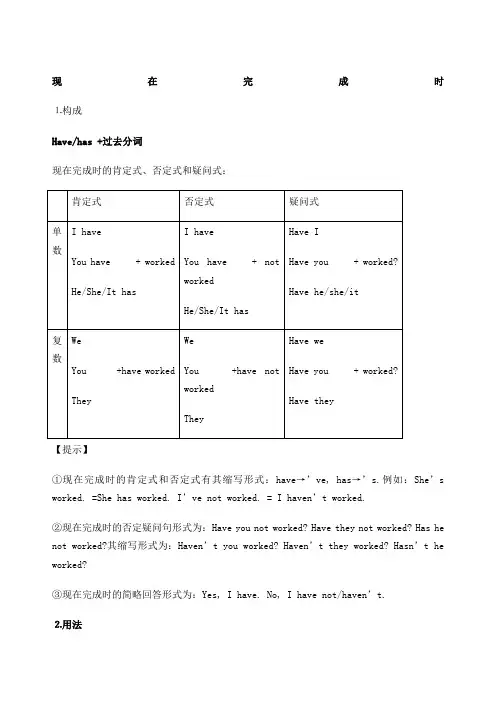
Have/has +过去分词 现在完成时的肯定式、否定式和疑问式:
肯定式 否定式 疑问式 单数 I have You have + worked He/She/It has I have You have + not worked He/She/It has Have I
Have you + worked?
Have he/she/it
复数 We You +have worked They We You +have not worked They Have we Have you + worked?
Have they
【提示】 ①现在完成时的肯定式和否定式有其缩写形式:have→’ve, has→’s.例如:She’s worked. =She has worked. I’ve not worked. = I haven’t worked.
②现在完成时的否定疑问句形式为:Have you not worked? Have they not worked? Has he not worked?其缩写形式为:Haven’t you worked? Haven’t they worked? Hasn’t he worked?
③现在完成时的简略回答形式为:Yes, I have. No, I have not/haven’t.
⒉用法 ⑴过去动作产生的影响等 表示过去发生的某一动作对现在造成的影响或产生的结果。在没有具体时间状语的情况下,现在完成时可以表示某一行为动作在说话之前已经完成,而其结果或影响至今仍然存在。因此,现在完车时这一时态强调的是过去的动作同现在的联系,也就是强调现在的影响和结果。例如:
Someone has broken the window.(“打破”这一动作虽然发生在过去,但影响延续至今,其结果是窗子仍然是破的,The window is now broken.)
I have lost my pen.(结果是:我现在无钢笔可用,I have no pen to use.) 二、单项选择(本题共15小题;每小题1分,满分15分) 页脚内容2 He’s locked the door.(结果是:现在门锁上了,我们进不去,Now the door is locked and we can’t go in.)
The party has started. (The party started and now it is going on.) I’ve forgotten her name= I forgot her name.
他今天还没吃任何东西.(现在一定很饿了) _________________________________________________________________ 我已经吃过午饭了(现在不饿了) ____________________________________________________
⑵过去的动作延续到现在和未来 表示一个开始于过去,持续到现在,并可能继续下去的动作或状态,常同for, since引导的时间状语连用,或用于How long…(多久)句型中,表示持续的时间。例如:
He has studied English for ten years.(可能继续学下去) She has lived here since then. He has been in Nanjing since 2003. Miss Lin has worked in the factory since she came to the city. 你已经住在这个房子里多久了? _____________________________________________________ 这个女孩已经病了一个星期了。 ______________________________________________________
【提示】for是介词,后面只能跟单词或词组;since是介词或连词,后面可以跟单词、词组或句子。
⑶同recently等状语连用 现在完成时常同表示从过去某时刻延续到现在并包括现在在内的一段时间状语连用,如recently, today, this morning, this week, lately, up to now, so far, in the past/last few months, since three years ago等。例如:
I haven’t seen him this week. 二、单项选择(本题共15小题;每小题1分,满分15分) 页脚内容3 I have been busy this morning. He has bought a new bike recently.
⑷同often等状语连用 现在完成时常同不明确指出具体时间的状语连用,如often, already, yet, never, ever, always, once, twice, sometimes, just, for a long time, only twice等。例如:
Have you done your homework yet? 我们已经完成了工作。 __________________________________ 我从没去过英国。 _______________________________________
⑸将来某时已经完成的动作 现在完成时可以用在条件或时间状语从句中,表示将来某个时刻之前已经完成的动作。例如:
He will come as soon as he has finished the homework. If you have read the book before I leave, please lend it to me. We shall wait here until the rain has stopped.
⑹have gone和have been have gone和have been意义上不同,前者表示“到某地去了,尚没回来,现在不在这里”,后者表示“曾经到过某地,现在已返回”。比较:
She has gone to Beijing.(她现在不在这里,去北京了,可能已经到达,也可能仍在途中)
She has been to Beijing.(她以前到过北京,现在已不在北京了) Where has he been?(他已回来) Where has he gone?(他现在不在这里) 比较: have been to do sth做过了某事 have gone to do sth去做某事了 二、单项选择(本题共15小题;每小题1分,满分15分) 页脚内容4 have come to do sth来做某事了
⑺for 2004还是since 2004 英语中有些动词表示的动作是一时性的、短暂的、不能延续的,所以,不能同for和since等引导的表示一段时间的状语连用,也不可用于“How long/How many+时间名词”句中。因此,这类动词可以单独使用于完成时中,但不可同表示一段时间的状语一起用于完成时中,包括现在完成时和过去完成时。这类动词有:go, come, leave, arrive, join, receive, get, die, buy, borrow, choose, close, fall, finish, kill, lend, marry, open, reach, return, start, stop, sit down, stand up等。比较:
How long may I keep the book? Her grandmother has been dead for five months. It is five months since her grandfather died. He has arrived. He arrived there three hours ago. It’s three hours since he arrived. It has been three hours since he arrived. He has been away from Shanghai for two weeks. It is two weeks since he left Shanghai. He has left Shanghai. She has joined the army. She has been in the army since 20004. It is three years since she joined the army. 【提示】①非延续性动词的完成时有时可以同for引导的短语连用,但表示的是某一动作的目的或结果,而不是表示动作本身延续的时间。例如:
She has come for two weeks.她已经来了,准备住两个星期。 He has gone for three days.他走了,要在三天后回来。
②非延续性动词的否定式表示动作的持续过程,具有延续性,因此可以同for或since引导的一段时间状语连用。例如:
I haven’t received her letter for a whole year. He hasn’t bought any book since last month.
牛津译林8b现在完成时题目含答案
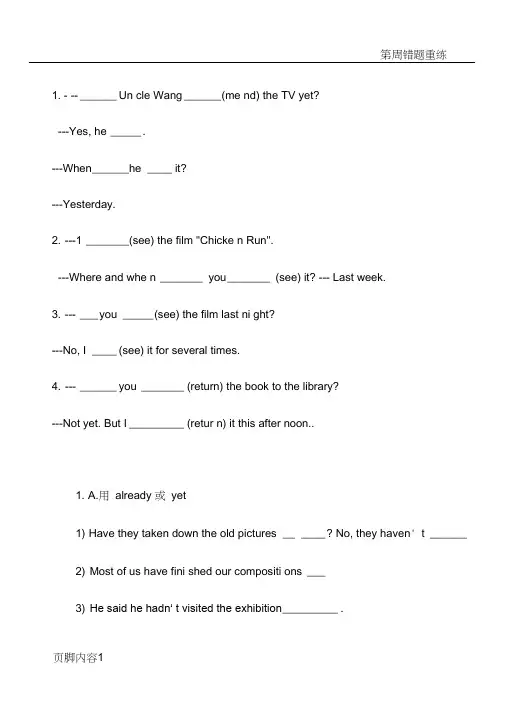
1. - -- ______ Un cle Wang ______ (me nd) the TV yet?---Yes, he _____ .---When ______ h e ____ it?---Yesterday.2. ---1 _______ (see) the film "Chicke n Run".---Where and whe n _______ you _______ (see) it? --- Last week.3. --- ___ you _____ (see) the film last ni ght?---No, I ____ (see) it for several times.4. --- ______ you _______ (return) the book to the library?---Not yet. But I _________ (retur n) it this after noon..1. A.用already 或yet1) Have they taken down the old pictures __ ____ ? No, they haven' t ______2) Most of us have fini shed our compositi ons ___3) He said he hadn‘ t visited the exhibition_________ .B. 用si nee 或for1) We have learned five lessons ______the beginning of this term.2) Mrs Liao has been in hospital ______last week.3) I have stayed at my aunt' s __ __two weeks.C. 用have gone 或have been1) Where are the boy stude nts? They ____ to the school factory.2) Is your father in? No, he __ _ to Shen zhe n. ______ h e ever ______ t here before ?Y es, he __ there several times3) He asked me if I __ __ to Han gzhou before.I told him that I wan ted to go there for a visit as I ____ n ever _ ___ to that city before.2. 选择填空I.Mother ____ me a new coat yesterday. I _______ i t on .It fits me well.A. had made…have triedB. made…have triedC. has made …triedD. made•…tried。
牛津译林版八年级下册 b 现在完成时
现在完成时⒈构成Have/has +过去分词现在完成时的肯定式、否定式和疑问式:【提示】①现在完成时的肯定式和否定式有其缩写形式:have→’ve, has→’s.例如:She’s worked. =She has worked. I’ve not worked. = I haven’t worked.②现在完成时的否定疑问句形式为:Have you not worked? Have they not worked? Has he not worked?其缩写形式为:Haven’t you worked? Haven’t they worked? Hasn’t he worked?③现在完成时的简略回答形式为:Yes, I have. No, I have not/haven’t.⒉用法⑴过去动作产生的影响等表示过去发生的某一动作对现在造成的影响或产生的结果。
在没有具体时间状语的情况下,现在完成时可以表示某一行为动作在说话之前已经完成,而其结果或影响至今仍然存在。
因此,现在完车时这一时态强调的是过去的动作同现在的联系,也就是强调现在的影响和结果。
例如:Someone has broken the window.(“打破”这一动作虽然发生在过去,但影响延续至今,其结果是窗子仍然是破的,The window is now broken.)I have lost my pen.(结果是:我现在无钢笔可用,I have no pen to use.)He’s locked the door.(结果是:现在门锁上了,我们进不去,Now the door is locked and we can’t go in.)The party has started. (The party started and now it is going on.)I’ve forgotten her name= I forgot her name.他今天还没吃任何东西.(现在一定很饿了)_________________________________________________________________我已经吃过午饭了(现在不饿了)____________________________________________________⑵过去的动作延续到现在和未来表示一个开始于过去,持续到现在,并可能继续下去的动作或状态,常同for, since引导的时间状语连用,或用于How long…(多久)句型中,表示持续的时间。
牛津译林版英语八年级下册8B Unit 2 Grammar(2)课件
现在完成时和一般过去时
He _h_a_s__w_o_r_k_e_d__(work) in our school for one
year.
He _c_a_m_e__(come) to our school last year/in
her husband to open the door. • I can’t find the way to the railway station
because I have lost my map.
用法: 二. for + 时间段
since + 时间点 present perfect tense
• in the past(last/ recent)three years
• recently,over / during the past century
• how long, all one’s life
2. 上下文提示结果 • He’s crying. He hasn’t passed the exam. • She has lost her key so she has to wait for
3. Tommy has had this motorcycle ___f_o_r___ three years.
4. I have been in Jiangyin __f_o_r____ forty years.
5. My parents has been married since twenty years __a_g_o____.
• buy → have • open → be open • close →be closed • join →be in / be a member of… • go to school → be at / in school • borrow → keep • catch a cold → have a cold • get to know → know • begin to study → study • get married → be married • wake up → be awake
牛津译林版八年级下册B现在完成时

在完成⒈组成Have/has +去分在达成的必定式、否认式和疑式:必定式否认式疑问式单I have I have Have I数You have+ worked You have + not worked Have you+ worked?He/She/It has He/She/It has Have he/she/it复We We Have we数You+have worked You+have not worked Have you+ worked?They They Have they【提示】① 在达成的必定式和否认式有其写形式:have→’ ve,has→’例s.如:She’ s worked. =She has worked. I’ ve not worked. = I haven’ t worked.② 在达成的否认疑句形式: Have you not worked? Have they notworked? Has he not worked?其写形式: Haven’t you worked? Haven’t they worked? Hasn ’ t he worked?③ 在达成的略回答形式: Yes, I have. No, I have not/haven’t.⒉用法⑴ 去作生的影响等表示去生的某一作在造成的影响或生的果。
在没有详细状的状况下,在达成能够表示某一行作在从前已达成,而其果或影响到现在仍旧存在。
所以,在完一的是去的作同在的系,也就是在的影响和果。
比如:Someone has broken the window.(“打破” 一作然生在去,但影响延到现在,其果是窗子仍旧是破的,The window is now broken.)I have lost my pen.(果是:我在无笔可用, I have no pen to use).He’ s locked the door.( 果是:在上了,我不去,Now the door islocked and we can ’ t go in.)The party has started. (The party started and now it is going on.)I ’ ve forgotten her name= I forgot her name.他今日没吃任何西.(在必定很了 )_________________________________________________________________我已吃午了(在不了)____________________________________________________⑵ 去的作延到在和未来表示一个开始于去,持到在,并可能下去的作或状,常同 for, since 引的状用,或用于 How long ⋯(多久)句型中,表示持的。
牛津译林版八年级英语下册:现在完成时讲解和练习(有答案)
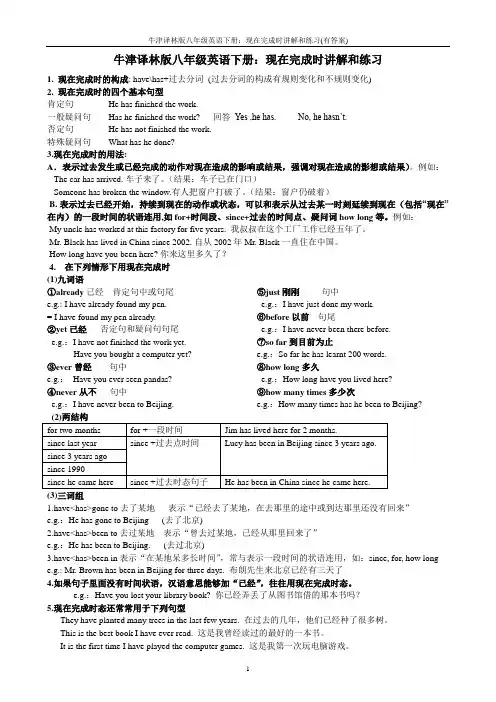
牛津译林版八年级英语下册:现在完成时讲解和练习1. 现在完成时的构成: have\has+过去分词(过去分词的构成有规则变化和不规则变化)2. 现在完成时的四个基本句型肯定句He has finished the work.一般疑问句Has he finished the work? 回答Yes ,he has. No, he hasn’t.否定句He has not finished the work.特殊疑问句What has he done?3.现在完成时的用法:A.表示过去发生或已经完成的动作对现在造成的影响或结果,强调对现在造成的影想或结果)。
例如:The car has arrived. 车子来了。
(结果:车子已在门口)Someone has broken the window.有人把窗户打破了。
(结果:窗户仍破着)B. 表示过去已经开始,持续到现在的动作或状态,可以和表示从过去某一时刻延续到现在(包括“现在”在内)的一段时间的状语连用,如for+时间段、since+过去的时间点、疑问词how long等。
例如:My uncle has worked at this factory for five years. 我叔叔在这个工厂工作已经五年了。
Mr. Black has lived in China since 2002. 自从2002年Mr. Black 一直住在中国。
How long have you been here? 你来这里多久了?4. 在下列情形下用现在完成时(1)九词语①already已经肯定句中或句尾e.g.: I have already found my pen.= I have found my pen already.②yet已经否定句和疑问句句尾e.g.:I have not finished the work yet.Have you bought a computer yet?③ever曾经句中e.g.:Have you ever seen pandas?④never从不句中e.g.:I have never been to Beijing. ⑤just刚刚句中e.g.:I have just done my work.⑥before以前句尾e.g.:I have never been there before.⑦so far到目前为止e.g.:So far he has learnt 200 words.⑧how long多久e.g.:How long have you lived here?⑨how many times多少次e.g.:How many times has he been to Beijing?(3)三词组1.have<has>gone to去了某地表示“已经去了某地,在去那里的途中或到达那里还没有回来”e.g.:He has gone to Beijing (去了北京)2.have<has>been to去过某地表示“曾去过某地,已经从那里回来了”e.g.:He has been to Beijing. (去过北京)3.have<has>been in 表示“在某地呆多长时间”,常与表示一段时间的状语连用,如:since, for, how longe.g.: Mr. Brown has been in Beijing for three days. 布朗先生来北京已经有三天了4.如果句子里面没有时间状语,汉语意思能够加“已经”,往往用现在完成时态。
译林版英语八年级下册第一单元现在完成时讲解及练习
译林版英语八年级下册第一单元现在完成时讲解及练习8B Unit 1Past and Present(第一课时)Grammar I )研究目的】初步认识和了解现在完成时的构成和用法。
课前准备】一、查字典,写出下列单词的意思,并且熟记他们。
(★★★)1、already _____________2、yet ________________3、just ___________________4、ever _________________5、never _____________6、before _________________7、since three years ago _______________8、for three years ______________二、写出下列动词的过去式和过去分词,同时也要熟记。
1、teach_______ ________2、bring _______ ________3、get _______ ________t4、know _______ ________5、grow_______ ________6、find_______ ________7、hold _______ ________8、show_______ ________9、keep_______ ________10、leave_______ ________11、lose_______ ________12、run_______ ________13、swim_______ ________14、drive_______ ________ 15、begin_______ ________三、尝试着阅读下面的知识链接,看看是否可以理解。
知识链接】现在完成时的“完成用法”和“未完成用法”一、现在完成时的结构:助动词have / has +动词的过去分词( Past Participle )其中have / has为助动词,因而它的否定和疑问句形式全部由have / has进行变化。
牛津译林版英语8B八年级下册Unit2Grammar现在完成时课件
A. have a cold
2.buy ---- have
B. be on
3.catch a cold ---- have a coldC. keep
4.become ---- be
D. be
5.arrive/come/go---- be in / at E. be in / at
6.begin/start---- be on
been
2.He has j-o-i-n--e-d the League for 3 years.
been in/a member of
3.He has -le--f-t his hometown for 20 years.
been away from
4.He has d--ie--d for 20 years.
F. be closed/open
7.leave ---- be away from G. be away from
8.close/op--e--nbe closed/openH.be in/a member of
9.die ---- be dead
J. be dead
10.join ----be in/a member of K. have
Mr Black has been dead for three years.
It is/ has been three years since Mr Black died.
Three years has passed since Mr Black died.
days. (3)I bought the watch 2 weeks ago
=I _h_a_v_e_h__a_d_the watch since 2 weeks ago. (4)It is 5 days since I borrowed the book
牛津译林版8BUnit1-3现在完成时专练单选翻译(含答案)
8B Unit1-3 现在完成时专练一、单选1. - When did you study in Japan? ---- _______ .A. Two years beforeB. For two yearsC. Two years agoD. Since two years ago2. Simon _____ up yet because he ______ to bed very late last night.A. didn't get; wentB. hasn't got; has goneC. doesn't get; wentD. hasn't got; went3. I have ______ heard of the surprising news.A. just nowB. justC. nowD. yet4. - Look! Someone ______ the icebox back to the corner.--- Well, it wasn't me. I didn't do it.A. has movedB. is movingC. was movingD. will move5. Mr Green has worked in Shanghai since his family _____ to China three years ago.A. movedB. moveC. movesD. has moved6. I have lived here _______ I was born.A. beforeB. whenC. forD. since7. I haven't seen Jack for three days. Is he ill?--- _______ . His mother told me that he was in hospital.A. I am afraid soB. I hope notC. I hope soD. I am afraid not8. - Why are you worried?----I'm expect in g(盼望)a call from my daughter. She ____ N ew York for three days.A. has gone toB. has been toC. has been inD. has come in9. Why don'tyou see the film this evening? Because I __________ it already.A. sawB. have seenC. will seeD. sees10. I _______ to Canada many times. I'st very beautiful.A. have goneB. won'tgoC. have beenD. don'tgo11. Mr Smith, together with his two sons, ____________ Shanghai for about five months.A. has leftB. have leftC. have been away fromD. has been away from12. The football match _______ for an hour, but we are still very excited.A. has finishedB. has endedC. has been overD. has over13. She _____ the book ______ two days ago.A. has borrowed; sinceB. has kept; sinceC. kept; forD. borrowed; for14. -- ________ has your grandpa lived here? --- Since last year.A. How longB. How oftenC. How soonD.How far15. My father _______ to South Hill. He _______ there for five years.A. has gone; has beenB. has been; has goneC. has gone; has goneD. has been; has been16. John has _____ the Birdwatching Club for two months.A. joinedB. been a member ofC. take part inD. joined in17. They will go to Hainan this winter, but they _______ when to leave yet.A. didn 't decideB. won 't decidedC. have decidedD. haven 't decided18. Amy, can we give away these soft toys? We ______ them for many years.--- M om, but I want to keep the bear.A. boughtB. hadC. have boughtD. have had19. -- W ill you watch the programme Running Man on Zhejiang Star-TV tonight?--- Y es, of course. It ______ one of the most popular shows since last October.A. wasB. becameC. has beenD. has become20. -- H ow long has Robert ________ ? --- Since 2014.A. been to BeijingB. become a policemanC. joined the Art ClubD. studied in this school21. The lonely woman _____ Shanghai since her husband ________ in 1990.A. has gone to; diedB. has left; diedC. has been in; diedD. has been to; has died22. -- H e has never been to Hong Kong before, has he?--- ______ . It 's the third time he has been there.A. Yes, he hasB. Yes, he has 'ntC. No, he hasn 'tD. No, he has23. The man ______ Shanghai an hour ago, so he ______ for an hour.D. has left; left town _______ for two weeks, but I ________B. has been open; haven 't beenD. has opened; haven 't been ?---- For about an hour, yes, it finished an hourago.A. has; been overB. has; finishedC. did; overD. has; ended26. More than 20 people ______ in traffic accidents _______ last May.A. have been dead; sinceB. die; forC. have died; forD. have been dead; for27. I _____ to learn English 5 years ago. I _____ over 1,000 English words since then.A. have begun; have learnedB. began; learnedC. began; have learnedD. have begun; learned28. There _____ great changes in our hometown in the past few years.A. has beenB. have beenC. wasD. were29. Mr. Smith ______ in Nanjing since he ______ to China years ago.A. worked; has movedB. has worked; has movedC. has worked; movedD. was working; moved30. How long has he worked on the farm? ___________ .A. Two years agoB. For two years agoC. Since two yearsD. Since two years ago31. When ______ your cousin ______ his hometown?---- He _______ for nearly two years.A. has; left; has leftB. did; leave; has leftC. did; leave; has been awayD. has; left; has been away32. - When _______ you _____ ?A. has left; has leftB. left; has leftC. left; has been away24. The new supermarket in our there yet.A. has opened; haven 't gone C. has been open; haven 't gone 25. --- How long ______ the film __---- I ______ for two months.A. did; get married; have got marriedB. have; got married; got marriedC. have; been married; have got marriedD. did; get married; have been married二、翻译句子1. 这本书我已经借了几天了。
牛津译林版8B Unit1 Gramma (共45张PPT)
past
present
4 years
一.现在完成时的含义
表示过去已完成的动作对现在产生的影响,常与 “already、ever、just 、never、recently、yet”等连 用; We have just finished the report. He has not returned the book to me yet. He has never visited the Great Wall. 表示过去发生动作持续到现在,常与“since、for”连 用。
13、He who seize the right moment, is the right man.谁把握机遇,谁就心想事成。2021/8/142021/8/142021/8/142021/8/148/14/2021 •14、谁要是自己还没有发展培养和教育好,他就不能发展培养和教育别人。2021年8月14日星期六2021/8/142021/8/142021/8/14 •15、一年之计,莫如树谷;十年之计,莫如树木;终身之计,莫如树人。2021年8月2021/8/142021/8/142021/8/148/14/2021 •16、教学的目的是培养学生自己学习,自己研究,用自己的头脑来想,用自己的眼睛看,用自己的手来做这种精神。2021/8/142021/8/14August 14, 2021 •17、儿童是中心,教育的措施便围绕他们而组织起来。2021/8/142021/8/142021/8/142021/8/14
3.现在完成时的一般疑问句
Yes, … have/has.
句型 Have/Has+主语+过去分词+…. No, … haven’t/hasn’t.
Have you finished the work? Yes, I have. / No, I haven’t.
(完整word版)牛津译林8b现在完成时题目含答案,文档.docx
1.- -- ______ Uncle Wang ______ (mend) the TV yet?---Yes, he______.---When _____ he _____ it?---Yesterday.2.---I ________ (see) the film "Chicken Run".---Where and when ________ you _______ (see) it? --- Last week.3.---____ you _____ (see) the film last night?---No, I _____ (see) it for several times.4. ---_______ you _______ (return) the book to the library?--- Not yet. But I _________ (return) it this afternoon..1. A. 用 already 或 yet1)Have they taken down the old pictures ___ ___? No, they haven ’ t____ ___.2)Most of us have finished our compositions _____.3)He said he hadn’ t visited the exhibition ________.1)We have learned five lessons __ __ _ the beginning of this term.2)Mrs Liao has been in hospital __ _ ___last week.3)I have stayed at my aunt ’ s ___ __two weeks.C. 用 have gone 或 have been1)Where are the boy students? They _____ to the school factory.2)Is your father in? No, he ___ _ to Shenzhen. _______he ever ______ there before ?Yes, he ___ there several times3)He asked me if I___ __ to Hangzhou before.I told him that I wanted to go there for a visit as I ____ never _ ___ to that city before.2.填空1.Mother ____me a new coat yesterday. I _______ it on. It fits me well.A. had made ⋯ have triedB. made⋯ have triedC. has made⋯ triedD. made⋯ tried2 “ He ____to draw horses already ” . “ When ______ he ?” “ Last year “A. learned ⋯ hasB. learned⋯ didC. has learned⋯ hasD. has learned⋯ did3.Tom _____up into the tree. Look, he ____ high up there !A. has got⋯ isB. has climbed⋯wasC. got ⋯ wasD. climbed ⋯ is4.____ you _____ the text yet ? Yes, we ____ it two hours ago.A. Did⋯ copy⋯ didB. Have⋯copied ⋯ haveC. Have⋯ copied ⋯ didD. Did ⋯ copy⋯ had5. “ Why ______ she _______ angry ?” “ Because he _____ at her just now . ”A. did⋯ get⋯ shoutedB. has⋯ got⋯ shoutedC. did⋯ get⋯ has shoutedD. has⋯ got⋯ has shouted6. ______you __________ the film before ? Where _____ you ____ it ?A. Have ⋯seen⋯ did ⋯ seeB. Did ⋯see⋯ did ⋯ watchC. Have⋯ seen⋯ have⋯ seenD. Did ⋯ see⋯ have⋯ seen7.You ____ me waiting for two hours. I ____ for you since five.A. kept⋯ waitedB. have kept⋯ waitedC. kept⋯ have waitedD. have kept⋯have waited8.Where ______ John _______ ? To the library. He _________ there for an hour.A.has⋯ been⋯ has goneB. has⋯ gone⋯ has beenC. did⋯ go⋯ wentD. did⋯ be⋯went9.______ the baby still _____ ? No, it _______ crying.A. Has⋯ cried⋯ has stoppedB. Is⋯ crying⋯ stoppedC. Did ⋯cry ⋯ stoppedD. Is⋯crying ⋯ has stopped10.I _______ the way. I ________ here for quite many years.A. knew⋯ have livedB. knew⋯ liveC. know⋯ have livedD. know⋯ live11._____ you ever _____ America ? Yes, I have.A. Have⋯ gone toB. Have⋯gone inC. Have⋯been toD. Have ⋯been in12.My brother ____college for over three years.A. has gone toB. has been toC. has been inD. has been at13.He ________ the Army by the end of 1989. He ______ in the army since then.A. joined ⋯isB. has joined⋯ has beenC. had joined⋯ isD. had joined⋯ has been14.By the time I _____ back they ____ up ten satellites.A. came⋯ have sentB. came⋯ had sentC. come⋯ have sentD. had come⋯ sent15.Jack ____ over five lessons by seven o’ clock. Then he ____ a rest.A. went ⋯ tookB. went⋯ had takenC. had gone⋯ tookD. had gone⋯ had taken16.We ____ out by that time that he ____ a spy for a long time.A. had found ⋯ had beenB. had found ⋯wasC. found⋯ had beenD. found⋯ was17.Before the news ____ him, he ____ to know about it.A. reaches⋯ has gotB. reached⋯ had gotC. reached⋯ gotD. had reached⋯got18.I _____ him a second letter before I ____ from him.A. wrote ⋯heardB. wrote ⋯ had heardC. had written ⋯ heardD. have written ⋯hear19.People ____ that the soldiers _____ fighting.A. say⋯ had stoppedB. said⋯ has stoppedC. say⋯ stoppedD. said⋯ had stopped20.We ____ in a good harvest because we ____ enough rain.A. didn’ t get ⋯ had hadB. got⋯ had hadC. had got⋯had hadD. got⋯hadn ’ t had21.They _______ for five hours when they ______ in New York.A. flew ⋯ arrivedB. had flown ⋯ had arrivedC. flew⋯had arrivedD. had flown ⋯arrived22.She ____ that it _____ for two days by that day.A. says⋯ has rainedB. says⋯ had rainedC. said⋯ had rainedD. said⋯ rained23.John _____ there since the year before, so he _____ them.A. had worked ⋯ knewB. had worked⋯ had knownC. worked⋯ knewD. worked⋯ had known24.He _____ angry because he ____ for a long time.A. had got⋯ had waitedB. got⋯waitedC. had got⋯ waitedD. got⋯ had waited25.-I have seen the film“ Titanic” already.-When __________ you __________ it ?-The day before yesterday.A. have; seenB. will ; seeC. did; seeD. did; seen26.Mr Black __________ in China since five years ago.A. livedB. has livedC. livesD. is going to live27.We ____________ trees last Sunday. So far we __________ over 3, 000 trees there.A. planted ; plantedB. planted ; have plantedC. have planted; plantedD. have planted ; have planted答案:1.A. 1) yet, yet2) already3) yetB. 1) since2) since3) sinceC. 1) have been2) has gone, Has, been, has been3) have been, have been2. BDACA ADBDC CDDBC ABCDB DCADC BB。