
上海市嘉定区2018届高三下学期教学质量调研(二模)政治试题(原卷版)
1 嘉定区 2017-2018学年度等级考第二次质量调研 政治试卷
一. 单项选择题(共 60 分, 每小题 3 分) 1. 2017 年 10 月以来,以混合所有制改革为突破口的国企改革进一步提速。目前在电力、石油、天然气、铁路、民航、电信、军工等重点行业,已推动两批共 19 家中央企业开展混合所有制改革试点。 国有企业的混合所有制改革旨在 A. 扩大国有经济控制力和影响力
B. 继续增强国有经济的主体地位
C. 引导非公有制经济的有序发展
2. 最近发布的《中华人民共和国资源税法(征求意见稿)》 提出全面实行从价计征方式, 即按照资源销售
的价格,按照一个比率来进行计算,调整目的在于缓解主要资源品目高价格与低税负之间的矛盾,促进资源节约和环境保护。这表明税收具有 A. 把握经济运行的监督作用 B. 组织财政收入的保证作用 C. 调节经济发展的杠杆作用 3. 全球化的过程当中只有赢家没有输家,实际上大家都是全球化受益者,只是受益程度不同,受益的速度
有快慢。国际社会普遍认为,要坚持和引导好经济全球化的走向,这是因为 A. 经济全球化消除了国际贸易中间的摩擦和歧视 B. 经济全球化顺应了现代市场经济世界性的特征 C. 经济全球化保障了各国的经济安全和发展规模 4. 人大代表是人民权力的受托者。以下体现人大代表履行职责的行为是
A. 参加所在单位职代会的换届选举 B. 联名向本级人大提交环境保护议案 C. 应邀列席党支部群众路线教育活动 5. 对于政党而言,它的社会号召力是指政党对于全社会的影响能力、凝聚能力、动员能力、引导能力等。
中国共产党具有强大的社会号召力,正带领全国人民迈向新时代,这是因为中国共产党 2
A. 坚持执政为民的宗旨意识, 始终保持党的先进性 B. 秉持依法行政的服务理念,尊重人民的主体地位 C. 围绕团结和民主两大主题,发挥人民的创造精神 6. 70 年来,内蒙古自治区通过地方立法使《民族区域自治法》规定的多项自治权落到实处,制定了一批具
有鲜明民族特色的地方性法规,促进了自治区的经济社会发展。 民族区 域自治地方的自治机关是 A. 自治地方的人大与法院 B. 自治地方的人大与政府 C. 自治地方的政府与法院 7. 作为中国民法典开篇之作的《中华人民共和国民法总则》,将影响每个中国人的社会生活,人们在不同的
人生阶段都将受到它的保护。有了民法总则, 13 亿中国人的生活之路将走得更安全、更踏实、更有平等机会、更有尊严。这说明 A. 有法可依是加强社会主义法制的根本前提 B. 执法必严是社会主义法制权威的体现 C. 违法必究是社会主义法制强制力的体现 8. 邓小平同志提出的“一国两制”的科学构想,既体现了原则性,又体现了高度的灵活性,是推进祖国和平
统一大业的基本方针。这里所说的原则性是指 A. 充分考虑香港、澳门、台湾的历史和现实 B. 实现祖国统一,维护国家主权 C. 特别行政区享有高度的自治权 9. 近年来,我国提出创新、协调、绿色、开放、共享的新发展理念,为其他国家和人民谋求发展提供了可
以借鉴的思想资源; “一带一路”“构建人类命运共同体”“共商、共建、共享” 先后被写入联合国决议。这些努力,使中国在全世界范围内受到越来越多的尊重。这表明 A. 国际交往中各国之间应和平共处 B. 共同利益是实现国际合作的基础 C. 我国积极参与全球治理体系建设 10. 近年来, 我国宗教界人士利用宗教活动场所和各种宗教活动等平台,把慈悲济世的宗教情怀,引导转
变为广大信教群众投身脱贫攻坚的社会行动。通过“宗教慈善周” 等形式开展各种扶贫济困活动,取得了显著成绩。 在这过程中 3
A. 保障了公民宗教信仰的自由 B. 发挥了宗教团体的积极作用 C. 依法保护了正常的宗教活动 11. 浙江省政府凭借先进的互联网技术优势,打破以部门割据为特征的传统行政审批模式, 让老百姓办事
“最多跑一次” 。这一改革举措体现了政府
A. 加强社会公共服务 B. 加强群众参与监督 C. 加强基层自治建设 12. 以下论断反映物质决定意识的是
A. 规划蓝图鼓励着人们积极改变生活面貌 B. 思想解放是人们行动的先导和力量之源 C. 科技进步成为科幻作品得以展开的依托 13. 为加强河流上下游、干支流等跨行政区域的河湖管理,云南省昆明滇池流域政府部门建立了上下游生态
补偿机制。 上游不达标补偿下游,末端断面不达标向财政缴纳补偿金。这项举措避免了“自扫门前雪” 现象,其管理思想的哲学依据是 A. 把握事物规律, 转移矛盾 B. 要明确特殊性,具体分析 C. 应当立足整体,统筹全局 14. 虽然有各种研究机构和智库提供大量咨询成果, 调研手段也引入了信息技术,但政府部门仍需要坚持
“面对面” 的调研方式,深入实际和群众,从而发现“真问题” 。重视深入基层调研, 这是因为
A. 感性材料揭示事物本质和规律 B. 丰富的感性材料是认识的基础 C. 感性材料的获得无需技术手段 15. 必然性和偶然性是辩证统一的。必然性
A. 存在于偶然性之中 B. 反映少数的偶然性 C. 受到偶然性的支配 16. 共产党人的信仰建立在马克思主义的科学真理之上,但马克思主义并没有结束真理,而是开辟了通向真
理的道路。 《共产党宣言》发表 170 年来,社会主义实践走过了跌宕起伏的历史征程。 科学社会主义理论的“真理之火” 之所以能穿越时空依然璀璨夺目,原因在于 A. 真理来自客观世界,基本原理的运用力求做到主观符合客观 4
B. 真理在继承中发展,基本原理的运用注重以历史条件为转移 C. 真理在实践中创新, 基本原理的运用以一次实践验证为终结 第 17~20 题, 每小题只能选一个答案, 选出最佳答案得 3 分,次佳答案得 2 分,错选得 0 分。 17. 2017 年中国汽车市场全年增速在 3%至 5%之间,进入微增长,主要是传统汽车受到了智能化技术的挑
战。 无论是跨国车企,还是本土车企,都在寻求突破。中国汽车产业只有抓住发展机遇, 才能有望在智能网联汽车上实现对外资品牌的超越。 这表明 A. 量变是质变的必要准备 B. 在量变中适时促成质变 C. 量变后必然会引起质变 18. 发展中国特色社会主义文化,就是以马克思主义为指导,坚守中华文化立场,立足当代中国现实,结合
当今时代条件,发展面向现代化、面向世界、面向未来的,民族的、科学的、大众的社会主义文化,推动社会主义精神文明和物质文明协调发展。 (摘自党的十九大报告) 以上这段内容的核心要义是,发展社会主义文化 A. 要在继承的基础上创新,赋予时代内涵 B. 要发挥文化的教化功能,弘扬时代先锋 C. 要作创造性转化与发展,发出时代表达 19. 上海老城厢是一片承载申城 700 多年历史文化的区域。一些有识之士想以“保护老城厢,守住上海‘文化
之根’”为题,向政府决策部门提出科学建议。为此,他们需要做好的基础工作是 A. 组织听证会议,推动舆论宣传 B. 了解民主程序,明确提交方式 C. 做好研究论证,形成调研文本 20. 违法建筑是城市的顽疾。 2015 年 9 月以来,上海市政府通过综合运用规划、工商、消防、安全、治
安、环境等法律资源和行政资源开展联合整治行动,并对相关人员进行教育、动员、安置等工作,城市环境整治初见成效。这场攻坚战中政府施策的精准处在于 A. 坚持法治与德治相结合 B. 调动各部门间联合执法 C. 加强城市的规划与布局 二.材料分析题( 共 20 分) 5
21. 近年来随着大数据等技术的高速发展,人工智能技术已迎来发展拐点。人工智能将成为未来二十年全球
最重要的科技,并成为工业机器人、无人机、无人驾驶、智能陪伴等新兴产业的重要基础。
(1) 智能时代也就是工业 4.0 时代,我国工业正努力从“制造”迈向“智造”的新跨越。 结合材料, 运用“科学技术对产业发展的影响”相关知识,描述我国人工智能产业的发展趋势,并简要说明理由。 对于人工智能,人们不免产生“人工智能替代了工作岗位,人们怎么办?”的担忧。但也有观点认为: 我们要改变人类与人工智能 PK 的对抗思维,树立“人机耦合” 的新思维,借助人工智能去做以前做不到、想不到的事情。世界是一个相互联系的整体。所谓联系,是指一切事物之间以及事物内部诸要素之间的相互影响、相互制约、相互作用。 在实际生活中我们要正确地认识世界和改造世界,必须研究事物之间的错综复杂的联系,学会用联系的观点看问题。注:耦合, 物理学上指两个或两个以上的体系或两种运动形式之间通过各种相互作用而彼此影响以至联合起来的现象。 (2)请据此简要评析上述观点。 三.论述题 22. 党的十九大报告提出, 要提高就业质量和人民收入水平。如何为进城务工人员提供更多更好的就业机
会?如何让贫困群众也能体面打工、增收奔小康? 甘肃省通过多项举措促进人民群众更高质量就业。甘肃省“提升就业质量”新举措外出打工 10 余年的甘肃省定西市岷县大龙村村民王永红,最近在福建省福清市的一家服装染织公司的化验室里工作,再也不必奔波劳碌,每月 5000 元的工资,食宿全包,还有涨薪空间。 政府还组织了接送,发放了交通补贴。 王永红的工作得益于福建福州同甘肃定西于 2017 年 2 月签订的《东西部扶贫协作框架协议》,两地人社部门按照强化劳务对接的要求,围绕精准对接、稳定就业的目标,组织定西市建档立卡贫困劳动力转移输出。截至目前,定西市人社部门已组织劳务输转近 2000 人。17 岁的李芳芳出去打工后发现,如果没有“一技之长”,找工作也不是件容易的事情。于是决定回到家乡
上海市黄浦区2019届九年级4月质量调研(二模)英语试题及答案---已校对
黄浦区2018-2019学年度第二学期初三年级学业质量调研英语学科试卷2019年4月(满分150分,考试时间:100分钟)考生注意:本卷有7大题,共94小题。
试题均采用连续编号,所有答案务必按照规定在答题纸上完成,做在试卷上不给分。
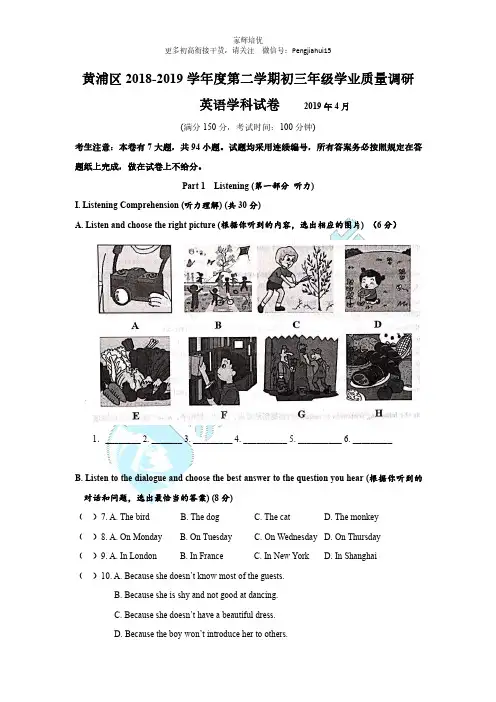
Part1Listening(第一部分听力)I.Listening Comprehension(听力理解)(共30分)A.Listen and choose the right picture(根据你听到的内容,选出相应的图片)(6分)1.________2._______3._________4.__________5.__________6._________B.Listen to the dialogue and choose the best answer to the question you hear(根据你听到的对话和问题,选出最恰当的答案)(8分)()7.A.The bird B.The dog C.The cat D.The monkey()8.A.On Monday B.On Tuesday C.On Wednesday D.On Thursday()9.A.In London B.In France C.In New York D.In Shanghai()10.A.Because she doesn’t know most of the guests.B.Because she is shy and not good at dancing.C.Because she doesn’t have a beautiful dress.D.Because the boy won’t introduce her to others.()11.A.By car B.By bus C.By taxi D.On foot()12.A.A handbag B.Some flowers C.A birthday cake D.A birthday card()13.A.350yuan B.400yuan C.700yuan D.800yuan()14.A.Teacher and student B.Shop assistant and customerC.Doctor and patientD.Husband and wife.C.Listen to the passage and tell whether the following statements are true or false(判断下列句子是否符合你听到的短文内容,符合的用“T”表示,不符合的用“F”表示)(6分)()15.David is the guest of“The Book Club”this week.()16.Miss Wang,a famous book reviewer,has come to the show.()o She Teahouse is one of Miss Wang’s favourite plays.()18.The book shows the audience life in China between1898and1944.()19.People can enjoy Beijing Opera and delicious Chinese food in the teahouse.()20.David can’t wait to go to visit the teahouse near Qian Men in Beijing.D.Listen to the dialogue and complete the following sentences(听对话,完成下列内容,每空格限填一词)(10分)21.John met his____________________Kitty one afternoon.22.John is____________________going abroad for a study trip.23.John’s father is now____________________in the east of Britain.24.Kitty is working as a____________________in a Japanese company.25.John is going to shop with his brother____________________this afternoon.Part2Phonetics,Vocabulary and Grammar(第二部分语音、词汇和语法)II.Choose the best answer(选择最恰当的答案):(共20分)26.Max drank a lot of beer to help himself relax at weekends.Which of the following is correct for the underlined word?A./beə/B./biə/C./bel/D./bi:/27.Mr.Black shared his huge house in the city centre_________his sisters.A.forB.inC.byD.with28.Some people enjoy pizza,but_________prefer Chinese fast food.A.othersB.the otherC.the othersD.another29.My brother and I like football._________play football together once a week.A.IB.TheyC.WeD.You30.We can get much_________about the school camping trip from the school Internet.A.pictureB.mapC.maprmation31._________visitors came to take photos of the Bund in Shanghai during the vacation.A.ThousandsB.ThousandC.Thousands ofD.Thousand of32.---I think it’s necessary to learn how to work in groups.---I quite agree.Sometimes it’s even_________than grades.A.importantB.more importantC.most importantD.the most important33.It was raining.My father asked me_________a raincoat.A.to takeB.takeC.takingD.took34.Tara practices_________for two hours every day to take part in a speech contest.A.speakB.to speakC.spokeD.speaking35.---How amazing this robot is!---Wow,it has video cameras in its eyes,so it________“see”and interact with people.A.mayB.canC.mustD.should36.Jack looked_________at his report.He failed in the maths exam again.A.lovelyB.friendlyC.sadlyD.lonely37.Bill likes reading.He_________lots of picture books with his dad up to now.A.has readB.is readingC.readsD.read38.David is a tennis player.He_________to play tennis when he was six years old.A.beginsB.beganC.will beginD.has begun39.The2022Winter Olympic Games_________in China.I’m sure it will be a great success.A.are heldB.were heldC.will be heldD.have been held40.I have already asked him twice,_________he hasn’t given me any reply.A.andB.butC.soD.or41.Tony was drawing a picture_________I was doing my homework at that time.A.whileB.becauseC.untilD.if42.Robert hardly knows anything about the car accident,_________?A.is heB.isn’t heC.does heD.doesn’t he43.---_________do you volunteer in Old People’s Home?---Once a week.We hope to help the old more.A.How soonB.How manyC.How longD.How often44.---Shall we join in the Winter Olympic Games?---_________.A.Good ideaB.You’re welcomeC.Not at allD.Never mind45.---Would like me to lock the door for you?---_________.A.Yes,I’d like toB.It’s a pleasureC.Yes,pleaseD.It doesn’t matterplete the following passage with the words or phrases in the box.Each can only be used once(将下列单词或词组填入空格。
2021年上海市杨浦区高考政治二模试卷(等级考)
2021年上海市杨浦区高考政治二模试卷(等级考)试题数:22,总分:1001.(单选题,3分)2021年3月12日闭幕的全国两会,5000余名代表委员发扬民主、履职尽责,向世人呈现了生动的社会主义民主政治“现场课”。
从两会触摸中国式民主的脉搏,感受中国式民主的魅力,读懂中国式民主的真谛。
中国式民主的真谛是()A.国家一切权力属于人民,人民当家作主人B.人大代表享有管理国家和社会事务的权利C.依法打击破坏社会主义现代化建设的势力2.(单选题,3分)2021年1月1日,《中华人民共和国民法典》正式实施,为保障人民权益、建设法治国家提供了法制保障。
下列国家机关中有权履行监督职责、保证《民法典》切实落实的是()A.审判机关B.检察机关C.权力机关3.(单选题,3分)十三届全国人大四次会议通过了《全国人民代表大会关于完善香港特别行政区选举制度的决定》,为全面落实“爱国者治港”提供了坚实的制度保障,国务院港澳办公室坚决拥护,并在工作中坚决执行。
对此以下理解正确的是()A.国务院港澳办公室是国家的权力机关B.中央政府对香港特别行政区直接管辖C.“一国两制”是我国的基本政治制度4.(单选题,3分)抗击疫情是国际社会面临的最紧迫任务,我国加强疫苗研发、生产,让疫苗真正成为各国人民用得上、用得起的公共产品。
截至目前,我国已向巴基斯坦等50多个发展中国家提供疫苗援助。
中国的做法体现了()A.维护共同利益是我国对外活动的出发点B.中国在全球疫情防控中发挥着主导作用C.中国用行动践行人类命运共同体的理念5.(单选题,3分)50年前,第26届联合国大会通过决议,恢复了中华人民共和国的合法席位。
从那个历史性时刻起,世界近四分之一人口的大国重返联合国大家庭,联合国真正具备了“普遍性”。
从联合国的宗旨看,这个“普遍性”()A.使得世界和平与发展事业增加了一支值得信赖和依靠的中坚力量B.推动联合国成为真正由世界上绝大多数主权国家组成的国际组织C.实现联合国大会通过的决议真正对各会员国产生广泛的政治影响6.(单选题,3分)2020年是新中国历史上极不平凡的一年,广大政协委员在特殊年份书写了特殊的“委员作业”。
2018汉中二模理综word含答案 陕西省汉中市2018届高三下学期第二次教学质量检测理科综合试题
汉中市2018届高三年级教学质量第二次检测考试理科综合能力测试本试卷共38题(含选考题),共300分,共15页,考试结束后,将本试卷和答题卡一并交回。
注意事项:1.答题前,考生先将自己的姓名、准考证号码填写清楚,将条形码准确粘贴在条形码区域内。
2.选择题必须使用2B铅笔填涂;非选择题必须使用0.5毫米黑色字迹的签字笔书写,字体工整、笔迹清楚。
3.请按照题号顺序在答题卡各题目的答题区域内作答,超出答题区域书写的答案无效;在草稿纸、试卷上答题无效。
4.作图可先使用铅笔画出,确定后必须用黑色字迹的签字笔描黑。
5.保持卡面清洁,不要折叠、不要弄破、弄皱,不准使用涂改液、修正带、刮纸刀。
可能用到的相对原子质量:H 1 C 12 N 14 O 16 Na 23 Mg 24 S 32Cl 35.5 Fe 56 Ba 137一、选择题:本题共13小题,每小题6分,共78分。
在每小题给出的四个选项中,只有一项是符合题目要求的。
1.下列关于细胞和细胞结构的相关叙述中,错误的是A.功能不同的生物膜中,其蛋白质的种类和数量也是不同的B.能进行光合作用的细胞可以没有叶绿体C.被称为“软黄金”的黑枸杞,其果实呈深黑色,是因为液泡中色素的种类和含量导致的D.植物细胞的细胞膜和细胞核膜具有选择透过性,而细胞壁和核孔具有全透性2.下图中甲曲线表示在最适温度下,某种酶促反应速率与反应物浓度之间的关系。
其余两条曲线分别表示该酶促反应速率随pH或温度的变化趋势。
下列相关分析错误的是A.在B点或C点适当增加酶的浓度,反应速率都将增大B.图中E点代表该酶的最适pH,H点代表该酶的最适温度C.影响酶促反应速率的因素包括底物浓度、酶浓度、温度和pH等D.在A点适当增加反应物的量,反应速率将增大3.如图是某细胞中转录和翻译的过程图解,下列说法正确的是A.组成DNA和mRNA的碱基种类和核苷酸种类均不同B.一个mRNA分子上结合多个核糖体同时合成多条不同的多肽链,可以提高翻译的效率C.DNA中的碱基序列决定了多肽链中的氨基酸序列D.该细胞中核糖体的形成与核仁密切相关4.果蝇的卷翅(A)对正常翅(a)为显性,灰体(B)对黑体(b)为显性,两对基因均位于常染色体上。
2023年上海市松江区中考二模道德与法治试题(解析版)
关键词②:近年来我国加强农村数字人才队伍建设,加强对农民的数字技能培训等举措→我国实施科教兴国、人才强国战略,将科技和教育摆在经济社会发展的重要位置,把经济建设重心转移到依靠科技进步和提高劳动者素质的轨道上来。
关键词②:方案(具体建议)→可链接具体的实施方案可以从学习相关法律、做好宣传、开展活动、进行总结等方面进行分析;
第三步:整合信息,组织答案。
第三步:整合信息,组织答案。
【小问2详解】
本题考查选择材料中的构图要素并说明寓意,属于开放性试题,言之有理即可。
【小问3详解】
第一步:审设问,明确主题、作答范围及作答角度;
本题的设问主体是国家,需要运用弘扬民族精神等方面的知识,从评析类习题的角度进行作答;
第二步:审材料,提取关键词,链接教材知识;
关键词:在全国第60个“学雷锋纪念日”之际,沪上开展以“奋斗之路进取中国”为主题的“红色移动美术馆”巡展活动→这对于弘扬民族精神、传承红色文化、凝聚中国力量等方面具有积极影响;
【解析】
分析】考点考查:人口特点、乡村振兴战略、科教兴国和人才强国战略
能力考查:获取和解读信息的能力、理解应用能力
核心素养:政治认同
【小问1详解】
第一步:审设问,明确主体、作答范围及作答角度。
本题的设问主体为国家,需要运用我国的人口特点的有关知识,从结论类习题的角度进行作答。
第二步:审材料,提取关键词,链接教材知识。
(3)综合运用所学内容,对上述活动进行评析
【答案】(1)①.任免权
②.立法权③.人民当家作主
(2)我选择推进“一带一路”这一构图要素,其寓意 :我国推进“一带一路”建设,让世界共享发展成果,致力于构建人类命运共同体。
海淀区2024届高三二模思想政治试题及答案

海淀区2023-2024学年第二学期期末练习高三思想政治 2024.5 本试卷共8页,100分。
考试时长90分钟。
考生务必将答案答在答题卡上,在试卷上作答无效。
考试结束后,将本试卷和答题卡一并交回。
第一部分本部分共15题,每题3分,共45分。
在每题列出的四个选项中,选出最符合题目要求的一项。
1.马克思、恩格斯在《共产党宣言》中庄严宣告:“过去的一切运动都是少数人的,或者为少数人谋利益的运动。
无产阶级的运动是绝大多数人的,为绝大多数人谋利益的独立的运动。
”这说明,马克思主义政党A.把实行改革开放作为推动社会发展进步的根本动力B.为人类求解放,始终代表社会各阶级各阶层的利益C.致力于实现以劳动人民为主体的最广大人民的根本利益D.坚持思想建党和制度治党同向发力,严肃党内政治生活2.榫卯之间,飞檐之下,有根脉,有乡愁,更有生活。
走进山西高平,游客会看到“一部活着的历史”:金代戏台、元代民居、明清古村落······在这里,古建筑不是“不可移动的化石”,而是“活”在人们的生活和精神世界中。
人们爱古建、护古建,在榫卯间搭建自己的生活。
“和古建共存”的生活方式让这座城市的魅力氤氲在四合院的炊烟中,荡漾在飞梁斗拱的点画里。
“和古建共存”的生活方式①说明不同地域文化的融通,可以丰富精神文化供给②让历史和现实连接,体现了保护文化遗产的自觉性③促进中华优秀传统文化的创造性转化,铸民族之魂文化④跨越时空对话,让人们享受栖居在“历史”中的生活A.①③B.①④C.②③D.②④3. 东西方文化在美学领域的碰撞与交融是一个极具魅力的话题。
西方的艺术观念侧重对现实的重现,中国的绘画理念则强调意象和意境。
莫奈的《睡莲》采用中国画的线条和散点透视法;中国近代海派画家则吸收西方绘画的焦点透视以及明暗变化。
由此可见①东西方文化相遇拓宽认识的来源,促进文化繁荣发展②东西方绘画技艺交流碰撞,推动绘画艺术的创新发展③绘画艺术的传承不囿于形式,才能保持文化的民族性④文化因交流而多彩,文明交流互鉴才能实现共同进步A.①②B.①③C.②④D.③④4.“手机响不停,时刻盯着“群””“手机里安装了二三十个工作群,各种打卡,报材料”,“指尖上的形式主义”在一定程度上困扰着不少基层干部。
上海市闵行区2018届高三英语二模试卷及答案
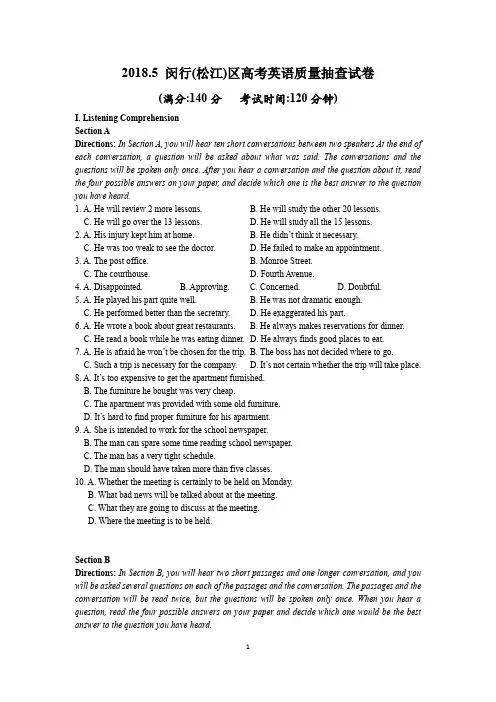
2018.5 闵行(松江)区高考英语质量抽查试卷(满分:140分考试时间:120分钟)I. Listening ComprehensionSection ADirections: In Section A, you will hear ten short conversations between two speakers At the end of each conversation, a question will be asked about what was said. The conversations and the questions will be spoken only once. After you hear a conversation and the question about it, read the four possible answers on your paper, and decide which one is the best answer to the question you have heard.1. A. He will review 2 more lessons. B. He will study the other 20 lessons.C. He will go over the 13 lessons.D. He will study all the 15 lessons.2. A. His injury kept him at home. B. He didn’t think it necessary.C. He was too weak to see the doctor.D. He failed to make an appointment.3. A. The post office. B. Monroe Street.C. The courthouse.D. Fourth Avenue.4. A. Disappointed. B. Approving. C. Concerned. D. Doubtful.5. A. He played his part quite well. B. He was not dramatic enough.C. He performed better than the secretary.D. He exaggerated his part.6. A. He wrote a book about great restaurants. B. He always makes reservations for dinner.C. He read a book while he was eating dinner.D. He always finds good places to eat.7. A. He is afraid he won’t be chosen for the trip.B. The boss has not decided where to go.C. Such a trip is necessary for the company.D. It’s not certain whether the trip will take place.8. A. It’s too expensive to get the apartment furnished.B. The furniture he bought was very cheap.C. The apartment was provided with some old furniture.D. It’s hard to find proper furniture for his apartment.9. A. She is intended to work for the school newspaper.B. The man can spare some time reading school newspaper.C. The man has a very tight schedule.D. The man should have taken more than five classes.10. A. Whether the meeting is certainly to be held on Monday.B. What bad news will be talked about at the meeting.C. What they are going to discuss at the meeting.D. Where the meeting is to be held.Section BDirections: In Section B, you will hear two short passages and one longer conversation, and you will be asked several questions on each of the passages and the conversation. The passages and the conversation will be read twice, but the questions will be spoken only once. When you hear a question, read the four possible answers on your paper and decide which one would be the best answer to the question you have heard.Questions 11 through 13 are based on the following passage.11. A. Appropriateness of the programs. B. The operation of national programs.C. The incomes of the corporation.D. The welfare of the staff.12. A. By donations from the public. B. By selling its programs.C. By selling broadcasting devices.D. By getting support from the royals.13. A. Its humorous styles. B. The richness of its programs.C. Famous news announcers.D. Its neutral views on news.Questions 14 through 16 are based on the following passage.14. A. Social progress and individual development.B. Human behaviors and social changes.C. General concepts about psychology and sociology.D. Relationship between cultures and human behaviors.15. A. What is the role of religion or art in a society?B. What is the main reason for revolution in a society?C. What are the causes of antisocial behavior?D. Why does one society progress more rapidly than another?16. A. Both psychology and sociology study human behavior.B. Mental problems should be dealt with by a sociologist.C. Sociology is the study of group behavior.D. Psychology pays more attention to individuals than to groups.Questions 17 through 20 are based on the following conversation.17. A. It looks into opinions that people hold about old age.B. It is about how to keep healthy in old age.C. It investigates causes of old people’s unhappiness.D. It reveals the secret of living longer.18. A. Arise people’s awareness of caring for the old.B. Encourage people to be more responsible for the old.C. Help people change their feelings about old age.D. Ease people’s fear and anxiety about mental illness of the old.19. A. They are mostly among the 60-70 age group.B. They are mostly abandoned by their families.C. People do not become more lonely because of old age.D. People among any age group are not lonely at all.20. A. They are changing suddenly and completely at a particular age.B. It’s hard to recognize a person when he is turning old.C. Old people can’t deal with events and problems properly.D. People do not change in old age a lot more than in middle age.II. Grammar and VocabularySection ADirections:After reading the passage below, fill in the blanks to make the passage coherent and grammatically correct. For the blanks with a given word, fill in each blank with the proper form ofthe given word; for the other blanks, use one word that best fits each blank.Aunt Jane is now well over seventy, but she is still a great cinema-goer. The cinema in our town closed down years ago and sometimes she has to travel twenty miles or more to see a good film. And once a month at least she goes up to London to see (21)________(late) foreign films. Of course she could see most of these films on television, but the idea does not attract her. “It isn’t the same,” she says. “For one thing, the screen’s too small. Besides, I like going to the cinema!”However, one thing which has always puzzled us is that (22)________ Aunt Jane has lots of friends and enjoys company, she always goes to the cinema alone. We discovered the reason for this only recently—from Mother. “It may surprise you to learn that Aunt Jane wanted to be an actress when she was young,” she told us. “She used to wait outside film studios all day, just (23)________(appear) in crowd scenes. Your aunt has probably appeared in dozens of films. Sometimes she did not even know the name of the film they (24)________(make). Therefore, she couldn’t go to see (25)________ in the film at the cinema!“All the time, of course, she was looking for a small part in a film. Her big chance came (26)________ they started to make a film in our town. Jane managed to meet the director at a party and he offered her (27)________ role as a shopkeeper. It really was a very small part, but it was an important moment for Jane. Before the great event, she rehearsed for days. In fact, she turned the sitting-room into a shop! We all had to help, going to and out of the shop (28)_______ she could remember her words perfectly. And (29)________ the actual day she was marvelous. Jane thought that this was the beginning of her film career!“Unfortunately, in the end, they did not include the shop scene in the film. But nobody told Jane! When the film first appeared in London, she took all her friends to see it. And of course she wasn’t in it! It was a terrible blow! She stopped (30)________ (go) to film studios and gave up the idea of becoming an actress. She still loves the cinema, as you all know, but from that day she has always gone alone!”Section BDirections: Complete the following passage by using the words in the box. Each word can only be(班卓琴) song, you’re probably (31)______ following the age-old advice that practice makes perfect. However, contrary to popular belief, doing the same thing over and over again might not be the most efficient way to learn foreign concepts.Traditionally, we’re taught using the “blocking” strategy. This instructs us to go over a single idea again and again until we’ve mastered it, before (32)______ to the next concept. But several new neurological (神经学的) (33)______ show that an up and coming learning method called “interleaving” improves our ability to keep and perform new skills over any traditional means by leaps and bounds.What interleaving does is to space out learning over a longer period of time, and it (34)______ the information we encounter when learning a new skill. So, for example, instead of learning one banjo chord at a time until you (35)______ it, you train in several at once and in shorter bursts.One of the practical ways you can use interleaving to train your brain to pick up new skillsquickly and effectively is to practice multiple (36)______ skills at once.Whether you’re trying to improve your motor skills or cognitive (认知的) learning abilities, the key to (37)______ how your brain processes new information is to break out of the habit of learning one part of a skill at a time. The advantage of this method is that your brain doesn’t get comfortable or store information in your short-term memory. Instead, interleaving causes your brain to (38)______ focus and problem-solve every step of the way, resulting in information getting stored in your long-term memory instead.Interleaving doesn’t cut any corners, so your brain is always on (39)______. Think of the difference between blocking and interleaving like a boxer who practices one (40)______ over and over again versus a boxer who practices by sparring in the ring. In the ring, you have to be ready for anything. It makes you faster and sharper.III. Reading ComprehensionSection ADirections: For each blank in the following passage there are four words or phrases marked A, B, C and D. Fill in each blank with the word or phrase that best fits the context.Since 1960, considerable scientific researches have been done on chimps in their natural habitats. Astonishingly, scientists have found out that the social 41 of Chimps are very similar to humans. Chimps will 42 in certain ways, like gathering in war parties to protect their territory. But beyond the minimum requirements as social beings, they have little instinct to 43 one another. Chimps in the wild seek food for themselves. Even chimp mothers regularly 44 to share food with their children. Who are able from a young age to gather their own food?In the laboratory, chimps don’t 45 share food either. If a chimp is put in a cage where he can pull in one plate of food for himself or, with no greater effort, a plate that also provides food for a neighbor to the next cage, he will pull 46 -- he just doesn’t care whether his neighbor gets fed or not. Chimps are truly selfish.Human children, 47 , are extremely cooperative. From the earliest ages, they decide to help others, to share information and to participate in achieving common goals. The psychologist Michael Tomasello has studied this 48 in a series of experiments with very young children. He finds that if babies aged 18 months see a worried adult with hands full trying to open a door, almost all will immediately try to help.There are several reasons to believe that the urges to help, inform and share are not taught, but naturally 49 in young children. One is that these 50 appear at a very young age before most parents have started to train their children to behave 51 . Another is that the helping behaviors are not improved if the children are rewarded. A third reason is that social intelligence 52 in children before their general cognitive skills, at least when compared with chimps. In tests conducted by Tomasello, the human children did no better than the chimps on the 53 world tests but were considerably better at understanding the social world.The core of what children’s minds have and chimps’ don’t is what Tomasello calls shared intentionality. Part of this ability is that they can 54 what others know or are thinking. But beyond that, even very young children want to be part of a shared purpose. They actively seek to be part of a “we”, a group that intends to work toward a(n) 55 goal.41. A. structures B. policies C. behaviors D. responsibilities42. A. conflict B. cooperate C. offend D. negotiate43. A. trust B. contact C. isolate D. help44. A. decline B. manage C. attempt D. oblige45. A. curiously B. reluctantly C. naturally D. carelessly46. A. in turn B. at random C. with care D. in advance47. A. all in all B. as a result C. in no case D. on the other hand48. A. cooperativeness B. availability C. interrelationship D. attractiveness49. A. cultivated B. motivated C. possessed D. stimulated50. A. attitudes B. instincts C. experiences D. coincidences51. A. creatively B. formally C. socially D. competitively52. A. develops B. decreases C. changes D. disappears53. A. abstract B. invisible C. imaginary D. physical54. A. infer B. adapt C. absorb D. balance55. A. realistic B. shared C. specific D. ambitiousSection BDirections:Read the following three passages. Each passage is followed by several questions or unfinished statements. For each of them there are four choices marked A. B. C and D. Choose the one that fits best according to the information given in the passage you have just read.(A)If a diver surfaces too quickly, he may suffer the bends.Nitrogen (氮) dissolved in his blood is suddenly liberated bythe reduction of pressure. The consequence, if the bubblesaccumulate (累积) in a joint, is sharp pain and a bent body—thus the name. If the bubbles form in his lungs or his brain, theconsequence can be death.Other air-breathing animals also suffer thisdecompression (减压) sickness if they surface too fast: whales,for example. And so, long ago, did ichthyosaurs. That theseancient sea animals got the bends can be seen from their bones. If bubbles of nitrogen form inside the bone they can cut off its blood supply. This kills the cells in the bone, and consequently weakens it, sometimes to the point of collapse. Fossil bones that have caved in on themselves are thus a sign that the animal once had the bends.Bruce Rothschild of the University of Kansas knew all this when he began a study of ichthyosaur bones to find out how widespread the problem was in the past. What he particularly wanted to investigate was how ichthyosaurs adapted to the problem of decompression over the 150 million years. To this end, he and his colleagues traveled the world’s natural-history museums, looking at hundreds of ichthyosaurs from the Triassic period and from the later Jurassic and Cretaceous periods.When he started, he assumed that signs of the bends would be rarer in younger fossils, reflecting their gradual evolution of measures to deal with decompression. Instead, he was astonished to discover the opposite. More than 15% of Jurassic and Cretaceous ichthyosaurs had suffered the bends before they died, but not a single Triassic specimen (标本) showed evidence of that sort of injury.If ichthyosaurs did evolve an anti-decompression means, they clearly did so quickly—and,most strangely, they lost it afterwards. But that is not what Dr. Rothschild thinks happened. He suspects it was evolution in other animals that caused the change.Whales that suffer the bends often do so because they have surfaced to escape a predator (掠食性动物) such as a large shark. One of the features of Jurassic oceans was an abundance of large sharks and crocodiles, both of which were fond of ichthyosaur lunches. Triassic oceans, by contrast, were mercifully shark and crocodile-free. In the Triassic, then, ichthyosaurs were top of the food chain. In the Jurassic and Cretaceous, they were prey (猎物) as well as predator—and often had to make a speedy exit as a result.56. Which of the following is a typical symptom of the bends?A. A twisted body.B. A gradual decrease in blood supply.C. A sudden release of nitrogen in blood.D. A drop in blood pressure.57. The purpose of Rothschild’s study is to see ________.A. how often ichthyosaurs caught the bendsB. how ichthyosaurs adapted to decompressionC. why ichthyosaurs bent their bodiesD. when ichthyosaurs broke their bones58. Rothschild’s finding stated in Paragraph 4 ________.A. confirmed his assumptionB. speeded up his research processC. disagreed with his assumptionD. changed his research objectives59. Rothschild might have concluded that ichthyosaurs ________.A. failed to evolve an anti-decompression meansB. gradually developed measures against the bendsC. died out because of large sharks and crocodilesD. evolved an anti-decompression means but soon lost it(B)However wealthy we may be, we can never find enough hours in the day to do everything we want. Economics deals with this problem through the concept of opportunity cost, which simply refers to whether someone’s time or money could be better spent on something else.Every hour of our time has a value. For every hour we work at one job we could quite easily be doing another, or be sleeping or watching a film. Each of these options has a different opportunity cost—namely, what they cost us in missed opportunities.Say you intend to watch a football match but the tickets are expensive and it will take you a couple of hours to get to and from the stadium. Why not, you might reason, watch the game from home and use the leftover money and time to have dinner with friends? This—the alternative use of your cash and time—is the opportunity cost.For economists, every decision is made by knowledge of what one must forgo—in terms of money and enjoyment—in order to take it up. By knowing precisely what you are receiving and what you are missing out on, you ought to be able to make better-informed, more reasonable decisions. Consider that most famous economic rule of all: there’s no such thing as a free lunch. Even if someone offers to take you out to lunch for free, the time you will spend in the restaurant still costs you something in terms of forgone opportunities.Some people find the idea of opportunity cost extremely discouraging: imagine spending your entire life calculating whether your time would be better spent elsewhere doing something more profitable or enjoyable. Yet, in a sense it’s human nature to do precisely that we assess theadvantages and disadvantages of decisions all the time.In the business world, a popular phrase is “value for money.” People want their cash to go as far as possible. However, another is fast obtaining an advantage: “value for time.” The biggest restriction on our resources is the number of hours we can devote to something, so we look to maximize the return we get on our investment of time. By reading this passage you are giving over a bit of your time which could be spent doing other activities, such as sleeping and eating. In return, however, this passage will help you to think like an economist, closely considering the opportunity cost of each of your decisions.60. According to the passage, the concept of “opportunity cost” is applied to ______.A. making more moneyB. taking more opportunitiesC. reducing missed opportunitiesD. weighing the choice of opportunities61. The “leftover money and time” in Paragraph 3 probably refers to the time ______.A. spared for watching the match at homeB. taken to have dinner with friendsC. spent on the way to and from the matchD. saved from not going to watch the match62. What are forgone opportunities?A. Opportunities you forget in decision-making.B. Opportunities you give up for better ones.C. Opportunities you miss accidentally.D. Opportunities you make up for.(C)Of all the components of a good night’s sleep, dreams seem to be least within our control. In dreams, a window opens into a world where logic is suspended and dead people speak. A century ago, Freud stated his revolutionary theory that dreams were the disguised (伪装的) shadows of our unconscious desires and fears; by the late 1970s, neurologists had switched to thinking of them as just “mental noise” — the random byproducts of the neural-repair work that goes on during sleep. Now researchers suspect that dreams are part of the mind’s emotional thermostat, regulating moods while the brain is “off-line”. And one leading authority says that these intensely powerful mental events can be not only influenced but actually brought under conscious control, to help us sleep and feel better. “It’s your dream,” says Rosalind Cartwright, chair of psychology at Chicago’s Medical Center. “If you don’t like it, change it.”The link between dreams and emotions shows up among the patients in Cartwright’s clinic. Most people seem to have more bad dreams early in the night, progressing toward happier ones before awakening, suggesting that they are working through negative feelings generated (产生) during the day. Because our conscious mind is occupied with daily life, we don’t always think about the emotional significance of the day’s events — until, it appears, we begin to dream.And this process need not be left to the unconscious. Cartwright believes one can exercise conscious control over repeated bad dreams. As soon as you awaken, identify what is upsetting about the dream. Visualize how you would like it to end instead; the next time it occurs, try to wake up just enough to control its course. With much practice people can learn to, literally, do it in their sleep.At the end of the day, there’s probably little reason to pay attention to our dreams at all unless they keep us from sleeping or “we wake up in a panic,” Cartwright says. Terrorism, economic uncertainties and general feelings of insecurity have increased people’s anxiety. Those suffering from persistent nightmares should seek help from a therapist. For the rest of us, the brain has itsways of working through bad feeling. Sleep — or rather dream — on it and you’ll feel better in the morning.63. By saying that “dreams are part of the mind’s emotional thermostat” in paragraph 1, theresearchers mean that ______.A. dreams can help us keep our mood comparatively stableB. dreams can be brought under conscious controlC. dreams represent our unconscious desires and fearsD. we can think logically in the dreams too64. The negative feelings generated during the day tend to ______.A. become worse in our unconscious mindB. develop into happy dreamsC. persist till the time we fall asleepD. show up in dreams early at night65. Cartwright believed with much practice, we can learn to ______.A. control what dreams to dreamB. sleep well without any dreamsC. wake up in time to stop the bad dreamsD. identify what is upsetting about the dreams66. Cartwright might advise those who sometimes have bad dreams to ______.A. lead their life as usualB. seek professional helpC. exercise conscious controlD. avoid anxiety in the daytimeSection CDirections: Read the following passage. Fill in each blank with a proper sentence given in the box.Choosing the right time to sleep, the correct moment to make decisions, the best hour to eat—and even go into hospital—could be your key to perfect health.Centuries after man discovered the rhythms of the planets and the cycles of crops, scientists have learned that we too live by precise rhythms that govern everything from our basic bodily functions to mental skills. Man is a prisoner of time.But it’s not just the experts who are switching on to the way our bodies work. 67 Prince Charles consults a chart which tells him when he will be at his peak on a physical, emotional and intellectual level. Boxer Frank Bruno is another who charts his bio-rhythms to plan for big fights.68 Sleep, blood pressure, hormone levels and heartbeat all follow their own clocks, which may bear only slight relation to our man-made 24-hour cycle.Research shows that in laboratory experiments when social signals and, most importantly, light indicators such as dawn are taken away, people lose touch with the 24-hour clock and sleeping patterns change. Temperature and heartbeat cycles lengthen and settle into “days” lasting about 25 hours.In the real world, light and dark keep adjusting internal clock to the 24-hour day. But the best indicator of performance is body temperature. As it falls from a 10 p.m. high of 37.2°C to a pre-dawn low of 36.1°C, mental functions fall too. 69The most famous example is the nuclear accident at Three Mile Island in the US. The three operators in the control room worked alternating weeks of day, evening and night shifts.70 Investigators believe this caused the workers to overlook a warning light and fail to close an open valve.Finding the secret of what makes us tick has long fascinated scientists and work done over the last decade has yielded important clues. The aim is to help us become more efficient. For example, the time we eat may be important if we want to maximize intellectual or sporting performance. There is already evidence suggesting that the time when medicine is given to patients affects how well it works.IV. Summary WritingDirections:Read the following passage. Summarize the main idea and the main point(s) of the passage in no more than 60 words. Use your own words as far as possible.Quiet Virtue: The ConscientiousThe everyday signs of conscientiousness (认真尽责)—being punctual, careful in doing work, self-disciplined, and scrupulous (一丝不苟的) in attending to responsibilities—are typical characteristics of the model organizational citizen, the people who keep things running as they should. They follow the rules, help out, and are concerned about the people they work with. It’s the conscientious worker who helps newcomers or updates people who return after an absence, who gets to work on time and never abuses sick leaves, who always gets things done on deadline. Conscientiousness is a key to success in any field. In studies of job performance, outstanding effectiveness for almost all jobs, from semi-skilled labor to sales and management, depends on conscientiousness. Among sales representatives for a large American car manufacturer, those who were most conscientious had the largest volume of sales.Conscientiousness also offers a buffer (缓冲) against the threat of job loss in today’s constantly changing market, because employees with this quality are among the most valued. For the sales representatives, their level of conscientiousness mattered almost as much as their sales in determining who stayed on.But conscientiousness in the absence of social skills can lead to problems. Since conscientious people demand so much of themselves, they can hold other people to their own standards, and so be overly judgmental when others don’t show the same high levels of model behavior. Factory workers who were extremely conscientious, for example, tended to criticize co-workers even about failures that seemed unimportant to those they criticized, which damaged their relationships.When conscientiousness takes the form of living up to expectations, it can discourage creativity. Success in creative professions like art or advertising calls for a balance between wild ideas and conscientiousness. Without enough conscientiousness to follow through, people become mere dreamers, with nothing to show for their imaginativeness.V. TranslationDirections:Translate the following sentences into English, using the words given in the brackets.72. 请把这封信寄给负责售后服务的人。
上海市各区年高三英语二模试题汇编--摘要写作(Summary Writing)--老师版(全部带答案精准校对)
IV. Summary WritingDirections: Read the following passage. Summarize the main idea and the main point(s) of the passage in no more than 60 words. Use your own words as far as possible.Clearly if we are to participate in the society in which we live, we must communicate with other people. A great deal of communicating is performed on a person-to-person basis by the simple means of speech. If we travel in buses, buy things in shops, or eat in restaurants, we are likely to have conversations where we give information or opinions, receive news or comment and very likely have our views challenged by other members of society.Face-to face contact is by no means the only form of communication and during the last two hundred years the art of mass communication has become one of the dominating factors of current society. Two things, above others, have caused the enormous growth of the communication industry. Firstly, inventiveness has led to advances in printing, telecommunications, photography, radio and television. Secondly, speed has revolutionized the transmission and reception of communications so that local news often takes a back seat to national news, which itself is often almost eclipsed (失去优势) by international news.No longer is the possession of information restricted to a wealthy minority. In the last century the wealthy man with his own library was indeed fortunate, but today there are public libraries. Forty years ago, people used to go to the cinema, but now far more people sit at home and turn on the TV to watch a program that is being channeled into millions of homes.Communication is no longer merely concerned with the transmission of information. The modern communication influences the way people live in society and broadens their horizons by allowing access to information, education and entertainment. The printing, broadcasting and advertising industries are all involved with informing, educating and entertaining.Keys:The passage talks about some changes of communication. First, the art of mass communication promoted by inventiveness and speed is one of the determining factors in the form of communication. Second, the possession of information belongs to the masses, not wealthy minority only. Third, modern communication is crucial to people’s lifestyle and broadens people’s horizons. (59 words)IV.Summary WritingDirections: Read the following passage. Summarize the main idea and the main point(s) of the passage in no more than 60 words. Use your own words as far as possible.In one of my earliest memories, I’m drawing. I don’t remember what the picture is supposed to be, but I remember the mistake. My marker slips, an unintentional line appears and my lip trembles. The picture has long since disappeared. But that feeling of deep frustration, even shame, stays with me.That’s the thing about perfectionism, a crucially self-defeating way to move through the world. It makes you better at your career and relationships and life in general.Culturally, we often see perfectionism as a positive.But the disadvantage of perfectionism isn’t just that it holds you back from being your most successful, productive self. Perfectionistic tendencies have been linked to a laundry list of clinical issues: depression and anxiety (even in children), self-harm, social anxiety disorder, eating disorders, and most damaging of all, suicide.“Based upon the 60-odd studies that we’ve done, we think that’s a misunderstanding,” says York St John University’s Hill. “Factors often labeled ‘healthy’ perfectionism, like striving for excellence, aren’t actually perfectionism at all. They’re just conscientiousness(尽职尽责)– which explains why people with those tendencies often have different outcomes in studies. Perfectionism isn’t defined by working hard or setting high goals. It’s that critical inner voice.”Take the student who works hard and gets a poor mark. If she tells herself: “I’m disappointed, but it’s okay; I’m still a good person overall,” that’s healthy. If the message is: “I’m a failure. I’m not good enough,” that’s perfectionism.Perfectionists can make smooth sailing into a storm, a brief ill wind into a category-five hurricane. Eventually, the behaviours perfectionists adapt, actually, do make them more likely to fail.Keys:Many of us believe perfectionism is a positive. But researchers are finding that it is nothing short of dangerous, leading to a long list of health problems and failure in study or life. Besides, perfectionism is different from conscientiousness in that the former is connected with beingparticular about oneself. (50 words)IV.Summary WritingDirections: Read the following passage. Summarize the main idea and the main point(s) of the passage in no more than 60 words. Use your own words as far as possible.Every time there is a mass shooting, the debate surrounding guns tends to flare up in America. The abuse of guns has been a serious problem in the U S all along, but why doesn’t the US government just dismiss owning guns privately?The right to own a gun and defend oneself is central to American society. As early as the 1600s, when the first Europeans set foot on the continent of North America, they had to face a lot of dangers. They could only rely on themselves. Therefore, guns played a significant role in self-defense. Guns were also important in America’s Independent War and the Civil War.Secondly, the American founding fathers believed that gun ownership was necessary for a truly free country. If the government distrusts the people and disarms them, then that government no longer represents the people. The Second Amendment to the US Constitution specifies that the American people cannot be deprived of the“right to keep and bear arms.”So the sale and purchase of firearms are legal in the United States according to law.The importance of guns is also derived from the role of hunting in American culture. In the nation’s early years, hunting was essenti al for food and shelter. Today, guns are a vital part of hunting, which remains very popular as both a sport and a way of life in many parts of the country. People spend time with friends, sharing the pleasure that the sport brings.For those reasons, when critics say guns mean violence, they miss a large part of the picture, and they misrepresent the complex nature of America’s diverse gun culture. Most people who own guns privately, are actually part of the gun culture. They have rational and thoughtful reasons to own and use guns.Keys:The US government doesn’t ban gums for the following reasons. Finally, guns serve as a means of self-defence. Besides, the possession of a gun is a symbol of freedom. Finally, guns are important because hunting is still p opular in people’s life as a sport. Despite the disputes,Americans are entitled to the use of guns. (59 words)IV.Summary WritingDirections: Read the following passage. Summarize the main idea and the main point(s) of the passage in no more than 60 words. Use your own words as far as possible.The Conflict of the OrdersThe types of people who served as officials in the Roman government changed over time. These changes stemmed from the attempts of common people to more rights. The struggles became known as the Conflict of the Orders.In the early republic, Romans were divided into two classes of people: patricians and plebeians. Patricians were powerful landowners who controlled the government. As nobles, they inherited their power. Plebeians, who made up most of the population, were mainly farmers and workers. For many years, plebeians had few rights. They could vote, but they were barred from holding most public offices. Plebeians could not even know Roman laws because laws were not written down. In court, a judge stated and applied the law, but only patricians served as judges.Over time, plebeians increased their power through demand and strikes. They gained the right to join the army, hold government office, form their own assembly, and elect leaders. In one of their greatest victories, they forced the government to write down the laws of the Roman Republic. In about 450, B.C. the Romans engraved their laws on tablets called the Twelve Tables. The laws were placed in the Forum, the chief public square, for all to view.The first plebeians were appointed to the government in the late 400s B.C. After 342 B. C, a plebeian always held one of the consul positions. By about 300 B. C. many plebeians had become so powerful and wealthy themselves that they joined with patricians to form the Roman nobility. From that time on, the distinction between patricians and plebeians was not as important. Membership in the nobility was still very important, however, since government officials were not paid a salary only wealthy nobles could afford to hold office. Thus, the nobles still controlled the republic.Keys:Romans consisted of two classes: patricians and plebeians. Patricians, the nobles, inheritedpower and controlled the government. Plebeians, the common people having few rights, gradually gained rights through struggles. Later, many plebeians gained power and wealth and became nobles. Only the rich could afford to hold the unpaid office, so the nobles still controlled Rome.(55 words)IV.Summary WritingDirections: Read the following passage. Summarize the main idea and the main point(s) of the passage in no more than 60 words. Use your own words as far as possible.A Workaholic EconomyAlthough the output per hour of work has more than doubled since 1945, leisure seems reserved largely for the unemployed and underemployed. Those who work full-time spend as much time on the job as they did at the end of World War Ⅱ. In fact, working hours have increased noticeably since 1970. Bookstores now abound with manuals describing how to manage time and cope with stress.There are mainly two reasons for lost leisure.Since 1970, companies have responded to improvements in the business climate by having employees work overtime rather than by hiring extra personnel. Some firms are even downsizing as their profits climb. A host of factors pushes employers to hire fewer workers for more hours and, at the same time, compels workers to spend more time on the job. Most of those incentives(诱因) involve the structure of compensation(报酬). The way salaries and benefits are organized makes it more profitable to ask 40 employees to labor an extra hour each than to hire one more worker to do the same 40-hour job. Once people are on salary, their cost to a firm is the same whether they spend 35 hours a week in the office or 70. Therefore, it is more profitable for employers to work their existing employees harder.For all that employees complain about long hours, they, too, have reasons not to trade money for leisure. “People who work reduced hours pay a huge penalty in career terms,” Bailyn of Massachusetts Institute of Technology maintains. “It’s taken as a negative signal about their commitment to the firm.” He adds that many corporate managers find it difficult to measure the contribution of their employees to a firm’s well-being, so they estimate staff productivity in terms of hours worked. Employees know this, and they adjust their behavior accordingly.Keys:People actually work more hours than before despite the increased productivity. On one hand, it’s because the payment distribution system makes it economical for companies to have employees work overtime than hiring more people. On the other hand, employees tend to work long hours because their working time is linked to their contribution to the firm. (56 words)IV. Summary WritingDirections: Read the following passage. Summarize the main idea and the main point(s) of the passage in no more than 60 words. Use your own words as far as possible.Quiet Virtue: The ConscientiousThe everyday signs of conscientiousness (认真尽责) —being punctual,, careful in doing work, sef-disciplined and scrupulous(一丝不苟的) in attending to responsibilities—are typical characteristics of the model organizational citizen, the people who keep things running as they should. They follow the rules, help out, and are concerned about the people they work with. It's the conscientious worker who helps newcomers or updates people who return after an absence, who gets to work on time and never abuses sick leaves, who always gets things done on deadline.Conscientiousness is a key to success in any field. In studies of job performance, outstanding effectiveness for almost all jobs, from semi-skilled labor to sales and management, depends on conscientiousness. Among sales representatives for a large American car manufacturer, those who were most conscientious had the largest volume of sales.Conscientiousness also offers a buffer(缓冲) against the threat of job loss in today's constantly changing market, because employees with this quality are among the most valued. For the sales representatives, their level of conscientiousness mattered almost as much as their sales in determining who stayed on.But conscientiousness in the absence of social skills can lead to problems. Since conscientious people demand so much of themselves, they can hold other people to their own standards, and so be overly judgmental when others don't show the same high levels of model behavior. Factory workers who were extremely conscientious, for example, tended to criticize co-workers even about failures that seemed unimportant to those they criticized, which damaged their relationships.When conscientiousness takes the form of living up to expectations, it can discourage creativity. Success in creative professions like art or advertising calls for a balance between wild ideas and conscientiousness. Without enough conscientiousness to follow through, people become mere dreamers, with nothing to show for their imaginativeness.Keys:Conscientiousness is the feature of model organizational employees and keeps the company functioning successfully. Conscientiousness has both advantages and disadvantages. With conscientiousness, employees give outstanding performance, so they are less likely be jobless. Meanwhile, conscientious people without social skills tend to have tense relationships with their fellow workers and conscientiousness can also damage creativity. (54 words)IV. Summary WritingDirections: Read the following passage. Summarize the main idea and the main point(s) of the passage in no more than 60 words. Use your own words as far as possible.The sharing economy has grown in recent years to include everything from apartment sharing to car sharing to community tool sharing.Since 2009, a new form of the sharing economy has been emerging in neighbourhoods throughout the US and around the world - Little Free Libraries. The libraries are boxes put in neighbourhoods from which local people can take out and put in books. Little Free Libraries come in all shapes and sizes. Some libraries also have themes, focusing on books for children, adults or tour guides.In 2009, Tod Bol built the first Little Free Library in the Mississippi River town of Hudson, Wisconsin, to honour his mother, who loved reading. When he saw the people of his community gathering around it, exchanging conversation as well as books, he knew he wanted to take his simple idea further.Since then, his idea has become a movement, spreading from state to state and country to country. According to LittleFreelibrary. org. there are now 18,000 of the little boxes around the world, found in each of the 50 US states and 70 countries in Europe, Africa and Asia.The Internet has helped to spread Little Free Libraries. But an Atlantic article said that they are something different in a world of e-reader downloads. The little wooden boxes are refreshinglyphysical and human. when you open the door of the box, chance and your neighbours' tastes determine what you'll find. You might find a graphic novel, a cookbook or a tour guidebook.For many people, this sense of discovery is Little Free Libraries main appeal. "A girl walking home from school might pick up a graphic novel that gets her excited about reading, a man on his way to the bus stop might find a book of poetry that changes his view on life, said The Atlantic article. "Every book is a potential source of inspiration."Keys:Little Free Libraries, composed of all sizes of boxes with various themes, have sprung up in neighborhoods across the world. Tod Bol established the first one to honor his mother fond of reading. Later the idea spread internationally online. Different from e-reader downloads, books inside the wooden boxes can make readers excited or change their views etc. by inspiring them.(60 words)IV. Summary WritingDirections: Read the following passage. Summarize the main idea and the main point(s) of the passage in no more than 60 words. Use your own words as far as possible.African elephants are in trouble. Their numbers have fallen violently from as many as ten million a hundred years ago to as few as 400,000 today. Losses are largely from poaching(偷猎)for the illegal ivory trade, and also because of the smaller living space for elephants, as people open up land for farming and development.Killing some elephants to help save the species is one suggested strategy for preserving them. Here’s the thinking: Invite rich hunters to pay generous fees to shoot specified numbers of elephants, and use that money as sources for various conservations.Some people claim that trophy hunting can provide generous financial support for people to conserve and restore wild elephant numbers, protect wildlife from poaching, and to help give local communities a boost in economy. Doing that, the theory goes, poor villagers won’t need to poach elephants to feed their families.To look into the new business closely, the trophy hunting industry does not provide significant benefits to the communities where it occurs. Across Africa, there are only about 15,000 hunting-related jobs created by the business—a tiny number,especially considering that the sixmain game-hunting countries alone have a population of nearly 150 million.Besides that, it is true the total income from trophy hunting is substantial. Take an unnamed area for example, the total income to wild conservancies from trophy hunting, amounted to $165,000. Six years later, this is expected to increase almost tenfold to $1,330,000. Yet after various kinds of processing fees and expenses are reduced, the local communities make an average of only ten cents a hectare (25 cents an acre) from trophy hunting. The return is so small that it justly explains locals’ lack of interest in preserving hunting areas and their continued poaching.Keys:African elephants are endangered with greatly reduced numbers due to unlawful poaching and shrinking habitat. Trophy hunting, legal elephant shooting for conservation fund, is considered a solution. According to some, it helps maintain elephant population and benefits local economy. However, it turns out the business employs few people and hunt fee trickling down to local villagers and communities is minimal. (60 words)IV. Summary WritingDirections: Read the following passage. Summarize the main idea and the main point(s) of the passage in no more than 60 words. Use your own words as far as possible.Do Smartphones Make Us Smarter?Should teachers allow cellphones in a classroom? A recent study on the way smartphones disturb learning might help explain the issue. Researchers published findings showing how students were affected by their phones in the classroom. They explored the differences in student performance in four situations: open phone use allowed, phones allowed in the classroom but could not be used, no phones in the classroom and a no-instruction control group. After watching a 20-minuted video, students took a short quiz. The result was that the students in a room without any cellphones performed significantly better on the test. Scientists believe the way we attach ourselves to our phones could be the problem.Smartphones have become to strongly established in society that many people are lost without them. We are now in an age when many people can’t imagine life without a phone. Thereis even a name for the anxiety caused by not having one-monophobia, which is the powerful feeling people get when they don’t have signal, their battery is about to die, or they are separated from their phones. Their fear of missing out on important information or connections can have a controlling effect on their lives and can divide their attention from other important things like learning.So does information technology help or block the way we think? In the past, people relied heavily on specific knowledge and knew how in their circle of friends would be most likely to know things in different subjects. Now, our friend with all the information is the Internet. Indications are that people don’t remember information as well if they know they can use a computer of phone to recall it quickly. So it may be more difficult to move information from the Internet into our long-term memory.But the impact of being exposed to so much information isn’t all bad. Reports show that frequent Internet use can strengthen fast-paced problem solving and can speed up the ability to spot patterns in a lot of data.Keys:Researchers recently found smartphones influenced learning. For one thing, smartphones have become an essential part of life, without which people feel at a loss, thus distracting their attention from learning. For another, people rely so heavily on smartphones that their long-term memory can be affected. However, having access to a large amount of information also benefits people in some aspects (60 words)IV. Summary WritingDirections: Read the following passage. Summarize the main idea and the main point(s) of the passage in no more than 60 words. Use your own words as far as possible.Better Memory Causes BoredomA new study shows that the better your short-term memory, the faster you feel fed up and decide you’ve had enough. The findings appear in the Journal of Consumer Research.Noelle Nelson, assistant professor of marketing and consumer behavior at the University of Kansas School of Business. She and her colleague Joseph Redden at the University of Minnesota tried to think outside the lunch box. “Something that was interesting to me is that some people gettired of things at very different rates. When you think about pop songs on the radio, some people must still be enjoying them and requesting them even after hearing them a lot. But a lot of other people are really sick of those same songs.” The difference, the researchers supposed, might have to do with memories of past consumption.The researchers tested the memory capacity of undergraduates. The students then viewed a repeating series of three classic paintings like The Starry Night, American Gothic, and The Scream or listened and re-listened to a series of three pop songs or three pieces of classical music. Throughout the test, the participants were asked to rate their experience on a scale of zero to ten. And the better a participant scored in the memory test, the faster they got bored.“We found that people with larger capacities remembered more about the music or art, which led to them getting tired of the music or art more quickly. So remembering more details actually made the participants feel like they’d experienced the music or art more often.”The findings suggest that marketers could cope with our desire for their products by figuring out ways to distract us and keep us from fully remembering our experiences. We could also trick ourselves into eating less junk food by recalling the experience of a previous snack. As for kids easily bored, just tell them to forget about it---it might help them have more fun.Keys:A study shows if a person has a good short-term memory he is likely to feel bored quickly. Assuming memories of past experience may influence the different rates at which some people feel fed up, two researchers conducted a tests, relating students’memory capacity to their performance, and got the result. The finding my apply to marketing, self-controlling and educating.(60 words)IV. Summary WritingDirections: Read the following passage. Summarize the main idea and the main point(s) of the passage in no more than 60 words. Use your own words as far as possible.As technology grows, many university instructors are finding ways to guide online learning platforms into their classrooms. Programs such as Blackboard, WebCT and Moodle allow teachers to post reading assignments, PowerPoint presentations, lecture notes and quizzes for students tocomplete outside of class. While posting lessons online can be friendly to students' communication styles and easily accessible, they also cause disadvantages.One disadvantage is that it may encourage students to depend on technology in the classroom. Instead of physical textbooks, many now bring cellphones to access materials during class discussions. While electronic devices can be valuable learning tools, they also can lead to distractions from learning, such as social networking and online games. It is extremely difficult for students being exposed to multiple electronic tasks to focus or remember key information.A second disadvantage is that online lessons open up potential for cheating. Many instructors require students to complete quizzes, post within discussion groups or submit major assignments online. As a result, there are some students having someone else complete their assignments. A contributing factor is that online assignments are best suitable for those self-motivated, self-directed students. Students who struggle with organization and completing assignments may find it easy to cheat online.In spite of these disadvantages, educators can take steps to make sure students use online lessons responsibly. If instructors are uncomfortable with electronic devices in the classroom, they can require students to print out assignments and readings to reference during sessions. To prevent cheating, teachers can use online assignments as a supplement to traditional in-class work, or create open-ended assignments rather than using assignments like multiple-choice quizzes that have only one right answer. Being familiar with what the platform looks like from a student perspective also can help instructors avoid potential pitfalls.Keys:Introducing online learning platform to university classrooms has two disadvantages: students’dependence on technology in the classroom and possibility for cheating. However, educators can find solutions to the problems. Furthermore, students can be asked to take paper files in class and be given supplementary online homework or open-ended assignment. Teachers’familiarity with the platform is helpful. (58words)IV. Summary WritingDirections: Read the following passage. Summarize the main idea and the main point(s) of thepassage in no more than 60 words. Use your own words as far as possible.The Conflict of the OrdersThe types of people who served as officials in the Roman government changed over time. These changes stemmed from the attempts of common people to more rights. The struggles became known as the Conflict of the Orders.In the early republic, Romans were divided into two classes of people: patricians and plebeians. Patricians were powerful landowners who controlled the government. As nobles, they inherited their power. Plebeians, who made up most of the population, were mainly farmers and workers. For many years, plebeians had few rights. They could vote, but they were barred from holding most public offices. Plebeians could not even know Roman laws because laws were not written down. In court, a judge stated and applied the law, but only patricians served as judges.Over time, plebeians increased their power through demand and strikes. They gained the right to join the army, hold government office, form their own assembly, and elect leaders. In one of their greatest victories, they forced the government to write down the laws of the Roman Republic. In about 450, B.C. the Romans engraved their laws on tablets called the Twelve Tables. The laws were placed in the Forum, the chief public square, for all to view.The first plebeians were appointed to the government in the late 400s B.C. After 342 B.C., a plebeian always held one of the consul positions. By about 300 B.C. many plebeians had become so powerful and wealthy themselves that they joined with patricians to form the Roman nobility. From that time on, the distinction between patricians and plebeians was not a important. Membership in the nobility was still very important, however, since government officials were not paid a salary, only wealthy nobles could afford to hold office. Thus, the nobles still controlled the republic.Keys:Romans was made up of two classes: patricians and plebeians. Patricians, the nobles, inherited power and controlled the government while plebeians, the common people, who used to have few rights, gradually gained various rights through struggles. From 300 B.C., the distinction between them was less obvious as many plebeians became nobles, and Rome was still controlled。
上海市金山区2018届高三下学期质量监控二模数学
(1) 求 PB 与平面 ABCD所成角的大小; (2) 求异面直线 PB 与 DC所成角的大小.
18. (本题满分 14 分,第 1 小题满分 7 分,第 2 小题满分 7 分 )
1
z(
复数
2
3 i)2 2 是一元二次方程 mx2+nx+1=0(m、 n R)的一个根.
·2·
1.函数 y=3sin(2x+ 3 )的最小正周期 T=
.
2.函数 y=lgx 的反函数是 .
3.已知集合 P={x| ( x+1)(x–3)<0}, Q={x| | x| > 2} ,则 P∩ Q= .
9
yx
4.函数
x , x (0, +∞)的最小值是
.
111
lim[
n
5.计算:
248
( 1 )n ] 2= .
(D) (4)
1
x
x
16.若对任意
( ,1) 2 ,都有 1
x
2x 2 =a0+a1x+a2x2+…+anxn +…,则 a2
a3 的值等于 ( ).
(A) 3
(B) 2
(C) 1
(D)1
三、解答题(本大题共有 5 题,满分 76 分)解答下列各题必须在答题纸相应编号的规定区域内写
出必要的步骤.
17. (本题满分 14 分,第 1 小题满分 7 分,第 2 小题满分 7 分 ) 在四棱锥 P–ABCD中,底面 ABCD是边长为 6 的正方形, PD 平面 ABCD, PD=8.
V1 8
r1
6.记球 O1 和 O2 的半径、体积分别为 r1、 V1 和 r2、 V2,若 V2 27 ,则 r2
2018届上海市各区高三英语二模试卷题型分类专题试题汇编--阅读理解C篇--学生版
One【2018届上海市虹口区高三英语二模试题】Section BDirections: Read the following three passages. Each passage is followed by several questions or unfinished statements. For each of them there are four choices marked A, B, C and D. Choose the one that fits best according to the information given in the passage you have just read.(C)Here’s the scary thing about the identity-theft ring that the feds cracked last week: there was nothing any of its estimated 40,000 victims could have done to prevent it from happening. This was an inside job,according to court documents.A lowly help-desk worker at Teledata Communications, a software firm that helps banks access credit reports online, allegedly(据说)stole passwords for those reports and sold them to a group of20thieves at$60a pop.That allowed the gang to cherry-pick consumers with good credit and apply for all kinds of accounts in their names. Cost to the victims: $3 million and rising.Even scarier is that this, the largest identity-theft bust to date, is just a drop in the bit bucket. More than 700,000 Americans hav e their credit hijacked every year. It’s one of crime’s biggest growth markets. A name, address and Social Security number--which can often be found on the Web--is all anybody needs to apply for a bogus(伪造的)line of credit. Credit companies make $1.3trillion annually and lose less than2%of that revenue(收入)to fraud,so there’s little financial incentive for them to make the application process more secure. As it stands now, it’s up to you to protect your identity.The good news is that there are plenty of steps you can take.Most credit thieves are opportunists, not well-organized gangs. A lot of them go Dumpster diving for those millions of “pre-approved” credit-card mailings that go out every day. Others steal wallets and return them, taking only a Social Security number. Shredding your junk mail and leaving your Social Security card at home can save a lot of agony later.But the most effective way to keep your identity clean is to check your credit reports once or twice a year. There are three major credit-report outfits: Equifax (at ), Trans-Union () and Experian (). All allow you to order reports online, which is a lot better than wading through voice-mail hell on their800lines.Of the three,I found TransUnion’s website to be the cheapest and most comprehensive--laying out state-by-state prices, rights and tips for consumers in easy-to-read fashion.If you’re lucky enough to live in Colorado, Georgia, Maryland, Massachusetts, New Jersey or Vermont, you are entit led to one free report a year by law. Otherwise it’s going to cost $8 to $14 each time. Avoid services that offer to monitor your reports year-round for about $70; that’s $10 more than the going rate among thieves. If you think you’re a victim of identity theft, you can ask for fraud alerts to be put on file at each of the three credit-report companies. You can also download a theft-report form at /idtheft,which,along with a local police report, should help when irate creditors come knocki ng. Just don’t expect justice. That audacious help-desk worker was one of the fewer than 2% of identity thieves who are ever caught.63.The expression “inside job”(Line 2, Paragraph 1) most probably means ___________.A. a crime committed by a person working for the victimB. a crime that should be punished severelyC. a crime that does great harm to the victimD. a crime that poses a great threat to the society64.You can protect your identity in the following way except ___________.A. destroying your junk mailB. leaving your Social Security card at homeC. visiting the credit-report website regularlyD. obtaining the free report from the government65.It is easy to have credit-theft because ____________.A. More people are using credit serviceB. The application program is not safe enoughC. Creditors usually disclose their identityD. Creditors are not careful about their identity66.The best title of the text is ____________.A. The danger of credit-theftB. The loss of the creditorsD. Why the creditors lose their identityC. How to protect your good nameTwo【2018届上海市黄浦区高三英语二模试题】Section BDirections: Read the following three passages. Each passage is followed by several questions or unfinished statements. For each of them there are four choices marked A, B, C and D. Choose the one that fits best according to the information given in the passage you have just read.(C)All across America,students are anxiously finishing their"What I Want To Be .."college application essays,advised to focus on STEM(Science,Technology,Engineering,and Mathematics) by experts and parents who insist that's the only way to become workforce ready. But two recent studies of workplace success contradict the traditional wisdom about "hard skills".Google originally set its hiring systems to sort for computer science students with top grades from top science universities. In 2013, Google decided to test its hiring theory by quickly dealing with large amounts hiring, firing, and promotion data collected since the company's establishment.Project Oxygen shocked everyone by concluding that,among the eight most important qualities of Google's top employees,STEM capability comes in dead last.The seven top characteristics of success at Google are all soft skills:being a good coach;communicating and listening well; possessing comprehension into others, being supportive of one's colleagues; being a good critical thinker and problem solver,and being able to make connections across complex ideas.Those characteristics sound more like what one gains as an English or theater major than as a programmer.Could it be that top Google employees were succeeding despite their technical training, not because of it? After bringing in more experts to dive even deeper into the data, the company enlarged its previous hiring practices to include humanities majors, artists, and even the MBAs (Master of Business Administration).Project Aristotle, a study released by Google this past spring, further supports the importance of soft skill seven in high-tech environments.Project Aristotle analyzes data on inventive and productive teams. Google takes pride in its A-teams, assembled with top scientists, each with the most specialized knowledge and able to throw down one creative idea after another.Its data analysis revealed,however,that the company's most important and productive new ideas come from B-teams comprised of employees who don't always have to be the smartest people in the room.Project Aristotle shows that the best teams at Google exhibit a range of soft skills: equality, generosity,curiosity toward the ideas of your teammates,understanding,and emotional intelligence. And topping the list:emotional safety. To succeed, each and every team member must feel confident speaking up and making mistakes. They must know they are being heard.STEM skills are vital to the world we live in today,but technology alone,as Steve Jobsfamously insisted,is not enough.We desperately need those who are educated to the human, cultural, and social as well as the computational.63.The underlined word:“contradict”most probably means “____________”.A. add toB. back upC. bring aboutD. conflict with64. Google conducted the studies of workplace success in order to ____________.A. determine what makes a workplace-ready studentB. check whether its hiring system serves the purposeC. prove soft skills are more important than hard onesD.impress its competitors with the employees’ excellence65. What can be inferred from Project Aristotle?A. Emotional safety enables people to express themselves freely.B. Listening and hearing helps develop problem-solving abilities.C.Learning from mistakes doesn’t necessarily mean improvement.D. Those without specialized knowledge can also make inventions.66. Which of the following is the best title for the passage?A. STEM skills our society needs for better educationB. The principal focus students have on application essaysC. The surprising thing Google learned about its employeesD. The soft skills Google programmers lack for career growthThree【2018届上海市浦东新区高三英语二模试题】Section CDirections:Read the passage carefully. Fill in each blank with a proper sentence given in the box. Each sentence can be used only once. Note that there are two more sentences than you need.(C)“Two centuries ago, Lewis and Clark left St. Louis to explore the new lands acquired in the Louisiana Purchase,”George W. Bush said, announcing his desire for a program to send men and women to Mars. “They made that journey in the spirit of discovery. America has ventured forth into space for the same reasons.”Yet there are vital differences between Lewis and Clark’s expedition and a Mars mission. First,they were headed to a place where hundreds of thousands of people were already living. Second, they were certain to discover places and things of immediate value to the new nation. Third, their venture cost next to nothing by today’s standards.A Mars mission may be the single most expensive non-wartime undertaking in U.S. history.Appealing as the thought of travel to Mars is, it does not mean the journey makes sense, even considering the human calling to explore. And Mars as a destination for people makes absolutely no sense with current technology.Present system for getting from Earth’s surface to low-Earth orbit are so fantastically expensive that merely launching the 1,000 tons or so of spacecraft and equipment a Mars mission would require could be accomplished only by cutting health-care benefits, education spending, or other important programs --- or by raising taxes. Absent some remarkable discovery, astronauts, geologists, and biologists once on Mars could do little more than analyze rocks and feel awestruck (敬畏的)staring into the sky of another world. Yet rocks can be analyzed by automated probes without risk to human life, and at a tiny fraction of the cost of sending people.It is interesting to note that when President Bush unveiled his proposal, he listed these recent major achievements of space exploration pictures of evidence of water on Mars,discovery of more than100planets outside our solar system,and study of the soil of Mars.All these accomplishments came from automated probes or automated space telescopes. Bush’s proposal, which calls for“reprogramming”some of NASA’s present budget into the Mars effort,might actually lead to a reduction in such unmanned science ---the one aspect of space exploration that’s working really well.Rather than spend hundreds of billions of dollars to hurl tons toward Mars using current technology,why not take a decade or two or however much time is required researching new launch systems and advanced propulsion(推进力)? If new launch systems could put weight into orbit affordably,and advanced propulsion could speed up that long,slow transit to Mars,the dream of stepping onto the red planet might become reality.Mars will still be there when the technology is ready.63. What do Lewis and Clark’s expedition and a Mars mission have in common?A. Instant value.C. Venture cost.B. Human inhabitance.D. Exploring spirit.64. Bush’s proposal is challenged for the following reasons except that __________.A. its expenditure is too huge for the government to afford.B. American people’s well-being will suffer a lot if it is implementedC. great achievements have already been made in Mars exploration in AmericaD. unmanned Mars exploration sounds more practical and economical for the moment65. Which cannot be concluded from the passage?A. Going to Mars using current technology is quite unrealistic.B. A Mars mission will in turn promote the development of unmanned program.C.Bush’s proposal is based on three recent great achievements of space exploration.D. The achievements in place exploration show how well unmanned science has developed.66. What is the main idea of the passage?A. Risky as it is, a Mars mission helps to re tain America’s position as a technological leader.B. A Mars mission is so costly that it may lead to an economic disaster in America.C. Someday people may go to Mars but not until it makes technological sense.D. A Mars mission is unnecessary since the s cientists once there won’t make great discoveries.Four【2018届上海市长宁区高三英语二模试题】Section BDirections: Read the following three passages. Each passage is followed by several questions or unfinished statements. For each of them there are four choices marked A, B, C and D. Choose the one that fits best according to the information given in the passage you have just read.(C)Dusty Nash, an angelic-looking blond child of seven, awoke at 5 one recent morning in his Chicago home and began to throw a fit. He cried and kicked. Every muscle in his 50-lb. body flew in violent motion. Finally, after about 30 minutes, Dusty pulled himself together sufficiently to head downstairs for breakfast. While his mother was busy in the kitchen, the extremely excited child pulled a box of Kix cereal from the cupboard and sat on a chair.But sitting still was not easy this morning.After grabbing some cereal with his hands,he began kicking the box,scattering little round corn puffs across the room.Next he turned his attention to the TV set, or rather, the table supporting it. The table was covered with a check-boardcon-tact paper, and Dusty began peeling it off. Then he became interested in the spilled cereal and started smashing it into bits.It was only 7: 30, and his mother Kyle Nash, who teaches a medical-school course on death and dying, was already feeling half dead from exhaustion. Dusty was to see his doctors that day at 4,and they had asked her not to give the boy the drug he usually takes to control his extreme excitement and attention problems,a condition known as attention deficit hyperactivity disorder(ADHD). It was going to be a very long day without help from Ritain, a powerful drug which some people take for pleasure, but which they can become addicted to.Karenne Bloomgarden remembers such days all too well. The spirited, 43-year-old boss and gym teacher was a disaster as a child growing up in New Jersey. “I did very poorly in school,” she recalls. Her teachers and parents were constantly on her case for tough behavior. “They just felt I was being bad---too loud, too physical, too everything.” A naughty tomb oy with few friends, she saw a psychologist at age 10. “but nobody came up with a diagnosis”. As a teenager she began prescribing her own medication: marijuana, and later cocaine.The athletic Bloomgarden managed to get into college, but she admits that she cheated her way to a diploma. “I would study and study, and I wouldn’t remember a thing. I really felt it was my fault.”After graduating,she did fine in physically active jobs but was anxious about administrative work. Then, four years ago, a doctor put a label on her troubles: ADHD.“It's been such a weigh off my shoulders”says Bloomgarden,who takes both stimulant Ritalin and the antidepressant Zoloft to improve her concentration. “I had 38 years of thinking I was a bad person. Now I’m rewriting the tapes of who I thought I was to who I really am.”63. What does the phrase“throw a fit” in the 1st paragraph probably mean?A. turn oneself around casuallyB. fall down to the ground carelesslyC. lose ones temper suddenlyD. shout and complain loudly64. Why did Dusty Nash mess the room?A. He was reluctant to listen to his motherB. He couldn't focus on anything for a while.C. He forgot to take the medicine he usually took.D. He was afraid to see the doctor with his mother.65. The passage is chiefly concerned with.A. the visible symptoms of the disease ADHDB. the precise definition of the disease ADHDC. D usty’s experiences in his childhood and collegeD. K arenne’s confessing of cheating to get a diploma66. What can be inferred from the passage?A. Dusty went to see his private doctor every week in the past yearsB. D usty’s mother took care of him till he was admitted to a college.C. A psychologist examined Karenne and cured her serious disease.D. Karenne didn't know herself well until she was diagnosed with ADHD.Five【2018届上海市徐汇区高三英语二模试题】Section BDirections: Read the following three passages. Each passage is followed by several questions or unfinished statements. For each of them there are four choices marked A, B, C and D. Choose the one that fits best according to the information given in the passage you have just read.(C)Earlier this year a series of papers in The Lancet reported that 85 percent of the $265 billion spent each year on medical research is wasted because too often absolutely nothing happens after initial results of a study are published. No follow-up investigations to replicate(复制) or expand on a discovery. No one uses the findings to build new technologies.The problem is not just what happens after publication—scientists often have trouble choosing the right questions and properly designing studies to answer them. Too many studies test too few subjects to arrive at firm conclusions.Researchers publish reports on hundreds of treatments for diseases that work in animal models but not in humans.Drug companies find themselves unable to reproduce promising drug targets published by the best academic institutions. The growing recognition that something has gone wrong in the laboratory has led to calls for, as one might guess, more research on research— attempts to find rules to ensure that peer-reviewed studies are, in fact, valid.It will take a concerted effort by scientists and other stakeholders to fix this problem. We can do so by exploring ways to make scientific investigation more reliable and efficient. These may include collaborative team science, study registration, stronger study designs and statistical tools, and better peer review,along with making scientific data widely available so that others can replicate experiments, therefore building trust in the conclusions of those studies.Reproducing other scientists’analyses or replicating their results has too often in the past been looked down on with a kind of “me-too”derision(嘲笑) that would waste resources— but often they may help avoid false leads that would have been even more wasteful.Perhaps the biggest obstacle to replication is the inaccessibility of data and results necessary to rerun the analyses that went into the original experiments. Searching for such information can be extremely difficult. Investigators die, move and change jobs; computers crash; online links malfunction. Data are sometimes lost— even, as one researcher claimed when confronted about spurious(伪造的) results, eaten by termites(白蚁).There has definitely been some recent progress. An increasing number of journals, including Nature and Science,have adopted measures such as checklists for study design and reporting while improving statistical review and encouraging access to data.Several funding agencies, meanwhile, have asked that researchers outline their plans for sharing data before they can receive a government grant.But it will take much more to achieve a lasting culture change.Investigators should be rewarded for performing good science rather than just getting statistically significant (“positive”) but nonreplicable results. Revising the present incentive(激励) structure may require changes on the part of journals, funders, universities and other research institutions.63.What is the problem reported in those papers in The Lancet?A. Great achievements in medical research failed to get published.B. Money was wasted on follow-up investigations in medical research.C. Too many new research findings are not put into use after publication.D. Few scientists are devoted to building new technologies for mankind.64.Which of the following situation is most similar to the problem described in paragraph 2?A. A high school decides to cut its art programs due to the lack of fund.B. A patient gets sicker because he does not follow the doctor’s advice.C. A marketing firm tests a website with participants that are not target population.D. A drug company fails to produce the new drug due to no access to the latest data.65.Which of the following can be inferred from the passage?A. Measures are taken to ensure publication of tested results only.B. Scientific experiments must be replicable to be considered valid.C. Experiment replication is unoriginal and not worthwhile.D. Rewards should be given only to those nonreplicable findings.66.The purpose of this article is to ___________.A. argue that scientific research lacks efficiencyB. explain the result of a recent scientific studyC. introduce some recent progress in medical researchD. highlight the possible problems of research studiesSix【2018届上海市闵行区松江区高三英语二模试题】Section BDirections: Read the following three passages. Each passage is followed by several questions orunfinished statements. For each of them there are four choices marked A, B, C and D. Choose theone that fits best according to the information given in the passage you have just read.COf all the components of a good night’s sleep, dreams seem to be least within our control. dreams, a window opens into a world where logic is suspended and dead people speak. A centuryago, Freud stated his revolutionary theory that dreams were the disguised (伪装的)shadows of ourunconscious desires and fears: by the late 1970se neurologists had switched to thinking of them asjust "mental noise"—the random byproducts of the neural-repair work that goes on during sleep.Now researchers suspect that dreams are part of the minds emotional thermostat, regulatingmoods while the brain is "off-line". And one leading authority says that these intensely powerfulmental events can be not only influenced but actually brought under conscious control, to help ussleep and feel better. "It's your dream," says Rosalind Cartwright, chair of psychology at Chicago'sMedical Center. "If you don't like it change it."The link between dreams and emotions shows up among the patients in Cartwright's clinic.Most people seem to have more bad dreams early in the night, progressing toward happier onesbefore awakening,suggesting that they are working through negative feelings generated(产生)during the day. Because our conscious mind is occupied with daily life. we don't always think about the emotional significance of the day' s events—until, it appears, we begin to dreams.And this process need not be left to the unconscious. Cartwright believes one can exercise conscious control over repeated bad dreams. As soon as you awaken, identify what is upsetting about the dream. Visualize how you would like it to end instead; the next time it occurs, try to wake up just enough to control its course. With much practice people can learn to, literally, do it in their sleep.At the end of the day, there's probably little reason to pay attention to our dreams at all unless they keep us from sleeping or"we wake up in a panic,"Cartwright says.Terrorism,economic uncertainties and general feelings of insecurity have increased people's anxiety. Those suffering from persistent nightmares should seek help from a therapist. For the rest of us, the brain has its ways of working through bad feeling Sleep—or rather dream—on it and you'll feel better in the morning.63. By saying that "dreams are part of the mind's emotional thermostat" in paragraph 1, theresearchers mean that__________.A. dreams can help us keep our mood comparatively stableB. dreams can be brought under conscious controlC. dreams represent our unconscious desires and fearsD. we can think logically in the dreams too64. The negative feelings generated during the day tend to________.A. become worse in our unconscious mindB develop into happy dreamsC. persist till the time we fall asleepD show up in dreams early at night65. Cartwright believed with much practice, we can lean to__________.A. control what dreams to dreamB. sleep well without any dreamsC. wake up in time to stop the bad dreamsD identify what is upsetting about the dreams66. Cartwright might advise those who sometimes have bad dreams to_________.A. lead their life as usualB. seek professional helpC. exercise conscious controlD. avoid anxiety in the daytimeSeven【2018届上海市奉贤区高三英语二模试题】Section BDirections: Read the following three passages. Each passage is followed by several questions or unfinished statements. For each of them there are four choices marked A, B, C and D. Choose the one that fits best according to the information given in the passage you have just read.C"Monday morning feeling "could be a crushing pain in the chest which leaves you sweating and gasping for breath. Recent research from Germany and Italy shows that heart attacks are more common on Monday mornings and doctors blame the stress of returning to work after the weekend break.he risk of having a heart attack on any given day should be one in seven, but a six-year study helped by researchers at the Free University of Berlin of more than 2, 600 Germans revealed that the average person had a 20 percent higher chance of having a heart attack on a Monday than on any other day.Working Germans are particularly not protected against attack, with a 33 per cent higher risk at the beginning of the working week. Non-workers, by comparison, appear to be no more at risk on a Monday than any other day.A study of 11,000 Italians proved 8 am on a Monday morning as the most stressful time for the heart, and both studies showed that Sunday is the least stressful day, with fewer heart attacks in both countries.The findings could lead to a better understanding of what is the immediate cause of heart attacks, according to Dr. Stefan Willich of the Free University. "We know a lot about long-term risk factors such as smoking and cholesterol(胆固醇)but we don't know what actually causes heart attacks, so we can 't make specific recommendations about how to prevent them," he said.Monday mornings have a double helping of stress for the working body as it makes a rapidchange from sleep to activity,and from the relaxing weekend to the pressures of work."When people get up,their blood pressure and heart rate go up and there are hormonal(荷尔蒙的) changes in their bodies.” Willich explained.“All these things can have an unfavorable effect in the blood system and increase the risk of a clot(血凝块) in the arteries(动脉) which will cause a heart attack. "When people return to work after a weekend off, the pace of their life changes. They have a higher workload, more stress, more anger and more physical activity," said willich. "We need to know how these events cause changes in the body before we can understand if they cause heart attacks."But although it is tempting to believe that returning to work increases the risk of a heart attack, both Willich and the Italian researchers admit that it is only a partial answer. Both studies showed that the over65s are also vulnerable on Monday morning even though most no longer work.The reason for this is not clear,but the Italian team speculated that the social interactions-the thought of facing another week and all its pressures—may play a part.What is clear, however, is that the Monday morning peak seems to be consistent from the northern Germany to southern Italy in spite of the differences in diet and lifestyle.63. Which of the following is TRUE according to the passage?A. 20% of the Italians appear to have higher possibility of having heart attacks.B. 33% of the Germans have heart diseases, so heart attacks are more common in Germanythan in any other country.C. The risk of having heart attacks on Monday mornings is the same as on any other day ofthe week to non-workers.D. non-smokers are more likely to have heart attacks on Sundays.64.The over65s are more likely to suffer from heart attacks on Monday mornings possiblybecause _________.A. they are afraid of returning to workB. they are reluctant to face the pressures of another weekC. most of them are not in good healthD. they are much busier on Mondays than on any other days of the week65. In the following research, Dr. Willich will probably try to find out___________.A. if smoking and cholesterol will cause heart attack。
2018届江苏省苏锡常镇高三5月调研(二模)英语试题(图片版+听力)
2017-2018学年度苏锡常镇四市高三教学情况调研(二)英语参考答案第一部分:听力(每小题1分,满分20分)1~5 CAACB 6~10 BCABB 11~15 ACCAC 16~20 BABCC第二部分:英语知识运用第一节单项填空(每小题1分,满分15分)21~25 ADCAB 26~30 DCCDB 31~35 ADACB第二节完形填空(每小题1分,满分20分)36~40 BCBCC 41~45 DDBDA 46~50 CCDBA 51~55 BBDAC第三部分:阅读理解(每小题2分,满分30分)56~57 C A 58~60 CBC 61~64 BCDA 65~70 DDCACB第四部分:任务型阅读(每小题1分,满分10分)71. hard 72. distinction 73. made 74. unable75. extent/degree 76. When 77. body 78. acting79. responsible 80. excuses第五部分:书面表达(满分25分)Possible version1:According to the caricature, summer slide refers to the academic loss to students who prefer playing to learning during summer holidays. The sharp decline in reading scores is an evident example.Obviously, the author of the caricature is worried about the phenomenon. Readers, especially parents, are warned of their children’s “sliding down”. Students are therefore advised to do some reading every day.From my perspective, it’s important not to fall into the pitfall of “summer slide”. Although vocations are meant for a rest to us students, it should not be at the expense of our study. We should respond to the author’s call to do daily reading. Anyway, abandoning ourselves in reading is actually a nother way of leisure. In addition, we’d better ask our parents to create an academic ground for us, like reading together with us, etc. With the joint efforts of both, the summer slide can surely be avoided.Possible version2:According to the caricature, summer slide refers to the academic loss to students who prefer playing to learning during summer holidays. The sharp decline in reading scores is an evident example.Obviously, the author of the caricature is worried about the phenomenon. Readers, especially parents, are warned of their children’s “sliding down”. Students are therefore advised to do some reading every day.Personally I don’t subscribe to the author’s idea. Although “summer slide” does exist, it doesn’t mean our holidays should be deprived of in such a name. Otherwise, what is the point of holidays? We students, and even parents, have long suffered from heavy burden of study. Taking a rest both physically and mentally is actually refreshing our mind for later improvement, which is in its nature a better way to avoid “summer slide”. Therefore, doing compulsory daily reading in summer holidays is nothing but a bad idea to me.书面表达评分标准:一、评分细则1. 本题总分25分,按5个档次给分。