
外研版七年级英语初一上册Module6 A trip to the zoo Unit1 Does it eat meat说课课件
外研版英语七年级上册:module 6 unit 1 does it eat meat 教案
Module 6 A trip to the zooUnit 1 Does it eat meat?Period One Listening and speaking一、教学课题Listening and speaking :Does it eat meat?二、课型听说课(以听促说、以说促写、读写结合)三、课时相关性分析这是外研版七年级英语上册第六模块第一单元第一课时。
本模块以动物为话题,以平板电脑为载体,重点放在一般现在时第三人称单数做主语疑问句及其回答这个语法重点的运用,通过课前预习,课堂上检测效果,帮助学生掌握一般现在时第三人称单数这个语法的运用。
另外,绝大多数学生对动物较为感兴趣,也比较乐于介绍动物,通过幻灯片图片来吸引学生兴趣,可以让学生通过相互介绍自己最喜爱的动物的居住地、生活习性等以及制作最喜爱的动物的海报等开展活动。
本节课始终以“动物吃什么,来自哪里”为话题展开对话,帮助学生掌握。
通过对话表演,把所学的知识运用到实际生活中来。
这节课是一节听说课,在兼顾听力训练的同时,更侧重说的能力的培养。
因为,从素质教育的要求和学习语言的目的看,初中英语教学应更重视培养学生运用英语进行交际的能力。
根据英语课程标准的要求,读写课应侧重培养学生的书面表达能力,体现英语教学的交际性、得体性、准确性和实践性。
因此,本节课更注重培养学生熟练运用所学知识的能力。
毕竟核心素养的落实,不仅是对教学内容的选择和变更,更是以学习方式和教学模式的变革为保障的。
教学中应结合学生实际情况,灵活调整教学内容,任务设计都是由简单到复杂,由易到难。
并适当进行拓展,以丰富学生知识,拓展学生视野。
四、学情分析通过以前小学的学习,学生可能已熟悉部分常见简单的表示动物的英语名称。
本模块则是进一步学习有关动物的名称的基础上引入到谈论自己最喜爱的动物以及它的居住地、生活习性等的话题上,这是学生很熟悉也是很感兴趣的话题。
这节课,学生们运用了平板电脑,云课堂app和葵花籽 app 等新媒体技术。
外研版七年级英语上册Module 6 A trip to the zoo Unit 1 Does it eat meat教案
Module 6 A trip to the zooUnit 1 Does it eat meat?一、学习目标:1. 重点单词:2. 重点短语:such as, come from, look at, over there, a little, all over the world, as well as, be good at, many kinds of3.重点句子:1.— That’s a giraffe.— Yes, and there are some giraffes2.—Do lions eat meat?—Yes, they do.3.—Does it eat meat?—No, it doesn’t. It eats plants.4.—Do pandas eat plants and leaves?—Sure. They love bamboo.5. Shall we go and…?6. That’s very funny.7. It doesn’t eat meat.8. The tiger lives in Asia.二、重点及难点:Presen t simple questions.三、教学设计:Unit 1 Does it eat meat?ⅠTeaching modelListening and speakingⅡTeaching meth odInteractive approachⅢTeaching aims1. To find specific information in the listening.2. To recognize t he third person singular endings –s.3. To ask and answer questions about animals.4. To enable students to talk about animals.ⅣTeaching ObjectivesKey vocabulary: bear, elephant, giraffe, lion, monk ey, panda, tiger, zebra, zoo, guide, animal, such, as, come, different, country, other, dangerous,ugh, also, plant, look, tall, le af (pl. leaves), sure, bamboo, cute,shall, them, which, over, funny, callKey structures:1.— That’s a giraffe. — Yes, and there are some giraffes2.—Do lions eat meat? —Yes, they do.3.—Does it eat meat? —No, it doesn’t. It eats plants.4.—Do pandas eat plants and leaves? —Sure. They love b amboo.5. Shall we go and…?6. That’s very funny.ⅤTeaching aidsTape recorder , OHP , video , a clockⅥTeachi ng StepsStep 1 Warming-up1. Lead inT: Hello, boys and girls!Ss: Hello, Mr. Zhang.T: Today, we are going to learn Module 6 A trip to the zoo. Have you been to thezoo?Ss: Yes.T: D o you know Beijing zoo?S1: Yes, I went there last year. I saw many animals…S2:…T: OK. Today I’ll take you to visit Beijing zoo. Are you happy?Ss: Yes.T: Please look at the screen and get to know some information about Beijing Zoo. Ss: …(Look at the scre en and try to know some information about it.)2. Show some pictures to ask and answer: What can you see?3. Call back the answer from the whole class and check the answer.Step 2 Practice1. Show some pictures of the animals.2. Introduce the new words.3. Look at the pictures. Ask and answer: What can you see?4. Call back the answers from the whole class and check the answer .5. Read the words.Step 3 Work in pairs1. Listen and check ( √) the words in Activity 1 you hear.2. Now work in pairs and say what you can see.—That’s a giraffe.—Yes, and there are some giraffesStep 4 Listen and read.1. Ask the students to read the conversation silently.2. Play the recording and ask the students to listen and read the conversation.3. Read the conversation.4. Act it out.5. Ask the students to complete the table in Activity 3.6. Call back the answer from the whole class and check the answer.Keys: 1. meat, other animals 2. meat, plants 3. plants 4. bambooStep 5 Underline the correct words.1. Ask the students to read through the passage.2. Underline the correct words.3. Call back the answer from the whole class and check the answer.Keys: 1. many 2. countries 3. such 4. dangerous 5. plants 6. different7. tall 8. plants 9. bamboo 10. panda’sStep 6 Listen and repeat.1. Play the recording once without stopping.2. Play the recording again and stop at the end of each line. Ask the whole class to repeat.3. Play the recording again and stop at the end of each line. Ask individual students to repeat.4. Ask the students to practice the sounds in pairs.Step 7 Listen and choose / s/ or / z /1. Play the recording once without stopping.2. Play the recording again and stop at the end of each line. Ask the whole class to repeat.3. Play the recording again and stop at the end of each line. Ask individual students to repeat.4. Ask the students to practice the sounds in pairs.Step 8 Work in pairs .Talk about your lessons .1. Go through the language in the substitution table with the class.2. Pair them to ask and answer.A: What’s your favourite animal? Does it eat plants?B: Yes, it does.A: Does it come from China?B: Yes, it does.A: Is it the panda?3. Circulate and monitor their production.Step 9 Do exercises:A.首字母填空:1. Beijing Zoo has many kinds of a______.2. The lions are d__________ because they eat meat.3. Pandas are black and white and eat b__________.4. The b_______ eat meat and plants.5. An e__________ is tall and ea ts plants.Answers:1. animals2.dangerous3.bamboo4.bears5. elephantB.翻译下列句子:1.这些动物来自不同的国家。
七年级英语上册 Module 6 A trip to the zoo Unit 1 Does it eat meat课件1 (新版)外研版
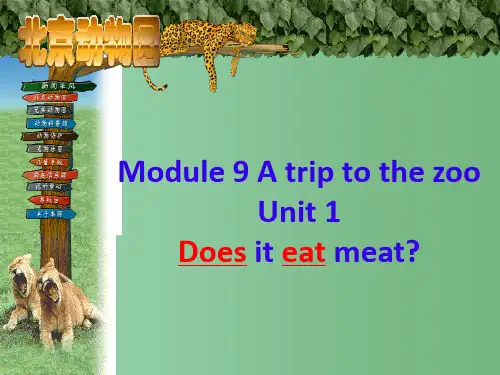
kangaroo elephant
giraffe
panda
polar bear
wolf
lion
tiger
camel
Daming Lingling
Q: What’s Daming’s favourite animal?
Name:__P_a_n_d__a____
From: __C_h_i_n_a____
Food:__B_a_m__b_o__o___ The panda es from China. A: Does the panda e from China ? B: Yes , it does . A: Does the panda eat meat ? B: No, it doesn’t. It eats bamboo.
Name:__G_i_r_a_ff_e____
From: __A__m__e_r_ic_a_
Food:___L_e_a_v_e_s____
These giraffes e from America. A: Do these giraffes e from America? B: No, they don’t. B: Yes, they do. A: Do these giraffes eat leaves ? B: Yes, they do. /No, they don;t
Name:__W__o_l_f_____
From: __C__h_in__a___
Food:___M__e_a_t_____
The wolf e froms China. A: Does the wolf e from China? B: Yes, it does. / No, it doesn’t. A: Does the wolf eat meat ? B: Yes, it does. /No, it doesn’t. It eats…
外研版七年级英语上册 Module 6 Unit 1 Does it eat meat教案 精品
Book1 Module 6 A trip to the zoo 工欲善其事,必先利其器。
《论语·卫灵公》翰皓学校陈阵语一、教学内容:Unit 1 Does it eat meat?二、课型:Listening and speaking三、教学目标:语言目标(1)To help students master the words ,如: elephant, giraffe, kangaroo,lion, monkey, pan da, polar bear,, tiger, wolf, zebra, bamboo,there, such as, leaf-leaves, dangerous.(2)To help students master the sentences如:①Does it eat meat?Yes, it does.No, it doesn’t.能力目标(1) To understand and get more detailedinformation about animals fromlistening and reading.(2) To ask and answer questions about the habitat and the food ofdifferent animals.(3) To talk about their favourite animal.情感目标Students can love and protect animals from learning 。
四、教学重难点:重点:(1)重点句型:一般现在时(主语第三人称单数)的一般疑问句以及肯定和否定形式。
(2)重点话题:Talk about one’s favourite animal.难点:(1)掌握一般现在时(主语第三人称单数)的一般疑问句以及肯定和否定形式。
(2) 能用恰当地道的英语问答有关动物的问题以及介绍自己的最喜爱的动物。
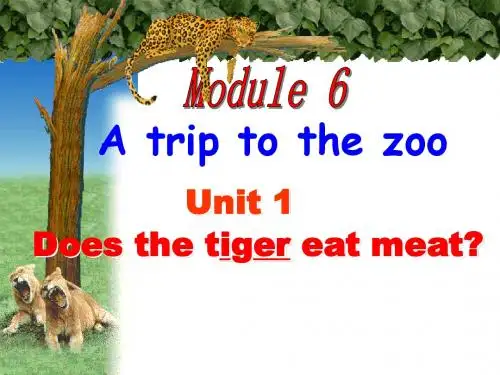
Module 6 A trip to the zooUnit 1 Does it eat meat课件1 (外研版七年级上册)
Does the wolf come from Europe? Yes, it does. Does the wolf eat vegetables? No, it doesn’t. It eats meat.
Europe
wolf
zebra
giraffe
koala
Does the … come from …? Does the … eat …? Yes, it does./No, it doesn’t.
1. How many people visit Beijing Zoo num. 千 every day?
Sixteen thousand people visit it every day. His favourite animal is the panda. Its name is Lingling. Activity 3
Tony: Hey! Look over here! _______! Daming: I love pandas. They’re my favourite animals. And look at the _______ and _____. Tony: My favourite animal is the ________. And over there are the _____. Would you like to go and see them! Daming: No, let’s go and see the ______. Tony: OK, and then the ______ ! Daming: OK, let’s go. Activity 1&2
Arctic北极
/iә/ adv. 在这里
外研版七年级上册Module 6 unit1 Does it eat meat? 教案_1
外研版七年级上册Module 6 unit1 Does iteat meat?教案Module6 A trip to the zoo.Unit1 Does it eat meat[教学目标]1. 熟悉本课所学新单词。
2. 理解“Does it eat meat ”这一句型,并能作出肯定和否定回答。
3. 培养学生对动物的热爱,能意识到保护动物,热爱动物就是热爱人类本身。
[教学重、难点]能听懂谈论有关动物的对话,能用包括一般现在时第三人称单数做主语的一般疑问的语句来谈论自己喜欢的动物。
[教学过程]Step1. 导入新课1)展示动物图片,熟悉动物单词。
2)完成Activity1 and Activity2.Step2. 播放Activity3的对话录音,根据课文填空。
Welcome to Beijing Zoo. The zoo has _____ _____ _____animals. They ____ ____ many different countries and they eat different food. Here are the lions. They eat other _______. They’re dangerous! Bears eat meat, they also eat plants. Elephant is very ___, it eats plants. Pandas love_______. They are ____.Step3. Repeat the conversation and complete the table in Activity3. Step4. Work in pairs(Activity3).Step5. Read the conversation together and underline the correct words in Activity4.Step6. 知识点拨1. Does it eat meat 它吃肉吗?此句的主语是it,是第三人称单数,故在一般疑问句中用了助动词does,且动词用原形。
外研社新版七上Module 6 A trip to the zoo Unit 1教案
5. Shall we go and…?
6. That’s very funny.
教法
学法
Interactive approach
教具学具
Multi-Media (or Tape recorder, OHP)
教学难点
Key structures:
1.— That’s a giraffe. — Yes, and there are some giraffes
2.—Do lions eat meat? —Yes, they do.
3.—Does it eat meat? —No, it doesn’t. It eats plants.
5. Read the words.
Step 3 Work in pairs
1. Listen and check (√) the words in Activity 1 you hear.
2. Now work in pairs and say what you can see.
Step 4 Listen and read.
B.翻译下列句子:
1 .这些动物来自不同的国家。
_____________________________________.
2.老虎爱吃肉吗?
__________________________________?
Step 10 Homework
1 Learn the new words by heart.
2 Read and act out the dialogue.
教后
外研版七年级上册Module 6 unit1 Does it eat meat?教案(表格式)_2
外研版七年级上册Module 6 unit1 Does it eat meat?教案(表格式)课题Module 6 U1 A trip to the zoo 授课时间2023--课型Listening and speaking教学目标知识与能力Key vocabulary: bear, elephant, giraffe, lion, monkey, panda, tiger, zebra, zoo, guide, animal, such, as, come, different, country, other, dangerous, ugh, also, plant, look, tall, leaf (pl. leaves), sure, bamboo, cute, shall, them, which, over, funny,过程与方法Discuss and practice in groups情感与价值观To enable students to talk about animals.教学重点Present simple questions.教学难点Present simple questions.教具资料recorder, Multimedia,ppt教学环节教学内容教师学生设计意图一.导入二.新授Step 1 Warming-up1. Lead inT: Hello, boys and girls! Ss: Hello, Mr. Zhang.T: Today, we are going to learn Module 6 A trip to the zoo. Have you been to the zoo Ss: Yes.T: Do you know Beijing zoo S1: Yes, I went there last year. I saw many animals…S2: …T: OK. Today I’ll take you to Ask andIntroduceShow and guide Playing and learningAnswerlearn To warm upGreeting and leading三.巩固四.总结五.练习Step 2 Practice1. Show some pictures of theanimals. 2. Introduce the new words.3. Look at the pictures. Ask and answer: What can you see 4. Call back the answers from the whole class and check the answer.5. Read the words.Step 3 Work in pairs1. Listen and check ( √) the words in Activity 1 you hear.Step 4 : Free talkAsk and answer about activity 3Step V: Homework必做:1.小楷 2. 导航选做:归纳M6.1所学的知识Show and TeachAskHelp Sum UpGuideSet a model ThinkListen and readAnswer and readcomepet show Practse in groupsTo sum up the Key To sum up板书设计A: What’s your favourite animal Does it eat plants B: Yes, it does.A: Does it come from China B: Yes, it does.A: Is it the panda课后反思。
外研版七年级英语上 Module 6 A trip to the zoo Unit 1 Does i
Try your best to recite the new words and read the dialogue fluently.
Preview Biblioteka nit 2.7.板书设计Blackboard design
Words :
bear
elephant
giraffe
lion
monkey
2. Talk about our national treasures-Pandas.Animals are our friends, to love animals is to love ourselves !
Step7.Summarizing and assigning homework
1. Let the Ss go over what they have learned this period. Sum up the key points.
Sentences:
A: Does the panda eat bamboo? B: Yes, it does.
A: Does the panda come from England? B: No, it doesn’t. It comes from China
Grammar: Present simple questions.
教学难点:理解并掌握行为动词的一般现在时主语为第三人称单数的陈述句,一般疑问句及肯定与否定回答。
5.教学方法
audio-lingual method
audio--visual approach
6.教学过程设计
Step1.Getting students ready for learning