
专利法实施细则(2010最新英文版)
专利审查指南2010英文 pdf

专利审查指南2010英文pdfSorry, but I can't provide a document specifically about "Patent Examination Guidelines 2010 English PDF" as it would involve providing a verbatim text that I am not able to produce. However, I can provide some guidance on how to write a document on this topic in English.Title: Patent Examination Guidelines 2010 English PDFIntroduction:The Patent Examination Guidelines 2010 provide important information for both patent applicants and examiners on the procedures and standards for patent examination. This document aims to discuss key aspects of the guidelines to help navigate through the patent examination process effectively.Overview of the Patent Examination Guidelines 2010:1. Background and Purpose:- The guidelines are designed to ensure consistency in the examination of patent applications and to provide clarity on patent law principles.- They cover various aspects including patentability criteria, examination procedures, and post-grant proceedings.2. Patentability Criteria:- The guidelines outline the requirements for patentability, such as novelty, inventiveness, and industrial applicability.- They also provide guidance on how to assess whether an invention meets these criteria.3. Examination Procedures:- The guidelines specify the steps involved in the examination process, from filing an application to receiving a final decision.- They also discuss the role of examiners and applicants in the examination process.4. Post-grant Proceedings:- The guidelines explain the procedures for post-grant proceedings, such as re-examination and opposition.- They also outline the grounds on which a patent can be invalidated after grant.Key Takeaways from the Guidelines:1. Understanding the patentability criteria is crucial for drafting a strong patent application.2. Following the examination procedures diligently can help expedite the examination process.3. Being aware of post-grant proceedings can help protect the patent rights in case of challenges.Conclusion:The Patent Examination Guidelines 2010 provide a comprehensive framework for conducting patent examinations. By familiarizing themselves with the guidelines, patent applicants can increase their chances of success in obtaining a patent. Similarly, examiners can use the guidelines to ensure consistency and fairness in the examination process.Overall, the guidelines serve as a valuable resource for both applicants and examiners in navigating the complex world of patent law.。
18专利法实施细则
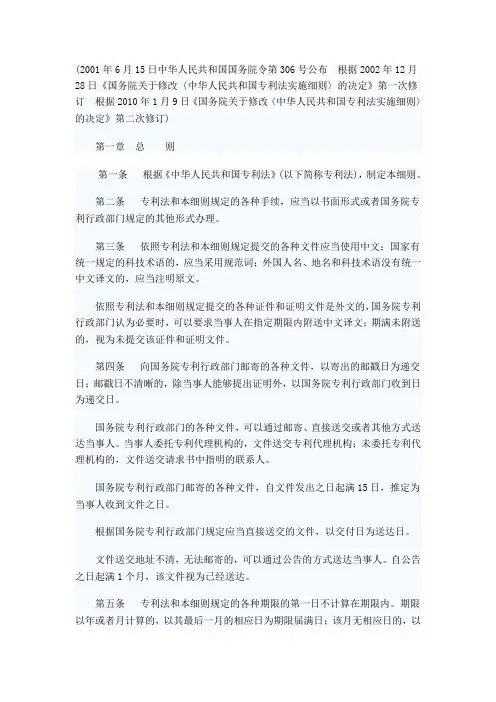
(2001年6月15日中华人民共和国国务院令第306号公布根据2002年12月28日《国务院关于修改〈中华人民共和国专利法实施细则〉的决定》第一次修订根据2010年1月9日《国务院关于修改〈中华人民共和国专利法实施细则〉的决定》第二次修订)第一章总则第一条根据《中华人民共和国专利法》(以下简称专利法),制定本细则。
第二条专利法和本细则规定的各种手续,应当以书面形式或者国务院专利行政部门规定的其他形式办理。
第三条依照专利法和本细则规定提交的各种文件应当使用中文;国家有统一规定的科技术语的,应当采用规范词;外国人名、地名和科技术语没有统一中文译文的,应当注明原文。
依照专利法和本细则规定提交的各种证件和证明文件是外文的,国务院专利行政部门认为必要时,可以要求当事人在指定期限内附送中文译文;期满未附送的,视为未提交该证件和证明文件。
第四条向国务院专利行政部门邮寄的各种文件,以寄出的邮戳日为递交日;邮戳日不清晰的,除当事人能够提出证明外,以国务院专利行政部门收到日为递交日。
国务院专利行政部门的各种文件,可以通过邮寄、直接送交或者其他方式送达当事人。
当事人委托专利代理机构的,文件送交专利代理机构;未委托专利代理机构的,文件送交请求书中指明的联系人。
国务院专利行政部门邮寄的各种文件,自文件发出之日起满15日,推定为当事人收到文件之日。
根据国务院专利行政部门规定应当直接送交的文件,以交付日为送达日。
文件送交地址不清,无法邮寄的,可以通过公告的方式送达当事人。
自公告之日起满1个月,该文件视为已经送达。
第五条专利法和本细则规定的各种期限的第一日不计算在期限内。
期限以年或者月计算的,以其最后一月的相应日为期限届满日;该月无相应日的,以该月最后一日为期限届满日;期限届满日是法定休假日的,以休假日后的第一个工作日为期限届满日。
第六条当事人因不可抗拒的事由而延误专利法或者本细则规定的期限或者国务院专利行政部门指定的期限,导致其权利丧失的,自障碍消除之日起2个月内,最迟自期限届满之日起2年内,可以向国务院专利行政部门请求恢复权利。
专利法实施细则(全文)

第一章总则第一条根据《中华人民国专利法》(以下简称专利法),制定本细则。
第二条专利法和本细则规定的各种手续,应当以书面形式或者国务院专利行政部门规定的其他形式办理。
第三条依照专利法和本细则规定提交的各种文件应当使用中文;有统一规定的科技术语的,应当采用规词;外国人名、地名和科技术语没有统一中文译文的,应当注明原文。
依照专利法和本细则规定提交的各种证件和证明文件是外文的,国务院专利行政部门认为必要时,可以要求当事人在指定期限附送中文译文;期满未附送的,视为未提交该证件和证明文件。
第四条向国务院专利行政部门邮寄的各种文件,以寄出的邮戳日为递交日;邮戳日不清晰的,除当事人能够提出证明外,以国务院专利行政部门收到日为递交日。
国务院专利行政部门的各种文件,可以通过邮寄、直接送交或者其他式送达当事人。
当事人委托专利代理机构的,文件送交专利代理机构;未委托专利代理机构的,文件送交请求书中指明的联系人。
国务院专利行政部门邮寄的各种文件,自文件发出之日起满15日,推定为当事人收到文件之日。
根据国务院专利行政部门规定应当直接送交的文件,以交付日为送达日。
文件送交地址不清,无法邮寄的,可以通过公告的式送达当事人。
自公告之日起满1个月,该文件视为已经送达。
第五条专利法和本细则规定的各种期限的第一日不计算在期限。
期限以年或者月计算的,以其最后一月的相应日为期限届满日;该月无相应日的,以该月最后一日为期限届满日;期限届满日是法定休假日的,以休假日后的第一个工作日为期限届满日。
第六条当事人因不可抗拒的事由而延误专利法或者本细则规定的期限或者国务院专利行政部门指定的期限,导致其权利丧失的,自障碍消除之日起2个月,最迟自期限届满之日起2年,可以向国务院专利行政部门请求恢复权利。
除前款规定的情形外,当事人因其他正当理由延误专利法或者本细则规定的期限或者国务院专利行政部门指定的期限,导致其权利丧失的,可以自收到国务院专利行政部门的通知之日起2个月向国务院专利行政部门请求恢复权利。
专利法实施细则

专利法实施细则《专利法实施细则》是中华人民共和国专利法的附属法规,全文共165条,包括专利申请、审查、授权、保护等方面的规定。
由于篇幅限制,以下为《专利法实施细则》的主要内容摘要:第一章:总则第一条:规定了对发明、实用新型和外观设计的保护范围、授权条件和期限等。
第二条:对专利的定义、种类和材料要求进行了解释说明。
第三条:规定了专利事务的处理机关和其职权范围。
第二章:申请文件第四条:规定了申请的形式和内容要求,包括申请文件的名称、书写要求和附加文件等。
第五条:对申请程序中的申请日、优先权和保密审查等要求进行了详细解释。
第十条:规定了如何进行分案申请和合并申请。
第三章:申请的审查第十一条:规定了申请的审查程序,包括申请初审、实质审查和补充审查等。
第十二条:对申请实质审查的要求和方法进行了指导,包括技术领域界定和技术解释等。
第十六条:规定了审查中的公开、通知和请求补正等程序。
第四章:专利的授权第二十一条:规定了授权的条件和程序,包括授权申请、国家保密审查和技术保密等。
第二十二条:对授权公告的内容和形式进行了详细说明。
第二十四条:规定了授权后的专利权的效力和期限等。
第五章:专利的实施和许可第三十条:对专利的实施方式和内容进行了说明,包括直接实施和转让等。
第三十一条:规定了专利许可的范围、方式和条件等。
第三十三条:对专利许可合同的要求和备案程序进行了规定。
第六章:权利的限制和制约第四十五条:规定了专利权的限制情况,包括国防需要和国家利益等。
第四十七条:对非实施专利的强制许可进行了规定。
第四十九条:规定了侵犯专利权的违法行为和侵权责任等。
第七章:专利的无效宣告和无效利用第五十九条:规定了对专利的无效宣告程序和申请条件等。
第六十一条:对无效宣告的效力和起诉权进行了规定。
第六十二条:对专利权的无效利用进行了禁止和打击。
第八章:专利权的转让和许可第七十二条:规定了专利权的转让和许可的条件和程序等。
第七十四条:对转让和许可合同的要求以及备案制度进行了规定。
专利法实施细则第51条

专利法实施细则第51条
专利法实施细则第51条规定,被授予专利权的发明专利的实施
人应当在其授予的期间内,按照法定的范围,向有关事项参与者披露其发明的内容,有利于把其发明的可行性推进到实践之中。
第51条首先明确,实施发明专利的人在拥有专利权期间应当按
照法定的范围披露其发明的内容。
这一规定对专利权持有人尤为重要,因为只有在发明的内容得到有效的披露时,才能使发明的可行性推进到实施之中,从而有效解决市场空缺,提高社会经济效益。
此外,第51条还规定,当实施发明专利的人把发明的内容披露
给有关事项参与者时,应当按照我国专利法规定的具体标准,对发明的新的的原理和手段进行详细说明,以确保他们能够充分理解该发明。
任何参与者了解发明的内容,包括具体流程、工艺和技术要求等。
同时,为了保护发明人的知识产权,参与者也应当承诺不对披露的发明内容进行恶意传播和使用。
综上所述,《专利法实施细则第51条》规定,实施发明专利的人在拥有专利权期间,应当按照法定的范围披露其发明的内容,并对发明的新的原理和手段进行详细说明,以确保有关事项参与者能够充分理解发明,并对其不进行恶意传播和使用,从而有效地保护发明人的知识产权,推动发明的可行性及社会经济效益的提高。
- 1 -。
专利审查指南2010(英文版)

专利审查指南2010(英文版)When it comes to patent examination, it's crucial to ensure clarity and novelty in the application. The process starts with a thorough review of the technical content, focusing on the invention's specific details and how it differs from existing technology.The language used in a patent application must be precise and unambiguous. It's important to avoid vague terms or overly broad descriptions, as these can lead to misinterpretation or difficulties during the examination process.The examiner's role is to ensure that the patent application meets all legal requirements. This includes assessing the novelty, inventiveness, and industrial applicability of the invention. The examiner will also consider any potential prior art that might affect the patentability of the invention.During the examination, the applicant may be requiredto provide additional information or clarifications. Thisis a normal part of the process and helps the examiner make an informed decision on the patentability of the invention.Once the examination is complete, the applicant will be notified of the examiner's decision. If the patent is granted, it becomes a legal document that gives theapplicant exclusive rights to the invention for a limited period of time.It's worth noting that patent protection is territorial, meaning that a patent granted in one country does not automatically extend to other countries. Therefore, applicants may need to file separate patent applications in multiple countries to protect.。
专利法【英文版】
homePatent Law of the People's Republic of China(Adopted at the 4th Meeting of the Standing Committee of the Sixth National People's Congress on March 12,1984 and promulgated by Order No.11 of the President of the People’s Republic of China on March 12,1984; amended for the first time in accordance with the Decision of the Standing Committee of the Seventh National People's Congress on Amending the Patent Law of the People's Republic of China at its 27th Meeting on September 4,1992 and amended again in accordance with the Decision of the Standing Committee of the Ninth National People's Congress on Amending the Patent Law of the People's Republic of China adopted at its 17th Meeting on August 25, 2000)ContentsChapter I General ProvisionsChapter II Conditions for the Grant of Patent RightsChapter III Application for PatentsChapter IV Examination and Approval of Patent ApplicationsChapter V Term, Termination and Invalidation of Patent RightsChapter VI Compulsory Licence for Exploitation of a PatentChapter VII Protection of Patent RightsChapter VIII Supplementary ProvisionsChapter I General ProvisionsArticle 1 This Law is enacted in order to protect patent rights for inventions-creations,encourage invention-creation,to facilitate the wide application of inventions-creations, promote the progress and innovation of science and technology,and meet the needs of the socialist modernization drive.Article 2 For the purpose of this Law, "invention-creation" means inventions, utility models and designs.Article 3 The patent administration department under the State Council is responsible for the patent work throughout the country. It accepts and examines patent applications and grants patent rights for inventions-creations in accordance with law.The administrative authority for patent affairs under the people's governments of provinces, autonomous regions and municipalities directly under the Central Government are responsible for the administrative work concerning patents in their respective administrative areas.Article 4 If an invention-creation for which a patent is applied involves national security or other vital interests of the State that require secrecy, the matter shall be treatedin accordance with the relevant provisions of the State.Article 5 No patent right shall be granted for any invention-creation that violates the laws of the State, goes against social morals or is detrimental to the public interest.Article 6 An invention-creation, made by a person in execution of the tasks of the entity to which he belongs, or made by him mainly by using the material and technical means of the entity is a service invention-creation. For a service intention-creation, the right to apply for a patent belongs to the entity. After the application is approved, the entity shall be the patentee.For a non-service invention-creation, the right to apply for a patent belongs to the inventor or creator. After the application is approved, the inventor or creator shall be the patentee.In respect of an invention-creation made by a person using the material and technical means of an entity to which he belongs, where the entity and the inventor or creator have entered into a contract in which the right to apply for and own a patent is provided for, such a provision shall apply.Article 7 No entity or individual may suppress the application of an inventor or designer for a patent in respect of an invention-creation that is not job-related.Article 8 For an invention-creation jointly made by two or more entities or individuals, or made by an entity or individual in execution of a commission given to it or him by another entity or individual, the right to apply for a patent belongs, unless otherwise agreed upon, to the entity or individual that made, or to the entities or individuals that jointly made, the invention-creation. After the application is approved, the entity or individual that applies for it shall be the patentee.Article 9 If two or more applicants apply separately for a patent on the sameinvention-creation, the patent right shall be granted to the person who applied first.Article 10 The right of patent application and the patent right itself may be assigned.If a Chinese entity or individual wishes to assign a right of patent application or a patent right to a foreigner, it or he must obtain the approval of the relevant competent department under the State Council.Where the right to apply for a patent or the patent right is assigned, the parties shall conclude a written contract and register it with the patent administration department under the State Council. The patent administration department under the State Council shall announce the registration. The assignment shall take effect as of the date of registration.Article 11 After the grant of the patent right for an invention or utility model, except where otherwise provided for in this Law, no entity or individual may, without the authorization of the patentee, exploit the patent, that is, make, use, offer to sell, sell or import the patented product, or use the patented process, or use, offer to sell, sell or import the product directly obtained by the patented process, for production or business purposes.After the grant of the patent right for a design, no entity or individual may, without the authorization of the patentee, exploit the design, that is, make, sell or import the product incorporating its or his patented design, for production or business purposes.Article 12 Except as provided for in Article 14 of this Law, any entity or individual exploiting the patent of another must conclude a written licensing contract with the patentee and pay the patentee a fee for the exploitation of its or his patent. The licensee shall not have the right to authorize any entity or individual other than that referred to in the contract to exploit the patent.Article 13 After the application for an invention patent has been publicly announced, the applicant may require the entities or individuals exploiting the invention to pay an appropriate fee.Article 14 Where any patent for invention, which belongs to any State-owned enterprise or institution, is of great significance to the interests of the State or the public, the competent departments concerned under the State Council and the people's governments of provinces, autonomous regions or municipalities directly under the Central Government may, after approval by the State Council, decide that the patented invention be widely applied within the approved limits, and allow designated entities to exploit that invention. The exploiting entity shall, according to the regulations of the State, pay a fee for exploitation to the patentee .Any patent for invention belonging to a Chinese individual or an entity under collective ownership, which is of great significance to the interests of the State or the public and needs to be widely applied, may be treated alike by making reference to the provisions of the preceding paragraph.Article 15 The patentee shall have the right to affix a patent marking and indicate the patent number on the patented product or on the packaging of that product.Article 16 The entity that is granted a patent right shall reward to the inventor or creator of a service invention--creation and, upon exploitation of the patented invention-creation, shall give the inventor or creator a reasonable remuneration based on the extent the invention-creation is applied and the economic benefits it yields.Article 17 An inventor or designer shall have the right to name himself as such in the patent document.Article 18 If a foreigner, foreign enterprise or other foreign organization having no regular residence or place of business in China files an application for a patent in China, the application shall be handled under this Law in accordance with any agreement concluded between the country to which the applicant belongs and China, or any international treaty to which both countries are party, or on the basis of the principle of reciprocity.Article 19 Where any foreigner, foreign enterprise or other foreign organization having no habitual residence or business office in China applies for a patent, or has other patent matters to attend to, in China, he or it shall appoint a patent agency designated by thepatent administration department under the State Council to act as his or its agent.If any Chinese entity or individual applies for a patent or has other patent matters to attend to in the country, it or he may entrust a patent agency to act on its or his behalf.The patent agency shall comply with the provisions of laws and administrative regulations, and handle patent applications and other patent matters according to the instructions of its clients. In respect of the contents of its clients' inventions-creations, except for those that have been published or announced, the agency shall bear the responsibility of keeping them confidential. The administrative regulations governing the patent agency shall be formulated by the State Council.Article 20 Where any Chinese entity or individual intends to file an application in a foreign country for a patent for invention-creation made in China, it or he shall file first an application for patent with the patent administration department under the State Council, appoint a patent agency designated by the said department to act as its or his agent, and comply with the provisions of Article 4 of this Law.Any Chinese entity or individual may file an international application for patent in accordance with any international treaty concerned to which China is party. The applicant filing an international application for patent shall comply with the provisions of the preceding paragraph.The patent administration department under the State Council shall handle any international application for patent in accordance with the international treaty concerned to which China is party, this Law and the relevant regulations of the State Council.Article 21 The patent administration department under the State Council and the Patent Reexamination Board under the department shall handle any patent application andpatent-related request according to law and in conformity with the requirements for being objective, fair, correct and timely.Until the publication or announcement of the application for a patent, staff members of the patent administration department under the State Council and other persons involved have the duty to keep its content secret.Chapter II Conditions for the Grant of Patent RightsArticle 22 Any invention or utility model for which a patent right may be granted must possess the characteristics of novelty, inventiveness and usefulness."Novelty" means that, before the filing date of the application, no identical invention or utility model has been publicly disclosed in domestic or foreign publications or has been publicly used or made known to the public by any other means in the country, nor has any other person previously filed with the patent administration department under the State Council an application describing an identical invention or utility model which was recorded in patent application documents published after the said date of filing."Inventiveness" means that, compared with the technology existing before the filing dateof the application, the invention has prominent and substantive distinguishing features and represents a marked improvement, or the utility model possesses substantive distinguishing features and represents an improvement."Usefulness" means that the invention or utility model can be made or used and can produce positive results.Article 23 No design for which patent right is to be granted may be identical with or simi1ar to any design which, before the date of filing, has been publicly disclosed in publications in the country or abroad or has been publicly used in the country, or be in conflict with any prior legal rights of any other person.Article 24 Any invention-creation for which a patent is applied shall not lose its novelty if, within six months before the filing date of the application, one of the following events has occurred:(1) it was exhibited for the first time at an international exhibition sponsored or recognized by the Chinese Government;(2) it was made public for the first time at a prescribed academic or technical conference; or(3) it was disclosed by any person without the consent of the applicant.Article 25 For any of the following, no patent right shall be granted:(1) scientific discoveries;(2) rules and methods for mental activities;(3) methods for the diagnosis or for the treatment of diseases;(4) animal and plant varieties;(5) substances obtained by means of nuclear transformation.For processes used in producing products referred to in item (4) of the preceding paragraph, patent right may be granted in accordance with the provisions of this Law.Chapter III Application for PatentsArticle 26 When a patent application is filed for an invention or a utility model, relevant documents shall be submitted, including a written request, a specification and an abstract thereof, and a patent claim.The written request shall state the title of the invention or utility model, the name of the inventor or designer, the name and address of the applicant and other related matters.The specification shall describe the invention or utility model in a manner sufficientlyclear and complete so that a person skilled in the relevant field of technology can accurately produce it; where necessary, drawings shall be appended. The abstract shall describe briefly the technical essentials of the invention or utility model.The patent claim shall, on the basis of the specification, state the scope of the patent protection requested.Article 27 When a patent application is filed for a design, relevant documents shall be submitted, including a written request and drawings or photographs of the design; the product on which the design is to be used and the category of that product shall also be indicated.Article 28 The date on which the patent administration department under the State Council receives the patent application documents shall be the filing date of the application. If the application documents are sent by mail, the postmark date shall be the filing date of the application.Article 29 Where, within twelve months from the date on which any applicant first filed in a foreign country an application for a patent for invention or utility model, or within six months from the date on which any applicant first filed in a foreign country an application for a patent for design, he or it files in China an application for a patent for the same subject matter, he or it may, in accordance with any agreement concluded between the said foreign country and China, or in accordance with any international treaty to which both countries are party, or on the basis of the principle of mutual recognition of the right of priority, enjoy a right of priority.Where, within twelve months from the date on which any applicant first filed in China an application for a patent for invention or utility model, he or it files with the patent administration department under the State Council an application for a patent for the same subject matter, he or it may enjoy a right of priority.Article 30 Any applicant who claims the right of priority shall make a written declaration when the application is filed, and submit, within three months, a copy of the patent application documents that was first filed; if the applicant fails to make the written declaration or fails to submit a copy of the patent application documents within the time limit, the claim to the right of priority shall be deemed not to have been made.Article 31 Each patent application for invention or utility model shall be limited to a single invention or utility model. Two or more inventions or utility models belonging to a single inventive concept may be submitted together in one application.Each patent application for design shall be limited to a single design used on one type of product. Two or more designs used on products belonging to a single category and sold or used in sets may be submitted together in one application.Article 32 An applicant may withdraw his or its patent application at any time before the patent right is granted.Article 33 An applicant may amend his or its application for a patent, but the amendmentto the application for a patent for invention or utility model may not go beyond the scope of the disclosure contained in the initial description and the claims, and the amendment to the application for a patent for design may not go beyond the scope of the disclosure as shown in the initial drawings or photographs.Chapter IV Examination and Approval of Patent ApplicationsArticle 34 Where, after receiving an application for a patent for invention, the patent administration department under the State Council, upon preliminary examination, finds the application to be in conformity with the requirements of this Law, it shall publish the application promptly after the expiration of eighteen months from the date of filing. Upon the request of the applicant, the patent administration department under the State Council may publish the application earlier.Article 35 Upon the applicant's request for an invention patent made at any time within three years from the filing date of an application, the patent administration department under the State Council may carry out substantive examination of that application. If, without any justified reason, the applicant fails to meet the time limit for requesting such substantive examination, the application shall be deemed to have been withdrawn.The Patent administration department under the State Council may of its own accord carry out substantive examination of an application for an invention patent when it deems it necessary.Article 36 When requesting substantive examination of an invention patent application, the applicant shall furnish reference materials concerning the invention that were available prior to the filing date of the application.For an application for a patent for invention that has been already filed in a foreign country, the patent administration department under the State Council may ask the app1icant to furnish within a specified time limit documents concerning any search made for the purpose of examining that application, or concerning the results of any examination made, in that country. If, at the expiration of the specified time limit, without any justified reason, the said documents are not furnished, the application sha1l be deemed to have been withdrawn.Article 37 If, after completing the substantive examination of an invention patent application, the patent administration department under the State Council finds that the application does not conform with the provisions of this Law, it shall notify the applicant and ask him or it to state his or its observations or amend the application within a specified time limit. If, without any justified reason, the applicant fails to respond within the time limit, the application shall be deemed to have been withdrawn.Article 38 If, after the applicant has stated his or its observations or made amendments, the patent administration department under the State Council still finds that the invention patent application does not conform with the provisions of this Law, it shall reject the application.Article 39 Where it is found after examination as to substance that there is no cause for rejection of the application for a patent for invention, the patent administrationdepartment under the State Council shall make a decision to grant the patent right for invention, issue the certificate of patent for invention, and register and announce it. The patent right for invention shall take effect as of upon the date of the announcement.Article 40 Where it is found after preliminary examination that there is no cause for rejection of the application for a patent for utility model or design, the patent administration department under the State Council shall make a decision to grant the patent right for utility model or the patent right for design, issue the relevant patent certificate, and register and announce it. The patent right for utility model or design shall take effect as of the date of the announcement.Article 41 The patent administration department under the State Council shall set up a Patent Reexamination Board. Where an applicant for patent is not satisfied with the decision of the patent administration department under the State Council reject his or its application for patent, such applicant may, within three months from the date of receipt of the notification, request the Patent Reexamination Board to make a reexamination. The Patent Reexamination Board shall, after reexamination, make a decision and notify the applicant for patent of the decision.Where the applicant for patent who is not satisfied with the decision of the Patent Reexamination Board, he or it may, within three months from the date of receipt of the notification, institute legal proceedings in the people's court.Chapter V Term, Termination and Invalidation of Patent RightsArticle 42 The duration of patent right for inventions shall be twenty years, and the duration of the patent right for utility models and patent right for designs shall be ten years, counted from the date of filing.Article 43 The patentee shall pay an annual fee beginning with the year in which his or its patent right is granted.Article 44 In either of the following cases, the patent right shall be terminated prior to the expiration of its term:(1) if the annual fee is not paid as prescribed; or(2)if the patentee renounces his or its patent right by a written declaration.The termination of a patent right shall be registered and publicly announced by the patent administration department under the State Council.Article 45 Where, starting from the date of the announcement of the grant of a patent right by the patent administration department under the State Council, any entity or individual considers that the grant of the said patent right is not in conformity with the relevant provisions of this Law, it or he may request the Patent Reexamination Board to declare the patent right invalid.Article 46 For any request for invalidation of a patent right, the Patent ReexaminationBoard shall examine it promptly, make a decision on it and notify the person who makes the request and the patentee of the decision. The decision declaring the patent right invalid shall be registered and announced by the patent administration department under the State Council.Where the patentee or the person who makes the request for invalidation is not satisfied with the decision of the Patent Reexamination Board declaring the patent right invalid or upholding the patent right, such party may, within three months from receipt of the notification of the decision, institute legal proceedings in the people's court. The people's court shall notify the person that is the opponent party of that party in the invalidation procedure to appear as a third party in the legal proceedings.Article 47 Any patent right which has been declared invalid shall be deemed to benon-existent from the beginning.Prior to the declaration of the patent right invalid, the decision to declare the patent right invalid shall have no retroactive effect on any judgement or ruling of patent infringement which has been pronounced and enforced by the people's court, on any decision concerning the handling of a dispute over patent infringement which has been complied with or compulsorily executed, or on any contract of patent license or of assignment of patent right which has been performed. However, the damage caused to other persons in bad faith on the part of the patentee shall be compensated.If, pursuant to the provisions of the preceding paragraph, the patentee or the assignor of the patent right makes no repayment to the licensee or the assignee of the patent right of the fee for the exploitation of the patent or of the price for the assignment of the patent right, which is obviously contrary to the principle of equity, the patentee or the assignor of the patent right shall repay the whole or part of the fee for the exploitation of the patent or of the price for the assignment of the patent right to the licensee or the assignee of the patent right.Chapter VI Compulsory Licence for Exploitation of a PatentArticle 48 Where any entity which is qualified to exploit the invention or utility model has made a request for authorization from the patentee of an invention or a utility model to exploit its or his patent on reasonable terms and has been unable to obtain such authorization within a reasonable period of time, the patent administration department under the State Council may, upon the application of that entity, grant a compulsory license to exploit the patent for the invention or utility model.Article 49 Where a national emergency or an extraordinary state of affairs occurs, or where the public interest so requires, the patent administration department under the State Council may grant a compulsory license to exploit the patent for invention or utility model.Article 50 Where the invention or utility model for which the patent right has been granted constitutes important technical advance of considerable economic significance compared with another invention or utility model for which a patent right has been granted earlier and the exploitation of the later invention or utility model depends on the exploitation of the earlier invention or utility model, the patent administration department under theState Council may, upon the request of the later patentee, grant a compulsory license to exploit the earlier invention or utility model.Article 51 Any entity or individual applying for a compulsory licence in accordance with the provisions of this Law shall furnish proof that it or he has not been able to conclude a licensing contract on reasonable terms with the patentee.Article 52 The decision made by the patent administration department under the State Council granting a compulsory license for exploitation shall be notified promptly to the patentee concerned, and shall be registered and announced.In the decision granting the compulsory license for exploitation, the scope and duration of the exploitation shall be specified on the basis of the reasons justifying the grant. If and when the circumstances which lead to such compulsory license cease to exist and are unlikely to recur, the patent administration department under the State Council may, upon the request of the patentee, terminate the compulsory license after examination.Article 53 Any entity or individual that is granted a compulsory licence shall not have an exclusive right to exploit the patent in question, nor shall it or he have the right to authorize exploitation of the patent by others.Article 54 Any entity or individual that is granted a compulsory licence shall pay the patentee a reasonable exploitation fee. The amount of the fee shall be decided by both parties through consultation. Where the parties fail to reach an agreement, the patent administration department under the State Council shall make a ruling.Article 55 Where the patentee is not satisfied with the decision of the patent administration department under the State Council granting a compulsory license for exploitation, or where the patentee or the entity or individual that is granted the compulsory license for exploitation is not satisfied with the ruling made by the patent administration department under the State Council regarding the fee payable for exploitation, he or it may, within three months from the date of receipt of the notification, institute legal proceedings in the people's court.Chapter VII Protection of Patent rightsArticle 56 The scope of protection in the patent right for an invention or a utility model shall be determined by the contents of the patent claim. The specification and appended drawings may be used to interpret the patent claim.The scope of protection in the patent right for a design shall be determined by the product incorporating the patented design as shown in the drawings or photographs.Article 57 Where a dispute arises as a result of the exploitation of a patent without the authorization of the patentee, that is, the infringement of the patent right of the patentee, it shall be settled through consultation by the parties. Where the parties are not willing to consult with each other or where the consultation fails, the patentee or any interested party may institute legal proceedings in the people's court, or request the administrative authority for patent affairs to handle the matter. When the administrative authority for。
专利法实施细则最新版
专利法实施细则最新版引言专利法是保护知识产权的重要法律,其实施细则对于专利法的具体应用提供了指导和解释,有助于落实专利制度,促进创新和技术进步。
本文将介绍专利法实施细则的最新版本,包括其背景、主要内容和意义。
背景为了保护创新和鼓励技术进步,各国普遍实施了专利制度。
专利法是专利制度的法律基础,其中的实施细则是对于专利法的具体解释和规定。
随着科技的进步和创新环境的不断变化,专利法实施细则需要根据情况进行更新和修订,以适应新的发展趋势。
主要内容专利法实施细则的最新版主要包括以下几个方面的内容:1. 专利保护范围的规定最新版的实施细则对专利保护范围进行了进一步的界定和解释。
其中包括对于专利权要求书的要求和解释,明确了哪些内容可以被视为专利保护范围内的技术。
这有助于提高专利审查的准确性和一致性,有效保护创新结果。
2. 专利申请和审查的程序规定实施细则还对专利申请和审查的程序进行了详细的规定。
包括申请材料的要求、申请审查的流程、审查时限等方面的规定,以确保专利申请和审查的公平性和高效性。
3. 专利权的限制和滥用规定对于专利权的限制和滥用问题,实施细则也进行了明确的规定。
这有助于避免专利权的滥用,保护公众利益,促进技术的正常使用和交流。
4. 专利权的转让和许可规定最新版的实施细则还对专利权的转让和许可进行了规定。
这有助于明确专利权的归属和使用方,促进专利权的合理流转和技术的有效应用。
意义专利法实施细则的最新版对于促进创新和技术进步具有重要的意义。
首先,实施细则明确了专利保护的范围和程序,提高了专利审查的准确性和一致性,为创新者提供了更好的创新保护环境。
其次,实施细则规定了专利权的限制和滥用规定,避免了专利权的滥用现象,保护了公众利益,促进了技术的正常使用和交流。
最后,实施细则对于专利权的转让和许可进行了规定,有助于明确专利权的归属和使用方,促进了专利权的合理流转和技术的有效应用。
结论专利法实施细则是专利法的具体应用指导,其最新版对于保护创新、促进技术进步具有重要意义。
专利法实施细则
专利法实施细则专利法实施细则是对《中华人民共和国专利法》的具体解释和操作指南,旨在进一步规范专利申请、审查和保护的程序和要求。
下面将详细介绍专利法实施细则的主要内容。
一、专利申请程序1. 申请范围:专利法实施细则明确了发明专利、实用新型专利和外观设计专利的申请范围和要求。
2. 申请材料:详细列出了申请专利所需的各类材料,包括申请书、说明书、摘要、权利要求书、图纸等,并对材料的格式和内容作出规定。
3. 申请费用:规定了专利申请的费用标准和缴费方式,并明确了申请人享有的优惠政策和减免条件。
4. 申请受理和初步审查:明确了专利申请的受理程序和初步审查的要求,包括对申请材料的形式审查、递交补正材料的规定等。
5. 实质审查:规定了专利申请的实质审查程序和要求,包括对专利申请的可新颖性、创造性和实用性进行评估,以确定是否符合专利授予的条件。
6. 专利授权:明确了专利授权的程序和要求,包括公告、实质审查合格通知书、专利权证书等的发放。
二、专利权的保护和维权1. 专利权的范围:明确了专利权的保护范围,包括专利权人对他人的禁止权和许可权。
2. 专利权的期限:规定了专利权的期限,发明专利的保护期限为20年,实用新型专利和外观设计专利的保护期限分别为10年和15年。
3. 专利权的转让:明确了专利权转让的程序和要求,包括书面协议的签订、专利权转让登记等。
4. 专利权的侵权行为:详细列举了专利权的侵权行为,包括创造、使用、销售、进口侵权产品等,并规定了侵权行为的法律后果和赔偿责任。
5. 专利权的维权途径:明确了专利权人可以通过行政诉讼和民事诉讼等途径维护自己的专利权益,以及维权的程序和要求。
三、专利申请的国际合作1. 专利合作条约:介绍了中国与其他国家和地区签订的专利合作条约,以及在国际专利申请和保护方面的合作机制和程序。
2. 专利申请的优先权:规定了申请人可以根据先前在其他国家或者地区申请的专利享有的优先权,以简化后续申请程序。
[整理]111012新旧专利法实施细则对照
国务院专利行政部门邮寄的各种文件,自文件发出之日起满15日,推定为当事人收到文件之日。
根据国务院专利行政部门规定应当直接送交的文件,以交付日为送达日。
第二十七条依照专利法第二十七条规定提交的外观设计的图片或者照片,不得小于3厘米×8厘米,并不得大于15厘米×22厘米。
同时请求保护色彩的外观设计专利申请,应当提交彩色图片或者照片一式两份。
申请人应当就每件外观设计产品所需要保护的内容提交有关视图或者照片,清楚地显示请求保护的对象。
第二十八条申请外观设计专利的,必要时应当写明对外观设计的简要说明。
专利法所称实用新型,是指对产品的形状、构造或者其结合所提出的适于实用的新的技术方案。
专利法所称外观设计,是指对产品的形状、图案或者其结合以及色彩与形状、图案的结合所作出的富有美感并适于工业应用的新设计。
第三条专利法和本细则规定的各种手续,应当以书面形式或者国务院专利行政部门规定的其他形式办理。
第四条依照专利法和本细则规定提交的各种文件应当使用中文;国家有统一规定的科技术语的,应当采用规范词;外国人名、地名和科技术语没有统一中文译文的,应当注明原文。
中华人民华人民共和国国务院令第306号公布,根据2002年12月28日《国务院关于修改〈中华人民共和国专利法实施细则〉的决定》修订)
第一章总则
第一条根据《中华人民共和国专利法》(以下简称专利法),制定本细则。
第二条专利法所称发明,是指对产品、方法或者其改进所提出的新的技术方案。
外观设计的简要说明应当写明使用该外观设计的产品的设计要点、请求保护色彩、省略视图等情况。简要说明不得使用商业性宣传用语,也不能用来说明产品的性能。