
译林牛津版九年级英语上unit7 Welcome to the unit
牛津译林版初一英语7上 Unit 7 课时作业(word版,无答案,共6课时)
牛津译林版初一英语7上 Unit 7 课时作业(word版,无答案,共6课时)
1 / 7 Unit 7 Welcome to the unit (I)
班级______________ 姓名______________ 学号______________
一、用所给单词的适当形式填空。
1. Some people like durian (榴莲)very much but others _________________ (讨厌) it.
2. We need them ____________________ (提,拿,搬) these old books with us.
3. There is a photo of his family in his ______________ (钱包).
4. Daniel isn’t _______________ (interesting) in ______________ (收集) stamps.
5. There are many big ___________ (大型购物中心) on both sides of the street.
6. If you want to find the hotel, go ____________ (沿着,向下) the road.
7. ____________________ (也许) it is not the kind of book you want.
8. Peter likes reading very much. He often goes to the ______________ (书店) .
9. Do you often do some __________ (购物) with your parents at weekends?
10. ___________ (金钱) doesn’t always bring happiness.
Unit 1 Welcome to the unit 课时练习 牛津译林版英语七年级上册(含答案)
1 / 4 Unit 1 This is me!
Comic strip & Welcome to the unit
一、根据句意及首字母提示写出单词
1. I don’t know you. Can you tell me your n________, boys?
2. We are m________of our country.
3. Jim l________playing football.
4. Sunday is the f________day of a week.
5. Does Daniel like r________books?
6. These aren’t our________(电子狗).
7. I say “Good________(上午)” to my teachers every day.
8. Does Simon like________(看) books?
二、用所给词的适当形式填空
1. How many________(class) do you have every day?
2. My friend Jim and I________(be not) in the same class.
3. ________English teacher is Miss Li. She is very nice to________(we).
4. Do you know________(that)________(boy) under the tree? They’re playing card
games.
5. Everyone________(like)________(listen) to music.
6. What’s________(be) name, please?
7. Are you________(I) Maths teacher?
Unit7Weletotheunit练习牛津译林版英语七年级下册(1)
Unit 7 Welcome to the unit
一、词汇运用。
1. After the hens __________ (lay) some eggs, all the students cheered.
2. Don’t leave your friend __________ (wait) for you all the time!
3. What great fun it is __________ (watch) my dog running after the ball at this time yesterday!
4. __________ (brush) you teeth twice a day will make your teeth healthy.
5. __________your face__________(hurt) when you fell off the bed this morning?
6. Be careful_____________(not burn) yourself when you start a fire.
7. If Sandy___________ (try) her best to practise more, she will pass the exam next week.
8 There____________(be)two basketball matches on TV tomorrow morning, aren't there?
二、单项选择。
1. You’d better try different ways you can think of _____ maths problems. It’s good for you to learn maths well.
A. work out B. to work out C. working out D .is working out
Unit3课文翻译2024-2025学年新牛津译林版英语七年级上册
7AU3 Welcome to our school!
Welcome to the unit
B.
Millie:Hello, Kate. It’s good to see you.
Kate:Hi, Millie. Nice to see you too! How’s your new school?
Millie:It’s great. The best part is the modern library.
Kate:Does your school have a library?
Millie:Yes, it does. We have a nice dining hall as well.
Kate:Cool! My school has a big dining hall too.
Millie:How many classrooms does your school have?
Kate:It has 36 classrooms. They’re all bright and clean.
Millie:That’s a lot! My school only has 18. My school is not big but it’s great. I love
it.
米莉:你好,凯特。很高兴见到你。
凯特:嗨,米莉。我也很高兴见到你!你的新学校怎么样?
米莉:很不错。最好的部分是现代化的图书馆。你们学校有图书馆吗?
凯特:是的,有。我们还有一个很好的食堂。
米莉:酷!我的学校也有一个大食堂。
凯特:你们学校有多少间教室?
米莉:有36间教室。它们都很明亮和干净。
凯特:好多呀!我的学校只有18间教室。我的学校不大但是很好。我喜欢它。
Reading
Hello, everyone! I’m Jack Liu from Grade 9. Welcome to our school!
牛津译林版英语九下Unit 3《Robot》(Welcome to the unit)教学设计

牛津译林版英语九下Unit 3《Robot》(Welcome to the unit)教学设计
一. 教材分析
牛津译林版英语九下Unit 3《Robot》主要介绍了机器人的发展、种类和应用。通过本单元的学习,学生能够了解机器人的基础知识,提高英语语言运用能力,激发对科技领域的兴趣。本单元包括两个阅读文章,分别是《The Development of
Robots》和《Types and Applications of Robots》。此外,还有相关的词汇、语法和听力练习。
二. 学情分析
九年级的学生已经具备了一定的英语基础,对于日常生活中的话题能够进行简单的交流。但是,对于科技领域的专业知识,学生可能较为陌生。因此,在教学过程中,需要帮助学生建立起知识桥梁,引导学生运用已有的英语知识去理解和表达科技领域的内容。
三. 教学目标
1. 知识目标:学生能够掌握关于机器人的相关词汇和表达方式,了解机器人的发展、种类和应用;
2. 能力目标:学生能够运用英语进行简单的交流,描述机器人的特点和功能;
3. 情感目标:激发学生对科技领域的兴趣,培养学生的创新意识。
四. 教学重难点
1. 重点:机器人的相关词汇和表达方式的掌握,以及阅读理解能力的提升;
2. 难点:对于机器人的专业知识的理解和运用,以及听力理解的提升。
五. 教学方法
1. 任务型教学法:通过设定各种任务,引导学生主动参与课堂,提高学生的英语运用能力;
2. 合作学习法:学生分组讨论,培养学生的团队协作能力和沟通能力;
3. 情境教学法:创设各种情境,帮助学生理解机器人的应用场景。
六. 教学准备
1. 教师准备:对于机器人的相关知识进行深入了解,准备教学PPT和教学素材; 2. 学生准备:预习本单元内容,对于机器人的基础知识有所了解。
七. 教学过程
1. 导入(5分钟)
教师通过展示一些机器人的图片,引导学生谈论关于机器人的话题,激发学生的兴趣。
9A Unit 6 TV programmes教案-2023-2024学年牛津译林版英语九年级上册
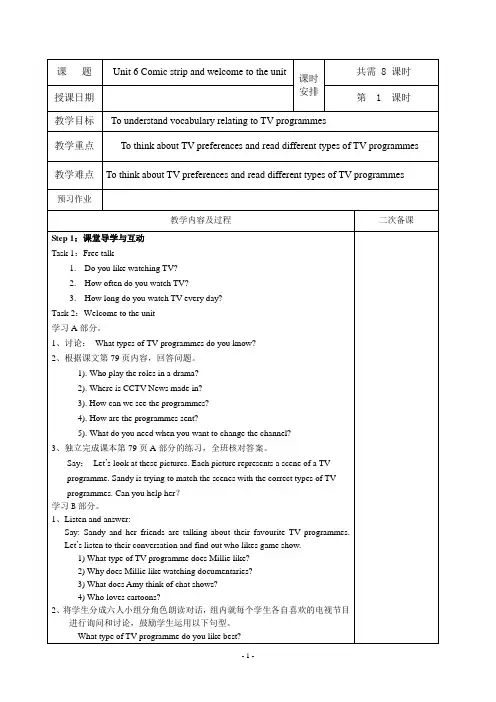
- 1 - 课 题 Unit 6 Comic strip and welcome to the unit 课时安排 共需 8 课时
授课日期 第 1 课时
教学目标 To understand vocabulary relating to TV programmes
教学重点 To think about TV preferences and read different types of TV programmes
教学难点 To think about TV preferences and read different types of TV programmes
预习作业
教学内容及过程 二次备课
Step 1:课堂导学与互动
Task 1:Free talk
1. Do you like watching TV?
2. How often do you watch TV?
3. How long do you watch TV every day?
Task 2:Welcome to the unit
学习A部分。
1、讨论: What types of TV programmes do you know?
2、根据课文第79页内容,回答问题。
1). Who play the roles in a drama?
2). Where is CCTV News made in?
3). How can we see the programmes?
4). How are the programmes sent?
5). What do you need when you want to change the channel?
3、独立完成课本第79页A部分的练习,全班核对答案。
Say: Let’s look at these pictures. Each picture represents a scene of a TV
Unit4 短语句型默写2024-2025学年新版牛津译林版七年级英语上册
新教材牛津译林7A Unit4 School days重点短语【背诵版】
Welcome to the unit
1 学习是打开世界的钥匙 Learning is the key to unlocking the world.
2 ★做某事的关键 the key to doing...
3 学习如何谈论我们的学校生活 learn how to talk about our school life
4 吃早饭/午饭/晚饭 have breakfast/ lunch / dinner 【三餐前不加the】
5 ★做早操/眼保健操 do morning/eye exercises 【exercise:操练,练习可数】
6 ★做更多的锻炼 do/take more exercise 【exercise:锻炼不可数】
7 ★做课后活动 do after-school activities
8 帮助家务 help with housework
9 ★在工作日 on weekdays
10 在周末 at/on weekends = at/on the weekend
11 去短暂的慢跑 go for a short jog
12 ★加入排球俱乐部 join the Volleyball Club
13 读了一点 read a little
14 ★玩的开心 enjoy oneself = have fun = have a good time
15 ★做某事的方法 way to do...= way of doing=how to do...
16 俱乐部活动是我玩的愉快并结交朋友的好方法 Club activities are s good way for me to enjoy myself and make
friends.
Unit3 短语句型默写2024-2025学年新版牛津译林版七年级英语上册
7A Unit 3 Welcome to our school ! 重点短语(背诵版)
Welcome to the unit
1 学校是学习的好地方 School is a great/perfect place for learning.
一个做某事的好地方 a good/great place(for sb.) to do sth.
=a good/great place for doing sth.
不同的地方 different places
我想找一个地方来放我的钢琴 I want to/would like to find a place to place my piano.
2 更了解我们的学校 know our school better【good/well→better(比较级)→best(最高级)】 【bad/badly/ill→worse(比较级)→worst(最高级)】
彼此了解 get to know each other
彼此讨论它们 discuss them with each other 【discussion 名词】
3 听一个关于...的介绍 listen to an introduction about...【introduce动词】
4 想象做某事 imagine doing sth.【imagination名词,imaginative形容词】
5 见到你真好 It is good to see you. 【It is good (for sb.) to do sth.】
6 一个很棒的体育场/运动场 a great sports field
7 教学楼 classroom building = teaching building
8 餐厅 dining room= dining hall 【dine动词】
9 也(肯定句句末) as well = too 【either (否定句句末)】
牛津译林版英语九上Unit 2《Colours》(Welcome to the unit)说课稿
牛津译林版英语九上Unit 2《Colours》(Welcome to the unit)说课稿
一. 教材分析
《牛津译林版英语九上Unit 2 Colours》是一篇关于颜色的文章,通过介绍各种颜色以及它们所代表的意义,引导学生学习并运用相关词汇和句型。文章内容丰富,贴近生活,有利于激发学生的学习兴趣,提高他们的英语水平。本节课的主要目标是让学生掌握颜色词汇的用法,能够用英语介绍自己的喜好和心情。
二. 学情分析
九年级的学生已经具备一定的英语基础,对于日常生活中常见的颜色词汇有所了解。但他们在运用英语进行表达时,还存在一定的困难。因此,在教学过程中,教师需要关注学生的个体差异,充分调动他们的学习积极性,引导他们更好地掌握本节课的内容。
三. 说教学目标
1. 知识目标:让学生掌握表示颜色的词汇,如red, yellow, blue等,以及相应的短语,如in favour of, feel like等。
2. 能力目标:培养学生用英语进行简单交流的能力,能够用所学词汇和句型介绍自己的喜好和心情。
3. 情感目标:激发学生学习英语的兴趣,培养他们的合作意识和跨文化交际能力。
四. 说教学重难点
1. 重点:颜色词汇的用法,以及用英语介绍自己的喜好和心情。
2. 难点:正确运用短语in favour of和feel like,以及如何根据实际情况灵活运用所学知识。
五. 说教学方法与手段
本节课采用任务型教学法,通过各种活动让学生在实践中学习英语。同时,运用多媒体手段,如图片、视频等,丰富教学内容,激发学生的学习兴趣。
六. 说教学过程
1. 导入:展示一幅色彩斑斓的画,引导学生谈论颜色,自然引入本节课的主题。
2. 新课呈现:通过展示不同颜色的物品,教授颜色词汇,让学生跟读并模仿。 3. 句型练习:利用颜色词汇,引导学生用英语描述自己的喜好,如“I
like green because it makes me feel relaxed.”
牛津译林版英语九上Unit4《GrowingUp》(welcometotheunit)说课稿
牛津译林版英语九上Unit 4《Growing Up》(welcome to the unit)说课稿
一. 教材分析
《Growing Up》是牛津译林版英语九上Unit 4的一篇文章,主要讲述了成长过程中遇到的各种挑战和变化。文章通过描述一个男孩在成长过程中的经历,让学生了解成长的不易和价值。本节课的教学内容主要包括词汇、语法、阅读理解和口语表达等方面。
二. 学情分析
九年级的学生已经具备了一定的英语基础,能够理解和运用所学知识进行简单的交流。但同时,部分学生对英语学习的兴趣不足,缺乏学习的积极性。针对这一情况,教师需要激发学生的学习兴趣,提高他们的学习积极性。
三. 说教学目标
1. 知识目标:学生能够掌握文章中的关键词汇和语法知识,理解文章的主旨大意。
2. 能力目标:学生能够运用所学知识进行阅读理解和口语表达,提高自己的英语应用能力。
3. 情感目标:学生能够认识到成长的不易,学会珍惜和面对生活中的挑战。
四. 说教学重难点
1. 重点:文章中的关键词汇和语法知识,以及阅读理解和口语表达。
2. 难点:运用所学知识进行实际交流,以及对文章深层含义的理解。
五. 说教学方法与手段
1. 任务驱动法:通过设定各种任务,激发学生的学习兴趣,提高他们的参与度。
2. 情境教学法:创设生活情境,让学生在实际情境中运用所学知识。
3. 合作学习法:鼓励学生相互合作,共同完成学习任务。
六. 说教学过程
1. 导入:通过提问方式引导学生思考成长过程中的挑战和变化,激发学生的学习兴趣。
2. 词汇教学:讲解文章中的关键词汇和语法知识,让学生理解和运用。 3. 阅读理解:学生自主阅读文章,回答相关问题,检验对文章内容的理解。
4. 口语表达:分组讨论,让学生运用所学知识进行口语交流。
5. 课堂小结:总结本节课所学内容,强调重点知识点。
七. 说板书设计
板书设计要清晰、简洁,突出文章主题和关键词汇。可以采用思维导图的形式,将文章内容进行梳理,便于学生理解和记忆。