
【精品推荐】(新教材)2019-2020人教版高中化学必修第二册新学案课件:第七章 第三节 第2课时 乙酸 官能
解析:用的药品应为乙醇、乙酸和浓硫酸混合物,因为玻璃管较 细,而乙酸与饱和 Na2CO3 溶液反应速率较快,容易导致玻璃管 内溶液的倒吸,所以玻璃管不能插入溶液中,故选项 A 错误;因 为乙醇与乙酸生成乙酸乙酯的反应是可逆反应,所以不可能使反 应物完全转化为乙酸乙酯,故选项 B 错误;NaOH 溶液作用下, 乙酸乙酯可以彻底水解,故选项 C 错误;乙酸乙酯和乙酸钠溶液 互不相溶,所以可以用分液的方法分离,故选项 D 正确。 答案:D
3.进一步了解该有机物的用途。
[演练新学考] 1.下列有机物中,含有两种官能团的是
()
解析: A、B 中均只含碳卤键,C 中含碳卤键和碳碳双键, D 只含羟基。 答案:C
2.下列化学用语正确的是 A.乙醇的官能团:—OH B.乙醇的分子式:CH3CH2OH C.乙烯的结构简式:CH2CH2 D.乙烯无官能团 答案:A
乙酯的溶解度,便于酯析出。并且不可以用氢氧化钠溶液代 替饱和碳酸钠溶液收集蒸出的酯,因为氢氧化钠碱性强,能 使酯彻底水解。
6.酯化反应的机理: 醇脱羟基中的氢,羧酸脱羧基中的羟基, 生成酯和水。即:
7.制得的酯通过分液的方法即可获得粗品。
[演练新学考]
1.炒菜时,加酒加醋可使菜变得味香可口,原因是 ( )
遇石蕊溶液 与Na
与NaOH 与Na2CO3 与NaHCO3 羟基氢活性
变红
不变红 不变红
变浅红
反应
反应
反应
反应
反应
不反应 不反应
反应
反应
—
不反应
反应
反应
—
不反应
不反应
CH3COOH>H2CO3>H2O>CH3CH2OH
[演练新学考]
1.下列涉及乙酸的物理性质的叙述中,不正确的是 ( ) A.食醋的颜色就是乙酸的颜色 B.乙酸的熔点比水高,很容易变成固体 C.醋酸是一种具有强烈刺激性气味的液体 D.乙酸和乙醇可以互溶,故不能用分液法分离
3.下列物质都能与金属钠反应放出 H2,产生 H2 的速率排序
正确的是
()
①C2H5OH ②NaOH 溶液 ③醋酸溶液
A.①>②>③
B.②>①>③
C.③>②>①
D.③>①>②
解析:金属钠与 NaOH 溶液反应,实质上是与其中的水反
应,钠与水反应的速率比乙醇快;醋酸溶液中氢离子浓度
更大,与钠反应速率更快。
解析: A 项,食醋中含有乙酸,但除乙酸外还含有其他物质, 因此两者的颜色不完全相同,符合题意;B 项,乙酸的熔点为 16.6 ℃,易凝结成晶体,不符合题意;C 项,醋酸有强烈刺激 性气味,不符合题意;D 项,两者不分层,因此不能用分液法 分离,不符合题意。 答案:A
2.食用醋中含有乙酸。下列关于乙酸的说法正确的是( ) A.结构简式为 C2H4O2 B.分子式为 CH3COOH C.食醋中含有 3%~5%的乙酸 D.分子中原子之间只存在单键 解析:乙酸的结构简式为 CH3COOH,故 A 错误;乙酸的 分子式是 C2H4O2,故 B 错误;乙酸分子中存在 C—C、C—H、 C=O 键,故 D 错误。 答案:C
[难度增一点] [典例] 分枝酸可用于生化研究,其结构简 式如图。下列关于分枝酸的叙述正确的是( ) A.分枝酸属于芳香族化合物 B.可与乙醇、乙酸反应,且反应类型相同 C.1 mol 分枝酸最多可与 3 mol NaOH 发生中和反应 D.可使溴的四氯化碳溶液、酸性高锰酸钾溶液褪色,且 原理相同
酸、碱性条件下的水解反应、取代反应[选考难ຫໍສະໝຸດ 点]1.某有机物的结构简式为
,它在一定条件下可
发生的反应为( )
①酯化反应 ②氧化反应 ③水解反应 ④加聚反应
⑤取代反应
A.②③④
B.①②③
C.①②③⑤
D.③④⑤
解析:该有机物中含有—OH、—COOH 和—COO—,故可发 生酯化反应、氧化反应、水解反应、取代反应,但不能发生加 聚反应。 答案:C
答案:C
[自学新教材] 阅读教材,回答下列问题: 1.实验探究
实验 操作
在一支试管中加入3 mL乙醇,然后边振荡试管边慢慢 加入2 mL浓硫酸和2 mL乙酸,再加入几片碎瓷片。 连接好装置,用酒精灯小心加热,将产生的蒸气经导 管通到饱和Na2CO3溶液的液面上
实验 装置
实验 现象
化学 方程式
饱和Na2CO3溶液的液面上有__无__色__透__明__的__油__状__液__体产生, 且能闻到______香_ 味
溶于 水 和乙醇。 (2)熔点:16.6 ℃,温度低于熔点时,乙酸凝结成类似冰一样的
晶体,所以纯净的乙酸又称 冰醋酸 。
2.乙酸的分子结构
3.乙酸的酸性
(1)乙酸是一元弱酸,具有酸的通性,乙酸在水中的电离方程式为 __C_H__3C__O_O__H_____C_H__3C__O_O__-_+__H_+____ 试写出乙酸与下列物质反应的离子方程式: ①Na:__2_N_a_+__2_C__H_3_C_O__O_H__=_=_=_2_C__H_3_C_O__O_-_+__2_N__a_+_+__H_2_↑__。 ②NaOH:_C_H__3_C_O__O_H__+__O_H__-_=_=_=_C__H_3_C_O__O_-_+__H__2_O__。 ③Na2O:2_C__H_3_C_O__O_H__+__N_a_2_O__=_=_=_2_C_H__3C__O_O__-_+__2_N_a__+_+__H_2_O_。 ④Na2CO3:_2_C_H__3C_O__O_H__+__C_O_32_-_=_=_=_2_C_H__3C_O__O_-_+__H_2_O_+__C__O_2_↑_。
[落实新知能]
酯化反应需注意的问题 1.加入试剂顺序:乙醇 3 mL、浓硫酸 2 mL、乙酸 2 mL。 2.为防止加热时液体发生暴沸,应加少许沸石或碎瓷片。 3.酯化反应中浓硫酸的作用:催化剂、吸水剂。 4.导管末端不插入 Na2CO3 溶液中,是为防止倒吸。 5.饱和碳酸钠溶液的作用:溶解乙醇、中和乙酸,降低乙酸
3.将 1 mol 乙醇(其中的羟基氧用 18O 标记)在浓硫酸存在并加 热下与足量乙酸充分反应。下列叙述不正确的是 ( ) A.生成的水分子中一定含有 18O B.生成的乙酸乙酯中含有 18O C.可能生成 45 g 乙酸乙酯 D.不可能生成相对分子质量为 88 的乙酸乙酯
答案:A
[自学新教材] 阅读教材,回答下列问题:
第三节 乙醇与乙酸
第 2 课时 乙酸 官能团与有机物分类
[新教材内容有哪些]
[新课程标准是什么] 1.认识乙酸的结构和主要化学性质及其应用等。 2.以乙酸、乙酸乙酯等为例认识有机化合物中的官能团,并能
认识官能团与有机化合物分类的关系。
[自学新教材]
阅读教材,回答下列问题: 1.乙酸的物理性质 (1)乙酸俗称醋酸,是一种有强烈 刺激性 气味的无色液体,易
3.某有机物的结构简式为
,下列各反应的
类型中:①取代,②加成,③加聚,④水解,⑤酯化,
⑥中和,⑦氧化,⑧置换,它能发生的反应有
()
A.①②③⑤⑥⑦
B.①②③⑥⑧
C.①②⑤⑥⑦⑧
D.③④⑤⑥⑦⑧
解析:
中含有羟基和羧基,能够发生
酯化反应或取代反应,能够与钠发生置换反应,能够被强氧化
剂氧化;含有苯环,能够发生加成反应和取代反应;含有羧基,
[答案] B
官能团
醇羟基(—OH) 羧基(—COOH)
[落实新知能] 主要性质
与酸性KMnO4溶液的氧化反应 与溴水或溴的CCl4溶液的加成反应
加聚反应 与活泼金属的置换反应 在Cu或Ag的催化作用下的氧化反应 与羧酸的酯化反应、取代反应 酸性:中和反应,与活泼金属反应 与盐反应,与金属氧化物反应等 与醇的酯化反应、取代反应
能够发生中和反应、酯化反应。不能发生加聚反应和水解反应,
故 C 项正确。 答案:C
4.苹果、葡萄、西瓜、山楂是人们普遍喜爱的水果,这些水果 富含一种有机物 A,又知 A 的分子式为 C4H6O5。为了弄清 该有机物的结构,某兴趣小组的同学做了以下实验: ①该化合物与 NaOH 溶液反应会生成正盐和酸式盐两种产 物;②该化合物既能与羧酸反应产生有香味的物质,又能与 醇反应产生有香味的物质;③1 mol 该有机物与足量金属钠反 应产生 1.5 mol H2;④利用仪器测知 A 分子中不含有甲基 (—CH3)。
[解析] A.分枝酸中不含苯环,不属于芳香族化合物。 B.可与乙醇、乙酸发生取代反应。C.1 mol 分枝酸最多可与 2 mol NaOH 发生中和反应,因为分子中只有 2 个羧基。D.可使 溴的四氯化碳溶液、酸性高锰酸钾溶液褪色,但反应原理不相 同,使溴的四氯化碳溶液褪色是加成反应,使酸性高锰酸钾溶 液褪色是氧化反应。
()
3.仔细观察物质 A(HO—CH2—CHCH—COOH)的组成和结构, 回答下列各问题: (1)从结构看:物质 A 含有的官能团分别有:________、 ________、________。 (2)从结构决定性质角度看:物质 A 能发生的反应类型有: ____________、__________、___________、____________等 (3)根据物质 A 可能具有的性质,判断该物质________(填 “能”或“不能”)代替醋酸除水垢。 答案:(1) 羟基 碳碳双键 羧基 (2)酯化反应(取代反应) 加成反应 氧化反应 中和反应 (3)能
官能团对有机物的性质具有决定作用,也是物质所属类别的标志
性部分,结合前面学习过的一些有机化学知识填写下表空白部分:
常见的有机化合物类别、官能团和代表物
物质类别 烷烃
官能团
结构式
(新教材)2019-2020学年新课程同步人教版高中英语必修第一册新学案UNIT 4 课时跟踪检测(一)

UNIT 4课时跟踪检测(一)Listening and Speaking一、听力强化训练Ⅰ.听下面方框内的单词,然后根据单词结尾-ed字母的发音将单词归类finished,_stressed,_reached,_focused,_hiked,_stopped2./d/damaged,_borrowed,_challenged,_planned,_welcomed,_answered3./ɪd/needed,_counted,_affected,_attracted,_pretended,_startedⅡ.听力训练(一)听第1段材料,完成第1至4题。
根据录音内容判断下列陈述是否正确,正确的在括号内填T,不正确的在括号内填F。
1.The woman is probably a reporter.(T)2.The man's wife was preparing for breakfast when the earthquake happened.(T) 3.The earthquake took place at 6:15.(F)4.The earthquake was level 6.(T)(二)听第2段材料,回答第5至7题。
5.What happened in Africa?A.A fire has destroyed many more square kilometres.B.Millions of people are suffering from starvation.C.Many people are buried under rubble.6.Which of the following isn't mentioned in the conversation?A.A flood.B.A forest fire.C.An earthquake.7.How many people died during the last disaster?A.6. B.Less than 20. C.Over 100.(三)听第3段材料,回答第8至10题。
2019最新人教版地理必修1《第三章 地球上的水》学案

2019最新人教版地理必修1《第三章地球上的水》学案三章地球上的水第一节自然界的水循环学习目标:1、说出水圈内的各种水体类型的数量和分布,知道淡水有限性,增强合理用水的意识.2、能够说出陆地水体之间的相互关系,通过水体的相互关系,加深对地理现象相互联系的理解.3、掌握水循环的概念、领域、类型、环节和地理意义。
自学案使用说明及学法指导:1、依据自学案通读教材,进行知识梳理;勾画课本并写上提示语、标注序号;熟记基础知识。
2、完成自学自测题目。
3、将自学中不能解决的问题标识出来,并填写到后面“我的疑问”处Ⅰ.教材助读一、相互联系的水体1、水在地理环境中以态、态和态三种形式相互转化,形成各种水体,共同构成了一个连续但不规则的圈层——水圈。
①气态水数量最,但分布最。
②液态水数量最,分布。
③固态水仅在、或条件下才能存在。
2、陆地水体类型:①地球上的水体包括水、水和水,其中海洋水是最主要的,占全球水储量的96.53% ;②分布在陆地上的各种水体,包括水、水、水、水、水、水等,水量只占全球水储量的3.47% ,但是在自然环境中的作用非常巨大,它供应了人类生产和生活所用的;③在地球淡水中,是主体,全球冰川面积约占陆地面积的1/10,水量约占淡水总量的2/3,但是目前把它作为淡水资源直接加以利用的还不多。
3、从运动更新的角度看,陆地上的各种水体之间具有水源相互补给的关系:补充案例1:补给关系为:河水补给地下水地下水补给河水案例2:黄河下游河床底部高出两侧地面,形成“地上河”——补给关系是河水补给地下水。
二、水循环的过程和意义1、水循环概念:水循环是指自然界的水的过程。
2、水循环类型:①海陆间大循环:由海水蒸发、水汽输送、陆地上的降水、地表径流、地下径流,最后由江河汇集返回大海,完成海陆间大循环。
意义:使陆地水不断得到补充、更新,使水资源得以。
②陆地循环(内陆循环):陆地水蒸发或植物蒸腾、水汽凝结又形成陆地降水。
意义:对水资源更新有一定作用,但补给陆地上水体的水量。
2019-2020年高中生物 第1章 实验:生物体维持PH稳定的机制学案 新人教版必修3
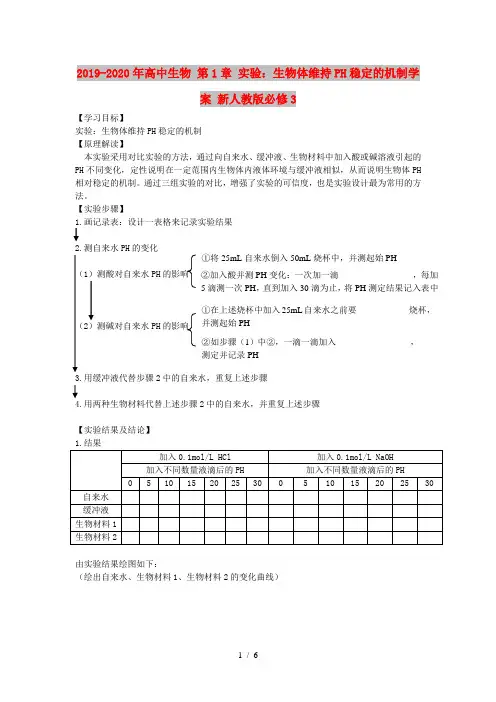
2019-2020年高中生物 第1章 实验:生物体维持PH 稳定的机制学案 新人教版必修3【学习目标】实验:生物体维持PH 稳定的机制 【原理解读】本实验采用对比实验的方法,通过向自来水、缓冲液、生物材料中加入酸或碱溶液引起的PH 不同变化,定性说明在一定范围内生物体内液体环境与缓冲液相似,从而说明生物体PH 相对稳定的机制。
通过三组实验的对比,增强了实验的可信度,也是实验设计最为常用的方法。
【实验步骤】1.画记录表:设计一表格来记录实验结果2.测自来水PH 的变化(1)测酸对自来水PH 的影响(2)测碱对自来水PH 的影响3.用缓冲液代替步骤2中的自来水,重复上述步骤4.用两种生物材料代替上述步骤2中的自来水,并重复上述步骤【实验结果及结论】 由实验结果绘图如下:(绘出自来水、生物材料1、生物材料2的变化曲线)①将25mL 自来水倒入50mL 烧杯中,并测起始PH②加入酸并测PH 变化:一次加一滴_________________,每加5滴测一次PH ,直到加入30滴为止,将PH 测定结果记入表中 ①在上述烧杯中加入25mL 自来水之前要____________烧杯,并测起始PH ②如步骤(1)中②,一滴一滴加入_________________,测定并记录PH2.结论:在一定范围内生物材料的性质类似于________,不同于________。
说明生物材料内含有___________,因而能维持PH的相对稳定。
【血浆PH调节机制】1.缓冲物质(1)概念:血液中含有许多对对酸碱度起缓冲作用的物质,也叫缓冲对。
(2)组成:每一对缓冲物质都是由一种弱酸和相应的一种强碱盐组成的,如H2CO3/NaHCO3、NaH2PO4/Na2HPO4等。
(3)作用:使血液的酸碱度不会发生很大的变化,从而维持相对稳定的状态。
2.调节机制(1)当酸性物质(如乳酸)增加时:HL + NaHCO3→ NaL + H2CO3 H2CO3→ H2O + CO2↑乳酸碳酸氢钠乳酸钠碳酸不稳定经呼吸系统排出(2)当碱性物质(如Na2CO3)增加时:Na2CO3 + H2CO3→ 2NaHCO3过多的NaHCO3可由肾脏排出,从而缓冲了体内的碱性变化。
2019_2020学年新教材高中语文第三单元第7课归园田居(其一)学案新人教版必修上册

归园田居(其一)公元405年(东晋安帝义熙元年),陶渊明在江西彭泽做县令,才不过八十天,便声称不愿“为五斗米折腰向乡里小儿”,挂印回家,从此结束了时隐时仕、身不由己的生活,终老田园。
陶渊明归来后,作《归园田居》诗一组,共五首,描绘田园风光的美好与乡居生活的淳朴可爱,抒发归隐后愉悦的心情。
课文选的是第一首。
田园诗派田园诗派是我国古代诗歌流派中重要的一支,陶渊明是其重要代表人物。
他的诗大部分取材于田园生活,有的接近于口语,有的近似歌谣,有的直抒胸臆,抒发诗人热爱躬耕生活之情;语言平淡而自然,朴实而又毫不缺乏色彩,给人一种清新、静谧、悠闲、纯美的感受;为古典诗歌开辟了一个新境界,并创造出一种田园牧歌式的生活,借以表达对现实的不满,对宁静平和生活的向往。
此后田园诗不断发展,到唐代形成了山水田园诗派,名家辈出,王维、孟浩然是其代表人物。
此类诗歌总体以描写自然风光、农村景物以及安逸恬淡的隐居生活见长,诗境隽永优美,风格恬静淡雅,语言清丽洗练,多用白描手法。
归园田居(其一)少① 无适② 俗③ 韵④,性⑤本⑥ 爱 少年时就没有迎合世俗的本性,天性原来就热爱山川丘山⑦。
误落 尘网⑧ 中, 一去田园间的生活。
不慎误落在尘世的罗网中,一离开三十年⑨。
羁鸟⑩ 恋 旧 林, 转眼就是三十年。
关在笼中的鸟留恋生活过的树林,池 鱼 思 故 渊⑪。
养在池里的鱼思念过去的深潭。
[ ①少:指少年时代。
②适:适应。
③俗:世 俗。
④韵:气质,情致。
⑤性:天性、本性。
⑥本:原来。
⑦丘山:这里泛指山川田园。
⑧尘网:尘世的罗网。
意指庸俗污浊的官场犹如罗网。
⑨三十年:夸大的说法,与实际情 ⎦⎥⎤况不符,也有人认为是“十三年”之误。
⑩羁鸟:笼中鸟。
羁,拴住,束缚。
⑪渊:深潭。
层解 第一层写归园之因。
开 荒 南 野 际⑫, 守拙⑬ 归 园田。
到南面的山野里开垦荒地,固守住愚拙,回乡过田园生活。
方⑭宅 十余亩, 草屋 八九间。
榆 柳 住宅周围有地十多亩,还有茅草小屋八九间。
2019-2020年高中语文文言学案赤壁之战鲁教版必修2

2019-2020年高中语文文言学案赤壁之战鲁教版必修22019-2020年高中语文文言学案赤壁之战鲁教版必修2【学习目标】:(本篇为高中文言文的重中之重,知识点多,考查频率高,相信你一定能用耐心和细心把他攻克!)1、理解重点文言实词卒、治、事、次、略等的含义2、理解重点文言虚词之、以、而、者等的意义和用法3、理解并掌握被动句式4、准确翻译文中的句子【知识梳理与归纳】:(建议课前自己先做,遇到疑难再查书,务请用红笔标出疑难,课上可以一起切磋,更可明确你的重难点,再逐个攻破。
书越读越薄,何乐而不为?)一、指出下列各句中的通假字.(看自己能不能把他们一网打尽!)1.将军禽操2.五万兵难卒合3.顷之,烟炎张天4.雷鼓大震5.卿能办之者诚决二、找出古今异义词并解释其古义。
1.荆州与国临接 2. 致殷勤之意3. 若能以吴越之众与中国抗衡4. 鼎足之形成矣5. 刘琮束手6. 方与将军会猎于吴7. 北面而事之 8. 操虽托名汉相,其实汉贼也。
9. 权起更衣 10. 当横行天下11.地方数千里 12.子布、元表诸人各顾妻子13.邂逅不如意 14.犹不失下曹从事15. 初一交战三、指出活用词并解释.1.敬贤礼士2.兵精粮多,足以立事3.必蹶上将军4.乘犊车,从吏卒5.诸人持议,甚失孤望6. 可烧而走也7.瑜等率轻锐 8. 与苍梧太守吴巨有旧9.操悉浮以沿江 10. 英雄乐业11. 备南走 12. 外托服从之名,内怀犹豫之计13. 兼有步兵,水陆俱下 14. 盖以十舰最著前,中江举帆四、解释加点的词语:1. 士民殷.富2. 此帝王之资.也3. 今刘表新亡,二子不协.4. 刘备天下枭雄..,与操有隙.5. 表恶.其能而不能用也6. 如有离违,宜别图.之7. 肃请得奉命吊.表二子 8 拔刀斫.前奏案9. 肃宣.权旨. 10 致.殷勤之意11. 遂与鲁肃俱诣.孙权 12 今操芟夷..大难13. 何不按.兵束甲 14 .权以示.群下15. 今操得荆州,奄.有其地 16 .不复料.其虚实17. 今以实校.之 18 曹操之众远来疲敝.19 .此天以卿二人赞.孤也 20 动以朝廷为辞.21.上建.旌旗 22 兼仗父兄之烈.23. 将兵与备并力逆.操 24 而操皆冒.行之25 .北军大坏. 26 悉使羸.兵负草填之27 晨夜兼道.. 28 兵精足用.29 权起更衣,肃追于宇.下 30 所得表众亦极.七八万耳31 羸.兵为人马所蹈藉.. 32 初.,鲁肃闻刘表卒33. 比.至.南郡 34. 累官故.不失州郡也35 吾不能举.全吴之地 36 成败之机.,在于今日五、一词多义(一)实词(1)卒:1、鲁肃闻刘表卒2、五万兵难卒合3、乘犊车,从吏卒,交游士林4、卒廷见相如(2)治:1、同心一意,共治曹操2、今治水军八十万众,方与将军会猎于吴(3)次:1、操军不利,引次江北2、余船以次俱进(4)引1、操军不利,引次江北2、操引军从华容道步走(5)数:1、统兵数万2、蒙冲斗舰乃以千数(6)事:1、不足与图大事2、事急而不断,祸至无日矣3、去亲戚而事君者4、苟如君言,刘豫州何不遂事之乎?(7)略:1、略已平矣2、助画方略(8)济1、宜别图之,以济大事2、若事之不济,此乃天也3、同舟共济4、欲济无舟楫,端居耻圣明(9)将1、曹操自江陵将顺江东下。
《金版新学案》2018-2019学年高中化学(人教版)必修1课件:第一章 从实验学化学 1.2.3
mol· L-1。 (2)100.0 mL 该浓盐酸中所含 HCl 的物质的量为 0.1 L×12.0 mol· L 1=1.20
-
mol,需要标准状况下 HCl 的体积为 1.20 mol×22.4 L· mol 1=26.88 L。(3)设配制
-
稀盐酸需要浓盐酸的体积是 V,则有 0.100 L×3.00 mol· L 1=V×12.0 mol· L 1,
化 学 必修1
第一章
从实验学化学
自主学习· 新知全解 合作探究· 课堂讲练 课时作业
解析: (1)设溶液的体积是 100.0 mL, 则 HCl 的物质的量为(100.0 mL×1.20 g· cm 3×36.5%)÷ 36.5 g· mol 1=1.20 mol,所以其浓度是 1.20 mol÷ 0.1 L=12.0
- -
mol+0.020 0 mol)÷ 0.020 0 L=2.50 mol· L 1。
-
答案:
(1)12.0
(2)26.88 L
(3)25.0 mL
(4)2.50 mol·L-1
化 学 必修1
第一章
从实验学化学
自主学习· 新知全解 合作探究· 课堂讲练 课时作业
[思考感悟] 1.已知一定体积的溶液中溶质的量,计算 c (1)已知溶质的质量。
- -
解得 V=0.025 0 L,即 25.0 mL。
化 学 必修1
第一章
从实验学化学
自主学习· 新知全解 合作探究· 课堂讲练 课时作业
(4)10.0 mL 3.00 mol· L-1 的盐酸中 Cl-的物质的量为 0.010 0 L×3.00 mol· L-1 =0.030 0 mol,10.0 mL 1.00 mol· L-1 的 MgCl2 溶液中 Cl-的物质的量为 0.010 0 L×1.00 mol· L 1×2=0.020 0 mol,则混合溶液中 Cl 的物质的量浓度是(0.030 0
(新教材)2019-2020学年新课程同步人教版高中英语必修第一册新学案UNIT 4 课时跟踪检测(二)
UNIT 4课时跟踪检测(二)Reading and Thinking一、语言基础训练Ⅰ.单词拼写1.She took a deep breath and sat up slowly with great effort (努力).2.I have dreams of this place and wonder what it would be like to breathe (呼吸) this air.3.Latest reports say that mudslides buried (埋) entire villages.4.The number of families seeking shelters rose by 17 percent (百分比).5.Don't leave the lights on.It wastes electricity (电).6.His bad habits ruined (毁灭) his chance of having a bright future.7.After the woman heard that her husband was killed in the car accident, she went into shock (休克).8.In order to catch the bear, some villagers set a trap (陷阱) and covered it with some leaves.Ⅱ.单句语法填空1.The boy walked in as if he had_bought (buy) the whole school.2.He was_trapped (trap) in the traffic jam and felt helpless.3.It was a shocking story, and we all got shocked. (shock)4.Burying (bury) himself in the newspaper, he didn't notice what was happening.5.Years of fighting have left the city in ruins (ruin); it would take a lot of money to rebuild it.6.A number of teachers are present today, the number of whom is 300. (be)7.We have to wait until the discussion between them comes to an end.8.His friend has suffered from illness for years.Ⅲ.选词填空be trapped in,in ruins,be buried in,dig out,come to an end,instead of1.After the exam, all the lessons in school also came_to_an_end.2.It was reported that an American couple had dug_out a lot of gold coins from their own yard.3.She was_buried_in thought, so she didn't notice the water was boiling.4.Why don't you play football instead_of just looking on?5.The city lay in_ruins after the earthquake.Now, rows of houses are being built.6.They are_trapped_in the burning building.Please call the fire department right away.Ⅳ.完成句子1.It_seemed_as_if he knew everything that happened last night.他好像知道昨晚发生的一切。
2019-2020学年新素养同步人教A版高中数学必修第二册学案:6.4.3 第2课时 正弦定理 Word版含答案
第2课时 正弦定理问题导学预习教材P45-P48的内容,思考以下问题: 1.在直角三角形中,边与角之间的关系是什么? 2.正弦定理的内容是什么?1.正弦定理对正弦定理的理解(1)适用范围:正弦定理对任意的三角形都成立.(2)结构形式:分子为三角形的边长,分母为相应边所对角的正弦的连等式.(3)揭示规律:正弦定理指出的是三角形中三条边与其对应角的正弦之间的一个关系式,它描述了三角形中边与角的一种数量关系.2.正弦定理的变形若R 为△ABC 外接圆的半径,则 (1)a =2R sinA,b =2R sin B ,c =2R sin C ; (2)sin A =a 2R ,sin B =b 2R ,sin C =c2R ;(3)sin A ∶sin B ∶sin C =a ∶b ∶c ; (4)a +b +csin A +sin B +sin C=2R .判断(正确的打“√”,错误的打“×”)(1)正弦定理不适用于直角三角形.( ) (2)在△ABC 中必有a sin A =b sin B .( )(3)在△ABC 中,若a >b ,则必有sin A >sin B .( ) (4)在△ABC 中,若sin A =sin B ,则必有A =B .( ) 答案:(1)× (2)× (3)√ (4)√在△ABC 中,a =3,b =5,sin A =13,则sin B =( )A.15 B.59 C.53D.1解析:选B.因为a =3,b =5,sin A =13,所以由正弦定理得sin B =b sin Aa =5×133=59.在△ABC 中,角A ,B ,C 所对的边分别是a ,b ,c ,若A =105°,B =45°,b =22,则c =( )A.22B.1C. 2D.2解析:选D.由三角形内角和定理得,C =180°-(A +B )=180°-(105°+45°)=30°. 由正弦定理得,c =b sin C sin B =22·sin 30°sin 45°=2.在△ABC 中,若sin A a =cos B b,则B 的度数为________.解析:根据正弦定理知,sin A a =sin Bb ,结合已知条件可得sin B =cos B ,又0°<B <180°,所以B =45°.答案:45°已知两角及一边解三角形在△ABC 中,已知c =10,A =45°,C =30°,解这个三角形. 【解】 因为A =45°,C =30°,所以B =180°-(A +C )=105°. 由a sin A =c sin C 得a =c sin Asin C =10×sin 45°sin 30°=10 2.因为sin 75°=sin(30°+45°)=sin 30°cos 45°+cos 30°sin 45°=2+64,所以b =c sin B sin C =10×sin (A +C )sin 30°=20×2+64=52+5 6.已知三角形的两角和任一边解三角形的思路(1)若所给边是已知角的对边时,可由正弦定理求另一角所对的边,再由三角形内角和定理求出第三个角.(2)若所给边不是已知角的对边时,先由三角形内角和定理求出第三个角,再由正弦定理求另外两边.1.在△ABC 中,已知a =8,B =60°,C =75°,则b =( ) A .42 B .4 3 C .4 6D .323解析:选C.A =180°-B -C =45°,由正弦定理a sin A =b sin B ,得b =a sin B sin A =8sin 60°sin 45°=4 6.2.在△ABC 中,A =60°,sin B =12,a =3,求三角形中其他边与角的大小.解:因为sin B =12,所以B =30°或150°,当B =30°时,由A =60°得C =90°;当B =150°时,不合题意,舍去.所以由正弦定理b sin B =c sin C =a sin A ,得b =sin B sin A ·a =sin 30°sin 60°×3=3,c =sin Csin A ·a =sin 90°sin 60°×3=2 3.已知两边及其中一边的对角解三角形已知△ABC 中的下列条件,解三角形: (1)a =10,b =20,A =60°; (2)a =2,c =6,C =π3.【解】 (1)因为b sin B =asin A,所以sin B =b sin A a =20sin 60°10=3>1,所以三角形无解.(2)因为a sin A =c sin C ,所以sin A =a sin C c =22.因为c >a ,所以C >A .所以A =π4.所以B =5π12,b = c sin Bsin C=6·sin5π12sin π3=3+1.[变条件]若本例(2)中C =π3改为A =π4,其他条件不变,求C ,B, b .解:因为a sin A =c sin C ,所以sin C =c sin A a =32.所以C =π3或2π3.当C =π3时,B =5π12,b =a sin Bsin A =3+1.当C =2π3时,B =π12,b =a sin Bsin A=3-1.(1)已知两边及其中一边的对角解三角形的思路 ①首先由正弦定理求出另一边对角的正弦值;②如果已知的角为大边所对的角时,由三角形中大边对大角,大角对大边的法则能判断另一边所对的角为锐角,由正弦值可求锐角;③如果已知的角为小边所对的角时,则不能判断另一边所对的角为锐角,这时由正弦值可求两个角,要分类讨论.(2)已知两边及其中一边的对角判断三角形解的个数的方法①应用三角形中大边对大角的性质以及正弦函数的值域判断解的个数;②在△ABC 中,已知a ,b 和A ,以点C 为圆心,以边长a 为半径画弧,此弧与除去顶点A 的射线AB 的公共点的个数即为三角形解的个数,解的个数见下表:1.(2019·广东省揭阳市检测)在△ABC 中,cos A =12,a =43,b =42,则B 等于( )A .45°或135°B .135°C .45°D .60°解析:选C.由cos A =12,得sin A =32,A =60°,由正弦定理得sin B =b sin A a =22.因为三角形的内角和为180°,且a >b ,所以B =45°.2.已知在△ABC 中,a =x ,b =2,B =45°,若三角形有两解,则x 的取值范围是( ) A .x >2 B .x <2 C .2<x <2 2D .2<x <2 3解析:选C.由a sin B <b <a ,得22x <2<x ,所以2<x <2 2.判断三角形的形状已知在△ABC 中,角A ,B 所对的边分别是a 和b ,若a cos B =b cos A ,则△ABC一定是( )A .等腰三角形B .等边三角形C .直角三角形D .等腰直角三角形【解析】 由正弦定理得:a cos B =b cos A ⇒sin A cos B =sin B cos A ⇒sin(A -B )=0,由于-π<A -B <π,故必有A -B =0,A =B ,即△ABC 为等腰三角形.【答案】 A[变条件]若把本例条件变为“b sin B =c sin C ”,试判断△ABC 的形状. 解:由b sin B =c sin C 可得sin 2B =sin 2C ,因为三角形内角和为180°, 所以sin B =sin C .所以B =C .故△ABC 为等腰三角形.判断三角形形状的两种途径[注意] 在两种解法的等式变形中,一般两边不要约去公因式,应移项提取公因式,以免漏解.已知a ,b ,c 分别是△ABC 的内角A ,B ,C 所对的边,满足a cos A =bcos B=ccos C,则△ABC的形状是()A.等腰三角形B.直角三角形C.等边三角形D.等腰直角三角形解析:选C.由正弦定理得asin A=bsin B=csin C,又acos A=bcos B=ccos C,得sin Acos A=sin Bcos B=sin Ccos C,即tan A=tan B=tan C,所以A=B=C,即△ABC为等边三角形.1.(2019·辽宁沈阳铁路实验中学期中考试)在△ABC中,AB=2,AC=3,B=60°,则cos C=()A.33 B.63C.32 D.62解析:选B.由正弦定理,得ABsin C=ACsin B,即2sin C=3sin 60°,解得sin C=33.因为AB<AC,所以C<B,所以cos C=1-sin2C=6 3.2.在△ABC中,角A,B,C的对边分别为a,b,c,且A∶B∶C=1∶2∶3,则a∶b∶c =()A.1∶2∶3B.3∶2∶1C.2∶3∶1 D.1∶3∶2解析:选D.在△ABC中,因为A∶B∶C=1∶2∶3,所以B=2A,C=3A,又A+B+C =180°,所以A=30°,B=60°,C=90°,所以a∶b∶c=sin A∶sin B∶sin C=sin 30°∶sin 60°∶sin 90°=1∶3∶2.3.在△ABC中,角A,B,C的对边分别是a,b,c,若c-a cos B=(2a-b)cos A,则△ABC 的形状是()A.等腰三角形B.直角三角形C.等腰直角三角形D.等腰三角形或直角三角形解析:选D.已知c-a cos B=(2a-b)cos A,由正弦定理得sin C-sin A cos B=2sin A cos A -sin B cos A,所以sin(A+B)-sin A cos B=2sin A cos A-sin B cos A,化简得cos A(sin B-sin A)=0,所以cos A=0或sin B-sin A=0,则A=90°或A=B,故△ABC为等腰三角形或直角三角形.[A基础达标]1.在△ABC 中,一定成立的式子是( ) A .a sin A =b sin B B .a cos A =b cos B C .a sin B =b sin A D .a cos B =b cos A解析:选C.由正弦定理a sin A =b sin B =c sin C,得a sin B =b sin A . 2.在△ABC 中,若3a =2b sin A ,则B =( ) A.π3 B.π6 C.π3或2π3D.π6或5π6解析:选C.由正弦定理,得3sin A =2sin B sin A ,所以sin A (2sin B -3)=0.因为0<A <π,0<B <π,所以sin A ≠0,sin B =32,所以B =π3或2π3. 3.(2019·济南检测)已知a ,b ,c 分别是△ABC 的三个内角A ,B ,C 所对的边,若A =60°,c =6,a =6,则此三角形有( )A .两解B .一解C .无解D .无穷多解解析:选B.由等边对等角可得C =A =60°,由三角形的内角和可得B =60°,所以此三角形为正三角形,有唯一解.4.在△ABC 中,若c =3,C =60°,则a +b +csin A +sin B +sin C =( )A .6B .2 3C .2D . 3解析:选C.利用正弦定理的推论,得a +b +c sin A +sin B +sin C =c sin C =3sin 60°=2.5.在△ABC 中,已知a 2tan B =b 2tan A ,则△ABC 的形状是 ( ) A .锐角三角形 B .直角三角形 C .钝角三角形D .等腰三角形或直角三角形解析:选D.将a =2R sin A ,b =2R sin B (R 为△ABC 外接圆的半径)代入已知条件,得sin 2A tan B =sin 2B tan A ,则sin 2A sin B cos B =sin A sin 2B cos A.因为sin A sin B ≠0,所以sin A cos B =sin Bcos A,所以sin 2A =sin 2B ,所以2A =2B 或2A =π-2B ,所以A =B 或A +B =π2,故△ABC 为等腰三角形或直角三角形.6.在△ABC 中,若a =3,cos A =-12,则△ABC 的外接圆的半径为________.解析:由cos A =-12,得sin A =1-cos 2A =32,设△ABC 的外接圆的半径为R ,由正弦定理,有2R =asin A=23,即△ABC 的外接圆的半径为 3.答案: 37.在△ABC 中,角A ,B ,C 的对边分别为a ,b ,c ,若a =3,B =2A ,cos A =63,则b =________.解析:因为cos A =63,所以sin A =33,因为B =2A ,所以sin B =sin 2A =2sin A cos A =223,又b sin B =asin A,所以b =2 6. 答案:2 68.在△ABC 中,若B =π4,b =2a ,则C =________.解析:在△ABC 中,由正弦定理a sin A =b sin B ,得a sin A =2a sin π4=2a 22=2a ,所以sin A =12,所以A =π6或56π.因为b =2a >a ,所以B >A ,即A <π4,所以A =π6,所以C =π-A -B =π-π6-π4=712π.答案:712π9.(2019·浙江温州月考)在△ABC 中,A =30°,C =45°,c =2,求a ,b 及cos B . 解:因为A =30°,C =45°,c =2, 所以由正弦定理,得a =c sin A sin C =2sin 30°sin 45°=1.又B =180°-(30°+45°)=105°, 所以cos B =cos 105°=cos(45°+60°)=2-64, b =c sin Bsin C =2sin 105°sin 45°=2sin 105°=2sin(45°+60°)210.如图所示,AB ⊥BC ,CD =33,∠ACB =30°,∠BCD =75°,∠BDC =45°,求AB 的长.解:在△BCD 中,∠DBC =180°-75°-45°=60°,由正弦定理知,33sin 60°=BCsin 45°,可得BC =116,在Rt △ABC 中,AB =BC tan ∠ACB =116×tan 30°=11 2.[B 能力提升]11.在△ABC 中,已知B =60°,最大边与最小边的比为3+12,则三角形的最大角为( ) A .60° B .75° C .90°D .115°解析:选B.不妨设a 为最大边,c 为最小边,由题意有a c =sin A sin C =3+12,即sin Asin (120°-A )=3+12,整理,得(3-3)sin A =(3+3)cos A .所以tan A =2+3,所以A =75°,故选B.12.在△ABC 中,角A ,B ,C 的对边分别为a ,b ,c ,已知b cos C +3b sin C -a -c =0,则角B =________.解析:由正弦定理知,sin B cos C +3sin B sin C -sin A -sin C =0.(*) 因为sin A =sin(B +C ) =sin B cos C +cos B sin C ,代入(*)式得3sin B sin C -cos B sin C -sin C =0. 因为sin C >0,所以3sin B -cos B -1=0, 所以2sin ⎝⎛⎭⎫B -π6=1,即sin ⎝⎛⎭⎫ B -π6=12.因为B ∈(0,π),所以B =π3.313.在△ABC 中,a ,b ,c 分别为角A ,B ,C 的对边,B =2π3,若a 2+c 2=4ac ,则sin (A +C )sin A sin C=________.解析:因为a 2+c 2ac =b 2+2ac cos B ac =4,B =2π3,所以b 2=5ac .由正弦定理得sin 2B =5sin A sin C =34,所以sin A sin C =320,所以sin (A +C )sin A sin C =sin B sin A sin C =1033.答案:103314.已知△ABC 中角A ,B ,C 所对的边分别为a ,b ,c ,且a cos C +32c =b . (1)求角A 的大小;(2)若a =1,b =3,求c 的值. 解:(1)由a cos C +32c =b , 得sin A cos C +32sin C =sin B . 因为sin B =sin(A +C )=sin A cos C +cos A sin C , 所以32sin C =cos A sin C . 因为sin C ≠0,所以cos A =32. 因为0<A <π,所以A =π6.(2)由正弦定理,得sin B =b sin A a =32.所以B =π3或2π3.①当B =π3时,由A =π6,得C =π2,所以c =2;②当B =2π3时,由A =π6,得C =π6,所以c =a =1.综上可得c =1或2.[C 拓展探究]15.在△ABC 中,已知a +b a =sin B sin B -sin A,且cos(A -B )+cos C =1-cos 2C . (1)试确定△ABC 的形状;(2)求a +c b的取值范围. 解:(1)在△ABC 中,设其外接圆半径为R ,根据正弦定理得,sin A =a 2R ,sin B =b 2R ,sin C =c 2R, 代入a +b a =sin B sin B -sin A, 得a +b a =b b -a, 所以b 2-a 2=ab .①因为cos(A -B )+cos C =1-cos 2C ,所以cos(A -B )-cos(A +B )=2sin 2C ,所以sin A sin B =sin 2C .由正弦定理,得a 2R ·b 2R=⎝⎛⎭⎫c 2R 2, 所以ab =c 2.②把②代入①得,b 2-a 2=c 2,即a 2+c 2=b 2.所以△ABC 是直角三角形.(2)由(1)知B =π2, 所以A +C =π2, 所以C =π2-A . 所以sin C =sin ⎝⎛⎭⎫π2-A =cos A . 根据正弦定理,得a +cb =sin A +sin C sin B =sin A +cos A =2sin ⎝⎛⎭⎫A +π4. 因为ac <ab =c 2,所以a <c ,所以0<A <π4,所以π4<A +π4<π2. 所以22<sin ⎝⎛⎭⎫A +π4<1, 所以1<2sin ⎝⎛⎭⎫A +π4<2, 即a +cb 的取值范围是(1, 2 ).。
人教版(2019)新教材高中英语选择性必修第一册第三单元词汇学案英语公开课精品资源
人教版(2019)新教材高中英语选择性必修第一册词汇学案UNIT THREE1. buffet [ˈbʌfɪt]: v. 连续猛击; 打来打去[ˈbʌfeɪ ; ˈb ufeɪ]: n. 自助餐1)We were buffeted by the wind and the rain.2)Strong winds buffet the ships from time to time.3)What is the charge of buffet for each person?4)We have the best buffet in this area.2. cloth[klɒθ][klɔːθ]: n. (一块)布; 织物; 布料(复数: cloths)clothes [kləʊðz]:n. 衣服(复数)clothing [ˈkləʊðɪŋ]:衣服(总称。
不可数名词)an item/article of clothing: 一件衣服1)I wake up to the sound of the wind buffeting the cloth of my tent.2)She took a cloth and cleaned the kitchen table.3)His desk is covered with a cloth.4)The holes in the cloth were made by mice.3. edge [edʒ]: n. 边; 边缘; 边线; 刀刃vt./vi. (使)徐徐移动; 给…加边age [eɪdʒ] : n. 年龄; 时代1)I leave my tent and walk over to the mountain edge.2)They live in a big house on/at the edge of the town.3)Be careful------The knife has a sharp edge.4)Our soldiers edged a little closer to the enemy’s camp. 5)The girl edged nervously past the dog.6)The thief edged towards the window.7)The table is edged with metal.4. valley [ˈvæli]: n. 谷; 山谷; 溪谷village[ˈvɪlɪdʒ]: n. 村庄; 村镇1)Spreading out before me, branches of the Rapa River flow through the valley below.2)The guide will take us back down to the valley.3)As they reached the top of the mountain, they saw the valley and lake before them.5. vast [vɑːst]: adj. 辽阔的; 巨大的; 庞大的1)Sarek’s mountains used to be covered by vast sheets of ice.2)The pollution has already turned vast areas into a wasteland.3)His business empire is vast.4)They found themselves in a vast underground cave.5)The development of education needs vast funds.6. glacier [ˈɡlæsiə(r)]: n. 冰川1)Around 9, 000 years ago, this ice melted, leaving behind about 100 glaciers.2)There is a glacier that covers the land in this area.3)Water of the river is mainly from snowmelt of glaciers.7. reindeer [ˈreɪndɪə(r)]: n. 驯鹿(单数复数同形)单复数同形的名词有:deer, fish, sheep, means, species等1)Soon after, reindeer began to arrive.- 1 -2)Nothing grows there so people eat reindeer meat and horse meat.3)By the way, may I ask how many reindeer you have?8. territory [ˈterətri]: n. 领土; 版图; 领域; 地盘1)Following the reindeer were the Sami people, who made this territory their home.2)We will fight for every inch of our territory.3)The whole territory is now controlled by our soldiers.4)This is my territory. I want you to get out of here at once.9. ban [bæn]: vt. 明令禁止; 取缔(banned --- banning)n. 禁令impose/lift/remove a ban : 颁布/解除禁令ban sb from sth: 禁止某人什么ban sb from doing sth: 禁止某人做什么1)China will ban smoking in public.2)Smoking is banned in all the offices.3)The woman was banned from the meeting.4)He was banned from driving for six months after the accident.5)The county has a ban on parking cars in this busy street.6)Countries including China support the ban.10. boundary [ˈbaʊndri] [ˈbaʊndəri]: n. 边界; 界限; 分界线border [ˈbɔ:də]: n. 国界; 边界(多指靠近两国或两地区分界线的区域)cross the border into...: 越过边界进入...1)Though the Sami are allowed to continue their traditional way of life in the park,no one else can live here, and all new development is banned within park boundaries. 2)The river is the boundary between China and North Korea.3)The fence marks the boundary between the school and the factory.4)The river forms the boundary between the two countries.5)After the war the national boundaries were redrawn.11. cottage [ˈkɒtɪdʒ]: n. 小屋;(尤指)村舍; 小别墅1)The cottage has a delightful sea view.2)They will leave the city for their summer cottages in Guizhou.3)We used to have a cottage in the forest.12. visible [ˈvɪzəbl]: adj. 看得见的; 可见的1)At the far side of the valley, an ancient Sami cottage is visible.2)China has made a visible effort to control/contain COVID-19.3)The temple is clearly visible from the bridge.4)The water is clear and plenty of fish are visible.5)The clever general took no visible action before the war.13. on the move: 在行进中; 在移动中1)The soldiers were on the move again after a short rest.2)He's always on the move and never has time to talk.3)The American people are always on the move for their jobs or life.14. accompany[əˈkʌmpənɪ]: vt. 陪同; 陪伴; 伴随; (尤指用钢琴)为…伴奏company [ˈkʌmpənɪ]:n. 公司; 陪伴accompany sb = keep sb company: 陪伴某人1)Since reindeer were always on the move, the Sami would pick up their tents andaccompany them.- 2 -2)His daughter will accompany him to Europe.3)Her husband accompanied her on the trip to Beijing.4)Children must be accompanied by an adult.5)She sang and Long Long accompanied her on the piano.15. adopt [əˈdɒpt]: vt. 采用; 采取; 采纳; 领养adoption[əˈdɒpʃn]: n. 采用; 领养adapt [əˈdæpt]: v. 适应; 适合; 改编; 改写adapt (oneself) to…: 适应adjust [əˈdʒʌst]: v. 调节; 校正; 适应adjust (oneself) to…: 适应1)I am not a Sami, but in Sarek I’ve adopted some of their habits.2)He adopted a different approach to the problem.3) I know that my parents adopted me at the time of my birth.4)He is not my real father; I'm adopted.16. sour [ˈsaʊə(r)]: adj. 酸的; 有酸味的sweet: adj. 甜的turn/go sour : 馊了; 变坏; 恶化; 出毛病soup [suːp]:n. 汤have/take/eat soup: 喝汤1)For example, this morning my breakfast is flat bread warmed over a fire, driedreindeer meat, and some sweet and sour berries that I found growing near my tent.2)The food has gone sour.3)This apple is too sour to eat. 17. set out: 出发; 启程; (怀着目标)开始工作set out to do …: 开始做什么set out for…:出发去…set off/forth: 出发; 上路; 动身1)After breakfast, I pack my bag and set out again.2)We will set out to find the truth behind the failure.3)They decided to set out (for the town) right away.18. bless [bles]: vt. 祝福blessed: adj. 神圣的; 有福的; 无忧无虑的1)However, I cannot complain. Being in such a beautiful and wild place makes mefeel blessed to be alive.2)They are blessed with three lovely children.3)Blessed are the Chinese people.4)God bless and thank you all!5)Good luck and God bless you.19. live off: 依靠…生活; 以吃…为生live/lead a ... life: 过...的生活live on...: 靠...为生/生存live by doing ...: 靠做...为生/生存1)You can't live off your parents your whole life.2)They find it hard to live off the money they make.3)We live off the food we stored during the autumn/fall.20. prohibition [ˌprəʊɪˈbɪʃn]: n. 禁止; 阻止; 禁令- 3 -1)The prohibition of smoking is the only solution.2)With more and more prohibitions, I may go mad one day.3)There is a prohibition against smoking.4)I do not understand this cause of prohibition.21. prohibit [prəˈhɪbɪt]: vt. (尤指以法令)禁止; 阻止prohibit (sb) doing…: 禁止(某人)做什么prohibit sb from doing…: 禁止/阻止某人做什么ban sb from sth: 禁止某人什么ban sb from doing sth: 禁止某人做什么1)Those people are prohibited from travelling abroad.2)Students are prohibited from smoking on campus.3)Parking/Smoking is prohibited in this street.4)The price prohitted us from buying it.22. journalist[ˈdʒɜːnəlɪst]: n. 新闻记者; 新闻工作者reporter [rɪˈpɔːtə]: n. 记者; 通讯员; 采访者press [pres]: n. 新闻界press conference: 记者招待会; 新闻发布会1)I believe that a journalist should be completely objective.2)As a journalist, she has always had a nose for a good story.3)He is an excellent journalist and a very fine man.23. sneeze [sniːz]: vi. 打喷嚏([pen] [ tì ])n. 喷嚏; 喷嚏声cough [kɒf]:n./v. 咳嗽cold [kəʊld]:n. 感冒; 寒冷catch/take/get (a) cold:患感冒have a cold:患感冒catch/get a bad/heavy/slight cold: 患重/轻感冒1)Whenever I sneeze, my English teacher says, “ Bless you!”2)When we sneeze, our eyes close.3)When China sneezes, the rest of the world will catch a cold.4)She gave a violent sneeze.24. teapot [ˈtiːpɒt]: n. 茶壶1)He bought a traditional tea set at the airport: a nice teapot and four tea cups.2)They took the teapot to America, but the American police found it.3)The old teapot was used to keep the tea warm.25. label [ˈleɪbl]: vt. 用标签标明; 贴标签(labeled/labelled—labeling/labelling)n. 标签; 标记1)People are confused about all the different labels on foods these days.2)There is a label on the box.3)The doctor carefully labelled the bottles “poison”.26. cream[kriːm]: n. 奶油; 乳脂; 护肤霜adj. 奶油色的; 淡黄色的scream [skriːm]: n./v. 尖叫screen [skriːn]: n. 屏幕; 荧屏1)He ordered the dish labelled “Pumpkin Pie and Ice Cream”.- 4 -2)Would you like milk or cream in your coffee?3)Do not use the cream on broken skin.4)The girl bought a cream dress last summer.27. leopard [ˈlepəd]: n. 豹tiger: n. 老虎lion[ˈlaɪən]: n. 狮子cat: n.猫; 猫科动物1)Last week, he wrote about another animals---- the rare snow leopard.2)A leopard hunts alone, and an injured leopard cannot hunt .3)A leopard can never change its spots.28. stretch [stretʃ]: vi 延伸; 延续; 伸展; 舒展1)It is good to get out of the car and stretch our arms and legs.2)Let's stretch for a minute--we've been sitting here for over 3 hours.3)The road stretches ahead across the plain.4)The forest stretches for about 150 kilometers.5)The project will stretch into next year.29. rewarding [rɪˈwɔːdɪŋ]: adj. 值得做的; 有益的reward [rɪˈwɔːd]: n. 奖励; 回报; 报酬; 悬赏金v. 奖励; 奖赏; 给报酬be worth doing...: 值得做It is worthwhile to do.../doing...: 做什么是值得的1)Teaching can be a very rewarding career.2)I find this kind of work extremely rewarding. 3)It is rewarding to learn a foreign language.4)Volunteering is fun and rewarding, but if you want to be a good volunteer, youneed to learn more.30. bush [bʊʃ]: n. 灌木tree: n. 树松树əs]: n. 柏树forest: n. 森林woods: n. 树林1)Trees and bushes grow down to the water's edge.2)Every flower and every bush is to be cut down.3)Be a bush if you can't be a tree.4)In the bush a mother bird has built her nest.31. lung [lʌŋ]: n. 肺liver: n. 肝heart: n. 心脏face: n. 脸cheek: n. 面颊; 脸颊nose: n. 鼻子skin: n. 皮肤forehead: n. 额; 前额eye: n. 眼睛tooth/teeth: n. 牙齿mouth: n. 口; 嘴ear: n. 耳朵shoulder: n. 肩膀hand: n. 手arm: n. 手臂finger: n. 手指nail: n. 指甲; 趾甲neck: n. 颈; 脖子heel: n. 足跟; 脚后跟foot/feet: n. 脚leg: n. 腿- 5 -hair: n. 头发body: n. 身体chest: n. 胸部; 胸膛breast: n. 乳房; 胸部back: n. 背bottom: n. 屁股head: n. 头; 头脑mind: n. 头脑; 大脑muscle: n. 肌肉; 瘦肉 fat: n. 脂肪; 肥肉bone: n. 骨头blood: n. 血at the top of one’s lung(s)/voice: 大声地in a low/loud voice: 小声/大声地1)The woman was born with only one lung.2)Ninety per cent of lung cancers are caused by smoking.3)Is there a link between smoking and lung diseases?32. cycle[ˈsaɪkl]: n. 自行车; 摩托车; 循环v. 骑自行车bike = bicycle [ˈbaɪsɪkl]: 自行车motor [ˈməʊtə]: n. 摩托车; 汽车motorcycle ['məʊtəsaikl]:n. 摩托车bus: n. 公共汽车minibus: n. 小型公共汽车car: n. 小车; 汽车taxi: n. 出租车cab: n. 出租车jeep: n. 吉普车truck: n. 卡车train: n. 火车ship: n. 轮船boat: n. 小船; 船plane: n. 飞机helicopter: n. 直升机spaceship:n. 宇宙飞船spacecraft: n. 宇宙飞船1)The girl bought a light-weight cycle last week. 2)The seasons of the year spring, summer, autumn and wFinter make a cycle.3)She will cycle to the town tomorrow afternoon.4) Cycling is good exercise. It strengthens all the muscles of the body.33. corridor[ˈkɒrɪdɔː(r)]: n. 狭长地带; 走廊; 过道; 通道p assage [ˈpæsɪdʒ]: n. 通道; 走廊; 段落passenger [ˈpæsɪndʒə]:n. 乘客; 旅客1)You'll find his office just along the corridor.2)He heard steps in the corridor last night.3)Many Red Army soldiers died in the Hexi Corridor.34. pedal[ˈpedl]: n. (自行车等的)脚镫子; 踏板vt./vi. 骑自行车; 踩踏板(pedaled/pedalled – pedaling/pedalling)1)The girl couldn't reach the pedals on her bike.2)I saw her pedalling along the street.3)You'll have to pedal hard up this hill.35. fountain [ˈfaʊntən]: n. 喷泉; 人工喷泉; 喷水池spring: n. 泉; 泉水; 春天mountain [ˈmaʊntɪn ][ˈmaʊntən]: n. 高山; 山脉1)Throw some money in the fountain and make a wish.2)There is a fountain in my garden.36. route [ruːt]: n. 路线; 路途; 途径The Eighth Route Army: 八路军The New Fourth Army: 新四军1)Plan your route in advance, using main freeways as far as possible.- 6 -2)Their village is not on a bus route.3)She took out a map and indicated the quickest route to the destination.4)The route has been marked in red.37. ahead[əˈhed]: adv. 向前; 在前面; 提前go ahead : 干吧; 进行吧; 继续ahead of …: 在…前面; 早于; 领先ahead of time/ schedule: 提前= in advancebehind schedule/time: 晚点; 误期; 误点in the days ahead : 在未来的几天in the weeks/months/years ahead =in the ... to come: 在未来的几周/月/年1)The party was planned weeks ahead.2)You have a great future ahead of you.3)We finished the project 20 days ahead of time.4)The road ahead is closed.5There is danger ahead.38. theme [θiːm]: adj. 有特定主题的n. 主题; 主题思想title: n. 题目;标题topic: n. 题目;话题;论题1)The theme of the meeting is the future of Asia.2)This paper attempts to analyze the theme of the novel.3)What will be the major theme of your article?39. theme park: 主题公园; 主题乐园1)Which theme park would you like to visit?2)It's the biggest theme park outside the United States.3)The theme park attracts 4 million visitors a year.40. roller coaster [ˈrəʊlə kəʊstə(r)]: n. 过山车1)We liked to ride/take the roller coaster.2)She looked pale after the ride on the roller coaster.3)She turned green when she got off the roller coaster.4)Do you enjoy a roller-coaster ride?5)Life is like a roller-coaster.41. incredible [ɪnˈkredəbl]: adj. 极好的; 极大的; 难以置信的unbelievable [,ʌnbɪˈliːvəbl]:adj. 难以相信的; 不可相信的; 惊人的It is incredible that ...: 难以置信; 无法相信It is unbelievable that...: 难以相信; 没法相信1)They will sell the incredible house.2)They're under incredible pressure at the moment.3)She has incredible interest in wildlife in the district.4)It is incredible that he should have gone to live in such a dangerous country.42. appeal [əˈpiːl]: vi. 有吸引力; 呼吁; 恳求; 上诉n. 吸引力; 呼吁; 上诉; 请求appear [əˈpɪə]:v. 出现; 似乎1)This kind of film has much/little/no appeal for me.- 7 -2)The police made an appeal to the public to remain calm.3)They made an appeal for food and money.4)I hear an appeal will take years.43. appeal to...: 有吸引力; 有感染力; 呼呼; 上诉; 打动appeal to sb to do...: 呼吁某人做什么1)Whichever and whatever you like, there is an incredible theme park that willappeal to you.2)It's a movie that will appeal to the young people.3)Smoking and drinking don’t appeal to me.4)The position will not appeal to the engineer.5)They will appeal to the local government for money to build a hospital.6)The school is appealing to everyone to save water and electricity.44. pirate [ˈpaɪrət]: n. 海盗; 盗版者vt. 盗印; 窃用parade [pəˈreɪd] : n. 游行; 阅兵fake: n. 假货; 假币; 赝品1)Stories about pirates often include a search for buried treasure.2)Those software pirates have made a great fortune.3)In many countries it's not illegal to pirate software/books.45. adorable [əˈdɔːrəbl]: adj. 可爱的; 讨人喜爱的adore [əˈdɔː]:v. 热爱; 爱慕: 崇拜; 喜爱1)Travelling through space, visiting a pirate ship, or meeting an adorable fairytaleor cartoon character are all possible at Disneyland.2)We have four adorable children.3)They thought you were so nice and adorable.46. wander [ˈwɒndə(r)]: n. 游荡; 闲逛; 流浪v. 闲逛; 漫游; 走失; 离散; 走神wonder [ˈwʌndə]:v. 想知道; 琢磨; 怀疑wander in/at/on/around...: 在...徘徊/游荡/漫游1)The girl was found wandering the streets alone.2)We wandered about the town for an hour or so.3)The tourist wandered away from the hotel and got lost.4)Try not to let your mind wander .5)I went to the park and had a wander around.47. amusement [əˈmjuːzmənt]: n. 娱乐(活动); 愉悦amuse [əˈmjuːz]: v. 使开心/愉快/发笑; 逗笑; 逗乐amused : adj. 愉快的; 开心的; 逗乐的; 觉得好笑的amusing: adj. 有趣的;好玩的;引人发笑的; 令人开心的/愉快的be amused at/by/with...: 因...而乐an amusement park: 游乐场to one’s amusement: 使某人高兴的是1)As you wander around the fantasy amusement park, you may see Snow Whiteor Mickey Mouse in a parade or even on the street.- 8 -2)Her chief amusement is listening to music.3)There are a lot of amusements at the park.4)We usually choose to play PC games as an amusement.5)To my amusement he couldn't get the door open.48. amuse [əˈmjuːz]: vt. (提供)消遣; (使)娱乐; 使快乐; 逗笑; 逗乐amuse oneself (by) doing...: 以...自娱1)They sang songs to amuse themselves during the break.2)The joke will amuse all the children.3)All the children were amused by the joke.4)The joke was amusing.49. enormous [ɪˈnɔːməs]: adj. 巨大的; 极大的(指尺寸或数量巨大的)huge[hjuːdʒ]: adj. 巨大的; 庞大的(指体积、数量、程度方面极大的)giant[ˈdʒaɪənt]: adj. 巨大的; 庞大的(只作定语,指比其他同类事物大的) vast[vɑːst]: adj. 巨大的;广阔的;浩瀚的(多指空间、面积、范围巨大的) big: adj. 大的;巨大的(体积、程度、数量等)large: adj. 大的;大规模的;大量的;大型号的(主要用于形容面积、体积、数量、重量;指人时表示身材高大的) great: adj. 伟大的; 大的; 巨大的; 数量大的; 众多的(体积、尺寸、程度等大于一般的)1)They live in an enormous house.2)It's like one enormous street carnival here.3)The couple saved up an enormous amount of money for their daughter.50. swing[swɪŋ] ( swung, swung): v. (使)摆动; 摇摆; 转弯; (使)突然转向1)Of course, Disneyland also has many exciting rides to amuse you, fromenormous swinging ships to scary free fall drops.2)Our arms will swing as we walk.3)The bus swung sharply to the left and hit a truck.51. iron [ˈaɪən]: n. 铁; 铁器; 铸铁; 熨斗v.(用熨斗)熨; 烫平metal: n. 金属steel: n. 钢gold: n. 黄金silver: n. 银bronze: n. 铜lead: n. 铅an iron and steel works: 钢铁厂electric/steam iron: 电熨斗/蒸汽熨斗1)This tool is made of iron.2)Strike while the iron is hot.3)Don't leave the iron on when you are not using it.4)The tailor was ironing (my shirt) when I arrived,52. fashion[ˈfæʃn]: n. 时尚; 时兴; 流行款式the world of fashion: 时装界the fashion industry: 时装业a fashion show: 时装表演(be) in fashion: 流行(be) out of fashion: 不流行; 过时come into fashion: 流行- 9 -go out of fashion: 不流行; 过时1)People come from all over America to see skilled workers make wood, glass andiron objects in the old-fashioned way.2)Fashion is constantly changing.3)Jeans are still in fashion .4)Some styles never go out of fashion .5)Long dresses have come into fashion again.53. rare [reə(r)]: adj. 稀少的; 珍贵的; (肉)半熟的It's rare for sb to do...: 某人难得/很少做什么1)Visiting the candy shop and trying some of the same kind of candy thatAmerican southerners made 150 years ago is a rare experience.2)The scientists found some rare plants in the forest.3)He suffers from a rare blood disease.4)How do you like your roast beef, rare or well done?5)It's rare that I have an evening meal with my parents.54. steam[stiːm]: n. 蒸汽; 水蒸气; 蒸汽动力vi. 蒸发; 散发蒸汽; 冒水汽1)Riding on the only steam engine still working in the southeastern United Statesis a special treat.2)She wiped the steam from her glasses.3)Who invented the steam engine/train?4)You can steam the fish. It will taste delicious.5)The cup of coffee was steaming. 55. superb[suːˈpɜːb]: adj. 极佳的; 卓越的super [ˈsuːpə]: adj. 超级的; 极好的;了不起的outstanding [aʊtˈstændɪŋ]:adj. 优秀的; 杰出的; 重要的excellent [ˈeksələnt]:adj. 优秀的; 很好的; 好极了1)And for those who like rides, Dollywood has a superb old wooden roller coaster,Thunderhead.2)You look superb.3)Michael Jordan is a superb player.4)My wife and I discovered some superb places to eat.5)The car is in superb condition.56. aquarium [əˈkweəriəm]: n. 水族馆; 水族玻璃槽; 养鱼缸(复数: aquariums /aquaria [ə'kweəriə])1)Last Friday we went to the Georgia Aquarium and saw different kinds of sea lifefrom over the world. It was really cool!2)What time does the Chongqing Aquarium open?57. up to...: 多达; 达到(某数量、程度等); 直到; 不多于; (体力或智力上)能胜任It is up to you. 由你决定。
【学案】人教版(2019)新教材高中英语选择性必修第二册第五单元词汇学案
人教版(2019)新教材高中英语选择性必修第二册词汇学案UNIT FIVE1.technique [tekˈniːk]: n. 技能; 技术; 技艺【多指某一领域(如艺术、体育等)的专门技术或技巧。
】technical [ˈteknɪk(ə)l]:adj. 技术的; 工艺的technology[tekˈnɒlədʒi]: n. 技术; 工艺【含义比technique 广泛,尤指生产工艺以及科学或工业技术。
】1)Her technique is almost perfect.2)His technique has improved a lot over the past season(赛季).3)The artist combines different techniques in the same painting.4)Science and technology have made major changes to the way we live.2. leaflet [ˈliːflət]: n. 散页印刷品; 传单; 小册子1)He picked up a leaflet about housing sales.2)The leaflet explains how to apply for a place/position.3)There are many girls at the entrance giving out leaflets.3. organ [ˈɔːɡən]: n. (人或动植物)器官; 机构; 风琴the sense organs : 感觉器官(包含eyes, ears, nose, etc.)play the organ: 弹风琴1)The skin is an essential part of your body and is its largest organ.2)The largest organ in the body is the liver(肝脏).3)The brain is the organ of thought.4)The nose is the organ of smell. 4. toxin [ˈtɒksɪn]: n. 毒素(尤指细菌产生的致病物质)virus[ˈvaɪrəs]: n 病毒germ [dʒɜːm]: n. 微生物; 细菌; 病菌bacterium(复数bacteria): n. 细菌[bækˈtɪərɪəm]1)Each frog produces enough of the toxin to kill 10 humans.2)Do you think there might be some sort of toxin?5. ray [reɪ]: n. 光线; 光束; (热、电等的)射线a ray of: 一点; 少量; 一线1)Your skin acts as a barrier against disease, toxins, and the sun's rays.2)When the sun's rays hit the earth, a lot of the heat is reflected back into space.3)There is a ray of hope left for us.6. sense of touch: 触觉sense of sight/smell/hearing/touch/taste: 视觉/嗅觉/听觉/触觉/味觉1)Your skin also helps control your body temperature, prevents your body fromlosing too much water, warns you when things are too hot or cold, and gives you your sense of touch.2)His sense of touch gradually took the place of sight.3)A pianist or a violinist must have a good sense of touch.7. radiation [ˌreɪdiˈeɪʃn]: n. 辐射; 放射线1)The satellite will study energy radiation from stars.2)Her hair started falling out as a result of radiation treatment.8. acid [ˈæsɪd]: adj . 酸性的n. 酸vine gar [ˈvɪnɪɡə(r)]: n. 醋- 1 -1)You can get burnt by a variety of things: hot liquids, steam, fire, radiation, thesun, electricity, acids, or other chemicals.2)The acid has burnt a hole in my jacket.3)Acid rain destroys trees and buildings.9. millimeter/millimetre [ˈmɪlimiːtə(r)]: n. 毫米;千分之一米centimeter/ centimetre: n. 厘米meter/metre: n. 米kilometer/ kilometre: n. 千米; 公里1)These affect only the top few millimetres of the skin.2)Millimeter is a unit of length.3)We measure rainfall by the millimeter.10. minor [ˈmaɪnə(r)]: adj. 较小的; 次要的; 轻微的tiny [ˈtaɪni]: adj. 极小的; 非常小的; 微小的(tiny -- tinier – tiniest)1)Examples include mild sunburn and burns caused by other minor householdincidents.2)There will be some minor changes to the schedule/plan.3)There is a minor road in front of us.4)He played a minor role in the organization.11. layer [ˈleɪə(r); leə(r)]: n. 层; 表层; 层次lay [leɪ]: v. 平放; 放置; 下(蛋); 产(卵)lay—laid—laidlie—lied—lied: 说谎; 撒谎lie—lay—lain: 位于; 躺; 保持1)These go below the top layer of the skin.2)How many layers of clothing are you wearing?3)I could see a thick layer of dust on the table.12. electric [ɪˈlektrɪk]: adj. 电的; 用电的;电动的electrical [ɪˈlektrɪk(ə)l]:adj. 电的; 用电的; 发电的; 与电有关的electricity [ɪˌlekˈtrɪsɪtɪ]:n. 电power [ˈpaʊə]: n. 力量; 能量; 电力; 电力供应electrical equipment/appliances /power/energy/wiring/signal/engineer/shock: 电气设备/电器/电力/电能/电线线路/电信号/电气工程师/触电electric light(lamp)/guitar/drill/chair/clock/bell/ fan /iron/stove/power/shock: 电灯/电吉他/电钻/电椅/电钟/电铃/电扇/电熨斗/电炉/电力/触电1)The electric bell rang.2)He invented the first electric clock.3)She will be sent to the electric chair.13. electric shock: 触电;电击1)Examples include burns caused by electric shocks, burning clothes, or petrol fires.2)She had been told about the risk of electric shocks and this made her verycareful while using hairdryers.3)You will get/receive an electric shock if you touch it.14. victim [ˈvɪktɪm]: n. 受害者; 患者accident/earthquake/fire/flood victim: 事故/地震/火灾/水灾的罹难者(受害者) AIDS/cancer victim : 艾滋病/癌症患者- 2 -fall victim (to sth): 成为…的牺牲品/受害者1)These burns cause very severe internal injuries and the victim must go to thehospital at once.2)The victim was outside a shop when he was attacked.3)The killer has cut the victim’s throat.4)Be careful not to fall victim to online banking fraud(诈骗).15. swollen [ˈswəʊlən]: adj. (身体部位)肿起的; 肿胀的1)My eyes were so swollen that I could hardly see anything.2)My legs are swollen.16. swell [swel] (swelled – swelled/swollen): vi. 膨胀; 肿胀1)The cool water stops the burning process and reduces the pain and swelling.2)Do your feet swell at night?3)My leg swelled (up) after the fall.17. blister [ˈblɪstə(r)]: n. (皮肤上因摩擦、烫伤等引起的)水疱;(金属等表面的)气泡; 水泡1)I am worried about the blisters on my hand.2)It is not a good idea to burst the blister on the foot.3)I have a blister on my heel because my shoe is too tight.18. underneath [ˌʌndəˈniːθ]: prep./adv. 在…底下; 隐藏在下面(与under 的意思相近,但含有将某物隐藏或遮盖起来之意)under : prep. 在…下面/底下(指某物在另一物的下面或底下,两者之间有无一定距离均可) below [bɪˈləʊ]: prep. 在…下面; 低于(指某物所处的位置低于另一物)beneath [bɪˈniːθ]: prep. 在…下面/正下方(指所处位置时,与under, below 基本同义,但有时强调在某物的正下方)1)She will leave the key underneath the mat.2)The coin has rolled underneath the piano.3)A bomb exploded underneath the bus.4)This jacket is too big, even with a sweater underneath.19. nerve [nɜːv]: n. 神经nervous: adj. 神经质的; 焦虑的; 担忧的nervously: adv. 神经质地; 焦急地; 提心吊胆地mental: adj. 精神的; 智力的spirit: n. 精神; 心灵; 情绪1)Every nerve in her body was tense.2)Have some tea; it'll calm/settle your nerves.3)It is a breakthrough in the study of the nerve system.20. fabric [ˈfæbrɪk]: n. 织物; 布料; (社会、机构等的)结构(尤指用于制作服装、窗帘、家具覆盖物等的织物) cloth [klɒθ][klɔːθ]:n. 布; 布料(普通用词,指用于制作服装的材料)material[məˈtɪəriəl]:: n. 布; 布料(与fabric 同义, 可换用)1)Remove any clothes using scissors if necessary, unless you see the fabric stickingto the burnt skin.2)She likes the fabric, but can't find a use for it.- 3 -3)The whole fabric of society was changed by the civil war.21. loose [luːs]: adj. 松的; 未系紧的; 宽松的lose (lost) [luːz]:v. 丢失; 丧失; 输掉loss [lɒs]:n. 损失; 丧失1)Cover the burnt area with a loose clean cloth.2)Crops will grow well if soil is loose.3)You are overweight. You had better buy a loose shirt.22. urgent [ˈɜːdʒənt]: adj. 紧急的; 急迫的; 急切的emergency [ɪˈmɜːdʒənsɪ]:n. 紧急情况/事件emergency shelter: 应急避难所1)If the victim is suffering from second or third-degree burns, there is an urgentneed to take him/her to the hospital at once.2)There is an urgent need for food and clean water in the region.3)I have an urgent message saying that your father is ill.4)He asked to see the manager for something urgent.23. ease [iːz]: v. 宽慰; 减轻; 缓解n. 容易; 舒适; 自在easy [ˈiːzɪ]:adj. 容易的; 简单的; 从容的; 舒适的with ease: 轻松地; 容易地(feel) in (one’s) ease: 舒适;无拘无束(feel) at home: 无拘无束;舒适自在(feel) more at home: 更无拘无束;更舒适自在1)This medicine can ease your pain. 2)To ease my mind, I stopped thinking about it.3)He has passed the exam with ease.4)This computer is popular for its good design and ease of use .5)The retired worker lives a life of ease.24. paramedic [ˌpærəˈmedɪk]: n. 急救医生; 护理人员1)It is my second week as a paramedic.2)To be a paramedic, you have to be kind, strong, and be willing to work underpressure.25. swallow [ˈswɒləʊ]: v. 吞下; 咽下n. 燕子1)We must chew food well before swallowing it.2)The pills should be swallowed whole.3)The coffee was too hot to swallow and made him choke for a moment.26. wrap [ræp]: v. 包; 裹; (用手臂等)围住(wrapped – wrapping)unwrap: v. 打开; 解开wrap A (up) in B: 用B包Awrap B around/round A: 用B包A1)If this does not work, you can perform the Heimlich manoeuvre by standingbehind him and wrapping your arms around his waist.2)I spent the evening wrapping up the Christmas presents.3)She wrapped the baby (up) in a blanket.= She wrapped a blanket around the baby.27. bathtub [ˈbɑːθtʌb]: n. 浴缸; 浴盆(US)- 4 -tub [tʌb]: n. 盆; 桶1)You look like a little boy in the bathtub.2)Never leave small children alone in a bathtub.3)Now you know you have to clean your bathtub after you use it.28. bath [bɑːθ]: n. 洗澡。