
【精校版】人教版新目标九年级英语上册Unit3单元检测卷(含答案详解)
人教版精品英语资料(精校版) UNIT 3 Teenagers should be allowed to choose their own clothes.检测题 (时间:60分钟;满分:100分) 一、听力部分(满分20分) Ⅰ.听对话,选择最佳答案。每段对话读一遍。(每小题1分,满分10分) 1. What is the woman? A. A student. B. A teacher. C. A Chinese engineer. 2. How long did Jane stay in Canada? A. 2 days. B. 3 days. C. 5 days. 3. Where is Amy’s father? A. In the hospital. B. At home. C. At work. 4. When did the plane leave? A. 12:05. B. 11:50. C. 11:35. 5. What is the man going to do? A. Run to the airport. B. Run to catch the bus. C. Wait for another bus. 6. Whose schoolbag is the heaviest? A. Lily’s. B. Bob’s. C. Ann’s. 7. What are they doing? A. They are drinking. B. They are eating. C. They are resting. 8. Whose history book is it? A. Tom’s. B. Linda’s. C. Mike’s. 9. What time does Lucy have to go to bed on Tuesday? A. At nine. B. At ten. C. At seven. 10. Is Tina afraid of speaking in public? A. Yes, she is. B. No, she isn’t. C. We don’t know. Ⅱ.听对话,选择最佳答案。对话读两遍。(每小题1分,满分6分) 听第一段对话,回答第11至13小题。 11. What does Peter want to do? A. He wants to take a vacation. B. He wants to go to Europe for studies. C. He wants to travel around Europe during this vacation. 12. Why will he stay in Youth Hotel? A. Because they are cheap and it is also possible to meet lots of young people there. B. Because they are cheap and comfortable to live in. C. Because it is possible to meet lots of old friends there. 13. How long is he going to stay in Europe? A. Six days. B. Six weeks. C. Two months. 听第二段对话,回答第14至16小题。 14. What’s the relationship between the two speakers? A. Teacher and student. B. Boss and interviewee (被采访者). C. Friends.
15. Why didn’t the woman find a job after she left school? A. Because she had to look after her father. B. Because she was badly ill at that time. C. Because she wanted to have a good rest. 16. What will happen to the woman? A. The woman will start to work soon. B. The woman will get the job in a factory. C. The woman will have to come again for a better chance. Ⅲ.听短文,选择最佳答案。短文读两遍。(每小题1分,满分4分) 17.How many glasses do you need in the experiment? A.One. B. Two. C. Three. 18.What’s the tape for? A.To hold the paper onto the glasses. B.To hold the paper together. C.Not to let water run out. 19. In the experiment, one piece of paper is white and the other is ______. A. red B. blue C. black 20. In hot weather, what clothes will you wear? A. Heavy clothes. B. Dark-colored clothes. C. Light-colored clothes. 二、笔试部分(满分80分) Ⅰ.根据句意及首字母提示完成单词(每小题1分,满分5分) 1. They talk instead of r_____in the park. 2.Don’t get your ears p . 3. Only then will I have a chance to a_______ my dream. 4. All the students must c_____ their attention on their work. 5. At last, they s_____in finishing that hard work. Ⅱ.用括号里所给单词的适当形式填空(每小题1分,满分5分) 6.He (teach) English at No. 2 Middle School last year. 7.I’m sure you will (success) if you work hard. 8. It’s important to make a correct (decide). 9. Something is wrong with my car.I’ll get it (repair). 10. All of you should learn the (important) of learning English. . Ⅲ.句型转换(每小题1分,满分5分) 11.We must do the work right now.(改为被动语态) The work right now. 12. This book shouldn’t be taken out of the library. (完成反意疑问句) This book shouldn’t be taken out of the library, ? 13.Kathy is a student. So is Jack.(合并为一句) Kathy Jack . 14.We must speak to old people politely.(改为同义句) Old people politely. 15.The man should be allowed to take a rest later.(改为一般疑问句) the man to take a rest later? Ⅳ.单项填空(每小题1.5分,满分15分) 16.Mother doesn’t allow me to go out alone weekends.She is very strict me. A.in;with B.at;in C.on;in D.at;with 17.I’ll be home late,but please don’t for me.You’d better go to bed first. A.stay up B.wake up C.fall asleep D.go to bed 18.The old man needed a rest,for he had done too much work. A.having B.to have C. had D.have 19.Hurry up!Your homework in one hour. A.must finish B.will finish C.must be finished D.won’t finish 20.We’re going to have a holiday next month. A.two week B.two-week C.three week’s D.three-weeks 21.-I am going out this evening. -_______. You should finish your English project first. A. I disagree B. I’m sure C. I think so D. Not at all 22.-I think teenagers should not be allowed to get car licenses. -I agree. They are not ______. A. serious enough B. something serious C. nothing serious D. enough serious 23. Swimming is good _____ our health, but at the same time we mustn’t forget the danger. A. for B. at C. on D. with 24.Her mother doesn’t allow her earrings. A.to wear B.wearing C.wear D.wore 25.She every Sunday volunteering in an old man’s home. A.gives B.spends C.uses D.takes Ⅴ.完形填空(每小题1.5分,满分15分) Students often talk about the rules that they must obey at school. For example, they have to 26 uniforms every day. They are not 27 to wear their own clothes. However, the problem is that none of the students believes the uniforms are 28 . They hope to look smart in their own clothes.But the teachers think that 29 they wear different kinds of clothes,they would not study 30 .Also the students should not be late for school.If 31 is late, the teacher will punish(惩罚)him or her. It is not allowed to take beepers(传呼机)or mobile phones into the classroom. During a test, the students should finish the paper 32 themselves. It’s wrong to talk about the answers with the other students. The students who are on duty should 33 the
人教新目标版九年级全册 Unit 3 测试题(有答案)
新目标9A Unit3单元测试题(满分:100分时间:45分钟)一.单项选择(30分)( )1. ---Could you please tell me how to get to ________ nearest bookstore?---Sure. Turn _______ left at the second crossing. You will find it easily.A./; / B.the; a C.the; / D./; the( )2. Have you ever heard of the old saying “or west, home is best”?A.East B.West C.South D.North ( )3. ---Why did you choose the red skirt instead of the long dress?---The red skirt is _______. I don't have enough money.A.more expensiveB. the most expensiveC. less expensiveD. the least expensive( )4. If you don't know the singer Li Ronghao, I suggest you some information on the Internet.A. should getB. to getC. gotD. getting ( )5. Wuyue shopping centre is a good place .A. hang outB. hung outC. hanging outD. to hang out ( )6. Tell her not to spend time playing computer games.A. too muchB. too manyC. much tooD. so many ( )7. ---Let me help you carry the box, Granny.---Thank you, Li Lei. It's very nice ________ you ________ me.A.of; to help B. for; to help C. of; helping D. for; helping ( )8. I really don’t know if she ________it when she ___________.A. will find, arrivesB. will find, will arriveC. finds, arrivesD. finds, will arrive( )9. ---The 7:30 plane to Anqing hasn't arrived yet. Why?---I hear it has changed its _______ to keep away from the sudden storm.A. journeyB. situationC. flyD. direction ( )10. --- Does my question sound enough?--- I don’t think so. You can ask more by using “could” instead of “can”.A. politely; politelyB. politely; politeC. polite; politelyD. polite; polite ( )11. -- You really went to the park last weekend?--- Yes, I go there. Look! This is a photo of me in the park.A. willB. wouldC. doD. did( )12. The bookstore is your right, beside the bank.A. inB. atC. onD. of( )13. It’s always busy, so come earlier to get a table.A. a bit ofB. a littleC. veryD. more( )14. Please don’t be late. Come here .A. at timesB. by the timeC. on timeD. in time( )15. --- Would you like to go to the forest park or the water park?--- Oh, it’s hard to choose. are my favorites.A. EitherB. NeitherC. BothD. All( )16. There a lot of useful on the website.A. are; informationsB. are; informationC. is; informationD. is; informations( )17. ---Look!There is a horse racing program on TV now.---Hmm…It ______ exciting.A.seem B.is seem C.seems D.seems like ( )18. ---The game is too hard for me. I will certainly lose.--- You never say no before you try.A. Forget it!B. I’m sorry.C. Come on!D. Don’t hurry.( )19. She was so angry at ___he was doing ____she walked out without a word.A. what; thatB. that ; whatC. what ; whatD. that ; that ( )20. ---I watched the NBA game last night. ---_______ amazing game it was!A. What anB. How anC. WhatD. How ( )21. A hen______in the nest(巢) and______a big egg yesterday and I______ the egg in a box .A. lie; lay ; layB. lay ; laid ; laidC. lying ; lay ; laidD. lie ; laid ; laid( )22. ---What’s today’s talk about? ---It’s about how to be polite when we.A.make requests B.ask help C.spend time D.be outside ( )23. Seeing the ________ snake, she was very ________.A.scared; scared B.scary; scaryC.scared; scary D.scary; scared( )24. On my way home, I pass a fruit shop every day.A. to, byB. to, pastC. \, byD. of, for( )25. ---Could you give me some ______ on how to learn English _____.---Sure. Practice makes perfect.A. advice;goodB. suggestions;goodC. advice;wellD. suggestion;well( )26. His grade in the exam put him _____ the top students in his class.A. withB. inC. betweenD. among( )27. At that time, Ben was wondering ___ there’s a bank in the shopping center.A. weatherB. ifC. whereD. how( )28. Which sweater do you like best, Linda? I can’t decide now. I really don’tknow__________.A. to choose which oneB. choose which oneC. which one to chooseD. which one I should choose it( )29. My deskmate asked me ________.A. when would I go to the zooB. whom I would play tennis withC. how did I get home that eveningD. whether I have been to Singapore( )30. The doctor wondered ______A. what is the matter with herB. what the matter is with herC. what was the matter with herD. what the matter was with her二.完型填空(10分)Mobile phones have changed our lives a lot. It's important to be polite when answering a mobile phone. The following advice may help you.◆Greet (和……打招呼) the caller in a 1 way. When answering a mobile phone, Caller ID will normally show who is calling you. Say something like, “Hi Steve, how are you?” If the 2 is strange or hidden, you may say, “Hello, may I ask who's calling?” And you don't need to say your name when answering the call.◆Ask 3 the person is calling. If you don't know the person, be polite 4saying “How can I help you today?” or “What can I do for you?” If you do know the person, you can say something like “What's up?” 5 even if you know the caller, don't s ay, “What?” or “What do you want this time?”◆Don't answer the phone while chewing gum (嚼口香糖) or food. Before answering, make sure there is 6 in your mouth. Even if you're talking to a friend, they may have a hard time 7 you if you have a mouth full of food.◆Don't talk to people around you until the call is over. During the phone call, don't talk to or joke with other people, 8 don't try to communicate silently. Even if the caller can't 9the words you're saying to someone, he'll be able to tell that you're not 10 focusing on (专注) the phone conversation.( )1. A. similar B. friendly C. creative D. useful( )2. A. voice B. face C. phone D. number( )3. A. why B. where C. who D. how ( )4. A. with B. by C. to D. in( )5. A. Request B. Review C. Remember D. Repeat( )6. A. something B. anything C. everything D. nothing( )7. A. understanding B. discovering C. believing D. pardoning( )8. A. but B. and C. so D. as( )9. A. miss B. pronounce C. hear D. describe( )10. A. easily B. correctly C. wisely D. completely三.阅读理解(30分)ATable manners from different cultures are totally different. Here are some interesting table manners in different countries.In Spain,you're supposed to use your bread as another piece of cutlery(餐具). Spanish people often hold a fork in their right hand,and a small piece of bread in their left hand,which is then used to help push food gently onto the fork.In Brazil,you should wipe your mouth with your napkin(餐巾) every time you take a drink.In Russia,you're not supposed to look into another one's plate. It's polite to leave a little food at the end of the meal.In Chile(智利),dishes should be served from the left and taken away from the right.In India,you should use the right hand to take food and use the left hand to pass dishes. South Indian meals are served on a banana leaf that has been cleaned with warm water.In the US and Canada,gentlemen should stand behind their chairs until women are seated. Before asking for additional servings,you should finish the serving on your plate.( )1.In Spain, you should push food onto your fork with ________.A.the spoon in your left hand B.the spoon in your right handC.the bread in your left hand D.the bread in your right hand( )2.You shouldn't ________ in Russia.A.stand behind your chair B.look into other people's platesC.wipe your mouth with your napkin D.leave any food on your plate( )3.In ________, people should take away dishes from the right.A.Spain B.Chile C.America D.Canada( )4.People use________to take food in India.A.forks B.napkin C.the left hand D.the right hand( )5.In South India,people put food________.A.in a bowl with warm water B.in a pot with warm waterC.on a clean banana leaf D.on a clean plateBSome British and American people like to invite friends and colleagues(同事)for a meal at home. You should not be upset if your English friends don’t invite you home. It doesn’t mean they don’t like you.Dinner parties usually start between 7 and 8 p. m. ,and end at about 11. Ask your hosts what time you should arri ve. It’s polite to bring flowers,chocolates or a bottle of wine as a present.Do you want to be extra(特别地)polite?Say how much you like the room,or the pictures on the wall. But remember not to ask how much things cost.You’ll probably start the meal with soup,or something small as a “starter(开胃菜)”,then you’ll have meat or fish with vegetables,and then a dessert(甜点),followed by coffee. It’s polite to finish everything on your plate and to take more if you want it. Some people eat bread with their meal,but not everyone does.Before they take out their cigarettes after the meal,most p eople usually ask,“Do you mind if I smoke here?”Did you enjoy the evening?Cal l your hosts the next day,or write them a short “thank you” letter. Perhaps it seems funny to you,but British and American people say “thank you,thank you,and thank you” all the time.( )6. If you aren’t invited to dinner at home by English or American friends,.A. it shows they don’t like youB. it shows they have no time to get togetherC. it shows they don’t want to make friends with youD. it doesn’t show they don’t like you( )7. When your friend invites you to go to his or her home,.A. yo u shouldn’t take anything with youB. you may take a small present with youC. you may take an expensive present with youD. you may go at any time( )8. In England and America,it’s not polite to .A. ask the price of a thingB. eat all the food on your plateC. talk to your hostsD. eat bread with your meal( )9. In the passage,the order of the serving of a meal is .A. dessert—meat or fish with vegetables—coffee—soupB. coffee—soup—dessert—meat or fish with vegetablesC. meat or fish with vegetables—dessert—soup—coffeeD. soup—meat or fish with vegetables—dessert—coffee( )10. Which is NOT right?A. In England or America,it usually takes about three or four hours to have a dinner partyat home.B. If you are invited to go to a dinner party,you can bring flowers.C. You mustn’t smoke after a m eal when you are with some American or English people.D. If you enjoy the evening,you can write a short “thank you” letter to your hosts or callthem.COnce a young man was traveling on a bike. He went a long way. At noon he felt very hungry. He wanted very much to find a restaurant to have a meal there, but he didn't know where to find one. Just then an old woman was coming. “Maybe she knows,” he thought. So he camp up to her and asked, “Hey, where is the nearest restaurant?”“Sorry, I don't know, young man. ”The young man was just going away when he heard the woman's voice, “Oh, yes, young man, you've just dropped something. ”The young man turned back and asked, “What have I dropped?”“You've dropped your manners. ”The young man was embarrassed(尴尬的) and asked the old man politely and the old woman helped him.Remember to be polite when you ask for a help.根据短文内容,回答下列问题。
2019年人教版新目标英语九年级上册 Unit 3 单元检测卷(含答案)
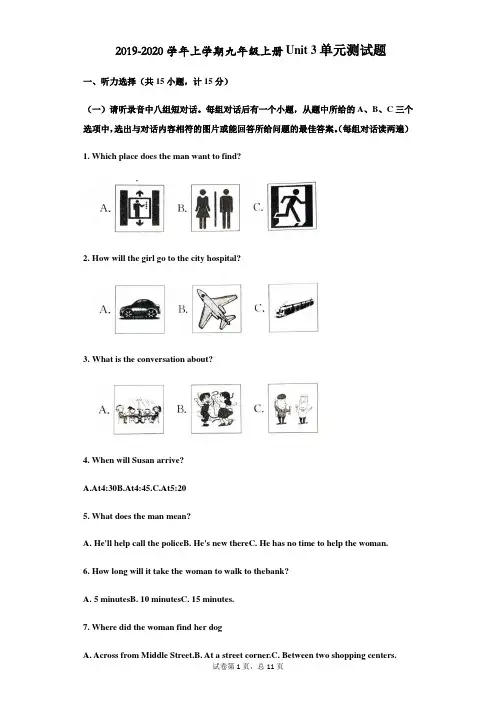
2019-2020学年上学期九年级上册Unit 3单元测试题一、听力选择(共15小题,计15分)(一)请听录音中八组短对话。
每组对话后有一个小题,从题中所给的A、B、C三个选项中,选出与对话内容相符的图片或能回答所给问题的最佳答案。
(每组对话读两遍)1. Which place does the man want to find?2.How will the girl go to the city hospital?3.What is the conversation about?4. When will Susan arrive?A.At4:30B.At4:45.C.At5:205. What does the man mean?A. He'll help call the policeB. He's new thereC. He has no time to help the woman.6. How long will it take the woman to walk to thebank?A. 5 minutesB. 10 minutesC. 15 minutes.7. Where did the woman find her dogA. Across from Middle Street.B. At a street corner.C. Between two shopping centers.8. Where are they?A. In a hotel.B. In a clothes store.C. In a restaurant.(二)请听录音中两段较长的对话。
每段对话后有几个小题,从题中所给的A、B、C 三个选项中,选出能回答所给问题的最佳答案。
(每段对话读两遍)听下面一段对话,回答第9至第11三个小题9. What does the woman want to buy?A. Some notebooks,B. Some stamps.C. Some magazines.10. Which bus can the woman take?A. The No 117 bus.B. The No 207 bus.C. The No 317 bus.二、听力填词(共5小题,计5分)请听下面一段独白。
人教新目标初中九年级英语上册unit3__练习题以及答案
新目标九Unit3试题Class: Name: Marks:(满分100分)一. 单项选择(15分)选择可以填入空白处的最佳选项。
( )1. — Is AC Milan Italian football club?—Yes. It’s one of most successful clubs in Italy.A. an; /B. an; theC. /; theD. /; /( )2. —Look! What’s that the corner of the room?—I can’t see clearly. It’s a little dark there.A. behindB. belowC. inD. under( )3. There are floors in the building and my home is on the floor.A. twenty; fifteenthB. twenty; fifteenC. twentieth; fifteenD. twentieth; fifteenth( )4. — What fruit would you like?— Some , please. They are my favorite.A. dessertB. grapesC. juiceD. biscuits( )5. — The Internet has made communication much more .— I agree. For example, I can communicate with my friends on WeChat any time.A. popularB. necessaryC. importantD. convenient( )6. — Whom would you for the job?—Tom, I think. He’s always careful and se rious.A. suggestB. remindC. rememberD. explain( )7. —Was Eric’s father very strict with him?— Yes. He never praised him he became one of the top students in his grade.A. sinceB. whenC. untilD. because( )8. — Excuse me, could you tell me where I can buy some ?—Sure. There’s a post office at the first crossing.A. snacksB. stampsC. umbrellasD. bananas( )9. — Will you be a supermarket on your way home?— Yes, Walmart is just beside my home.A. looking forB. setting upC. fixing upD. passing by( )10. — Does my question sound enough?—I don’t think so. You can ask more by using “could” instead of “can”.A. politely; politelyB. politely; politeC. polite; politelyD. polite; polite( )11. —It’s not enough an English club. You should also read English newspapers and magazines often.— Thanks for your advice.A. joinB. to joinC. joiningD. to joining( )12. — You really went to the park last weekend?— Yes, I go there. Look! This is a photo of me in the park.A. willB. wouldC. doD. did( )13. — Are you going to Beijing for the summer holiday next week?— Yes. But I haven’t got the air tickets and don’t know we will set out.A. howB. whereC. whenD. what( )14. —I don’t know next.—Let’s ask our teacher for help.A. what to doB. what should I doC. how to doD. how I should do( )15. — The game is too hard for me. I will certainly lose.—You never say no before you try.A. Forget it!B. I’m sorry.C. Come on!D. Pardon me?二. 完形填空(15分)阅读下列短文,选择可以填入空白处的最佳选项。
2019-2020学年(人教新目标版)九年级上:unit3单元评价检测试卷(有答案)-(英语)(精校版)
单元评价检测(三)一、单项选择(共10小题;共10分)1. --- Could you tell me where I can get a dictionary?--- Sure. Go along the street, and there's a on your right.A. bankB. bookstoreC. museumD. restaurant2. --- I've shown you all the interesting and important places of our school.--- Thank you for so much time.A. takingB. spendingC. costingD. having3. We're going to the movies this evening. I wonder you can go with us.A. ifB. whenC. thatD. where4. --- Could you tell me ? I'm going to pick you up at the airport.--- At 15:45 this Friday.A. where you met meB. who you are coming withC. when you came hereD. what time you are arriving5. --- Jim, could I use your computer?--- Yes, of course you .A. couldB. canC. mustD. should6. --- me, can you tell me where I can post the letter?--- Sorry, I am new here.A. SuggestB. RequestC. PardonD. Tell7. It's impolite information directly when asking for help.A. askB. askingC. askedD. to ask8. Could you please tell me the cool T-shirt?A. where you buyB. where do you buyC. where did you buyD. where you bought9. --- I often use micro-blog to communicate with others.--- You are so smart! Can you please tell me ?A. how to doB. how to use itC. how to useD. when can I use it10. --- Could you please pass me the book?---A. Yes, I couldB. No, I couldn'tC. Sure. Here you areD. No, that's no problem二、完形填空(共10小题;共15分)Around the world, people have different ideas about what good manners are. When you go to restaurants in different parts of the world, it's 11 to know the right and wrong things to do. For example, in China it's OK to 12 a lot of noise in a restaurant. In fact, if a restaurant isn't noisy and 13 , you may think there's something wrong with it. However, in many western countries, restaurants are 14 places. If people at a table talk too loud, other people who are eating there might even 15 to the owner of the restaurant.Paying the bill is also different from country to country. In China, one person usually pays for 16 . In western countries, one person pays if he or she is entertaining clients (宴请宾客), but 17 friends eat together, they usually share the cost. This is called "going Dutch (均摊费用)". Also, when westerners pay the bill, they usually leave some money for the 18 . This is called "leaving a tip". Leaving a tip is thought to be polite. In the U.S., it's 19 to leave tips of 10%,15%, or 20% of the bill, which is decided by how good the service(服务) is. Good waiters can make a lot of money!The way people eat food is not the same in different parts of the world, but you can 20 the same kinds of food in many countries. Chinese and Indian foods, for example, are popular all over the world.11. A. popular B. difficult C. important D. enjoyable12. A. cause B. keep C. hear D. make13. A. lively B. friendly C. lucky D. polite14. A. noisy B. quiet C. busy D. clean15. A. shout B. explain C. complain D. speak16. A. everybody B. nobody C. somebody D. none17. A. until B. when C. unless D. since18. A. gatekeeper B. seller C. waiter D. visitor19. A. terrible B. common C. serious D. unusual20. A. invent B. discover C. prefer D. find三、阅读理解(共3小题;共6分)Your school has planned a visit to Lions Nature Education Centre. Here is what you should know about the centre. Please read it.Lions Nature Education CentreLions Nature Education Centre opened in 1991 on what was once a government farm in Sai Kung. Both the government and the Lions Club own it now.AimsThe aim of the centre is to show visitors everything to do with rural(乡下的) Hong Kong. We also hope to educate people about the environment. For this reason, it's really a popular place for school trips and outings.Facilities(设施)The centre has a large number of indoor and outdoor facilities and exhibitions(展品). The outdoor facilities include a garden, vegetable fields and a place where trees grow for study. Indoor exhibition halls provide different kinds of plants, fishes and other things from land to sea. The Farmers' Market is open at weekends.Rules for visitorsWear proper clothes, shoes and hats.Bring some water and food, but take your rubbish away with you.Do not break any natural appearance or plants, and do not make the water dirty.Care for other visitors and wildlife(野生动植物), and do keep quiet wherever you go.Opening hoursWe are open daily from 9:30 a.m. to 5:00 p.m. Exhibition halls are open from 9:30 a.m. to 4:30 p.m. The centre is closed every Tuesday.Address: Hiram's Highway, Sai Kung. Phone: 2792 2234Website: /lnec21. You can visit Lions Nature Education Centre .A. in the city centreB. at Hiram's HighwayC. on a government farmD. inside the exhibition halls22. In the centre, visitors can learn about .A. rural clothes and shoesB. different kinds of seafoodC. outdoor lions in natureD. the environment around us23. Before the visitors go to the centre, you should tell them .A. not to visit the Farmers' MarketB. not to make a noise or wear hatsC. to care for the wildlife and waterD. to look for rubbish and take it away四、翻译(根据中文提示完成句子)(共5小题;共5分)24. 请告诉我火车站在哪儿好吗?Could you please tell me ?25. 每个人都应该依靠自己去创造未来。
最新人教版新目标 初三英语九年级上册Unit3单元综合测试题及答案
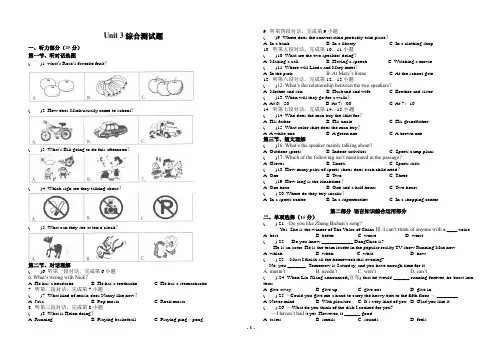
Unit 3综合测试题一、听力部分(25分)第一节、听对话选图( )1. what’s Rose’s favorite fruit?( )2. How does Mark usually come to school?( )3. What’s Bill going to do this afternoon?( )4. Which sign are they talking about?( )5. What can they see at ten o’clock?第二节、对话理解( )6 .听第一段对话,完成第6小题.6. What‘s wrong with Nick?A. He has a headacheB. He has a toothacheC. He has a stomachache7. 听第二段对话,完成第7小题.( )7. What kind of music does Nancy like now?A. JazzB. Pop musicC. Rock music8. 听第三段对话,完成第8小题.( )8. What is Helen doing?A. RunningB. Playing basketballC. Playing ping﹣pong 9. 听第四段对话,完成第9小题.( )9. Where does the conversation probably take place?A. In a bankB. In a libraryC. In a clothing shop10. 听第五段对话,完成第10、11小题.( )10. What are the two speakers doing?A. Making a callB. Having a speechC. Watching a movie( )11. Where will Linda and Mary meet?A. In the parkB. At Mary‘s homeC. At the school gate12. 听第六段对话,完成第12、13小题.( )12. What‘s the relationship between the two speakers?A. Mother and sonB. Husband and wifeC. Brother and sister( )13. When will they go for a walk?A. At 6:50B. At 7:00C. At 7:1014. 听第七段对话,完成第14、15小题.( )14. Who does the man buy the shirt for?A. His fatherB. His uncleC. His grandfather( )15. What color shirt does the man buy?A. A white oneB. A green oneC. A brown one第三节、短文理解( )16. What‘s the speaker mainly talking about?A. Outdoor sportsB. Indoor activitiesC. Sports camp plans( )17. Which of the following isn‘t mentioned in the passage?A. GlovesB. ShortsC. Sports suits( )18. How many pairs of sports shoes does each child need?A. OneB. TwoC. Three( )19. How long is the lunchtime?A. One hourB. One and a half hoursC. Two hours( ) 20. Where do they buy snacks?A. In a sports centerB. In a supermarketC. In a shopping center第二部分语言知识综合运用部分二、单项选择(15分)( ) 21. –Do you like Zhang Bichen‘s song?--Yes. She is the winner of The V oice of China Ⅲ. I can‘t think of anyone with a ____ voice.A. bestB. betterC. worseD. worst( ) 22. ---Do you know ____________ DengChao is?--He is an actor. He is the team leader in the popular reality TV show Running Man now.A. whichB. whenC. whatD. how( ) 23. --Must I finish all the homework this evening?--No, you _______. Tomorrow is Saturday, and you have enough time for it.A. mustn‘tB. needn‘tC. won‘tD. can‘t( ) 24. When Liu Xiang announced(宣布) that he would ______ running forever, he burst into tears.A. give awayB. give upC. give outD. give in( ) 25. – Could you give me a hand to carry the heavy box to the fifth floor. –- ________A. Never mind.B. With pleasure.C. It‘s very kind of youD. Glad you like it.( ) 26. —What do you think of the dish I cooked for you?—I haven‘t had i t yet. However, it ______ good.A. tastesB. smellsC. soundsD. feels( ) 27. It is necessary for everyone to _______ a good habit of reading.A. enjoyB. chooseC. developD. accept( ) 28. Practice more, _______ you‘ll learn English better.A. orB. soC. andD. but( ) 29.—Tony is never late for school, is he?—______. He always comes to school earlier than others.A. Yes, he is.B. No, he isn‘tC. Yes, of course.D. No, sometimes ( ) 30. ---I hear two high speed railways will be built in Xiangyang _______ a few years.---That sounds great. It‘ll be more convenient and faster for us to go out.A. afterB. onC. inD. at( ) 31. —I wonder ________.—Yes, of course.A. where we can buy the partsB. how often you hear form your sisterC. if I may have a word with youD. why he arrived late yesterday( ) 32. —Look at the sign. You can‘t park your car here, sir. —Sorry, I ________ it.A. don‘t seeB. didn‘t seeC. haven‘t seenD. hadn‘t seen( ) 33. —It will be my turn. I feel a little nervous.—______. You can make it!A. Congratulations!B. Take it easy.C. Look out!D. Have a good time.( ) 34. —Can I use your e-dictionary? —Sorry. I don‘t have ______.A. itB. thisC. thatD. one( )35. Do you know if _______ back tomorrow? If he ________ back, please call me.A. will he come, comesB. he comes, will comeC. will he come, will comeD. he will come, comes三、完形填空(10分)When I was a junior high school student in 1980, God gave me a gift, it was happiness.One weekend, I went to visit my grandparents in the countryside. On my way home a car ran over me and cut off my 36 because of its high speed.Several days later when I woke up at the hospital, I realized I had to spend the rest of my life 37 arms. How sad I felt at that time! Even I was full of fears. But slowly I knew I had to face the fact and got over it. I couldn‘t get my arms back even though I 38 every day.However, it‘s easier 39 than done. It took me nearly half a year to get out of the sadness 40. I got so much from my past story. From then on, I could treat my life with a 41 mind. But in our daily life, I often see my classmates get worried about little things: They get a bad grade on a test; their bus comes late; they don‘t have a mobile phone but others have, and so on. But I only 42 life. I was lucky to realize from an accident: It is a waste of our life to focus on what you have 43. We should always think of what we have. So why are so many people unhappy? Someone may say, ―My whole life would improve 44 I have a new car.‖ But when you get the car and what happens? For a whole week you are walking on air. Then you go right back to being unhappy.Happiness depends on what we ha ve! It‘s in our heart. It‘s a state of mind, even though you own the whole world, you may still feel 45.Happiness comes from mastering the art of appreciating(感激) and taking pleasure in what you really have.( )36. A. feet B. legs C. arms D. ears( )37. A. with B. without C. for D. on( )38. A. cried B. laughed C. sat D. stood( )39. A. dreamed B. acted C. called D. said( )40. A. strongly B. especially C. completely D. similarly( )41. A. crazy B. normal C. full D. special( )42. A. hate B. dislike C. enjoy D. save( )43. A. lost B. had C. found D. spent ( )44. A. because B. as C. if D. whether( )45. A. funny B. happy C. excited D. unhappy四、阅读理解(40分)A]Hour and 30 MinutesI‘ve never imagined the movie is so interesting. There are 64 kinds of animals in it. After I watched the movie, I learned more about animals. I would highly recommend this movie to those animal lovers.—— JohnI have seen many cartoons of this kind, but this one is surprisingly funny and I love the sweet voice in it. My brother and I just couldn‘t help laughing from the beginning to the end.—— David This movie is so well made. I went to see it with my 5-year-old son last Sunday afternoon. I love the beautiful music while my son loves the rabbit police officer Judy very much. It shows that small animals like her can also do serious work.—— Nancy ( ) 46. The poster shows that ______ is spoken in the movie.A. JapaneseB. FrenchC. EnglishD. Chinese( ) 47. From the poster, we can know that the movie lasts ______.A. 60 minutesB. 90 minutesC. 100 minutesD. 120 minutes( ) 48. John likes this movie because of ______.A.the different kinds of animalsB. the funny actorsC. the sweet voiceD. the beautiful music( ) 49. It cost Nancy and her son ______ to watch the movie.A.$75B. $90C. $100D. $120( ) 50. According to the poster, the movie most probably tells a ______ story.A. frighteningB. sadC. trueD. funnyBHave you ever dreamed about sending a letter to yourself or your friends in the future? While express mail(快递) is a fast way to send your letters, there is another type of mail appearing in China as a new business—future mail.―The letter should be sent next Mother‘s Day a nd not a day earlier!‖ Lin Xiaofan, a college student in Shanghai, tells one of the companies offering the service.Lin Xiaofan wrote the letter to her mother nearly a year earlier to express her love to her mother for next Mother‘s Day.―Offering this ser vice makes people slow down and lets them understand the meaning of ‗time‘ in another way,‖ said Zheng Zhimin, manager at a ―future mail‖ company. Zheng thinks ―future mail‖ letters help remind us of care, friendship and love.While ―future mail‖ is becomi ng more and more popular, some people are wondering what will happen if the postal address changes or if the company goes broken before the letters arrive.Zheng said customers are glad to sign a contract(签订合同) to make sure that they can be compensated if their letters are lost or damaged.Most of the customers are college students and young white-collar(白领) workers. Psychologists (心理学家) said that young Chinese might have a new way to express their feelings through this service. Most people put their hopes and wishes in the letter so that they can experience the connection(联系) between the past and the present when they receive the letter. ( ) 51. ―Future mail‖ is a/an ______ way to send your letter. A. fast B. old C. new D. cheap ( ) 52. The underlined word ―compensate ‖ means ______ in Chinese. A. 赔偿 B.完成 C. 送达 D.抛弃 ( ) 53. The ―future mail‖ service is popular among ______.A. junior studentsB. college studentsC. young childrenD. blue-collar workers ( ) 54. The ―future mail‖ service can help us ______.A. sign a contractB. express our love and careC. forget friendshipD. understand the meaning of ―time‖ in a wrong way ( ) 55. You‘d better use ―future mail‖ if you want to ______.A. save money from sending express mailB. send a birthday gift to your friend quicklyC. talk with your friends about your life freelyD. send a your best wishes to yourself on January 1, 2020CHave you ever asked your relatives or friends if there is Wi-Fi in their houses? Have you ever searched for Wi-Fi when you are at restaurants or hotels? The answers will probably be "Yes". Most of us want Wi-Fi everywhere as if we can't live without it. But we can only use free Wi-Fi in some public places. We still have to spend some money accessing(连接)the Internet at most time. Here comes a piece of good news.A rich, powerful organization in the USA called the Media Development Investment Fund (MDIF) has decided to change the age ofonline computing (计算) completely by giving free Wi-Fi to every person on Earth. They will send up hundreds of satellites into low Earth orbit(轨道)in 2015.This is because they have made a survey and found that only 60% of the world's population has been able to get information on the Internet. And this is also because many countries are unable to offer people the necessary infrastructure(基础设施)to access the web.We can expect to use free Wi-Fi everywhere in the near future.任务型阅读。
新目标九年级上册英语Unit3单元素养检测卷及答案
新目标九年级上册英语Unit3单元素养检测卷及答案一、根据汉语意思完成句子,每空一词。
(共10分)1. 有时我们需要花时间导入请求。
Sometimes we need to spend time ________ ________ ________ a ________.2. 乘地铁虽然很方便,但是常常很拥挤。
Taking the subway is ________,but it's often very ________.3. 学会在不同的场合运用适当的语言很重要。
It's important to learn how to use suitable language ________ ________ ________. 4. 在计算机博物馆里,供孩子们玩乐的东西很多。
There are a lot of ________ things for children ________ ________ ________ in the computer museum.5. 请你告诉我怎样礼貌地请求帮助好吗?Could you please tell me how to ________ ________ ________ ________?二、用所给词的正确形式填空(5分)1. The old man was angry with him because he was very ________(polite).2. Her parents request her ________(make) the bed after getting up every morning.3. With ________(who) are they playing soccer?4. The ________(speak) today is from No. 1 Middle School.5. It is not enough ________(finish) the work on time.We must do it well.三、用方框中所给单词的适当形式填空。
人教版九年级英语上册Unit3 单元检测卷(附答案)
Unit3单元检测卷听力部分一.听力(本题有15小题,第一节每小题1分,第二、三节每小题2分,共计25分)第一节听对话,选图片1.________2.________3.________4.________5._________第二节,听对话,选答案( )6.When will the film begin?A.At 7:05pmB.At 7:25pmC.At 7:45pm( )7.Where did the woman find her dog?A.Across from Middle SchoolB.At a street cornerC.Between two shopping centers ( )8.Why does the woman want to open the window?A.It is too hotB.It’s too noisy insideC.She can’t stand the air in the room.( )9.How long will it take the woman to walk to the bank?A.5 minutesB.10 minutesC.15 minutes( )10.What can we infer from the dialogue?A.The weather at that moment was pleasant.B.The man won’t go on a picnic in bad weather.C.Both of the speakers like going out for a picnic.第三节听长对话,回答问题。
Dialogue One( )11.When did the boy get up that morning? A.At ten to eight B.About eight C.At ten ( )12.Which of the following couldn’t work that morning?A. The school busB.The taxiC.The clockDialogue Two( )13.What does the man think of his card?A.SweetB.SpecialC.Colorful( )14.Who will the woman send the birthday card to?A.Her friendB.Her motherC.Her teacher( )15.Why do the speaker go to the mall?A.To go shoppingB.To make a surveyC.To have a drink笔试部分二.完型填空(15分)Some students cheat ( 作弊) because they're busy or lazy and they want to get good grades without __16___ the time studying. Other students might feel that they can't __17__ the test without cheating. Even when there seems to be a "good reason" for cheating, it isn't a good _18_.A student who thinks cheating is the only way to pass a test __19__ to talk with the teacher and his or her parents , so they can find some better ways together. Talking about these problems and _20__ them out will help feel better than cheating.If a student is _21__ while cheating, the teacher may give a "_22__" on the test, send him or her to the head teacher's _23__, and call his or her parents. Worse than the __24__ grade may be the feeling of having disappointed those people, ___25_ parents and teachers. A parent may worry that you are not an ___26__ person and a teacher might watch you more __27_ the next time you're taking a test.There are plenty of reasons why a kid shouldn't cheat, but some students have already cheated. If that's you, it's __28_ too late to stop cheating. Cheating can become a __29__, but a student is always able to act better and make better _30____. It might help to talk the problem over with a parent, teacher or friend.( )16. A. taking B. spending C. costing D. using( )17. A. write B. exercise C. pass D. expect( )18. A. idea B. plan C. custom D. story( )19.A.decides B. hopes C. refuses D. needs( )20. A. breaking B. dreaming C. missing D. working( )21. A. caught B. offered C. appeared D. suggested( )22. A. prize B. result C. zero D. treat( )23. A. office B. school C. seat D. conversation( )24. A. natural B. dangerous C. anxious D. bad( )25. A. and B. besides C. like D. among( )26. A. outside B. advantageous C. interesting D. honest( )27. A. closely B. bravely C. certainly D. hardly( )28. A. always B. never C. once D. neither( )29. A. menu B. medicine C. habit D. match( )30. A. education B. decisions C. challenges D. risks三.阅读理解(30分) (A)To realize the value of one year, ask a student who has failed a final exam.To realize the value of one month, ask a mother who has given birth to a premature(早产的) baby.To realize the value of one week, ask an editor of a weekly newspaper.To realize the value of one hour, ask the lovers who are waiting to meet.To realize the value of one minute, ask a person who has missed the train , bus or plane.To realize the value of one second, ask a person who has survived an accident.To realize the value of one millisecond(毫秒), ask the person who has won a silver medal in the Olympic. Time waits for no one. Treasure(珍惜) every moment you have.( )31.What is the passage most likely to be?A.A songB.An advertisementC. A reportD.A poem(诗歌)( )32.What does the underlined word “survived” mean in the passage?A.发生B.幸存C.丧生D.目击( )33.The passage tells us to ________.A.wait for timeB.make good use of timeC.realize the value of timeD.treasure every moment we have(B)Lots of young people like reading magazines in their free time for fun. Of so many different magazines, Reader’s Digest(读者文摘) is famous and popular.Reader’s Digest is a monthly magazine. Before the 1980s, it belonged to a privately held company, which was started in 1922 by Lila Bell Wallace and Dewitt Wallace. This magazine is small and easy to carry, it’s just half the size of most American magazines, which caused a phrase in 2005, ―America in your pocket‖. It is the best selling magazine in the USA. At present, its circulation(发行) in the USA has reached 10 million copies and the number of the readers there is 38 million. Outside the USA, another 40 million people throughout more than 70 countries also read this magazine in 21 languages.This magazine’s focus is not news but more of cultural views because the editors think peopl e now can get timely news from somewhere else such as TV and newspaper. They hope this magazine can give readers something that is about special personal experiences, or something the readers can share with their families. In different countries, this magazine provides a window to the world for the local readers. Some parts of the magazine are about the local customs(习俗)and interests of the loc al readers. The other parts give the local readers information from all over the world.This magazine actually used to be a public business until the Wallace died in the 1980s. Because they had no children, there was no one to take over the company. Sixteen years ago, this company went public and became a public company.( )34.How often does Reader’s Digest come out in the USA?A.once a yearB. once a monthC. once a weekD. once a day( )35.Which of the following is NOT the focus of Reader’s Digest?A.Timely newsB.Personal experiencesC.Cultural viewsD. Local customs( )36.Which of the following is TRUE?A.Reader’s Digest is the name of a newspaperB.Reader’s Digest is big and not easy to carryC.Reader’s Digest can open people’s eyesD.Reader’s Digest is still a family business today( C )It was a cold winter afternoon before Christmas. My parents and I sat on the bench in Washington, D.C.’s Union Station, waiting for the train. Inside the waiting hall were many people.A boy sat nearby. His worn jacket, pale face, dirty hands all seemed to tell me that he was homeless.“He must be cold and hungry. Maybe I should help him,” I said to myself. Just at that moment, a well-dressed young couple walked towards him.“Excuse me,” the man bent down. “My wife and I boughttwo meal boxes but one was enough for us. We hate to waste good food. Can you help us out and put this to use?” he handed the boy a meal box.The boy thanked them and opened the box with joy and care. Suddenly he stopped. In the direction to which he looked, I saw an old man in rags-in a worn sweater, worn trousers and open shoes, entering the hall.Putting the meal box aside, the boy stood and helped the old to his seat. He took off his jacket and covered it on the old man’s shou lders, saying, “A gentleman brought me this warm meal but I just finished eating. I hate to waste good food. Can you help me out?” He placed the still-warm meal box in the old man’s hands without waiting for an answer.“Sure, son, but if only you share that sandwich with me. It’s too much for a man at my age. ”We were all touched. Dad went away and soon returned with cups of hot chocolate and a big pizza. Mum and dad went up to those rags, “Excuse me…”I rushed into a KFC and took out my pocket money. It was so cold that afternoon but I felt much warmer than I had ever thought possible.( )37.Who gave the boy a meal box?A. The young woman.B. The old man.C. The young man.D. Mum and Dad.( )38.Why didn’t the boy have the meal?A. He was not hungry.B. He wanted to help the old man.C. He didn’t like the food.D. He saw a sandwich in the meal box.( )39.What did the writer most probably do at the end of the story?A. He bought some food for the homeless.B. He told his story to the people in the KFC.C. He gave his pocket money to the homeless.D. He asked the other passengers to help the homeless.( )40.What’s the best title for the passage?A. A poor boyB. A worn jacketC. A big pizzaD. A warm meal box( D )You are surfing the Internet now, aren’t you? Everybody knows the Internet we’re surfing is called World Wide Web—that is WWW. But do you know who invented the Internet ? Most people think it may be Bill Gates. No, it’s not the chairman of Microsoft Company. At the end of 1990, the Wide Web was born. For this event we have one man to thank, Tim Berners Lee, the father of the Web.Berners Lee was born on June 8,1955 in London, England. His parents, both computer designers, encouraged him to think and work creatively as he grew up. He was an excellent student and naturally took an interest in computers and science.After graduating from Oxford University, Tim went to work at a science research center in Switzerland. There he developed some of the different systems that would later become the Web. The first was HTML, the computer language used to make web pages. The second was an address system that let computers anywhere find each other and send and receive information. In 1990, while still at the science center in Switzerland , he put them together to make the first Internet browser . It could run on any computer and allowed people to create website to share their information with the rest of the world.Tim knew that the more people used the Web, the more useful it would be. He wasn’t interested in money but knowledge, so he gave out his invention for free to anyone who was interested. Many were interested and the growth of the Internet began.Today Tim works as a professor at the MIT in America , researching new and interesting ways to use the Web. He has received many awards from governments and organizations for his efforts. He is still notvery interested in money. That is why he is so admired by his students and workmates. It may also be one of the reasons that few people outside the world of technology know his name.( )41.Where does Berners Lee live today?A.EnglandB.SwitzerlandC.AmericaD.Canana( )42.What can we learn about Berners Lee from the passage?A.He was encouraged to be creativeB.He didn’t do well at schoolC.He is a very poor businessmanD.He is well-known all over the world( )43. What’s the meaning of the word “browser”?A.退出键B.浏览器C.显示器D.调制解调器( )44.Which of the following statements is true according to the passage?A.The address system was used to make web pages.B.The World Wide Web was created in Switzerland.C.The first web browser was very expensive to buy.D.Many people could use the Internet before 1990.( )45.What is the passage mainly about?A.The events took place in 1990B. The history of the InternetC.The invention of the Internet browserD.The man who created the WWW四.单词运用(15分)47.Could you please tell me what her _________is? I want to see her.48.He usually studies about ten ________in the school, so he is very busy.49.On National Day I went to Mount Tai ,and I found the beauty there was so ________.50.As teenagers, we should speak to the old _________.B.根据中文提示完成所缺单词(10%)It might seem more difficult to speak politely than __51__(直接地).However, it is important to learn how to use the right __52__(语言) in different situations. This will help you __53__(交流)better with other people.Good ___54___(说话者) will change the way they speak in different situations. What they say might depend on ___55___(谁)they are speaking to or how well they know each other. For example, it’s all right to ask direct questions to your classmates. But it’s __56____(不礼貌) to say to your teachers like that. Sometimes we even need to spend time leading in to a ___57_____ (请求)when we first say to a stranger, such as “Excuse me, I __58___(想知道) if you can help me?”or “I’m sorry to __59_____(打扰) you, but….”before asking for help.We all know it’s not enough to just ask a question ___60____(正确的), we also need to learn how to be polite when we ask for help.51_______ 52._______ 53._________ 54._________ 55.________56._______ 57._________ 58._________ 59.__________ 60.-________五.语法填空(10分)It was the last day of school and I__61__( plan) to travel to my friend's hometown. I hadn't seen him for years and this was a good ___62____(decide) to meet him again.I was busy at school so it was rather late when I came back home. It was already 10 o'clock ____63____night. Time was running out. After a hurried meal I left. ___64___ (lucky)I found a taxi verysoon. Asking the driver to drive me fast to the station, I relaxed for a while, imagining what my friend looked like now. I was soon at the station and was sure that I would be able __65___(catch) the train. Unfortunately, I fell on the way and lost some time. To my complete ___66____(surprised) , when I reached the platform, I saw that the train had just left! It was the last train ,so I had to return home.My mother was glad to see me back as she had a feeling about my trip. But I was unhappy. I tried to relax and went to bed ___67___ I had a bad sleep. The next morning I was very tired. A s I was having breakfast, the newspaper arrived. I read over the __68____(page) and was shocked to find that the train I missed had __69____accident. How __70___(thank)I was that I missed the train!61_______ 62._______ 63._________ 64._________ 65.________66._______ 67._________ 68._________ 69.__________ 70.-________六.任务型阅读(5分)(共5小题,每小题1分,共5分)( )72:All Jeff’s hard work is paying off. He’s ____________on the rest of his competitors.( )73: After being in the used car business for 40 years, Simon finally ________.( )74:Sarah was _______ after losing her job and her apartment.请选择以上其中一个你喜爱的俚语造一个句子。
人教新目标初中九年级英语上册unit3__练习题以及答案
新目标九Unit3试题Class: Name: Marks:(满分100分)一. 单项选择(15分)选择可以填入空白处的最佳选项。
( )1. — Is AC Milan Italian football club?—Yes. It’s one of most successful clubs in Italy.A. an; /B. an; theC. /; theD. /; /( )2. —Look! What’s that the corner of the room?—I can’t see clearly. It’s a little dark there.A. behindB. belowC. inD. under( )3. There are floors in the building and my home is on the floor.A. twenty; fifteenthB. twenty; fifteenC. twentieth; fifteenD. twentieth; fifteenth( )4. — What fruit would you like?— Some , please. They are my favorite.A. dessertB. grapesC. juiceD. biscuits( )5. — The Internet has made communication much more .— I agree. For example, I can communicate with my friends on WeChat any time.A. popularB. necessaryC. importantD. convenient( )6. — Whom would you for the job?—Tom, I think. He’s always careful and se rious.A. suggestB. remindC. rememberD. explain( )7. —Was Eric’s father very strict with him?— Yes. He never praised him he became one of the top students in his grade.A. sinceB. whenC. untilD. because( )8. — Excuse me, could you tell me where I can buy some ?—Sure. There’s a post office at the first crossing.A. snacksB. stampsC. umbrellasD. bananas( )9. — Will you be a supermarket on your way home?— Yes, Walmart is just beside my home.A. looking forB. setting upC. fixing upD. passing by( )10. — Does my question sound enough?—I don’t think so. You can ask more by using “could” instead of “can”.A. politely; politelyB. politely; politeC. polite; politelyD. polite; polite( )11. —It’s not enough an English club. You should also read English newspapers and magazines often.— Thanks for your advice.A. joinB. to joinC. joiningD. to joining( )12. — You really went to the park last weekend?— Yes, I go there. Look! This is a photo of me in the park.A. willB. wouldC. doD. did( )13. — Are you going to Beijing for the summer holiday next week?— Yes. But I haven’t got the air tickets and don’t know we will set out.A. howB. whereC. whenD. what( )14. —I don’t know next.—Let’s ask our teacher for help.A. what to doB. what should I doC. how to doD. how I should do( )15. — The game is too hard for me. I will certainly lose.—You never say no before you try.A. Forget it!B. I’m sorry.C. Come on!D. Pardon me?二. 完形填空(15分)阅读下列短文,选择可以填入空白处的最佳选项。
人教新目标版九年级英语上册 Unit 3 达标测试卷(含详细解答)
人教新目标版九年级英语上册Unit 3 达标测试卷(限时: 60分钟满分: 100分)班级:姓名:得分:一、单项选择(每小题1 分,共10 分)1. What did you see ________ the zoo?A. on your way toB. in your way toC. on your way atD. in your way at2. I’m already twenty years old. I can’t________ my parents any longer.A. depend onB. pay attention toC. look afterD. look up3. Paul ________ going to the zoo, but I’d like to go to the park.A. suggestsB. decidesC. keepsD. wants4. —I hear we’ll have a n ew English teacher this term.—Really? Do you know ________?A. what subject he teachesB. where he comes fromC. if he is a math teacherD. why he teaches so well5. If you behave ________, others will think you are ________.A. polite; politeB. polite; politelyC. politely; politeD. politely; politely6. — What did our English teacher say to you just now?—He asked me ________.A. why I am sadB. if have I done my homeworkC. when did I do my homeworkD. how I planned to go on vacation7. — Where is the bookstore?—It’s ________ the second floor. And it’s ________ the school and the bank.A. at; next toB. to; in front ofC. on; betweenD. in; across from8. — Could you tell me where the post office is?—________ I didn’t hear clearly.A. Pardon?B. How are you?C. How do you do?D. Yes, please.9. —I don’t know ________ next.—You’d better finish your homework first.A. what to doB. how to doC. when to doD. where to do10. I spent a lot of time ________ English last weekend.A. to practice speakingB. practicing to speakC. practicing speakingD. to practice to speak二、完形填空(每小题1. 5 分,共15 分)John was a manager in a factory. He enjoyed running for exercise around the park when he was free.One Sunday afternoon, after running as usual, John ________11 to go home and have a rest. Just then, he noticed an old woman standing by the road. ________12 old woman looked around worriedly. John went over and asked what ________13 for her. After a short talk, John came to know that she forgot her way home and got lost. Besides, she was very tired and hungry. John called the old woman’s son and then took her to the ________14 restaurant.In the restaurant, John ordered food and drink for the old woman ________15. While eating, sometimes she carelessly sprinkled (撒)food and drink on the table and on her coat. Other customers felt disgusted(厌恶的)at this sight. ________16John didn’t care about this. He stood up and cleaned the table from time to time ________17 silence.It took the old woman some time ________18 eating. After that, John paid the billand they were ready to leave when the old woman’s son arrived. He held John’s hands and said“, Thanks to your help. My mother was treated ________19!”“You’re welcome. She makes me remember my mom who died years ago. I did what a son should do,” said John. All the ________20 around showed respect(尊敬) to John. They were touched by his kindness.11. A. decided B. has decided C. decides D. will decide12. A. A B. An C. The D. /13. A. can he do B. he can do C. could he do D. he could do14. A. nearest B. nearer C. farthest D. farther15. A. polite B. politely C. angry D. angrily16. A. And B. But C. Or D. So17. A. on B. for C. in D. with18. A. to finish B. finish C. finishes D. finished19. A. good B. better C. well D. best20. A. woman B. women C. customer D. customers三、<荣德原创> 阅读理解(每小题3 分,共15 分)I ran into a stranger as he walked by me.“Oh, excuse me please” was my reply.He said, “Please excuse me too. I wasn’t even watching out for you.”Later that, when I was cooking, my daughter was standing too close to me. When I turned to reach for some milk, I nearly knocked her over.“Move out of the way!” I said in a loud voice.She walked away. Her little heart was broken. I didn’t realize how rude I was.While I was in bed that evening, my husband said to me, “While dealing with a stranger, you were polite, but with a daughter you love, you were unkind. Your daughter brought you some flowers that she picked herself this afternoon. You’ll fi nd them in the kitchen by the door. Have you seen the tears in her eyes? ”I quietly went and knelt down by my daughter’s bed.“Honey, I’m so sorry,” I said. “Are these the flowers you picked for me? ”She said“, I found them by the tree. I picked them bec ause they’re pretty like you.I knew you’d like them, especially the blue ones.”I tearfully replied, “Sweetie, I’m really sorry for the way I acted today.”“It’s okay. I love you anyway,” she said as she kissed me on my cheek.If we can be polite to strangers, why can’t we do the same for the ones we love?21. What happened when the writer and the stranger knocked into each other?A. They fought.B. They said sorry to each other.C. They did nothing.D. They picked up their own things.22. What does the underlined word “rude” mean?A. Smart.B. Careful.C. Angry.D. Impolite.23. What does the underlined word “them” refer to?A. The strangers.B. Blue flowers.C. Foods.D. The father and the daughter.24. In the passage, the husband thought ________.A. the writer shouldn’t shout at the daughterB. the writer shouldn’t say sorry to the strangerC. the writer should act rudely towards their daughterD. both he and the writer should apologize to their daughter25. What’s the main idea of the passage?A. We should always apologize first.B. We should be polite to people around us.C. Shouting is not polite behavior.D. We should watch out for strangers.四、词汇运用(每小题1 分,共10 分)A)根据句意及汉语或首字母提示写单词。
人教版新目标九年级英语上册Unit13单元检测题(含听力+答案)
九年级英语单元检测题(十三)Grade ________ Class ________ Name________ Marks________ 一、听力理解(每小题1分,满分30分)A.听句子,根据所听句子的内容和所提的问题,选择符合题意的图画回答问题。
每小题听一遍。
( ) 1. What can we see in the picture?( ) 2. What was found in the sea?( ) 3. What did the boy advise to take?( ) 4. What should T om do?( ) 5. What's on the table?B.听对话或独白,根据每段对话或独白的内容后面的问题,在各题所给的三个选项中选出一个最佳答案。
每段对话听两遍。
听第一段对话,回答第6小题。
( )6. What animals are endangered?A. Manatees.B. Tigers.C. Pandas.听第二段对话,回答第7小题。
( )7. What do you know about the bag?A. It was made of old jeans.B. Her mother bought it for her.C. The woman bought the bag in the shop.听第三段对话,回答第8小题。
( )8. What must be done with the trees?A. The trees must be taken good care of.B. The trees must be watered well.C. The trees must be planted.听第四段对话,回答第9小题。
( )9. What does the woman like best?A. Monkeys.B. Rabbits.C. Dogs.听第五段对话,回答第10小题。