
英语修辞手法大全
英语中的比喻修辞手法

英语中的比喻修辞手法
英语中的比喻修辞手法主要包括明喻、隐喻和借喻三种。
1. 明喻(Simile):是将两种具有共同特征的不同事物或现象进行对比,表明本体和喻体之间的相似关系,常用的比喻词有like、as 等。
例如:
- She runs like a cheetah. 她跑得像一只猎豹。
- His heart is as cold as ice. 他的心像冰一样冷。
2. 隐喻(Metaphor):是一种比较含蓄的比喻,它不使用比喻词,而是直接将本体说成喻体。
例如:
- Life is a journey. 生活是一次旅行。
- The world is a stage. 世界是一个舞台。
3. 借喻(Metonymy):是一种以小见大的比喻,它不直接把所要说的事物名称说出来,而是用跟它有关系的另一种事物的名称来称呼它。
例如:
- The pen is mightier than the sword. 笔杆子比刀剑更有力。
- He is the Newton of our time. 他是我们这个时代的牛顿。
这些比喻修辞手法可以使语言更加生动形象,增强表达力和感染力。
英语中的修辞手法及英英释义
英语中的修辞手法及英英释义英语中的修辞手法有很多种,以下是其中几种常见的修辞手法及其英英释义:1.Metaphor(隐喻):a figure of speech in which a word or phrase is used torepresent something that it does not literally denote in order to suggest a similarity or parallelism between the two.2.Simile(明喻):a figure of speech in which a word or phrase is used torepresent something by comparing it to another thing, using words such as "like" or "as" to make the comparison.3.Synecdoche(提喻):a figure of speech in which a part is used to representthe whole or vice versa, such as using the term "head" to refer to a person's entire body.4.Personification(拟人):a figure of speech in which non-human objects orconcepts are given human characteristics or abilities, such as using words like "the night sings" to describe the darkness.5.Hyperbole(夸张):a figure of speech in which an object or event isexaggerated or exaggerated for effect, such as using words like "I wasstarving for days" to describe a short period of hunger.6.Irony(反讽):a figure of speech in which the intended meaning of astatement is the opposite of its literal meaning, such as using words like"nice weather we're having" when it's raining.7.Oxymoron(矛盾修饰法):a figure of speech in which two opposite orcontradictory words or phrases are used together to create a paradoxicaleffect, such as using words like "bittersweet" to describe a mixed feeling of happiness and sadness.这些修辞手法都可以增强语言的表达力,帮助传达更深刻的意义。
英语修辞手法的例子
英语修辞手法的例子英语修辞手法是作者在表达中使用的技巧和策略,旨在增加作品的说服力、创造力和艺术性。
以下是一些常见的英语修辞手法的例子:1. 比喻(Metaphor):将两种不同的事物进行比较,以传达出更深层次的含义。
例如:“他是我生命中的一束阳光。
”比喻中的“一束阳光”代表了这个人的对生活的积极和充满活力。
2. 拟人(Personification):将无生命的东西描述成有人的特征和行为。
例如:“风在低声呢喃,树叶在低语。
”拟人化的描写使得自然界的元素更具有生气和情感。
3. 反问(Rhetorical Question):提出一个问题,但不需要实际回答。
通过反问,作者可以引起读者的思考和注意。
例如:“难道我们不应该为环境保护贡献一份力量吗?”反问转而强调了环保的重要性。
4. 排比(Parallelism):在句子或段落中使用相似结构的词语或短语,以增强表达的力量和节奏感。
例如:“今天我们来到这个地方,不是为了安逸,而是为了勇敢;不是为了逃避,而是为了面对;不是为了放弃,而是为了坚持。
”排比通过重复的结构和反复的用词,增强了表达的力度。
5. 比较(Simile):使用“像”或“如同”等词语进行比较。
例如:“她美若天使,皮肤如同雪一般洁白。
”比较使得形容女性的美丽更为生动形象。
6. 倍数修饰(Hyperbole):通过夸张的表达来增强语气。
例如:“这个礼物是我有生以来收到的最棒的礼物!”通过夸大表达,强调了礼物的重要性和特别之处。
7. 对比(Contrast):通过对两个事物或概念进行对比,突显它们之间的差异和重要性。
例如:“黑暗中的孤独和明亮中的欢乐形成了鲜明的对比。
”对比使得表达更加鲜明,更能引起读者的共鸣。
8. 双关(Pun):使用同音异义词创造幽默效果。
例如:“时间如流沙,一去不复返。
”这里的“流沙”既有实际的流沙之意,也指的是时间的流逝,形成了幽默效果。
9. 借代(Metonymy):用代表整体的部分代替整体来表达意思。
英语中所有26种修辞手法的全部解释和例句
英语修辞手法总结Figures of speech (修辞)are ways of making our language figurative. When we use words in other than their ordinary or literal sense to lend force to an idea, to heighten effect, orto create suggestive imagery, we are said to be speaking or writing figuratively. Now we are going to talk about some common forms of figures of speech.1) Simile:(明喻)It is a figure of speech which makes a comparison between two unlike elements having at least one quality or characteristic (特性)in common. To make the comparison, words like as, as...as, as if and like are used to transfer the quality we associate with one to the other. For example, As cold waters to a thirsty soul, so is good news from a far country.2) Metaphor:(暗喻)It is like a simile, also makes a comparison between two unlike elements, but unlike a simile, this comparison is implied rather than stated. For example, the worldis a stage.3) Analogy: (类比)It is also a form of comparison, but unlike simile or metaphor which usually uses comparison on one point of resemblance, analogy draws a parallel between two unlike things that have several common qualities or points of resemblance.4) Personification: (拟人)It gives human form of feelings to animals, or life and personal attributes(赋予) to inanimate(无生命的) objects, or to ideas and abstractions(抽象). For example, the wind whistled through the trees.5) Hyperbole: (夸张) It is the deliberate use of overstatement or exaggeration to achieve emphasis. For instance, he almost died laughing.6) Understatement: (含蓄陈述) It is the opposite of hyperbole, or overstatement. Itachieves its effect of emphasizing a fact by deliberately(故意地) understating it,impressing the listener or the reader more by what is merely implied or left unsaid than by bare statement. For instance, It is no laughing matter.7) Euphemism: (委婉) It is the substitution of an agreeable or inoffensive(无冒犯) expression for one that may offend or suggest something unpleasant. For instance, we refer to "die" as " pass away".8) Metonymy (转喻)It is a figure of speech that has to do with the substitution of the mane of one thing for that of another. For instance, the pen (words) is mightier than the sword (forces).9) Synecdoche (提喻) It is involves the substitution of the part for the whole, or thewhole for the part. For instance, they say there's bread and work for all. She was dressedin silks.10) Antonomasia (换喻)It has also to do with substitution. It is not often mentioned now, though it is still in frequent use. For example, Solomon for a wise man. Daniel for a wise and fair judge. Judas for a traitor.11) Pun: (双关语) It is a play on words, or rather a play on the form and meaning of words. For instance, a cannon-ball took off his legs, so he laid down his arms. (Here "arms" has two meanings: a person's body; weapons carried by a soldier.)12) Syllepsis: (一语双叙) It has two connotations.In the first case, it is a figure by which a word, or a particular form or inflection of a word, refers to two or more words in the same sentence, while properly applying to or agreeing with only on of them in grammar or syntax(句法). For example, He addressed you and me, and desired us to follow him. (Here us is used to refer to you and me.)In the second case, it a word may refer to two or more words in the same sentence. For example, while he was fighting , and losing limb and mind, and dying, others stayed behind to pursue education and career. (Here to losing one's limbs in literal; to lose one's mindis figurative, and means to go mad.)13) Zeugma: (轭式搭配) It is a single word which is made to modify or to govern two or more words in the same sentence, wither properly applying in sense to only one of them, orapplying to them in different senses. For example, The sun shall not burn you by day, nor the moon by night. (Here noon is not strong enough to burn)14) Irony: (反语) It is a figure of speech that achieves emphasis by saying the opposite of what is meant, the intended meaning of the words being the opposite of their usual sense. For instance, we are lucky, what you said makes me feel real good.15) Innuendo: (暗讽) It is a mild form of irony, hinting in a rather roundabout (曲折)way at something disparaging(不一致) or uncomplimentary(不赞美) to the person or subject mentioned. For example, the weatherman said it would be worm. He must take his readings in a bathroom.16) Sarcasm: (讽刺) It Sarcasm is a strong form of irony. It attacks in a taunting and bitter manner, and its aim is to disparage, ridicule and wound the feelings of the subject attacked. For example, laws are like cobwebs, which may catch small flies, but let wasps break through.17) Paradox: (似非而是的隽语) It is a figure of speech consisting of a statement or proposition which on the face of it seems self-contradictory, absurd or contrary to established fact or practice, but which on further thinking and study may prove to be true, well-founded, and even to contain a succinct point. For example more haste, less speed.18) Oxymoron: (矛盾修饰) It is a compressed paradox, formed by the conjoining(结合) of two contrasting, contradictory or incongruous(不协调) terms as in bitter-sweet memories, orderly chaos(混乱) and proud humility(侮辱).19) Antithesis: (对照) It is the deliberate arrangement of contrasting words or ideas in balanced structural forms to achieve emphasis. For example, speech is silver; silence is golden.20) Epigram: (警句) It states a simple truth pithily(有利地) and pungently(强烈地). It is usually terse and arouses interest and surprise by its deep insight into certain aspects of human behavior or feeling. For instance, Few, save the poor, feel for the poor.21) Climax: (渐进) It is derived from the Greek word for "ladder" and implies the progression of thought at a uniform or almost uniform rate of significance or intensity,like the steps of a ladder ascending evenly. For example, I came, I saw, I conquered.22) Anti-climax or bathos: (突降)It is the opposite of Climax. It involves stating one's thoughts in a descending order of significance or intensity, from strong to weak, from weighty to light or frivolous. For instance, But thousands die, without or this or that, die, and endow(赋予) a college, or a cat.23) Apostrophe: (顿呼) In this figure of speech, a thing, place, idea or person (dead or absent) is addressed as if present, listening and understanding what is being said. For instance, England! awake! awake! awake!24) Transferred Epithet: (转类形容词) It is a figure of speech where an epithet (anadjective or descriptive phrase) is transferred from the noun it should rightly modify(修饰) to another to which it does not really apply or belong. For instance, I spent sleeplessnights on my project.25) Alliteration: (头韵) It has to do with the sound rather than the sense of words for effect. It is a device that repeats the same sound at frequent intervals(间隔) and since the sound repeated is usually the initial consonant sound, it is also called "front rhyme". For instance, the fair breeze blew, the white foam flew, the furrow followed free.26) Onomatopoeia: (拟声) It is a device that uses words which imitate the sounds made by an object (animate or inanimate), or which are associated with or suggestive(提示的) of some action or movementExplanation version1一、什么是修辞格修辞格(figures of speech)是提高语言表达效果的语言艺术。
英语修辞手法总结
英语修辞手法总结
1. 嘿,simile(明喻)呀,就像“她的笑容像阳光一样灿烂”,这不是一下子就让你感受到她笑容的温暖了嘛!
2. 哇哦,metaphor(隐喻),比如“时间是小偷”,多形象地表达了时间悄悄偷走东西的感觉呀!
3. 嘿呀,personification(拟人),像“风在怒号”,把风当成会发怒的人,是不是很有趣呢?
4. hyperbole(夸张)可太有意思啦,“我能吃下一头牛”,这得是多大的食量呀,哈哈!
5. understatement(低调陈述),“这不算太坏”,其实可能已经挺糟糕了,但这么说就感觉还好啦。
6. irony(反讽),“你可真聪明啊”,但其实是说反话,在讽刺呢,这种感觉很奇妙吧!
7. euphemism(委婉语),“他去见上帝了”,多委婉地说一个人去世了呀。
8. metonymy(转喻),“白宫决定了”,其实是说美国政府呢,很巧妙吧!
9. synecdoche(提喻),“帆来了”其实说的是船来了,这种指代很特别呢!
10. alliteration(头韵),“Sally sells seashells by the seashore”,读起来朗朗上口,很有意思吧!
我觉得英语修辞手法真的是让语言变得丰富多彩,充满魅力呀!它们能让我们更生动、更形象地表达自己的想法和感受呢!。
英语中所有19种修辞手法的全部解释和例句
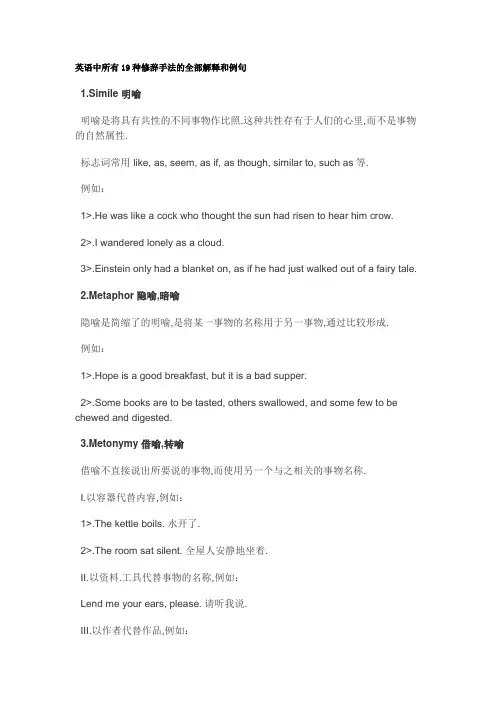
英语中所有19种修辞手法的全部解释和例句1.Simile 明喻明喻是将具有共性的不同事物作比照.这种共性存有于人们的心里,而不是事物的自然属性.标志词常用 like, as, seem, as if, as though, similar to, such as等.例如:1>.He was like a cock who thought the sun had risen to hear him crow.2>.I wandered lonely as a cloud.3>.Einstein only had a blanket on, as if he had just walked out of a fairy tale.2.Metaphor 隐喻,暗喻隐喻是简缩了的明喻,是将某一事物的名称用于另一事物,通过比较形成.例如:1>.Hope is a good breakfast, but it is a bad supper.2>.Some books are to be tasted, others swallowed, and some few to be chewed and digested.3.Metonymy 借喻,转喻借喻不直接说出所要说的事物,而使用另一个与之相关的事物名称.I.以容器代替内容,例如:1>.The kettle boils. 水开了.2>.The room sat silent. 全屋人安静地坐着.II.以资料.工具代替事物的名称,例如:Lend me your ears, please. 请听我说.III.以作者代替作品,例如:a complete Shakespeare 莎士比亚全集VI.以具体事物代替抽象概念,例如:I had the muscle, and they made money out of it. 我有力气,他们就用我的力气赚钱.4.Synecdoche 提喻提喻用局部代替全体,或用全体代替局部,或特殊代替一般.例如:1>.There are about 100 hands working in his factory.(局部代整体)他的厂里约有100名工人.2>.He is the Newton of this century.(特殊代一般)他是本世纪的牛顿.3>.The fox goes very well with your cap.(整体代局部)这狐皮围脖与你的帽子很相配.5.Synaesthesia 通感,联觉,移觉这种修辞法是以视.听.触.嗅.味等感觉直接描写事物.通感就是把不同感官的感觉沟通起来,借联想引起感觉转移,“以感觉写感觉”。
英语修辞手法及例句
英语修辞手法及例句常见的英语修辞手法有Simile 明喻、Metaphor 隐喻,暗喻、Synecdoche 提喻、Personification拟人、Hyperbole 夸张、Euphemism 委婉,婉辞法等。
1、Simile 明喻It is a figure of speech which makes a comparison between two unlike elements having at least one quality or characteristic (特性)in common.(明喻是将具有共性的不同事物作对比,这种共性存在于人们的心里,而不是事物的自然属性)常见标志词有:like, as, seem, as if, as though, similar to, such as 等。
eg.This elephant is like a snake as anybody can see.(大家都看得出来,这头大象就像一条蛇)2、Metaphor 隐喻,暗喻It is like a simile, also makes a comparison between two unlike elements, but unlike a simile, this comparison is implied rather than stated.(隐喻是简缩了的明喻,是将某一事物的名称用于另一事物,通过比较形成)eg.Hope is a good breakfast, but it is a bad supper.(希望是顿美好的早餐,但却是一顿糟糕的晚餐。
)3 、Synecdoche 提喻It is involves the substitution of the part for the whole, or the whole for the part. (提喻用部分代替全体,或用全体代替部分,或特殊代替一般)eg.The fox goes very well with your cap. (这狐皮围脖与你的帽子很相配。
英语修辞手法的例子
英语修辞手法的例子
英语修辞手法有许多种,下面为你列举几种常见的例子:
1. 隐喻(Metaphor):隐喻是指将两个不同的事物进行比较,暗示它们在某个方面有相似之处。
例如,“Life is a journey”(生活是一场旅行)。
2. 拟人(Personification):拟人是指将非人的事物赋予人的特性或情感,使其更加生动形象。
例如,“The sun smiled on the happy day”(太阳在快乐的日子里微笑)。
3. 夸张(Hyperbole):夸张是指通过夸大或缩小事物的尺寸、数量、程度等来强调表达的效果。
例如,“She has a heart of gold”(她有一颗金子般的心)。
4. 排比(Parallelism):排比是指将几个结构相似、意义相近的句子或短
语并列使用,以增强语言的表现力。
例如,“I came, I saw, I conquered”(我来,我看见,我征服)。
5. 对偶(Antithesis):对偶是指将两个相反、相对的概念或事物进行对比,以突出表达的效果。
例如,“It is better to live rich than to die rich”(与其遗富于子,不如遗德于子)。
这些是英语中常见的修辞手法,它们可以帮助人们更生动、形象地表达自己的思想感情,增强语言的艺术感染力。
(完整版)英语中的修辞手法
英语中的修辞手法1.明喻(Simile)明喻是一种最简单、最常见的修辞方法,是以两种具有共同特征的事物或现象进行对比,表明本体和喻体的关系,两者都在对比中出现,其基本格式是“A像B”,常用的比喻词有as, like, as if, as though等。
例如:●He jumped back as if he had been stung, and the blood rushedsintoshis wrinkled face.●The cheque fluttered to the floor like a bird with a broken wing. (支票跌落到地上,像一只断了翅膀的小鸟。
)●Like climbing a mountain, we struggle up three feet and fall back two.(正如爬山,我们费力爬上三英尺,又掉下去两英尺。
)I see also the dull, drilled, docile, brutish masses of the Hun soldiery blodding on like a swarm of crawling locusts.(丘吉尔在此使用了一个恰当的比喻,把德国士兵比作蝗虫,因为二者有着共同之处-传播毁灭。
)2.暗喻(Metaphor)暗喻也是一种比喻,但不用比喻词,因此被称作缩减了的明喻(a compressed simile)。
它直接把一种事物名称用在另一事物上,从而更生动、更深刻地说明事理,增强语言的表现力。
例如:●What will parents do without the electronic baby-sitter? (如果没有这位电子保姆,父母该怎么办呢?)形象地说明了电视机的保姆功用。
●... while most of us are only too ready to apply to others the cold wind of criticism, we are somehow reluctant to give our fellows the warm sunshine of praise.(……但是我们中的很多人太容易给别人批评的冷风,而不愿意给自己的同伴赞扬的阳光。
常见的英语修辞
常见的英语修辞常见的英语修辞修辞手法是通过修饰、调整语句,运用特定的表达形式以提高语言表达作用的方式和方法。
修辞不仅仅在中文里很常见,在英文里也是多种多样。
这篇文章里,我们就来谈一谈英文中常见的修辞手法。
1.simile明喻明喻是常用as或like等词将两种不同事物通过比较而连接起来的一种修辞手法。
让我们看几个例子:好的咖啡如同友谊,丰厚,温暖,热烈。
人生就像一罐沙丁鱼,我们大家都在找开启的起子。
他这人就像一只骄傲的公鸡,以为太阳升起是为了它的啼叫。
2.metaphor暗喻暗喻是将两种有共同点的不同事物进行隐晦比较的修辞手法。
明喻与暗喻的不同点就在于是否有出现like或者as(像)这一类比喻词,下面这几个句子都是暗喻:幽默是生活的减震器,它可以鼓舞人们付诸于行动。
时间,你这个小偷。
可是我的心是孤独的猎手,在孤独的小山上狩猎。
3.personification拟人拟人是一种为无生命或抽象物体赋予人类特质与能力的修辞手法。
奥利奥:牛奶最喜爱的曲奇。
大风凛冽,发出怒吼。
这里唯一的怪物就是赌博怪物,它将你母亲沦为奴隶!我叫它赌棍,该把你母亲从他的霓虹灯魔爪下救出来的时候了!4.euphemism委婉语委婉语是使用较委婉含蓄的语言替换强烈冒犯的话语。
这种修辞可能听起来陌生,但在日常生活中的使用频率其实很高。
比如,老人去世的时候我们会采用“过世”、“走了”这一类的话语,这其实就是委婉语。
英文里也有类似的用法,了解委婉语背后真正的含义对阅读英语文章也是很有帮助的哦~下面我们就一起看几个例子:elder citizen老年人(不用old people)pass away逝世(不用die)You've got a prime figure.你的体态丰腴。
(不用fat)5.pun双关语双关语是指利用同词不同义或是同音不同词来制造文字游戏的一种修辞方式。
部分电视剧的幽默效果就是通过双关语来实现的。
生前劳碌奔命,死后化灰入土。