
人教版七年级下册UnitUnit7-unit12单元知识点复习
1 Unit7 It’s raining! 1. –今天北京的天气怎么样?-- How’s the weather in Beijing today? (无like用How) --是晴天。-- It’s sunny. (其他天气:windy, cloudy, sunny=fine=nice) 同义句:-- What’s the weather like today? (有like用What) -- It’s sunny. (其他天气:warm, hot, cool, cold, dry, humid) 练:We don’t know _______ the weather will be tomorrow. A. how B. what C. how’s D. what’s 2. --你最近过得怎么样?-- How’s it going with you? --相当好:Pretty good. 很棒:Great. 还不错:Not bad. 很糟糕:Terrible. 3. (1) 在夏天天是多雨的。It’s rainy in summer. (it后有be动词is, 后面用形容词rainy) (2) 在夏天天经常下雨。It often rains in summer. (it后无be动词is, 后面用动词rains) (3) 现在正在下雨:It’s raining now. (is和动词ing构成―现在进行时‖) 相同用法的词还有snowy, snows. 练:(1) What do you do when it ______? A. rain B. rainy C. raining D. is rainy (2) It’s __________ (rain) heavily in Harbin now. (3) The radio says it will be __________ (rain) tomorrow. (4) – How’s the weather on Sunday? -- ________. A. It’s rain B. It’s raining C. It’s rains D. It rainy 4. 谢谢你参加中央电视台―环游世界‖节目。 Thank you for joining CCTV’s Around The World show. 句型:感谢你做某事:Thank you for doing sth 5. 有许多人正躺在沙滩上:There are many people lying on the beach. ① 句型:有某人正在做某事:There be sb doing sth ② 躺在沙滩上:lie on the beach (lie加ing的规则:将ie变成y, 再加ing) 6. 一些正在拍照,另外的正躺在沙滩上。 Some are taking photos, others are lying on the beach. other, the other, others, the others, another 1)other可作形容词或代词。adj. “别的,其他的” Do you have any other questions? 你还有其他的问题吗? Ask some other people. 问问别人吧。 2) the other 代词,(两者中的)“另一个” (other为代词) one……the other……一个„„,另一个„„ He has two sons, one is a doctor, the other is a worker. 他有两个儿子,一个是医生,另一个是工人。 3) others代词,是other的复数形式,泛指“其余的(人或物)” (指其余的部分) some……others……一些„„,(另)一些„„ There are lots of students on the playground, some are playing basketball, others are dancing. 操场上有许多学生,有些人在打篮球,有些人在跳舞。 Give me some others, please. 给我一些别的东西吧。 4) the others代词,特指某一范围内的“其他的(人或物)”(指其余的全部) There are lots of students on the playground, some are playing basketball, the others are dancing. 操场上有许多学生,有些人在打篮球,其余的都在跳舞。 5) another = an+other,可作形容词或代词,泛指同类事物中的三者或三者以上的“另一个”,只能代替或修饰单数可数名词。 I don’t like this one. Please show me another. 我不喜欢这个,请给我看看另一个。
7. 他们看起来很酷:They look cool. 他看起来很酷:He looks cool. 2
8. 电话用语:(1) 你是谁? Who’s that? 不能用:Who are you? (2) 你是某某吗? Is that…? 不能用:Are you…? (3) 是某某在说话吗? Is that … speaking? 回答用:Yes, it is. / No, it isn’t. (4) 我是某某: This is…. 不能用:I’m …. (5) 是某某在说话:This is … speaking. 9. 句型:做完某事:finish doing sth 完成某事:finish sth 如:He finishes reading a book about science. He finishes his homework at home every day. 10. 句型:为了做某事:in order to do sth 跟在to后面的动词用原形。 11. 与look有关的词组: (1) 看着某人/某东西:look at sb/sth (2) 寻找某人/某东西:look for sb/sth (3) 照顾某人/某东西:look after sb/sth (4) 看起来像某人/某东西:look like sb/sth (5) 小心:look out (6) 朝…外面看:look out of… 如:朝窗外看:look out of the windows 12. 与―人‖有关的形容词+ed 如:relaxed, surprised, interested, excited 与―物‖有关的形容词+ing 如:relaxing, surprising, interesting, exciting 练:(1) The teacher is __________ (surprise) at the news. (2) I’m having a good time and __________ (relax). 13. 烧饭(总称):cook meals 烧早饭(中饭,晚饭):cook breakfast/lunch/dinner 14. 在度假:on vacation 度假:have a vacation 15. 拍照片:(单数) take a photo (复数) take photos 16. 打沙滩排球:play beach volleyball 17. 在这种热度下:in this heat 18. 围围巾:(单数) wear a scarf (复数) wear scarves 19. (天气)晴朗的:sunny = fine = nice 如:Today is sunny. = Today is fine. = Today is nice. 20. 学习:study 三单:studies (以辅音字母+y结尾的,去y加ies) 海滩:beach 复数:beaches (以s, x, ch, sh结尾的,加es)
Unit8 Is there a post office near here?
I词型转换 1、near反义词: far 2.across动词:cross 名词:crossing 3.front反义词:back 4. north形容词:northern 5.right反义词:left/wrong 6.enjoy第三人称单数:enjoys 7.easily形容词:easy 8.free反义词:busy II短语归纳 1、 post office邮局 2.police station警察局 3.pay phone付电话费 4.on Bridge Street在大桥街上 5.across from 在„„的对面 6.next to在„„的旁边 7.between the post office and the library 在邮局和图书馆之间 8.in front of在„„前面 9.on Center Street在中央大街上 10.near here在这附近 11.go along沿着„„走 12.turn right 向右转 turn left 向左转 on one’s left在某人的左边 on the right在右边 13.at the first crossing 在第一个十字路口 14.in my neighborhood在我的附近;邻近 III用法集萃 1、turn right/left at the +序数词+crossing. 在第几个十字路口向右/左转。 2、 spend+时间/金钱+(in)doing sth. 花费时间/金钱在„„
人教版七年级下册英语Unit12知识点
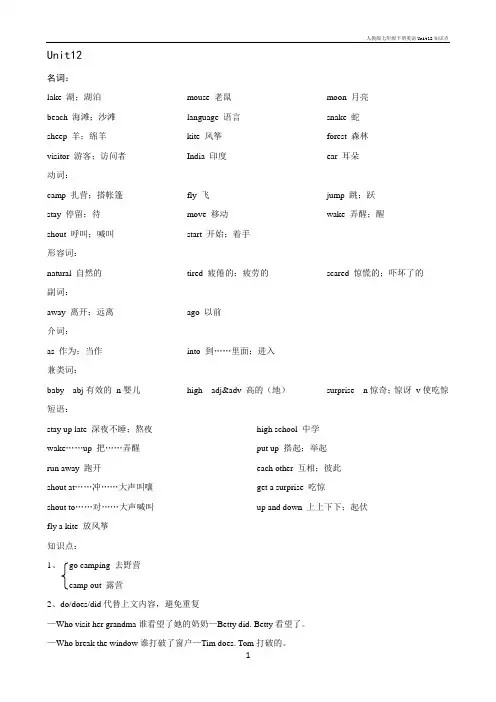
Unit12名词:lake 湖;湖泊beach 海滩;沙滩sheep 羊;绵羊visitor 游客;访问者mouse 老鼠language 语言kite 风筝India 印度moon 月亮snake 蛇forest 森林ear 耳朵动词:camp 扎营;搭帐篷stay 停留;待shout 呼叫;喊叫fly 飞move 移动start 开始;着手jump 跳;跃wake 弄醒;醒形容词:natural 自然的tired 疲倦的;疲劳的scared 惊慌的;吓坏了的副词:away 离开;远离ago 以前介词:as 作为;当作into 到……里面;进入兼类词:baby abj有效的n婴儿high adj&adv 高的(地)surprise n惊奇;惊讶v使吃惊短语:stay up late 深夜不睡;熬夜wake……up 把……弄醒run away 跑开shout at……冲……大声叫嚷shout to……对……大声喊叫fly a kite 放风筝high school 中学put up 搭起;举起each other 互相;彼此get a surprise 吃惊up and down 上上下下;起伏知识点:1、go camping 去野营camp out 露营2、do/does/did代替上文内容,避免重复—Who visit her grandma谁看望了她的奶奶—Betty did. Betty看望了。
—Who break the window谁打破了窗户—Tim does. Tom打破的。
do/does/did取决于问句中的时态3、as + 名词作为……As a player, you should have a strong body. 作为一名运动员,你应该有一个强壮的身体。
She worked as a teacher in this school. 她曾在学校里当过老师。
4、(1)how引导的感叹句How + 形容词或副词(+ 主语+ 谓语)!多么……啊!How happy they look!他们看起来多么高兴啊!How hard he is working!他工作地多么努力啊!(2)what引导的感叹句①What + a/an + 形容词+ 可数名词单数(+ 主语+ 谓语)!多么……啊!What a clever boy(he is)!他是多么聪明的一个小男孩啊!②What + 形容词+ 可数名词复数(+ 主语+ 谓语)!多么……啊!What beautiful flowers!多么漂亮的花啊!5、be tired of(doing)sth 厌烦(做)某事She is tired of this excuse. 她厌烦了这个借口。
新人教版七年级下册英语复习重点总结

Unit 1 Can you play the guitar?1、在某方面帮助某人你能帮孩子们(kids)游泳吗?help sb. with sth Can you help kids with swimming?2、帮助某人做某事我姐姐帮助我学英语。
help sb. (to) do sth My sister helps me (to) learn English.(My sister helps me with my English.)3、善于应付...的;和……相处的好这个老师和孩子们(kids)相得很好。
The teacher is good with the kids.be good with 你和老人(old people)相处的好吗?Are you good with old people?4、擅长be good at 我擅长英语。
I am good at English.他擅长游泳。
He is good at swimming.5、和某人谈论(某事)(两个短语)他和我谈论足球。
He talks with me about soccer.talk to sb /talk with sb (about sth.)6、告诉某人某事tell sb. sth. 我告诉他真相(the truth)。
I tell him the truth.7、讲故事tell stories 8、play the violin/guitar/drums/piano 弹奏…(乐器)9、一点a little 我会讲一点英语。
I can speak a little English.10、want的用法:想做某事want to do sth 我想踢足球。
I want to play football.想要某物want sth 我想要一台钢琴。
I want a piano.11、like的用法:我喜欢打篮球。
I like to play basketball./I likeplaying basketball.like to do sth./like doing sth 我喜欢与人们交谈和做游戏。
人教版七年级英语下册单元知识归纳Unit12.doc
最新人教版七年级英语下册单元知识归纳Unit12Unit 12 What did you do last weekend?重点清单1.do one's homework 做家庭作业2.go to the cinema 去看电影3.go boating 去划船4.camp by the lake 在湖边露营5.go to the beach 去海边6.play badminton 打羽毛球7.living habits 生活习惯8.have a good weekend 度一个好周末9.stay up 熬夜10.two weeks ago 两个星期前11.go camping 去露营12.put up 穿(戴)上13 make a fire 生火14.each other 相互15.get a surprise 吃惊16.look out of 朝外看17.shout to ... 对 ... 大喊18.start to do sth. 开始做某事19.up and down 到处20.wake ... up 叫醒 .......21.1stayed up late to watch the soccer game・我熬夜看足球比赛。
22.1worked as a guide at the Natural History Museum.我在自然历史博物馆当导游。
23.They have a butterfly house with over 200kinds of butterflies.他们有一个蝴蝶屋,里面有200多种蝴蝶。
24.There we put up our tents and made a fire to keep us warm and cook food on.在那我们支起一个帐篷,并生火取暖,在火上烹饪食物。
25.1was so tired that I went to sleep early.我太累了,因此很早就去睡觉了。
新目标七下英语Unit12知识点梳理+课文和单词
七年级下册Unit 12知识点梳理+课文和单词◆◆◆Unit12 单词(音标)camp [kæmp] v.扎营;搭帐篷lake [leɪk] n.湖;湖泊beach [biːtʃ] n.海滩;沙滩badminton [ˈbædmɪntən] n.羽毛球运动sheep [ʃiːp] n.羊;绵羊as [æz] prep.&adv.作为;当作natural [ nætʃərəl] adj.自然的butterfly [ˈbʌtəflaɪ] n.蝴蝶visitor [ vɪzɪtə] n.游客;访问者tired [ taɪəd] adj.疲倦的;疲劳的stay [steɪ] v.停留;待stay up late 深夜不留睡;熬夜away [ə weɪ] adv.离开;远离run away [ rʌnəˌweɪ] 跑开mouse (pl. mice) 老鼠;耗子baby [ beɪbi] adj.&n.幼小的;婴儿shout [ʃaʊt] v.呼叫;喊叫shout at… 冲……大声叫嚷woof int.(狗叫声)汪汪language [ læŋgwɪdʒ] n.语言fly (flew) v.飞kite [kaɪt] n.风筝fiy a kite 放风筝high [haɪ] adj.&adv.高的(地)high school 中学ago [ə gəʊ] adv.以前India [ ɪndɪə] n.印度tent [tent] n.帐篷put up [ pʊtʌp] 搭起;举起moon [muːn] n.月亮surprise [sə praɪz] n.&v.惊奇;惊讶;使吃惊get a surprise 吃惊snake [sneɪk] n.蛇scared [ /skeəd] adj.惊慌的;吓坏了的move [muːv] v.移动shout to… 对……大声喊叫start [stɑːt] v.开始;着手jump [dʒʌmp] v.跳;跃up and down 上上下下;起伏wake (woke) v.弄醒;醒wake…up 把……弄醒into [ ɪntuː] prep.到……里面;进入forest [ˈfɒrɪst] n.森林ear [ɪə] n.耳朵【重点短语】1. last weekend 上周末2. do one’s homework 做作业3. go to the cinema 看电影4. go boating 去划船5. camp by the lake 在湖边露营6. go to the beach 去海滩7. play badminton 打羽毛球8. on Saturday morning 在周六的早上9. study for the English test 为了英语考试学习10. feed some cows 喂一些奶牛11. work as a guide 做为一个导游工作12. Natural History Museum 自然历史博物馆13. butterfly house 蝴蝶馆14. over 200 kinds ofbutterflies 超过200多种蝴蝶15. tell sb about … 告诉某人关于…16. living habits 生活习惯17. be kind of tired 有点儿累19. stay up 熬夜20. play with sb. 和某人玩21. lose things 丢东西22. run away 跑开23. fly a kite 放风筝24.as a special gift 作为一个特殊的礼物25. take sb. to sp. 把某人带到某地26. go camping 去露营27. put up the tents 搭建帐篷28. make a fire 生火29. keep sb. warm 使某人保持温暖30. on the first night 在第一天晚上31.so...that... 如此…以至于…32. go to sleep 去睡觉33. get a surprise 吃惊34. see sb. doing sth. 看见某人正在做某事35. jump up and down 上蹦下跳36. climb onto one’s back 爬到某人背上37. shout at/shout to 大声喊叫38 wake …up 把...弄醒39. move into… 移入,爬进…中40. a useful lesson 有用的一课【重点句型】1.---What did you do last weekend?你上周末做了什么?---Well, on Saturday, I played badminton.噢.周六我打羽毛球了。
人教版英语七年级下Unit12课本知识梳理及课后习题
The train arrives inBeijingat 8 o’clock。
=The train gets toBeijingat 8 o’clock.
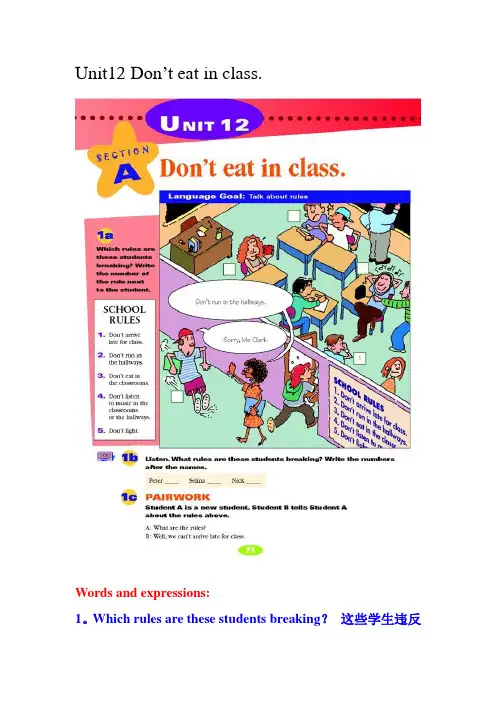
①本句是一个祈使句的否定句.祈使句是指动词原形开头,表达命令或者乞求的句子.其否定句是在句首加“Don't”构成.
Don’t listen to music in class。
Don’t play basketball in the classroom。
Don't run in the hallways.
practice作名词时,意思是“练习,实践,训练”。
Practice makes perfect。
It takes a lot of practice to become a good swimmer.
注意:区分every day和everyday
every day是名词短语,相当于副词,常用于作状语,意思是“每天”。everyday是形容词,常放在名词前作定语,意思是“每天的,日常的”.
=Which is your sister's hat?
②rule在句中作名词,“规则,规定”
We must obey school rules.
常见的词组:
obey a rule遵守规定break a rule违反规定
carry out a rule执行规定abolish a rule废除规定
③break是动词,“破坏,违反”,还可以表示“破坏,打破,打碎”。
人教版 英语 七年级下册 12单元知识点笔记

Unit121.Who visited her grandma?-----Becky did. (助动词did,代替前文的动词visited her grandma。
)动词的替代常用助动词:do, does, did 例:Who likes English?-----Kevin does.2.How interesting! 多么有趣啊!感叹句句式:How+ 形容词/副词(+主语+谓语)!How handsome (he is)!What+ 名词(+主语+谓语)!What a handsome teacher (he is)!3. a second language = another language 另一门语言不定冠词+序数词+可数名词单数表示另一个。
或又一个。
a third boy 又一个男孩定冠词+序数词+名词表示第。
个。
the third boy 第三个男孩4.so+形容词/ 副词that+ 句子如此。
以至于。
The boy is so young that he can’t go to school.5.surprised 和surprising 的区别:surprised修饰人,surprising 修饰物(tired, tiring, bored, boring, excited, exciting….用法类似)例: I am surprised the surprising news. 我对这个令人惊讶的消息感到惊讶。
to one’s surprise 令某人吃惊的是,in surprise吃惊地get a surprise 吃惊be surprised at….对…感到惊讶6.固定搭配:Shout at…. 对。
叫嚷(含指责,敌意)shout to….对。
大声喊(距离远,大声喊)Stay up late to do sth 熬夜做某事重点句型:1. That’s why it’s important to learn a second language.翻译:那就是为什么再学一门语言很重要。
人教版英语七年级下册单元Unit 12 知识点+测试卷+思维导图
Unit 12 What did you do last weekend?1.重点词汇:lake, beach, sheep, kite, moon, snake, forest, surprise, pretty, natural, shout, fly, stay, move, jump, wake2. 短语归纳:1.work as 以……身份而工作2.have a good weekend 周末过得愉快3.kind of 有点儿4.stay up late 熬夜5.run away 跑开6.shout at 对……大声叫嚷7.put up 搭起,举起8.in the countryside 在乡下9.get a surprise 吃惊10.make a fire 生火11.each other 互相12.so… that… 如此……以至于……13.look out of… 向……外看14.up and down 上上下下15.wake…up 把……弄醒16.move into… 移进……3. 必背典句:1. —What did you do last weekend? 上个周末你做什么了?—I did my homework. / We went boating. 我做了我的家庭作业。
/我们去划船了。
2. —Who visited her grandma? 谁看望了她的奶奶?—Becky did. 贝姬看望了。
3. My sister finished high school two weeks ago. 我的姐姐两周前中学毕业了。
4. But I was so tired that I went to sleep early. 但是我是如此疲倦,以至于我很早就睡着了。
4.语法知识:1. 一般过去时的几种句型:(1)be动词的一般过去时的句型:①肯定句结构为:主语+was / were+其它。
人教版英语七年级下册Unit12 知识点汇总解析及练习
七下Unit 12一、单词英译汉badminton language sheepflyAs highvisitorsurprisetiredmovestaystartawayjumpshout二、短语1.study for. 为……学习2.go boating去划船3.camp by the lake湖畔扎营4.as a guide作为一名导游5.go for a walk 去散步6.butterfly house 蝴蝶馆7.tell sb.about告沂某人关于8.one’s living habits 某人的生活习惯9.have a good/busy weekend 度过愉快/繁忙的周末10.read a book about 看一本关于……的书11.g o with sb. 和某人一起去12.put up a tent搭帐蓬13.kep sb. warm 使某人暖和14.on the first night在第一个夜晚15.talk show 脱口秀16.stay at home 呆在家里三、句型1. 最先,我们乘长途公共汽车到乡村的一个湖边。
First, we took a long bus rideto a lake in the countryside.2. 在那儿,我们支起帐蓬,生起火为我们保暖并煮饭。
There we put up our tents and made a fire to keep us warm and cook food on.3. 第一晚上,我们坐在月亮下,相互之间讲故事。
On the first night, we just sat under the moon and told each other stories.4. 但是我是如此之累,以至于很早就入睡了。
But I was so tired that I went to sleep early.5. 当我们向帐蓬外边看的时候,我们看到一条大蛇正睡在火堆旁。
人教版七年级下册英语知识点复习(完整版)
人教版七年级下册英语知识点复习(完整版) Unit 1 Can you play the guitar?1,情态动词+V原can do= be able to do2,Play+ the+ 乐器+球类,棋类3,join 参加社团、组织、团体4,4个说的区别:say+内容Speak+语言Talk 谈论talk about sth talk with sb talk to sbTell 告诉,讲述tell sb (not)to do sthTell stories/ jokes5,want= would like +(sb)to do sth6,4个也的区别:too 肯定句末(前面加逗号)Either否定句末(前面加逗号)Also 行前be 后As well 口语中(前面不加逗号)7,be good at+ V-ing=do well in 擅长于be good for 对…有益(be bad for对…有害)be good to 对…友好(good 可用friendly,nice,kind替换)be good with和…相处好=get on/ along well with8,特殊疑问句的构成:疑问词+一般疑问句9,How/ what about+V-ing …怎么样?(表建议)10,感官动词(look, sound, taste, smell, feel)+adj/ like11,选择疑问句:回答不能直接用Yes或者No,要从中选择一个回答12,students wanted for school show(wanted表示招募,含有被动意义)13,show sth to sb=show sb sth give sth to sb=give sb sth14,help sb (to)do sthHelp sb with sthWith sb’s help= with the help of sbHelp oneself to 随便享用15,be busy doing sth/ be busy with sth16,need to do sth17,be free= have time18,have friends= make friends19,call sb at +电话号码20,on the weekend= on weekends21,English-speaking students 说英语的学生(带有连词符,有形容词性质)22,do kung fu表演功夫Unit 2 What time do you go to school?1,问时间用what time或者whenAt+钟点at 7 o’clock at noon/ at night(during/ in the day)On+ 具体某天、星期、特指的一天on April 1st on Sunday on a cold winter morningIn +年、月、上午、下午、晚上2,时间读法:顺读法逆读法:分钟≤30用past five past eight(8:05)half past eight(8:30)分钟>30用to a quarter to ten(9:45)整点用…o’clock 7 o’clock(7:00)3,3个穿的区别:wear 表状态,接服装、手套、眼镜、香水等Put on 表动作,接服装Dress 表动作,接sb/ oneself get dressed穿衣3,感叹句:How+adj+主谓!How+adj+a/an +n单+主谓!What+ a/an +adj+ n单+主谓!What+ adj+ n复/ 不可数+主谓!4,from…to…5,be/ arrive late for6,频度副词(行前be 后)Always usually often sometimes seldom hardly never7,一段时间前面要用介词for for half an hour for five minutes8,eat/ have…for breakfast/ lunch/ dinner/ supper9,either…or10,a lot of=lots of11,it is +adj+for sb +to do sth (adj修饰to do sth)It is important for me to learn English.it is +adj+of sb +to do sth (adj修饰sb)It is kind/ friendly/ nice of you to help me.Unit 3 How do you get to school?1,疑问词How 如何(方式)how long 多长(时间)答语常用“(For/ about +)时间段”how far多远(距离)答语常用“(It’s +)数词 +miles/ meters/ kilometers”how often多久一次(频率)答语常用“Always/ often/ every day/…”或“次数+时间”等表频率的状语How soon多快,多久以后,常用在将来时中。
人教版七年级下册英语期末复习知识点总结汇编
人教版七年级下册英语期末复习知识点总结汇编人教版七年级下册英语期末复知识点总结汇编Unit1 Can you play the guitar?一词形转换1.singv.唱歌singern.歌手singingn.歌唱2.swimv.游泳swimmern.游泳者swimmingn.游泳3.dancev.跳舞XXX.舞者dancingn.跳舞4.drawv.画画drawern.抽屉drawingn.图画5.XXX.说话XXX.发言者XXX发言6.writev.写writern.作家writingn.写作7.XXX.小提琴violinistn.小提琴手8.XXX.钢琴pianistn.钢琴家9.musicn.音乐musiciann.音乐家10.XXX.教XXX.教师二、短语及用法1.play the +西洋乐器play the XXX……play +球类/活动play XXX2.XXX讲英语XXX讲故事talk to/ with sb.和某人交谈 3.be good at + doing XXX擅长做某事=do well in (doing )sthbe good for对……有好处反义:be bad for对……有坏处be good to sb.对……友好= be friendly tobe good with善于应付……的4.make XXX和某人交朋友5.stay at home待在家6.help sb。
with sth/ help sb。
(to )do XXX帮助某人做某事7.on the weekend = on weekends在周末XXX教某人做某事XXX什么俱乐部music XXX XXX10.want to do XXX想要做某事want sb。
to do XXX想要或人做某事11.like to do sth/ doing XXX喜爱做某事12.be free/busy有空/忙碌的13.call sb。