
小学英语人教版五上 Unit3 What_would_you_like说课稿
PEP小学英语五年级上册
Unit 3 What would you like?
尊敬的各位评委专家,你们好!
今天我要进行说课的题目是《Unit 3 What would you like?》。
下面我将从教材、教法、学情、学法、教学过程\板书设计六个方面来谈谈我的课堂教学设想:
一、说教材
(一)、教材内容
本节课为PEP五年级上册第三单元第一课时,本课时的主要内容是与一日三餐有关的词汇。
通过本课教学使学生能够听、说、认读新授单词rice、fish、beef、soup、noodles、vegetable,并结合实物图片,在真实情景中运用所学单词以及所学句型What would you like? I’d like … . Can I have some…? Sure.Here you are. 本课时内容比较贴近学生生活,是学生们比较喜欢的话题之一,所以有利于学生间开展交流。
(二)、教材地位
在本课时之前学生已经学习了一些有关食物、饮料的单词:juice,bread,milk,chicken,hot dog,hamburger...以及句型:“What do you like? Do you like...?”并且能够表达自己的喜好(I like....Can I have some…?),有了一定的基础,而本课时是第五单元的第一课时,学好本课为更好地学习本单元有关食物的话题奠定了基础。
(三)、教学目标
1.语言技能与知识目标
能够听、说、认读单词rice, noodles, fish, beef, soup, vegetable。
初步掌握What would you like? I’d like some….
2.运用能力目标
能够听、说、认读单词rice,noodles,fish,beef,soup,vegetable。
初步掌握What would you like? I’d like some….
3. 情感、策略、文化等有关目标
(1)情感态度:激发学生学习英语的兴趣,培养学生学习英语的积极态度,使学生乐于合作参与,勇于进行实践。
(2)学习策略:注重合作学习。
(四)、教学重难点
1、教学重点:能够听、说、认读单词rice, noodles, fish, beef, soup, vegetable。
2、教学难点:A、能够正确读单词vegetable. B、能在情境中正确使用所学句型:What would you like? I’d like some…及Can I have some…? Sure, here you are.
二、说教法学法
根据以上对教材的分析,结合自己英语教学生活化、情境化的教学理念,我采用了情境法、TPR教学法以及任务型教学法,通过创设多个生活化的情景,来复习旧知、引出新知、操练新知,在教学过程中坚持“词不离句”的教学原则,从说单词到说句子并过渡到说段,逐步引导学生运用英语完成一个个有实际意义的语言任务。
三、说学情
“What would you like?”这单元的内容与学生的日常生活息息相关,单词都是平常在生活中吃到的食物和用到的餐具,句子也是很常用的,“你喜欢吃什么?”这就将英语的学习和日常生活紧密联系在一起了。
四年级学生爱游戏、好模仿、好奇,喜欢群体活动,喜欢被称赞。
所设计的教学手段及方法符合学生的实际,教学内容基本能面向各层次学生。
因为学生好动,在做游戏时,可能会出现一些混乱的情况
四、说教学程序
Step 1 Revision
1、Enjoy the song “What would you like?”, 师播放歌曲,让学生在快乐的学习氛围中投入到本节课学习。
2、Free talk。
3、Revise the words and sentences.
Step 2 Presentation
1、单词导呈
教学单词rice, soup, fish, beef, noodles, vegetable
2、教授What would you like?I’d like some…
Step 3 Practice
1、听读正音。
放录音,生指单词跟读。
2、合作学习。
(1)全班齐读,小组齐读、个别读。
(2)小组内兵教兵,此时,教师辅导检查后进生。
3、看口型猜单词。
T: Look at my mouth, and guess the word.
4、猜一猜,说一说
Step 4 Let’s play
1、教师扮演一名顾客,请一名同学上台扮演营业员,师生之间练习对话:Can I have some…please? Sure. Here you are . 2/… yuan 。
付钱时可象征性地拍一下对方的手。
2、请学生三人或四人一组表演对话。
Step 5 Good to know :What’s the healthy food?
Step 6 Homework
1、听录音跟读。
2、用“what do you like?”调查小组内同学的喜好食物。
板书设计。
PEP小学英语五年级上册Unit3What would you like说课课件

10
Key Points and Difficulty
Key Points: New words, expressions and some important sentences.
Difficulty: Master some expressions about discussing the food .(eg:What would you like? I’d like….)
students' academic performance
In our class, most of the students have a good foundation in English. And they are active, out-going and thirst for new knowledge. They have already learnt
some knowledge about food and the
good learners average leaners slow leaners
teacher can help them develop a good vocabulary of“food”and master some
important expressions of discussing the
Unit 3 What would you like ? New Words: sandwich salad hamburger ice cream tea Expressions: would like to , I’d like…. Structure: - What would you like to eat /drink? - I’d like ……..
五年级上册英语教案Unit 3 What would you like 人教
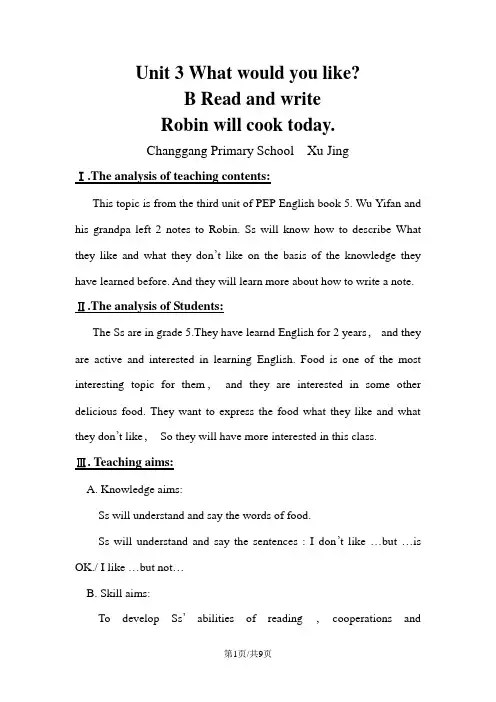
Unit 3 What would you like?B Read and writeRobin will cook today.Changgang Primary School Xu JingⅠ.The analysis of teaching contents:This topic is from the third unit of PEP English book 5. Wu Yifan and his grandpa left 2 notes to Robin. Ss will know how to describe What they like and what they don’t like on the basis of the knowledge they have learned before. And they will learn more about how to write a note. Ⅱ.The analysis of Students:The Ss are in grade 5.They have learnd English for 2 years,and they are active and interested in learning English. Food is one of the most interesting topic for them,and they are interested in some other delicious food. They want to express the food what they like and what they don’t like,So they will have more interested in this class.Ⅲ. Teaching aims:A. Knowledge aims:Ss will understand and say the words of food.Ss will understand and say the sentences : I don’t like …but …is OK./ I like …but not…B. Skill aims:To develop Ss’abilities of reading ,cooperations andcommunications with others.C. Emotion aims:Ss will love their life and get more interests in learning English. Ⅳ.Teaching points:A. Important points:The understanding of the words about food and the sentences: My favourite food is. It’s/they’re…;I don’t like beef but chicken is OK;I like vegetables but not carrots.B. Difficult points:The writing of a note about what they like or don’t like.Ⅴ. Teaching aims:CAI,PPT and some pictures of food.Ⅵ. Teaching methods:TPR,situational teaching method,reading teaching methods. Ⅶ. Teaching procedures:Step4:Assessment1. Say goodbye.2.Homework1.Read p. 29.2.Try to write about yourfather or mother’s note toRobin.Read and interviewtheir fathers andmothers.Write a note toconsolidate.通过了解父母的喜好培养学生的分享意识,令他们更加期待下节英语课的到来。
人教pep五年级上册英语 《Unit3 What would you like》 教案
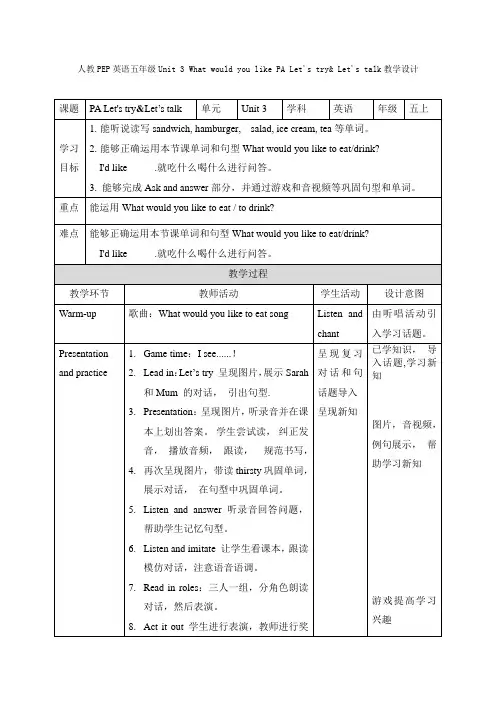
能够正确运用本节课单词和句型What would you like to eat/drink?
I'd like _____.就吃什么喝什么进行问答。
教学过程
教学环节
教师活动
学生活动
设计意图
Warm-up
歌曲:What would you like to eatsong
Listen andchant
9.Pair work跟读图片联系句型
播放learn部分动画,学生跟读,并模仿语音语调。
10.Group work进行问答练习
1.两人一组,角色扮演顾客和服务员。
2.互相进行问答,合作完成表格
1. What would you like to eat?
2.What would you like to drink?
2.为你的爸爸妈妈设计一个健康菜单。
呈现复习对话和句话题导入
呈现新知
动画跟读
Watch and learn
积极完成作业
已学知识,导入话题,学习新知
图片,音视频,例句展示,帮助学习性,更好的掌握新授内容
小组活动,团队合作
对学习成果的巩固。
人教PEP英语五年级Unit 3 What would you like PA Let's try& Let's talk教学设计
课题
PA Let's try&Let’s talk
单元
Unit3
学科
英语
年级
五上
学习
目标
1.能听说读写sandwich, hamburger, salad, ice cream, tea等单词。
由听唱活动引入学习话题。
五年级上册英语教案Unit 3 What would you like3 人教
英语
年级
五
单元
Unit 3
课型
新授
课题
Unit3 What would you like?
课时安排
Period 3
主备教师
备课时间
复备教师
班级
授课时间
教学目标
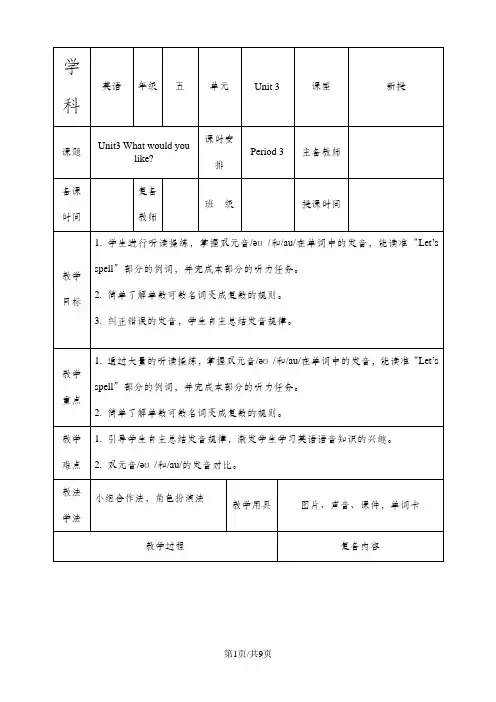
1.学生进行听读操练||,掌握双元音/əʊ/和/au/在单词中的发音||,能读准“Let’s spell”部分的例词||,并完成本部分的听力任务。
(2)教师画一间房子||,墙面上有一扇开着的窗户||,房子外面有一棵树||,树上没有树叶||,树下面堆积着黄色的树叶||,树干上趴着一只蜗牛||,天上飘着雪花||,然后教师说:“Look at the blackboard. Some leaves are on the ground. The snow is falling down. It’s cold. Close the window||,please. Oh||,the snail is slow. When canit go home?”。
(5)学生填写表格||,师生一起核对答案。
(四)、课堂小结
1.师生一起总结本节课学习的词汇和句型。
2.鼓励学生在日常英语学习中注意单词的发音||,要发准音、多模仿。
(五)、反馈测评
把下列句子重新排序||,组成意思完整的对话:
( ) We have tofu||,fish and rice.
( ) Your school meals are yummy.
(6)播放本部分的教学录音||,全班跟着录音读||,提醒学生在跟读时要注意模仿录音中的发音||,尽量做到读准元音字母的发音。
2. Listen||,number and say
五年级上册英语教案Unit3 What would you like A ∣人教PEP
《Unit 3 What would you like? Part A 》教案要练说,得练看。
看与说是统一的,看不准就难以说得好。
练看,就是训练幼儿的观察能力,扩大幼儿的认知范围,让幼儿在观察事物、观察生活、观察自然的活动中,积累词汇、理解词义、发展语言。
在运用观察法组织活动时,我着眼观察于观察对象的选择,着力于观察过程的指导,着重于幼儿观察能力和语言表达能力的提高。
【教学目标】我国古代的读书人,从上学之日起,就日诵不辍,一般在几年内就能识记几千个汉字,熟记几百篇文章,写出的诗文也是字斟句酌,琅琅上口,成为满腹经纶的文人。
为什么在现代化教学的今天,我们念了十几年书的高中毕业生甚至大学生,竟提起作文就头疼,写不出像样的文章呢?吕叔湘先生早在1978年就尖锐地提出:“中小学语文教学效果差,中学语文毕业生语文水平低,……十几年上课总时数是9160课时,语文是2749课时,恰好是30%,十年的时间,二千七百多课时,用来学本国语文,却是大多数不过关,岂非咄咄怪事!”寻根究底,其主要原因就是腹中无物。
特别是写议论文,初中水平以上的学生都知道议论文的“三要素”是论点、论据、论证,也通晓议论文的基本结构:提出问题――分析问题――解决问题,但真正动起笔来就犯难了。
知道“是这样”,就是讲不出“为什么”。
根本原因还是无“米”下“锅”。
于是便翻开作文集锦之类的书大段抄起来,抄人家的名言警句,抄人家的事例,不参考作文书就很难写出像样的文章。
所以,词汇贫乏、内容空洞、千篇一律便成了中学生作文的通病。
要解决这个问题,不能单在布局谋篇等写作技方面下功夫,必须认识到“死记硬背”的重要性,让学生积累足够的“米”。
1. 知识与技能教师范读的是阅读教学中不可缺少的部分,我常采用范读,让幼儿学习、模仿。
如领读,我读一句,让幼儿读一句,边读边记;第二通读,我大声读,我大声读,幼儿小声读,边学边仿;第三赏读,我借用录好配朗读磁带,一边放录音,一边幼儿反复倾听,在反复倾听中体验、品味。
Unit 3 What would you like A Let's talk 说课稿
Unit 3 What would you like? Part A let’s talk 说课稿尊敬的各位领导、老师:大家好!今天我说课的课题是人教版小学英语五年级上册What would you like? 第一课时。
首先,我对本课题进行分析。
一、说教材本课时是一节情境对话课,围绕“征询意见”这一日常用语展开。
本课时的教学内容是会用What would you like ?进行点餐询问,且通过活动,学生能听懂What would you like for dinner? I’d like…的对话,并让学生能在实际生活中运用,进而培养学生乐于并善于表达自己的情感,培养学生对英语的学习兴趣,培养他们的合作意识。
教学重点与难点是句子的熟练掌握和正确使用。
根据这一安排和学生的整体认知水平,从知识教学、能力培养等方面考虑,我确立本课时的教学目标为:二、说学情“PEP Primary English”强调语言运用,注重能力培养,突出兴趣激发,重视双向交流,重视灵活扩展。
本课学习的对象是五年级学生,他们已具备一定的英语听说基础,良好的英语学习习惯,一定的自学能力,较强的接受能力,而且食物与学生的生活实践联系紧密,是学生感兴趣的话题,他们接触过用“I like…句型来表达自己喜欢某些食物以及请别人吃东西时的句型,因此在这个基础上我结合学生实际情况,采用了这样的教学模式:热身、复习、导入、操练、巩固、拓展。
三、说目标:认知目标:(1)单词:rice, fish, beef, soup, noodles, vegetable (2)句子:What’s for dinner? Wait and see. Everything’s ready. (3)句型:What would you like?)I’d like some….能力目标:运用句型“What would you like ? (What would you like for breakfast/lunch/dinner? I’d like some….”进行交际及相互调查。
人教pep五年级上册英语 《Unit 3 What would you like 》 教案
PEP人教版小学英语五年级上册《Unit 3 What would you like ? Part B Let’s talk》教学设计教学目标:一知识目标:1. 能听、说、认读单词“favourite”和“delicious”。
2. 继续讨论最喜欢的食物并给出原因。
3. 能完成“Let’s try”部分的听音连线任务。
4. 提高学生的英语交际能力,培养学生学好英语的自信心。
二能力目标:1. 能够正确、熟练地朗读对话,做到语调、重音地道,自然。
2. 从角色扮演到创设情景,能运用所学词汇和句型What’s your favourite food?等编创一段对话,谈论喜欢的食物。
三情感目标:教育学生养成良好的饮食习惯---要多吃蔬菜和水果;不要浪费食物。
教学重点及难点:(一) 重点1. 能听、说、认读单词“favourite”和“delicious”。
2. 继续谈论最喜欢的食物并给出原因。
(二) 难点能在实际情景中运用本课时的重点句型进行交流。
教学准备:教学课件、教学音频、单词卡、句子卡。
教学过程:Step 1-- Preparation1---Enjoy a song 《What would you like to eat? 》2-Free talk --自己的照片,Tell students to guess the food I like3-引出favourite,教授favourite4-Ask and answer: What’s your favourite food & drink? My favourite food & drink is..... Step 2 ---Presentation1---Let’s try2-教学情境图① Who are they ?②What are they talking about ?3---Watch the video and Answer①What’s Zhang Peng’s favourite food ?②What’s Sarah’s favourite food ?4---Listen to the tape and repeat5---Read in pairsStep 3---Practice1--ConsolidationChallenge1、2、3Step 4---Extention1---Role-playMake a new dialogue about ordering food and drink. 编创关于点餐的对话。
人教版PEP五年级上册英语《Unit3Whatwouldyoulike第一课时》教学设计
人教版PEP五年级上册英语《Unit 3 What would you like第一课时》教学设计一. 教材分析《Unit 3 What would you like》是人教版PEP五年级上册英语的教学内容,本单元主要围绕食物和饮料的主题,让学生学会用英语询问并回答别人想要什么食物和饮料。
本课时的教学内容主要包括食物和饮料的词汇,以及询问别人想要什么的句型。
二. 学情分析五年级的学生已经掌握了基本的英语语法和词汇,具备了一定的听、说、读、写的能力。
但是对于一些食物和饮料的词汇可能还没有接触过,因此在教学过程中需要教授新词汇。
同时,学生对于询问别人想要什么的句型也可能是第一次接触,需要通过反复操练来掌握。
三. 教学目标1.能听懂、会说、会读本课时的核心词汇:pizza, hot dog, ice cream,milk, water。
2.能用英语询问并回答别人想要什么食物和饮料。
3.能用英语简单描述自己的喜好。
四. 教学重难点1.重点:食物和饮料的词汇,以及询问别人想要什么的句型。
2.难点:食物和饮料的词汇的准确发音和记忆,以及询问别人想要什么的句型的运用。
五. 教学方法采用情境教学法、游戏教学法和任务型教学法,通过设定情境、游戏和任务,让学生在实际语境中学习和运用语言。
六. 教学准备1.准备食物和饮料的图片或实物。
2.准备教学课件和教案。
3.准备录音机或播放器,准备本课时的录音材料。
七. 教学过程1.导入(5分钟)通过播放本课时的录音,让学生初步感知本课时的主题和内容。
然后老师通过提问学生“What would you like?”来引导学生回答自己喜欢的食物和饮料。
2.呈现(10分钟)老师通过展示食物和饮料的图片或实物,教授本课时的核心词汇:pizza, hot dog, ice cream, milk, water。
同时,老师用“What would you like?”的句型来询问学生,让学生用英语回答。
英语人教版五年级上册unit 3 说课稿
Unit 3 what would you like?Part A Let’s try & Let’s talkGood morning, ladies and gentlemen, I am so excited to stand here to present my lesson. Today I will talk about my teaching. It is made up of 6 parts: teaching content, teaching objectives, teaching key and difficult points, teaching approach and learning strategy, teaching procedures and board design.Teaching contentFirstly, I’ll talk about teaching content. It has two parts.The first one is analysis of the teaching material. It’s PEP primary English Book 5 unit 3 what would you like? Part A let’s try & let’s talk. The topic is about food. This period is the first lesson in this unit, it’s the basic and important part, it contains the corn sentence patterns: what would you like? I’d like …The topic is related to our life, so it’s easy to arouse learners’ interest. As we all know, interest is the best teacher for students. If learners get them well, they will be quiet easy to learn the next part, let’s learn, which wants students to learn sandwich, hamburger and the sentences what would you like.The second one is learners. Our students are in Grade 5, they have learned English for 2 years, so they can understand many words and simple sentences. They are active, eager to show what they know, and interested in new things, I’ll design some interesting activities to attracttheir attention. Because they are in Grade 5, they have learned some words and sentences about food in Grade 4, such as rice, noodles, vegetables and what would you like for dinner? Would you like some…? So it’s not so difficult for them.Teaching objectivesNext, I’ll talk about teaching objectives.By the end of the lesson, Enable Ss write down the food they hear when the teacher plays the recorder. Enable Ss understand the main meaning of the dialogue under the help of the teacher and video. Enable Ss understand the meaning of sandwich, hungry and thirsty in the context, and pronounce them right. Enable Ss read the dialogue with right pronunciation and proper tune. Enable Ss role-play in a situation to ask and order food properly with what would you like to eat/drink? I’d like…In this lesson, the emotional objectives are to arouse the students’interests in English and to improve their motivation of communication, to develop the spirit of cooperation by pair work and competition, to ask and order food politely.Teaching key and difficult pointsThe key points: Word: sandwich, hungry, thirsty. Sentences: What would you like to eat/drink? I’d like …The difficult points: the pronunciation of thirsty, role-play in asituation.Teaching approach and learning strategyFourthly, It’s about teaching approach and learning strategy.In this lesson, I will mainly use task-based language teaching method, situational method, game teaching method and communicative language teaching method. Ss will learn this lesson with practice strategy, cooperation strategy. Teacher guide and student centered. I will achieve my lesson with these teaching tools: multimedia, PPT, some food and drink, a food tray, waitress uniform, paper with disordering sentences and some menus.Teaching proceduresI’ll finish the lesson in 5 stepsStep 1. warm up and lead inIn this period, I’ll greet to them and ask students to greet with each other to get easy, then sing a song “BINGO”. These can form a relaxing atmosphere and let the students get ready for the next step. It will cost 2 minutes.After singing, I pretend I’m hungry, (teach the word hungry here) and my friends are hungry, too. Here I will show them a video, the movie Frozen, it’s about Anna and her friends looking for Elsa, but they are lost in a maze and hungry, they need food. In this way, I lead the lesson to food and ask students to help them get food. Play the bingotask game. This will cost 2 minutes.Step 2 presentationThis is the main part, I will divide it into 3 parts: task 1, task 2, task 3. It will take 23 minutes.Task 1. I can say.I will act like a waitress, take out a food tray with lots of food and ask students “what’s this?”. After that I will ask “would you like some…”then I will show them sandwich and teach them this word. I will ask some kids to eat some food and drink some water or milk while I’m teaching. Because I always believe: Teach me, I will forget. Involve me, I will remember.Then I will serve students by asking what would you like? And help students answer I’d like some…I teach the sentence patterns here. Situational approach is used here.Finish task 1: I can sayPlay a game to consolidate words and sentences.The game is Wooden child.When I read words facing to board, students will read after me. When I read words looking back, students should be quiet. Otherwise, you fail. Students like to play games and they will be very excited and careful.Game method is used here.After that I will show Anna get to the first door and get a sandwich.Task 2 I can listenStudents will hear a sound, it means someone is hungry. I will say what’s that? It will arouse Ss’ curiosity.Then show the picture and say, Aha, Sarah, it’s you. you are hungry. Ask Ss what would she like to eat?Finish task 2 I can listen, that is let’s try.Write down the words you hear.Check the answer with students.Show Anna get to the second door and get a glass of milk.Task 3. I can readSarah is hungry, let’s see what her mother prepare for her.I will show Sarah and her family’s conversation. Firstly Ss answer some questions, then they read after me, we will meet the word t hirsty here, I will act and explain, show how to pronounce th. Thirdly they read together.I will take out some words and phrases from the conversation, students try to fill in the blanks.At last I give out some paper with disordering sentences, let Ss reorder them and read them loudly.Show Anna get to the third door and get some foodStep 3. PracticeTo learn is to use. So let’s go to step 3 practice.Task 4. I can speak and write. That is ask and answer.Ss will be the waiters and customers in a restaurant.I will divide students into small groups, four in a group, student A, B, C, D. A as a group leader, to organize the group, B as a secretary, to help his team member, C as a writer, to take notes, D as a reporter, to report what they say.I will show them some useful sentences to help them finish the task.Can I help you? Yes.What’s your name? My name is …What would you like to eat? I’d like…What would you like to drink? I’d like some… Thank you. That’s OK.(show Anna get to the last door and find Elsa, they are happy. Laughter.) It will cost 8 minutesTask-based language teaching approach, situational and communicative method are used here, and students’cooperation ability will be well developed.Step 4 summaryIt will take 3 minutesIn this step, I’ll guide students to conclude key words and sentence pattern, let them know to ask and order food politely to reach the lastemotional objective.Step 5 homeworkIn the end, I will give some homework. It will take 2 minutes.1.Read the words and sentences to your classmates.Sandwich, hungry, thirsty,What would you like to eat/drink? I’d like…2.Ask your classmate what would you like for lunch?3.Serve your parents politely when you get home.Board designAt last, it’s about the board design. It should be as simple and important as it can be to attract Ss’attention. I will write the main sentences on the board to help students know the importance. I also paste some pictures, it emphasizes the word sandwich.Unit 3 what would you like?Part A 1 let’s try- ask and answerI’m hungry/ thirsty.eat? I’d like a sandwich.(picture)What would you like todrink? I’d like some water.That’s my teaching, thank you.。
人教PEP版英语五年级上册Unit 3 What wouldyou like?说课课件
Analysis of the Teaching Procedures
Step 1 Speaking
16 mins.
Step 2 Step 3
1. Guide students to learn to be waiters and customers in communicative activities.
1. Summary: summarize the lesson with the layout. 2. Homework:
✓ Make a slogan for the fast food restaurant. ✓ Make a conversation of ordering at home.
Aids
• Multi-media • Blackboard • Realia • Material Bags
Analysis of the Teaching Procedures
Step 1 Step 2 Step 3 Step 4
Lead-in
4 mins.
1. Watch a video about Chinese food. 2. Set a scene: I want to open a restaurant. 3. Infer the Theme of the Restaurant.
Analysis of the Teaching Objectives
By the end of the lesson, students will be able to:
Culture awareness