
Module 6 Animals in danger教案
1 Module 6 Animals in danger 【教材分析】 本模块以“Animals in danger”为话题,以学习动词不定式的用法为主线,介绍了当前濒临灭绝,需要人类保护的动物的情况, 并重点介绍了大熊猫的保护情况。在此基础上,学生可以根据自己的建议制定更合理的动物保护措施。 Unit 1 It allows people to get closer to them. 【教学目标】 Knowledge objective To master the useful words and sentences. Words: snake, thin, danger, interested, allows, wild, protect, grow, enough, dirty, peace, earth, raise Expressions: in danger, at last, be interested in, think of, take away, in peace, on earth, in order to, look after Ability objective 1. To help students to improve their ability of listening and speaking. 2. Enable students to understand conversations about animals in danger. Moral objective 1. To help students know the importance of protecting animals and our environment. 2. Improve their sense of duty to love and protect animals. 【教学重点】 New words and expressions. To learn the grammar knowledge of infinitive. 【教学难点】 Cultivating the ability of expressing opinions. 【教学方法】 2
PWP method, task-based method and interactive approach 【教学手段】 A tape recorder, multimedia and some pictures 【教学过程】 Teaching Procedures: Step 1 Lead-in Ss look the pictures and guess what the animal is. Step 2 Consolidate new words Look and say. The teachers shows the pictures of new words and let the students to say the new words as quickly as possible. Step 3 Say the meaning of the phrases. Work in pairs. Let Ss say the meaning of the phrases as quickly as possible. Step 4 Listening Listen and answer the questions. 1. What’s this week’s Animal World about? 2. Which animals are in danger? Step 5 Listen to Activity 3 and answer the following questions. 1. Is Betty more interested in Wolong Panda Reserve? 2. Do many animals have a safe place to live? Step 6 Find out the sentence of infinitive. Work in pairs. Let Ss find out the sentences of infinitive as many as possible. Give the prize to the first group. Step 7 Read Activity 3 and answer the questions. 1. Did Betty see the pandas at the zoo? 2. Is Betty interested in the pandas? 3. What does Lingling think of the pandas and other animals in danger? 3
4. Why do many animals not have a safe place to live? Step 8 Now complete the table. Why animals are in danger What we can do to help
Step 9 Complete the passage with the correct form of the words and expressions in the box. Let Ss read the passage first and choose the words and expressions from the box. Step 10 Everyday English …at least! Help! What can we do? Step 11 Language points 1. But I am more interested to see the pandas in the Wolong Panda Reserve. be interested to do sth. 对做……感兴趣 be interested in sth. 对……感兴趣 be more interested in 对……更感兴趣 e.g. The boy is interested in the film. 2. …because it allows people to get closer to them. to get closer to them在句中作宾语补足语,类似的结构有很多,例如: ask sb. to do sth. 请求某人做某事 need sb. to do sth. 需要某人做某事 want sb. to do sth. 想要某人做某事 allow sb. to do sth. 允许某人去做某事 e.g. His father doesn’t allow him to play before finishing his homework. 3. It’s sad to think of pandas and other animals in danger. think of 想到,想出 4
e.g. What do you think of the zoo? in danger 处于险境,处于危险之中 e.g. The girl is very ill and her life is in danger. 女孩病的很重,生命垂危。 4. … have a safe place to live 表示“有安全的居住地”。to live放在名词place的后面做定语。 5. …because villages and farms are growing bigger and are taking away their land and forest. ......因为村庄和农场越来越大,侵占了它们的土地和森林。 take away 表示“夺去,拿走”。代词要放在中间。 e.g. Please take away your things. Step 12 Listen and mark when the speaker pauses 1. It allows people to get closer to the pandas. 2. We want to save the panda, and we need you to help us. 3. We can give money to protect the animals. Listen again and repeat. Step 13 Work in pairs. Ask and answer the questions. 1. Why do you visit the zoo? 2. Where do most animals live? 3. Do you think animals are happy in the zoo? 4. What can we do to help the animals? Step 14 Talk with your partner about what we can do to protect animals in danger and share your ideas with the rest of the class -To protect …we should… -We need to … to protect… Step 15 Grammar 动词不定式的功能 Step 16 Summary
Module 6 reading-Animals in danger 教案
Module 6 reading-Animals in danger 教案老师聘请考试题库训练理论学问13高校科专业基础学问面试技巧Animals in dangerGood morning , it is my great honor to stand here to present my lesson. The lesson I choose to illustrate is taken from Module6 in Senior High New Standard English Book5. I will explain my lesson design in the following parts.Teaching materialThe topic of module6 is about Animals in danger. This is an important topic for students, all the activities in this module are helpful to know the importance of protecting animals and nature. Ill finish this module in 6 periods. This lesson, Ill teach period2 Reading Part . Next class, Ill teach Grammar. In last lesson, they have learned some endangered animals. So they are eager to know what happened about the antelopes .StudentsMost students are interested in different animals.So this topic can greatly attract their interests.Teaching AimsKnowledge aim:Know the endangered animal--- antelopes and deal with the words, phrases and sentences.Abilities aim :Improve the students reading skills and communication ability.Emotion aim:Arouse students interest to love nature and wild animals.Teaching PointsKey point:Get the students to grasp the main idea of the passageDiffcult point: Get the students to learn about the importance of protecting animals and find some important sentences about atrributive clauseTeaching AidsMulti-media computer, Tape recorder,Teaching and Studying MethodsAs to the teaching methods, communicative teaching method ,audio-visual teaching method , "task-based' teaching method will be adopted in this lesson.As for learning, Ss will learn through independent reading, discussing and cooperating. Ill give the students some tasks and arrange several kinds of activities: watching pictures, listening, making conversation, acting, group work and so on. Teaching ProcedureHere comes the most important part, the teaching procedure. It includes 7 stepsStep 1 Lead-in ------speaking abilityFuwa are the mascots of the 29th Beijing Olympic Games , students are familiar with them. So I use it to lead in my lesson.I ask them some questions as follows :Can you say which one represents the antelope?yingying is a lovely and interesting cartoon antelope, And do you know its meaning?And then show some terrible pictures about the Tibetan antelopes. Facing the terrible scenes,what should we do toprotect them ? (ask some students to put up their opinions) Luckly, many people are active in protecting the antelopes. Today well learn more about itThis step is the brain storm , in order to make students interested in the topic and equip students with some related words about the antelopes ,to prepare them for the coming discussion in the end.。
高中英语Module 6 Animals in Danger教学设计
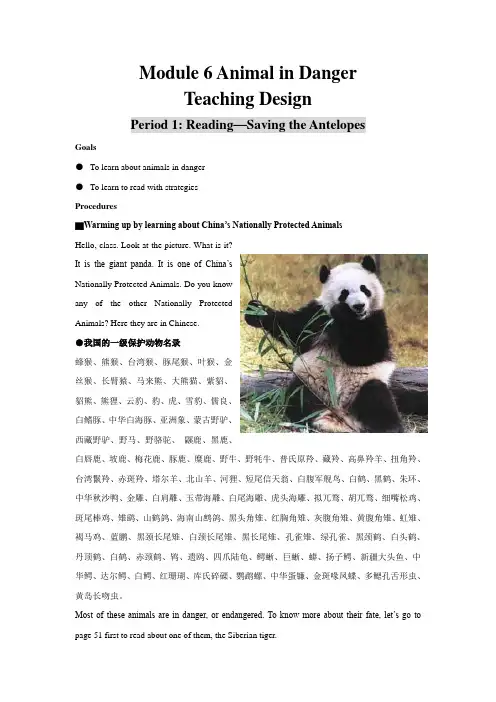
Module 6 Animal in DangerTeaching DesignPeriod 1: Reading—Saving the AntelopesGoals●To learn about animals in danger●To learn to read with strategiesProcedures▇Warming up by learning about China’s Nationally Protected AnimalsHello, class. Look at the picture. What is it?It is the giant panda. It is one of China’sNationally Protected Animals. Do you knowany of the other Nationally ProtectedAnimals? Here they are in Chinese.●我国的一级保护动物名录蜂猴、熊猴、台湾猴、豚尾猴、叶猴、金丝猴、长臂猿、马来熊、大熊猫、紫貂、貂熊、熊狸、云豹、豹、虎、雪豹、儒良、白鳍豚、中华白海豚、亚洲象、蒙古野驴、西藏野驴、野马、野骆驼、鼷鹿、黑鹿、白唇鹿、坡鹿、梅花鹿、豚鹿、糜鹿、野牛、野牦牛、普氏原羚、藏羚、高鼻羚羊、扭角羚、台湾鬣羚、赤斑羚、塔尔羊、北山羊、河狸、短尾信天翁、白腹军舰鸟、白鹤、黑鹤、朱环、中华秋沙鸭、金雕、白肩雕、玉带海雕、白尾海雕、虎头海雕、拟兀骛、胡兀骛、细嘴松鸡、斑尾棒鸡、雉鹞、山鹤鸽、海南山鹧鸽、黑头角雉、红胸角雉、灰腹角雉、黄腹角雉、虹雉、褐马鸡、蓝鹏、黑颈长尾雉、白颈长尾雉、黑长尾雉、孔雀雉、绿孔雀、黑颈鹤、白头鹤、丹顶鹤、白鹤、赤颈鹤、鸨、遗鸥、四爪陆龟、鳄蜥、巨蜥、蟒、扬子鳄、新疆大头鱼、中华鳄、达尔鳄、白鳄、红珊瑚、库氏碎磲、鹦鹉螺、中华蛋镰、金斑喙凤蝶、多鳃孔舌形虫、黄岛长吻虫。
高中英语Module 6 Animals in Danger教案
Teaching plan(教案)Book5 Module6 Reading and vocabularySaving the AntelopesTeaching goals:1. Language knowledge goals:1) Key words: endanger, antelope, poacher, illegal, confiscate, ideal2) Key phrases: give one’s life to, on the spot, come into fashi on, raid on, get tough with sb3) Key sentence patterns:Although surprised, the poachers had an advantage—there were more of them.Often working at night, the poachers shoot whole herds of antelopes at a time, leaving only the babies, whose wool is not worth so much.2. Language skill goals:a. To know sth about the endangered antelopes.b. To improve the students’ reading ability.c. Enable the students talk about how to protect animals3.Emotional attitude goals:a.Cultivate the students’ awareness of lo ving animals and the nature as well as protecting theenvironment. Also encourage the students to take an active part in social practice and exploration.b.Guide the students to learn how to cooperate with othersc.Help the students further enhance the ability of self-studyTeaching important points:a. key sentence patterns: Although surprised(V-ed as adverbial), leaving only the babies(V-ing as adverbial of result)b. key topics: How to protect animals in dangerTeaching difficult points:a. Improve the stud ents’reading ability, simultaneously train the students to capture the key sentence and seize the key information.b. Get students to talk about “How can we protect the animals〞through group cooperation. Teaching methods:Task-based teaching methods, reading, pair or group work, discussion.Teaching aids:A multi-media computer & a blackboardTeaching procedures:Crazy English:read the new words in this module togetherStep1. (Lead in) Watch a piece of video and answer the questions. (3′)•Where is the last habitat of antelope?•Is the number of antelope growing or falling? Why?•Did the local government take measures to protect it?Step2. Read fast to choose the main idea of each paragraph(6′)Tip: Just read the first and the last sentences of the each paragraphA. the reasons why such event happenB. the ways the poachers deal with the antelopesC. measures to protect the antelopesD. the event about Jiesang SuonandajieE. other measures and the resultsPara 1 Para 2 Para 3 Para 4 Para 5Step3. Careful-reading: (13′)Para1: Event (3′)Para 2:Reasons(2′)What’s the reason for killing the antelope?Para 3:Ways recite(背诵) the four sentences . (4′)Put the following sentences into correct order:a. The shawls are exported to rich countries in North America and Europe.b. The poachers shoot whole herds of antelopes at a time .c. The wool is taken to India where it is made into the shawls .d.The animals are skinned on the spot .Para 4&5Find out the measures taken↓Create_______________catch________________In China confiscate ________________Officials / volunteers (Jiesang)in foreign countries get tough with_________the number of poachers___________Results the antelope population__________Step4.. Which one is the structure of this passage? (2′)A. B.Step5.. What `s the author’s purpose to write this passage ? ____(1′)A. To tell readers something about Jiesang .B. To warn people the Tibetan antelopes are in danger of extinction.C. To introduce the present situation of the Tibetan antelopes.D. To call on people to save the antelopes.归纳:_________________________________________________________________________ Step6. In your opinion, what should we do to save the endangered animals? 〔watch another piece of video 〕(5′)___________________________________________________________________________________________________________________________________________________________________________________________________________________________________________________________________________________________________________________________ Step7.Writing guidance :while writing , try to use as many words we have learnt as you can. (8′)目前,越来越多的动物濒临灭绝,请你分析原因〔至少两点〕并提出解决措施〔至少两点〕。
高中英语Module 6 Animals in Danger优秀教案

Module 1 Speaking and cultural cornerTeaching goals1. Target languagea. key words and phrasessecondary, semester, system, teenager, , cover, diplomago to college , be divided into ,take part inb. important sentencesIs the school similar to your school?What similarities or differences do you know about...?2. Ability goalsGet the students to know the similarities and differences about American and Chinese school systems.3. Learning ability goalsEnable the Ss to learn how to find out the similarities and differences about American and Chinese school systems.Teaching important and difficult pointsLearn about the differences and similarities between American and Chinese school systems.Teaching methodsSpeaking, discussingTeaching proceduresStep Ⅰlead-inHave the students listen to a song named the beautiful campus and then encourage theme to talk about their school life in senior high. For example: what do you think of your new school /your new teachers? What do your usually do after school?Step ⅡSpeakingHave the students turn to page 7 and talk about what the students usually do after school in America according to the pictures.Step ⅢCultural CornerAsk the Ss to read the letter from a Senior High student in the US on page 9.While reading, ask them to underline the words or phrases they don’t understand. And then deal with these difficulties for them. Then ask them to read the passage again and decide the main idea of each paragraph. After that, have the students fill in the chart below in pairs and check it up together. At last, the teacher asks some students to talk about it.Chinese and American School SystemsStep ⅤHomeworkLook more information about the similarities and differences between Chinese and American school systems from the website or magazines.。
module6 Animals in Danger Reading教案

Module 6 Animals in Danger【Teaching aims】1. Get Ss to learn some words and information about the protection of the wild animals2. Read a passage about the present situation of the Tibetan antelopes and the efforts made to protect them.3. Help Ss to consolidate their reading skills.【Important and difficult points】Important points:1. Get Ss to realize the importance of saving the animals in danger and protecting the nature.2. Get Ss to learn how to call on more people to save the animals in danger and take measures to protect them.Difficult points:1. Enable Ss to talk about the current situation of wild animals.2. Guide Ss to summarize the main idea of the text 【Teaching procedures】Step1.Warm upAsk Ss a question “What animals do you know?〞. Then show the class some pictures about animals.设计意图:通过让学生答复简单的问题,活泼气氛;通过展示动物图片,吸引学生的注意力,提高学习兴趣,同时为后文做铺垫。
2021年《Module 6 Animals in danger》优秀教案
Modue 6 Anima in danger
【教材分析】
本模块以“Anima in danger”为话题,以学习动词不定式的用法为主线,介绍了当前濒临灭绝,需要人类保护的动物的情况, 并重点介绍了大熊猫的保护情况。
在此基础上,学生可以根据自己的建议制定更合理的动物保护措施。
Unit 1 It aow
Chinaai and chooe the correct anwer
1 Read the emai and get the main idea
2 Chooe the correct anwer to the three entence
Stea in danger
1.Stea ou’re going to heeet
2.what ou’re going to do
3.where ou’re going to meet
Steae a a ou want to heation to the ae it more intereting
Wor in a free and chooe the bet one to how
Stee eercie and draw the anwer from the S
Stee eercie from the entrance eam to enior high choo
Stemar
1动词不定式的语法功能。
2重点短语
Steewor
你如何看待动物?哪些动物是濒危动物?你认为如何保护濒危动物?结合所学知识阐述一下你的观点,写一篇50词左右的短文
【课后反思】
1。
Module 6 Animals in Danger教案22 (2)
Module 6, Book 5 Animals in DangerReading and V ocabularyTeaching aims and demands:1. Knowledge and Skills(1) Ss will learn some information about the present situation of the wild animals and the effort made to protect the wild animals.(2) Ss will learn to recognize the important reasons to protect the animals in danger and help them to realize that saving the wild animals is saving human beings.(3) Help Ss to consolidate their reading skills like skimming and scanning for details.2. Process and methodology(1) Communicative approach(2) Task-based strategy(3) Cognitive strategy3. Emotion, attitude and value(1) Help Ss to sense the importance of saving the animals in danger and the necessity of protecting the earth.(2) Help Ss learn how to realize the dream, how to call on more people to realize the importance of saving the animals in danger.Important and Difficult points:1. Enable the Ss to talk about the current situation of wild animals.2. Guide the Ss to summarize the main idea of each paragraph as well as the main idea of the text.3. Help Ss learn what effort has been made to change the serious situation and what else should be done.Teaching methods:1. Task-based activities and fast reading skills for main ideas and details.2. Discussions to improve Ss' reading comprehension of the passage.3. Individual,pair or group work to make every student work in class.Teaching aids:Computer, tape recorder, and blackboard and papers.Teaching procedures:Step 1. Greetings. Greet the whole class as usual.Step 2. Warming up.Begin with several pictures of dinosaurs, which will help the Ss to realize the topic of this module. And talk about several pictures with 2 questions:1. What do the giant panda and Siberian tiger have in common?2. What can we do to help them in their struggle for survival?Step 3. PresentationWith the help of several pictures and a flash, let the students predict the text.Step 4. Reading.1. Fast reading: help the Ss get some general information of the passage.A. Who is Jiesang Suonandajie?B. Why do the poachers kill the antelopes?2. Careful reading: Summarize the general idea of the whole passage.Para. 1 Jiesang Suonandajie died when protecting antelopes.Para. 2 The reason for the trade.Para. 3 The process of the trade.Para. 4 The result of the battle.Para. 5 The present situation and the future of the battle.3. Listen to the tape to catch specific information of the passage and ask the Ss to fill in the blanks.The general idea of the text:The reading gives a brief description of the current situation of antelopes. Realize the importance and urgency of protecting the wild animals. The struggle of protecting antelopes will last a long time and will call on more and more people to take part in it. Step 5. Reading for details and comprehension.Step 6. Discussions: let the Ss realize the purpose of learning this passage, the importance of saving antelopes and the necessity of taking immediate measures. (a flash 藏羚羊的心愿will help the Ss fully understand the topic.)1. What do you learn from the text?2. Why do we have to prevent the animals from dying out?3. In your opinion, what should we Chinese people do to save the endangered Tibetan antelope?Step 7. Collecting answers and making a summaryStep 8. HomeworkRead the text and underline the difficult sentences.Finish exercise 4 on Page53.。
高中英语Module 6 Animals in Danger教案
外研社高中英语必修五module 6 Animals in Danger 阅读板块教学设计课题名称:Reading:Saving the Antelopes课型:阅读课授课班级:xx南山实验高二15班授课教师:xx南山实验英语组秦锐授课时间:20xx年12月11日本课时教学内容为外研版新标准高中英语必修五module 6 Animals in Danger中的Reading,是该模块的第二课时,在单词和introduction的教学之后。
一.教材分析1.本模块的话题是保护濒危动物。
首先在“introduction〞中介绍了一些野生动物,也引入了与动物有关的词汇,为之后的学习做了铺垫。
本课时“Reading〞带着同学们了解保护藏羚羊的故事,保护的措施以及藏羚羊的现状,是同学们正确了解自然与人的关系,增强保护生态环境的意识,并从身边的小事做起,保护大自然,保护大自然。
二.设计思路和理论依据《普通高中英语课程标准〔实验〕》在“课程目标〞中指出:“高中英语课程应该强调再进一步开展学生综合语言能力的根底上,着重提高学生用英语获取信息、处理信息、分析问题和解决问题的能力,特别注重提高学生用英语进行思维的和表达的能力;形成跨文化交际的意识和能力。
〞本课堂希望做到知识和能力、情感态度和价值观、学生个性开展,教学和教育的四个统一。
三.教学目标1.知识目标了解许多珍稀动物正濒临灭绝这一严峻现实,帮助学生增强拯救野生动物、保护自然环境的意识对文章的整体框架,组织结构有清晰的认识2.技能目标能在阅读中通过语境识别新学词汇、短语并推断其意思能正确理解介绍藏羚羊或野生动物的短文能从文中提取和筛选信息并进行重组。
能运用新学和已学的词汇和知识进行表达和讨论。
3.情感态度与价值观了解本单元的总体学习目标,以激发学生的学习动力正确了解自然与人的关系,增强保护生态环境的意识,并从身边的小事做起,保护野生动物,保护大自然4.教学重点、难点:引导学生理解、提取、筛选、重组信息启发学生运用信息及语言点就“Saving the Antelopes〞进行有意义的语言输出四.教学步骤Step1. Lead-in (5 min)1.show students a video about Jiesang and antelopes2.ask students to guess what’s this picture about3.look at this picture and review wordsStep2. Fast reading (5 min)Ask students to read this passage and find out the main idea of each paragraph.Step3. Careful reading (17 min)1. Read paragraph 1 and think about what happened to Jiesang. (4 min)2. Read para2-3,do true or false questions and two multiple choices. (7 min)3. Read para4-5 and do the multiple choices. (6 min)Step4. Post reading〔3 min〕Ask students to answer these two questions according to the passage.Step5. Interview (10 min)Suppose you are a reporter and your partner is a poacher who was arrested by the police, you are interviewing him, and what questions do you want to ask? And what will you tell him? Now make a dialogue according to the passage.Step6. Homework (writing)。