
Unit5 On the farm
Unit5 On the farm
教学内容
《牛津小学英语6A》第五单元B﹑C&F部分
教学设想
根据小学生好动、爱玩的年龄特点,利用图片提供情景,并设计游戏或劳动场面,
让学生在做中玩,玩中用。帮助学生掌握四会词汇和重点句型。
教学目标
知识目标
四会:
词汇:pick(oranges), cook, pull up(carrots), water(flowers), taste, milk(cows),
collect(eggs)
句型:What (else) did you do on Sunday/ Monday/Tuesday…? I watched cartoons.
能力目标
1.掌握所学的pick, cook, collect, water, taste, milk等动词的含义,并能用其过去
式表达过去的动作。
2.能够熟练地运用句型What (else) did you do on Sunday…?I …,对过去行为进行
询问和回答。
情感目标
通过动词的学习,培养学生热爱劳动的好习惯,学会尊重别人劳动成果。
教学重点
理解实义动词所表示的动作含义,并能运用动词及其过去式表示发生的动作。
教学难点
能够用动词准确地表示相应的动作,并能运用其过去式就句型What (else) did you
do?做出回答。
教学准备
图片、多媒体课件、调查表
教学设计
Step1 Warming-up
1. Greetings to each other
2. Revision
T: We’ve learned part A of Unit 5, Let’s see who has a good memory.
Questions:
1. What holiday was it last week?
2. What did Nancy do on Wednesday?
3. What did Helen do on Monday?
4. What did Helen do on Tuesday?
The students answer the questions.
Step2 Presentation and practice
1. T: Children, do you know where Helen was last week?
S: She was on the farm.
(板书On the farm)
2. T: Today let’s go to visit the farm. What can we see on the farm?
(PPT出示一个胡萝卜图片)
Teach: a carrot
(PPT出示一堆胡萝卜)
T: A carrot?
Ss: No, they are carrots.
Teach: carrots
(PPT出示女孩们拔胡萝卜的图片)
T: What are the girls doing?
Ss: They’re pulling up carrots.
Teach: pull up carrots(边说边做动作)
3. T: I pulled up carrots just now.
板书句型
Ask and answer one by one
4. T: Look, what animal is coming?
Teach: cow & cows
T: What is the man doing?
Ss: He’s milking cows.
Teach: milk cows.
5. T: Is the woman milking cows?
Ss: No, she’s collecting eggs.
Teach: collect eggs
6. T: Look, I’m in the kitchen. What am I doing?
Ss: You’re cooking.
Teach: cook food.
7. T: Guess , what am I doing? I’m in the garden.(做浇花的动作)
S: You’re watering flowers.
Teach: water flowers
8. T: Here’s an orange. I picked it yesterday.
Teach: pick—picked
9. T: The orange looks nice. I’d like to taste it
(T品尝橘子) It’s wonderful!
Would you like to taste it? S1—S2—S3.
Teach: taste—tasted
10. T: Let’s play a game.
Do the actions according to the orders.
(每人一张卡片,上面写着这节课所学的词组,学生根据这些词组做相应的动
作。)。
Teach: What else did you do?
板书句型
11. T: Boys and girls , what do you find out?
Ss: 都加了ed
T: Why?
If something happened in the past, we should change the form of the verb.
We should add ed. You can read the words on the screen.
(PPT出示一般过去时的定义、变化规则)
12. T: Children ,do you know how to pronounce ed?
(PPT出示读音规则)
老师指导学生把这节课所学的动词过去式的读音归类,并齐读。
13. T: Let’s say a chant together.
(PPT呈现chant)
Step3. Consolidation
T: Last week was the National Day holiday. Mike’s family went to the farm. Now
Mike is telling Gao Shan about he did last week. Look at the pictures. What are
they saying? Practise with a partner.
(PPT出示C部分图片,学生先同桌操练,然后笔头完成该部分练习)
Step4. Homework
Do a survey on your classmates’ activities last weekend. Work in groups. Then
tell the class about your group’s activities.
六年级Unit5-Animals in danger-Part1
It has got two long ears. It lives in the forest. It eats other animals. It is red.
.
It has got four legs. It has got a l o n g nose.
It’s a very big animal. It lives in Africa and Asia.
No, it hasn’t.
Does it eat grass? Does it eat other animals?
Does it live in Africa?
Does it live on a farm?
Does it eat grass?
Does it live on a farm?
Yes, it does.
grass other animals fruit leaves
My favourite animal is_________. It has got ____________.
It eats _______________.
photo
It lives_______________. It is _________________. ______________________________. ______________________________.
非洲 亚洲
It has got four legs. It eats grass. It’s bigger than a hamster. Foxes like to eat it.
Let’s match!
Foxes like to eat it. It gives us milk. It lives in the Arctic.
人教版高一英语必修二语法unit5-定语从句(4)介词+关系代词

e.g. The school in which he once studied is very famous.
他曾经上学的学校非常著名。
The girl about whom we are talking is a doctor.
我们正在谈论的那个女孩是个医生。
[即时演练1] 用“介词+关系代词”填空
介词+关系代词: 介词的选择
3. 根据主从句的句意确定介词
Air, without which man can’t live, is really important. The pen, with which he is writing now, was bought yesterday.
This is my pair of glasses, without which I cannot see clearly.
= of which the roof is red.
I know a boy whose father is a doctor. = the father of whom is a doctor. = of whom the father is a doctor.
三、“介词+关系代词”的拓展 1.复杂介词+关系代词 用于该结构中的关系代词有which, whom和whose。常用的 复杂介词有because of, in front of, as a result of, at the back of 等。 He was badly hurt in the accident, because of which he didn't go to work. 他在事故中严重受伤。因此,他没去上班。 They arrived at a farmhouse, in front of which sat a boy. 他们来到一座农舍,农舍前面坐着一个男孩。
人教版七年级下册Unit5 阅读理解专题练习(含答案)
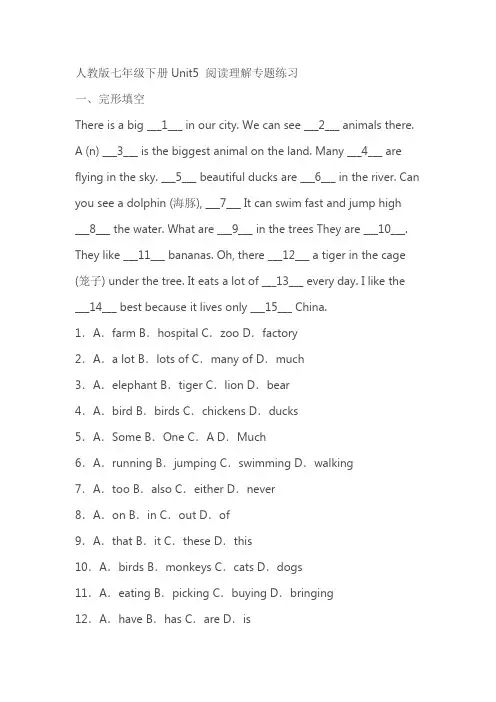
人教版七年级下册Unit5 阅读理解专题练习一、完形填空There is a big ___1___ in our city. We can see ___2___ animals there.A (n) ___3___ is the biggest animal on the land. Many ___4___ are flying in the sky. ___5___ beautiful ducks are ___6___ in the river. Can you see a dolphin (海豚), ___7___ It can swim fast and jump high___8___ the water. What are ___9___ in the trees They are ___10___. They like ___11___ bananas. Oh, there ___12___ a tiger in the cage (笼子) under the tree. It eats a lot of ___13___ every day. I like the ___14___ best because it lives only ___15___ China.1.A.farm B.hospital C.zoo D.factory2.A.a lot B.lots of C.many of D.much 3.A.elephant B.tiger C.lion D.bear4.A.bird B.birds C.chickens D.ducks5.A.Some B.One C.A D.Much6.A.running B.jumping C.swimming D.walking 7.A.too B.also C.either D.never8.A.on B.in C.out D.of9.A.that B.it C.these D.this10.A.birds B.monkeys C.cats D.dogs11.A.eating B.picking C.buying D.bringing 12.A.have B.has C.are D.is13.A.grass B.leaves C.meat D.bamboos14.A.tiger B.panda C.lion D.koala15.A.in B.on C.at D./二、阅读理解AMost people don’t know about blobfish (水滴鱼). They are the world’s ugliest animal.Blobfish live in the sea near Australia and New Zealand. For most of time, they stay in the water between 600 to 1,200 meters deep. When some little fish swim past them, they try to catch them for food. They can grow up to 30cm long. They have very large heads, small bodies and thin tails. They look like a large jelly (果冻). So they get their names.People don’t eat blobfish, because they are not good for people to eat. But fishermen kill thousands of them each year when they catch other fish in the sea. Scientists are worried that this will put the blobfish on the list of animals in danger.16.What do blobfish look likeA.Friendly. B.Ugly. C.Smart. D.Shy.17.What can we learn about blobfish from the passage A.Blobfish live in the sea around the world. B.Blobfish can grow up to 50cm long.C.Blobfish look like other fish. D.Each year thousands of blobfish are killed.18.Blobfish get their name because of their ________. A.shape (形状) B.color C.eyes D.heads19.Which of the following is NOT trueA.Blobfish eat small fish. B.Fishermen catch blobfish for food. C.Blobfish’s tails are thin. D.Blobfish’s heads are big.20.We can learn that ________ from the passage.A.there will be rules to catch blobfish B.blobfish will become pets C.there will be fewer blobfish D.blobfish can swim fastBMany people have the wrong ideas about pigs. Pigs are actually (实际上) very clean animals. On the farm, they live in dirty places, so they become very dirty. But in the wild, pigs keep themselves very clean.They are also very smart. They may be smarter than dogs. So pigs can learn things from people.Pigs are very friendly animals. Some people raise (饲养) them as pets. Of course, people raise the small kind, not the big kind. Small pigs are very cute. And they don’t break things in the house. Big pigs usually live outside on the farm, not in people’s homes. 21.Which words can describe (描述) pigsA.Nervous and strange. B.Dirty and stupid. C.Dangerous and friendly. D.Smart and friendly.22.What does the underlined phrase (短语) “in the wild” mean A.In nature. B.On the farm. C.In dirty places. D.In people’s homes. 23.Which of the following is TRUEA.Pigs like to be dirty. B.People can teach pigs things. C.Dogs are smarter than pigs. D.Only farmers raise pigs. 24.What kind of pigs do people raise in their homesA.The very big kind. B.The small kind. C.The kind from farms. D.The ugly kind.25.The passage does not discuss (讨论) ________.A.pigs and pets B.pigs on the farm and in the wild C.raising dogs D.people’s wrong ideas about pigsC阅读短文,根据短文内容,从文后的六个选项中选出能填入短文空白处的最佳选项。
七年级英语下册Unit5Whydoyoulikepandas知识点总结
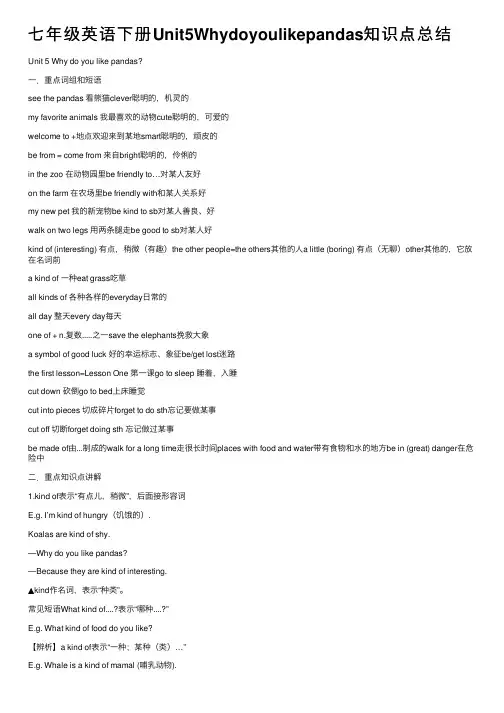
七年级英语下册Unit5Whydoyoulikepandas知识点总结Unit 5 Why do you like pandas?⼀.重点词组和短语see the pandas 看熊猫clever聪明的,机灵的my favorite animals 我最喜欢的动物cute聪明的,可爱的welcome to +地点欢迎来到某地smart聪明的,顽⽪的be from = come from 来⾃bright聪明的,伶俐的in the zoo 在动物园⾥be friendly to…对某⼈友好on the farm 在农场⾥be friendly with和某⼈关系好my new pet 我的新宠物be kind to sb对某⼈善良、好walk on two legs ⽤两条腿⾛be good to sb对某⼈好kind of (interesting) 有点,稍微(有趣)the other people=the others其他的⼈a little (boring) 有点(⽆聊)other其他的,它放在名词前a kind of ⼀种eat grass吃草all kinds of 各种各样的everyday⽇常的all day 整天every day每天one of + n.复数.....之⼀save the elephants挽救⼤象a symbol of good luck 好的幸运标志、象征be/get lost迷路the first lesson=Lesson One 第⼀课go to sleep 睡着,⼊睡cut down 砍倒go to bed上床睡觉cut into pieces 切成碎⽚forget to do sth忘记要做某事cut off 切断forget doing sth 忘记做过某事be made of由...制成的walk for a long time⾛很长时间places with food and water带有⾷物和⽔的地⽅be in (great) danger在危险中⼆.重点知识点讲解1.kind of表⽰“有点⼉,稍微”,后⾯接形容词E.g. I’m kind of hungry(饥饿的).Koalas are kind of shy.—Why do you like pandas?—Because they are kind of interesting.▲kind作名词,表⽰“种类”。
译林版五年级英语上册各单元知识点

Unit1知识点单词bear熊forest森林there(与be连用)有house房子sou p汤just right正合适,正好room房间har d硬的soft柔软的afraid害怕的in front of在…前面her她(宾格)Help!救命啊!betw een在…之间beside在…旁边really真的then然后find找到,发现their他们的,她们的,它们的词组goldilocks and the three bears金发女孩和三只熊in the forest在森林里a beautiful house一幢漂亮的房子hungry and thirsty又饿又渴tired and thirsty又累又渴too cold/ho t太冷/热just right正好,正合适very har d/soft非常硬/柔软be tired累了be afraid害怕beside the house在房子旁边betw een the desks在课桌之间in front of h e r/h im/me/t h e m在她/他/我/她们前面have a cold得了感冒pu t on your coats穿上你的衣服in Western countries在西方国家in China在中国find their cousin找到他们的表妹/弟易错词组betw een the trees在树之间(参照物必须是两个)in front of+宾语(介词后面使用宾语)the cakes in the fridge冰箱里的蛋糕three bears in front of me我前面的三只熊some sou p on the table桌子上的一些汤in front of the window在窗户前面under the chair在椅子下面how many+名词复数句型1.What a beautiful house!多漂亮的一座房子啊!2.How beautiful the house is!3.The s ou p is too cold.这汤太冷了。
(完整版)五年级下册英语知识总结思维导图

完整版)五年级下册英语知识总结思维导图Unit 1:What's your hobby。
你的爱好是什么?Vocabulary:词汇hobby:爱好collect:收集stamp:邮票coin:硬币butterfly:蝴蝶postcard:明信片Grammar:语法一般疑问句Do you have any hobbies。
你有什么爱好吗?回答疑问句Yes。
I do。
是的,我有。
No。
I don't。
不,我没有。
Unit 2:___ 天气预报Vocabulary:词汇___:天气___:晴朗的cloudy:多云的___:多雨的___:下雪的temperature:温度___:度Grammar:语法祈使句(表达请求、命令等)Take your ___。
带上你的伞。
表达温度The temperature is 25 degrees。
温度是25度。
Unit 3:A day at the farm 农场一日游Vocabulary:词汇farm:农场pig:猪___:羊cow:牛duck:鸭子horse:马___:花园Grammar:语法一般现在时___ 猪是粉红色的。
物主代词This is my sheep。
这是我的羊。
Unit 4:My dream 我的梦想Vocabulary:词汇dream:梦想astronaut:宇航员scientist:科学家singer:歌手artist:艺术家pilot:飞行员engineer:工程师Grammar:语法一般将来时I want to be an astronaut。
我想要成为一名宇航员。
Unit 5:On the farm 在农场里Vocabulary:词汇fence:围栏barn:谷仓scarecrow:稻草人tractor:拖拉机field:田地hay:干草Grammar:语法介词短语The dog is running in the field。
七年级英语下册Unit-5-Why-do-you-like-pandas知识点总结
Unit 5 Why do you like pandas?一.重点词组和短语see the pandas 看熊猫clever聪明的,机灵的my favorite animals 我最喜欢的动物cute聪明的,可爱的welcome to +地点欢迎来到某地smart聪明的,顽皮的be from = come from 来自bright聪明的,伶俐的in the zoo 在动物园里be friendly to…对某人友好on the farm 在农场里be friendly with和某人关系好my new pet 我的新宠物be kind to sb对某人善良、好walk on two legs 用两条腿走be good to sb对某人好kind of (interesting) 有点,稍微(有趣)the other people=the others其他的人a little (boring) 有点(无聊)other其他的,它放在名词前a kind of 一种eat grass吃草all kinds of 各种各样的everyday日常的all day 整天every day每天one of + n.复数.....之一save the elephants挽救大象a symbol of good luck 好的幸运标志、象征be/get lost迷路the first lesson=Lesson One 第一课go to sleep 睡着,入睡cut down 砍倒go to bed上床睡觉cut into pieces 切成碎片forget to do sth忘记要做某事cut off 切断forget doing sth 忘记做过某事be made of由...制成的walk for a long time走很长时间places with food and water带有食物和水的地方be in (great) danger在危险中二.重点知识点讲解1.kind of表示“有点儿,稍微”,后面接形容词E.g. I’m kind of hungry(饥饿的).Koalas are kind of shy.—Why do you like pandas?—Because they are kind of interesting.▲kind作名词,表示“种类”。
小学六年级英语-Unit-5-On-the-farm
2.planted trees pulled up carrots
3.collected eggs
picked oranges 4.watched a film
listened to music 5.played football
milked cows
6.played volleyball
/Id/
standed needed eated
shooted
The National Day holiday 国庆假日
farm
农场
Did you like …?
Yes,I did.I liked it very much.
No,I didn’t. I liked …
fun 有趣的事;娱乐的 That’s fun!
Miss Wang
√ √ √ √
一般过去时:
表示过去的动作或状态,一般情况下,在动 词后加ed来表示。 过去式(ed)发音:
单词以清音结尾+ed /t/ 单词以浊音结尾+ed /d/ 单词以t、d结尾+ed /Id/
汇报结束
谢谢大家! 请各位批评指正
cleaned the house
Do a survey
Played football Played table tennis Played the piano Played the violin Danced Watched TV Listened to music Washed clothes Cleaned the bedroom Watered flowers Cooked food
小学六年级英语-Unit-5-On-the-farm
六年级上英语课课练-Unit5On the farm Period 3-译林版(三起)
D Listen and writeE Read and judge一、听录音,给下列句子标序号()What did you do last Sunday?()Did you like the cartoons?()There were some fruit trees on the farm.()I watched a cartoon at home last weekend.()Helen visited a farm with her classmates on Monday.二、问答对对碰1. Were there any trees in your school?2. Where were you yesterday?3. How many people are there in your family?4. What did you do last week?5. Did you play basketball yesterday afternoon?6. I like the food there.7. Were you tired?8.What date was yesterday?三、双语园地1. 做饭__________________2. 摘苹果________________3. 浇花__________________4. 去野营__________________5. clean the house _______________6. at a camp __________________7. walk in the mountains ________________8. play a lot of games __________________重点难点,一网打尽。
四、排排序A. What did you do there?B. Yes, I did. It was fun!C. I was at a camp with my friends.D. Did you like going camping?E. We played basketball and planted trees.F. What else did you do?G. We walked in the mountains, too.H. I want to go camping, too.I. Where were you last Sunday?五、单词串串烧1. the,what,do,at, you,camp,did (?)______________________________________2.farm,trees,fruit,there,were,any,the,on (?)______________________________________3. it,we,like,very,all,much (.)______________________________________4. live, grandparents, town, a, in,small, Liu Tao’s (.)________________________________________举一反三,应用创新,方能一显身手!六、快乐阅读,在星期后的横线上写上合适的动词词组A: Hi, Ben! It was National Day holiday last week. What did you do?B: On Monday I watched a film with my family. On Tuesday and Wednesday I was at a camp. I played football with my family. On Thursday I played computer gameswith my friends. On Friday and Saturday I visited my uncle and aunt. The y’refarmers. On Sunday I stayed at home and watched TV.A: Wow, you were busy.Sunday ______________________________Monday ______________________________Tuesday_______________________________Wednesday ____________________________Thursday______________________________Friday ________________________________Saturday _______________________________D E一、听力材料:1. I watched a cartoon at home last weekend.2. Did you like the cartoons?3.Helen visited a farm with her classmates on Monday.4. What did you do last Sunday?5. There were some fruit trees on the farm.答案:4 2 5 1 3二、1~4 H D A F 5~8 G C E B三、1.cook food 2. pick apples 3. waterflowers 4. go camping 5. 打扫屋子 6. 在野营营地7. 在山间行走8. 玩很多游戏四、I C A E F G D B H五、1. What did you do at the camp?2.Were there any fruit trees on the farm?3.We all like it very much.4.Liu Tao’s grandparents live in a small town.六、Sunday watch TVMonday watch a filmTuesday play footballWednesday play footballThursdy play computer gamesFriday visit his uncle and aunt Saturday visit his uncle and aunt。
牛津小学英语6a课文及翻译
牛津小学英语6a课文及翻译Unit 1 Public signs []第一课公共标志Today is Saturday. Ben and his cousin, Jack,are in the Park.Jack is only four years old.but he always has a lot of questions. He sees some public signs in the park. He is asking Ben some questions about them.There are a lot of signs here,Ben.Yes.They're public signs.They mean different things.There's a sign on the wall.What does it mean?It means 'Danger'!Can I go in?No, you can't.You must stay away form the building.There's a sign on the grass.What does it mean?It means 'Keep off the grass'.What does that mean?It means we shouldn't walk on the grass.The sign on the bird's cage is interesting. What does it mean?It means 'Be quiet'!We shouldn't make noise here.Now I know a lot about public signs.Thank you, Ben.今天是周六。