
中式英语之鉴
中式英语之鉴读书笔记(下)

中式英语之鉴读书笔记(下)
本篇博客将继续上篇的内容,总结《中式英语之鉴》⼀书的剩余部分。
Part Two:句⼦结构
上⼀部分是希望让⼀个英语句⼦变得简洁,本部分则是希望让句⼦变得清晰且有逻辑。上⼀部分是雪中送炭,这⼀部分希望做到锦上添花。
因此,这⼀部分的错误将会⽐Part One 中的错误更难识别。
名词“瘟疫”
臃肿晦涩的名词会如同「瘟疫」⼀般,影响、⼲扰、蔓延⾄整个句⼦的其他部分,从⽽使整个句⼦由于若⼲个使⽤不慎的名词变得沉闷。⽽
中式英语的⼀⼤特征就是,名词的使⽤⼗分臃肿⽽晦涩。Part One中介绍过了 冗余名词、 ⽆义名词 与 种类名词 等,这些名词有时甚⾄会额
外引⼊⼀些⽆意义的词,本章将主要介绍那些会对健康句⼦带来的「瘟疫」的抽象名词。请谨慎使⽤抽象名词
「具体」的名词要⽐「抽象」名词更清晰、更有⼒。滥⽤抽象名词的句⼦The prolongation of the existence of this temple is due to the solidity of its construction.
This temple has endured because it was solidly built原句中各个抽象名词的堆叠让整个句⼦都看起来⾮常别扭image packaging and impression management
dress to create a favorable impression
解决⽅案可以将原有的抽象名词动词化,即直接写出来要做的事情即可,不必造作式地转换成名词叙述,例如:there can be no achievements in our work
we can achieve nothing
将抽象名词换为动名词
或者还可以将抽象名词换为动名词,这样可以将原有⽣硬晦涩的句⼦变得更有⽣机,⽽且使原来搭配的指向性更强。economic revitalization will be an xxx
中式英语之鉴阅读
中式英语之鉴阅读
Here is an essay on the topic of "Appreciating Chinese-Influenced
English" with a word count exceeding 1,000 words, written entirely in
English without any additional titles or punctuation.
The English language has evolved significantly over the centuries
with various influences from different cultures and regions around
the world. One of the most fascinating and unique forms of English is
what is often referred to as "Chinese-influenced English" or
"Chinglish." This hybrid linguistic style has emerged as a result of the
dynamic interaction between the Chinese language and the English
language, creating a distinctive mode of expression that offers
valuable insights into cross-cultural communication and the
adaptability of language.
At its core, Chinglish represents the creative and pragmatic attempts
中式英语之鉴 逻辑连接

中式英语之鉴 逻辑连接
中式英语是指中国人在使用英语时,受到汉语思维方式影响,导致表达方式含糊不清或语法错误的现象。以下是中式英语常见的逻辑连接错误示例:
1. 重复使用连接词:
错误:I like swimming and I like running and I like playing tennis.
修正:I like swimming, running, and playing tennis.
2. 未使用适当的连接词:
错误:He is good at playing basketball, he also excels in
volleyball.
修正:He is good at playing basketball, and he also excels in
volleyball.
3. 强行使用某个连接词:
错误:She is my best friend; however, she is always late.
修正:She is my best friend, and she is always late.
4. 逻辑顺序错误:
错误:I am tired, but still study all night.
修正:I study all night even when I am tired.
5. 错误使用否定词:
错误:I don't like neither coffee nor tea.
修正:I don't like either coffee or tea.
6. 逻辑对比混乱:
错误:China has a large population, but the United States has big
cities.
修正:China has a large population, while the United States has
big cities.
浅谈中式英语之鉴
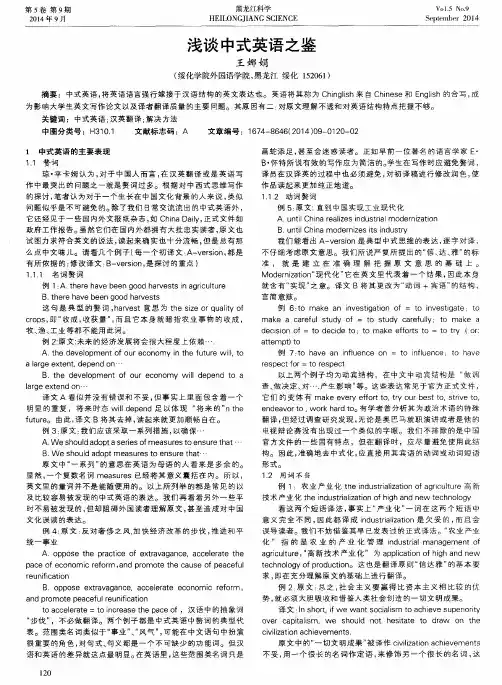
第5卷第9期 2014年9月 黑龙江科学 HEIL0NGJIANG SCIENCE V01.5 0.9 September 2014
浅谈中式英语之鉴
王娜娟
(绥化学院外国语学院,黑龙江绥化152061)
摘要:中式英语,将英语语言强行嫁接于汉语结构的英文表达也。英语将其称为Chinglish来自Chinese和English的合写,成
为影响大学生英文写作论文以及译者翻译质量的主要问题。其原因有二:对原文理解不透和对英语结构特点把握不够。
关键词:中式英语:汉英翻译;解决方法
中图分类号:H310.1 文献标志码:A 文章编号:1674—8646(2014)09—01 20—02
1 中式英语的主要表现
1.1赘词
琼・平卡姆认为,对于中国人而言,在汉英翻译或是英语写
作中最突出的问题之一就是赘词过多。根据对中西式思维写作
的探讨,笔者认为对于一个生长在中国文化背景的人来说,类似
问题似乎是不可避免的。除了我们日常交流流出的中式英语外,
它还经见于一些国内外文报纸杂志,如China Daily,正式文件如
政府工作报告。虽然它们在国内外都拥有大批忠实读者,原文也
试图力求符合英文的说法,读起来确实也十分流畅,但是总有那
么点中文味儿。请看几个例子(每一个初译文:A—version,都是
有所依据的:修改译文:B—version,是探讨的重点)
1.1.1 名词赘词
例1:A.there have been good harvests in agriculture
B.there have been good harvests
这句是典型的赘词,harvest意思为the size or quality of crops,即“收成,收获量”,而且它本身就暗指农业事物的收成,
牧、渔、工业等都不能用此词。
例2:原文:未来的经济发展将会很大程度上依赖….
A.the development of our economy in the future will,to
中式英语之鉴from-nowhere
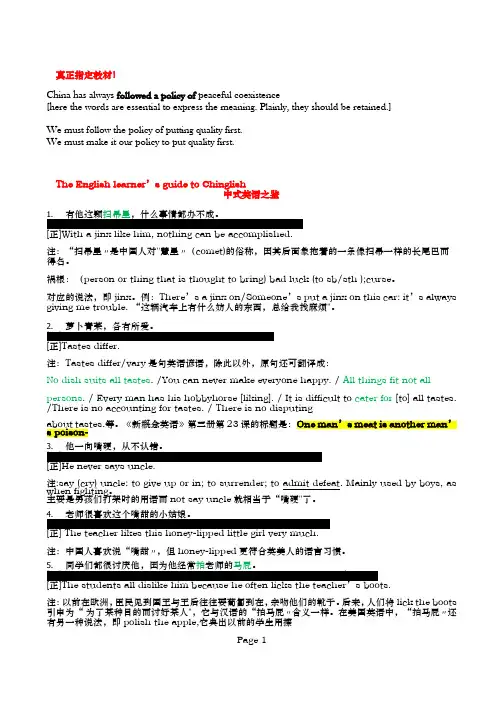
真正指定教材!
China has always followed a policy of peaceful coexistence
[here the words are essential to express the meaning. Plainly, they should be retained.]
We must follow the policy of putting quality first.
We must make it our policy to put quality first.
The English learner’s guide to Chinglish 中式英语之鉴
1. 有他这颗扫帚星,什么事情都办不成。 [误]With a comet like him, nothing can be accomplished. [正]With a jinx like him, nothing can be accomplished.
注:“扫帚星〃是中国人对''慧星〃(comet)的俗称,因其后面象拖着的一条像扫帚一样的长尾巴而得名。
祸根:(person or thing that is thought to bring) bad luck (to sb/sth );curse。
对应的说法,即 jinx。例:There’s a jinx on/Someone’s put a jinx on this car: it’s always giving me trouble. “这辆汽车上有什么妨人的东西,总给我找麻烦"。
2. 萝卜青菜,各有所爱。 [误] Some prefer radish but others prefer cabbage. [正]Tastes differ.
注:Tastes differ/vary是句英语谚语,除此以外,原句还可翻译成:
10中式英语之鉴
1Dangling Modifiers
上个章节中,我们讨论了位置错误的修饰语,即功能和形容词或副词⼀样但因为位置
错误⽽不合逻辑的短语。正如我们所⻅,最常⻅的处理⽅式就是改变句⼦中的语序。
另⼀组修饰语不合逻辑不是因为位置错误,⽽是因为和句⼦中其他成分错误的语法关
系。因此,改变语序通常不⾜以纠正,译者需要找到其他解决⽅式。我们现在就要来
讨论这类通常认为是“⽆归属的”或者“垂悬的”修饰语。
以学⽣、记者和其他英语⺟语作者为对象的规范性⽂章和⼿册,列举了⼀系列不同类
型的垂悬修饰语。在本章中,我们主要了解那些经常出现在中国译者作品中的垂悬修
饰语。⼀共分为5种,其中3种为动词形式(分词,动名词,不定式)。另两种是介词短
语和独⽴形容词。
垂悬分词
正如你在英语学习过程中了解到的⼀样,分词是动词形式的⼀种,它在句⼦中的功能
和形容词⼀样。规则的分词分为以-ing结尾的现在分词(a pleasing child 令⼈愉悦的孩
⼦)和以-ed结尾的过去分词(a pleased child 感到愉悦的孩⼦)。
像其他形容词⼀样,⼀个分词(或分词短语)需要贴近其修饰的名词或代词。如果没
有,就成为“⽆归属”(“垂悬”)。垂悬分词是英语⺟语者在写作中犯的最常⻅的错误之
⼀,因此我们也不必意外它经常出现在中式英语中。
在上⼀章节中,我们其实已经讨论过垂悬分词了,尽管我们并没有下定义。例如:
-Inside the grand Dacheng Palace in the middle of the Temple of Confucius,
musicians will play tunes allegedly refined by Confucius, using antique instruments
including the stringed guqin.
2在这个句⼦中,本⽤于修饰“musicians”的分词短语反⽽更贴近前⾯的名
词“Confucius”。如你所想,要想建⽴正确的逻辑联系,修改者将这个短语移到了它本
中式英语之鉴英文简易介绍
中式英语之鉴英文简易介绍
英文回答:
Chinese Pidgin English (CPE), also known as Chinglish,
is a specific form of simplified English used in China
primarily for communication between native Chinese speakers
and foreigners who do not speak Mandarin or other Chinese
dialects. It is characterized by its unique grammar,
vocabulary, and pronunciation, which often deviate from
standard English.
CPE emerged in the late 19th and early 20th centuries
during a period of increased trade and interaction between
China and the West. As foreign merchants and missionaries
arrived in China, they found it difficult to communicate
with the local population, who spoke a variety of Chinese
dialects. To facilitate communication, a simplified form of
English evolved, borrowing words and phrases from both
languages and adapting them to the Chinese grammatical
[详解]中式英语之鉴
Part One: Unnecessary WordsAll authorities on the style of English prose agree that good writing is concise. Careful writers say what they mean in as few words as
possible.
Vigorous writing is concise. A sentence should contain no unnecessary words, a paragraph no unnecessary sentences, for the same
reason that a drawing should have no unnecessary lines and a machine no unnecessary parts.
It follows that any words which perform no useful function in the
sentence—that is , which add nothing to the meaning—should be edited out.
Almost every text that has been translated into English from Chinese( or that has been written directly in English by a native speaker
of Chinese) contains unnecessary words. Draft translations are commonly
full of them, and even polished final versions are seldom free of them. Read anything that has been published in English for foreign
中式英语之鉴中文版P175-P187
P175-P187——牛睿译
反对“疫病”
正如我们在第一章所看到的,如果一个名词是空洞的或多余的,就可以简单地将其删除。然而,如果它承载的意义的一个必要元件,译者就必须找到其他的方式处理它。
通常的解决办法是转变名词的词性。接下来我们来看看转变词性的三种方式。如果这三种都不可行,下面还有一个有效的方法可以选用。
1、用动词提代名词
这是最常用也是最先可以考虑使用的策略。我们在第一章的开始就已经反复使用这个方法来处理“多余的动词+名词结构”(“make an improvement”= “improve”)
这个方式还适用于很多情况。例如:
A: Adherence to Marxism is vital to China, and so is adherence to socialism.
B: It is vital for us to adhere to Marxism and socialism.
(坚持马克思主义和社会主义是至关重要的。)
A: otherwise, there can be no achievements in our work
B: otherwise, we can achieve nothing
(否则,我们将一事无成)
A: such behavior on the part of leading cadres will encourage extravagance
B: if leading cadres behave that way, they will encourage extravagance
(领导干部的如此行为方式将会带动铺张浪费)
A: reading of newly published materials is also important
中式英语之鉴英文版
中式英语之鉴英文版
英文回答:
Chinese English, also known as Chinglish, is a blend of
English and Chinese languages that is characterized by the
use of English words and phrases with Chinese grammar and
syntax. It is often used in informal settings, such as
social media, text messages, and spoken conversations.
There are several reasons why people use Chinese
English. Some people find it easier to express themselves
in this way, as it allows them to use familiar Chinese
words and phrases while still communicating in English.
Others use it as a way to show their cultural identity or
to create a sense of humor.
Chinese English can sometimes be difficult to
understand for native English speakers, as it often uses
words and phrases that have different meanings in English.
For example, the phrase "no problem" is often used in Chinese English to express agreement, whereas in English it