
冀教版英语七年级下册教案
冀教版英语七年级下册教案 Lesson One May I Go to Beijing? 1.导入新课: 教师出示一副天安门广场的图片。 Ask: Do you know what its name is? Help them to answer: It’s Tian’anmen Square. Teach: square Ss repeat: square. Ask: Do you know where it is? Ss: It’s in Beijing. T: Beijing is the capital city of our country. Have you been to Beijing? (教师提示学生汉语) S1: I have been to Beijing. S2: I have never been to Beijing. T: Li Ming is a student. He has never been to Beijing. He wants to go to Beijing very much. Now he is talking with his mother. 2.介绍本课内容。 1) 教师讲解情态动词may的用法: May I go to Beijing? 肯定回答:Yes, you may. 否定回答:No, you may not. 2) too„to句型: ZhaoYang is too young to go to school. 3) go+ ving go shopping,go boating,go skating 3.表演 学生听两遍录音,模仿录音,朗读对话。首先教师扮演妈妈,找一学生扮演李明,进行表演。然后找三组学生到前面进行表演,评出最佳表演小组。 4.展示能力 教师提供词组:The Water Park, go boating, eat an ice-cream, go swimming. 学生两人一组编对话,要求学生运用句型: May I „? Yes, you may. No, you may not. 5.总结拓展 总结本课重点短语和句型,要求学生记住谚语, “One is never too old to learn.” 告诫学生“学无止境,积极进取”。 6.随堂测试 测试本课内容,结束本课。 Lesson 2 May I Invite Danny and Jenny? 1.复习 1). 采用小组表演形式复习Lesson 1 2)复习打电话的日常用语。 A: Hello! 喂! B: Hello!This is Ann speaking. Who’s that? 喂!我是安,你是谁? 2.导入新课 请一名学生来当记者,采访李明: Journalist: I know you want to go on a trip to Beijing. Who are you going with? Li Ming : I want Danny and Jenny to come on our trip to Beijing Journalist: Does your mother agree with you? Li Ming: I’m not sure. / I don’t know. 3.听、读、操练 学生听一遍录音,回答教师的问题。 “Does Li Ming’s mother want to talk to Mrs. Smith? 再放两遍录音,学生跟读。两人一组进行练习。 4.讲解本课内容 1) 教师讲解情态动词can的用法: can + 动词原型 Jenny can come. She can sing English songs. 2) leave 与leave for 辨析 We will leave Shanghai at 9:00. 我们将在9点离开上海。 They leave for Shanghai at 9:00. 他们在9点向上海出发。 3)arrive When do you arrive in Beijing? 你们什么时候到达北京? They will arrive at the hospital before six o’clock. 他们将在6点前到达医院。 5.打电话表演 四人小组表演对话。要求动作表情到位 ( 李明和詹尼的动作必须符合情节,并且要表现出迫不及待的心情 )。评出最佳表演小组。 6.总结拓展 总结本课重点短语和句型。 7.随堂测试 请试着翻译下列词组,看谁写得又快又准。 1. 我们的旅行 2. 与格林夫人交谈 3. 去旅行 4. 在加拿大居住 5. 到达上海 6. 向天津出发
Lesson 3 How Far Is Beijing?
1. 复习--导入新课 教师出示一小男孩数数字的图片。 教师:Look at the picture. What’s the boy doing? 帮助学生回答:He is counting. Ss repeat: count 教师:Can you count from one to one hundred? 抽取几个学生进行速诵数字的比赛。one, two, three, four„ 教师:Can you count from one hundred to one thousand? Can you count from one thousand to ten thousand? 2. 听,读数词。 放第一部分的录音,学生跟读三遍,教师纠正不正确的发音。 如: thousand。 让学生反复练习。 3. 数词读写比赛。 4. 四人小组用阿拉伯数字写出20个数词,请一位同学做评委,掌握好其他三人读完数字所需的时间, 评出获胜者。 教师在幻灯片上出示一系列数词, 各小组评出的获胜者在班级进行决赛,评出速读冠军。 5. 教师在幻灯片上出示一系列数词, 全体学生用英语写出数词, 看谁写得又快有准确。 6.听录音,找数词 教师放第二部分的录音,学生找出对话中出现的数词。 找三位同学回答所听到的数词。其他学生齐读数词,然后随录 音模仿。 教师讲解距离的表达方法: How far is it from your home to school? It’s two kilometres. How far is it from China to Canada? About eight thousand five hundred kilometres. 7.小组操练句型 教师给出关键词,学生两人一组进行练习。 1) Shijiazhuang Qinghuangdao 600 kilometres 2) home factory 5 kilometres 8.总结拓展 总结本课重点短语和句型。 Lesson 4 How Can We Go to Beijing?
1.导入新课 教师播放一段飞机、公共汽车、火车的视频片断,播放同时教师介绍: An airplane is fast. A bus is slow. A train is faster than a bus but slower than an airplane. 2.听录音,学新词 教师出示飞机、公共汽车、火车的图片,学生边看图片,边听课本录音第一部分,掌握新词 airplane, fast. slow的读音。 3.讲解形容词的比较级 1) 教师出示自行车和公共汽车的图片,说:A bike is slower than a bus. A bus is faster than a bike. 2) 出示公共汽车和火车的图片,说:A bus is slower than a train. A train is faster than a bus. 教师讲解比较级的构成形式:A +is +形容词的比较级+than+ B. 3) 学生运用教师出示的交通工具图片进行模仿操练。 4.听,读, 说 教师提问:How can Li Ming go to Beijing? 学生听一遍录音后,找到问题的答案。 学生跟读录音两遍,两人小组进行练习。 5. let sb do sth 句型操练 Let’s go to Beijing by plane. Let’s sing a song. Let’s take a train. 6.唱歌。 教师讲解歌词,学生唱歌,巩固复习本课的重点句型。 7.总结拓展 总结本课重点短语和句型。 8.随堂测试
Lesson 5 Leaving and arriving
1.复习 请两组同学表演 Lesson 4 , Part2。 2.导入新课 教师:We have known Jenny and Danny will come to China. They will go on a trip to Beijing. Now I have some questions to ask you. Show flash cards, ask the students to answer the questions. 1) When do they leave Canada? 2 ) When do they arrive in China? 3)When do they leave for Beijing? 4)When do they arrive in Beijing? 3.听,读,说 教师放两遍第一部分的录音,学生找到问题的答案。 学生以两人为小组,问答幻灯片上的问题。教师要求学生正确运用介词in, on ,at。 4.介绍本课新内容 1)教师出示写信、购物、天安门广场、故宫的图片,教学词组:write home, go shopping, go to Tan’anmen Square, go to the Palace Museum. 2) 生以四人小组为单位,拿出课前准备好的台历,听录音,读单词,掌握星期名称Sunday, Monday, Tuesday, Wednesday, Thursday, Friday, Saturday. 5.根据表格内容,谈论旅行计划。
冀教版英语七年级下册教案 Lesson 1 A Trip to China
Lesson 1 A Trip to China教学设计【教学目标】1.Master the words and phrases:trip, silk, road, lead, chance--; guess what, learn about--2.To enable students to make polite requests and answers in English.【教学重难点】重点:掌握本课重点单词、短语及提出关于旅行请求的句型。
难点:使学生能够有礼貌地用英语提出请求及回答。
【课时安排】1课时【授课时间】2020年( )月( )日星期( )【教学过程】一、导入环节(2分钟)(一)导入新课,板书课题导入语:Good morning, class. How are you? Today, we are going to learn:Lesson 1 A Trip to China(二)出示学习目标过渡语:First ,let’s read the learning goals together.1.我要掌握单词和短语:trip, silk, road, lead, chance--; guess what, learn about--2.通过学习,我要学会能够有礼貌地用英语提出请求并做出回答。
过渡语:I believe everyone can achieve your goal? Can you ? Let’s begin .二、先学环节(15分钟)过渡语:First look at the guides carefully and then finish the tasks step by step.(一)出示自学指导1.读课文,划出不熟悉的单词、短语和句子2.完成自学检测(二)自学检测反馈I.抄写本课生词(英语、词性、汉语意思)(1)____________________(2)_____________________(3)__________________ (4)____________________(5)_____________________(6)__________________ (7)____________________(8)_____________________(9)__________________ Ⅱ.翻译下列短语1.学习;了解____________ 2.丝绸之路____________ 3.lead the trip____________ 4.worry about…____________5.think about___________6.send sb an email____________ 7.guess what____________8.a trip around China____________参考答案:1.learn about2.the Silk Road 3.带领这次旅行4.担心……5.考虑6.给某人发一封电子邮件7.猜猜看;你猜怎么着8.环中国旅行III.根据课文内容完成下列句子1.这个月我们在学校学习有关丝绸之路的知识。
冀教版七年级英语下册教案Unit 1 第1课时

Unit 1 A Trip to the Silk Road 单元目标第一课时Lesson 1 A Trip to China 课时目标自主学习一、根据句意及汉语提示写出单词。
1.She led(带路)me into the drawing-room.2.Jenny's father and mother read the note(便笺).3.I had to give him a chance(机会).4.He sent (寄)me a note to thank me for the dinner.5.We won the game.What good news(消息)!二、写出下列画线短语的汉语意思。
1.Guess what!We're learning about the Silk Road this month in school.猜怎么着;了解2.Read the note from Jenny's school and take turns asking for permission to go on the trip.轮流;请求允许;去旅行自主学习环节1新课导入T:Hello, boys and girls.Do you like to travel?Ss:Yes.T:So, tell me something about your travel experiences.S1:I went on a trip to Beijing last summer with my parents.We visited many places of interest...S2...设计意图:师生之间的问答谈及旅行,这就自然而然地引出本课时的话题,为接下来的课文学习作铺垫。
环节2新课学习1.教师邀请3名学生分角色朗读教材第2页的对话内容,教师注意纠正学生的发音问题。
2.教师让学生快速阅读对话,阅读后邀请一名学生说出该对话谈论的主题。
【冀教版】七年级英语下册:Unit 1 A Trip to the Silk Road全单元教案
Unit 1 A Trip to the Silk RoadLesson 1 A trip to ChinaI. Learning aimsKey vocabulary: trip silk road lead note chance send news Key phrases: learn about(学习,了解);learn(…) from…(向……学习……、从……获得……知识);learn to do sth.(学习做某事)send sb. sth.= send sth. to sb.(把某物寄给某人)tell sb. sth.= tell sth. to sb.(告诉某人某事)think about(考虑、认为)Key structures: What does \do sb. think about sth.?Practice listening、speaking、reading and writing skills.II. Learning important pointsWe are learning about the Silk Road this month in school.这个月我们正在学校学习丝绸之路。
(1).learn about 学习、了解(2).learn(…) from…(向……学习……、从……获得……知识)(3).learn to do sth. 学习做某事learn to swim 学习游泳learn to ride a bike 学习骑自行车(4).the Silk Road2.Mum and dad, may I ask you a question?爸爸妈妈,我可以问你们一个问题吗?May I…? 此句式表达有礼貌地请求对方允许,语气十分委婉,还可以表达为:Could I \ Can I?其肯定回答常用:Yes.可以。
\ Sure.\ Certainly.当然可以。
冀教版七年级英语下册Unit7全单元教案
Unit 7 Sports and Good HealthLesson37:You Are What You Eat!Ⅰ.Learning aims:1:Grasp main words:truth decide change habit usual health alful。
2:Understand important sentences.3:Know about some food are good for us and have a balanced diet.Ⅱ.Learning main points:1:Grasp words and phrases.2:Key sentences and structures:There be 句型.3:Learn about You Are What You Eat!Ⅲ。
Learning difficulties:1: Grasp words and phrases.2:There be 句型。
3: Learn about You Are What You Eat!。
Ⅳ。
导学环节:(一)self—learning:1:Talk about food they like and dislike in group of 4 ,then make a list of which food is good for us which are bad,read out food are good for us。
Then look at Lesson37.Listen to the tape and complete Let's Do It 1,read the passage again and check in group of 4。
2:小组合作互助释义:英汉互译to tell you the truth ________as uaual________have a dream______ You Are What You Eat!________________ be good for_________饮食习惯醒来谚语Complete Let’s Do It 2 then read the paassage loudly and check. (二)展示交流:小组展示:Complete Let's Do It 4讨论如何培养良好的饮食习惯,怎样关爱健康?(三)拓展提升:反馈矫正:Complete Let's Do It 3and check in group of 4.(四)课堂作业:1:朗读课文.2:复习课堂中自己掌握不够彻底的知识。
最新冀教版七年级下册英语教案(全册)
冀教版七年级英语下册教学计划一、学情分析:经过一学期的学习,七年级大部分学生对英语仍然保持着浓厚的兴趣,但有少数学生由于遇到困难,教学兴趣可能会开始减退。
因此,这个学期在教学中,教师应该以学生的发展为宗旨,以培养学生的创新精神和实践能力为重点,面向全体学生,在激发学生兴趣的同时,扎扎实实地从每个学生抓起。
教师在以活动为课堂教学的主要形式的同时,要充分发挥任务性教学的优化使用,设计丰富多彩的教学活动,有效的教学任务。
同时注意到学生中存在的两极分化,教学内容注意由简到难,循序渐进,在知识的复现中做好及时补差工作。
充分培养学生的听说读写能力,尤其要加强识读,拼写的能力,重视阅读能力和写作能力的同步培养,重视英语作为语言的交际功能。
结合“双减”政策的进一步落实,减少作业量,杜绝低效作业,实行分层次作业布置。
二、教材分析:本册教材分为8个单元,每单元6课,共48课。
冀教版初中英语是根据“新课程标准”中一级要求进行编写,以“话题---功能---结构---任务”相结合的原则,力求使话题、功能、结构和任务四个方面在比较真实的情景中紧密联系,融为一体;本教材提倡“任务型”的教学模式,让学生在教师的指导下,通过感知、体验、实践、参与和合作等方式,实现任务的目标,感受成功。
在教学过程中进行情感和策略调整,以形成积极的教学态度,促进语言实际运用能力的提高。
在设计教案时,不但要对培养学生的综合素质发挥积极作用,同时也要满足立德树人的要求。
三、教学目标:1.能按要求掌握所学的单词和句型。
2.能运用日常交际用语,活用句型,进行简单的交流,并做到大胆开口,发音正确,所用话语与场合符合。
3.能在图片、手势,情景等非语言提示的帮助下,听懂清晰的话语与录音。
4.培养良好的书写习惯,能做到书写规范整洁。
5.培养良好的听英语、读英语、说英语、用英语的习惯,能自觉的模仿语音、语调,逐步培养语感。
6.能在任务型教学的过程中运用相关的语言知识,完成某项任务,并促使语言能力的提高。
冀教版英语七年级(下)全册教案
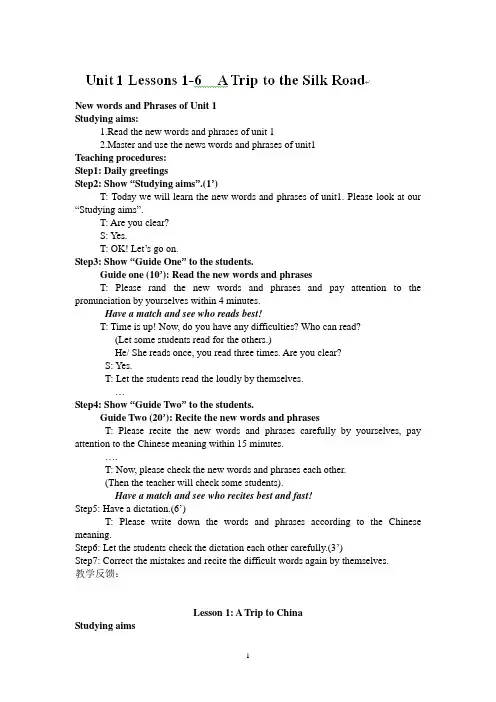
New words and Phrases of Unit 1Studying aims:1.Read the new words and phrases of unit 12.Master and use the news words and phrases of unit1Teaching procedures:Step1: Daily greetingsStep2: Show “Studying aims”.(1’)T: Today we will learn the new words and phrases of unit1. Please look at our “Studying aims”.T: Are you clear?S: Yes.T: OK! Let’s go on.Step3: Show “Guide One” to the students.Guide one (10’): Read the new words and phrasesT: Please rand the new words and phrases and pay attention to the pronunciation by yourselves within 4 minutes.Have a match and see who reads best!T: Time is up! Now, do you have any difficulties? Who can read?(Let some students read for the others.)He/ She reads once, you read three times. Are you clear?S: Yes.T: Let the students read the loudly by themselves.…Step4: Show “Guide Two” to the students.Guide Two (20’): Recite the new words and phrasesT: Please recite the new words and phrases carefully by yourselves, pay attention to the Chinese meaning within 15 minutes.….T: Now, please check the new words and phrases each other.(Then the teacher will check some students).Have a match and see who recites best and fast!Step5: Have a dictation.(6’)T: Please write down the words and phrases according to the Chinese meaning.Step6: Let the students check the dictation each other carefully.(3’)Step7: Correct the mistakes and recite the difficult words again by themselves.教学反馈:____________________________________________________________ _____________________________________________________________________ _____________________________________________________________________Lesson 1: A Trip to ChinaStudying aims1.Understand the meaning of this dialogue.2.Recite some important sentences and structures.Teaching procedures:Step1: Daily greetingsStep2: Show “Studying aims”.(1’)T: Today we will learn lesson 1. Please look at our “Studying aims”…T: Are you clear?S: Yes.T: OK! Let’s go on.Step3: Show “Guide One” to the students.Guide One (6’): Read and translate the dialogue of lesson.T: Please read and translate the dialogue of lesson by yourselves. If you have any questions, you can ask your classmate or ask me. Understand?S: Yes.T: 2 minutes. Please go.Have a match and see who reads best!…T:OK, now, do you have any questions? Who can read it?(Let some students read for the others.)He/ She reads once, you read twice. Are you clear?S: Yes.T: Please go. (Read the dialogue in groups)Step4: Show “Guide Two”.Guide Two(7’): Read the dialogue and finish the exercise within 4 minutes.T: Please read the dialogue and finish the exercise 1 & 2 on page 3within 4 minutes.Let’s have match, who can do it best?( Ask two students to finish it on the blackboard.)…T: Now, let’s check the answers together.Step5: Show “Guide Three”.Guide Three(8’): Please recite some important sentences from the dialogue1).We’re learning about the Silk Road this month in school.2).May I ask you a question? Yes, you may.3). Who will learn the trip?4). This is a good chance for you.5)I will send Li Ming an e-mail and tell him the good news.T: Now I will give you five minutes to recite the.Time is up. Who can recite? Please check with your classmates.(Then the teacher will check some students).Step6:Do exercise (一) (10’)Fill in the blanks with words in the box .(P3-3)Let the two students finish it on the blackboard.后进生板演。
冀教版英语七年级下册 Lesson 1 A Trip to China教案
Lesson 1 A Trip to China 教案课题Lesson 1 A Trip to China单元Unit1 学科English年级七下学习目标知识与技能目标:(1)掌握词汇:trip, silk, road, lead, note, chance, send, news.(2)掌握短语及句型:1.语法讲解一般将来时2.plan sth.“计划某事”;plan to do sth.“计划做某事”。
3.lead sb.to do sth.“致使/导致某人做某事”。
4.be made of “由……制成”。
5.chance to do sth.”或chance“of doing sth.“有机会做某事”6.send sth to sb用send sb sth。
送给某人某物。
7.a piece of news 一则新闻。
过程与方法目标:能够在日常情境下使用相关的单词,短语知识点进行有关旅游计划的交谈。
情感态度与价值观目标:激发和培养学习英语的兴趣,用所学英语进行交际的意识和勇气。
重点掌握本课时的重点词汇、短语及句型。
难点 1.会在生活中灵活运用所学内容。
2.掌握一般将来时的用法。
导入新课Step 1:Lead-in展示相关图片。
Step 2:展示问题1. Do you know what it is?提问学生讲授新课Step 1:Learn new wordsRead and ask the students to fill in the blanks.Step 2:Listen to the tape and answer questions.Step 3Read the dialogue in the lesson and answer the questions.。
冀教版英语七年级下册教案
Lesson 1 May I Go to Beijing? Lesson ObjectivesAt the end of this lesson, students will be able to:1. understand the meaning of the text2. remember the mastery vocabulary3. find and use the list of mastery vocabulary in Lesson 8Class OpeningGREETINGThis is a new term. Greet the students by saying Hello, class. How is your vacation?New ConceptsDEMONSTRATE Demonstrate the word trip. Explain it in English like this:Li Ming is going to Beijing.Li Ming wants to go to Beijng.That is a trip.Li Ming is going on a trip to Beijing.Then point to the picture in No. 1 of the student book and ask the class: Where is he going? If you wanted too to on a trip, what would you do next?Look at the picture in No. 2 of the student book with your class. What does Li Ming do next? DRILLMay I…? Yes / Use word cards in a pocket panel to show the students how to substitute words in No. Point to the words as you say them.STUDENT BOOK L1Play the tape of the text in the student book. Ask the students to listen carefully as they follow along in their student books.PLAY “MOTHER, MAY I”Play it in a simple form, with numbers and big or little steps. You could also play variation 1 of and e at eat read a book, sing a song, write a story, draw a picturethe game with phrases such asan apple. If you do this, brainstorm possible phrases before you start the game.ACTIVITY BOOK Finish Exercise 2.Class ClosingRetrospect of the lessonLesson 2 May I Invite Danny and Jenny? Lesson ObjectivesAt the end of this lesson, students will be able to:1. understand the meaning of the text2. get familiar with the oral vocabularyClass OpeningGREETINGRemember to greet the students with phrases they have learned.PLAY “MOTHER, MAY I?”May I…? Yes/ No, you ma y / may not.This is a good game to review New ConceptsDEMONSTRATE Role-play come and g o go with students in the class. Use gestures to make your meaning clear. For come and then goexample, ask individual students to Lead the class through a dialogue such as this:Teacher: I want to go on a trip to Beijing! (Pick up your suitcase, point ahead and start walking.) (Start walking Here I go! (Stop and point to a student.) You come, too. You come with me.again, with the student.) Let’s go.PRACTICEPlay “The Trip Game.” Refer to the “Games” section at the back of this guide. DEMONSTRATEarrive. The students know most of the words in the sentences Note that this lesson uses leave and a rrive.that use leave and arrive. Can they guess what the words mean? Remember to praise any student who tries to answer. STUDENT BOOK L2Play the tape of the text in the student book. They follow the text in their book and pay special go on a trip.attention to c ome on our tripcome on our trip and g o on a tripACTIVITY BOOK Finish Exercise 2.PRACTICEDiscuss the story in the student book. What does Li Ming want? (He want s Danny and Jenny to come.)How does Mrs. Li talk to Mrs. Smith? (On the telephone.) where is Mrs. Smith? (In Canada.) Can Jenny come on the trip? Can Danny come?Class ClosingRetrospect of the lessonLesson 3 How Far Is Beijing? Lesson ObjectivesAt the end of this lesson, students will be able to:1. understand the meaning of the text2. remember the mastery vocabulary3. find and use the list of mastery vocabulary in Lesson 8Class OpeningGREETINGPLAY “THE TRIP GAME”Play variation 2 of the game. New ConceptsDEMONSTRATE Numbers are very regular in English. Once you know how to count to 100, you can count to 1000. Teach them how to read the numbers between 100 and 1000.E.g. 101: one hundred and one426: four hundred and twenty-six917: nine hundred and seventeenDemonstrate about with examples. Draw two quick stick people on the blackboard, a very tall boy and very short girl. Draw a tape measure beside each with an exact height marker off(such as 1.8 metres and 1.2 metres ) Lead a dialogue such as:Teacher: (Point to ech stick person in turn.) He is one-point-eight metres tall. How tall is she?Class: One point two metres tall.Teacher: Yes, he is one point eight etres tall and she is one point two metres tall. He is about two metres tall and she is about one metre tall.PRACTICECall out any number and ask the students in any row to count sequentially from that number. Stop and start the game several times with different numbers and different rows of students. DEMONSTRATE1. Explain from…to…. Write the names of cities in China on the blackboard. Write the distances from our city to these cities on the blackboard. Work these out before class and use exact numbers. Then lead the dialogue like this:—How far is…? Or How far is it from…to …? It’s about…—About …kilometers.far. Lead a dialogue like this:2. Teach near and f ar—(Standing next to the volunteer.) He / She is near. (Take the volunteer to a far corner of the room and walk back to my original position. Point to the volunteer.) Is he / she near or far?—Far.ACTIVITY BOOK Finish Exercise 3.Class ClosingRetrospect of the lessonLesson 4 How Can We Go to Beijing? Lesson ObjectivesAt the end of this lesson, students will be able to:1. understand the meaning of the text2. remember the mastery vocabulary3. understand and sing the song “A plane is fast. A bus is slow.”Class OpeningGREETINGPLAY “SPELL IT”Play “Spell it” to revew modes of transportation the students have mastered (bicycle, car, cab, truck). See t he directions for this game in “Games” at the back of this guide. Leave the words on the blackboard. Then ask for volunteers to draw pictures to match the words.New ConceptsDEMONSTRATE Teach: airplane, train, fast, faster, slow, slowerslow by talking fast and slowly, or walking fast and slowly, as you make up Demonstrate fast and s lowappropriate sentences.slower than with two balls of the same size, but different colours. Demonstrate faster than and s lower thanRoll them at different speeds. Construct a sentence that describes their relative speed. As for volunteers to roll the balls and each construct a correct sentence that describes the relative speed of their ball.Demonstrate train and airplane with your large vocabulary cards. Then lead a dialogue such as:—(Hold up a vocabulary card.)What’s this?— A train/ An airplane.— Is a train faster than an airplane? (Use gestures to make your meaning clear.)— No…— No! A train is slower than an airplane. Is an airplane faster than a train?— Yes, an airplane is… — …faster than a train. Note that p lane plane is short of airplane . STUDENT BOOK L4Review the story so far. Li Ming wants to go on a trip to Beijing. His mother is coming. Jenny and Danny are coming, too. Look at the pictures in No. 1 of the student book. What’s it about? DEMONSTRATE Let’s take…Show the meaning of take first by doing some actions and at the same time holding your word cards of transportation vehicles. And then ask your students to join in your actions, and say: Let’s take a bicycle or or L et’s take a bus.Let’s take a bus. STUDENT BOOK L4Teach “The Trip Song” in No. 3 of the student book with the tape. Then sing the song. ACTIVITY BOOK Finish Exercise 2. Class ClosingRetrospect of the lessonLesson 5 Leaving and Arriving Lesson ObjectivesAt the end of this lesson, students will be able to: 1. understand the meaning of the text 2. remember the mastery vocabulary3. understand and learn “The leave arrive chant” Class Opening GREETINGPLAY “WHAT DAY IS IT?” AND SING “THE TRIP SONG” New Concepts DEMONSTRATE arrive, leaveDraw a circle at each end of the blackboard. Label one circle with the name of your home city. Label the other with the name of another city. Ask for a volunteer. You and the volunteer stand next to your home city. Lead the dialogue such as this: —Please go to…(the other circle) —(start walking to the other circle.)—Goodbye. He/ She is leaving… Please come to…(the first circle.) Now, he/she is arriving in STUDENT BOOK L 5 Play the tape. PRACTICEDivide the class into small groups: Ask each group to plan a trip to Beijing the way Li Ming planned a trip in the student book. DEMONSTRATEStudy the course plan of your students. Find out what classes they have on Monday, Tuesday, Wednesday, Thursday, Friday, Saturday and and S unday.Sunday.Teach “The leave arrive Chant” ACTIVITY BOOK Finish Exercise 2. Class ClosingRetrospect of the lessonLesson 6 Li Ming Packs His Suitcase Lesson ObjectivesAt the end of this lesson, students will be able to: 1. understand the meaning of the text 2. remember the mastery vocabulary3. understand and chant “The This That” Class Opening GREETINGREVIEW “NEAR”AND”F AR”Review near and far. Ask two volunteers to stand on close to you and one in a far corner of the room. Lead a dialogue such as:—(Indicate the volunteer close to you.) …is near. (Point to the other volunteers and talk to first volunteer.) Is…near or far?—…is far.(Repeat with other volunteers and eventually allow students to lead the dialogue.) DRILLReview regular plurals with an object-prompt drill..You show a book, and say “I have a book.” Then you add another book and say, “Now I have two books.” and so on. New Concepts DEMONSTRATE This, that, these, thoseUse objects around the room and model the following structures: Teacher Teacher: (Hold up one object.) The …is near. This is near. (Point to an object far away) The…is : (Hold up one object.) The …is near. This is near. (Point to an object far away) The…is far. That is far. (Hold up two objects.) The…s are near. These are near. (Point to two objects far away.) The …s are far. Those are far.Remind the students about some special plurals in English. Brainstorm a chart like this on the blackboard. This, that ————these, those ;sweater ——sweaters ;pencil ——pencils; pant ————pants DRILLUse word cards in a pocket panel to show the students how to substitute words in the phrase I like t his/that/these/those…(colour or other adjective )them. DEMONSTRATE Packing my / your / his / her suitcaseDo this with a real suitcase and real clothes. Use demonstrative pronouns to make choices anbout the clothes you pack. STUDENT BOOK L6Review the story so far. Jenny, Danny and Li Ming are going on a trip to Beijing. Look at the pictures in the student book with the class. What is Li Ming doing in this lesson? What is Jenny a pair of. The students have heard these words before. Does Jenny and Li Ming use the words anyone remember what they mean?Play the tape.PRACTICE IN PAIRSDivide the class into pairs. Ask each pair of students to make up a dialogue about packing a suitcase. One student packs and one student helps. They can use their flashcards for clothes to prompt conversation about clothing choices, or they can draw and cut out clothes on paper. They packing the clothes.can use a pencil case as a pretend suitcase for Yes, please / No, thanks.Do you like this/ that/ these/ those…A pair ofHow many…do you have?DEMONSTRATE Clothes, jacketTeach jacket with the real clothes.CHANTTeach “The This Tat Chant” in No. 2 of the student ook.ACTIVITY BOOK Finish Exercise 1.Class ClosingRetrospect of the lessonLesson 7 Buying Train Ticket Lesson ObjectivesAt the end of this lesson, students will be able to:1. understand the meaning of the text2. remember the mastery vocabulary3. find and use the list of mastery vocabulary in Lesson 8Class OpeningGREETINGCHANT “THE LEAVE ARRIVE CHANT”TELL THE TIMEReview how to read time. Draw clocks on the blackboard and ask the class to recite the time. New ConceptsDEMONSTRATE Jump / run / walk from…to… Sit down. Stand up. jump, run and walk. Then do these actions from one object to another. Ask for a Act out jump, run volunteer to do the actions from one object to another with you . Then ask for volunteers to do them without you. But as you direct, sometimes change your directions while your volunteers are still moving between objects. -TAC-TOE”TOE”PLAY “TIC-TAC--Tac-Toe” Give the students directions such as those below. Note that, in English, you Toe” Give the students directions such as those below. Note that, in English, you P lay “Tic-Tac-from…to… or to…from… Both are correct. The students must listen carefully to the can say f rom…to… or to…from…construction of each sentence you say.Please walk to the clock from the door.Please don’t run from the chair to the window. Please jump. PRACTICE Play “Mother, May I?” with s it, stand sit, stand and other vocabulary from this unit. ACTIVITY BOOK Finish Exercise 2. Class ClosingRetrospect of the lessonLesson 9 Getting on the Train Teaching content: mastery words: get, get on, very, stop, stand, where, see, mana dialogue about getting on the train the usage of word look and see Teaching goals: understand the meaning of the text learn some mastery words Teaching key points: difference of see and look The usage of imperative Sentence Difficult points: the usage of Imperative Sentence Teaching aids: recorder, slide projector, flashcards Type : text Teaching procedure Class opening Greet the students in English and make sure they can response correctly. duty report (such as the weather, the school life, their classmates and teachers and so on) check yesterday’s homework New lesson Step1 Lead in Discuss the questions in “THINK ABOUT IT” Do you argue with your friends? Why? Do you have a friend who gets very excited? Who? Why? Answer the questions and say “We are going to learn a dialogue today. Li Ming and his friends are looking for their seats on the train. Danny sits on a wrong seat. So there is an argument. Now let’s loo k at it. Step2 Listen to the text with the following questions: Why is Jenny angry with Danny? Which is Danny’s seat? Step3 Step3 After After After listening listening listening to to to the the the tape, tape, tape, answer answer answer the the the questions questions questions and and and read read read through through through the the the whole whole whole text. text. text. Make Make Make sure sure sure they they understand the meaning. Deal with the language points at the same time. ( using the slide projector) Step4 Listen to the tape again and let the students read after it. Step5 Practice Have them read the dialogue aloud and correct their pronunciation if necessary. Then have them act it out in roles. Step6 Come to “LET’S DO IT”: Draw a map of the inside of a train. Draw the seats and write their numbers. You should also draw the door, washroom, stairs and hot water room on the map. Describe your map to a partner. Where do you like to sit? Why? Do this part in class if time permits. Step7 A test 1. I see him ____ away. A. to run B. run C. runs D. ran 2. I _____ but ____ nothing. B. looked , saw A. looked, looked A. looked, looked C. saw, looked D. saw, saw C. saw, ’s father.3. The ____ behind the tree is MaryA. man B. woman C. boy D. girl A. man Step8 Summary Today we learn a dialogue about getting on the train. Hl Ming and his friends get on the train. They are very argument with Jenny. In this text excited. Danny sits on the wrong seat. He takes another man’s seat. He has an we learn some words such as look and see. We should be able to use them. You must practice after class. 3. Homework 1) Understand the meaning of the text 2) Learn to use the mastery words 3) Finish the exercise in the activity book 4) Read the next reading in lesson 10 Lesson 10 What Are They Looking at? Teaching content: Mastery words: find, their, woman, point a dialogue about what they see through the train window There is/are…Teaching goals: At the end of this lesson, students will be able to: understand the meaning of the text remember the mastery words find and use the list of mastery vocabulary in lesson 16 Teaching key points: 1. There is/are….2. Difference of some words: see, look, watch, find Difficult points: the usage of some words Teaching aids: tape recorder, slide projector, word cards Type: dialogue Teaching procedure Class opening greetings in English duty report (say anything he/she likes to say) check the homework of last lesson New lesson Step 1 Lead in Discuss the questions in “THINK ABOUT IT” with the students:Look out of the window of your classroom. What can you see? What can you see out of your bedroom window? In this part they will have many things to say. Their answers may be different. Gather their answers. Step 2 Play the audiotape with the following questions: What do Danny and Jenny see outside? Can they see a village? Is there a school outside the train? Answer the questions and discuss the whole text with the students. Make sure they understand the meaning of the the text. text. text. Deal Deal Deal with with with the the the language language language points points points at at at the the the same same same time. time. time. The The The teacher teacher teacher can can can write write write the the the important important important points points points on on on the the blackboard or use the slide projector. Step 3 Listen to the audiotape again and let them read after it. Step 4 Have them read the text aloud for a few minutes and then let them act out the text in roles. Step 5 Practice Divide the class into small groups. Ask them to make up a dialogue that uses loud and quiet. Please read about making making up up up dialogues dialogues dialogues in in in “Teaching “Teaching “Teaching Techniques.” Techniques.” Techniques.” To To To mak mak make e e up up up a a a dialogue, dialogue, dialogue, the the the students students students need need need to to to think think think and and and be be creative! Encourage them to use the dialogue in the student book as an example, not as something to memorize. Step 6 Deal with “LET’S DO IT”Work with two partners. Write and practice a dialogue. What else do you think Jenny, Danny and Li Ming see? Present your dialogue to your classmates. Step 7 A test 词形转换词形转换1)quiet (反义词)__________ 2) read (现在分词) _______ 3) bottle (复数) _____________ 4) drawing (原形) __________ 5) sing (现在分词) ___________ 6) tree (复数) _________ 7) photo (近义词) ___________ 8) woman (复数)________ 9) baby (复数) _____________ 10) be (第三人称单数) ________ Step 8 Activity book If time permits, do exercise 1 Homework understand the meaning of the text in lesson 10 finish the exercises in activity book next reading in student book Lesson 11 Danny’s New FriendsTeaching content: mastery words: farm, hear, meet, course, of course, lot, lot of, enjoy 2. A dialogue between Danny and his new friend 3. The usage of some phrases Teaching goals: At the end of the lesson, the students will be able to: 1. Understand the meaning of the text 2. Remember the mastery words 3. Find and use the list of mastery vocabulary in lesson 16 Teaching key points: 1.introduce where you are from 2. some useful expressions Difficult points: how to introduce yourself Teaching aids: word cards, audiotape, flashcards, and slide projector Type: dialogue Teaching procedure Class opening Greet the students in everyday English. Duty report. Main revision of last lesson. Explain when necessary. New lesson Step1 Lead in Ask the students some questions: Do you like to make new friends? Why or why not? Who is your newest friend? How do you meet? Discuss them with the class and you gather many different answers. Step2 Listen to the tape and answer the following questions: What does Danny want to buy in Beijing? Who is Danny’s new friend?Where does Wu Li come from? After listening to the tape, answer the questions and discuss the whole text. Make sure the students understand the meaning of the text. Deal with the language points in this period. Write the key points on the blackboard or use the slide projector. Step3 Listen to the audiotape again and let the students read after it. Step4 Practice Have them read the text aloud for a few minutes and correct their pronunciation when necessary. Then have them act out the dialogue in roles. Step5 Deal with “LET’S DO IT”You meet a new friend on the train or bus. What should one say to a new friend? What can one do to enjoy time with a new friend? With a partner, write and practice a dialogue. Present your dialogue to your classmates. In this part the teacher should guide the students to discuss the questions. You may give them some words to help them. Step6 A test 句型转换句型转换1)The woman behind me is singing. (一般疑问句) ______________________________________? 2) She is talking to the man. (对划线部分提问) ___________________________________? 3) The baby is sleeping. (否定句) ____________________________. Walk to the station. (否定句) _________________________. Ben is noisy in class. ( 同义句) ___________________________. Step7 Summary Today we learn a dialogue about Li Ming and his friends. They meet a new friend on the train. Then they feel hungry and they discuss what to eat. What did they say? After class, read the text fluently. Homework understand the meaning of the text finish the exercises in the activity book read the dialogue in the next lesson.Lesson 12 Lunch on the Train Teaching content: mastery words: wait, drink, fruit, grape, thirsty, bottle 2. a dialogue about having lunch on the train 3. What would you like? I would like ….. 4. Plural Forms of Nouns Teaching goals: At the end of this lesson, the students will be able to: 1. Understand the meaning of the text 2. Remember the mastery words in this lesson 3. find and use the list mastery vocabulary in lesson 16 Key points: 1. express your favourite 2. Some useful expressions 3. Plural Forms of Nouns Difficult points: how to express your favourite How to express some liquid things Teaching aids: word cards of different food, flash cards, audiotape, and slide projector Type: text Teaching procedure 1. Warming up Greetings in everyday English. Duty report (about weather, your classmates, your teacher and so on) Mainly revision of last lesson 2. New lesson Step1 Lead in Discuss the questions in “THINK ABOUT IT”Do you like to eat lunch on the train or bus? What do you like to eat when you travel? Let the students learn to express themselves freely. We are going to learn a text today. Let’s look at what Li Ming and his friends want to eat on the train?Step2 Listen to the tape with the following questions. What do Danny, Jenny and Li Ming want to eat? What did Wu Li buy on the train? What is a snack? Answer the questions with the students and discuss the whole text to make sure they understand the meaning of the text. Deal with the language points at the same time. The teacher can use blackboard or the slid projector to help the teaching. Step 3. Listen to the audiotape again and let the students read after it and pay attention to the pronunciation. Step 4. Have them read the text for a few minutes and then ask them to act out the dialogue in roles. Step 5. Practice: LET’S DO ITIn a small group, make a menu for the train. What foods can you buy on the train? How much do they cost? Write the menu on a piece of paper. Practice using the menu with your classmates. Divide the class into pairs. Each pair makes up a dialogue about being thirsty and wanting something to drink. The students can use their flashcards to represent drinks. Step 6 A test 词汇词汇1)一杯茶)一杯茶 _______ 2) 2) 一杯水______ 3) 3) 一箱子鸡蛋________ 4) 一瓶汽水________ 5) 五瓶热水五瓶热水 _______ 6) 十位女教师十位女教师 _______ 7) 九位男医生_______ 8) 三张票三张票 _________ 9) 两个儿童两个儿童 ________ Step 7 Exercise If time permits, do Number 2 in activity book. 3. Homework 1) understand the meaning of the text of lesson 12 2) finish the activity book in lesson 12 3) the next reading Lesson 13 What Are You Doing? Teaching content :1. Mastery words: quiet, word, newspaper, baby 2. A dialogue about what they are doing 3. Present Continuous Tense Teaching goals: 1. understand the meaning of the text 2. remember the mastery words 3. use the Present Continuous Tense Key points: 1. What are you doing? I am…… 2. some useful words Difficult points: the Present Continuous Tense Teaching aids: audiotape, flashcards, slide projector, word cards Type: text Teaching procedure Class opening Greet the students in everyday English and make sure they can response correctly. Duty report: they can say anything they like to say Check the homework in lesson 12 and explain when necessary. New lesson Step 1 Lead in Discuss the questions in “THINK ABOUT IT”What is your favourite game? Why? Do you like babies? Why or why not? Today Today we we are are going going going to to to learn learn learn a a a dialogue. dialogue. dialogue. It It It happens happens happens on on on the the the train. train. train. Li Li Li Ming Ming Ming and his friends and his friends are are doing doing doing different different things. Let’s look at what they are doing.Step 2 Listen to audiotape and answer the following questions: What is the baby doing? What are Wu Li and Jenny doing? What is Danny doing? Answer them with the students and discuss the text again. Deal with some important points at the same time. Make Make sure sure sure the the the students students students understand understand understand the the the meaning meaning meaning of of of the the the dialogue. dialogue. dialogue. When When When explaining explaining explaining the the the language language language points points points the the teacher can use some pictures, write on the blackboard or on the slide projector. Step 3 Listen to audiotape again and let the students read after it. Step 4 Have them read the text aloud and correct their pronunciations when necessary. Then have them act out the dialogue in roles. Step 5 Practice Divide the class into small groups. Ask each group to make up a dialogue about offering and eating foods. When the students “eat,” some are quick and some are slow. The students need to be creative about situations where this would happen! Step 6 Deal with “LET’S DO IT”Play a word game in a small group. Cut some pieces of paper into 2cm squares. Try to make about 100 squares. On each piece of paper, write a letter of the alphabet. Then use the squares to make English words. Join the words together like a crossword. Step 7 A test 根据首字母完成句子根据首字母完成句子 Welcome to Beijing! You want to know something about Chinese f____. Let me tell you. We eat r____, v_____, f______ and m_____ every day. We also have d_______ or n_______ . You can find your f________ food. At 12:00 we eat l_______ . (food, rice, vegetables, fruit, meat, dumplings, noodles, favourite) Step 8 Summary Today we learn a dialogue between Li Ming and his friends. They are on the train to Beijing. They are doing different different things. things. things. Jenny Jenny Jenny and and and Wu Wu Wu Li Li Li are are are playing playing playing a a a word word word game. game. game. Danny Danny Danny is is is playing playing playing with with with a a a baby. baby. baby. So So So we we we must must remember how to express what sb. is doing. After class you should practice the Present Continuous Tense. Homework understand the meaning of the text remember the mastery words in this lesson finish the activity book of lesson 13 Lesson 14 What Is He Selling? Teaching content: mastery words: sleep, loudly, listen, tired What is he/she doing? He /She is …..some useful word: tired, loud Teaching goals: understand the meaning of the text remember the mastery words use the Present Continuous Tense Key points: 1. the usage of tired, sleep, listen and loud What is he/she doing ?Difficult points: the usage of the Present Continuous Tense Teaching aids: pictures or some real objects, audiotape, flash cards, slide projector Type: text Teaching procedure Class opening greetings in everyday English duty report mainly revision of last lesson New lesson 。
冀教版七年级英语下全册教案
冀教版七年级英语下全册教案1.导入新课:教师出示一副天安门广场的图片。
Ask: Do you know what its name is?Help them to answer: It’s Tian’anmen Square.Teach: squareSs repeat: square.Ask: Do you know where it is?Ss: It’s in Beijing.T: Beijing is the capital city of our country. Have you been to Beijing? (教师提示学生汉语)S1: I have been to Beijing.S2: I have never been to Beijing.T: Li Ming is a student. He has never been to Beijing. He wants to go to Beijing very much. Now he is talking with his mother.2.介绍本课内容。
1) 教师讲解情态动词may的用法:May I go to Beijing?肯定回答:Yes, you may.否定回答:No, you may not.2) too…to句型:ZhaoYang is too young to go to school.3) go+ ving go shopping,go boating,go skating3.表演学生听两遍录音,模仿录音,朗读对话。
首先教师扮演妈妈,找一学生扮演李明,进行表演。
然后找三组学生到前面进行表演,评出最佳表演小组。
4.展示能力教师提供词组:The Water Park, go boating, eat an ice-cream, go swimming. 学生两人一组编对话,要求学生运用句型:May I …? Yes, you may. No, you may not.5.总结拓展总结本课重点短语和句型,要求学生记住谚语,“One is never too old to learn.” 告诫学生“学无止境,积极进取”。
冀教版七年级英语下册教案
冀教版七年级英语下册教案第一单元:教师自我介绍教学目标•了解教师的职业特点和工作经历;•能够用简单的英文自我介绍。
教学过程Step 1:自我介绍教师向学生介绍自己的姓名、职业、工作经历和兴趣爱好,并邀请学生也介绍一下自己。
Step 2:观看视频播放一段英文自我介绍的视频,让学生了解英语自我介绍的常用表达方式。
Step 3:共同探讨老师与学生共同讨论英语自我介绍的常用表达方式和常见错误,加深学生对自我介绍的认识。
Step 4:合作练习让学生两两合作,根据老师提供的模板,用英语互相进行自我介绍,并刻意避免句子结构简单重复和语法错误。
Step 5:展示演讲邀请几位学生上台展示自己的英语自我介绍,老师需要进行语音语调分析和修正。
相关扩展•学生可在家完成英文自我介绍的作业,与全班分享;•学生可以与老师或同学进行多次合作练习,并不断优化自己的表达能力。
第二单元:身体健康教学目标•掌握身体部位的名称,如头、腿等;•学会用简单的句子描述身体部位的疼痛情况。
教学过程Step 1:图片展示展示人体各个部位的图片,引导学生认识身体的各个部位,并了解其名称。
Step 2:身体部位练习让学生模仿老师口头描述身体部位名称,并进行口头练习。
Step 3:疼痛描述让学生用英语简单描述身体部位的疼痛情况,并教授有关疼痛描述的常用表达方式。
Step 4:角色扮演让学生两两合作,进行角色扮演,模拟身体部位疼痛的情况。
其中一名学生扮演患者,另一名学生扮演医生,进行简单的交流和诊断。
相关扩展•学生可以通过查阅相关资料,了解有关身体健康和急救知识;•可以邀请医生和护士进行讲课,增强学生对身体健康的认识。
第三单元:家庭和职业教学目标•了解家庭成员和职业的名称;•能够用英语简单描述某个家庭成员或职业的特征。
教学过程Step 1:图片展示展示家庭成员和职业的图片,让学生了解家庭成员和职业的名称,简单了解其特征。
Step 2:分类练习让学生将家庭成员和职业分类,并进行口头训练。