
牛津译林版七年级上册英语Unit1知识点和考点汇总
牛津译林版七年级英语上册
Unit 1 This is me
Ⅰ考点一览
考点题源
Good morning/ afternoon/ evening good night
good night
e-dog冠词用法an apple
an umbrella and a raincoat
enjoy enjoy drawing
be good at is your cousin good at
want to be good at
fly My mother often flies kites with me
Mike often flies kites near the Qinhuai river
My cousin Judy with his friends sometimes flies a kite 考察be动词一般现在时的一般疑问句形式Is she in the classroom
单词一hobby my hobbies are
单词二age at the age of
Ⅱ考点讲解
1. Good morning/ afternoon/ evening 早上好/ 下午好/ 晚上好
(1)本知识点的基本意义属于打招呼的礼貌用语。
(2)本知识点的核心考察考察good night在情景中的使用。
需注意其与good evening的区别,good evening是指晚上刚见面的时候说的,一个美好夜晚的开始,而夜晚结束了,比如睡觉前,则应该是good night,晚安的意思。
【南京一中】28.-Tom, it's ten o'clock. It's time to go to bed.
— _______________.
A.Good morning
B.Good afternoon
C.Good evening
D.Good night
答案D
【玄外】19. — Jack, it is 11:00 p.m.. It is time to go to bed now.
— OK,________,dad.
A. good evening
B. good night
C. good morning
D. good afternoon
答案 B
2. I love e-dogs.
(1)e-dog的核心考点考察其之前的冠词,是a还是an?主要是根据其后面的第一个单词的第一个音素是元音还是辅音,如果是元音,用an;如果是辅音,用a。
还有一个较为简便的方法,即如果开头字母为a,e,i,那么用an;如果开头字母为o,一般用an,只在后面的第一个单词为one时,才用a,如a 100-meter race;如果开头字母为u,在u发字母本身音的情况下,用a,如a useful book,其他情况下用an。
(2)拓展知识点单个字母之前冠词的选择问题。
直接说明简便的方法为一句口诀:Mr Li has one fox.其中的每个字母前都加an,共13个,有一个重复,因此为12个。
那么字母之前加a的共有14个,为什么呢?
【南京一中】l9.-There is _____ apple on the table. Do you want to have it?
A.an
B.a
C.the
D.不填
答案A
【玄外】16. — Tom, it’s raining outside. Remember to take____umbrella or ______raincoat with you
— OK, mum.
A. a; a
B. a; an
C. an; a
D. an; an
答案C
3. love/ like/ enjoy reading 喜爱读书
(1)enjoy的基本含义做及物动词,后面可以加名词、代词或动词ing作为宾语,意思为享受...的乐趣;喜欢。
(2)enjoy的核心考点考察enjoy后面加动词ing的形式,为非谓语动词的考察【2016-2017 三文】( )25.Li Hua likes music very much. He enjoys to his favorite songs at weekends.
A hear
B hearing
C listen
D listening
答案D
46.【汇文】Amy enjoys _______(draw) and she puts her pictures on the bedroom wall.
答案:drawing
4. He is good at Maths.
(1)be good at的基本含义be good at的意思是擅长于
(2)be good at的核心考点一结合本单元语法考察其一般疑问句形式。
(3)be good at的核心考点二结合want to do考察其原形形式。
47.【汇文】_______(be) your cousin good at ball games?
答案:Is
【江北】24. She is in the Reading Club now because she wants to ___________ reading.
A. be good at
B. is good at
C. do good to
D. be bad for
答案A
5. Listen to the music. It’s nice.
(1)listen的基本含义做不及物动词,后面不可以直接接宾语,意思是听。
如果要加宾语,必须要加上介词to。
(2)listen的核心考点考察特殊疑问词的用法,对于音乐、电视等不可数名词的数量的提问,用how much,如how much TV do you watch a week?
【2016-2017 联合体玄外】22.- music do you every week?
-Over an hour.
A.How long;listen to
B.How much; listen
C.How long; listen
D.How much; listen to
答案D
6. These students often fly kites
(1)fly的基本考点做及物动词,意思是放...,固定搭配放风筝。
(2)fly的核心考点考察其三单形式。
fly的三单形式属于不符合直接加s变三单的情况,而是去y变i加es,所以设为了考点。
56.【玄外】My father often (fly)kites with me at the weekend.
答案:flies
48.【汇文】Mike often _______(fly) a kite near the Qinhuai river in spring.
答案:flies
【江北】61. My cousin Judy with his friends sometimes ▲(fly) a kite in the park.
答案:flies
关于语法
be动词的一般现在时
(1)核心考点考察其一般疑问句形式。
询问某人是否在某地的句子。
23. 【汇文】— ?
—No, she isn’t. She is on the playground.
A. Is she in the classroom
B. Is she a middle school student
C. Does she have too much homework
D. Does she have a meeting in the school hall
答案A
关于词汇
(1)单词一hobby,做可数名词,意思是爱好。
其复数形式不符合一般的变化规则,要去y变i,加es。
(2)单词二age,做不可数名词,意思是年龄。
at the age of属于固定搭配。
obby
【南京一中】62.My _______ (hobby) are playing volleyball and going swimming.
答案:62.hobbies
【江北】52. Children in China usually go to school at the ▲(年龄) of six.
答案:age
Ⅲ考点回顾
1. 考察Good morning/ afternoon/ evening 的用法,属于打招呼的礼貌用语。
主要易混淆的点在于good evening和good night.
2. 考察冠词。
主要是两种考法,一种是考察单词之前加冠词的用法,另外一种
是考察字母之前加冠词的用法。
3. 考察enjoy的用法,主要是考察enjoy后面加动词ing形式,ing形式的变化规则也要多注意一下。
4. 考察be good at 的用法,主要是考察它的一般疑问句形式和原形形式。
没有考察到它之后加doing形式,也没有考到其与do well in的相互转换问题。
5. 考察fly的用法,主要是考察在一般现在时中其采用三单形式的句子。
fly的三单形式比较特殊,常见的相同变法的还有study,try和carry。
6. 考察be动词一般现在时的一般疑问句形式
7. 考察单词hobby和age。
hobby属于复数形式变化不规则的,常见的相同变法的还有family,factory,city,story。
牛津译林版英语七年级上册单元知识点归纳1-4单元

7A Unit1 2019.111.How to look after your e-dog? 怎样照料你的电子狗?look after 的意思是“照顾,照料”,相当于take care of 。
如:(a) Millie often her mother. 米莉经常照顾她的妈妈。
(b)Could you help me my bird? 你能帮我照料一下我的小鸟吗?(c) 他妈妈生病了,他必须在家照看她。
His mother is ill. He must her.★ look after…well = take good care of 好好保管(d) 你们要好好保管你们的新书(翻译)You should your new book = You should your new book.2 .I love reading. 我喜欢看书。
I like ( listen ) to music. 我喜欢听音乐。
★He enjoys(play) computer games. 他喜欢玩电脑游戏。
like, love, enjoy后面接动词的-ing形式,构成句型“like / love / enjoy doing sth.”意为“喜欢干某事”。
例如:She loves ( dance ).她喜欢跳舞。
She loves( swim ).她喜欢游泳。
★I really enjoy (teach) you. 我真的一直很喜欢给你们上课。
Mary ( like) (play) the violin.玛丽非常喜欢拉小提琴。
3.My parents come from Shanghai.我父母是上海人。
come from意为“来自……(地方),是……(地方)人”。
come from =be fromMy parents come from Shanghai.=My parents Shanghai.例如:Jim comes from America.= Jim America.吉姆来自美国。
牛津译林版七年级英语上册units1-4知识点整理归纳
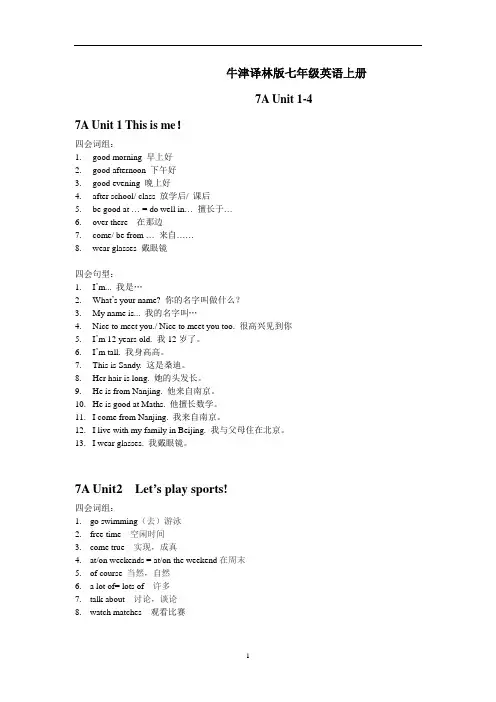
牛津译林版七年级英语上册7A Unit 1-47A Unit 1 This is me!四会词组:1.good morning 早上好2.good afternoon 下午好3.good evening 晚上好4.after school/ class 放学后/ 课后5.be good at … = do well in…擅长于…6.over there 在那边e/ be from …来自……8.wear glasses 戴眼镜四会句型:1.I’m... 我是…2.What’s your name? 你的名字叫做什么?3.My name is... 我的名字叫…4.Nice to meet you./ Nice to meet you too. 很高兴见到你5.I’m 12 years old. 我12岁了。
6.I’m tall. 我身高高。
7.This is Sandy. 这是桑迪。
8.Her hair is long. 她的头发长。
9.He is from Nanjing. 他来自南京。
10.He is good at Maths. 他擅长数学。
11.I come from Nanjing. 我来自南京。
12.I live with my family in Beijing. 我与父母住在北京。
13.I wear glasses. 我戴眼镜。
7A Unit2 Let’s play sports!四会词组:1.go swimming(去)游泳2.free time 空闲时间e true 实现,成真4.at/on weekends = at/on the weekend在周末5.of course 当然,自然6. a lot of= lots of 许多7.talk about 讨论,谈论8.watch matches 观看比赛四会句型:1.Really? 真的吗?2.I walk to my bowl many times a day.我每天都往我的碗那儿走好多次。
牛津译林版七年级英语上册Unit1语法知识点讲解
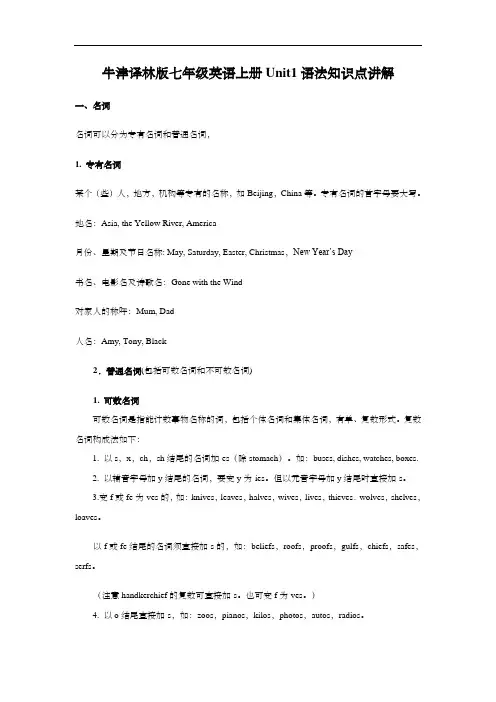
牛津译林版七年级英语上册Unit1语法知识点讲解一、名词名词可以分为专有名词和普通名词,1. 专有名词某个(些)人,地方,机构等专有的名称,如Beijing,China等。
专有名词的首字母要大写。
地名:Asia, the Yellow River, America月份、星期及节日名称: May, Saturday, Easter, Christmas,New Year’s Day书名、电影名及诗歌名:Gone with the Wind对家人的称呼:Mum, Dad人名:Amy, Tony, Black2.普通名词(包括可数名词和不可数名词)1. 可数名词可数名词是指能计数事物名称的词,包括个体名词和集体名词,有单、复数形式。
复数名词构成法如下:1. 以s,x,ch,sh结尾的名词加-es(除stomach)。
如:buses, dishes, watches, boxes.2. 以辅音字母加y结尾的名词,要变y为-ies。
但以元音字母加y结尾时直接加-s。
3.变f或fe为-ves的,如:knives,leaves,halves,wives,lives,thieves.wolves,shelves,loaves。
以f或fe结尾的名词须直接加-s的,如:beliefs,roofs,proofs,gulfs,chiefs,safes,serfs。
(注意handkerchief的复数可直接加-s。
也可变f为-ves。
)4. 以o结尾直接加-s,如:zoos,pianos,kilos,photos,autos,radios。
加-es,如:Negroes,heroes,potatoes,tomatoes。
(有生命的加es, 无生命的加s, 注意植物是有生命的)复数不规则的名词名词复数的不规则变化1)变内部元音。
如foot—feet tooth—teeth man—men woman—women由一个词加man 或woman构成的合成词,其复数形式也是-men 和-women,如an Englishman,two Englishmen。
牛津译林版-英语-七上-7A 1单元 知识点及考点
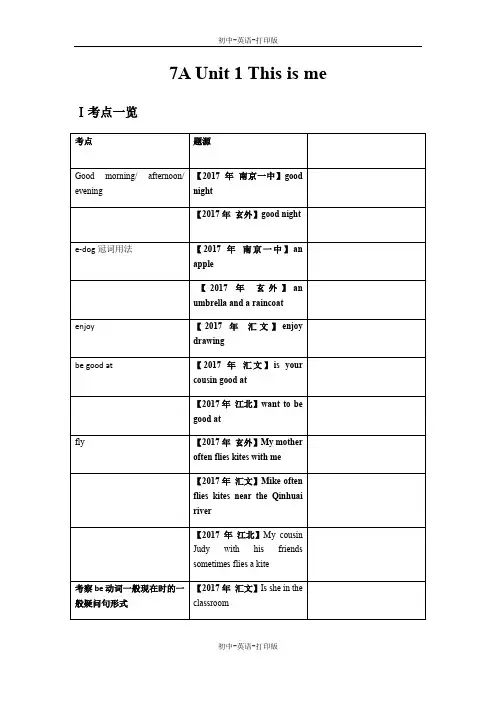
7A Unit 1 This is me Ⅰ考点一览Ⅱ考点讲解1.Good morning/ afternoon/ evening 早上好/ 下午好/ 晚上好(1)本知识点的基本意义属于打招呼的礼貌用语。
(2)本知识点的核心考察考察good night在情景中的使用。
需注意其与good evening的区别,good evening是指晚上刚见面的时候说的,一个美好夜晚的开始,而夜晚结束了,比如睡觉前,则应该是good night,晚安的意思。
【2017年南京一中】28.-Tom, it's ten o'clock. It's time to go to bed.— _______________.A.Good morningB.Good afternoonC.Good eveningD.Good night答案D【2017年玄外】19. — Jack, it is 11:00 p.m.. It is time to go to bed now.— OK,________,dad.A. good eveningB. good nightC. good morningD. good afternoon答案B2.I love e-dogs.(1)e-dog的核心考点考察其之前的冠词,是a还是an?主要是根据其后面的第一个单词的第一个音素是元音还是辅音,如果是元音,用an;如果是辅音,用a。
还有一个较为简便的方法,即如果开头字母为a,e,i,那么用an;如果开头字母为o,一般用an,只在后面的第一个单词为one时,才用a,如a 100-meter race;如果开头字母为u,在u发字母本身音的情况下,用a,如a useful book,其他情况下用an。
(2)拓展知识点单个字母之前冠词的选择问题。
直接说明简便的方法为一句口诀:Mr Li has one fox.其中的每个字母前都加an,共13个,有一个重复,因此为12个。
牛津译林版七年级英语上册 Unit1 知识点归纳课件 (共62张PPT)

Language points
1.I love e-dogs.我喜欢电子狗。
love sth/doing sth =like sth/doing sth
2.How to look after your e-dog?怎样照顾你的电子狗
1). how to do sth 如何做某事 疑问词+to do where to go/what to do
回答:How
How are you ?
do you do?
How do you do?(初次见面问候)
Good morning.
Good afternoon.
Good evening.
Nice to meet/see you!
Glad to meet/see you!
• 1.你叫什么名字? • 2.我的名字是… • 3.我的主人 • 4.读书 • 5.早上好 • 6.下午好 • 7.晚上好 • 8.很高兴见到你 • 9.照看
• __________________________
•__________________________
• get to know sb. … 。
• 认识一下我的表哥安迪(Andy): __________________________
你叫什么名字?
• 这是What引导的特殊疑问句,用来询问姓名,为 了礼貌起见,常在末尾加上”please”;答语的 句型为: My name is….或者 I am…,意为“我 是…”。
Welcome to Class1,Grade7!
.welcome v. 欢迎,如: “Welcome to +某地” 欢迎你到某地来,”你” 经常被省略,如果要加上则要这么翻译:“You are welcome to…”, 如:Welcome to Beijing. 欢迎来到北京。You are welcome. 不用谢。 欢迎大家来到我的学校。 ____Welcome______ ____to____my school. 欢迎到家 Welcome to home
牛津译林版英语七年级上册Unit 1 复习课课件

A. but
B. so
C. and
根据汉语提示完成句子
1.莉莉12岁了,她擅长英语。 Lily is 12_ye_a_r_s __o_l_d_ and she _i_s_ g_o_o_d_ __a_t English. 2.你能帮我照顾我的狗吗? Can you_h_e_lp_ me _lo_o_k_ __a_ft_e_r my dog?
短语呈现
1.照顾 2. 认识 3. 在第一天 4. 踢足球
look after get to know on the first day play football
5. 放学后 6 来自 7. 擅长 8. 放风筝
after school be/come from
be good at fly kites
---Yes, I __a_m_. 5.--- What _a_r_e_ those?
----They _a_re_ his notebooks. 6.My hair__is__ very short and I wear glasses.
按要求改写句子。
1. I am good at dancing. (改为否定句) __I’_m_ __n_o_t _ good at dancing.
或者主语当前的性质、特征等。 2.连系动词be的一般现在时有三种形式:_a_m_,_is__ ,_a_re__. 3.句型结构: (1).肯定句:__主__语_+_b__e_+_其_他
eg: It is a football. (2).否定句:___主__语__+_b_e_+_n_o_t+其他 eg: They are not at school today. (3).一般疑问句:_B_e_+_主__语__+_其__他_?______ eg:Is your mother a teacher?
牛津译林版英语七年级上册Unit 1知识点梳理课件
购物
大扫除
做饭
do some reading do some washing do some sightseeing
看书
洗东西
去观光
1. ______ is a good hobby.
A. Read
B. Reads
C. To read
D. Reading
2. Tom has many books, he often ______ books at weekends.
________floors________ her.
A. in, three, above
B. on, third, below
C. in, three, below
D. on, three, above
3. —Where is my baseball?
—It’s ________ the table, _________the floor.
单词讲解
8.over 在…之上;强调在…的正上方,垂直无接触的正上方。
不强调正上方 over的反义词--under ; above的反义词--below
1. There is an old bridge _____ the river.
A. above
B. in
C. over
D. on
2. Kitty lives________ the ground floor and Sandy lives
3.reading 阅读;swimming 游泳;dancing 舞蹈。 这些词的词性是什么? 那动名词是名词还是动词呢???
另外:do some reading=read some books
类似do some doing结构的短语还有:
牛津译林版七年级英语上册Unit1 知识归纳与拓展
牛津译林版七年级英语上册 7A Unit1 知识归纳与拓展 【短语归纳】 1.read this book读这本书 2.how to look after the e-dog 怎样照顾这只电子狗 3.get to know认识 4.in Class 1,Grade 7在七年级一班 5.have short hair留着短发 6.play football踢足球 7.after school放学后 8.tall and slim高且苗条 9.be good at swimming擅长游泳=do well in swimming 10.1ike sports喜欢运动 11.over there在那儿 12.fly kites放风筝 13.play games做游戏 14.be/come from来自 15.live with my family in Beijing 和我的家人一起居住在北京 16.all the lessons 所有的课程 17.wear glasses戴眼镜 18.introduce yourself 介绍你自己 19.talk about 谈论....... 20. Her hair is short.=She has short hair. 21. look the same 看起来一样 22. like/love +doing 喜欢做…… 23. Let’s +do 24. What’s your mum like? 你妈妈长怎么样?
25. one of my classmates 我同学中的一个
【句型分析】 1.How to Look After Your E-dog(P6) 如何照看你的电子狗 I don’t know what to do next. 我不知道接下来做什么。 Could you tell me when to start tomorrow? 你能告诉我明天什么时候出发吗? look after表示“照看;照料”,相当于take care of。 You should look after your pet dog well. =You should take good care of your pet dog. 你应该好好照料你的宠物狗。 2.Good morning./Good afternoon./Good evening.(P7)上午好。/下午好。/晚上好。 Good morning.用于早晨起床后至午饭前这段时间;Good afternoon.用于下午五六点钟以前;Good evening.一般用于晚上(通常是九点以前)。 3.Hi,Kitty.This is.my cousin Andy.Andy,this is my new classmate Kitty.(P14)你好,基蒂,这位是我表哥安迪。安迪,这位是我的新同学基蒂。 一Hi,Amy.This is my brother Benny. 一Nice to meet you,Amy. 一Nice to meet you too,Benny.
牛津译林英语七年级上册7AUnit1知识点整理
牛津译林英语七年级上册7AUnit1知识点整理Unit1 This is me!1.e-dog: electronic dog电子狗electronic形容词,意为“电子的",组成合成词时省略为“e”。
如: email电子邮件e-friend网友,e -card电子卡。
注意:“一只电子狗”正确译为"an e-dog”,而不是“a e-dog”。
练习题Mr Smith is___C___old man and he usually walks his dog after____supper.A. a;theB.an;aC. an;不填D. the;不填2.master n.主人复数形式为masters.Who's the master of the dog?谁是这只狗的主人?Where is the master of the MP4?这台MP4的主人在哪儿?3.Good morning.早晨/上午好。
(1)Good morning.是人们早上或上午见面时较正式的问候语,用于起床到中午12点这段时间,回答也用“Good morning."(2)Good afternoon是人们下午|面时较正式的问候语,用于12,点月傍晚6点,回答也用“Good afternoon,"(3)Good evening,是人们晚上见面时的问候语,用于晚饭后到就寝这段时间。
回答也用“Good evening."4.What's your name?句中的's是is的缩写,此句型常用来询问对方的姓代名。
为了表示礼貌,还可以在句末加上please, 其前用逗号与前面的句子隔开,即What's your name, please?回答可以用:My name is...或I am..---一What's your name,please?请问,你叫什么名字?--- My name is Mary/I'm Mary..我叫玛丽。
牛津译林版七年级英语上册7A Unit1知识点归纳总结
牛津译林版七年级英语上册7A Unit1 This is me!1.一只电子狗an e-dog2.你是我的主人吗?Are you my master?3.怎样照顾你的电子狗how to look after your e-dog (how to do sth. )4.和、、、交朋友make friends with5.第一天the first day 在二楼on the first floor6.互相each other 互相帮助help each other 互相聊天chat with each other7.晚上好Good evening 晚安Good night8.can(可以)+动词原形must (必须)+动词原形let(让)+动词原形why not (为什么不)+动词原形do/ does+动词原形help(帮助)+动词原形9.我12岁了。
I’m 12 years old.= I’m 12.一个12岁的女孩。
a 12-year-old girl10.在七年级一班in Class 1, Grade 711.我在阅读兴趣小组I’m in the Reading Club. = I’m a member of the Reading Club. Swimming Club游泳兴趣小组Drawing Club绘画兴趣小组12.我出生在上海。
I was born in Shanghai. = Shanghai is my birthplace.上海是我的出生地。
13.住在北京live in Beijing 和我的家人住在一起live with my family14喜欢在放学后踢足球.love playing football after school 喜欢听音乐like listening to music 喜欢玩电脑游戏enjoy playing computer games15.来自北京come from Beijing = be (am, is, are )from Beijing16.长着黑色的长发have long black hair17. 她学习刻苦she works hard. =she studies hard.18.她擅长游泳。