
三年级英语下册 unit8教案 北师大版
(北师大版)三年级英语下册教案Unit8
Unit 8 Big bird
一、教学内容:
1.会说This is a turtle. This is an young/old turtle.
2.单词:happy 、tall、short、big和small。
二、教学目标:
1.会说This is a turtle. This is an young/old turtle.
2.单词:happy 、tall、short、big和small。
三、教学重点:
单词:happy 、tall、short、big和small。能会说及应用
四、教学难点:
单词:happy 、tall、short、big和small。能会说及应用
五、教学用具:单词卡片,录音机
六、教学课型:新授课
七、教学过程:
一、让学生准备好学生用书附录小的“反义词图板”。给学生展示本页并解释每对图片的内容都是相反的。让学生看前两张图,指着第一幅图中的箭头和箭头所指的人,说:“He is a boy.”把句子写在黑板上。指着每个单词朗读句子。让学生跟读。让学生看第二幅图。重复上面的步骤。用“She is a short
girl.”更换。让学生看鸟的图片。用练习tall和short的步骤练big和small。
二、引入turtle。指着每幅图里的乌龟说:“This is a turtle.”同法练习This is an young/old turtle.
替换句型Mocky is a good/bad monkey.
情景引入问学生是否曾在公园或森林里散步,让学生描述所见到的景色。展示tree和animals的教学卡片。示范单词让学生重复。
拿起“反义词图板。”指着鸟的图,问,“What’s this?”引导学生回答: “It’s a bird.”。用同样的方法练习turtle。把单词turtle写在黑板L,让学生跟读。
问学生在森林中散步的感受。试着引导学生用汉语说出“快乐”这个 单词,并把英语单词happy写在黑板上。也可以画一个笑脸。
示范对话用“反义词图板”复习句型“He is a tall boy.”让学生重复。
用同样的图呈现句型“He’s not a short boy.”让学生跟着重复。用同样的方法完成其余的图。 讲故事学生用书第14、15页,让学生打开书翻到故事这两页。把这两页给学生展示。根据图片提问以下图片:
1.Ken,Ann和Mocky在哪儿? 他们在看什么?
2.Mocky在和谁说话? 你认为Mocky在说什么?
3.Ann和Mocky在看什么? 你认为Ann在说什么?Mocky是怎样回答的?
4.现在发生了什么?
听故事学生用书第14、15页告诉学生:“我们现在要听听故事中的人物怎么说。”放录音让学生边听边看图。
再放一遍录音,每—幅图后暂停。让学生重复句
三、布置作业:
让学生给“反义词图板”的图涂上颜色,下—节课还要用到。
北师大版三年级英语下册全册教案1.doc

1 19 北师大版三年级英语下册全册教案1
unit function structure vocabulary7 at the
restaurantasking and answering questions about likes and
dislikedo you like (hot dogs)?yes, i do.no, i don’twhat food
do you like?i like (chicken).i don’t like (vegetables).(ken)
likes (bananas).core: food, fruit, vegetables, chicken, hot
dog, french fries, fired rice, hamburger, noodles, corn,
restaurant, menuphonics: camera, cat, kite, cabbage, circle,
circus, cd, cent, kangaroocontextual: here’s the restaurant.8
big bird!describing people and animalshe is a tall boy.he’s
not a short boy.is she a short girl?yes, she is.no, she
isn’t.what animal is it?is it a big animal?core: tall, short,
thin, fat, young, old, long, short, big, small, good, bad, girl,
boy, woman, man, animal, turtle, giraffe, treephonics: gate,
goat, girl, cabbage, orange, page, giraffecontextual:
北师大版小学英语三年级下册教案
北师大版小学英语三年级下册教案
Unit 7 Is it a pear? Lesson1 Prepare the Student Book used last term. 1.Review The following exercise reviews some of the English expressions in Units 2 and 3. Display your copy of pages 14 and 15 of Book one. Show the children the pictures and ask what they remember of the story. You may have to prompt the children by asking specific questions about each picture. Tell the children, “In Unit 2, Mocky takes Ann and Ken to meet Uncle Booky. Mocky says to them, ‘Come on!’ when they set out. What do we say when we want someone to come with us?” Elicit an appropriate expression in Chinese. Say, “Yes, and in English we say Come on!” Repeat the words Come on! and mime an appropriate gesture as you do so. Have the children do the same. Say, “Mocky says, ‘Oh, no!’ when he sees that the leopard is going to eat a lemon. What is Mocky feeling?” The children can answer in Chinese. Say, “Yes, in English we say Oh, no! when we are surprised or frightened or worried.” Elicit a similar expression in Chinese. Have the children say Oh, no! with an appropriate expression on their faces. Display your copy of page 27 of Book One. Say, “Later in the story Mocky falls down and Ken says, ‘Oh! Poor Mocky.’” Ask, “What is Ken feeling?” Have the children answer in Chinese. Confirm their answer. “Yes, Ken feels sorry for Mocky. He says, ‘Oh! Poor Mocky.’” Have the children repeat Oh! Poor Mocky. with expression in their voices and on their faces. 2.Model the dialog Ask the children what they say when they see something exciting or amazing. Tell them, “In English, we can say Wow!” Have the children repeat the word a few times, with expression on their faces. Ask the children what they say when they taste something really delicious. Tell them, “In English, we can say Oooh, yum!” Have the children repeat the words a few times. 北师大版小学英语三年级下册教案
北师大版三年级下册英语教案(三年级起)
1 Unit 7 Is it a pear?
Lesson1
Prepare the Student Book used last term.
1.Review
The following exercise reviews some of the English expressions in
Units 2 and 3.
Display your copy of pages 14 and 15 of Book one. Show the children
the pictures and ask what they remember of the story. You may have to
prompt the children by asking specific questions about each picture.
Tell the children, “In Unit 2, Mocky takes Ann and Ken to meet
Uncle Booky. Mocky says to them, ‘Come on!’ when they set out. What
do we say when we want someone to come with us?” Elicit an appropriate
expression in Chinese.
Say, “Yes, and in English we say Come on!” Repeat the words Come
on! and mime an appropriate gesture as you do so. Have the children do
the same.
Say, “Mocky says, ‘Oh, no!’ when he sees that the leopard is going
新北师大版三下英语 Unit 8 Vegetables Lesson 4 Get It Right 学案
Lesson 4 Get It Right 学案
学习目标1. 能够辨别字母 t 和 d 在单词中的发音;
2. 能够认读蔬菜的词汇;3. 能正确书写蔬菜的词汇。
学习重点字母 t 和 d 在单词中的发音。
学习难点辨别字母 t 和 d 在单词中发音的不同。
学习过程
Get Ready看图读单词,复习学过的词汇。
Listen and Repeat
(1) 教师在黑板上画出租车的简笔画, 边画学生边猜, 跟老师学单词, 用同样的方法, 学习第一部分的剩下单词。
(2) 听录音, 跟读单词,听第二遍录音, 学生边听边指相应的图片。
(3) 听单词, 指出起始字母是 t 还是 d。
Match the Sounds
(1) 读单词, 并根据首字母的发音给单词分组,看书上的出租车和小狗, 并读出来。(2) 学生指着图中的物品, 试着读一读单词。 然后根据首字母的发音,
让学生给单词连线。
(3) 每读一个单词,学生判断首字母是与 taxi 还是 dog 的首字母发音相同。
Trace and Copy(1) 看教材上蔬菜的图, 说出蔬菜的名称。 看虚线的单词并描写。
(2) 学生观察并说一说单词 tomatoes 在四线格上的位置, 教师归纳总结,
利用四线格抄写。(3) 用同样的步骤完成其他虚线单词的描写。
Read and Match1. 看一看, 读一读
(1) 学生看蔬菜的插图, 说一说蔬菜的名称。
(2) 指句子, 试着读出来, 然后指出相应的蔬菜并连线。
(3) 学生独立读句子并连线。(4) 学生指出相应的蔬菜, 全班一起核对完成情况。
2. “找朋友” 游戏
(1) 本节课所学单词 mushrooms, carrots, tomatoes, beans, onions,cabbages,
potatoes 按照所学顺序分成两组。
(2) 游戏前教师先带读每组单词, 然后把单词卡和写有 They are …. 的纸条
北师大版英语三下《教案》教学设计
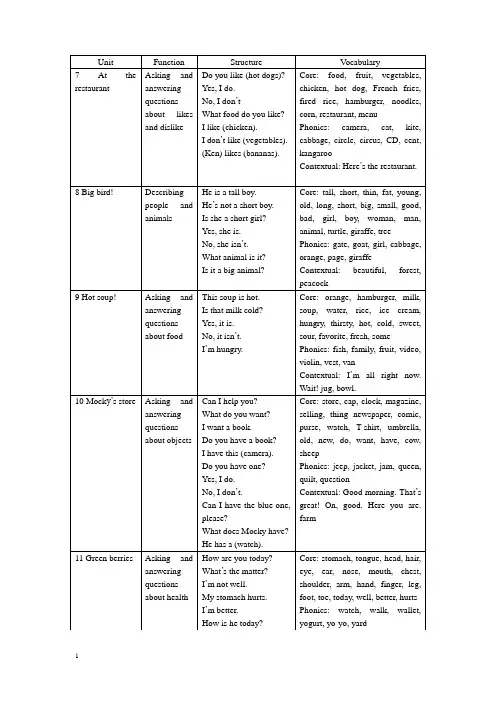
1 Unit Function Structure Vocabulary
7 At the
restaurant Asking and
answering
questions
about likes
and dislike Do you like (hot dogs)?
Yes, I do.
No, I don’t
What food do you like?
I like (chicken).
I don’t like (vegetables).
(Ken) likes (bananas). Core: food, fruit, vegetables,
chicken, hot dog, French fries,
fired rice, hamburger, noodles,
corn, restaurant, menu
Phonics: camera, cat, kite,
cabbage, circle, circus, CD, cent,
kangaroo
Contextual: Here’s the restaurant.
8 Big bird! Describing
people and
animals He is a tall boy.
He’s not a short boy.
Is she a short girl?
Yes, she is.
No, she isn’t.
What animal is it?
Is it a big animal? Core: tall, short, thin, fat, young,
old, long, short, big, small, good,
bad, girl, boy, woman, man,
animal, turtle, giraffe, tree
Phonics: gate, goat, girl, cabbage,
[原创]北师大版小学三年级下册英语全册教案
![[原创]北师大版小学三年级下册英语全册教案](https://360docs-1393072327.cos.ap-beijing.myqcloud.com/5fd5c00080eb6294dc886c9f.webp)
小学英语三年级(下册)
全册备课
对新课标理解:
现在的社会是向着全球化,社会化发展的,将来的地球不管是哪一个角落都
是一我们地球林的一个村民,那么语言就成了一个统一交流的媒介,尤其是英语的重要性在这一进程中日益突出。
本次对于课程标准的重新更定是一次符合社会发展进程和基础教育进程的改革。重点是要改革英语课程的教学,过分重视语法和词汇知识的讲解与传授,忽视对学生实际语言运用能力的培养倾向,强调课程应从学生的学习兴趣、生活体验和认知水平出, 倡导学生体验、实践、参与、合作与交流的学习方式和任务型的必学途径,发展学生的综合语言运用能力,使语言学习的过程成为学生形成积极的情感态度,主动思维和大胆实践,提高跨文化意识和形成自主学习能力的过程。
做到这些要求,首先需要的就是学生浓厚的对英语学习的兴趣,那怎么样培养学生学习兴趣就成了一个基础话题,这一问题要面向全体学生,特别是要关注学生的个别差异引起的情感问题。帮助学生建立成就感和自信心。
在教学中注意创设能引导学生主动参与的教学环境,激发学生的学习积极性。使每个学生都能得到充分的发展。在这一过程中教学模式的转变起到了一定的作用,一定要从以老师为中心的教学模式身以学生为中心的教学模式转变。强调学生的参与和体验,强调采用多种形式的教学活动。比如可以利用我们学校已有的良好电教资源,听原版录音带练习发音,也可以利用网络找一些贴近课堂学习的情境对话或小动画,以更直接的方式引导学生学习英语,对英语产生浓厚的兴趣。
利用听、说促进学生写单词,写短语,写句子,写对话,不能反其道而行,又造成以往我们说的“哑吧英语”。
总的来说,新课标对发展学生自我主观能动性起到了很积极的作用。素质教育在其中深有体现。并且由升学教育向终身教育的转变等等都是很好的突破。在这一新课标的指导下,希望在英语教学中可以达到更好的效果。
Teaching contents:
本册书共六个单元,其中五个单元是精读课文,一个复习单元。这册书在编排时很注意学生兴趣的培养,尤其在单词字母学习这一环节,教材把手写字母相同的单词进行了归类,并且安排了大量的听、说、读、写 等多项练习,利用图片教授学习是培养学生学习英语兴趣的主要途径。除此之外还有多首英文歌曲的学习,书后有分类清晰的词汇表,更有利学教师的教和学生的学。
北师大版(2019)英语必修 第三册 Unit 8 Green Living—Topic Talk 教案
1 / 3
Unit 8 Green Living
Topic Talk
教学目标 在本课结束时,学生能够:
1.认识绿色生活,说出“green living”的具体内容和内涵;
2.获取听力语篇中“green living”话题的关键信息,补全相关内容并分析表达逻辑;
3.分析表达逻辑,运用所学词汇和表达方式,发表个人对“green living”的认识和打算。
教学重难点 获取听力语篇的关键信息,表达对绿色生活的看法。
教学过程
教学目标 教学活动与步骤 设计意图 评价要点
1.认识绿色生活,说出“green
living”的具体内容和内涵。 Step 1
Look at some pictures
depicting environmental
problems, solutions, and
human activities. Talk about
your understanding of “green
living”. Answer the questions.
(1) What is green living?
(2) What can you do to
improve green living? 通过图片进行头脑风暴,激活学生关于绿色生活方式的背景知识。 根据图片提示,学生能说出有关环境问题、生活方式与环境的关系等内容,并学习相关词汇和表达方式。
2.获取听力语篇中“green
living”话题的关键信息,补全相关内容并Step 2
1. Listen to the introduction
and complete the sentences in
Activity.
2. Answer the questions.
(1) How many parts are there
in the exhibition? 听取关键信息,并分析表达的逻辑,培养学生的听力能力及思维品质。 通过全篇听和分段听,学生能够听懂、补全语句,说明展览各部分之间的关系和逻辑顺序,并表达自己对 2 / 3
Unit 8 Lesson 1第2课时示范教案【高中英语北师大版必修第三册】
1 / 2 Unit 8 Green Living
Lesson 1 Period 2
教材分析
本节课是第八单元第一课Roots & Shoots的第二课时,重点是课文内容的回顾与拓展及对文本语言、语法知识的学习。本课涉及的语法点是非谓语动词,要求学生区分以-ing结尾和以-ed结尾的动词在句中充当定语、状语、宾语补足语、表语的用法。
教学目标
在本课学习结束时,学生能够:
1. 在小组展示中口头介绍“根与芽”组织;
2. 正确理解并使用动词-ing形式和动词-ed形式;
3. 在情境中通过角色扮演内化运用所学语言。
教学重难点
【教学重点】
1. 动词-ing形式和动词-ed形式的语法功能;
2. 主题汇报及与他人沟通时的表达技巧。
【教学难点】
对动词-ing形式和动词-ed形式多样的语法功能的理解。
教学过程
Step 1 Warming-up
Task 1: Group Presentation. Introduce Roots and Shoots.
设计意图:通过小组展示的形式锻炼学生合作调研、演讲思辨的能力,加深对“根与芽”环保组织的了解。小组展示后的同伴点评、教师点评环节引导学生互相学习,总结演讲的表达技巧。
Task 2: Complete the summary of the text on page 32, Ex. 8.
设计意图:填空回顾课文内容,引导学生关注语篇中的动词-ing形式和动词-ed形式,为语法学习做准备。
Step 2 Grammar Focus
The teacher introduces the usage of the –ing/ed form of the verb.
设计意图:通过例句展示、句型转换等方式引导学生归纳提炼动词-ing形式和动词-ed形式在句中充当形容词或副词,起到定语、状语、宾语补足语或表语的作用。
Step 3 Practice
Unit 8 Lesson 3第2课时示范教案【高中英语北师大版必修第三册】
1 / 2 Unit 8 Green Living
Lesson 3 Period 2
教材分析
本节课是第八单元第三课White Bikes on the Road阅读课的第二课时,重点是课文内容巩固输出、话题拓展、语法学习。本课涉及的语法点是词形及词性变换,聚焦名词动词同形现象。要求学生能根据上下文判断词性及含义,掌握常见的名词动词同形的词汇并熟练运用。
教学目标
在本课学习结束时,学生能够:
1. 进行“共享经济”相关的主题汇报,有条理地介绍事物发展阶段及特点;
2. 掌握常见的名词动词同形的词汇及用法;
3. 介绍北京共享单车的情况,分析利弊,就如何健康发展提出自己的建议。
教学重难点
【教学重点】
1. “共享经济”的具体方式、对于“绿色生活”的贡献、利弊及发展建议等;
2. 名词动词同形的词汇用法。
【教学难点】
1. 对共享经济的批判性思考;
2. 对词性及词形变换的判断。
教学过程
Step 1 Warming-up
1. Group Presentation: Do some research on “sharing economy” and introduce a sharing project
(e.g. carpooling, clothes sharing). Draw a flow chart outlining important events, i.e. how and
where the idea begun, how it developed, etc.
设计意图:小组主题汇报分享调研成果,引导学生运用思维导图梳理信息,提高逻辑思维能力。通过同伴互评、教师点评,总结共享经济的发展形式、特点,评估趋势并提出建议。
2. Complete the summary with the information you have learnt.
设计意图:回顾课文内容,巩固重点表达。
最新北师大版三年级下册英语Lesson 1精品教案 (7)
Lesson 1
Preparation
You will also need:
•children’s Opposites Master from Unit 8
•flashcards for soup, hamburger, rice, water,
milk from this Unit.
1.Review
•Have the children take out their Opposites
Master. Use them in a quick class drill to review
structures and vocabulary from Unit 8 (tall/short,
big/small, young/old, good/bad, long/short).
•Show your Opposites Master. Point to the first
picture and elicit the correct sentence, “He is
a tall boy.”
•Point to the picture again and ask, “Is he a
short boy?” Elicit, “No, he isn’t.” Ask, “Is
he a tall boy?” Elicit, “Yes, he is.”
2.Set the scene •Ask the children about their favorite food. Then
ask them about their favorite drink. Explain to
the children that in English we use the word
favorite. Write the word on the board. Read the
word aloud and have the children repeat it after