
自动化专业英语第三版王树青1.1翻译
文档从网络中收集,已重新整理排版.word版本可编辑.欢迎下载支持.
1word版本可编辑.欢迎下载支持.
自动化专业英语第三版
1.1 介绍过程控制
1. 近年来,对过程系统的性能改善需求变得越来越困难. 更为激烈的竞争,更加严格的环
境和安全规范,以及快速变化的经济条件都是加强工厂产品质量规范的关键因素
2. 更为复杂的情况是,由于现代制造业朝着规模更大,集成度更高的方向发展,而使不同的加
工环节之间的协调能力更低, 所以加工过程更难控制.
在这种工厂中,要想让一个生产环节出现的问题不对其相连的另一个生产环节产生影响,
几乎是不可能的.
3. 近年来,考虑到工业制造逐渐加强的安全、高效需求,过程控制这个课题变得越来越受
重视.
实际上,对于大多数现代工业,要满足安全、高效,产品质量的要求,没有控制系统是不可
能的.
1.1.1说明性的例子
1. 图1.1.1 所示的连续加热搅拌器可以作为过程控制的典型例子.
输入液态流体的质量流量率为w,温度为Ti. 槽内成分搅拌均匀,并且用电加热器,功率为
Q瓦特.
2.假设输入和输出流量率是相等的,并且液体密度保持恒定,也就是说温度变化足够小,密
度对温度的影响可以忽略不计. 在这些条件下,槽内液体的体积保持恒定
3. 加热搅拌器的控制目标是保持输出温度T在一个恒定参考值TR上.
参考值在控制术语中指的是给定值. 下面我们考虑两个问题.
把加热搅拌器内的液体从输入温度Ti加热到输出温度TR,需要多少热量?
1.要确定达到设计运行条件下的热量需求,我们需要写下槽内液体的稳定能量平衡式.
在写平衡式之前,假设槽内是完美搅拌的,同时忽略热损耗.
2. 在这些条件下,槽内成分的温度保持一致,因此,输出温度等于槽内液体温度.
根据稳态能量守恒,加入的热量等于输入和输出流体之间的焓变化量.
3. 在一个 分别表示Ti, T, w, 和 Q 的稳定设计标定值,
C 是液体的比热. 我们假设C是恒定的. 在设计条件下, . 将其代入方程(1),
可以得到标定热量输入为
1. 方程(2)是加热器的设计方程.
如果我们的假设是正确的,同时输入流量和输入温度等于他们的标定值,那么有方程(2)
给出的输入热量将使输出温度保持在期望值TR.
但是,如果给定条件变化,会产生什么样的结果呢?这给我们带来第二个问题:
2. 问题2. 假设输入温度Ti随时间变化. 我们如何确保温度T保持或靠近给定值TR?
最为一个特殊的例子,假设Ti增加到一个大于 的值. 如果Q保持在标定值 上恒
定,我们可以得到输出温度将增加,因此T>TR.
为应付这种情况,有一些可能的策略控制出口温度T
方法1。测量和调整问题
1.一种控制温度T避免Ti干扰的方法是,基于T的测量来调整输入热量Q. 直观上来说,如
果温度太高,我们应该减少输入热量;如果温度太低,我们可以增加输入热量. 这种控制策
略将使温度趋向于温度给定值TR,并且可以用几种不同的方法来实现.
2. 例如,工厂操作员可以观察测量温度,将测量值与TR进行比较.
然后操作员将用恰当的方式改变输入热量Q. 这是手动控制的应用.
然而,用一个电子设备来代替人来控制,是更为简单和经济的,这就是使用自动控制
方法2。测量Ti,调整Q。
QandwTTi,,,
R
TT
:Q
文档从网络中收集,已重新整理排版.word版本可编辑.欢迎下载支持.
2word版本可编辑.欢迎下载支持.
作为一个替代方法,我们可以方法1,Ti和Q相应调整为干扰变数。
因此,如果Ti比_Ti大,我们可以减少Q;Ti<_Ti,我们可以设置Q>_Q
方法3。测量T,调整 w
与调整输入热量Q类似,我们可以选择操作质量流量w. 因此,如果温度太高,我们将增加
流量w,使得搅拌槽的能量输入速率相对于质量流量减少,因此使输出温度得以降低.
方法4。测量Ti,调整 w
和方法3类似,如果Ti太高了,我们应该增加。
方法5。测量Ti,调整 Q
该方法结合方法1和2。
方法6。测量Ti和T,调整 w
该方法结合方法3和4。
方法7. 在输入流安置一个热交换器. 热交换器意图减少Ti的干扰,因此可以减少温度T的
扰动. 这个方法有时又叫做输入束缚法.
方法8. 1.使用一个更大的槽. 如果使用更大的槽,因为更大的热容,Ti的波动会趋向于衰减.
然而,体积增加使得开支增加,会使工厂系统的解决方案变得更加昂贵.
2. 要指出的是这个方法类似于化学实验室中水缸的使用,水缸大的热容量可以看作散热装
置,因此可以为小型实验仪器提供一个恒温环境.
1.1.2 分类控制策略
1. 接下来,我们将给这8种控制方法进行分类,同时讨论他们各自的优缺点. 方法1和3 是
反馈控制的例子. 在反馈控制中,测量被控过程变量,该测量值用于调整另一个可以操做的
过程变量. (即测量变量,操作变量,测量变量用于调整操作变量.)
2. 因此,对于方法1来说,测量变量是T,操作变量是Q. 对于方法3,测量变量仍旧是T,
但是操作变量则是w. 需要注意的是,在反馈控制中,扰动变量Ti没有被测量.
1. 区分负反馈和正反馈很重要. 负反馈是指期望达到的形势,控制器的校正作用使得被控
变量趋于给定值.
2. 相反地,当正反馈存在时,控制器使局面变得更加糟糕,它使被控变量远离给定值. 因
此,对于加热搅拌器来说,如果T太高,我们将减少输入Q(负反馈),而不是增加输入热
量Q(正反馈).
1. 方法2和4都是前馈控制策略. 这里,扰动变量Ti是被测量的,并且用于操作输入热量
Q或输入流量w. 注意的是,在前馈控制中,被控变量T是没有被测量的.
2. 方法5是前馈-反馈控制策略,因为它是方法1和2的综合. 同样地,方法6也是前馈-
反馈控制策略,因为它是方法3和4的综合
3. 方法7和8包含了设备的设计变化,因此并不是真正的控制策略. 注意方法7有点不合
适,因为它涉及到在加热搅拌器的入口通道中添加一个热交换器,而加热搅拌器本身的设计功
能就是个热交换器. 加热搅拌器的控制策略在表格1.1.1中做了总结.
1. 到目前为止,我们仅仅考虑了Ti波动这一种干扰源. 我们也应该考虑其他过程变量干扰
的可能性,如会影响槽中散热量的环境温度.
2. 回忆一下前面我们假定热损失是可忽略的. 过程设备的变化是另一个可能的干扰源. 例
如,加热器的特性会因为液体结垢而随时间变化. 考察这些不同类型的干扰对前馈和反馈控
制策略的影响是有益的
1. 首先,考虑方法2中的前馈控制方法,在这种方法中测量的是干扰Ti,并且测量用于调整
可操作量Q. 从理论上讲,尽管存在干扰Ti, 这种控制方案有能力保持被控变量精确在给定
值TR
2. 在理想情况下,如果对Ti的精确的测量是可能的,并且以一种合适的方法对Q进行调整,
文档从网络中收集,已重新整理排版.word版本可编辑.欢迎下载支持.
3word版本可编辑.欢迎下载支持.
那么加热器的校正作用将在T被影响以前就抵消干扰的影响. 如此而言,从维持被控变量在
给定值的意义上讲,前馈控制原则上能够提供完美 (无差,没有误差)的控制.
1. 但是如果干扰源来自其他过程变量,这种前馈控制的策略如何发挥作用呢? 特别地,假如
流量w不能维持恒定,而是随时间变化. 在这种情况下,w被看作是一个扰动变量.
2. 如果w增加,出口温度T将减少,除非加热器提供更多的热量. 然而,在方法2的控制策略
中,只要Ti不变,热量输入值Q就维持恒定. 因此,对没有测量的流量扰动就不会采取校正动
作.
3. 原则上说,处理这种情况,我们可以同时测量Ti和w,然后调整Q来同时补偿这两种扰动.
然而,从实际出发,试图测量所有潜在的干扰一般来说是昂贵的. 既然反馈控制可以对未知的
干扰提供校正动作,采用前馈和反馈组合的控制策略将更加实际,正如我们下面将要讨论的那
样.
4. 因此在工业应用中,前馈控制一般是和反馈控制结合使用的.
1.下面我们考虑扰动Ti或w出现的情况下,方法1的反馈控制如何实行. 如果采用方法1, 校
正动作只有在干扰已经影响了过程之后发生,也就是说, 直到T偏离了TR之后.
2. 既然在校正动作产生前,被控量必须偏离给定值,所以就其本身的固有属性而言,反馈控制
不是完美(无差)控制. 然而,反馈控制的一个极其重要的优点是, 不论对什么样的扰动, 都可
以产生正确的校正动作.
3. 因此,在方法1中, 当扰动Ti 或w 引起T偏离给定值后, 校正动作都会产生(通过调整
Q). 这种处理未知起因、没有测量的扰动的能力是反馈控制在过程控制中应用如此之广的主
要原因.
自动化专业英语原文和翻译

自动化专业英语原文和翻译Automation in the Field of EngineeringIntroduction:Automation plays a crucial role in various industries, and the field of engineering is no exception. In this document, we will explore the importance of automation in engineering and its impact on various aspects of the industry. We will also provide a detailed analysis of the benefits and challenges associated with automation in engineering. Additionally, we will discuss the significance of specialized English language skills in the automation profession and provide a translated version of the content in Chinese.Importance of Automation in Engineering:Automation has revolutionized the engineering industry by enhancing productivity, efficiency, and accuracy. It involves the use of advanced technologies and systems to control and monitor various engineering processes. Automation enables engineers to streamline operations, reduce manual labor, and improve overall performance. It plays a vital role in areas such as manufacturing, construction, energy, transportation, and telecommunications.Benefits of Automation in Engineering:1. Increased Productivity: Automation eliminates repetitive and mundane tasks, allowing engineers to focus on more complex and strategic activities. This leads to increased productivity and faster project completion.2. Improved Efficiency: Automated systems can perform tasks more efficiently than humans, resulting in reduced errors and improved quality of work.3. Enhanced Safety: Automation reduces the risk of accidents and injuries by replacing manual labor with machines in hazardous environments.4. Cost Savings: By automating processes, companies can reduce labor costs, minimize waste, and optimize resource utilization, leading to significant cost savings.5. Better Decision-Making: Automation provides engineers with real-time data and analytics, enabling them to make informed decisions and optimize processes for better outcomes.Challenges of Automation in Engineering:1. Initial Investment: Implementing automation systems requires a significant upfront investment in technology, infrastructure, and training.2. Technological Complexity: Automation involves advanced technologies such as robotics, artificial intelligence, and machine learning, which require specialized knowledge and expertise to operate and maintain.3. Workforce Adaptability: Automation may lead to job displacement and require the workforce to acquire new skills to adapt to the changing industry landscape.4. Cybersecurity Risks: With increased reliance on interconnected systems, the risk of cyber threats and data breaches becomes a significant concern in automated engineering environments.Importance of Specialized English Language Skills in Automation:English language proficiency is crucial for professionals in the automation field due to the global nature of the industry. Engineers need to communicate effectively with colleagues, clients, and stakeholders from different countries. Additionally, technical documentation, research papers, and industry standards are often written in English. Proficiency in specialized English terminology related to automation is essential for clear and accurate communication.Translation in Chinese (简体中文翻译):工程自动化的重要性:自动化在各个行业中都发挥着重要作用,工程领域也不例外。
自动化专业英语翻译Part3U
P3U5B Embedded Systems Design 第三部分第五单元课文B 嵌入式系统设计
B 嵌入式系统设计 1.课文内容简介:主要介绍嵌入式系统的统基本组成、嵌入式系统设计、解析嵌入式系统设计中的难点等内容。 2.温习《嵌入式系统》中硬件组成、编程语言和通讯方式等内容。 3. 生词与短语 hydraulic adj. 水压的 exponential adj. 指数的 defrost v. 除霜 deodorize v. 除……臭 lapse n. (时间等)流逝 drastic adj. 激烈的
01
02
P3U5A A first Look at Embedded Systems 第三部分第五单元课文A 初识嵌入式系统
5. 参考译文 A 初识嵌入式系统 概述 现在像嵌入式这样的术语越来越流行。我们被无处不在的嵌入式系统淹没。现在,问题是,从根本上说,嵌入式系统是什么?我们可以把嵌入式系统定义为“看起来不像计算机的基于微处理器的系统”或者可以说“设计用来执行特定功能的计算机硬件、软件和附加的机械的或者其他部件的结合。在一些情况下,嵌入式系统实大型系统或者产品的一部分,如汽车中的防抱死系统。” 嵌入式系统包含很多硬件和软件,它们执行宿主系统的特定功能,例如,卫星,洗衣机,机器人,手持电话和汽车。
P3U5B Embedded Systems Design 第三部分第五单元课文B 嵌入式系统设计
实时性:我们可以把系统定义为对用户、外界或者自身(如定时器)输入做出反应的子系统或者组件集合。通常情况下,输入给定时间和系统反应时间之间存在时间差。在任何系统中,人们很自然地期望系统在特定时间间隔内做出反应。有一些系统,必须满足严格时间(不一定是短时间)要求。这些系统被称为实时系统。这些特性是:“迟到的答案是错误的”。实时系统可以分为: 硬实时系统:实时系统一旦没有满足最后时限,将引起严重的后果,导致人员财产损失。如飞行器,核反应堆等。 软实时系统:实时系统即使没有满足时限要求,也不会给用户带来很大不便。例如,电视机,DVD播放机或者音乐系统,互联网传输的多媒体流(能够承受数据包的损失)。 基于操作时间限制,实时系统还可以分为快速和慢速系统。 和实时性密切相关的概念是决定性。这也是实时编程区别于日常应用编程的重要概念。实时系统在一定时间内做出响应,
自动化专业英语(王宏文主编)课文翻译完整版

PART 1 Electrical and Electronic Engineering Basics UNIT 1 A Electrical Networks ———————————— 3 B Three-phase Circuits UNIT 2 A The Operational Amplifier ——————————— 5 B Transistors UNIT 3 A Logical Variables and Flip-flop —————————— 8 B Binary Number System UNIT 4 A Power Semiconductor Devices —————————— 11 B Power Electronic Converters UNIT 5 A Types of DC Motors —————————————15 B Closed-loop Control of DC Drivers UNIT 6 A AC Machines ———————————————19 B Induction Motor Drive UNIT 7 A Electric Power System ————————————22 B Power System AutomationPART 2 Control Theory UNIT 1 A The World of Control ————————————27 B The Transfer Function and the Laplace Transformation —————29 UNIT 2 A Stability and the Time Response ————————— 30 B Steady State————————————————— 31 UNIT 3 A The Root Locus ————————————— 32 B The Frequency Response Methods: Nyquist Diagrams ————— 33 UNIT 4 A The Frequency Response Methods: Bode Piots ————— 34B Nonlinear Control System 37UNIT 5 A Introduction to Modern Control Theory 38B State Equations 40UNIT 6 A Controllability, Observability, and StabilityB Optimum Control SystemsUNIT 7 A Conventional and Intelligent ControlB Artificial Neural NetworkPART 3 Computer Control TechnologyUNIT 1 A Computer Structure and Function 42B Fundamentals of Computer and Networks 43UNIT 2 A Interfaces to External Signals and Devices 44B The Applications of Computers 46UNIT 3 A PLC OverviewB PACs for Industrial Control, the Future of ControlUNIT 4 A Fundamentals of Single-chip Microcomputer 49B Understanding DSP and Its UsesUNIT 5 A A First Look at Embedded SystemsB Embedded Systems DesignPART 4 Process ControlUNIT 1 A A Process Control System 50B Fundamentals of Process Control 52UNIT 2 A Sensors and Transmitters 53B Final Control Elements and ControllersUNIT 3 A P Controllers and PI ControllersB PID Controllers and Other ControllersUNIT 4 A Indicating InstrumentsB Control PanelsPART 5 Control Based on Network and InformationUNIT 1 A Automation Networking Application AreasB Evolution of Control System ArchitectureUNIT 2 A Fundamental Issues in Networked Control SystemsB Stability of NCSs with Network-induced DelayUNIT 3 A Fundamentals of the Database SystemB Virtual Manufacturing—A Growing Trend in AutomationUNIT 4 A Concepts of Computer Integrated ManufacturingB Enterprise Resources Planning and BeyondPART 6 Synthetic Applications of Automatic TechnologyUNIT 1 A Recent Advances and Future Trends in Electrical Machine DriversB System Evolution in Intelligent BuildingsUNIT 2 A Industrial RobotB A General Introduction to Pattern RecognitionUNIT 3 A Renewable EnergyB Electric VehiclesUNIT 1A 电路电路或电网络由以某种方式连接的电阻器、电感器和电容器等元件组成。
电气自动化专业英语1,2,3,5,8,13章翻译
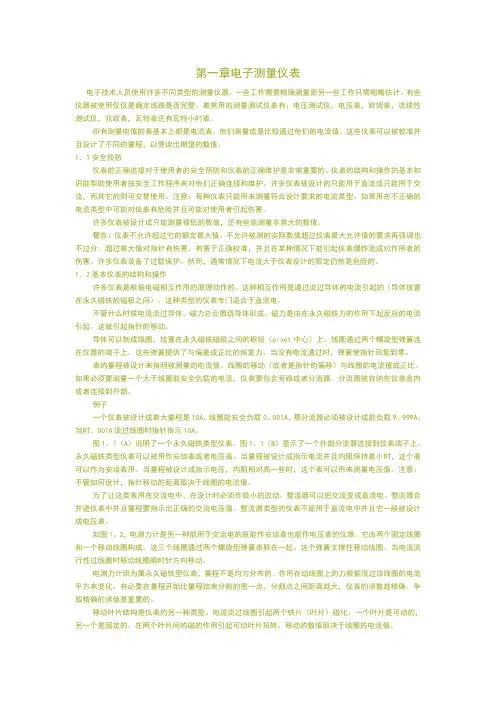
第一章电子测量仪表电子技术人员使用许多不同类型的测量仪器。
一些工作需要精确测量面另一些工作只需粗略估计。
有些仪器被使用仅仅是确定线路是否完整。
最常用的测量测试仪表有:电压测试仪,电压表,欧姆表,连续性测试仪,兆欧表,瓦特表还有瓦特小时表。
所有测量电值的表基本上都是电流表。
他们测量或是比较通过他们的电流值。
这些仪表可以被校准并且设计了不同的量程,以便读出期望的数值。
1.1安全预防仪表的正确连接对于使用者的安全预防和仪表的正确维护是非常重要的。
仪表的结构和操作的基本知识能帮助使用者按安全工作程序来对他们正确连接和维护。
许多仪表被设计的只能用于直流或只能用于交流,而其它的则可交替使用。
注意:每种仪表只能用来测量符合设计要求的电流类型。
如果用在不正确的电流类型中可能对仪表有危险并且可能对使用者引起伤害。
许多仪表被设计成只能测量很低的数值,还有些能测量非常大的数值。
警告:仪表不允许超过它的额定最大值。
不允许被测的实际数值超过仪表最大允许值的要求再强调也不过分。
超过最大值对指针有伤害,有害于正确校准,并且在某种情况下能引起仪表爆炸造成对作用者的伤害。
许多仪表装备了过载保护。
然而,通常情况下电流大于仪表设计的限定仍然是危险的。
1.2基本仪表的结构和操作许多仪表是根据电磁相互作用的原理动作的。
这种相互作用是通过流过导体的电流引起的(导体放置在永久磁铁的磁极之间)。
这种类型的仪表专门适合于直流电。
不管什么时候电流流过导体,磁力总会围绕导体形成。
磁力是由在永久磁铁力的作用下起反应的电流引起。
这就引起指针的移动。
导体可以制成线圈,放置在永久磁铁磁极之间的枢钮(pivot中心)上。
线圈通过两个螺旋型弹簧连在仪器的端子上。
这些弹簧提供了与偏差成正比的恢复力。
当没有电流通过时,弹簧使指针回复到零。
表的量程被设计来指明被测量的电流值。
线圈的移动(或者是指针的偏移)与线圈的电流值成正比。
如果必须要测量一个大于线圈能安全负载的电流,仪表要包含旁路或者分流器。
自动化专业英语原文和翻译

自动化专业英语原文和翻译Automation in the Manufacturing Industry: Overview and TranslationIntroduction:Automation has revolutionized various industries, and the manufacturing sector is no exception. This article provides an overview of automation in the manufacturing industry, discussing its benefits, challenges, and future prospects. Additionally, a translation of the content into English is provided.Overview of Automation in the Manufacturing Industry:Automation refers to the use of technology to perform tasks with minimal human intervention. In the manufacturing industry, automation plays a crucial role in improving efficiency, productivity, and quality. It involves the use of advanced machinery, robotics, and computer systems to streamline production processes.Benefits of Automation in Manufacturing:1. Increased Efficiency: Automation eliminates the need for manual labor, allowing tasks to be completed at a faster pace. This leads to increased production output and reduced production time.2. Improved Quality: Automated systems ensure consistent and accurate production, minimizing errors and defects. This results in higher product quality and customer satisfaction.3. Cost Reduction: While initial investment in automation may be high, it results in long-term cost savings. Automation reduces labor costs, decreases material waste, and optimizes energy consumption.4. Enhanced Safety: Automation eliminates the need for workers to perform hazardous tasks, reducing the risk of workplace accidents and injuries.5. Flexibility and Adaptability: Automated systems can be easily reprogrammed to accommodate changes in production requirements. This allows manufacturers to quickly adapt to market demands.Challenges of Automation in Manufacturing:1. Initial Investment: Implementing automation systems requires significant upfront investment, including the cost of machinery, software, and employee training. This can be a barrier for small and medium-sized enterprises.2. Workforce Transition: Automation may result in job displacement, as some tasks previously performed by humans are now automated. Companies must provide training programs and support for employees to transition into new roles.3. Technical Complexity: Automation systems involve complex machinery and software, requiring skilled technicians to operate and maintain them. Companies need to invest in training and hiring qualified personnel.4. Cybersecurity Risks: As manufacturing processes become more digitized, the risk of cyber threats increases. Companies must implement robust cybersecurity measures to protect sensitive data and prevent unauthorized access.Future Trends in Automation:1. Collaborative Robots: Collaborative robots, also known as cobots, are designed to work alongside humans. They can perform repetitive or physically demanding tasks, enhancing productivity and worker safety.2. Internet of Things (IoT): The integration of IoT in manufacturing enables machines to communicate and share data, leading to improved efficiency and predictive maintenance.3. Artificial Intelligence (AI): AI technologies, such as machine learning and computer vision, can optimize production processes, detect anomalies, and make real-time adjustments.4. Cloud Computing: Cloud-based automation systems allow manufacturers to access and analyze data remotely, facilitating data-driven decision-making and improving overall efficiency.5. Sustainable Automation: Automation can contribute to sustainable manufacturing practices by optimizing energy consumption, reducing waste, and improving resource efficiency.Translation of the Content:自动化在制造业中的应用:概述与翻译简介:自动化已经彻底改变了各行各业,制造业也不例外。
自动化专业英语中文翻译

PART 1Electrical and Electronic Engineering BasicsUNIT 1A Electrical Networks ————————————3B Three-phase CircuitsUNIT 2A The Operational Amplifier ———————————5B TransistorsUNIT 3A Logical Variables and Flip-flop ——————————8B Binary Number SystemUNIT 4A Power Semiconductor Devices ——————————11B Power Electronic ConvertersUNIT 5A Types of DC Motors —————————————15B Closed-loop Control of DC DriversUNIT 6A AC Machines ———————————————19B Induction Motor DriveUNIT 7A Electric Power System ————————————22B Power System AutomationPART 2Control TheoryUNIT 1A The World of Control ————————————27B The Transfer Function and the Laplace Transformation —————29 UNIT 2A Stability and the Time Response —————————30B Steady State—————————————————31 UNIT 3A The Root Locus —————————————32B The Frequency Response Methods: Nyquist Diagrams —————33 UNIT 4A The Frequency Response Methods: Bode Piots —————34B Nonlinear Control System 37UNIT 5 A Introduction to Modern Control Theory 38B State Equations 40UNIT 6 A Controllability, Observability, and StabilityB Optimum Control SystemsUNIT 7 A Conventional and Intelligent ControlB Artificial Neural NetworkPART 3 Computer Control TechnologyUNIT 1 A Computer Structure and Function 42B Fundamentals of Computer and Networks 43UNIT 2 A Interfaces to External Signals and Devices 44B The Applications of Computers 46UNIT 3 A PLC OverviewB PACs for Industrial Control, the Future of ControlUNIT 4 A Fundamentals of Single-chip Microcomputer 49B Understanding DSP and Its UsesUNIT 5 A A First Look at Embedded SystemsB Embedded Systems DesignPART 4 Process ControlUNIT 1 A A Process Control System 50B Fundamentals of Process Control 52UNIT 2 A Sensors and Transmitters 53B Final Control Elements and ControllersUNIT 3 A P Controllers and PI ControllersB PID Controllers and Other ControllersUNIT 4 A Indicating InstrumentsB Control PanelsPART 5 Control Based on Network and InformationUNIT 1 A Automation Networking Application AreasB Evolution of Control System ArchitectureUNIT 2 A Fundamental Issues in Networked Control SystemsB Stability of NCSs with Network-induced DelayUNIT 3 A Fundamentals of the Database SystemB Virtual Manufacturing—A Growing Trend in AutomationUNIT 4 A Concepts of Computer Integrated ManufacturingB Enterprise Resources Planning and BeyondPART 6 Synthetic Applications of Automatic TechnologyUNIT 1 A Recent Advances and Future Trends in Electrical Machine DriversB System Evolution in Intelligent BuildingsUNIT 2 A Industrial RobotB A General Introduction to Pattern RecognitionUNIT 3 A Renewable EnergyB Electric VehiclesUNIT 1A 电路电路或电网络由以某种方式连接的电阻器、电感器和电容器等元件组成。
自动化专业英语原文和翻译
自动化专业英语原文和翻译AbstractWith the rapid advancement of technology, automation has become an integral part of various industries. As a result, there is a growing demand for professionals who are proficient in both automation and English language skills. This document aims to provide a standard format for writing original texts and their translations in the field of automation.IntroductionAutomation, also known as automatic control, is the use of various control systems for operating equipment and machinery without human intervention. It involves the application of computer systems, robotics, and information technologies to streamline processes and increase efficiency. The automation industry is expanding rapidly across the globe, and professionals in this field are required to possess not only technical expertise but also strong English language skills to effectively communicate and collaborate with international partners.Original TextTitle: The Role of Automation in Manufacturing IndustryAutomation has revolutionized the manufacturing industry by significantly improving productivity and reducing human errors. This article explores the various applications of automation in manufacturing and its impact on production processes. It discusses the use of programmable logic controllers (PLCs), robotics, and computer numerical control (CNC) machines in automating tasks such as assembly, material handling, and quality control. Furthermore, it highlights the benefits of automation, including increased accuracy, faster production cycles, and reduced labor costs. The article concludes by emphasizing the importance of continuous innovation and adaptation to stay competitive in the dynamic manufacturing landscape.Translation标题:自动化在制造业中的作用自动化通过显著提高生产效率和减少人为错误,彻底改变了制造业。
自动化专业英语原文和翻译
自动化专业英语原文和翻译Automation in the Manufacturing IndustryIntroduction:Automation plays a crucial role in the manufacturing industry, revolutionizing the way products are produced. This article aims to provide a detailed overview of automation in the manufacturing industry, including its benefits, applications, and challenges. Additionally, a translation of this article into English will be provided.I. Definition and Benefits of Automation in the Manufacturing Industry:Automation refers to the use of technology and machinery to perform tasks with minimal human intervention. In the manufacturing industry, automation has numerous benefits, such as increased productivity, improved quality, reduced costs, enhanced safety, and reduced lead times. By automating repetitive and manual tasks, manufacturers can optimize their operations and achieve higher efficiency.II. Applications of Automation in the Manufacturing Industry:1. Robotic Assembly:Robotic assembly involves the use of robots to perform complex assembly tasks. These robots are equipped with sensors and programmed to perform precise movements, ensuring accurate and efficient assembly of products. This application of automation significantly reduces human error and increases production speed.2. Automated Material Handling:Automated material handling systems use conveyors, robotics, and automated guided vehicles (AGVs) to transport materials within a manufacturing facility. These systems improve efficiency by reducing manual material handling, minimizing the risk of damage, and optimizing inventory management.3. Computer Numerical Control (CNC) Machining:CNC machining involves the use of computer-controlled machines to fabricate parts and components. These machines follow pre-programmed instructions, resulting in precise and consistent output. CNC machining offers increased flexibility, faster production times, and improved accuracy compared to traditional manual machining methods.4. Industrial Internet of Things (IIoT):The Industrial Internet of Things (IIoT) refers to the network of interconnected devices, sensors, and machinery in a manufacturing environment. IIoT enables real-time data collection, analysis, and communication, allowing manufacturers to optimize processes, predict maintenance needs, and improve overall productivity.III. Challenges and Considerations in Implementing Automation:1. Cost of Implementation:Implementing automation in the manufacturing industry requires a significant upfront investment. Companies need to consider the cost of purchasing automation equipment, integrating it into existing systems, and training employees. However, the long-term benefits and cost savings outweigh the initial investment.2. Workforce Adaptation:Automation often leads to changes in job roles and responsibilities. While some tasks may be automated, new job opportunities arise in programming, maintenance, and supervision of automated systems. Companies must ensure that their workforce is properly trained and equipped to adapt to these changes.3. Cybersecurity:As automation relies heavily on interconnected devices and networks, cybersecurity becomes a critical concern. Manufacturers need to implement robust cybersecurity measures to protect sensitive data, prevent unauthorized access, and ensure the smooth operation of automated systems.IV. Conclusion:Automation has transformed the manufacturing industry, offering numerous benefits such as increased productivity, improved quality, and reduced costs. By leveraging technologies like robotics, automated material handling, CNC machining, and IIoT, manufacturers can streamline their operations and stay competitive in the global market. However, companies must carefully consider the challenges associated with implementing automation, including the cost of implementation, workforce adaptation, and cybersecurity. With proper planning and execution, automation can revolutionize the manufacturing industry and pave the way for a more efficient and sustainable future.Translation:自动化在制造业中的应用简介:自动化在制造业中扮演着至关重要的角色,彻底改变了产品生产的方式。
自动化专业英语教程-全文全套翻译版
UNIT 1 A 电路 电路或电网络由以某种方式连接的电阻器、电感器和电容器等元件组成。如果网络不包含能源,如电池或发电机,那么就被称作无源网络。换句话说,如果存在一个或多个能源,那么组合的结果为有源网络。在研究电网络的特性时,我们感兴趣的是确定电路中的电压和电流。因为网络由无源电路元件组成,所以必须首先定义这些元件的电特性. 就电阻来说,电压-电流的关系由欧姆定律给出,欧姆定律指出:电阻两端的电压等于电阻上流过的电流乘以电阻值。在数学上表达为: u=iR (1-1A-1)式中 u=电压,伏特;i =电流,安培;R = 电阻,欧姆。 纯电感电压由法拉第定律定义,法拉第定律指出:电感两端的电压正比于流过电感的电流随时间的变化率。因此可得到:U=Ldi/dt 式中 di/dt = 电流变化率, 安培/秒; L = 感应系数, 享利。 电容两端建立的电压正比于电容两极板上积累的电荷q 。因为电荷的积累可表示为电荷增量dq的和或积分,因此得到的等式为 u= , 式中电容量C是与电压和电荷相关的比例常数。由定义可知,电流等于电荷随时间的变化率,可表示为i = dq/dt。因此电荷增量dq 等于电流乘以相应的时间增量,或dq = i dt, 那么等式 (1-1A-3) 可写为式中 C = 电容量,法拉。 归纳式(1-1A-1)、(1-1A-2) 和 (1-1A-4)描述的三种无源电路元件如图1-1A-1所示。注意,图中电流的参考方向为惯用的参考方向,因此流过每一个元件的电流与电压降的方向一致。 有源电气元件涉及将其它能量转换为电能,例如,电池中的电能来自其储存的化学能,发电机的电能是旋转电枢机械能转换的结果。 有源电气元件存在两种基本形式:电压源和电流源。其理想状态为:电压源两端的电压恒定,与从电压源中流出的电流无关。因为负载变化时电压基本恒定,所以上述电池和发电机被认为是电压源。另一方面,电流源产生电流,电流的大小与电源连接的负载无关。虽然电流源在实际中不常见,但其概念的确在表示借助于等值电路的放大器件,比如晶体管中具有广泛应用。电压源和电流源的符号表示如图1-1A-2所示。 分析电网络的一般方法是网孔分析法或回路分析法。应用于此方法的基本定律是基尔霍夫第一定律,基尔霍夫第一定律指出:一个闭合回路中的电压代数和为0,换句话说,任一闭合回路中的电压升等于电压降。网孔分析指的是:假设有一个电流——即所谓的回路电流——流过电路中的每一个回 路,求每一个回路电压降的代数和,并令其为零。 考虑图1-1A-3a 所示的电路,其由串联到电压源上的电感和电阻组成,假设回路电流i ,那么回路总的电压降为 因为在假定的电流方向上,输入电压代表电压升的方向,所以输电压在(1-1A-5)式中为负。因为电流方向是电压下降的方向,所以每一个无源元件的压降为正。利用电阻和电感压降公式,可得等式(1-1A-6)是电路电流的微分方程式。 或许在电路中,人们感兴趣的变量是电感电压而不是电感电流。正如图1-1A-1指出的用积分代替式(1-1A-6)中的i,可得1-1A-7
自动化专业中英文对照外文翻译文献
中英文对照外文翻译Automation of professional developmentAutomation in the history of professional development, "industrial automation" professional and "control" professional development of the two main line, "industrial automation" professional from the first "industrial enterprises electrified" professional.In the 1950s, the New China was just founded, the 100-waste question, study the Soviet Union established system of higher education, Subdivision professional. Corresponding to the country in the construction of industrial automation and defense, military construction in automatic control, successively set up the "electrification of industrial enterprises" professional and "control" professional (at that time in many schools, "Control" professional secrecy is professional) . After several former professional name of evolution (see below), and gradually develop into a "biased towards applications, biased towards strong," Automation, and the latter to maintain professional name of "control" basically unchanged (in the early days also known as the "automatic learning And remote learning, "" Automatic Control System "professional), and gradually develop into a" biased towards theory, biased towards weak, "the automation professional, and come together in 1995, merged into aunified" automatic "professional . In 1998, according to the Ministry of Education announced the latest professional undergraduate colleges and universities directory, adjusted, the merger of the new "automated" professional include not only the original "automatic" professional (including "industrial automation" professional and "control" professional ), Also increased the "hydraulic transmission and control of" professional (part), "electrical technology" professional (part) and "aircraft guidance and control of" professional (part).Clearly, one of China's automation professional history of the development of China's higher education actually is a new development of the cause of a microcosm of the history, but also the history of New China industrial development of a miniature. Below "industrial automation" professional development of the main line of this example, a detailed review of its development process in the many professional name change (in real terms in the professional content changes) and its industrial building at the time of the close relationship.First a brief look at the world and China's professional division history. We know that now use the professional division is largely from the 19th century to the beginning of the second half of the first half of the 20th century stereotypes of the engineering, is basically industry (products) for the objects to the division, they have been the image of people Known as the "industry professionals" or "trade associations." At present the international education system in two categories, with Britain and the United States as the representative of the education system not yet out of "industry professionals" system, but has taken the "generalist" the road of education and the former Soviet Union for Europe (close to the Soviet Union) as the representative The education system, at the beginning of theimplementation of "professionals" education, professional-very small, although reforms repeatedly, but to the current "industry professionals" are still very obvious characteristics.In the 1950s, just after the founding of New China, a comprehensive study and the Soviet Union and sub-professional very small; Since reform and opening up, only to Britain and the United States to gradually as the representative of the education system to move closer, and gradually reduce the professional, the implementation of "generalist" education through a number of professional Restructuring and merger (the total number of professionals from the maximum of 1,343 kinds of gradually reducing the current 249 kinds), although not out of "industry professionals" and "Mei Ming," but many of the colleges and universities, mostly only one of a Professional, rather than the past more than a professional.Before that, China's first professional automation from the National University in 1952 when the first major readjustment of the establishment of professional - electrified professional industrial enterprises. At that time, the Soviet Union assistance to the construction of China's 156 large industrial enterprises, automation of much-needed electrical engineering and technical personnel, and such professional and technical personnel training, and then was very consistent with China's industrial construction. By the 1960s, professional name changed to "industrial electric and automation," the late 1970s when to resume enrollment "Electric Industrial Automation" professional. This is not only professional name changes, but has its profound meaning, it reflects China's industries from "electrified" step by step to the "automatic" into the real history and that part of the development trend of China's automation professional reflects how urgent countries Urgent for the country'seconomic construction services that period of history and development of real direction.1993, after four years of the third revision of the undergraduate professional directories, the State Education Commission issued a call "system integrity, more scientific and reasonable, the harmonization of norms," the "ordinary professional directory of undergraduate colleges and universities." "Electric Industrial Automation" and "production process automation" merger of the two professional electrician to set up a kind of "industrial automation" professional, by the then Ministry of Industry Machinery centralized management colleges and universities to set up industrial automation teaching guide at the Commission, responsible for the "Industrial Automation "professional teaching and guiding work at the same time," Control "was attributable to the professional category of electronic information, the then Ministry of Industry of electronic centralized management control to set up colleges and universities teaching guide at the Commission, responsible for the" control " Professional teaching guide our work. After the professional adjustment, further defined the "industrial automation" professional and "control" professional "- both strong and weak, hardware and software into consideration and control theory and practical system integration, and the movement control, process control and other targets of control "The common characteristics with the training objectives, but also the basic set of" industrial automation "biased towards strong, professional, biased towards applications," Control "professional biased towards weak, biased towards the theory of professional characteristics and pattern of division of labor. 1995, the State Education Commission promulgated the "(University) undergraduate engineering leading professional directory", the electrical category "industrialautomation" professional and the original electronic information such as "control" of professional electronic information into a new category of "automatic" professional . As this is the leading professional directory, are not enforced, coupled with general "industrial automation" strong or weak, both professional "into" a weak professional category of electronic information is not conducive to professional development and thus many Schools remain "industrial automation" professional and "control" the situation of professional co-exist. Since 1996 more, again commissioned by the Ministry of National Education Ministry of Industry and electronic machinery industries of other parts of the establishment of the new session (second session) centralized management guidance at the University Teaching Commission, making the leading professionals have not been effective Implemented.1998, to meet the country's economic construction of Kuan Koujing personnel training needs, further consolidation of professional and international "generalist" education track by the Ministry of Education announced a fourth revision of the latest "Universities Undergraduate Catalog." So far in the use of the directory, the total number of professionals from the third amendments to the 504 kinds of substantially reduced to 249 species, the original directory is strong, professional electrician and a weak professional category such as electronics and information into categories Electric power, the unity of Information, a former electrician at the same time kind of "industrial automation" professional and the type of electronic information "control" professional formal merger, together with the "hydraulic transmission and control of" professional (part) , "Electric technology" professional (part) and "aircraft guidance and controlof" professional (part), the composition of the new (enforcement) are electrical information such as "automatic" professional. According to statistics, so far the country has more than 200 colleges and universities set up this kind of "automatic" professional. If the name of automation as part of their professional expertise (such as "electrical engineering and automation," "mechanical design and manufacturing automation," "agricultural mechanization and automation" and other professionals) included Automation has undoubtedly is the largest in China A professional.Of the characteristics of China's automation professional:Recalling China's professional history of the development of automation, combined with the corresponding period of the construction of China's national economy to the demand for automation and automated the development of the cause, it is not difficult to sum up following professional characteristics:(1) China's automation professional is not only a relatively long history (since 1952 have been more than 50 years), and from the first day of the establishment of professional automation, has been a professional one of the countries in urgent need, therefore the number of students has also been The largest and most employers welcome the allocation of the professional one.(2) China's automation is accompanied by a professional from the electrification of China's industrial automation step by step to the development of stable development, professional direction and the main content from the first prominent electrified "the electrification of industrial enterprises" step by step for the development of both the electric and automation " Industrial electric and automation ", highlighting the electrical automation" Electric Industrial Automation "and prominent automation" industrial automation ", then the merger of professional education reform in1995 and" control "of professional content into a broader" automated " Professional. From which we can see that China's automation professional Although the initial study in the Soviet education system established under the general environment, but in their development and the Soviet Union or the United States and Britain did not copy the mode, but with China's national conditions (to meet national needs for The main goal) from the innovation and development of "cross-industry professionals," features the professional.自动化专业的发展自动化专业的发展历史中,有“工业自动化”专业与“自动控制”专业两条发展主线,其中“工业自动化”专业最早源于“工业企业电气化”专业。