
译林版六年级英语下册Unit 1The lion and the mouse 语法和练习
Unit 1 The lion and the mouse
【词组短语】
1. make a study plan 制定学习计划 2. in the forest 在森林
3. large and strong 大而壮 4. one day 有一天
5. walk by 路过,走过 6. wake sb up 吵醒某人
7. some day 将来某一天 8. say quietly 轻声地说
9. small and weak 小而弱 10. laugh loudly 大声地笑
11. let…go释放,放开 12. the next day 第二天
13. two men 两个人 14. catch sb with sth 用某物抓住某人
15. bite sth with one’s sharp teeth 用尖利的牙齿咬开某物
16. get out 出来 17. ask sadly 伤心地问
18. just then 就在那时 19. make a big hole 弄出了大洞
20. say happily 高兴地说 21. from then on 从那时起
22. become friends 成为朋友 23. play table tennis 打乒乓
24. be good at 擅长 25. cheer for sb 为某人欢呼
26. hit sth hard 使劲地打 27. a hole in the ground 地上一个洞
28. can’t reach sth 够不到某物 29. have an idea 有办法,有主意
30. bring some water quickly 很快取来一些水
31. pour… into the hole 把某物倒进洞里
32. Well done. 干得好 33. last Sunday 上个星期天
34. go to the shopping centre 区购物中心 35. look sad 看上去很伤心
36. go to sb. 朝某人走去 37. help sb up 帮某人起来
38. take sb to an office 将某人带到办公室 39. become happy 变得开心
40. like helping people 乐于助人 41. talk soon 尽快回复
【句子分析】
1. One day, a mouse walked by and woke the lion up. 一天,一只老鼠从狮子身边走过并吵醒了狮子。
I can help you some day. 将来某一天我会帮你的。
1)one day一般在讲故事时经常会说到,表示的是过去有一天。
some day通常指将来某一天。
例如:One day, a monkey met a lion. 有一天,一只猴子碰到了一只狮子。
I hope I can go to the moon some day. 我希望将来有一天能到月球上去。
2)wake sb up 将某人吵醒,如果后面跟人名,就要把人名放在后面,例如:
Wake up Mike. It’s eight o’clock. 把迈克叫醒,已经8点了。
也可以直接说wake up,例如:
Wake up, please! It’s eight o’clock. 醒醒。已经8点了。
2. The next day, two men caught the lion with a large net.
第二天,两个人用大网抓住了狮子。
1)the next day是指过去时态中的第二天,表示将来的第二天为:tomorrow。
例如:The next day, I went to the park. 第二天我去了公园。
I’m going to the park tomorrow. 我明天打算去公园。
2)men是man(男人)的复数形式。以此相应的名词变复数还有:
woman—women, policeman—policemen, policewoman—policewomen
我们学过的名词复数特殊变化的还有: child—children, tooth—teeth, foot—feet …
3. Sam is too excited and he hits the ball hard.
山姆太兴奋了,他使劲地把球打了出去。
句中hard是副词,表示努力地,使劲地,hard也可以作形容词,表示“硬的”,例如:
We must study hard. 我们必须努力学习。
The bed is very hard. 这床很硬。
4. Finally, Sam and Bobby find a hole in the ground.
最后,山姆和波比发现地上有个洞。
此句中hole不是在地面上,而是在地里面,所以我们要用介词in,同样的如:
a hole in the wall 墙上的洞 a hole in the ice 冰上的洞
5. He brings some water quickly an pours it into the hole.
他很快地取来一些水,将水倒进洞里。
bring和take的区别
bring意思是带来,拿来,取来,指从别处把某人或某物带到或拿到说话者所在的地点来。例如:
I’m hungry. Please bring some bread for me. 我饿了。请带些面包给我。
I’m ill. Can you bring me some fruit? 我病了。你能给我带些水果吗?
take意思是带去,拿走,和bring相反,指从说话者所在地把某人或某物带去或拿走。
例如:We’ll take the students to the zoo.我们将带学生到动物园去玩。
Sam took my storybook.山姆把我的故事书拿走了。
【语法】
一、副词
如: dance beautifully, sit quietly, run fast, walk carefully, jump high
1. 副词(Adverb)是指在句子中表示行为或状态特征的词,是一类用以修饰动词(相当于英语的verb)或加强描绘词组或整个句子的词。
目前我们学过的副词有:
时间副词:now, then, often, always ,usually, early, today, next, soon, too, finally,
before, ago, sometimes, yesterday...
地点副词:here, there, in, out, inside, home, around, near, off, past, up, away, on.
方式副词:carefully, fast, well, slowly, hard, quietly, loudly, sadly, happily…
程度副词:much, very, so, too, quite...
疑问副词:how, when, where, why
表顺序的副词:first, then ,next, finally
2. 副词在句中可作状语、表语、补语、定语。
1) 在许多情况下,副词都放在所修饰的动词后面或句末。如:
The girl dances very well. 这个女孩跳舞跳得好。
We must work hard. 我们必须努力工作。
He does his work very carefully. 他做工作非常仔细。
I want to see the film very much. 我很想看这部电影。
2) 有时也放在主语后面,谓语动词前面(对动作加以强调)。如:
He angrily closed the door. 他生气地把门关上了。
3) 置于句中的副词,若碰上助动词,则通常放在助动词之后、主要动词之前: He is often late for school. 他经常上学迟到。
He can also play basketball. 他还会打篮球。
形容词变副词的规则
1. 直接+ly
careless— carelessly quiet— quietly careful— carefully
beautiful— beautifully
2. 以—le 结尾的形容词去e + ly
terrible— terribly possible— possibly
其它以e结尾的形容词直接+ly
wise— wisely nice— nicely polite— politely close— closely
3. 以 辅音+y结尾的,去y 为i+ly
happy— happily easy— easily angry— angrily heavy— heavily
healthy— healthily
lucky— luckily
4. 形容词与副词 同形
fast— fast early— early hard— hard late— late far— far
alone— alone little--little
注意以ly结尾的形容词
friendly lovely
小结:形容词变副词
angry—angrily beautiful—beautifully busy—busily
careful—carefully cold—coldly cool—coolly
cute—cutely dead—deadly deep—deeply
excited—excitedly early—early fast—fast
final—finally first—first good—well
happy—happily hard—hard healthy—healthily
heavy—heavily high—high hungry—hungrily
late—lately loud—loudly near—nearly
new—newly quick—quickly quiet—quietly
real—really sad—sadly safe—safely
useful—usefully usual—usually warm—warmly
二、动词过去式不规则变化
bite—bit let—let wake—woke catch—caught
六年级英语下册Unit1Thelionandthemouse知识点梳理

六年级英语下册Unit1Thelionandthemouse知识点梳理
1 / 3
六年级英语下册 Unit1Thelionandthemouse
知识点梳理
六年级英语下册 Unit1Thelionandtheouse 知识点梳理
一词组
intheforest 在丛林里 2.alby 走过;经过
aeup 醒,醒来 4.aesbup 把某人叫醒
beangryithsb 对某人生气 6.thenextday 次日
beangryatsth 对某事生气 8.anttodosth 想要做某事
antsbtodosth 要某人做某事 10.soeday 某一天
1.sayquietly 小声地说 12.sitquietly 静静地坐着
ughloudly 高声地笑 14.letsbdosth 让某人做某事
catchthelionithlargenet 用一口大网捉住狮子
bitethenetithsharpteeth
用尖利的牙齿咬网
assadly 悲伤地问,悲伤地问 18.justthen 就在那时
sayhappily 高兴地说, 20.frothenon 从那时起
1.beefriends 成为朋友 22.sayexcitedly 喜悦地说,激
动地说
3.aeastudyplan
拟订学习计划
24.Itdoesn
’tatter.
没
关系。
theboyoverthere 那处的那个男孩
playtabletennishappily 高兴地打乒乓球 六年级英语下册Unit1Thelionandthemouse知识点梳理
2 / 3
cheerforsbloudly 高声地 某人 呼 beexcitedat/about ⋯ ⋯⋯很
// 激 intheground 在地下 30.reachtheapple 得着那个苹果
译林版六年级英语下册作业课件课后练单元导航 Unit 1
1
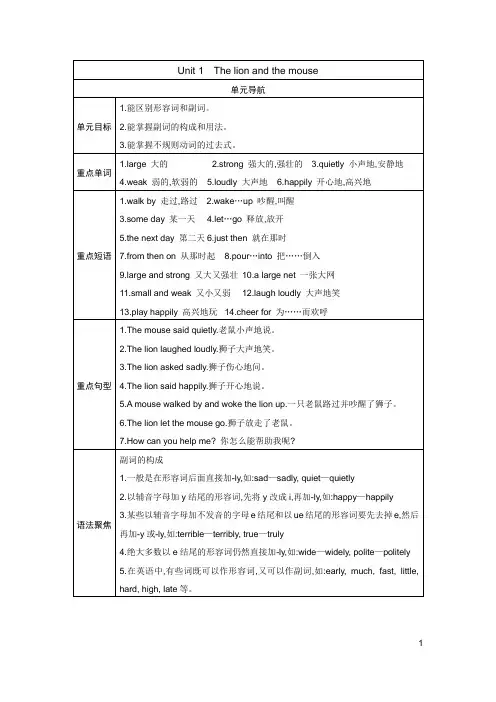
Unit 1 The lion and the mouse
单元导航
单元目标 1.能区别形容词和副词。
2.能掌握副词的构成和用法。
3.能掌握不规则动词的过去式。
重点单词 rge 大的 2.strong 强大的,强壮的 3.quietly 小声地,安静地
4.weak 弱的,软弱的 5.loudly 大声地 6.happily 开心地,高兴地
重点短语 1.walk by 走过,路过 2.wake…up 吵醒,叫醒
3.some day 某一天 4.let…go 释放,放开
5.the next day 第二天 6.just then 就在那时
7.from then on 从那时起 8.pour…into 把……倒入
rge and strong 又大又强壮 10.a large net 一张大网
11.small and weak 又小又弱 ugh loudly 大声地笑
13.play happily 高兴地玩 14.cheer for 为……而欢呼
重点句型 1.The mouse said quietly.老鼠小声地说。
2.The lion laughed loudly.狮子大声地笑。
3.The lion asked sadly.狮子伤心地问。
4.The lion said happily.狮子开心地说。
5.A mouse walked by and woke the lion up.一只老鼠路过并吵醒了狮子。
6.The lion let the mouse go.狮子放走了老鼠。
7.How can you help me? 你怎么能帮助我呢?
语法聚焦 副词的构成
1.一般是在形容词后面直接加-ly,如:sad—sadly, quiet—quietly
2.以辅音字母加y结尾的形容词,先将y改成i,再加-ly,如:happy—happily
3.某些以辅音字母加不发音的字母e结尾和以ue结尾的形容词要先去掉e,然后再加-y或-ly,如:terrible—terribly, true—truly
牛津译林版六年级英语下册Unit 1 The lion and the mouse 习题

1 / 3 Unit 1 The lion and the mouse
习题
一、用所给词的适当形式填空。
1. The girl likes reading. Now she is reading ___________. ( loud )
2. Sam and Bobby are good at ___________ table tennis. ( play )
3. My sister is _________ at swimming. She swims ________. ( good )
4. We should read _________ in the library. ( quiet )
5.The bear is_________ the meat. (bite)
二、句型转换。
1 The lion bit the net with his teeth.(改成一般疑问句)
_________ the lion_________ the net with his teeth?
2 The girl woke her mother up this morning.( 改成否定句)
The girl__________________ her mother up this morning.
3 The cat caught the mouse just now.(对划线部分提问)
What _________ the cat_________ just now?
三、转化正在进行时
dance skate make worke
look play walk run
jog swim
四、完成句子提问
译林六年级英语下册Unit 1 The lion and the mouse 知识汇总
译林六年级英语下册
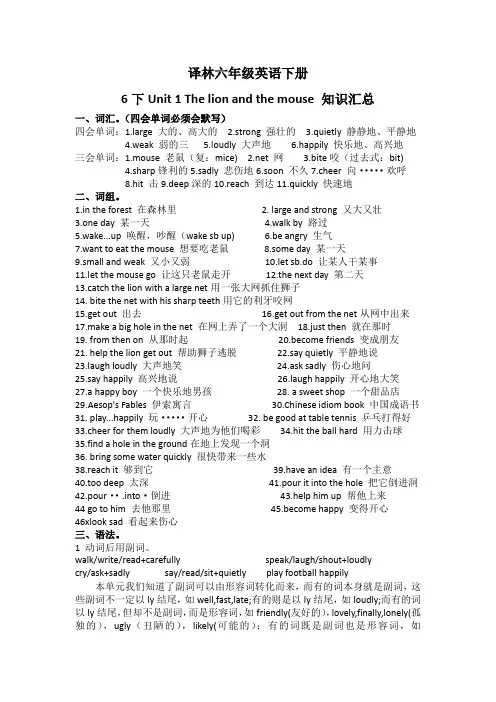
6下Unit 1 The lion and the mouse 知识汇总
一、词汇。(四会单词必须会默写)
四会单词:rge 大的、高大的 2.strong 强壮的 3.quietly 静静地、平静地
4.weak 弱的三 5.loudly 大声地 6.happily 快乐地、高兴地
三会单词:1.mouse 老鼠(复:mice) 网 3.bite咬(过去式:bit)
4.sharp锋利的5.sadly 悲伤地6.soon 不久7.cheer 向·····欢呼
8.hit 击9.deep深的10.reach 到达11.quickly 快速地
二、词组。
1.in the forest 在森林里 2. large and strong 又大又壮
3.one day 某一天 4.walk by 路过
5.wake...up 唤醒,吵醒(wake sb up) 6.be angry 生气
7.want to eat the mouse 想要吃老鼠 8.some day 某一天
9.small and weak 又小又弱 10.let sb.do 让某人干某事
11.let the mouse go 让这只老鼠走开 12.the next day 第二天
13.catch the lion with a large net用一张大网抓住狮子
14. bite the net with his sharp teeth用它的利牙咬网
15.get out 出去 16.get out from the net从网中出来
17.make a big hole in the net 在网上弄了一个大洞 18.just then 就在那时
苏教译林版英语 六年级下册 Unit 1 The lion and the mouse 知识点总结

苏教译林英语 六年级下册Unit 1
The lion and the mouse 知识点
一、词汇
mouse老鼠 large大的 strong强大的,强壮的 quietly小声地,安静地 weak弱的,软弱的 loudly大声地 net网 bite咬 sharp锋利的,尖的 sadly难过地,伤心地 soon不久,很快 happily开心地,高兴地 hit打,击 cheer欢呼 deep深的 reach够得着
quickly迅速地,快地 wake…up吵醒,叫醒 some day某一天 walk by走过,路过 let…go释放,放开 the next day第二天 just then就在那时 from then on从那时起 pour...into把…倒入
二.句型及语法
1. There was a lion in the forest. “There be…” “某处有某物”
there be 句型的就近原则:be动词后面如果跟的是不止一种物品,就根据离它最近的近的物品选用is或are.
课程中所用的是过去式,is的过去式是was,are的过去式是were。
2. large 常指面积、范围等,可表示数和量(当它直接用于人时,可表示身体大);
big 常指程度、规模、重量等,亦可指人,比较口语化。
China is a large and beautiful country.
He is a big man.
3. walk by “经过,走过” ,此短语中by意为“在...旁边”
I sit by the window. 我坐在窗户旁边。
4. wake… up “吵醒;叫醒”; up为副词,如果后面接的宾语是代词,则要放在wake…up的中间;如果后面接的宾语是名词,则放在中间或后面均可。
Unit1 The lion and the mouse cartoon(讲义) 英语六年级下册
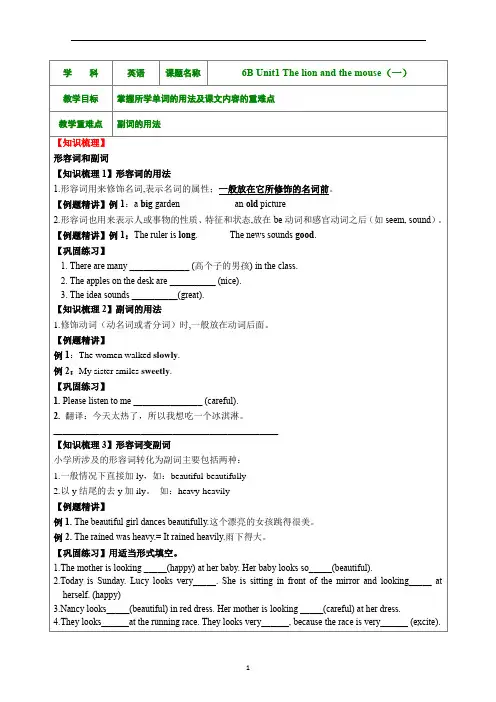
1 学 科 英语 课题名称 6B Unit1 The lion and the mouse(一)
教学目标 掌握所学单词的用法及课文内容的重难点
教学重难点 副词的用法
【知识梳理】
形容词和副词
【知识梳理1】形容词的用法
1.形容词用来修饰名词,表示名词的属性;一般放在它所修饰的名词前。
【例题精讲】例1:a big garden an old picture
2.形容词也用来表示人或事物的性质、特征和状态,放在be动词和感官动词之后(如seem, sound)。
【例题精讲】例1:The ruler is long. The news sounds good.
【巩固练习】
1. There are many _____________ (高个子的男孩) in the class.
2. The apples on the desk are __________ (nice).
3. The idea sounds __________(great).
【知识梳理2】副词的用法
1.修饰动词(动名词或者分词)时,一般放在动词后面。
【例题精讲】
例1:The women walked slowly.
例2:My sister smiles sweetly.
【巩固练习】
1. Please listen to me _______________ (careful).
2. 翻译:今天太热了,所以我想吃一个冰淇淋。
_________________________________________________
【知识梳理3】形容词变副词
小学所涉及的形容词转化为副词主要包括两种:
1.一般情况下直接加ly,如:beautiful-beautifully
2.以y结尾的去y加ily。 如:heavy-heavily
【例题精讲】
例1. The beautiful girl dances beautifully.这个漂亮的女孩跳得很美。
苏教牛津译林版英语六年级下册单元同步练习含答案
苏教牛津译林版英语六年级下册单元同步练习含答案
Unit 1 The lion and the mouse第一课时 习题
一、连线题。
1. wake up A. 从那时起
2. walk by B. 叫醒
3. just then C. 走过
4. get out D. 就在那时
5. from then on F. 出去
二、根据和首字母填空。
1 .strong(反义词)____________
2. tooth(复数)______________
3. quiet(副词)______________
4. wake (过去式) ___________
5. sad (副词) ______________
三、根据汉语提示写单词。
1. The lion is _______ (强壮的).
2. You should walk into the bedroom _______ (轻轻地).
3. Let’s read it ______ (大声地).
4. The _____ (老鼠) is clever.
5. My father is sing ______ (高兴地) in the living room.
四、选择题。
( ) 1. There are some animals _______the forest.
A. in B. on C. from
( ) 2.I like helping people. ________about you?
A. Which B. What C. what
新译林 6B Unit 1 The lion and the mouse第一单元第一课时辅导
Unit 1 第一单元第一课时辅导
(1)阅读下列词组
make a study plan制作一个学习计划 in the forest在森林里
large and strong又大又强壮 small and weak 又小又弱
walk by走过 wake up吵醒
the next day第二天
catch the lion with a large net用一张大网抓住了狮子
bite the net with his sharp teeth用他锋利的牙齿咬网
get out出来 just then就在那时
make a big hole in the net with his teeth用他的牙齿在网上弄了一个大洞
from then on从那时起 become good friends变成好朋友
(2)注意以下词性变化
形容词 quiet loud sad happy careful beautiful
副词 quietly loudly sadly happily carefully beautifully
形容词修饰名词。
副词修饰动词。一般置于动词的后面。
注意:课文中的Said the mouse quietly. 意思就是The mouse said quietly.
(3) 读一读下列动词的过去式
原形 过去式 原形 过去式
do did buy bought
go went bring brought
eat ate catch caught
drink drank can could
have had get got
meet met become became
苏教译林版英语六年级下册第一单元练习及解析
【精品】Unit 1 The lion and the mouse story time
(练习)译林版(三起)
六年级下英语
一、翻译词组。
1.在森林里_________________________ 2.又大又强壮_________________________
3.又小又弱_________________________ 4.走过_________________________
5.吵醒, 唤醒_________________________ 6.第二天_________________________
7.出来_________________________ 8.就在那时_________________________
9.从那时起_________________________ 9.变成好朋友_________________________
二、根据课文内容判断句子是否相符,相符的写T,不相符的写F。
1. The mouse woke the lion up. ( )
2. The lion ate the little mouse . ( )
3. Two men caught the lion with a small net. ( )
4. The mouse made a hole in the net and helped the lion get out. ( )
5. Then lion and the mouse were friends at last. ( )
2023六年级英语下册Unit1Thelionandthemouse知识点梳理译林牛津版
Unit 1 The lion and the mouse知识点梳理
Key phrases:
large and strong大和强壮 laugh happily开心地大笑
walk by路过 sweet shop甜品店
wake …up 唤醒 Aesop’s Fables 伊索寓言
want to eat the mouse想要吃老鼠
some day 某一天 be good at table tennis乒乓打得好
so small and weak这么小和弱 cheer for them loudly大声地为他们喝彩
let the mouse go 让这只老鼠走开 hit the ball hard用力击球
catch the lion with a large net用一张大网抓住狮子
find a hole in the ground在地上发现一个洞
bite the net with his sharp teeth用它的厉牙咬网 too deep太深
get out from the net破网而出 reach it(到达)触碰到它
Just then就在那时 have an idea有一个主意(想法)
make a big hole in the net在网上做了一个大洞 bring some water quickly很快带来一些水
from then on从那时起 pour it into the hole把它倒进洞
bee good friends变成好友 In a shopping centre在一个购物中心
help the lion get out帮助狮子逃脱 look sad看起来伤心