
高二英语选修七unit4语法--导学案
高二英语选修七unit4语法--导学案 1 / 5 波峰中学高二英语 课前双基预习案(A) 姓名 班级 组别 编制 辛成霞 时间 编号 05 审批 选修七 Unit 4 Grammar 【学习目标】学生可以熟练掌握限制性定语从句的用法和构成,并能在文章中理解其含义。 【重点难点】复习限制性定语从句的用法,能够正确使用关系代词和关系副词。会分析定语从句的构成,了解先行词,关系代词,关系副词等概念。 【完成目标】 一、概念 1) 定语从句:在主从复合句中用作定语的从句叫定语从句。定语从句一般紧接在先行词后面,但as引导的修饰全句的定语从句可以放在句首。 2) 先行词:被定语从句修饰的成份。先行词可以为一个词,短语,或整个主句。 3) 关系词:引导定语从句的词叫关系词,分为关系代词和关系副词。 关系词的作用: (1) 引导定语从句,连接主句和从句,相当于一个连词; (2) 必在从句中作某个句子成份(可以做主语,宾语,表语,定语,状语); 常用的关系代词: that、 which、 who、whom、whose、as 、but 1. that多指物,有时也指人。在从句中作主语或宾语,有时作表语,作宾语时常省略。 2. which指物,在从句中作主语或宾语,作宾语时常省略。 3. who指人,在从句中作主语或宾语。 4. whom指人, 在从句中作宾语, 在口语及非正式文体中常省略。 5. whose可指人,也可指物,在从句中作定语。 6. as指人或物,在从句中作主语或宾语。 当先行词被the same,as,such等修饰时,多用as引导。 7. but文语, 置于否定词之后=that/who…not…, "没有……不……", 在从句中作主语,宾语。 二、关系代词引导的定语从句 1) which, that 它们所代替的先行词是事物的名词或代词,在从句中可作主语、宾语等,例如: A prosperity which / that had never been seen before appears in the countryside.(which / that在句中作宾语) The package (which / that) you are carrying is about to come unwrapped. (which / that在句中作宾语) 2) who, whom, that 这些词代替的先行词是人的名词或代词,在从句中所起作用如下: Is he the man who/that wants to see you?(who/that在从句中作主语) He is the man whom/ that I saw yesterday.(whom/that在从句中作宾语) 3) whose 用来指人或物,(只用作定语,若指物,它还可以同of which互换),例如: Please pass me the book whose (of which) cover is green. 4) 关系代词that和which (1) 不用that的情况: a) 在引导非限定性定语从句时 (错)The tree, that is four hundred years old, is very famous here. b) 介词后不能用 We depend on the land from which we get our food. (2) 只能用that作为定语从句的关系代词的情况 a) 在不定代词,如:anything, nothing, everything, all, much, few, any, little等作先行词时,只高二英语选修七unit4语法--导学案 2 / 5 用that,不用which。 All that is needed is a supply of oil. Finally, the thief handed everything that he had stolen to the police. b)先行词有the only, the very, the just修饰时,只用that。 He is the very man that helped the girl out of the water. c) 先行词为序数词(the last)、数词、形容词最高级时,只用that。 The first English book that I read was "The Prince and the Pauper" by Mark Twin. d) 先行词既有人,又有物时。 He talked about the teachers and schools that he visited. e) 当主句是以who 或which 开始的特殊疑问句时,用that 以避免重复。 Who is the person that is standing at the gate. f) 关系代词在从句中做表语 He is not the man that he used to be. (3) 用which不用that的情况 a) which可以引导非限制性定语从句,that不能。(非限制性定语从句将在M1U3复习) He had failed in the maths exam,which made his father very angry. b) which可以用在介词后,that不可。 That is the house in which Mark Twain used to live. c) 一个句子中若有两个定语从句,一个用that引导。另一个不能再用that,而用which。 He bought an American magazine that could give him so much English knowledge and which could help him to kill the time. 5) who、whom及whose who、whom、whose作为关系代词既可以引导限制性定语从句,也可以引导非限制性定语从句,其先行词主要指人,其中whose也可指物。关系代词在定语从句中作主语时用who,作宾语或表语时用whom或who,表示所属关系时用whose。 (1) whose的用法 whose表示所属关系,与名词连用,可指人或物。“whose+名词”在从句中可作主语、动词宾语或介词宾语。 a) When I looked through the window, I saw a girl whose beauty took my breath away.(whose beauty作主语,whose指人a girl) b) It was a meeting whose importance I did not realize at the time.(whose importance 作动词realize的宾语,whose指物a meeting) c) Atlas (in Greek mythology) was a kneeling man on whose shoulders the world rested.(whose shoulders作介词on 的宾语) (2) 多用who 的情况 a) 关系代词在从句中做主语 A friend who helps you in time of need is a real friend. b) 先行词为those, people 时 Those who were either fools or unfit for their offices could not see the cloth. c) 先行词为all, anyone, ones, one 指人时 One who doesn't work hard will never succeed in his work. d) 在There be句型中 There is a stranger who wants to see you. e) 在被分隔的定语从句中 A new teacher will come tomorrow who will teach you German. f) 在有两个定语从句的句子中,其一用who,其二用that, 但若先行词后接两个以上的并列定高二英语选修七unit4语法--导学案 3 / 5 语从句时,后一个必须重复前一个关系代词。 The student who was praised at the meeting is the monitor that is very modest and studies very hard. There is a teacher who is always ready to help others and who enjoys what he does. (3) who和whom的区别: a) 不能用whom在从句中作主语,只能作宾语或表语。而who作主语、宾语、表语均可。 例如:a) The girl who we supposed was drowned came back. b) The girl who/whom we supposed drowned came back. b) whom在作动词或介词宾语时,特别是在口语中,一般省去,或用who、that代替。而在以介词结尾的定语从句中最好不用whom。例如: I think you should stay faithful to the person whom you're married to. (×) 上面一句一般被认为是不正确的,宜改为: I think you should stay faithful to the person who/that you’re married to. (口语中) I think you should stay faithful to the person you’re married to. I think you should stay faithful to the person to whom you’re married. (正式文体中) c) 在非限制性定语从句中,最好whom用作宾语,且不能省略。 His mother, whom he loved dearly, died in 1818. 6) 关系代词who,whom和which的选用 在某些特定的情况下,要使用who,whom或which,一般不使用that。 ①非限制性定语从句中不用that,指人时用who或whom,指物时用which。 Mr Wang,who Was my former teacher, retired last year. (此句中的who不能用that) This is the book,which he bought yesterday. ②介词后用whom指人,用which指物,不用that。 D0 you know the boy to whom I spoke just now? This is the factory in which he works. ③如果有两个定语从句,其中前一句的关系代词用了that,后一句宜用which。 Let me show you the novel that I borrowed from the library which Was newly open to us.
高中英语选修七第四单元教案正式版

高中英语选修七第四单元教案Unit 4 Sharing ---WritingTeaching goals 教学目标1. Ability goals能力目标Enable the students to write about a person’s experience by using time expressions. Enable the students to write a letter to a child they would like to sponsor.2. Learning ability goals学能目标Help the students learn how to write about a person’s experience by using time expressions. Help the students learn how to write a letter to a child they would like to sponsor. Teaching important and difficult points教学重难点The characteristics of narration.Teaching methods教学方法Task-based method and writing.Teaching aids教具准备A projector and a computer.Teaching procedures & ways教学过程与方式Step I RevisionCheck the homework.Ask some students to read the sentences with attributive clauses i n “A LETTER FROM PLAN”.1. My name is Rosanna and I work as a community volunteer in an area of Ecuador where Orlando and his family have lived for as long as they can remember.2. Although they still have time to play, they also have to help with daily jobs, which can take up a lot of time.3. Orlando’s family lives in a small metal house that has a straw roof and a dirt floor. Step Ⅱ Pre-writingT: Let’s recall something about Dr Mary Murray, who worked as a volunteer with Medecins Sans Frontieres (MSF). Who’d like to say something about her Let’s try it this way. Each of you is given the chance to say only one sentence about Dr Mary Murray. OK, begin. Of course, you can have an attributive clause in your sentence.Sa: Dr Mary Murray was a volunteer, who worked with Medecins Sans Frontieres (MSF). Sb: Dr Mary Murray once worked in clinic in both Malawi and Sudan which are developing countries in Africa.…Step Ⅲ WritingT: Very good. Now you are asked to write about Dr Murray for the school magazine. Write a paragraph on each topic below in the order shown. Remember to use time expressions listed on Page 36.1. who she is2. reasons why she joined MSF3. what she did in Malawi4. what she did in the Sudan5. the effects on her of her experiences6. her plans for the futureAfter the students have finished writing, show two samples on the screen and check the mistakes if any.Step Ⅳ Writing taskDeal with WRITING TASK on Page 75.T: Imagine that you have decided to sponsor Shan-shan, a 11-year-old girl from Gansu Province. Her family cannot afford to keep her at school. But she loves practicing English. Write a letter to her in English. In your letter, you can:Introduce yourselfSay something about your interests and hobbiesDescribe your familyLet her know you want to make friend with her and hear from herOther things you would like to tell herAfter the students have finished writing, ask several of them to read their letters.Unit 4 Sharing----ListeningTeaching goals 教学目标1. Target language目标语言a.词汇和短语:volunteer, clinic, challenging, over the last few years, in the future, in two weeks’ time, a couple of, developing country, Medecins Sans Frontieres(MSF), Malawi, Sudan, The Fred Hollows Foundation, The Cancer Council, Youth in the city, go blind, beliefb. 重点句子:Why did Mary decide to work in the developing countriesWhy were conditions in the clinic in the Sudan challengingIn the Sudan, why was it nearly impossible for Mary to get to the clinics when the rains came2. Ability goals能力目标Improve the students’ listening ability by listening to Dr Mary Murray’s experience as a volunteer with Medecins Sans Frontieres (MSF)3.Learning ability goals学能目标Learn to predict what will be heard.Help the students understand time expressions and use them.Teaching important point 教学重点Learn to make notes while listening to the material and number the events in the order they are heard.Teaching difficult point 教学难点Learn to use time expressions and work together with a partner to describe a pe rson’s experience..Teaching methods 教学方法Listening and cooperative learning.Teaching aid 教具准备A recorderTeaching procedures & ways 教学过程与方式Listening and cooperative learning.Step I Warming Up1. GreetingsT: Good morning /afternoon everyone!Ss: Good morning /afternoon, Sir/ Madam!T: Have you ever helped others What did you do to help your parents Or other relatives Or your friends Or people in your community Or people outside your community I’m sure you have a lot to say. Ok, let divide into groups of three and finish the survey form. Then in groups, discuss whether someone who helps the groups on the survey form can be called a “volunteer”.Suggested answers:T: Which one can be called a volunteer Or what kind of things do volunteers doS: Volunteer work includes: Be a coach of the football lovers, plant trees, help people with disabilities.T: Correct. Only those who don’t work not for rewards – especially money and materials,and not forced to do so are volunteers. And not only the person but also the society and the environment benefit from it. For example, Dr Mary Murray was a volunteer with Medecins Sans Frontieres(MSF). Now turn to Page 35, read Exercises 1 and 2, and predict what you will hear in the listening material. You can also discuss with your partner.Sa: Now Jennifer Wells is interviewing Dr Mary Murray about what has happened in Mary’s life.Sb: She once worked in a clinic in Malawi and Sudan.Sc: Malawi and Sudan are developing countries.Sd: Many children died when she worked in Malawi.Se: Conditions in the clinics in the Sudan were very terrible and challenging.Sf: Medecins Sans Frontieres(MSF) is an organization that provide free medical care to children in poor countries.T: Very good. You see, even without listening to the dialogue you can get much information, if you study the questions carefully. Now let’s listen to their dialogue. You will pay attention to the time expressions and number them in the order you hear them. (Show the 11 time expressions on Page 35). And also you will answer as many of the questions in Exercise 2 as you can.Step II Listening(I)(The teacher plays the tape and the students listen to it.)T: Now let’s check the answers of Exerci se 1 and 2.(The students will answer the questions)T: Now let’s listen to the dialogue for a second time. When you are listening, you can check the answers of Exercise 2 and finish Exercises 3 and 4. Learn to make notes about Mary’s experiences in the t able on Page 35. And share your notes with your partner and then with other groups.(The students will makes notes, and share their notes.)T: Ok, let’s listen to it for a third time to check the notes.Step III Listening(II)T: Perhaps you may wonder, because we are students, what we can do to help. That is, what can we do to serve communities outside the school Ok, let do LISTENING in the workbookon Page 70. You are also required to predict what you will hear, according to the four questions.Sa: There are three characters in the material: Jason, Mick and Annie.Sb: They want to raise money to help.Sc: Perhaps they will help children in hospital, or serve soup to the homeless, or protect the environment.Sd: They will spend some time working for their s chool’s Community Care Committee (CCC). T: It couldn’t be better. Now we’ll listen and check our prediction and also finish the exercises on Page 70.Step V AssignmentT: Boys and girls, today we have listened to two materials about giving help to others.I do hope all of us will help those who need help. Besides, you should learn to predictwhat you will hear before listening and pay attention to the time expressions while listening.Homework for today.1. Finish the LISTENING TASK on Page 75-76. Remember to predict what you will hear accordingto the given information and also pay attention to time expressions.2. Google for more information about MSF and share it between us.Now class is over. Goodbye, everyone.Ss: Goodbye, sir/madam.Unit 4 Sharing.语法在复合句中修饰名词或代词的从句叫定语从句。
高二英语外研版选修7教案:Module4MusicBorninAmerica4含解析

英语:Module 4《Music Born in America》英文教案(4)(外研版选修7)Teaching Goals:1。
To learn the grammar – adverbial clauses of time and ellipses.2。
To enable Ss to use adverbial clauses of time freely。
3。
To enable Ss to use adverbial clauses of time and ellipses in right situations.Teaching Procedures:Step 1。
RevisionCheck the answers of Vocabulary Activities in the Workbook on pages 110~111。
Step 2。
Grammar (1)1. Ask Ss to take a look at the sentence in Activity 1 and choose the best answer. Ask them to think What kind of sentence does it belong to。
2. Ask Ss to finish Activity 3 on page 48。
3. Give Ss some explanation of adverbial clauses of time。
(1)时间状语从句通常用下列从属连词来引导:after,before, as,once,till,until, (ever)since,when,whenever,while,now (that), as long as,as soon as。
如:①Now (that)you've grown up,you must stop this childish behavior。
模块7unit4导学案1

A.choke backB.choke outC.choke upD.choke off
4)The increasing number of cars on the road ________traffic. This is the reason why wecan’t get here on time.
1)他答应星期五之前完成这项任务
He ___________________________________________ the task before Friday.
2)I would like to propose Mr.Harrison_________ the important task.
1)很小的玩具可使婴儿窒息。_________________________________________________
2)Hearing what he said, I _________________________________(我气得说不出话来)。
[知识网络]choke on sth被…噎住;choke to death噎死;choke sth (up) with sth被…塞满,堵塞;choke up(因感情激动而)哽咽、噎住,说不出话:choke sth. back抑制住、忍住(愤怒、悲伤等);choke down硬咽,硬吞:choke off阻止,限制;打断,使停止。
1)I find it impossible to ________ to her.
A. get throughB. look throughC. go throughD.put through
高中英语 Unit4 reading导学案(无答案) 牛津译林版选修7 学案
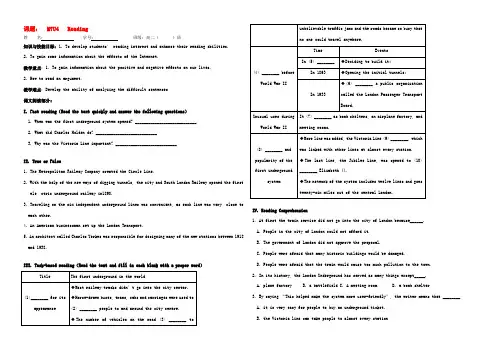
课题: M7U4 Reading姓名:学号:班级:高二()班知识与技能目标:1. To develop students’ reading interest and enhance their reading abilities.2. To gain some information about the effects of the Internet.教学重点:1. To gain information about the positive and negative effects on our lives.2. How to read an argument.教学难点:Develop the ability of analyzing the difficult sentences课文阅读部分:I. Fast reading(Read the text quickly and answer the following questions)1. When was the first underground system opened? ____________________________2. What did Charles Holden do? ____________________________3. Why was the Victoria Line important? ____________________________II. True or False1. The Metropolitan Railway Company created the Circle Line.2. With the help of the new ways of digging tunnels, the city and South London Railway opened the firstele ctric underground railway in1890.3. Traveling on the six independent underground lines was convenient, as each line was very close toeach other.4. An American businessman set up the London Transport.5. An architect called Charles Yerkes was responsible for designing many of the new stations between 1918and 1938.III. Task-based reading(Read the text and fill in each blank with a proper word)IV. Reading Comprehension1. At first the train service did not go into the city of London because______.A. People in the city of London could not afford it.B. The government of London did not approve the proposal.C. People were afraid that many historic buildings would be damaged.D. People were afraid that the train would cause too much pollution to the town.2. In its history, the London Underground has served as many things except_____.A. plane factoryB. a battlefieldC. A meeting roomD. a bomb shelter3. By saying “This helped make the system more user-friendly”, the writer means that ________A. it is very easy for people to buy an underground ticket.B. the Victoria line can take people to almost every stationC. people can go to different places in the city by taking the underground.D. the workers of the underground ticket office are friendly4. It can be inferred from the passage that the London underground ________A. is the best underground system in the worldB. plays a very important part in Londoner’ livesC. is the only means of transport in central LondonD. shows the quality of Londoners’ lives.V. Match the new words from the article with their meanings (D of p52)VI. Study the text carefully and complete the following sentences (one word in each blank)1. 伦敦地铁久负盛名,因为它是世界上最古老和最复杂的地铁系统。
高二英语选修7学案:语法解读Unit4 Sharing含解析

语法解读限制性定语从句一、在复合句中修饰某一名词或代词的从句叫定语从句,一般都紧跟在它所修饰名词后面。
被定语从句所修饰的名词或代词叫做“先行词”。
定语从句可分为限制性定语从句(Restrictive Attributive Clauses)和非限制性定语从句(Non Restrictive Attributive Clauses)两种。
本单元主要复习限制性定语从句的用法。
1。
形式上:限制性定语从句紧跟在先行词后面,不能用逗号把从句与先行词分隔开来。
2.意义上:限制性定语从句使先行词的意思十分明确,成为特定的人或东西,是句子中不可缺少的成分,少了它句子就会失去意义不能成立,或意思不清楚,不能说明问题。
例如:He is a man who/that never leaves today’s work till tomorrow。
他是一个从不把今天的工作留到明天去做的人。
二、引导定语从句的词叫“关系词".关系词有关系代词和关系副词之分。
关系代词有that,which,who,whom,whose,as等;关系副词有when,where,why等.定语从句中关系代词和关系副词最基本的用法是:which指代物,who,whom,whose指代人,that既可以指代物,也可以指代人;where指代地点,when指代时间,why指代原因等等。
关系词通常有下列三个作用:1)引导定语从句;2)代替先行词;3)在定语从句中担当一个成分.例如:The car which my uncle had just bought was destroyed in theearthquake 。
句中,which my uncle had just bought是定语从句,修饰先行词the car;which是引导定语从句的关系词,代替先行词the car,在定语从句中作主语。
关系词功能在从句中的成分例句that指人/物作主语、宾语The school made threerules that would playimportant role in ourschool life.which指物作主语、宾语He asked two days off which cost him 100 yuan。
高二英语人教版选修7unit4 Section Ⅳ Grammar精品课件
Unit 4 Sharing
3.(教材 P29)But last weekend another teacher, Jenny, and I did visit a village _w__h_ic_h__ is the home of one of the boys, Tombe. 4.(教材 P29)We walked for two and a half hours to get there—first up a mountain to a ridge from _w__h_e_r_e_ we had fantastic views and then down a steep path to the valley below.
Unit 4 Sharing
Section Ⅳ Grammar
Unit 4 Sharing
限制性定语从句
1.(教材 P29)I know you’re dying to hear all about my life here, so I’ve included some photos __w_h_i_c_h_ will help you picture the places I talk about. 2.(教材 P29)The boys __w_h_o___ had never come across anything like this before started jumping out of the windows.
Unit 4 Sharing
关系代词
1.关系代词 who, whom 和 whose
关系代词
先行词
在从句中充当的成分
who
人
主语、宾语、表语
whom
人教版高二英语选修七第四单元《Unit 4 XXX》教学设计
人教版高二英语选修七第四单元《Unit 4XXX》教学设计学生已经学过了一定的英语基础知识,能够基本理解英语文章的大意和部分细节。
但是在阅读和理解文章时,可能会遇到一些词汇和句子结构的难点。
同时,学生对于贫困地区的生存现状和支教旅行的经历可能缺乏直接的了解和体验。
教学目标知识目标:1.通过阅读文章,学生能够掌握并理解文章的主要内容。
2.学生能够理解和运用文章中的重点词汇和句子结构。
3.学生能够通过文章了解贫困地区的生存现状和支教旅行的经历。
能力目标:1.学生能够通过思维导图的方式整理和梳理文章中的信息。
2.学生能够通过批判性思维的方式对文章中的信息进行分析和评估。
3.学生能够通过英语表达自己的观点和看法。
情感目标:1.学生能够通过阅读文章了解和关心贫困地区的生存现状和支教旅行的经历。
2.学生能够通过分享和合作的方式,增强团队意识和社会责任感。
教学重点1.理解和掌握文章的主要内容。
2.运用思维导图的方式整理和梳理文章中的信息。
3.运用批判性思维的方式对文章中的信息进行分析和评估。
教学难点1.如何通过英语表达自己的观点和看法。
2.如何通过阅读文章了解和关心贫困地区的生存现状和支教旅行的经历。
教学方法1.阅读理解法:通过阅读文章,理解和掌握文章的主要内容。
2.思维导图法:通过思维导图的方式整理和梳理文章中的信息。
3.批判性思维法:通过批判性思维的方式对文章中的信息进行分析和评估。
4.合作研究法:通过分享和合作的方式,增强团队意识和社会责任感。
教学过程设计Step 1:导入(5分钟)教师通过图片或视频等形式,引导学生了解贫困地区的生存现状和支教旅行的经历,唤起学生的兴趣和情感共鸣。
Step 2:阅读文章(15分钟)教师让学生阅读文章,并在阅读过程中提出问题,引导学生思考和理解文章的主要内容和重点词汇。
Step 3:思维导图(20分钟)教师让学生用思维导图的方式整理和梳理文章中的信息,并让学生分享自己的思维导图,增强团队合作意识和思维能力。
新课标导学高中英语人教选修七课件:Unit 4 Sharing 单元导航
写一篇志愿活 动或有关haring 的记叙文
背景知识链接
▪ 文章大意:本文介绍了一个名叫Peter Hodes的人从事的有关干细胞传递的志愿 者工作,并主要讲述了他的一次难忘的经 历。在传递干细胞的过程中,他深刻地意 识到时间就是生命。
▪ I am Peter Hodes,a volunteer stem cell courier .Since March 2012,I’ve done 89 trips — of those,51 have been abroad.I have 42 hours to carry stem cells(干细胞
新课标导 学
英语
选修⑦ ·人教 版
Unit 4
Sharing
1 学习目标
展
示
2 背景知识
链
接
学习目标展示
必记单词
voluntary relevant adjust participate otherwise donate purchase
distribution operate
重点短语
经典句型
some stem cells that are urgently needed
▪ For this courier job,you’re consciously aware that in that box you’ve got something that is potentially going to save somebody’s life.
caught by a hurricane in America.I picked up the stem cells in Providence,Rhode Island,and was meant to fly to
新课标模块7Unit4教案、单元小测及答案(新课标版高二英语选修七教案教学设计)
on subsistence farming to make a living.
Education: About 85% of children start school but only about 60% of these reach Year 5.
Part 1 (Paragraph 1):
Opening of the letter and introduction to what will be talked about in the passage.
Part 2 (Paragraph 2-3):
The school where Jo worked and Jo’s work at school.
What do you know about Papua New Guinea?
There are many volunteers working in different mountainous areas or developing countries, among which Papua New Guinea (PNG) is one.
Step5. Homework
Suppose you've graduated from a key university and now you are a volunteer who works in the remote region to assist the basic education there. And you are to write a letter home to introduce your present situation. (you can refer to the text).
高二英语译林版选修7学案:目标导引 Unit4Publictrans
Unit 4 Public transport
一览众山小
单元概要
表二
阅读旅游指南
在旅游某个地方之前,一项必做的功课是阅读旅游指南,因为旅游指南能让我们对这个城市有一个全方位的了解,有助于你在旅游的过程中欣赏美丽景色的同时,又可以对这个地方深层次的人文文化有更多的认识。
本文是关于伦敦地铁发展历史的旅游指南,通过对它的阅读,我们可以了解到它建立的时间和地铁不断发展、完善的过程,以及它的建立对伦敦的影响和带来的改变。
在指南中也可以找到一些幽默轻松的东西,比如本文提到的在二战中地铁的用途。
指南的最后,也对读者提出了邀请“So why not take a trip on the oldest underground system today?”
有的旅游指南中也会给大家一些提醒和建议,因此阅读的时候要注意它包含的信息。