
仁爱版八年级上册英语Unit1 Topic2 知识点梳理
1
仁爱版八年级上英语
Unit 1 Topic 2 知识点梳理
1. help sb=do sb a favor=give sb a hand帮助某人
Eg: 1) Please help me
= Please do me a favor
= Please give me a hand
2) I want to help her.
= I want to do her a favor.
= I want to give her a hand.
2. 1) There is going to be a soccer game between Class Two and Class Five.
= Class Two is going to have a soccer game against Class Five.
2) Class Six is going to have a basketball game against Class One.
= There is going to be a basketball game between Class Six and Class One.
3. one of + the + 形容词的最高级 +名词复数:最......之一
Eg: 1) The Great wall is one of the greatest (wonder) in the world.
2) Tom is one of the tallest (boy)in our class.
4. take part in = join in = be in + 某项活动
join + 某个组织
Eg: Lily will take part in the high jump. (同义句)
= Lily will join in the high jump.
= Lily will be in the high jump.
join the Army:参军
join the party:入党
join the league:入团
join ....... club / team / us / them
5. Would you mind + 动词的ing形式:意为你介意做.....吗?
Eg: 1) Would you mind (open) the window?
2) Would you mind (teach) me?
▲ Would you mind + 动词的ing形式的答语:
肯定回答:of course not / certainly not / Not at all
否定回答:You’d better not / Better not
▲ Would you mind +动词的ing形式的否定是在mind后加not,就构成了否定句。
Eg:1) Would you mind helping me?(否定句)
Would you mind not helping me?
2) Would you mind closing the window? (否定句)
Would you mind not closing the window?
6. Let’s + 动原
1)Let’s (visit) the Great Wall. 2
2) Let’s ( go ) shopping.
7. Practice:动词 意为练习
Practice doing sth:练习做某事
Eg:1)Lily often practices (speak) English in the morning.
2) I want to practice (play) soccer.
8. Kick sb sth = kick sth to sb:踢某物给某人
Eg:1) Please kick me the ball.(同义句)
= Please kick the ball to me
像这样内似的词组有:
give sb sth = give sth to sb:给某人某物
pass sb sth = pass sth to sb:传递某物给某人
show sb sth = show sth to sb:展示某物给某人看
buy sb sth = buy sth for sb:为某人买某物
make sb sth = make sth for sb:为某人制作某物
9. keep doing sth: 坚持做某事
keep sb doing sth:让某人一直做某事
Keep sb / sth + 形容词:使某人/某物是.....样的
Eg: 1) Please keep (work) hard. Don’t give up.
2) Why do you keep me (wait) for a long time?
3) We should keep our parents happy every day.
10. be good at:擅长......
= do well in:在......做得好
▲ am good at / are good at = do well in
is good at = does well in
Eg:1)I am good at playing soccer.(同义句)
= I do well in playing soccer.
2) My sister is good at drawing pictures. (同义句)
= My sister does well in drawing pictures.
注意:be good at和do well in 后的动词用ing形式。
Eg:1) Lily is good at (sing).
2) Kang Kang does well in ( play)basketball.
11. ▲ Could you please 后+动词原形
▲ Could you please 的否定是在please后加not 就构成了否定句
Eg:1) Could you please give me a hand? (否定句)
Could you please not give me a hand?
2) Could you please open the door? (否定句)
Could you please not open the door?
▲ Could you please + 动原的答语: 3
肯定回答:Sure. / Certainly. / of course.
否定回答: I’m afraid I can’t. / I’m sorry I can’t.
12. fall ill = be ill 患病;生病
Eg:1)One of my teammates fell ill. (同义句)
= One of my teammates was ill.
2) Jim often falls ill.(同义句)
13. Would you mind teaching me? (同义句)
= Could you please teach me?
14. else:意为其他的;别的 置于不定代词之后
Eg:1) I will put it somewhere else.
2) Are there anybody else in the classroom?
15. throw around:乱扔;乱抛
Eg:1) Don’t throw around your socks.
2) Throwing bottles isn’t a good habit.
Section B
1. 对含有because 的句子提问用Why.
Eg: 1)We lost the game because you wouldn’t pass the ball.(提问)
Why did you lost the game?
2) Lily didn’t go to school because she was ill yesterday.(提问)
Why didn’t Lily go to school?
3) I don’t like English because it’s boring.(提问)
Why don’t you like English?
2. What do you mean? (同义句)
= What’s your meaning?
3. shout at sb:冲某人大声嚷
Eg:1)Don’t shout at your father.
4. want sth = would like sth 想要某物
want to do sth = would like to do sth想要做某事
want sb to do sth = would like sb to do sth想要某人做某事
注意: 1) want = would like 想要
2)Want 和would like 后的动词要用to do
3) would like 不受人称的限制,而want 要受人称的限制 即want 要加s或es.
Eg:1)I want to go fishing. (同义句)
= I would like to go shopping.
2)Lily would like to visit the Great Wall.(同义句)
= Lily wants to visit the Great wall.
3) My sister wants (watch) TV this morning.
4) Jim would like (have) supper with me.
仁爱英语八年级上册知识点总结unit1-topic1

1 / 4 Unit 1 Playing Sports
Topic 1 I’m going to play basketball
Section A
1. be going to +动词原形表示“打算\准备做某事”。如:He is going to write an email tonight. 他打算今晚写封电子邮件。一
2. be going to与will的区别,在表示将来发生的事情时,二者的区别主要是:
1) be going to 用于主观判断,及说话人主观上计划或安排将要去做的事情
will则多用于客观的情况,即客观上将要发生的事情。例如:
I’m not going to ask her. 我不打算去问她。
It will be rainy tomorrow.明天会下雨。
2)be going to 表示近期、眼下就要发生的事情,will 表示的将来时间则较远一些。例如:
He’s going to do it right away. 他马上就去做。
Will she arrive on time next time? 下次她会按时到吗?
3)可表示说话人按照他的意图将要发生或进行的动作时,各有侧重:
若表示没有经过事先计划或考虑,而是在说话的当时临时想到的意图或临时作出的决定时,则要用will。若表示经过事先考虑好的意图时,要用be going to。例如:
I’ll answer the telephone.我去接电话。(事先没经过考虑)
I’m going to meet him at the railway station. 我去火车站接他。(已经过考虑)
4)在有条件从句的主句中一般不用 be going to, 而多用will,因为此时多少带有些意愿。例如:
I won’t go if he doesn’t come.他不来,我就不去。
5)在正式的通知(如新闻媒体公布的官方消息,气象预报等)中用will结构。例如:
仁爱版英语八年级上册Unit-1—Unit-2重点知识点归类及复习(有答案)
文档收集于互联网,已重新整理排版.word版本可编辑.欢迎下载支持.
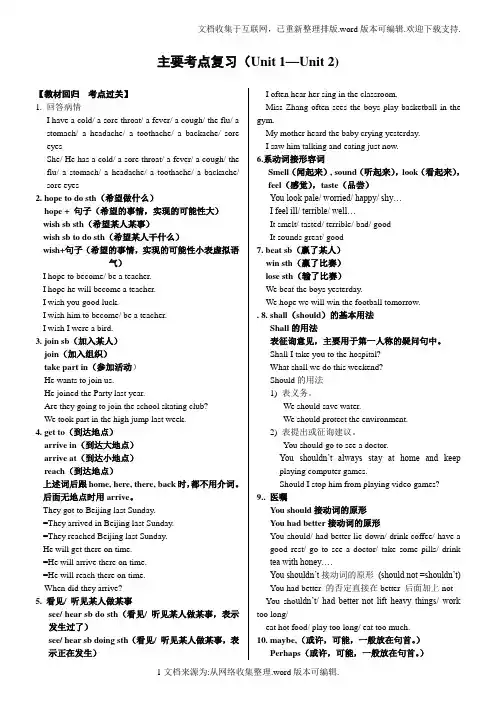
1文档来源为:从网络收集整理.word版本可编辑. 主要考点复习(Unit 1—Unit 2)【教材回归 考点过关】
1. 回答病情
I have a cold/ a sore throat/ a fever/ a cough/ the flu/ a
stomach/ a headache/ a toothache/ a backache/ sore
eyes
She/ He has a cold/ a sore throat/ a fever/ a cough/ the
flu/ a stomach/ a headache/ a toothache/ a backache/
sore eyes
2. hope to do sth(希望做什么)
hope + 句子(希望的事情,实现的可能性大)
wish sb sth(希望某人某事)
wish sb to do sth(希望某人干什么)
wish+句子(希望的事情,实现的可能性小表虚拟语气)
I hope to become/ be a teacher.
I hope he will become a teacher.
I wish you good luck.
I wish him to become/ be a teacher.
I wish I were a bird.
3. join sb(加入某人)
join(加入组织)
take part in(参加活动)
He wants to join us.
He joined the Party last year.
Are they going to join the school skating club?
We took part in the high jump last week.
4. get to(到达地点)
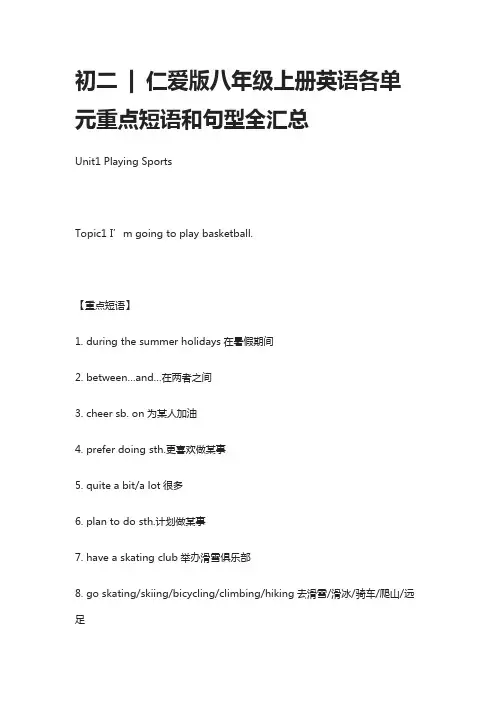
仁爱版初二八年级上册英语各单元重点短语和句型全汇总
初二 | 仁爱版八年级上册英语各单元重点短语和句型全汇总
Unit1 Playing Sports
Topic1 I’m going to play basketball.
【重点短语】
1. during the summer holidays在暑假期间
2. between…and…在两者之间
3. cheer sb. on为某人加油
4. prefer doing sth.更喜欢做某事
5. quite a bit/a lot很多
6. plan to do sth.计划做某事
7. have a skating club举办滑雪俱乐部
8. go skating/skiing/bicycling/climbing/hiking去滑雪/滑冰/骑车/爬山/远足 9. arrive in/at到达
10. play against…与……对抗/较量
11. for long很久
12. leave for…动身去…
13. the day after tomorrow后天
14. China’s national team中国国家队
15. play baseball打棒球
16. at least至少
17. What a shame! 多羞愧!
18. be good at善于做某事
19. take part in参加
20. all over the world全世界
21. be good for对……有益
22. a good way一种好方法
23. keep fit/healthy保持健康
24. relax oneself放松某人自己
【重点句型】
1. What’s your favorite sport? = What sport do you like best? 你最喜爱的运动是什么?
2. Which sport do you prefer? = Which sport do you like better?你更喜欢什么运动?
Unit 1 Topic 2 We should learn teamwork(仁爱版八上)
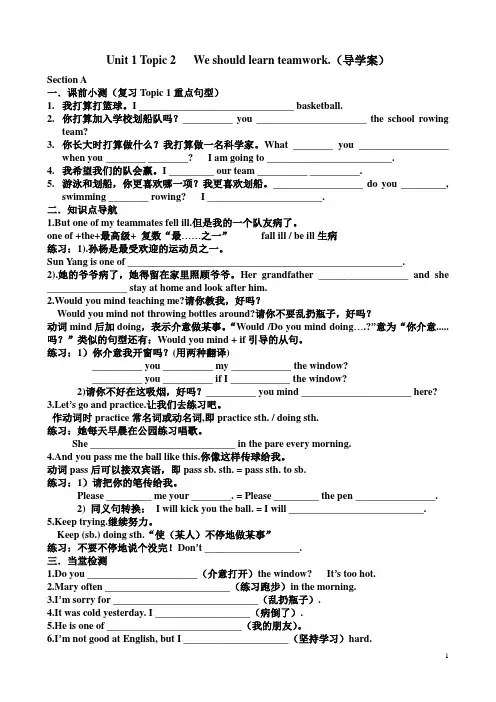
1 Unit 1 Topic 2 We should learn teamwork.(导学案)
Section A
一.课前小测(复习Topic 1重点句型)
1. 我打算打篮球。I _______________________________ basketball.
2. 你打算加入学校划船队吗?__________ you ______________________ the school rowing
team?
3. 你长大时打算做什么?我打算做一名科学家。What ________ you __________________
when you ________ ________? I am going to _________________________.
4. 我希望我们的队会赢。I _________ our team __________ __________.
5. 游泳和划船,你更喜欢哪一项?我更喜欢划船。__________________ do you _________,
swimming ________ rowing? I _______________________.
二.知识点导航
1.But one of my teammates fell ill.但是我的一个队友病了。
one of +the+最高级+ 复数“最……之一” fall ill / be ill生病
练习:1).孙杨是最受欢迎的运动员之一。
Sun Yang is one of _______________________________________________________.
2).她的爷爷病了,她得留在家里照顾爷爷。Her grandfather __________________ and she
________________ stay at home and look after him.
八年级上册Unit 1 (T2)仁爱版英语常用词组
1
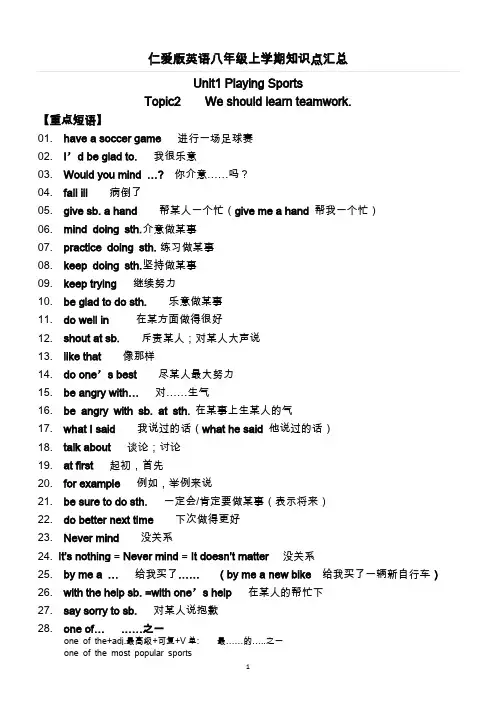
仁爱版英语八年级上学期知识点汇总
Unit1 Playing Sports
Topic2 We should learn teamwork.
【重点短语】
01. have a soccer game 进行一场足球赛
02. I’d be glad to. 我很乐意
03. Would you mind …? 你介意……吗?
04. fall ill 病倒了
05. give sb. a hand 帮某人一个忙(give me a hand 帮我一个忙)
06. mind doing sth. 介意做某事
07. practice doing sth. 练习做某事
08. keep doing sth. 坚持做某事
09. keep trying 继续努力
10. be glad to do sth. 乐意做某事
11. do well in 在某方面做得很好
12. shout at sb. 斥责某人;对某人大声说
13. like that 像那样
14. do one’s best 尽某人最大努力
15. be angry with… 对……生气
16. be angry with sb. at sth. 在某事上生某人的气
17. what I said 我说过的话(what he said 他说过的话)
18. talk about 谈论;讨论
19. at first 起初,首先
20. for example 例如,举例来说
21. be sure to do sth. 一定会/肯定要做某事(表示将来)
22. do better next time 下次做得更好
23. Never mind 没关系
24. It’s nothing = Never mind = It doesn’t matter 没关系
仁爱版八年级上册英语unit1知识点总结06528

Unit 1 Playing sports
Topic1 I’m going to play basketball.
Section A
1、what are you gonging to do? 你要做什么?
2、I’m going to play basketball.我要打篮球。
3、I often saw you play basketball during the summer holldays.暑假期间我经常看到你打篮球。
4、We are going to have a basketball game against Class Three on
Sunday.星期天我们要和三班进行一次篮球比赛。
have a game against Class Three和三班打比赛
5、Would you like to come and cheer us on?你会来为我们加油吗?
cheer sb on 为某人加油
6、win-----lose赢----败
7、Which sport do you prefer ,swimming or rowing? I prefer rowing.游泳和划船你更喜欢那一项?我更喜欢划船。
prefer doing sth更喜欢做某事
8、Do you row much? Yes ,quite a lot / No, seldom.你常划船吗?是的,常划/不,很少
quite a lot表示经常
9、Are you going to join the school rowing team?你要参加学校的划船队吗?
Section B 10、 what’s your favorite sports ,Marla? Basketball, of course.玛利亚,你喜欢什么运动?当然是篮球。
11、 who’s your favorite player?你最喜欢的运动员是谁?
仁爱版八年级英语英语第一单元知识点
1 Unit1 Playing Sports
Topic 1 I’m going to play basketball.
重点词语:
1. almost(反义词)never 2.win(过去式)won(名词)winner 3.skate(现在分词)
skating
4.famous(比较级)more famous 5.arrive(同义词) reach 6.leave(过去式)left
7.popular(最高级)most popular 8.healthy(同义词)fit(名词)health
重点词组
1. during the summer holidays 在暑假期间
2. between…and… 在两者之间
3. cheer sb. on 为某人加油
4. prefer doing sth. , prefer to do sth 更喜欢做某事
5. quite a bit = quite a lot 很多
6. plan to do sth. 计划做某事
7. join the school rowing team 加入学校划船队
8. go skating /cycling/climbing/hiking 去滑雪/骑车/爬山/远足
9. arrive in+大地方,arrive at+小地方,get to +地点名词,
get +home/here/there ,reach+地点 到达某地
10.play against…与…对抗/较量
11. for + 一段时间for long很久
仁爱英语八年级Unit1 Topic 2重点知识点讲解、例题讲解、课后练习
Topic 2 What has happened to the population?
1. -- I really hate to go such a place . 我真讨厌去那样的地方。
-- So do I . 我也是。
So do I .为倒装句,表示前面提到的肯定情况也同样适合另外一个主体,表“某某也一样”,结构为“so + be /情态动词/ 助动词 + 主语”。
eg: Jim is a student, so is Tom. 吉姆是一名学生,汤姆也是。
Jim can swim, so can Tom. 吉姆会游泳,汤姆也会。
Jim likes sports, so does Tom. 吉姆喜欢运动,汤姆也喜欢。
如表前面不怎样,后面“也不”怎样时,其结构为“ neither/ nor + be /情态动词/
助动词 + 主语”。
eg: Jim wasn’t Chinese, neither/ nor were they. 吉姆不中国人,他们也不是。
Jim can’t speak Japanese, neither can I . 吉姆不会说日语,我也不会。
Jim didn’t go there, neither did I . 吉姆没去那儿,我也没去。
如前后两句表达的是同一个主体,则不能倒装,表“的确如此”。如:
eg: Jim is a good student. So he is. 吉姆是一名好学生,的确如此。
Jim swims well. So he does. 吉姆游泳很好,的确如此。
2.At that time, China was the country with the largest population in the world.
那时,中国是世界上人口最多的国家。
2014仁爱英语八年级上册第一单元第一单元unit1topic2 辅导讲义
一、知识点梳理
二、知识点讲解
1. 词汇学习
lover 爱好者,热爱着
cricket 板球(运动)
main 主要的
person 人,个人
hero 英雄
grass 草坪,草地
point 得分,观点,
v.指着
hit 击球,碰撞
bat 球拍,蝙蝠
2. 课文呈现
Sports are important in English life. The people of England are sports lovers.
Some of the world’s famous sports began here such as football and cricket.
Football is a game played in winter and early morning. Lots of people play
football in parks or playgrounds just for fun. With hundreds of year’s history, it is one
of the most important sports in England. The English love football very much and
they turned most of their main players into famous persons. David Beckham and
Bobby Charlton became heroes for many children. The most interesting part of the
八年级u1t2英语知识点总结归纳仁爱版
八年级u1t2英语知识点总结归纳仁爱版
八年级 U1T2 英语知识点总结归纳
八年级 U1T2 英语知识点总结归纳,是对仁爱版教材中第一单元第二课时所学习的英语知识点进行总结和归纳。本文将以词汇、语法、听力和口语等方面为主要内容,以帮助同学们更好地掌握和应用这些知识点。
一、词汇(Vocabulary)
1. 日常生活词汇(Daily Life Vocabulary)
在生活中,我们经常使用各种词汇来表达自己的需求和感受。以下是一些常见的日常生活词汇示例:
- Breakfast(早餐)
- Lunch(午餐)
- Dinner(晚餐)
- Bed(床)
- Clothes(衣服)
- Shoes(鞋子)
2. 动词短语(Verb Phrases)
动词短语是由一个动词和一个或多个副词或介词组成的短语。以下是一些常见的动词短语示例: - Look after(照顾)
- Take care of(照料)
- Come up with(想出,提出)
- Give up(放弃)
- Set up(建立)
3. 形容词和副词(Adjectives and Adverbs)
形容词用来描述名词的特征和性质,副词则用来描述动词的方式和程度。以下是一些常见的形容词和副词示例:
- Beautiful(漂亮的)
- Kind(善良的)
- Slowly(慢慢地)
- Loudly(大声地)
- Carefully(小心地)
二、语法(Grammar)
1. 一般现在时(Simple Present Tense)
一般现在时用于描述经常性的动作、习惯或真理。以下是一些常见的一般现在时用法示例:
- I go to school every day.(我每天去学校。) - She plays the piano well.(她弹钢琴弹得好。)
- They always eat lunch at noon.(他们总是在中午吃午饭。)