
服务产品策略PF英文
❖Low-contact services do not require the customer’s continuous presence while the service is carried ou1t3.–7
13–2
The Nature aervices
An intangible product involving a deed, performance, or effort that cannot be physically possessed
Application of human and/or mechanical efforts directed at people or objects
Chapter Learning Objectives
❖ To understand the nature and importance of services
❖ To identify the characteristics of services that differentiate them from goods
❖ Service Facts (U.S.)
Service industries account for over 50% of GDP.
Service industries employ 80% of nonfarm 13–3 workers.
Characteristics of Services
❖supplementary services that differentiate the service bundle from those of other competitors.
❖“Basic,” “Standard,” and “Deluxe” service combinations are custom-tailored to consumers’ specific needs.
The production of a service cannot be separated from its consumption by the customer.
❖Services are produced, sold, and consumed all at th13e–4 same time.
13–10
Developing and Managing ❖ DMevaerlokpemtienngt oMf Siexrevicsesfo(croSnte’dr)vices
Effective delive(rycoofnsetr’vdic)es
❖Segment the pleasure and combine the pain ❖Get bad experiences out of the way as soon as
❖ To describe how the characteristics of services influence the development of marketing mixes for services
❖ To understand the importance of service 13–1 quality and explain how to deliver
❖ Intangibility
Services are actions that have no permanent physical qualities as opposed to goods which can be touched and possessed over time.
❖ Inseparability of Production and Consumption
❖ Customer Contact
The level of interaction between the service provider and the customer necessary to deliver the service
❖High-contact services require the customer to be present during the production of the service.
Chapter Outline
❖ The Nature and Importance of Services ❖ Characteristics of Services ❖ Developing and Managing Marketing Mixes
for Services ❖ Service Quality ❖ Nonprofit Marketing
The Tangibility Continuum
13–5
FIGURE 13.1
Characteristics of Services (cont’d)
❖ Heterogeneity
Variation in the quality of services delivered by individuals and organizations
13–8
13–9
Developing and Managing ❖ DMevaerlokpemtienngt oMf Siexrevicsesfor Services
Package or bundle of services consists of
❖core services that are the expected basic service experience.
❖ Client-Based Relationships
Interactions that result in satisfied customers who use a service repeatedly over time
13–6
Characteristics of Services (cont’d)
广告行业英文术语之一

Repetition is the mother of skills 重复是技能之母
-----------Joseph Dietzgen
Co Company 公司的缩写 Co.,Ltd. Inc.
企业·市场
OA
OA是Office Automation的缩写,指办公室自动化或自动化办公。
CRM
Customer Relationship Management,即客户关系管理。CRM也是 一个管理学术语,也可能是一个软件系统:指用计算机自动化分析 销售、市场营销、客户服务以及应用支持等流程的软件系统。它的 目标是缩减销售周期和销售成本、增加收入、寻找扩展业务所需的 新的市场和渠道以及提高客户的价值、满意度、赢利性和忠实度。
Tel Tel就是英文telephone的简写,有时写作ph 。 Mobile:移动电话。
企业·市场
OEM Original Equipment Manufacturer,原始设备制造商,常说的贴牌生 产;指一家厂家根据另一家厂商的要求,为其生产产品和配件,亦称为 定牌生产或授权贴牌生产
FMCG Fast Moving Consumer Goods的首字母缩写,代表快速消费品, 指那些使用寿命较短、消费速度较快、消费者需要不断重复购买的 产品,涉及食品、饮料、化妆品、洗涤用品、电池、卫生纸等多个 行业。典型的快速消费品包括日化用品、食品饮料、烟草等;药品 中的非处方药(OTC)通常也可以归为此类。
CD Creative Director 创意总监
ECD 执行创意总监 GCD (创意)群总监
广告·行销
Media 媒介、媒体、传媒
NP newspaper 报纸 O/D outdoor 户外
DM 1、Direct mail 直邮 2、Direct marketing 直复营销、直效营销
CMMI for Service 中英文对照 SG and SP简略实践列表

SCON持续服务SERVICE CONTINUITYSG1 识别必要的服务依赖SG1 Identify Essential Service DependenciesSP1.1 识别和排列必要的功能SP1.1 Identify and Prioritize Essential FunctionsSP1.2 识别和排列必要的资源SP1.2 Identify and Prioritize Essential ResourcesSG2 准备持续服务SG2 Prepare for Service ContinuitySP2.1 建立持续服务计划SP2.1 Establish Service Continuity PlansSP2.2 建立持续服务培训SP2.2 Establish Service Continuity TrainingSP2.3 提供和评估持续服务培训SP2.3 Provide and Evaluate Service Continuity TrainingSG3 验证和确认持续服务计划SG3 Verify and Validate the Service Continuity PlanSP3.1 准备验证和确认持续服务计划SP3.1 Prepare for the Verification and Validation of the Service Continuity Plan SP3.2 验证和确认持续服务计划SP3.2 V erify and Validate the Service Continuity PlanSP3.3 分析验证和确认的结果SP3.3 Analyze Results of Verification and ValidationCAM能力与有效性管理CAPACITY AND A V AILABILITY MANAGEMENTSG1准备能力与有效性管理SG1 Prepare for Capacity and Availability ManagementSP1.1建立能力与有效性管理策略SP1.1 Establish a Capacity and Availability Management StrategySP1.2选择度量项和分析技术SP1.2 Select Measures and Analytic TechniquesSP1.3建立服务系统代表SP1.3 Establish Service System RepresentationsSG2监督和分析能力与有效性SG2 Monitor and Analyze Capacity and AvailabilitySP2.1监督和分析能力SP2.1 Monitor and Analyze CapacitySP2.2监督和分析有效性SP2.2 Monitor and Analyze AvailabilitySP2.3汇报能力与有效性管理数据SP2.3 Report Capacity and Availability Management DataSD服务交付SERVICE DELIVERYSG1 建立服务协议SG1 Establish Service AgreementsSP1.1 分析当前服务协议和数据SP1.1 Analyze Existing Agreements and Service DataSP1.2 建立服务协议SP1.2 Establish the Service AgreementSG2 准备服务交付SG2 Prepare for Service DeliverySP2.1 建立服务交付方法SP2.1 Establish the Service Delivery ApproachSP2.2 准备服务系统运行SP2.2 Prepare for Service System OperationsSP2.3 建立请求管理系统SP2.3 Establish a Request Management SystemSG3 交付服务SG3 Deliver ServicesSP3.1 接受和处理服务请求SP3.1 Receive and Process Service RequestsSP3.2 运行服务系统SP3.2 Operate the Service SystemSP3.3 维持服务系统SP3.3 Maintain the Service SystemSST服务系统转变SERVICE SYSTEM TRANSITIONSG1 准备服务系统转变SG1 Prepare for Service System TransitionSP1.1 分析服务系统转变需要SP1.1 Analyze Service System Transition NeedsSP1.2 开发服务系统转变计划SP1.2 Develop Service System Transition PlansSP1.3 动员相关共利益者参与变革SP1.3 Prepare Stakeholders for ChangesSG2 部署服务系统SG2 Deploy the Service SystemSP2.1 部署服务系统组件SP2.1 Deploy Service System ComponentsSP2.2 分析和控制转变影响SP2.2 Assess and Control the Impacts of the TransitionIRP事故解决与预防INCIDENT RESOLUTION AND PREVENTIONSG1 准备事故解决与预防SG1 Prepare for Incident Resolution and PreventionSP1.1 为事故解决与预防建立一个渠道SP1.1 Establish an Approach to Incident Resolution and Prevention SP1.2 建立事故管理系统SP1.2 Establish an Incident Management SystemSG2识别、控制和解决事故SG2 Identify, Control, and Address IncidentsSP2.1识别和记录事故SP2.1 Identify and Record IncidentsSP2.2分析事故数据SP2.2 Analyze Incident DataSP2.3 解决事故SP2.3Resolve IncidentsSP2.4 监督事故状态直到关闭SP2.4 Monitor the Status of Incidents to ClosureSP2.5 报告事故的状态SP2.5 Communicate the Status of IncidentsSG3 分析和解决所选择的事故的原因和影响SG3 Analyze and Address Causes and Impacts of Selected Incidents SP3.1 分析所选择的事故SP3.1Analyze Selected IncidentsSP3.2 策划方案来应对未来的事故SP3.2Establish Solutions to Respond to Future IncidentsSP3.3 建立和应用方案来降低事故发生率SP3.3Establish and Apply Solutions to Reduce Incident OccurrenceSTSM战略服务管理STRA TEGIC SERVICE MANAGEMENTSG1 为标准服务建立战略需要和计划SG1 Establish Strategic Needs and Plans for Standard ServicesSP1.1 收集和分析相关数据SP1.1 Gather and Analyze Relevant DataSP1.2 建立标准服务的计划SP1.2 Establish Plans for Standard ServicesSG2 建立标准服务SG2 Establish Standard ServicesSP2.1 建立标准服务和水平的特性SP2.1 Establish Properties of Standard Services and Service Levels SP2.2 建立标准服务的描述SP2.2 Establish Descriptions of Standard ServicesSSD服务系统开发SERVICE SYSTEM DEVELOPMENTSG1 开发和分析相关共利益者需求SG1 Develop and Analyze Stakeholder RequirementsSP1.1开发共利益者需求SP1.1 Develop Stakeholder RequirementsSP1.2开发服务系统需求SP1.2 Develop Service System RequirementsSP1.3分析和确认需求SP1.3 Analyze and Validate RequirementsSG2 开发服务系统SG2 Develop Service SystemsSP2.1选择服务系统解决方法SP2.1 Select Service System SolutionsSP2.2开发设计SP2.2 Develop the DesignSP2.3保证接口兼容性SP2.3 Ensure Interface CompatibilitySP2.4执行服务系统设计SP2.4 Implement the Service System DesignSP2.5 集成服务系统组件SP2.5 Integrate Service System ComponentsSG3 验证和确认服务系统SG3 Verify and Validate Service SystemsSP3.1 准备验证和确认SP3.1 Prepare for V erification and ValidationSP3.2 执行同行评审SP3.2 Perform Peer ReviewsSP3.3 验证所选择的服务系统组件SP3.3 V erify Selected Service System ComponentsSP3.4确认服务系统SP3.4 V alidate the Service SystemREQM需求管理Requirements ManagementSG1 Manage RequirementsSG1管理需求SP1.1 obtain an understanding of requirementsSP1.1获得对需求的理解SP1.2 obtain commitment to requirementsSP1.2获得对需求的承诺SP1.3 manage requirements changesSP1.3管理需求变更SP1.4 maintain bidirectional traceability of requirementsSP1.4维护需求的双向溯源性SP1.5 Ensure Alignment Between Work Products and Requirements SP1.5识别工作与需求的不一致性WP工作策划Work PlanningSG1 establish estimatesSG1建立估算值SP1.1 Establish the Service StrategySP1.1建立服务策略SP1.2 estimate the scope of the workSP1.2估计工作范围SP1.3 Establish Estimates of Work Product and Task AttributesSP1.3建立工作产品和属性的估计值SP1.4 define lifecycleSP1.4定义生命周期SP1.5 determine estimates of effort and cost SP1.5确定工作量和成本的估计值SG2 develop a work planSG2拟订工作计划SP2.1 establish the budget and schedule SP2.1确定预算和进度SP2.2 identify risksSP2.2识别风险SP2.3 plan for data managementSP2.3策划数据管理SP2.4 plan the resourcesSP2.4策划资源SP2.5 plan for needed knowledge and skills SP2.5策划必要的知识和技能SP2.6 plan stakeholder involvementSP2.6策划共利益者介入SP2.7 establish the work planSP2.7拟订工作计划SG3 obtain commitment to the planSG3获得对计划的承诺SP3.1 review plans that affect the workSP3.1评审影响工作的计划SP3.2 reconcile work and resource levels SP3.2使工作与资源水平协调SP3.3 obtain plan commitmentSP3.3获得对计划的承诺WMC工作监督与控制work monitoring and controlSG1 monitor the work against planSG1根据计划监督工作SP1.1 Monitor Work Planning Parameters SP1.1监督工作策划参数SP1.2 Monitor CommitmentsSP1.2监督承诺SP1.3 Monitor RisksSP1.3 监督风险SP1.4 Monitor Data ManagementSP1.4监督数据管理SP1.5 Monitor Stakeholder Involvement SP1.5监督共利益者介入SP1.6 Conduct Progress ReviewsSP1.6执行进展审查SP1.7 Conduct Milestone ReviewsSP1.7执行里程碑审查SG2 manage corrective action to closureSG2管理纠正措施直到结束SP2.1 analyze issuesSP2.1分析问题SP2.2 take corrective actionSP2.2采取纠正措施SP2.3 manage corrective actionSP2.3管理纠正措施SAM供方协定管理supplier agreement management contextSG1建立供方协定SG1 establish supplier agreementsSP1.1 determine acquisition typeSP1.1确定采购类型SP1.2 select suppliersSP1.2选择供方SP1.3 establish supplier agreementsSP1.3建立供方协定SG2 satisfy supplier agreementsSG2满足供方协定SP2.1 execute the supplier agreementSP2.1执行供方协定SP2.2 accept the acquired productSP2.3接受采购的产品SP2.3 transition productsSP2.3转移产品MA测量和分析Measurement and AnalysisSG1 align measurement and analysis activitiesSG1协调测量分析活动SP1.1 establish measurement objectivesSP1.1建立度量目标SP1.2 specify measuresSP1.2规定度量项SP1.3 specify data collection and storage procedures SP1.3规定数据采集和存储规程SP1.4 specify analysis proceduresSP1.4规定分析规程SG2 provide measurement resultsSG2提供度量结果SP2.1 collect measurement dataSP2.1收集度量数据SP2.2 analyze measurement dataSP2.2分析度量数据SP2.3 store data and resultsSP2.3存储数据和结果SP2.4 communicate resultsSP2.4通报结果PPQA过程和产品质量保证process and product quality assuranceSG1 objectively evaluate processes and work productsSG1客观地评价过程和工作产品SP1.1 objectively evaluate processesSP1.1客观地评价过程SP1.2 objectively evaluate work products & servicesSP1.2客观地评价工作产品和服务SG2 provide objective insightSG2提供客观情况SP2.1 communicate and ensure resolution of noncompliance issues SP2.1通报不符合问题并确保解决SP2.2 establish recordsSP2.2建立记录CM配置管理configuration managementSG1 establish baselinesSG1建立基线SP1.1 identify configuration itemsSP1.1确定配置项SP1.2 establish a configuration management systemSP1.2建立配置系统SP1.3 create or release baselinesSP1.3建立或放行基线SG2 track and control changesSG2跟踪和控制变更SP2.1 track change requestsSP2.1跟踪变更请求SP2.2 control configuration itemsSP2.2控制配置项SG3 establish integritySG3建立完整性SP3.1 establish configuration management recordsSP3.1建立配置管理记录SP3.2 perform configuration auditsSP3.2执行配置审计OPF组织过程聚焦organizational process focusSG1 determine process improvement opportunitiesSG1确定过程改进机会SP1.1 establish organizational process needsSP1.1确定组织过程需要SP1.2 appraise the organization’s processesSP1.2评价组织过程SP1.3 identify the organization’s process improvementsSP1.3识别组织过程改进项SG2 plan and implement process improvementsSG2策划和实施过程改活动SP2.1 establish process action plansSP2.1制定过程行动计划SP2.2 implement process action plansSP2.2实施过程行动计划SG3 deploy organizational process assets and incorporate lessons learnedSG3部署过程财富及吸收经验SP3.1 deploy organizational process assetsSP3.1部署组织过程财富SP3.2 deploy standard processesSP3.2部署标准过程SP3.3 monitor implementationSP3.3监控实施SP3.4 incorporate process-related experiences into the organizational process assets SP3.4提交过程相关经验到财富库OPD组织过程定义organizational process definitionSG1 establish organizational process assetsSG1创建组织过程财富SP1.1 establish standard processesSP1.1建立标准过程SP1.2 establish lifecycle model descriptionsSP1.2建立生存周期模型描述SP1.3 establish tailoring criteria and guidelinesSP1.3制定剪裁准则和指南SP1.4 establish the organization’s measurement repositorySP1.4建立组织度量库SP1.5 establish the organization’s process asset librarySP1.5建立组织过程财富库SP1.6 establish work environment standardsSP1.6建立工作环境标准SP 1.7Establish Rules and Guidelines for TeamsOT组织培训organizational trainingSG1 establish an organizational training capabilitySG1识别培训需要并准备培训SP1.1 establish the strategic training needsSP1.1建立战略培训需要SP1.2 determine which training needs are the responsibility of the org.SP1.2确定有哪些培训由组织负责SP1.3 establish an organizational training tactical plan SP1.3制订组织战术培训计划SP1.4 establish training capabilitySP1.4建立培训能力SG2 provide necessary trainingSG2提供必要培训SP2.1 deliver trainingSP2.1提供培训SP2.2 establish training recordsSP2.2建立培训记录SP2.3 assess training effectivenessSP2.3评价培训效果IWM集成工作管理Integrated Work ManagementSG1 use the work’s defined processSG1运用工作已定义过程SP1.1 establish the defined processSP1.1建立工作已定义过程SP1.2 use org. proc. Assets for planning work activities SP1.2运用组织过程财富策划工作活动SP1.3 establish the work environmentSP1.3建立工作环境SP1.4 integrate plansSP1.4集成计划SP1.5 manage the work using the integrated plansSP1.5使用集成的计划管理工作SP1.6 Establish TeamsSP1.7 contribute to the organizational process assetsSP1.7为组织过程财富做贡献SG2 coordinate and collaborate with relevant stakeholders SG2与相关的共利益者协调SP2.1 manage stakeholder involvementSP2.1管理共利益者介入SP2.2 manage dependenciesSP2.2管理依存关系SP2.3 resolve coordination issuesSP2.3解决协调问题RSKM风险管理risk managementSG1 prepare for risk managementSG1准备风险管理SP1.1 determine risk sources and categoriesSP1.1确定风险来源和分类SP1.2 define risk parametersSP1.2定义风险参数SP1.3 establish a risk management strategySP1.3建立风险管理策略SG2 identify and analyze risksSG2识别和分析风险SP2.1 identify risksSP2.1识别风险SP2.2 evaluate, categorize, and prioritize risksSP2.2风险评价分类和排列优先权SG3 mitigate risksSG3缓解风险SP3.1 develop risk mitigation plansSP3.1拟订风险缓解计划SP3.2 implement risk mitigation plansSP3.2实施风险缓解计划DAR决策分析和决定Decision Analysis and ResolutionSG1 evaluate alternativesSG1评价候选方案SP1.1 establish guidelines for decision analysisSP1.1建立决策分析指导原则SP1.2 establish evaluation criteriaSP1.2建立评价准则SP1.3 identify alternative solutionsSP1.3确定候选方案SP1.4 select evaluation methodsSP1.4选择评价方法SP1.5 evaluate alternativesSP1.5评价候选方案SP1.6 select solutionsSP1.6选择解决方案OPP组织过程性能organizational process performanceSG1 establish performance baselines and modelsSG 1建立性能基线和模型SP1.1 establish quality and process performance objectivesSP1.1 设定质量和过程性能目标SP1.2 select processesSP1.2 选择过程SP1.3 establish process performance measuresSP1.3 建立过程性能度量项目SP1.4 Analyze Process Performance and Establish Process Performance Baselines SP1.4 分析过程性能和建立过程性能基线SP1.5 establish process performance modelsSP1.5 建立过程性能模型QWM 定量工作管理quantitative project managementSG1 quantitatively manage the projectSG 1 定量管理项目SP1.1 establish project’s objectivesSP1.1 确定项目目标SP1.2 compose the defined processSP1.2 组成已定义过程SP1.3 select the subprocesses that will be statistically managed SP1.3 选定将进行统计管理的子过程SP1.4 manage project performanceSP1.4 管理项目性能SG2 statistically manage subprocess performanceSG 2统计管理子过程性能SP2.1 monitor performance of the selected subprocessesSP2.1 监控所选子过程的性能SP2.2 Manage Work PerformanceSP2.2 管理工作表现SP2.3 Perform Root Cause AnalysisSP2.3 执行根据原因分析OPM组织性能管理Organizational Performance ManagementSG1 Manage Business PerformanceSG 1 管理商业性能SP 1.1Maintain Business ObjectivesSP1.1维护商业目标SP 1.2Analyze Process Performance DataSP1.2分析过程性能数据SP 1.3Identify Potential Areas for ImprovementSP1.3识别潜在的改进区域SG 2Select ImprovementsSG2选择改进项SP 2.1Elicit Suggested ImprovementsSP2.1解释建议的改进项SP 2.2Analyze Suggested ImprovementsSP2.2分析建议的改进项SP 2.3Validate ImprovementsSP2.3确认改进SP 2.4Select and Implement Improvements for Deployment SP2.4选择和实施部署的改进项SG 3Deploy ImprovementsSG3部署改进SP 3.1Plan the DeploymentSP3.1计划部署SP 3.2Manage the DeploymentSP3.2管理部署SP 3.3Evaluate Improvement Effects SP3.3评估改进效果CAR原因分析和决定Causal Analysis and ResolutionSG1 Determine causes of defectsSG 1决定造成缺陷的原因SP1.1 select outcomes for analysis SP1.1 选择待分析的缺陷数据SP1.2 analyze causesSP1.2 分析原因SG2 address causes of defectsSG 2 处理造成缺陷的原因SP2.1 implement the action proposals SP2.1 实施行动建议方案SP2.2 evaluate the effect of changes SP2.2 评估变更的效果SP2.3 record dataSP2.3 记录相关数据持续服务Service Continuity (SCON)Purpose: The purpose of Service Continuity (SCON) is to establish and maintain plans to ensure continuity of services during and following any significant disruption of normal operations.目的:SCON的目的是为了建立和维护确保持续服务的计划,以便于在任何正常运行中断时能够提供不间断的服务。
广告词汇中英文对照
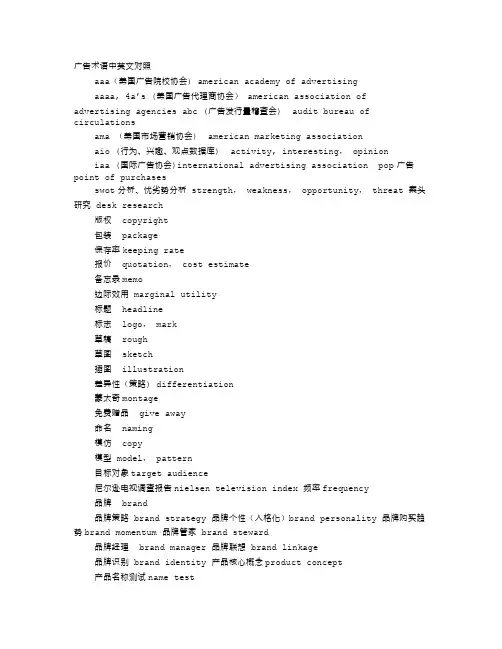
广告术语中英文对照aaa(美国广告院校协会) american academy of advertisingaaaa, 4a’s (美国广告代理商协会) american association ofadvertising agencies abc (广告发行量稽查会) audit bureau ofcirculationsama (美国市场营销协会) american marketing associationaio (行为、兴趣、观点数据库) activity, interesting, opinioniaa (国际广告协会)international advertising association pop广告point of purchasesswot分析、优劣势分析 strength, weakness, opportunity, threat 案头研究 desk research版权 copyright包装 package保存率keeping rate报价 quotation, cost estimate备忘录memo边际效用 marginal utility标题 headline标志 logo, mark草稿 rough草图 sketch插图 illustration差异性(策略) differentiation蒙太奇montage免费赠品 give away命名 naming模仿 copy模型 model, pattern目标对象target audience尼尔逊电视调查报告nielsen television index 频率frequency品牌 brand品牌策略 brand strategy 品牌个性(人格化)brand personality 品牌购买趋势brand momentum 品牌管家 brand steward品牌经理 brand manager 品牌联想 brand linkage品牌识别 brand identity 产品核心概念product concept产品名称测试name test产品效用 benefit产品形象 product image产品原型 product prototype产品原型测试prototype test产品周期 product life-cycle产品属性 product attribute陈列 display冲击力impact出口广告 export advertising创意 creative创意草图 idea sketch创意策略 creative strategy创意概念 creative concept创意提案 creative presentation 创意总监 creative director (cd) 从众 follow促销活动 promotion打样 color proof打字照排 typesetting代理商agent导演 director到达率reach到达频率 frequency第一知名度 top of mind (tom)点子 idea电话调查 telephone interview电视媒体 tv media调查员interviewer定量研究 quantitative research 定位 positioning定性研究 quality research动画 animation动机 motivation, motion动机分析 motivation analysis动机强度 motivation intension独家赞助 sponsored event独特销售理论unique selling proposition (usp) 发行量circulation 菲林,胶片 film分类广告 classified advertising分散式媒体组合assorted media mix分色 color separation分销 distribution风险知觉 perceived risk服务质量 serve quality负片 negative覆盖率coverage概念 concept概念测试 concept test感觉 sense个人收视率 personal audience rating 个性,性格 personality工作进度报告公共关系 public relations购买 purchase, buy购买后分析 post-buy—analysis购买环境 shopping environment购买决策 purchase decision购买决定因子购买率purchase rate购买模型 purchase model购买频率 purchase frequency购买者buyer购买周期 purchase period购买准备 purchase preparation关键词keyword观察法observe method广播电视网 network广播媒体 broadcast mediastatus report purchase decision factor广告 advertising (ad)广告标语 advertising slogan广告测试 advertising test广告策略 advertising strategy广告创意 advertising creative广告创作人员creator广告对象 advertising target广告概念 advertising concept广告稿效果调查 copy test广告代理商,广告公司广告管理 advertising management 广告计划 advertising plan广告监测 advertising monitor, advertising track 广告精读率attentive readership score 广告客户 client广告目标 advertising goal广告目的 advertising objective 广告牌 billboard广告认知效果advertising recognition effect 广告时代 advertising age (ad age)广告诉求 advertising appeal广告文案 advertising copy广告效果advertising effect, advertising impact 广告效果监测advertising impact track广告音乐 jingle广告占有率 share of voice广告招贴 poster广告作品 advertisement国际广告媒体international mediaadvertising agency篇二:主要广告术语中英对照aadvertising广告广告活动ads 广告物account executive 客户主管account 客户项目account planning 客户策划account services 客户部account service 客户服务art director美术指导advertising campaign 广告活动advertising agency 广告代理商4a ( american association of advertising agencies) 美国广告代理商协会above-the-line advertising 线上广告.广告代理商能从媒介获得代理费的广告regulatory matters广告规章和法规agency profit management利润管理advertising department 广告部airport advertising 机场广告appeal 诉求area sampling 区域抽样audience 受众。
定价方法英文

定价方法英文定价方法是指企业在市场上销售产品或提供服务时所采用的价格策略。
正确选择合适的定价方法可以帮助企业提高销售额、增加市场份额,并实现盈利最大化。
本文将介绍几种常见的定价方法及其优缺点。
1. 成本加成定价方法(Cost-plus pricing):该方法是根据产品或服务的生产成本加上一个预期的利润率来确定价格。
优点是简单易懂,容易计算,并能确保盈利。
缺点是忽略了市场需求和竞争状况,可能导致价格偏高或偏低。
2. 市场导向定价方法(Market-oriented pricing):该方法是根据市场需求和竞争对手的定价来决定自己的价格。
通过调查市场需求和竞争情况,企业可以根据消费者对产品的价值做出定价决策。
优点是能够充分考虑市场需求和竞争状况,确保价格具有市场竞争力。
缺点是市场导向调研较为繁琐,需要投入一定的人力和物力。
3. 差异化定价方法(Differentiated pricing):该方法是根据不同的顾客群体或市场细分来制定不同的定价策略。
根据顾客群体对产品价值的不同认知,可以通过高端产品线的定价来提高品牌形象和利润,通过低价产品吸引更多的市场份额。
优点是能够根据不同市场细分制定个性化的价格策略,最大限度地满足不同顾客的需求。
缺点是需要进行消费者调研和市场细分,并且需要灵活的供应链管理。
4. 时价定价方法(Dynamic pricing):该方法是根据市场供求关系和实时数据来调整价格。
通过将价格与需求和供应的动态变化相结合,企业可以在不同的时间段设定不同的价格。
优点是能够根据市场的实时情况做出灵活的定价决策,提高销售效率。
缺点是对于消费者来说,价格的变动可能导致不稳定感,同时需要有强大的数据分析和市场监测能力。
5. 留守固定定价方法(Penetration pricing):该方法是低价销售产品或服务,以尽快占领市场份额。
通过提供具有竞争力的价格,企业可以吸引更多的顾客,并根据需求进行产品提升和调整价格。
营销策略英文作文范文

营销策略英文作文范文英文回答:Marketing Strategy。
A marketing strategy outlines the roadmap for achieving marketing goals. It involves identifying target customers, defining value propositions, setting marketing objectives, and selecting the appropriate marketing mix strategies to reach the target market.Target Customers。
The first step in developing a marketing strategy is to identify the specific group of customers the business aims to reach. This involves understanding their demographics, psychographics, and behaviors. By defining the target customer, the business can tailor its marketing efforts specifically to their needs and preferences.Value Proposition。
A value proposition is a statement that conveys the unique benefits and value a product or service offers toits customers. It should clearly differentiate the offering from competitors and address the specific needs of the target customer.Marketing Objectives。
品牌出海计划的英文术语

品牌出海计划的英文术语品牌出海计划是现代企业在全球化竞争中,加强国际市场布局,提升品牌影响力的重要战略之一。
以下是相关英文术语及其解释:1. Global Expansion 全球扩张指企业通过出海计划,涉足全球各地市场,增加产品/服务销售额的战略。
2. Brand Awareness 品牌认知度指消费者对品牌的了解和认同感,是企业开展品牌出海计划的前提和核心目标。
3. Market Segmentation 市场细分将市场划分为不同的目标群体,根据客户需求和偏好来进行差异化营销。
4. Cultural Adaptation 文化适应在不同的国家和地区,企业需要根据当地文化、消费习惯、价值观等因素来调整自己的产品、服务和营销策略,以满足当地需求。
5. Consumer Behavior 消费者行为消费者在购买商品或接受服务时表现出的心理、生理和行为上的特征,企业需要深入了解消费者的购买决策过程,以制定更有效的市场营销策略。
6. Supply Chain Management 供应链管理包括采购、生产、物流等环节的有效协调和管理,以实现高效、低成本的供应链运作,提高企业的市场竞争力。
7. Social Media Marketing 社交媒体营销通过社交网络上的内容、互动和广告来进行品牌营销,吸引并与潜在客户建立关系,增强品牌在社交媒体上的曝光度。
8. E-commerce 电子商务通过互联网渠道进行商品销售、付款和交付的商业活动,是品牌出海策略中的重要方式之一。
9. International Partnership 国际合作伙伴关系通过与当地企业、机构、政府等建立稳定的商业伙伴关系,加强品牌在目标市场中的影响力和市场地位。
10. Brand Localization 品牌本土化在本地市场上,根据当地文化和市场需求,对品牌的形象、口号、广告等进行调整,提高品牌的亲和力和认知度。
销售英文术语
销售英文术语在如今竞争激烈的商业世界中,了解和掌握销售英文术语是非常重要的。
销售过程中使用英文术语可以帮助您更准确地表达自己的意图,与客户交流更加顺畅。
本文将介绍一些常用的销售英文术语,帮助您提升销售技巧和与客户沟通的效率。
1. ProspectsProspects指的是潜在客户,即有可能成为您客户的个人或组织。
在销售过程中,识别并了解潜在客户的需求和偏好对于促成交易至关重要。
2. LeadsLeads是指具有潜在购买意向的潜在客户,通常通过各种渠道获取。
销售团队会对Leads进行跟进,以确定其购买意向和需求,从而转化为实际销售机会。
3. Cold CallingCold Calling是指销售人员主动致电潜在客户,而非等待客户主动联系。
这是一种开拓市场和寻找新客户的重要方式。
在Cold Calling过程中,销售人员需要准备好对方可能的反应,并有条理地表达自己的产品或服务优势。
4. Value PropositionValue Proposition指的是产品或服务所提供的核心价值和优势。
销售人员需要清晰地向客户传达产品或服务的Value Proposition,使客户了解购买的利益所在,从而提高销售成功的几率。
5. ClosingClosing是指最终促成销售交易的过程。
在销售过程中,销售人员需要通过适当的技巧和策略来促使客户做出购买决定。
Closing不仅是达成销售目标的关键一步,也是建立客户信任和关系的契机。
6. Up-sellingUp-selling是指销售人员在客户购买产品或服务时,主动推荐更高价值或更全面的解决方案。
通过Up-selling,销售人员可以增加每笔交易的价值,提高客户满意度和销售额。
7. Cross-sellingCross-selling是指在客户购买产品或服务时,额外推荐相关的其他产品或服务。
通过Cross-selling,销售人员可以扩大客户购买范围,提高交易价值。
公共服务领域英文译写标准
公共服务领域英文译写标准公共服务领域英文译写标准:1. 公共服务领域:Public Service Sector2. 公共服务机构:Public Service Institutions3. 公共服务项目:Public Service Projects4. 公共服务管理:Public Service Management5. 公共服务效能:Efficiency of Public Services6. 公共服务改革:Reform of Public Services7. 公共服务质量:Quality of Public Services8. 公共服务策略:Public Service Strategies9. 公共服务职责:Responsibilities in Public Services10. 公共服务监督:Supervision of Public Services11. 公共服务投入:Investment in Public Services12. 公共服务需求:Demand for Public Services13. 公共服务创新:Innovation in Public Services14. 公共服务承诺:Commitment to Public Services15. 公共服务评估:Evaluation of Public Services16. 公共服务合作:Collaboration in Public Services17. 公共服务法规:Regulations for Public Services18. 公共服务信息:Information on Public Services19. 公共服务可及性:Accessibility of Public Services20. 公共服务效果:Effectiveness of Public Services。
品质管理常用英文术语
品质管理常用英文术语在品质管理领域,掌握一些常用的英文术语对于有效地沟通、理解和实施品质管理策略至关重要。
以下是一些常见且重要的品质管理英文术语。
一、基本术语1、 Quality 质量指产品或服务满足规定或潜在需要的特征和特性的总和。
2、 Quality Assurance (QA) 质量保证为使人们确信产品或服务能满足质量要求,在质量管理体系中实施并根据需要进行证实的全部有计划和有系统的活动。
3、 Quality Control (QC) 质量控制为达到质量要求所采取的作业技术和活动。
4、 Inspection 检验对产品或服务的一种或多种特性进行测量、检查、试验、度量,并将结果与规定的要求进行比较以确定其符合性的活动。
二、统计过程控制(SPC)相关术语1、 Process 过程将输入转化为输出的一组相互关联或相互作用的活动。
2、 Variation 变异过程的输出之间的差异。
3、 Control Chart 控制图用于区分过程中的正常变异和异常变异的一种统计工具。
4、 Upper Control Limit (UCL) 上控制限控制图中控制上限的值。
5、 Lower Control Limit (LCL) 下控制限控制图中控制下限的值。
6、 Center Line (CL) 中心线控制图中代表过程均值的线。
三、抽样检验相关术语1、 Sample 样本从总体中抽取的一部分个体。
2、 Sampling 抽样抽取样本的过程。
3、 Random Sampling 随机抽样按照随机原则抽取样本的方法。
4、 Acceptance Sampling 验收抽样确定一批产品是否可被接受的抽样检验方法。
四、缺陷与不合格相关术语1、 Defect 缺陷产品或服务中不满足预期使用要求的特性或特征。
2、 Nonconformity 不合格未满足规定的要求。
3、 Major Defect 主要缺陷可能导致产品或服务失效或严重降低其使用性能的缺陷。
广告中英文互译
Feelings 感受Truth事实Product产品策略(strategy)简报(brief)难题(Problem)什么是策略?What is a Strategy如何发展策略How to Formulate a Strategy策略基本构架1. 背景/行销目标background/Marketing Aims2. 广告目标ad objective3. 目标市场消费群/消费者最大难题target group/consumer’s big problem4. 竞争情况/竞争范畴competitive frame/frame of reference5. 消费者认知consumer perception6. .消费者利益consumer benefit7. 广告主张ad propositionunique selling positionpositioningpromise8. 支持广告主张的理由support/reason whytarget group/consumer’s big problem9. 表现基调和手法tone and manner/personality行销目标Marketing Aims伦巴原则RUMBA PrincipleR : relevantU : understandableM : measurableB : believableA : achievable广告目标Advertising Objectives目标市场消费群竞争情况Competitive Frame消费者认知Consumer Perception直接反应,也就是DR(Direct Response), 亦称为Direct Marketing。
消费者利益Consumer Benefit一个利益点,一个承诺。
One Benefit, One Promise.广告主张Ad Proposition讯息(message)信服(believe)习惯(habit),态度(attitude)认知(perception)广告目标(ad objective)重要的(important)消费者利益(benefit)消费者的难题(problem)需求(need)欲求(wants)产品特征(Product feature)产品使用(Product custom)生活形态(life style)潜意识(Subconscious)品牌形象(Brand image)支持点Support表现基调和手法Tone and Manner谁来准备策略单?Who Produces a Strategy Paper?如何进行工作How to Raise a Job工作单“没有工作单,不要开始工作。