
牛津译林版英语八年级上册:Unit 7 Seasons. 第二课时Reading 1 教学设计
1 8A Unit 7 Seasons 教学设计 第二课时 Reading 1 一、教学分析 教学内容 Reading(第82页),本课时主要学习Reading A文章的内容。
教材分析 Reading板块通过一篇描写四季的诗歌,体会诗歌的“意象美、语言美、音韵美”,让学生熟练掌握和运用一些功能用语,谈论喜欢的季节的一些特征以及喜欢的原因。为在Task板块有效地组织句子,写一篇描述最喜欢的季节的文章做好准备。 学情分析 本单元的话题是四季,在welcome to the unit中,学生对四季的表达及特点已经进行了初探,因此学生对四季的话题是不陌生的。但由于诗歌的特殊性,学生们还不能理解诗歌的“音美、形美、意美”,教师们还需要用多种途径从深层次和高度上帮助学生理解这首诗歌,从而达到欣赏的目的。
教学项目 词汇: shower, pile, upon, shade, as, temperature, drop, rise 词组: be full of, forget to grow, turn brown, fall into piles upon the ground, harvest crops, fly far away, among flowers 句型: What a perfect time to fly a kite! Farmers work to harvest crops, as the days are shorter and the temperature drops. 课文: a poem about the seasons 教学方法 任务型教学法、学生中心教学法、多媒体教学、归纳教学法
教学目标 语言知识 To learn some useful words and expressions about the weather. 语言技能 To learn to describe the differences between seasons. 语言运用 To learn to use superlative to express preference about seasons. 文化意识 Poetry is the highest form of literature, the highest art, is the essence of all knowledge. 情感态度 To treasure our time, and make full use of our time, especially spring and morning. 学习策略 autonomic learning strategy cooperative learning strategy 教学重点 To learn to describe the differences between seasons. 教学难点 To learn to use superlative to express preference about seasons. 教学用具 Multimedia, recorder,pictures,chalk,blackboard
二、教学过程 时间 教学步骤 教师活动 学生活动 教学目的 2
第1-2分钟 Warming up(Enjoy a music) Play a music called“一年四季歌”for the students, then have a free talk: ①Are you familiar with the music? ②Do you like it ? ③In English it is translated into…? ④what does “Song of the year” tell? So together with the music, let’s go on our trip through the four seasons. Ok, today we’ll learn a poem about seasons of a year. Are you ready to learn it? First, open your book to page82. First listen to the music, then answer the questions. 通过欣赏一首熟悉、轻快的儿歌“一年四季歌”导入,快速调动学生的学习兴趣,又自然过渡到本节课的话题上来。
第3-6分钟 Pre-reading (fast reading) 1. Read through the poem, try to find out the tone of the poem, and what do you feel about the poem? 2. Ask some questions: ①After reading the poem, do you feel sad? Do you feel excited or other feelings? What do you feel about the poem? ②Do you feel stressed? ③Do you feel cheerful? ④Do you feel hopeful? Good, so after reading the poem, I feel cheerful, relaxed and hopeful. 3. Deal with some new words. ① For the first reading, I think there’re some new words that stop you from understanding the poem, 1. read by themselves and feel the tone of the poem. 2. answer the questions 3. Pick out the new words that stop them from reading. e.g. I want to ask Line 10 of para 3 the word “s-h-a-d-e”… 学生整体阅读诗歌感受诗歌的基调,不光为体会诗人想要表达的感情打下基础,也为之后理解本诗的语言、意象、以及表达方法指明了方向。 解决诗词中的生词,为进一步理解诗歌扫清障碍。这种处理单词的方法,主要是使得学生的主体地 3
now pick them out. (e.g. pile. There’re some books on the desk, and put them together, we can say it a pile of books. And everyday you have a pile of homework to do, right? Of course, I have a pile of homework to correct…) 位得以凸显,充分发挥老师的主导作用。
第7-9分钟 Pre-reading (lead in) 1. Before we go into each part of this poem. I would like you to read a Chinese poem, I’ll show you. Have you ever heard about this poem? Have you ever learnt it? 春江晚景 (宋)苏轼 竹外桃花三两枝, 春江水暖鸭先知。 蒌蒿满地芦芽短, 正是河豚欲上时。 2. After you read the poem emotionally, I think some pictures came into your mind. What kinds of pictures can you have? 3. A good poem always have beautiful pictures in your mind. So we can see it, hear it, and feel it. 1. Read the Chinese poem emotionally. 2. Describe some pictures of the Chinese one by one. 出示一幅春江晚景图,并欣赏其中的诗歌,让学生们通过熟知的中文诗,唤醒他们听觉、视觉、感觉中的细胞,为下文做了很好的铺垫。
第10-39分钟 While-reading (detailed-reading) 一、About para.1-winter 1. let’s go into out English poem. Let’s see it, hear it and feel it.. ① First of all, tell me what the season is in the first poem, say it together. ② What can you see or feel in winter? Use your Read carefully and answer the questions. 本环节分六部分,前四部分是对文本进行分段处理。主要采用问题启发式,从时间、从空 4
imagination, think about your winter days. 2. listen to the poem ① What can you feel from the first para.? ② What do the birds do? Why? ③ Do we people hope to have a warm and sunny day in winter? ④ Can we fly to the south? 3. Read the poem together. ① Discuss in groups, try to find out the answer. Can you guess the writer’s feelings? 二、About para.2-spring 1. If the winter comes, will spring be far away? Now spring is coming, here’s the spring. ① Do you like spring? Why? ② What do you like to in spring? ③ What does the writer want to do? 2. Read by yourself, and try to find out the key word.. ① What does each line talk about? ② What’s the weather like in this paragraph? ③ What do people usually do? ④What animals are mentioned? 3. That’s the writer’s spring, we have warm weather, lovely animals and people, all kinds of activities. So what’s Listen to the poem carefully, then answer the questions. Discuss in groups, try to guess the writer’s feelings Free talk about their own spring. Read by yourself, and try to find out the key word. Then answer some questions. Discuss in 间、从机会、从活动,采用“小组合作”的基本组织形式,通过反复提问学生在诗中看到了什么?听到什么?感受到了什么?脑海中出现怎样的画面?通过调动学生的视觉、味觉、听觉等多种感官引导他们领会诗人的意图,感受诗的意境,深层次和高度上理解这首诗。
牛津译林版英语八年级上册《Unit 7 Seasons Welcome to the unit》教学
牛津译林版英语八年级上册《Unit 7 Seasons Welcome to the unit》教学设计10一. 教材分析牛津译林版英语八年级上册《Unit 7 Seasons Welcome to the unit》主要介绍四季的特点以及不同季节的活动。
本节课通过讨论四季的变化,使学生能够运用所学知识描述季节特点和进行简单的交流。
教材内容丰富,插图生动,激发学生学习兴趣。
二. 学情分析八年级的学生已经具备一定的英语基础,能够听、说、读、写简单的英语句子。
但部分学生对季节词汇和表达季节活动的句子还不够熟悉。
因此,在教学过程中需要关注学生的个体差异,尽量让每个学生都能参与到课堂活动中来。
三. 教学目标1.知识目标:学生能够掌握四季的英文名称和基本特点,以及描述季节活动和天气的句子。
2.能力目标:学生能够在日常生活中运用所学知识进行简单的交流,提高听说能力。
3.情感目标:培养学生热爱生活、关注大自然的情感。
四. 教学重难点1.重点:四季的英文名称、特点以及描述季节活动和天气的句子。
2.难点:正确运用所学知识进行实际交流。
五. 教学方法1.情境教学法:通过设定四季的场景,让学生在实际情境中学习英语。
2.交际教学法:引导学生进行小组讨论,提高学生的交流能力。
3.任务型教学法:设计具体任务,让学生在完成任务的过程中运用所学知识。
六. 教学准备1.课件:制作包含四季图片、词汇和句子的课件。
2.学具:准备与四季相关的图片、卡片等学具。
3.录音机和磁带:准备四季相关的录音材料。
七. 教学过程1.导入(5分钟)利用课件展示四季的图片,引导学生谈论各自喜欢的季节。
同时,板书课题《Seasons》。
2.呈现(10分钟)展示四季的英文名称(spring, summer, autumn, winter)和基本特点,让学生跟读并模仿。
接着,呈现描述季节活动和天气的句子,如:“I likeswimming in the summer.”和“It’s sunny in spring.”,让学生模仿并理解含义。
最新牛津译林版中学八年级英语上册 Unit 7 Seasons Task教案(1)
Unit 7 Seasons Task教学目标1.知识目标:学习词汇:deep, land, exciting, throw, ice, everywhere, frozen, scream, snowman 学习词组:be covered in deep white snow, during this season, throw snowballs at each other, use carrots for their noses学习句子:It is exciting to have big snowball fights.2. 技能目标:1)学习在写作前先列提纲。
2)学习如何写作自己喜欢的季节。
3. 情感目标:能用更丰富的词汇介绍四个季节的特点、人们在各个季节的活动和喜好。
教学重点1.学习在写作前先列提纲。
2.学习如何写作自己喜欢的季节。
教学难点培养学生的语篇意识。
学法指导先构思,再注意格式。
教学过程Step1:预习指导与检测见导学案Step2:展示目标见导学案Step3:课堂导学与互动任务一: Free talkT:Where is it?1. Which season is it in the picture?2. Wha t’s the weather like?3. W hat do people w ear?4. What are people doing?5. What are the rivers and lakes like?任务二:Listen and answerHarbin is a city of ice and snow. Winter is amazing. Simon is readingan article about it on the Internet. Listen to the article and findthe answers to these questions.1.Which season does the author like best?2.Why does the author like winter?3.What’s the weather like?4. Can you see beautiful flowers and green trees during this再备season?5. What else does the author enjoy in winter?任务三:DiscussionWhat information does each paragraph include?Paragraph 1: … is my favourite season.Paragraph 2: The temperature is usually …It is often sunny/windy/snowy...Para graph 3: My friends and I often …During this sea son, you can/cannot…Paragraph 4: … is great.任务四:DiscussionCan you think of questions to match the information in the article?1.What is your favourite season?2.What’s the weather like then?3.Why does your city look like ?4. Why do you like this season?5. Are there any holiday s or festivals during this season?6. What activities do people enjoy doing in this season? Repeat after the tape sentence by sentence.任务五:Discuss ho w to write an article about your favourite season?任务六:Group work : Write your own article每个同学根据提纲独立完成自己的文章。
牛津译林版英语八上Unit7《Seasons》(task)说课稿1
牛津译林版英语八上Unit 7《Seasons》(task)说课稿1一. 教材分析牛津译林版英语八上Unit 7《Seasons》主要介绍季节的变化以及与季节相关的天气、活动等。
本单元以季节为主题,通过描述不同季节的特点,让学生了解和掌握与季节相关的词汇和表达方式。
本节课的任务部分旨在让学生运用所学知识,进行实际的语言输出和交流。
二. 学情分析根据学生的学习情况,大部分学生已经具备了一定的英语基础,能够听懂并运用基本的英语进行交流。
但是,对于季节相关的词汇和表达方式,部分学生可能还比较陌生。
因此,在教学过程中,需要关注学生的个体差异,针对不同学生的学习需求进行有针对性的教学。
三. 说教学目标1.知识目标:学生能够掌握与季节相关的词汇和表达方式,如spring,summer, autumn, winter, warm, cold, sunny, rny等。
2.能力目标:学生能够运用所学知识,进行实际的语言输出和交流,如描述季节特点、表达喜欢的季节等。
3.情感目标:通过学习,学生能够增强对大自然的热爱,提高对生活的认识和感悟。
四. 说教学重难点1.重点:季节相关的词汇和表达方式的运用。
2.难点:如何准确描述季节特点和表达个人喜好。
五. 说教学方法与手段1.任务驱动法:通过设定具体任务,引导学生运用所学知识进行实际的语言输出和交流。
2.情境教学法:创设相关情境,让学生在具体情境中感知、体验和学习语言。
3.小组合作学习:鼓励学生分组讨论、合作完成任务,提高学生的参与度和积极性。
六. 说教学过程1.导入:通过展示四季变化的图片,引导学生谈论季节变化,激发学生的学习兴趣。
2.新课呈现:通过情境教学法,展示季节相关的词汇和表达方式,让学生在具体情境中学习。
3.任务实施:设定具体任务,如描述季节特点、表达喜欢的季节等,引导学生进行实际的语言输出和交流。
4.小组合作:学生分组讨论,合作完成任务,教师巡回指导,帮助学生提高语言运用能力。
牛津译林版八年级英语上册Unit7SeasonsReading2教案
Unit7SeasonsReading2教学目标1.知识目标:学习词汇:butterfly,shower,memory,stream,shade,pile,upon,harvest,crop,as,temperature,drop,rise学习词组:befullof,forgettogrow,flyfaraway,amongflowers,turnbrown,fallintopilesupontheground,harvestcrops学习句子:Whataperfecttimetoflyakite! Farmersworktoharvestcrops,asthedaysareshorterandt hetemperaturedrops.2.技能目标:1)Understandthepoem.2)Masterthenewwordsinthispoem.3)Reviewandenrichyourvocabularyonthefourseasons.3.情感目标:学习把对每个季节的感受充分融入到诗歌朗诵中去。
教学重1)Understandthepoem.2)Masterthenewwordsinthispoem.点教学难点Enrichyourvocabularyonthefourseasons.学法指导查阅资料与练习相结合。
教学过程Step1:预习指导与检测见导学案Step2:展示目标见导学案Step3:课堂导学与互动【课堂导学与互动】任务一:Watchandtrytoanswerthefollowingquestions:Winter:(1)Whatcanyouseeinwinter?(2)Cantreesandflowersgrowinwinter?(3)Whydothebirdsflyfaraway?Spring:(1)Whatcanwedoinspring?再备(2)Whatdobeesandbutterfliesdoinspri ng?Summer:(1)Whatcanwedoinsummer?(2)Wherecanweoftenplayinsummer? Autumn:(1)Whatcanweseepilesofautumnleaves?(2)Whatarethefarmersbusydoinginautu mn?任务二:Practicerepeatingthepoemafterthetape.P ay attentiontoyourpronunciationandinto nation.任务三:Canyoudescribee achseasonwiththewordsi nthepoem?SeasonsoftheyearWinterSpringSummerAutumn细读R eading部分,Practiceactingoutthepoem. Usethekeywordsandusefulphrasestohelpyo u.任务四:教师解释语言点,归纳总结。
牛津译林版八年级英语上册Unit 7 Reading (II) 示范课教学设计
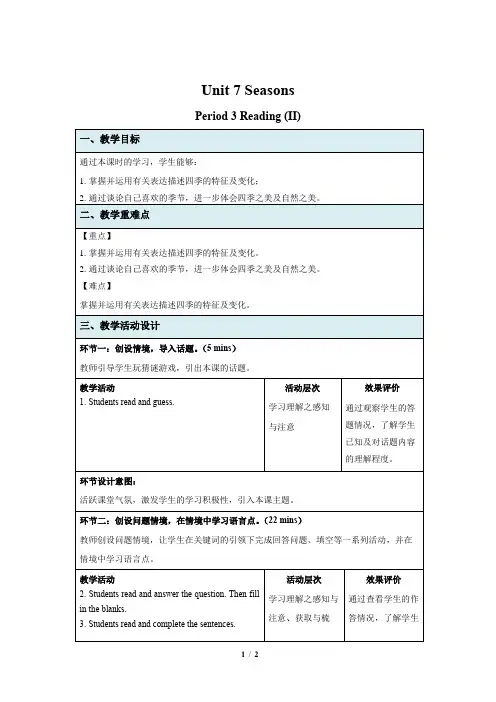
Period 3 Reading (II)
一、教学目标
通过本课时的学习,学生能够:
1.掌握并运用有关表达描述四季的特征及变化;
2.通过谈论自己喜欢的季节,进一步体会四季之美及自然之美。
二、教学重难点
【重点】
1.掌握并运用有关表达描述四季的特征及变化。
2.通过谈论自己喜欢的季节,进一步体会四季之美及自然之美。
应用实践之内化与运用
效果评价
通过查看学生的作答情况,了解学生对诗歌细节的把握情况及相关语言点的理解情况。
通过观察学生的作答情况,了解他们对语言点的理解及运用情况。
环节设计意图:
通过不同的阅读活动,培养学生梳理诗歌关键信息的能力,帮助学生理解及运用语言知识。
环节三:在情境中运用所学知识,与同伴进行谈论,并制作海报。(18mins)
环节设计意图:
活跃课堂气氛,激发学生的学习积极性,引入本课主题。
环节二:创设问题情境,在情境中学习语言点。(22mins)
教师创设问题情境,让学生在关键词的引领下完成回答问题、填空等一系列活动,并在情境中学习语言点。
教学活动
2. Studentsread andanswer the question. Then fill in the blanks.
【难点】
掌握并运用有关表达描述四季的特征及变化。
三、教学活动设计
环节一:创设情境,导入话题。(5 mins)
教师引导学生玩猜谜游戏,引出本课的话题。
教学活动
1. Studentsreadand guess.
活动层次
学习理解之感知与注意
效果评价
通过观察学生的答题情况,了解学生已知及对话题内容的理解程度。
牛津译林版八年级英语上册《Unit 7 Seasons》教案:8A Unit 7 (Reading 1)教案
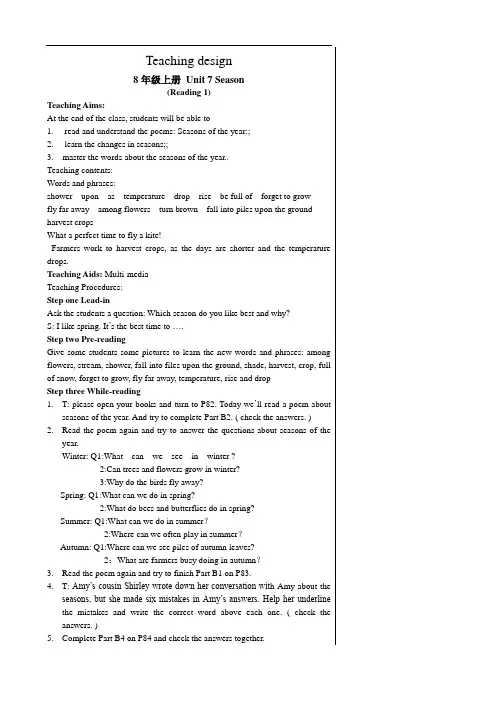
Teaching design8年级上册Unit 7 Season(Reading 1)Teaching Aims:At the end of the class, students will be able to1. read and understand the poems: Seasons of the year:;2. learn the changes in seasons;;3. master the words about the seasons of the year..Teaching contents:Words and phrases:shower upon as temperature drop rise be full of forget to growfly far away among flowers turn brown fall into piles upon the ground harvest cropsWhat a perfect time to fly a kite!Farmers work to harvest crops, as the days are shorter and the temperature drops.Teaching Aids: Multi-mediaTeaching Procedures:Step one Lead-inAsk the students a question: Which season do you like best and why?S: I like spring. It’s the best time to ….Step two Pre-readingGive some students some pictures to learn the new words and phrases: among flowers, stream, shower, fall into files upon the ground, shade, harvest, crop, full of snow, forget to grow, fly far away, temperature, rise and dropStep three While-reading1.T: please open your books and turn to P82. Today we’ll read a poem aboutseasons of the year. And try to complete Part B2. ( check the answers. )2.Read the poem again and try to answer the questions about seasons of theyear.Winter: Q1:What can we see in winter ?2:Can trees and flowers grow in winter?3:Why do the birds fly away?Spring: Q1:What can we do in spring?2:What do bees and butterflies do in spring?Summer: Q1:What can we do in summer?2:Where can we often play in summer?Autumn: Q1:Where can we see piles of autumn leaves?2:What are farmers busy doing in autumn?3.Read the poem again and try to finish Part B1 on P83.4.T: Amy’s cousin Shirley wrote down her conversation wit h Amy about theseasons, but she made six mistakes in Amy’s answers. Help her underline the mistakes and write the correct word above each one. ( check the answers. )plete Part B4 on P84 and check the answers together.6.Try to describe the four seasons of the year.7.Ask the students to read the poem.Step four HomeworkBlackboard design:Reflection:。
中学八年级英语上册 Unit 7 Seasons教案 (新版)牛津版 教案
Unit 7SeasonsWele to the unitTeaching aims:Knowledge Objective:Words: rainy snowyPhrases: look cool with nothing onSentences: Which season do you like best?It’s the best time to play football outside.Which is your favourite season?Ability Objective:To learn to describe weather and seasonsTo learn to talk about your favourite seasons EmotionObjective:学习使用不同的形容词来谈论自己喜欢的季节,热爱自然,热爱生活。
【学习重、难点】Difficult points:1.掌握本课四会单词与短语,并能熟练运用。
2.谈论喜欢的季节Teaching steps:Step 1. Presentation1. Show some pictures to learn some words .2. Then read aloud the new words.foggy, rainy, snowyStep 2.Do some exercises.1. Do Part A on page 81.2. Check the answers.Step 3. Listen and answer1. Listen to the tape and answer the follow questions.1) What does Eddie ask hobo to do?2) Is it cold today?3) Does hobo think Eddie look cool?2. Read the dialogue after the recorder.3. Read the dialogue in pairs.4. Act it out.Step 4. Listening.1. Listen to part B and answer the following question.1) Which season does Simon like best?2) What’s the weather like in Autumn?3) What can Amy do in summer?2. Read after the recorder.3. Pratice in pairs.4. Act it out.Step 5. Explanation1. Bring me my clothes, Hobo.bring 带来take 带走e.g. Please bring me my coat.Take your book home after school2. You’ll look cool and feel cool with nothing on!look cool 看起来酷3. Which season do you like best, Simon?Which is your favourite season?like … best / favourite 最喜欢……e.g. I like spring bestMy favourite season is spring.Step 6. Exercises一、根据汉语提示或所给词的正确形式填空。
牛津译林版英语八上Unit7《Seasons》(Welcometotheunit)说课稿
牛津译林版英语八上Unit 7《Seasons》(Welcome to the unit)说课稿一. 教材分析《Seasons》是牛津译林版英语八年级上册Unit 7的一篇文章,主要介绍了春夏秋冬四个季节的特点以及人们在不同季节里的活动。
文章语言简洁,内容贴近生活,适合学生学习。
通过本文的学习,学生可以提高自己的阅读理解能力,学到关于季节的词汇和表达方式,同时增强对英语学习的兴趣。
二. 学情分析八年级的学生已经具备了一定的英语基础,对日常生活话题有了一定的了解。
但是,学生在阅读长篇文章时,可能会遇到生词和语法难点,影响理解。
此外,学生对季节的认识主要来源于生活经验,如何将生活经验与英语学习相结合,提高学生的阅读理解能力,是本文教学的关键。
三. 说教学目标1.知识目标:学生能够掌握关于季节的词汇和表达方式,如spring,summer, autumn, winter, sunny, rny, hot, cold等。
2.能力目标:学生能够阅读并理解文章内容,提高自己的阅读理解能力。
3.情感目标:学生能够体会到不同季节的独特魅力,增强对生活的热爱。
四. 说教学重难点1.重点:学生能够阅读并理解文章内容,掌握关于季节的词汇和表达方式。
2.难点:学生能够运用所学知识,描述自己喜欢的季节及原因。
五. 说教学方法与手段1.教学方法:采用任务型教学法,让学生在完成任务的过程中,提高自己的阅读理解能力和语言表达能力。
2.教学手段:利用多媒体课件、图片、卡片等辅助教学,激发学生的学习兴趣。
六. 说教学过程1.导入:教师通过展示春夏秋冬的图片,引导学生谈论各自喜欢的季节,从而引入本文。
2.阅读理解:学生自主阅读文章,回答相关问题,教师引导学生讨论并解答疑问。
3.词汇学习:教师出示季节词汇卡片,学生跟读并模仿,教师讲解词汇用法。
4.文章总结:学生分组讨论,总结文章主题和季节特点。
5.输出表达:学生分组完成任务,描述自己喜欢的季节及原因。
最新译林牛津版初中英语八年级上册Unit 7 Seasons公开课教学设计
课 题
Comic strip and Welcome to the unit
课 时
Period 1
教 具
A recorder and teaching pictures
Teaching aims
To revise vocabularyandexpressions to describe seasons at the same time, learn more new words and phrases.
These two teams will read Eddie’s part and these two will read Eddie’s part and these two will read Hobo’s part.
What’s the weather like in summer? It’s sunny and hot. It’s the best time to go swimming.
What’s the weather like in autumn? It’s sunny and cool. It’s the best time to plan a day out.
Look! There is a lot of fog. We can’t see anything clearly. It’s foggy.
Step2 Practice
Do the game one by one.
What’s the weather like?
It’s sunny.
Now let’s play a game. The first student in each group will show the second student a weather card and ask him or her the question What’s the weather like? The second student will answer the question and then ask the third one the same question. The team which finishes first and does the best will win the game.
最新译林牛津版初中英语八年级上册Unit 7 Seasons Task公开课教学设计
Unit 7 SeasonsTaskLearning aims1. To learn the article “I love winter” and know its structure well.2. To learn how to write the article “My favourite season”.Learning proceduresStep 1 Warming-up and presentation课前欣赏MTV “Jingle bells”1.New wordsHello, everyone! I’m your new English teacher Miss Yu. Nice to meet you. Just now you enjoyed a video, do you like it? Yes. So exciting.Many people like winter because of the exciting sport, do you think so? Which season do I like? Can you guess? (show a photo) Look, I like winter, too. Look, I am making a snowman with my son. It’s exciting to make a snowman. Look at the pictures. The land is covered in deep white snow, and the lakes and rivers are frozen. Look at the boy, what is he doing? He is throw ing snowballs at each other with his father.They are scream ing and laughing happily.We love winter because “ winter days are full of snow, when trees and flowers forget to grow, and the birds fly far away, to find a warm and sunny day.”(连续播放冬日美景图并朗诵)Just now we talked about the winter here, but weather can be very different in different places. Do you want to learn what is the winter like in Harbin? Simon is reading the article about the winter in Harbin on the Internet. Let’s go and read it, too.2.Read the article about the winter in Harbin and match the paragraphswith the correct descriptions.the author’s opinion Para 1 What activities do people enjoydoing in this season?the reasons Para 2 How do you find the season?Para 3 What is the weather like and what’s the city like then?the author’s feelings Para 4 which is yo ur f avourite season?3.Do asking and answering.1)Do you love winter in Harbin?2)Why or why not? (the weather then; the scene of the city then; theactivities people enjoy doing )4. Read it again and underline some good words, expressions and structures. This time you can read it aloud.Do you think it’s a good article? Why do you think so?Discuss with your partner.Possible answers:The structure is very clear.The author used some good words, expressions and structures. Try to find them.Some adjec tives:Some verbs:Some conjunctions and adverbs:Structures:( Do you want to write an article about your favourite season? ) Step 2 Practice1. Before writing, we should be a thinker and come up with new ideas. Now think hard and complete the following table by yourselves, and then share your ideas in your groups.To be a thinker2. Show timeLet’s share your wonderful ideas. I’ll write them down your keywords on the blackboard.3. Writing time1) While writing, we should be an editor. The ideas on the blackboard may help you. Please choose one season to write about. Do you know how to organize your ideas? Now let’s go over the sample writing, pay attention to its structure. (PPT打出)Para 1: which is your favourie season? your opinionPara 2-3: why do you like this season? the reasonsPara 4: How do you find it? your feelings2) While writing, we should be a careful writer. We should try to make our articles attractive and we should also pay attention to the tense we use.3) Write the article “ My favourite season”.Step 3 Production1) Writing an article on your own.(Individual work)2) Discussing and checking.(Group work)学生写完后教师根据学生所写的不同季节重新分组讨论,写相同季节的学生组成四人小组展开讨论,推出优作展示,其他组同学发表观点评价。