
牛津译林版七年级英语上册Unit-2 grammar语法课时教案
牛津译林版七年级英语上册7A Unit2 Let's play sports ----GrammarTeaching aims1.了解常用语言形式的基本结构和常用表意功能2.在实际运用中体会和领悟语言形式的表意功能。
Teaching objectivesKnowledge objectives:1. To grasp what the simple present tense is and when to use it.2. To learn to use the verb to do in the simple present tense.Ability objectives:To talk about sb./ sth. using the verb to do in the simple present tense. Teaching procedureSte pⅠ. RevisionSay:I am your English teacher. You are my students. We are in Class3, Grade 7.This is our classroom. It is big and new. There are thirty students in our class.Bella is our monitor(班长).Ms Han is our head teacher. We are happy.总结:我们常使用“to be”的一般现在时谈论事实和状态。
Ste pⅡ. PresentationSay:Kobe plays basketball very well. Many students like him. They often watch his games on TV. In my free time, I like watching TV too. But my friendMillie likes reading. She often does some reading after class.1. Do you know when to use the simple present tense?(1)They often watch his games on TV.She often does some reading after class.在学生讨论之后归纳:当谈论经常性、习惯性的动作时用一般现在时,一般现在时表示经常性或习惯性的动作。
常与sometimes, often, always, every day, usually等时间状语连用。
(2)Kobe plays basketball very well. Many students like him.I like watching TV too. But my friend Millie likes reading.讨论后归纳:当谈论爱好、能力等时常用一般现在时,一般现在时表示目前的爱好和能力等。
(3)我们还可用一般现在时表示客观事实和真理。
The earth goes around the sun. The moon moves round the earth.2. Books open. P23让学生进一步理解一般现在时的用法和意义。
3. Show the passage to the students again. Ask the students to pay attention to the verb “to do”.Say: When the subject is he/she/it, we need to add an “s” to the verb.Ask: Do you want to know how to add an “s” to the verb? Let’s read the table on page23 together. How many ways are there to add an “s” ? What are they?只有当主语是第三人称单数时,动词用三单形式,其他人称都用动词原形。
动词三单形式的变化规则:(1)多数情况下直接在动词词尾加-s.(2)以字母s, x, ch, sh或o结尾的动词,在词尾加-es.watch----watches wish----wishes do----does go----goesfix----fixes(3)以“辅音字母加-y”结尾的动词,要变y为i再加-es.try----tries study----studies cry----cries fly----flies (4)特殊变化:have-----hasStepⅢ.Practice1.写动词的三单形式。
2.Students’ Book , p24, Part A3.Say something about Daniel.Daniel is 12 years old. He is in Class1, Grade 7 at Sunshine Middle School. He comes from Nanjing. But now he lives with his family in Beijing.Daniel is not tall. His hair is very short, and he wears glasses.He likes all the lessons, and he is good at Maths.He has some new friends at school. They are all very nice.4.Say something about yourself, then another one say something about you to theclass. One sentence by one sentence.课后练习1.复习一般现在时并预习没有讲过的内容。
2.用英语介绍自己的一位好朋友。
教学反思:Grammar IITeaching aims 1.了解常用语言形式的基本结构和常用表意功能2.在实际运用中体会和领悟语言形式的表意功能。
Teaching objectivesK nowledge objectives:1. To learn to make negative sentences using the verb to do in the simplepresent tense .2. To learn to ask and answer questions using the verb to do in the simplepresent tense.Ability objectives: To use the simple present tense to have a conversation.【Teaching procedure】StepⅠ. Revision1.一般现在时的三种使用情况。
2.动词三单形式的变化规则。
3.完成《补充习题》p13 A并快速校对答案。
Ste pⅡ. Presentation1. Say:I like reading, but I don’t like sports.My friend Mary likes singing, but she doesn’t like reading.Do you know how to make negative sentences?学生讨论后总结:改为否定句时,在动词之前加don’t,当主语是第三人称单数时,在动词之前加doesn’t,动词恢复原形。
StepⅢPracticePut these sentences into negative sentences:Kobe doesn’t play basketball very well. Many students don’t like him. They don’t watch his games on TV. In my free time, I don’t like watching TV . But my friend Millie doesn’t like reading. She doesn’t do some reading after class. Ste pⅣ. PresentationMillie and Simon are talking about their favourite sports. Please read their conversation.Millie:I like O’Neil very much. He plays basketball v ery well.Simon:Of course. He looks very tall and strong. Do you often watch his games? Millie:Yes, I do. What about you?Simon:Oh, I don’t like basketball. My father and I like football very much. Millie:What about your mother?Simon:She doesn’t like football at all. She likes tennis.Millie:Well, does she like Federer, a famous tennis player?Simon:No, she doesn’t. She likes Nadal because he is handsome.找规律——一般现在时的一般疑问句结构:在主语之前加助动词do,肯定回答用:Yes,主语+do.否定回答用:No,主语+don’t;但当主语是第三人称单数时,则在主语之前加does,动词恢复原形。
肯定回答用:Yes,主语+does.否定回答用:No,主语+doesn’t。
StepⅤPractice1.Students’ Book , p24, Part B, ask and answer in pairs. You can ask morequestions.2.《补充习题》p13 Part CStepⅥActivitiesAsk S1: Do you often watch TV?Ask S2: Does he often watch TV?………play football, play basketball, sing, dance, do some reading, go fishing, goshopping, etc.StepⅦPracticeStudents’ Book , p24, Part C课后练习1.复习一般现在时的用法。
牛津译林版七年级上册英语Unit2Grammar课件

◇行为动词一般现在时的肯定形式
1.I come from Yangzhou.
2. We have lunch at school.
3. You play football very well.
4. They often go shopping at weekends.
3. She sings very well in our class.
often ___r_e_a_d_s__(读)story books.
1. 谈论经常做的事。 2. 谈论总是正确的客观事实。
3. 谈论现在是正确的事实。比如爱好、能力等。
请判断下列句子是哪种情况 1) Tigers eat meat.
(_________________________) 2) She has an e-dog.
1) 否定句是在行为动词前添加__d_o_n_’_t__或__d_o_e_s_n_’_t_。当主语
是第三人称单数时,助动词用doesn’t。
2) do not =____d_o_n_’_t____ does not =___d_o__e_s_n_’_t____ 3)注意在否定句中,助动词之后的行为动词均用__原______形。
当谈论经常性、习惯性的动作,爱好,能力等时, 常用行为动词的一般现在时。
当谈论经常性、习惯性的动作,爱好,能力等时, 常用行为动词的一般现在时。
like dances goes plays watches
Does Amy like dancing ? No, she doesn’t like dancing. Do you like dancing ? No, I don’t like dancing.
◇行为动词一般现在时的一般疑问句及其回答 1.– Do you like sports? – Yes, I do. 2.--- Does Millie speak Chinese very well? ---No, she doesn’t. 【观察与思考】 1) 行为动词一般现在时的一般疑问句直接把助动词do或does放
【牛津译林版】七年级上Unit2第3课时教案讲解分析习题设计
Period III: Grammar (第三课时)第一部分教案设计教学内容Grammar(第23~24页)重点学习行为动词的一般现在时的用法。
教材分析本课时是语法课,在第一单元学习了be动词的一般现在时的基础上,进一步行为动词的一般现在时的用法,并学会灵活运用,能够与be动词的一般现在时加以区分。
主要内容包括:理解行为动词的一般现在时的两种形式,掌握其肯定句、否定句、疑问句及其肯定、否定回答的基本用法;理解行为动词在一般现在时中的变化,掌握其变化规则;能用一般现在时在日常生活中进行相关的表达。
教学目标:基础知识掌握词汇:drawing , weekend , shop词组:at/on weekends =at/on the weekend of course句型:Millie gets up at 6:30 every morning. Cats eat fish. Simon likes playing football.基本技能:1. 理解行为动词一般现在时的用法;2. 掌握行为动词一般现在时的肯定句、否定句、疑问句及其肯定和否定回答的基本用法;3. 学会用一般现在时进行交际综合素质:结合本单元的话题用一般现在时进行交流。
教学重难点及突破重点:掌握基本的四会单词、词组及句型。
难点:行为动词的一般现在时的肯定句、否定句、疑问句及其肯定、否定回答。
教学突破:在行为动词的一般现在时中,要特别注意注意是第三人称单数的情况,可以借助口诀帮助学生记忆。
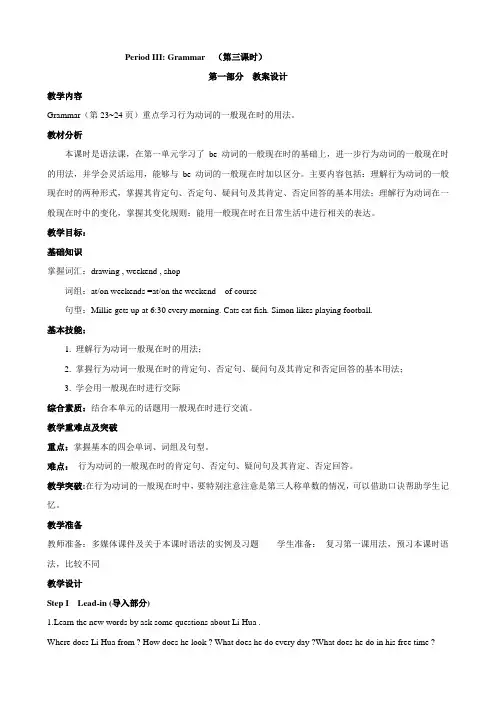
教学准备教师准备:多媒体课件及关于本课时语法的实例及习题学生准备:复习第一课用法,预习本课时语法,比较不同教学设计Step I Lead-in (导入部分)1.Learn the new words by ask some questions about Li Hua .Where does Li Hua from ? How does he look ? What does he do every day ?What does he do in his free time ?2. Look ,who are these men in the picture? They are basketball players. They play basket very well. This is Kobe .He looks very strong. Kobe plays basketball very well. Many students like him. They often watch his game on TV in their free time. I like watching TV too. But my cousin likes reading .He often reads storybooks.Look at these sentences pay attention to the verbs. We use the Verb” to be” in the these three sentences while we use the verb” to do in these ones. Today we’ll learn the simple present tense of the verb to do.Step ⅡPresentation(新授)1. Complete the sentences using the simple present tense of the verb to do .He often _________(play) football after school .She __________(like) playing volleyball .It ________(look) like a cat .We ___________(enjoy) reading very much .They usually ___________(get) up at 6:00 in the morning .You _________(like) sports .2. Explain the use of the simple present tense of the verb to do. Open your books at page 23 and read the sample sentences .3. Can you find the different forms of the verb to do in these sentences ?When the subject is he/ she / it , we need to add an “s” to the verb .Do you want to know how to add an “s” to the verb ? Let’s read the table on page 23 together . How many ways are there to add an “s” ? What are they ?写出动词的第三人称单数形式put __________ enjoy_________ write ______ fly __________play___________ have_____________ guess _________ match ________go_________ do _________________ study _______ stay ____________4. Millie is writing about herself and her classmates. Please help her complete the sentences in part A with the words in the box.Now who can read the sentences to us ?other listen carefully and check the answers. Finish Part A .Step ⅢPractice(操练)1. Do you know how to make negative sentences and ask and answer questions using the verb to do in the simple present tense ? OK , change the sentences on the board into negative sentences and ask and answer questions .2. Now let’s read the tables on page 23 together .3. Finish Part B on page 24 .4. Look at the table on page 24 and work in pairs, look at this table .It tells us the activities Millie and herclassmates like. Please complete the questions in Part B and then use the information in the table to answer them. Does Daniel like walking ? Yes , he does .Do Amy and Sandy enjoy reading ?Yes ,they do .Does Daniel like drawing ? No , he doesn’t .Do Millie and Kitty enjoy swimming ? No , they don’t .5. Finish Part C6. Explain some language points : at/ on weekends = at/on the weekend of course .7. Work in pairs .教材习题英语书第24页,Part A : 1 like 2 dances 3 goes 4 plays 5 watchesPart B :1 Do; Yes, they do. 2 Does; No she doesn’t.3Does; Yes, she does.4 Does; No, he doesn’t. 5 Do; No, they don’t.Part C Keys: 1 Do, play 2 play 3 Do, go 4 watches 5 reads 6 shops 7 stay 8 go随堂小练习I.用所给动词的适当形式填空。
英语七年级上-Unit2教案(语法)
A. usually B. hardly
C. often
D. always
( A )3. Sam ____ with his friends every weekend. (2019北京)
A. skates
B. is skating C. has skated D. was skating
( D )4. Ken was ____ late for school. The bell rang right after he entered the classroom. (2019河北)
二、选择填空
( A )1. She's brought you some eggs. As you know, she ____ chickens.(2019湖北武汉)
A. keeps
B. will keep C. has kept
D. kept
( B )2.My brother has a healthy living habit. He ____ stays up late, and he is an early bird. (2019山东青岛)
七年级上册 Module 1 My life
Unit 2 Daily life
第3课时 Grammar
语法聚焦
一、频率副词 1.频率副词是表示与次数、频率有关的副词。 常见的频率副词有:always (总是), usually (通常), often (经 常), sometimes (有时), seldom (不常), rarely(极少), never (从不), once (一次), twice (两次)等。 I usually go out for a walk after supper. 我通常晚饭后出去散步。 He seldom goes out at night. 他很少晚上外出。 I do sports twice a week. 我一周做两次运动。
牛津译林英语 七年级上册unit2 Grammar(共21张PPT)

games on TV? Millie: Yes, we do.
Summary How to make negative sentendcoensot
= don’t
I/You/We/They He/She/It
B. Complete the questions and then use the information to answer them.
1. Do Sandy and Kitty enjoy listening to music? Yes, they do.
2. _D__o_es_ Millie like swimming? _N_o_,_s_h_e_d_o_e_s_n_’_t_. 3. _D__o_es_ Amy enjoy reading? _Y_e_s_,_s_h_e_d_o_e_s_. 4. _D_o_e_s_ Simon like walking? _N_o_,_h_e__d_o_e_s_n_’t_. 5. _D__o__ Simon and Daniel love dancing?
Daniel: I often _s_t_a_y_ (stay) at home. Sometimes I __g_o_ (go) swimming with my dad.
Homework
1. Write a passage to introduce the hobby of your partner and his/her family.
How does she go to school? She goes to school on foot.
牛津译林七年级英语上册unit2 Grammar课件

8. Jordan _p_l_a_y_s__(play) basketball. He _d_o_e_s_n_’t__p_la_y_(not play)
football.
9. I __g_o____(go) swimming on Sunday.
But I__d_o_n_’_t_g_o__ (not go) shopping.
middle school. 3 We_ta_k_e_(take) Eddie for a walk after supper. 4 He_w__a_sh_e_s_(wash) his own clothes every day. 5 His uncle__g_o_e_s_ (go) fishing on Sundays. 6 My friends_h_e_l_p_ (help)me a lot with my Chinese.
• I like playing basketball. • Yi Jianlian is my favourite
basketball player • I like him very much. • I often watch his games on TV.
导
Yi Jianlian _p_l_a_y_s_ (play) basketball very well. Many students l_i_k_e_(喜欢)him. They often _w__a_t_c_h_(watch) his games on TV. In my free time, I _e_n_j_o_y(enjoy) watching TV, too. But my cat _l_i_k_e_s_(like) reading. It often _r_e_a_d__s__(read) story books.
牛津译林版英语七年级上册 Unit2 Grammar
6.---How D___ he go to work?
---He ____ to work by bus.
A.does, go
swimming pool.
n. 画画 n. 周末 在周末
当然 vi. 购物
Words review
drawing weekend at /on weekends =at/ on the weekend of course shop
词汇练习:
1. __D__ra__w_i_n_g__ (画画)is my favourite.
Daniel: I often __s_ta_y__ (stay) at home. Sometimes I __g_o_ (go) swimming with my dad.
单选选择
1.In some western countries, shops are
closed ___C___ weekends.
4、我喜欢游泳。你呢?
I love/like swimming. What about you?
5、他看起来强壮,而且足球踢得好。
He looks strong and plays football very
well.
回顾动词为“be”时,一般现在时的构 成:
be与主语的搭配: 我(I)用am, 你(you)用are, is用于他(he)她(she)它(it); 单数is,复数are.
语法一般现在时iisimplepresenttense了解一般现在时的形式了解一般现在时的用法了解如何使用一般现在时翻一下列短语
语法 一般现在时(II) (Simple Present Tense)
➢ 了解一般现在时的形式 ➢ 了解一般现在时的用法 ➢ 了解如何使用一般现在时
译林版英语七年级上册unit2教案
3、Now let’s listen to the tape and answer the questions: What sport does Eddie like? Does Eddie really like walking?
1、Please listen to the tape and follow in chorus. Pay attention to the pronunciation and intonation.
2、Show-time
Step4Have a test.
Homework
1.熟读并背诵课文;
2.记忆四会单词。
3.找出课文中的重点短语和句型。
板书设计
教学反思
课题
Reading2
课时
第3课时
教学目标
1.知识目标:1、Know a football player called Li Hua
2、Use English to introduce your favourite player
2、These two teams read Eddie’part.And these two read Hobo’s part, please.
Step7: Show time
1、Work in pairs and read the dialogue between Eddie and Hobo. You can add your own ideas.
If you have time, you can walk many times a day. Do you like walking? Do you often walk to school?Oh, really?
七年级上册英语Unit 2 Grammar-Task讲解-译林版
Unit 2 Let’s play sports!Grammar1.含有实义动词的一般现在时态的句子转换(1)动词原形肯定句:We have lessons from Monday to Friday.否定句:We don’t have lessons from Monday to Friday.一般疑问句:Do you have lessons from Monday to Friday?肯定回答:Yes,we do.否定回答:No,we don’t.(2)动词三单形式肯定句:He swims in summer.否定句:He doesn’t swim in summer.一般疑问句:Does he swim in summer?肯定回答:Yes, he does. 否定回答:No, he doesn’t.练习:1)Mr. Black comes from London (对划线部分提问)________ ________ Mr. Black ________ from?2)She drinks milk every morning. (改一般疑问句,并作否定回答)________ she ________ milk every morning? ________ , she ________.3)She enjoys watching TV (改为否定句)She ________ ________ watching TV.4)Amy likes reading and drawing.(对画线部分提问)_______ _______ Amy like?5)There is only one lion in the zoo.(划线提问)__________________________________________________6)There are many people over there.(划线提问)_______________________________________________7)写出下列单词的第三人称单数形式:like________ study________ watch________cry________ dress________ fix________Key: 1.Where does, come 2.Does, drink, No, doesn’t 3. doesn’t enjoy4.What does5.How many lions are there in the zoo?6.How many people are there over there?7.likes, studies, watches, cries, dresses, fixes1.Do Sandy and Kitty play computer games? Do you play football at weekends? But my dad sometimes watches our games. Sometimes he reads at home, and my mum often shops at weekends.【1】词组play computer games:玩电脑。
牛津译林版七年级英语上册Unit 2 Grammar课件
You + like sports.
They
当主语是第一人称、第二人称、第三人称复数时,
谓语动词以_动__词__原__形____构成。
How to change into negative sentences
Activity 1: Look and say.
1. I talk to my parents at lunchtime. →I don’t talk to my parents at lunchtime.
4. 他们每天带小狗出去散步。 _T_h_e_y__ta_k_e__th_e__d_o_g_f_o_r_a__w_a_lk__e_v_e_ry__d_a_y_. _________
How to use the simple present tense of the verb to do
Activity 2: Work out the rule.
3. We often go shopping at weekends. _W__e_d_o_n_’_t _o_ft_e_n__go__s_h_o_p_p_in__g_a_t_w_e_e_k_e_n_d_s_._______ _D_o__y_o_u_o_f_t_e_n_g_o__sh__o_p_p_in_g__a_t _w_e_e_k_e_n_d_s_?________ _Y_e_s_, _w_e_d_o_._/_N__o_,_w_e__d_o_n_’t_.___________________
4. 米莉在晚上写作业。 _M__i_ll_ie__d_o_es__h_e_r_h_o_m__e_w_o_r_k_i_n_t_h_e_e_v_e_n_i_n_g_. _______
How to use the simple present tense of the verb to do
牛津译林版七年级英语上册Unit 2 let's play sports! grammar课件
2. We use simple present tense to talk about things that are always true.
The earth goes around the sun.
2. He comes from Guangdong, but now lives in Beijing. 3. He plays football every day. In his free time, he
studies English. He also enjoys listening to music. 4. He wants to play in the next World Cup.
2. 第三人称单数:第三人称中指一个人或事物的 代词或名词,如: he, she, it, Millie, his friend, the dog等。
They _____a_r_e____ basketball players. (be) They ____p_l_a_y_____ basketball very well. (play).
He doesn’t often fly to Beijing.
6. My family usually watches TV in the evening. (对划线部分提问) W_h_a_t_ _d_o_e_s_ _y_o_u_r_ father usually _d_o__ in the evening?
句型转换
1. Millie lives in a flat in Beijing. (改为否定句)
Millie doesn’t live in a flat in Beijing.