
虚拟语气讲解及练习(有答案)
虚拟语气讲解及练习
虚拟语气在if引导的条件句中的用法三点: 从句(条件) 主句(目的)
表示于现在事实相反的虚拟条件句 If+主语+动词的过去式(be用were)
If I had time, I would attend
the meeting.
主语+would(should could
might)+动词原型
表示与过去事实相反的拟条件句 If+主语+had+动词的过去分词
If he had hurried ,he could
have caught the train. 主语+would(should could
might)+have+动词的过去分词
表示与将来事实相反的虚拟条件句 1、If+主语+动词过去式
2、If+主语+were to+ 动词原形
3、If+主语+should +动词原形
If I were to go abroad ,I would
go to America. 主语+would(could should
might)+动词原型
错综时间条件句——主从句时间不一致的情况下的虚拟语气
有时条件从句中的动作与主句中的动作,发生的时间不一致,这是动作的形式应根据它所表示的时间加以调整。
If you had followed my advice , you would be better now.
If you had studied hard before, you would be a college student now.
含蓄条件句 有时虚拟条件句并没用if从句表示出来,而是用介词短语(otherwise,or,without,but for)上下文或其他方式来表示。
1. 条件暗含在短语中;
2. 条件暗含在上下文中;
3. 虚拟式变为习惯说法,很难找出其暗含的条件。
条件从句中省略if采用倒装语序的情况 在if引导的表示虚拟的条件状语从句中,有时可以把虚拟条件中的连词if省去,而将had,should,were等助动词提到主语之前。
例:原句:1: If she were younger,she,would do it.
去if:Were she younger,she,would do it.
2: If you had come earlier, you would have met him.
去if: Had you come earlier, you would have met him
3:If it should rain tomorrow, we would not go climbing.
去if:Should it rain tomorrow, we would not go climbing.
虚拟语气在as if/as 1.表示与现在事实相反或对现在情况有怀疑,谓语动词用过去式。(be→were)
He treats the boy as if he were his own son.
2.表示与过去事实相反,谓语动词用过去完成时。
He spoke as if he had known about it.
though引导的方式状语从句中 表示与将来事实相反,(表示将来的可能性不大),用would (might,
could)+动词原形
He acts as if he could win in the game .
注意:1.在as if/as though 句中,如果有可能成为事实,用陈述语气。
例:He looks as if he going to be ill.
2.as though或as if引导的状语从句,从句主语和主句主语相同时,从句中可省略主语和部分谓语。
虚拟语气用在lest,for
fear that,so that及in
order that引导的目的状语从句中表示“以防,以免”等意思
谓语动词多用should/could/might+动词原型构成
For fear that it may rain tomorrow, we should bring an umbrella.
由“providing(that)/provided(that)/on
condition that/suppose(that)/supposing(that)”引导的条件从句
根据情况,1.可以用虚拟语气。
例:suppose/supposing that it rained,we shouldn’t go
out.
2.也可以用陈述语气。
例:They are willing to surrender provided they are
given free pardon..
“In case”引导的从句中即可用陈述句,也可以用虚拟语气 (should)+动词原型
例:1.The game will be put off in case it (should) snow.
2.The game will be put off in case it snows.
名词性从句中的虚拟语气
一:宾语从句中的虚拟语气
1.在动词wish后的宾语从句中的虚拟语气,表示一种不可能实现的愿望。 对现在情况的虚拟:从句谓语动词用过去式。(be→were)
I wish (that) I were a bird.
对过去情况的虚拟:从句谓语动词用过去完成时。
I wish (that) I had seen the film last night.
对将来情况的虚拟:从句谓语“would/should/could/might+动词原形”。
I wish (that) I would\could go.
在表示建议,命令,要求,忠告,等动词的后面的宾语从句中的虚拟语气 均以“should+动词原型”表示这种语气,“should”常被省略。
We suggested that the meeting (should) be put off.
They insisted that the boy (should) go with them.
常用的此类动词有:
表示“提议,劝告,建议”的:propose,suggest,recommend,advise.
表示“要求”的:ask,desire, request,demand,require,beg
表示“同意,坚持”的:insist
表示“决定,命令”的:decide,order 注意:suggest,insist不表示建议或坚持要某人做某事时,即它们用于其本意暗示,表明,坚持认为时,宾语从句用陈述语气。
The smile on his face suggested(暗示) that he was satisfied with our
work.
The man insisted 【坚持认为】that he had never stolen the money.
在expect,believe,think,suspect等动词的否定或疑问形式后的宾语从句中的虚拟语气 经常用“should+动词原型(或完成形式),表示惊奇,怀疑,不满等情绪。
I cannot believe that you should think so.
Would rather,had
rather,后的宾语从句中的虚拟语气 谓语动词用过去式表示与现在或将来相反
I would rather you told me the truth.
用过去完成式表示与过去事实相反。表示“宁愿做什么”或“对过去做的事的懊悔”。
I would rather you had gone there last Sunday.
注意:1.若某人愿自己做某事,would rather后用动词原型
2.would rather…..than……中用动词原型
I would rather do it by myself.
I would rather watch TV at home than go to the cinema.
主语从句中的虚拟语气
“It is(was)+形容词(或过去分词)+that….”结构中的虚拟语气 表达形式为should+动词原形或省略should
It’s quite necessary that we should have a walk now.
常用的形容词:natural,appropriate,advisable,necessary,important,urgent,probable,possible,desirable,strange。
注意:在上述所列形容词后面用that引出的宾语从句中,谓语动词也要用虚拟语气。
例:I don’t think it advisable that Tom be assigned to the job since he
has no experience.(汤姆缺乏经验,指派他做这项工作我认为是不恰当的).
在“It is (was)+名词+that…..”结构句中的虚拟语气 表示建议,命令,请求,道歉,怀疑,惊奇等。
It’s a pity that you (should) miss a good chance.
这类名词有:advice,decision,desire,demand,idea,order,pity,proposal,recommendation,suggestion,surprise,wish,wonder等。
表语从句或同位语从句中的虚拟语气
某些表示建议,请求,命令等主观意向的名词做主语时,其后的表语从句或同位语从句需用虚拟语气 表达形式为should+动词原型或直接用动词原型。
My idea is that we (should ) think it over before accepting it.
We all agree to that suggestion that the meeting (should) be put off.
在It is demanded/suggested/ordered/required….
that-clause句型中从句用(should )+动词原型
高中英语虚拟语气讲解及练习带答案
高中英语虚拟语气讲解及练习
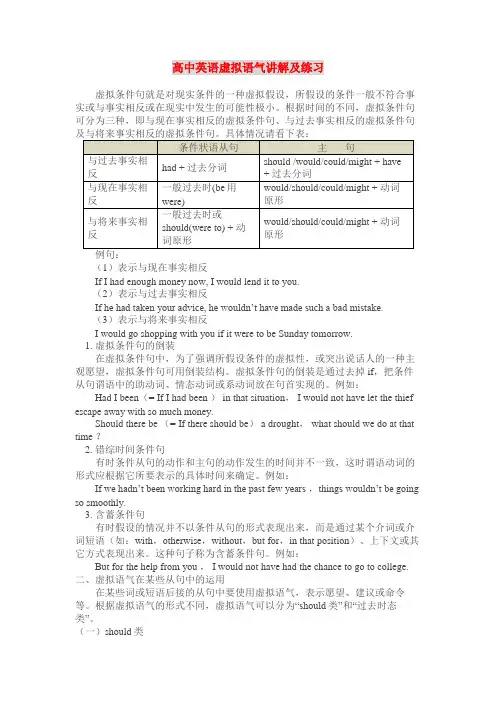
虚拟条件句就是对现实条件的一种虚拟假设,所假设的条件一般不符合事实或与事实相反或在现实中发生的可能性极小。根据时间的不同,虚拟条件句可分为三种,即与现在事实相反的虚拟条件句、与过去事实相反的虚拟条件句及与将来事实相反的虚拟条件句。具体情况请看下表:
条件状语从句 主 句
与过去事实相反 had + 过去分词 should /would/could/might + have
+ 过去分词
与现在事实相反 一般过去时(be用were) would/should/could/might + 动词原形
与将来事实相反 一般过去时或should(were to) + 动词原形 would/should/could/might + 动词原形
例句:
(1)表示与现在事实相反
If I had enough money now, I would lend it to you.
(2)表示与过去事实相反
If he had taken your advice, he wouldn’t have made such a bad mistake.
(3)表示与将来事实相反
I would go shopping with you if it were to be Sunday tomorrow.
1. 虚拟条件句的倒装
在虚拟条件句中,为了强调所假设条件的虚拟性,或突出说话人的一种主观愿望,虚拟条件句可用倒装结构。虚拟条件句的倒装是通过去掉if,把条件从句谓语中的助动词、情态动词或系动词放在句首实现的。例如:
Had I been(= If I had been ) in that situation, I would not have let the thief
escape away with so much money.
Should there be (= If there should be) a drought, what should we do at that
高中虚拟语气的讲解+练习+详解

高中英语虚拟语气讲解及练习
虚拟条件句就是对现实条件的一种虚拟假设,所假设的条件一般不符合事实或与事实相反或在现实中发生的可能性极小。根据时间的不同,虚拟条件句可分为三种,即与现在事实相反的虚拟条件句、与过去事实相反的虚拟条件句及与将来事实相反的虚拟条件句。具体情况请看下表:
条件状语从句 主 句
与过去事实相反 had + 过去分词 should /would/could/might + have
+ 过去分词
与现在事实相反 一般过去时(be用were) would/should/could/might + 动词原形
与将来事实相反 一般过去时或should(were to) + 动词原形 would/should/could/might + 动词原形
例句:
(1)表示与现在事实相反
If I had enough money now, I would lend it to you.
(2)表示与过去事实相反
If he had taken your advice, he wouldn’t have made such a bad mistake.
(3)表示与将来事实相反
I would go shopping with you if it were to be Sunday tomorrow.
1. 虚拟条件句的倒装
在虚拟条件句中,为了强调所假设条件的虚拟性,或突出说话人的一种主观愿望,虚拟条件句可用倒装结构。虚拟条件句的倒装是通过去掉if,把条件从句谓语中的助动词、情态动词或系动词放在句首实现的。例如:
Had I been(= If I had been ) in that situation, I would not have let the thief
escape away with so much money.
Should there be (= If there should be) a drought, what should we do at that
高考英语语法虚拟语气练习题30题(带答案)
高考英语语法虚拟语气练习题30题(带答案)
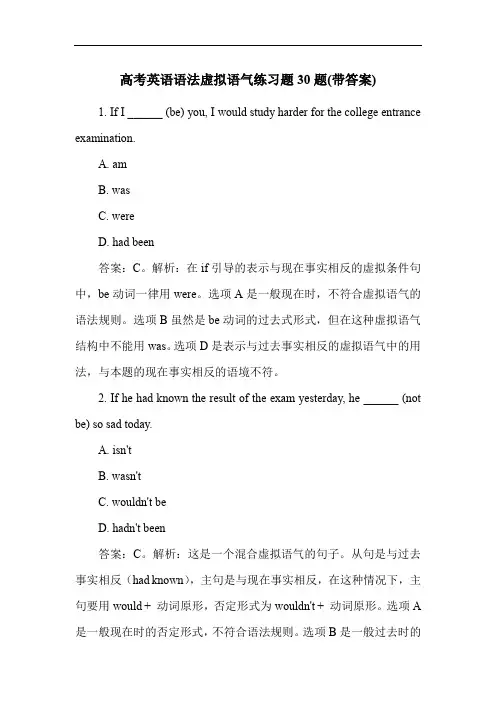
1. If I ______ (be) you, I would study harder for the college entrance
examination.
A. am
B. was
C. were
D. had been
答案:C。解析:在if引导的表示与现在事实相反的虚拟条件句中,be动词一律用were。选项A是一般现在时,不符合虚拟语气的语法规则。选项B虽然是be动词的过去式形式,但在这种虚拟语气结构中不能用was。选项D是表示与过去事实相反的虚拟语气中的用法,与本题的现在事实相反的语境不符。
2. If he had known the result of the exam yesterday, he ______ (not
be) so sad today.
A. isn't
B. wasn't
C. wouldn't be
D. hadn't been
答案:C。解析:这是一个混合虚拟语气的句子。从句是与过去事实相反( had known),主句是与现在事实相反,在这种情况下,主句要用would + 动词原形,否定形式为wouldn't + 动词原形。选项A是一般现在时的否定形式,不符合语法规则。选项B是一般过去时的
否定形式,也不符合混合虚拟语气的要求。选项D是与过去事实相反的虚拟语气中主句的用法,不适合这里与现在事实相反的情况。
3. If it ______ (rain) tomorrow, we would cancel the football match.
A. rains
B. rained
C. will rain
D. should rain
答案:D。解析:在if引导的表示与将来事实相反的虚拟条件句中,有三种形式:动词过去式、should + 动词原形、were to+动词原形。选项A是一般现在时,用于表示将来的真实条件句,不符合虚拟语气规则。选项B是一般过去式,虽然可用于虚拟语气,但在这里没有选项D全面。选项C是一般将来时,不能用于虚拟条件句。
高中英语虚拟语气练习题(附答案)

高中英语虚拟语气讲解及练习
虚拟条件句就是对现实条件的一种虚拟假设,所假设的条件一般不符合事实或与事实相反或在现实中发生的可能性极小。根据时间的不同,虚拟条件句可分为三种,即与现在事实相反的虚拟条件句、与过去事实相反的虚拟条件句及与将来事实相反的虚拟条件句。具体情况请看下表:
条件状语从句 主 句
与过去事实相反 had + 过去分词 should /would/could/might + have
+ 过去分词
与现在事实相反 一般过去时(be用were) would/should/could/might + 动词原形
与将来事实相反 一般过去时或should(were to) + 动词原形 would/should/could/might + 动词原形
例句:
(1)表示与现在事实相反
If I had enough money now, I would lend it to you.
(2)表示与过去事实相反
If he had taken your advice, he wouldn’t have made such a bad mistake.
(3)表示与将来事实相反
I would go shopping with you if it were to be Sunday tomorrow.
1. 虚拟条件句的倒装
在虚拟条件句中,为了强调所假设条件的虚拟性,或突出说话人的一种主观愿望,虚拟条件句可用倒装结构。虚拟条件句的倒装是通过去掉if,把条件从句谓语中的助动词、情态动词或系动词放在句首实现的。例如:
Had I been(= If I had been ) in that situation, I would not have let the thief
escape away with so much money.
Should there be (= If there should be) a drought, what should we do at that
初中虚拟语气讲解及专项练习与答案(带解析)
百度文库
1 虚拟语气专练
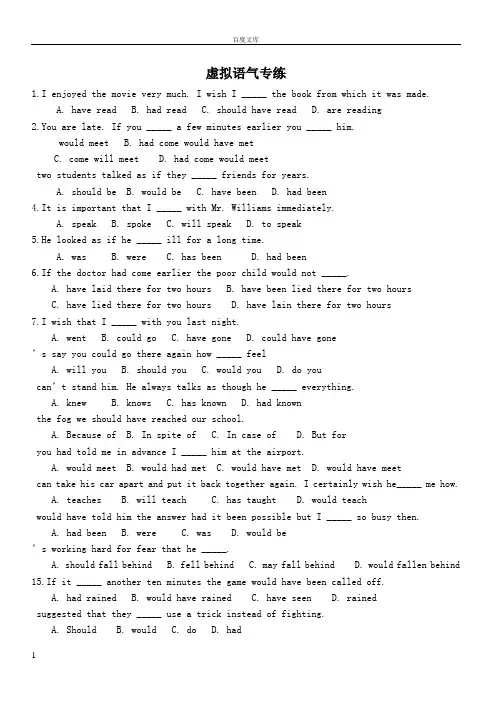
1.I enjoyed the movie very much. I wish I _____ the book from which it was made.
A. have read B. had read C. should have read D. are reading
2.You are late. If you _____ a few minutes earlier you _____ him.
would meet B. had come would have met
C. come will meet D. had come would meet
two students talked as if they _____ friends for years.
A. should be B. would be C. have been D. had been
4.It is important that I _____ with Mr. Williams immediately.
A. speak B. spoke C. will speak D. to speak
5.He looked as if he _____ ill for a long time.
A. was B. were C. has been D. had been
6.If the doctor had come earlier the poor child would not _____.
A. have laid there for two hours B. have been lied there for two hours
C. have lied there for two hours D. have lain there for two hours
虚拟语气练习题及答案

虚拟语气练习题及答案
1. 如果我昨天早一点起床,我就不会迟到了。
- 答案:If I had got up earlier yesterday, I wouldn't have
been late.
2. 他本应该在会议上发言,但他没有准备好。
- 答案:He should have spoken at the meeting, but he
wasn't prepared.
3. 要是我知道答案,我就会告诉你。
- 答案:If I knew the answer, I would tell you.
4. 她希望她能通过这次考试。
- 答案:She wishes she could pass this exam.
5. 要是我没有这么多工作,我就可以和你一起去旅行了。
- 答案:If I didn't have so much work, I could go on a
trip with you.
6. 我们建议他应该更加小心。
- 答案:We suggest that he should be more careful.
7. 如果你当时在场,你会怎么做?
- 答案:What would you have done if you had been there?
8. 要是他早点告诉我,我就能帮他了。
- 答案:If he had told me earlier, I could have helped him.
9. 我本应该更加努力地学习。
- 答案:I should have studied harder.
10. 要是他没有生病,他就能参加比赛了。
- 答案:If he hadn't been sick, he could have
participated in the competition.
答案解析
- 虚拟语气通常用于表示与现实相反的情况,或者表达愿望、建议等。
高中英语虚拟语气讲解及练习带答案 2
高中英语虚拟语气讲解及练习
虚拟条件句就是对现实条件的一种虚拟假设,所假设的条件一般不符合事实或与事实相反或在现实中发生的可能性极小。根据时间的不同,虚拟条件句可分为三种,即与现在事实相反的虚拟条件句、与过去事实相反的虚拟条件句及与将来事实相反的虚拟条件句。具体情况请看下表:
条件状语从句 主 句
与过去事实相反 had + 过去分词 should /would/could/might + have
+ 过去分词
与现在事实相反 一般过去时(be用were) would/should/could/might + 动词原形
与将来事实相反 一般过去时或should(were to) + 动词原形 would/should/could/might + 动词原形
例句:
(1)表示与现在事实相反
If I had enough money now, I would lend it to you.
(2)表示与过去事实相反
If he had taken your advice, he wouldn’t have made such a bad mistake.
(3)表示与将来事实相反
I would go shopping with you if it were to be Sunday tomorrow.
1. 虚拟条件句的倒装
在虚拟条件句中,为了强调所假设条件的虚拟性,或突出说话人的一种主观愿望,虚拟条件句可用倒装结构。虚拟条件句的倒装是通过去掉if,把条件从句谓语中的助动词、情态动词或系动词放在句首实现的。例如:
Had I been(= If I had been ) in that situation, I would not have let the thief
escape away with so much money.
Should there be (= If there should be) a drought, what should we do at that
2022年高考英语虚拟语气讲解及练习题(附答案)
高中英语虚拟语气讲解及练习
虚拟条件句就是对现实条件的一种虚拟假设,所假设的条件一般不符合事实或与事实相反或在现实中发生的可能性极小。根据时间的不同,虚拟条件句可分为三种,即与现在事实相反的虚拟条件句、与过去事实相反的虚拟条件句及与将来事实相反的虚拟条件句。具体情况请看下表:
条件状语从句 主 句
与过去事实相反 had + 过去分词 should /would/could/might + have
+ 过去分词
与现在事实相反 一般过去时(be用were) would/should/could/might + 动词原形
与将来事实相反 一般过去时或should(were to) + 动词原形 would/should/could/might + 动词原形
例句:
(1)表示与现在事实相反
If I had enough money now, I would lend it to you.
(2)表示与过去事实相反
If he had taken your advice, he wouldn’t have made such a bad mistake.
(3)表示与将来事实相反
I would go shopping with you if it were to be Sunday tomorrow.
1. 虚拟条件句的倒装
在虚拟条件句中,为了强调所假设条件的虚拟性,或突出说话人的一种主观愿望,虚拟条件句可用倒装结构。虚拟条件句的倒装是通过去掉if,把条件从句谓语中的助动词、情态动词或系动词放在句首实现的。例如:
Had I been(= If I had been ) in that situation, I would not have let the thief
escape away with so much money.
Should there be (= If there should be) a drought, what should we do at that
虚拟语气练习题(简单含答案和解释)
虚拟语气练习题(简单含答案和解释)
1.I enjoyed the movie very much。I wish I had read the book
from which it was adapted.
2.You are late。If you had come a few minutes earlier。you
would have met him.
3.The two students talked as if they had been friends for years.
4.It is important that I speak with Mr。Williams XXX.
5.He looked as if he had been ill for a long time.
6.If the doctor had come earlier。the poor child would not
have lain there for two hours.
7.I wish that I could have gone with you last night.
8.Let's say you could go there again。how would you feel?
9.I can't stand him。He always talks as if he knows
everything.
10.But for the fog。we should have reached our school.
11.If you had told me in advance。I would have met him at
the airport.
12.Mike can take his car apart and put it back XXX. 13.I would have told him the answer had it been possible。but I was so busy then.
高中英语虚拟语气练习题(附答案) 2
高中英语虚拟语气讲解及练习
虚拟条件句就是对现实条件的一种虚拟假设,所假设的条件一般不符合事实或与事实相反或在现实中发生的可能性极小。根据时间的不同,虚拟条件句可分为三种,即与现在事实相反的虚拟条件句、与过去事实相反的虚拟条件句及与将来事实相反的虚拟条件句。具体情况请看下表:
条件状语从句 主 句
与过去事实相反 had + 过去分词 should /would/could/might + have
+ 过去分词
与现在事实相反 一般过去时(be用were) would/should/could/might + 动词原形
与将来事实相反 一般过去时或should(were to) + 动词原形 would/should/could/might + 动词原形
例句:
(1)表示与现在事实相反
If I had enough money now, I would lend it to you.
(2)表示与过去事实相反
If he had taken your advice, he wouldn’t have made such a bad mistake.
(3)表示与将来事实相反
I would go shopping with you if it were to be Sunday tomorrow.
1. 虚拟条件句的倒装
在虚拟条件句中,为了强调所假设条件的虚拟性,或突出说话人的一种主观愿望,虚拟条件句可用倒装结构。虚拟条件句的倒装是通过去掉if,把条件从句谓语中的助动词、情态动词或系动词放在句首实现的。例如:
Had I been(= If I had been ) in that situation, I would not have let the thief
escape away with so much money.
Should there be (= If there should be) a drought, what should we do at that