
仁爱版英八年级上册全册教案
Unit 1 Playing Sports Topic 1 Are you going to play basketball? Section A The main activities are 1a and 2. 本课重点活动是1a和2。 Ⅰ.Teaching aims and demands 教学目标 1. Learn some new words and phrases: almost, against, term, cheer, cheer … on, team, win, row, quite, bit, quite a bit / a lot, join, club, skate, volleyball, tennis, table tennis 2. Learn some useful sentences: (1)I saw you play basketball almost every day during the summer holidays. (2)Would you like to come and cheer us on? 3. Learn the future tense with be going to: (1)We are going to have a basketball game against Class Three on Sunday. (2)Are you going to join the school rowing club? 4. Talk about preferences: —Which sport do you prefer, cycling or rowing? —I prefer rowing. 5. Talk about sports and games. Ⅱ. Teaching aids 教具 图片/海报/教学挂图/录音机/小黑板 Ⅲ. Five-finger Teaching Plan 五指教学方案
Step 1 Review 第一步 复习(时间:7分钟) 复习学过的运动项目名称,引出生词。 1. (展示一些有关运动的图片,并通过师生对话,引出新的运动项目名称。) T: Welcome back to school, boys and girls. The new term begins. This is our first English lesson this term. Did you enjoy yourselves during your summer holidays? What did you do during your holidays? Did you do sports during your summer holidays? Ss: … (板书并要求学生掌握。) term T: We all know doing sports is good for our health. Now let’s review some sports and learn some new ones. (展示学生在打篮球的图片。) T: Look at the picture. Do you know what they are doing? S1, please. S1: They are playing basketball. T: Do you like playing basketball? S1: Yes, I do. / No, I don’t. T: How many players are there in the basketball team? (板书并要求学生掌握。) team S1: There are five players. (展示学生在打排球的图片。) T: What are they doing? S2, do you know? S2: They are playing volleyball. (教师帮助该生回答。) (板书并要求学生掌握。) volleyball (用同样的方式引出生词cycle, row, skate, tennis, table tennis, ski。) (板书,并让学生跟读,要求学生理解cycle, ski;掌握row, skate, tennis, table tennis。) cycle, row, skate, tennis, table tennis, ski 2. (用黑板上有关运动的生词操练,导出prefer的用法。) T: Which sport do you like better, cycling or rowing? S3: Rowing. T: Good! The phrase “like … better” means “prefer”. (板书并要求学生理解。) prefer T: S4, which sport do you prefer, basketball or soccer? S4: I prefer basketball. …
Step 2 Presentation 第二步 呈现(时间:10分钟) 通过师生对话,呈现1a中部分生词及功能句,并使学生初步掌握be going to句型。 1. (利用plan to do sth.,导入“be going to+do”结构。) T: I’m very glad you all like doing sports and know a lot about them. Do you want to play volleyball tomorrow afternoon? S1, please. S1: Yes, I do. T: So you plan to play volleyball tomorrow afternoon, right? S1: Yes. T: OK. When we plan to do something, we can say we are going to do something. (板书,学习新语法。) be going to do sth. T: When I tell you my plan, you retell it with be going to. OK, boys and girls? Ss: OK. T: I plan to go out for dinner tonight. S2, please. S2: You are going to go out for dinner tonight. T: I plan to climb mountains tomorrow. S3, please. S3: You are going to climb mountains tomorrow. T: Good! When we express something that is going to happen or we plan to do something, we can use be going to. 2. (教师让几个学生说说明天户外活动的打算,并引出be going to结构的一般疑问句式,过渡到1a。) T: OK, S4, please tell me what you plan to do tomorrow afternoon. S4: I’m going to swim with my brother tomorrow afternoon. T: Are you going to swim? S4: Yes, I am. (板书,学习新句型。) 3
—Are you going to swim? —Yes, I am. (教师视学生掌握的情况来决定是否要进行更多的操练。) 3. (展示一幅即将进行篮球赛的海报,引出单词against, cheer和短语cheer … on。) T: Now look at the poster. Here is the news. Our class is going to have a basketball game against Class 3 at 5:00 this afternoon. Would you like to cheer them on? Ss:Yes, we’d love to./I’d love to. (板书,让学生猜词义,并要求掌握。) against, cheer, cheer ... on (出示教学挂图,让学生看图片猜测对话内容,导入1a。) T: Look at this picture. They are Kangkang and Michael. What are they talking about? Can you guess? Please listen to 1a and then answer the following questions. (出示小黑板。) (1) Which class is Michael’s class going to play against? (2) Is Kangkang going to cheer them on? (听后核对答案。) 4. (学生朗读1a,画出疑难点和关键词,然后教师解释疑难点。) (出示小黑板,领读关键词;解释并要求学生掌握almost和win。) basketball—saw—play—almost—every day—against—Sunday—game—term—come— cheer … on—I’d love to—hope—win
Step 3 Consolidation 第三步 巩固(时间:10分钟) 创设情景,编对话,在真实的语境中培养学生口头交流能力。 1. (根据小黑板上的关键词,分角色表演对话。) T: OK. Now you can use the key words above to act out the dialog in roles. 2. (教师引导学生,通过讨论新学期的计划来操练be going to+do句型。) (教师先做示范,然后让学生两人一组练习。) T: S1, what are you going to do this term? S1: I’m going to learn English better. T: What about you, S2? S2: I’m going to study math hard. T: Oh, it’s a good plan. S3, do you know what your partner is going to do? S3: Yes. He is going to learn rowing. T: Discuss with your partner what you are going to do this term. 3. (创设情景,依据1a编对话,巩固1a及be going to+do句型,完成1b。) T: Just now you talked about your plans for this term. Now suppose you meet your classmate on the playground and you want to talk about your plans for this week. Please make a similar conversation with your partner according to 1a. You can use the key words on the blackboard. (板书) be going to, play, I’m afraid, homework, summer, play against, I hope (学生两人一组编对话,教师进行鼓励启发,必要时应给予帮助。) Example: S4: Hi, S5. S5: Hi, S4. I am going to play … Are you going to play with us? S4: I’m afraid I can’t. I have to do my homework first. By the way, I saw you play … almost every day during the summer holidays.
八年级仁爱版英语上册教案

八年级仁爱版英语上册教案Teaching Aims:1. To enable students to ask for and give directions in English.2. To practice using the phrases "Excuse me, could you tell me how to get to...?" and "Sure. It's..."3. To develop students' speaking and listening skills.Teaching procedures:Step 1: Lead-in1. Greet the students and ask them if they have ever been lost and needed to ask for directions.2. Show a map of a nearby area and ask if any students have been there before.Step 2: Presentation1. Introduce the phrases "Excuse me, could you tell me how to get to...?" and "Sure. It's..."2. Use flashcards or pictures to demonstrate different locations on the map and how to ask for directions to them.3. Model the dialogues between a lost person and a local resident, using the target phrases.Step 3: Practice1. Divide the class into pairs and have them practice asking for and giving directions using the target phrases.2. Monitor the pairs and provide help and feedback as needed.3. Ask some pairs to perform their dialogues in front of the class.Step 4: Production1. Have students work in groups of three to create a dialogue asking for directions to a specific location on a map.2. Encourage them to be creative and use the target phrases accurately in their dialogues.3. Select a few groups to perform their dialogues for the whole class.Step 5: Wrap-up1. Summarize the key phrases and language points covered in the lesson.2. Encourage students to practice asking for and giving directions in real-life situations outside the classroom.Homework:1. Review the target phrases and practice asking for and giving directions with a family member or friend.2. Write a short paragraph describing a situation in which they needed to ask for directions and how they did it.。
八年级上册英语教案仁爱版

八年级上册英语教案仁爱版教案标题:Unit 1: Hello! Nice to meet you!教学目标:1. 学会问候和自我介绍的基本用语,并能运用于实际交流中。
2. 掌握英语字母表的发音和书写。
3. 学习描述人物外貌特征和个性特点的词汇。
4. 培养学生的听、说、读、写能力,提高他们的语言表达和交流能力。
教学重点:1. 学会问候和自我介绍的基本用语。
2. 掌握英语字母表的发音和书写。
3. 学习描述人物外貌特征和个性特点的词汇。
教学难点:1. 学会正确发音和书写英语字母。
2. 运用所学词汇描述人物外貌特征和个性特点。
教学准备:1. 教材:仁爱版八年级上册英语教材。
2. 多媒体设备:电脑、投影仪等。
3. 教具:图片、单词卡片、白板、彩色粉笔等。
教学过程:Step 1: Warm-up (5 minutes)- 通过展示一些图片,引导学生回顾并复习已学的问候用语和自我介绍。
- 教师和学生进行简单的问候和自我介绍。
Step 2: Presentation (15 minutes)- 使用多媒体设备展示英语字母表的发音和书写。
- 教师逐个介绍每个字母的发音和书写方式,学生跟读。
- 学生分组进行字母书写练习。
Step 3: Practice (20 minutes)- 教师出示一些人物图片,引导学生用所学词汇描述人物的外貌特征和个性特点。
- 学生分组进行对话练习,互相描述自己和其他人的外貌和个性。
Step 4: Consolidation (10 minutes)- 教师出示一些问题,要求学生用所学内容回答。
- 学生逐个回答问题,并进行相关语言表达的操练。
Step 5: Extension (10 minutes)- 学生分组进行角色扮演,模拟真实情境中的问候和自我介绍。
- 学生展示他们的表演,教师给予反馈和指导。
Step 6: Homework (5 minutes)- 布置家庭作业:要求学生复习所学内容,并准备下节课的课前预习。
仁爱版英语八年级上册Unit 1 Topic 2 Section B教案
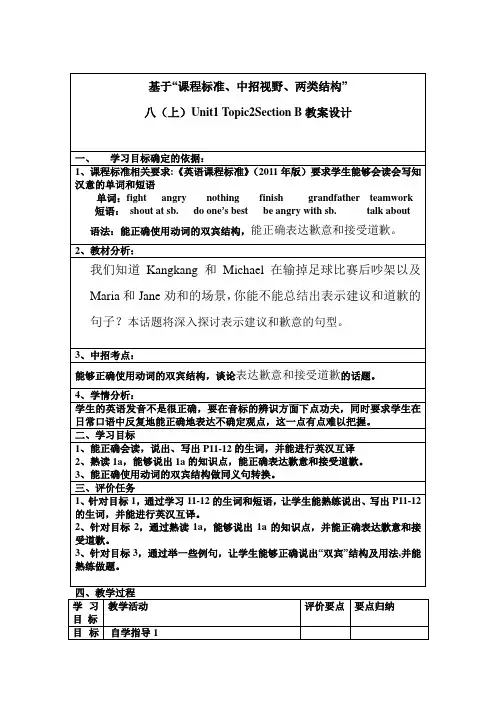
能够正确使用动词的双宾结构,谈论表达歉意和接受道歉的话题。
4、学情分析:
学生的英语发音不是很正确,要在音标的辨识方面下点功夫,同时要求学生在日常口语中反复地能正确地表达不确定观点,这一点有点难以把握。
二、学习目标
1、能正确会读,说出、写出P11-12的生词,并能进行英汉互译
2、熟读1a,能够说出1a的知识点,能正确表达歉意和接受道歉。
5.Don’t be angry with each other.
2.学生通过熟读1a,能够说出1a的知识点,能够熟练运用知识点做题。
say hello/sorry/thanks/goodbye to sb.
对某人问候/道歉/道谢/道别
1.do one’s best = try one’s best尽力,努力
1.fight v.
fight with sb.
n. have a fight
2.finish +v-ing
3.It’s nothing.用来回答别人的道歉。
4.do one’s best to do sth.
学习目标
教学活动
评价要点
要点归纳
目标2、熟读1a,能够说出1a的知识点,能正确表达歉意和接受道歉。
基于“课程标准、中招视野、两类结构”
八(上)Unit1 Topic2Section B教案设计
一、学习目标确定的依据:
1、课程标准相关要求:《英语课程标准》(2011年版)要求学生能够会读会写知汉意的单词和短语
单词:fight angry nothing finish grandfather teamwork
2.Sentences with direct and indirect object structure.
仁爱版英语八年级上册UNIT 1 TOPIC 1 Section C 教案
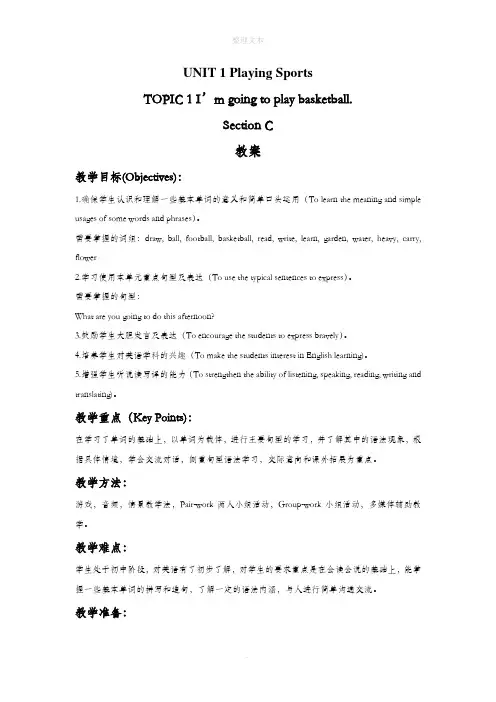
UNIT 1 Playing SportsTOPIC 1 I’m going to play basketball.Section C教案教学目标(Objectives):1.确保学生认识和理解一些基本单词的意义和简单口头运用(To learn the meaning and simple usages of some words and phrases)。
需要掌握的词组:draw, ball, football, basketball, read, write, learn, garden, water, heavy, carry, flower2.学习使用本单元重点句型及表达(To use the typical sentences to express)。
需要掌握的句型:What are you going to do this afternoon?3.鼓励学生大胆发言及表达(To encourage the students to express bravely)。
4.培养学生对英语学科的兴趣(To make the students interest in English learning)。
5.增强学生听说读写译的能力(To strengthen the ability of listening, speaking, reading, writing and translating)。
教学重点(Key Points):在学习了单词的基础上,以单词为载体,进行主要句型的学习,并了解其中的语法现象,根据具体情境,学会交流对话,侧重句型语法学习,交际意向和课外拓展为重点。
教学方法:游戏,音频,情景教学法,Pair-work两人小组活动,Group-work小组活动,多媒体辅助教学。
教学难点:学生处于初中阶段,对英语有了初步了解,对学生的要求重点是在会读会说的基础上,能掌握一些基本单词的拼写和造句,了解一定的语法内涵,与人进行简单沟通交流。
八年级英语上册 Unit 1 Sports and Games Topic 2教案 仁爱版 教案

英语八年级上Unit 1 Sports and Games Topic 2 教案I. Teaching objectives教学目标II. Teaching materials analyzing 教材分析Section A 1a、1b是两个男生之间的对话,还是围绕着运动这个话题,并让学生模仿对话练习。
2a是个听力练习,同时学习如何表达请求和回复;2b要求学生把请求与适当的回复搭配并表演该对话;3是个听说训练,图文搭配。
Section B 1a是3组朋友之间的对话,让学生进行情景表演;1b是词汇练习,将阅读与词汇很好的结合在一起学习;2重点学习本节的重点句型Would you mind…? 3加强学生对请求和回复的掌握。
Section C 1a、1b的对话发生在小记者Kangkang与篮球运动员之间;1c是个写作练习,假设自己是Ming,写一段自我介绍;2是一篇有关篮球历史的阅读理解,让学生了解篮球的诞生过程;3是个课堂小活动,调节课堂气氛。
Section D 1a、1b是一篇有关跑步锻炼的阅读,学生通过对锻炼前后的对比,使学生加强自身身体锻炼;2听力练习;3a、3b的语法学习让学生复习掌握如何表达请求和回复;4强化练习本节的重点句型Would you mind…? 4是个课堂小活动,让学生自己学习乒乓球这项体育运动的历史。
III Teaching plans for each period 分课时教案The fifth period Listening and speakingTarget language目标语言1. Words & phrases 生词和短语ill, fall ill, be glad to, mind, practice, window, get to, No., Capital Stadium, far from, smoke, somewhere, make one’s bed, loudly, right away2. Key sentences 重点句子Could you do me a favor?But one of my teammate fell ill.But I am not good at it.Would you mind teaching me?You need to take bus No. 2.Ability goals 能力目标Enable the students to understand the requests and responses and express complaints and apologies. Learning ability goals 学能目标Help the students listen to the requests and responses and express complaints and apologies. Teaching important and difficult points 教学重难点Understand the requests and responses.Teaching aids教具准备A tape recorder.Teaching procedures and ways 教学过程与方式Step I Lead inT: Good morning, boys and girls.Ss: Good morning. Mr. / Ms…T: If you get into trouble, what will you do?S1: I will try my best to solve it, but maybe it’s difficult.S2: I will ask my parents to help me.S3: I will ask some friend to give me some help.T: Good. No matter what, most people will ask for some help. Let’s listen to a dialog between Kangkang and Michael. Listen carefully what happened.Step II Listening (1a, 1b, 2a)Play the recorder once. If necessary, play the recorder again.T: OK. What’s wrong with Kangkang?S1: He will have a soccer game this Saturday. But one of his teammates fell ill. He wants Michael join them.T: Good. Dose Michael agree with him?S2: Yes.T: You have understood the conversation. Practice it with your partner and role-play the conversation. You can change some information if you want to.After students practice the conversation, ask two pairs to perform it for their classmates. Then let students do the other listening practice.T: Listen to else two listening material, listen and fill in the blanks.Play the recorder. Then check the answers. T: Up to now, we listened 3 listening material. Have you find out the common grounds and the purpose that we listened to them?S1: The common ground is they all need others’ help.T: Good. They made requests.S2: So I think the purpose that we listened to these materials is learning how to make request and responses.T: Yes. Have you learned it? Please write some sentences in your exercise book that you’ve learnt from the listening practice.After students finished, teacher show some sentences on the slide.T: These sentences are from the listening material. Have you written them down?Ss: Yes.Step III Work alone (3)T: There are four pictures. Let’s look at them and guess where they are and guess what the relationship is between them.Give students one minute to discuss with their partner.S1: The first picture is in hospital. The woman is a nurse and maybe the man is looking in the patient.S2: The second picture is at the door. Maybe the old woman is the man’s neighbor.S3: The woman in third picture is at home. Maybe the man is her husband or her friend.S4: The fourth picture is at the boy’s room. The woman is his mother.T: Good. Now listen and read the four dialogs. Then match them with the pictures and check if you guess is right.Let students match the conversations with pictures.T: The four conversations are all about requests and responses. There is an important sentence pattern: “would you mind…?” Do more practices after class.Step IV Homework (2)T: There are ten separate sentences. Match the requests with the right responses. Then practice with your partner and act out the conversation. See you next class.The sixth period Speaking and VocabularyTarget language目标语言1. Words & phrases 生词和短语careless, chance, goal, fight, do one’s best, angry, serve, quickly, turn down, clearly, in a minute, ready, important2. Key sentences 重点句子You are always so careless.You shouldn’t shout at me. I didn’t want to miss the goal.Shame on you.Would you mind saying sorry to Michael?I am very sorry for what I said.Keep trying.We are sure to win next time.Ability goals 能力目标Enable the students to make apology and response.Learning ability goals 学能目标Help the students make apology and response.Teaching important and difficult points 教学重难点Making apology and response.Teaching aids教具准备A multimedia. Teaching procedures and ways 教学过程与方式Step I RevisionT: Good morning, boys and girls.Ss: Good morning. Mr. / Ms…T: Have you finished your homework?Ss: Yes.T: Who would like to show your conversation for us? Volunteers?A sample conversation:A: Excuse me. Could you please do me a favor?B: Sure. What is it?A: Could you tell me how to get to the Capital Stadium?B: It’s far from here. You need to take bus No. 2.A: Thank you very much.B: You are welcome.Step II Lead inT: If your friends fought, what will you do?S1: I will advice them saying sorry to each other. Good friends should forget the friend’s mistake. S2: I will write two letters of apology for everyone and write his friend’s name. Maybe they will forgive each other.T: Good idea. Did you remember that Michael helped Kangkang play soccer last period?Ss: Yes. One of Kangkang’s teammates fell ill, so he asked Michael to join them.T: Do you know the result?S3: Maybe they win the game.S4: Maybe they lost the game.Step III Reading (1a)T: Read the first conversation with your partner carefully. What happened?After they read the first dialog, ask student to answer the question.S1: Michael missed a good chance in the soccer game, so they fought.T: What will happen? Let’s go on our reading.Let students read the second conversation.S2: Maria and Jane persuade them not to fight, and they hope that Kangkang could say sorry to Michael.S3: They believe Michael can do better next time.T: Very good. Good friend should understand each other. Let’s go on the last conversation. Let students read the last conversation.S4: At last, Kangkang says sorry to Michael. They are still good friends.T: Very good. Work in groups and play a role of the four students. You can change some information if you think it’s necessary.Then ask one or two groups act in front of the class.Step IV Vocabulary (1b)T: Read the conversation above again by yourself. There are nine words in the box. Please find some of them out in the conversation, and then fill them in the blanks.Three minutes later.Check the answers together.Step V Speaking i (2)T: Read the example, A make request to B and B make apology to A. You are required to make three similar dialogs using the sentence pattern: “would you mind…?” You should choose a, b orc in the box on the right according to the scene. I will give you five minutes to prepare. Thenperform it. OK?Ss: OK. Five minutes later, ask some students perform their dialogs in front of the class. Give students more chances to speak in public.A sample dialog:A: Your room is too dirty.Would you mind cleaning your room?B: Sorry. I’ll do it in a minute.Step VI Speaking ii (3)T: There are two groups of sentences. One group is about apologies, and the other group is about responses. First match each apology with the best response of part 3. Then practice them with your partner.Three minutes later, ask some pairs to perform.A sample:A: I am sorry I didn’t call you last night.B: Never mind. I guess you were busy.Step VII Homeworka.Make four sentences about apologies and responses.b.Make four sentences about requests and responses.The seventh period ReadingTarget language目标语言1. Words & phrases 生词和短语traveling, tiring, as well, competition, Canadian, invent, college, Springfield College, indoor, even, score, put, well, basket, throw, court, follow, over, century, more and more2. Key sentences 重点句子That’s a lot of traveling.But very tiring as well.He invented an indoor game for his students so that they could play it even in bad weather.You must follow the rules.More and more people play basketball.Ability goals 能力目标Enable the students to talk about team games and racing.Learning ability goals 学能目标Help the students talk about team games and racing.Teaching important and difficult points 教学重难点Talking about team games and racing.Teaching aids教具准备A multimedia.Teaching procedures and ways 教学过程与方式Step I Lead inT: Good morning, boys and girls.Ss: Good morning. Mr. / Ms…T: Look at the picture on Page 13. Do you know the tall man?S1: Yes. He is Yao Ming. He is very famous in China even in the world.T: Right. There are many students like him in our class. Yao Ming’s fans are around the world.If you are a reporter and you have a chance to communicate with Yao Ming face to face. What do you want to ask him?S2: I want to ask him what his dream is.S3: I want to ask him how long he will play basketball in USA in the future.S4: I want to know which pop star he likes best.S5: I will ask him when he will marry.T: Very interesting. If you want to know him better, you can find more information about Yao Ming.Now let’s read the conversation between Ming and Kangkang. Step II Reading and speaking (1a, 1b)T: OK. Now Kangkang has the chance to communicate with him. Read the conversation with your partner carefully and then complete the following chart on the slide. Three minutes are given. Show the chart on the slide.T: OK. Time is up. Have you got the answers? Volunteers?S1: The first blank. Ming will take part in the games in France in March.S2: The second blank. In June, he will be in Korea.S3: The third blank. In August he will be in Russia.T: Good. Dose Ming like traveling?S4: He likes traveling and he enjoying playing in different countries.T: When did he start playing basketball?S5: Ming starts playing basketball about seven years old.T: You all got it. Are there some students who want to be a reporter in the future?Ss: Yes.T: Reporter is an exciting job. You can communicate with different people and many stars. Now role-play the conversation with your partner. If you have enough time, you can make another conversation. For example, you can communicate with Beckham, Zhou Jielun or Cai Yinlin. I’ll give you five minutes to prepare.Five minutes later.T: Are you ready?Ss: Yes.Ask some volunteers to present their conversation.A sample conversation:Zhang Ming: This year is important for you, isn’t it, Beckham?Beckham: Yes, that’s right. In March I will go to Japan. In June, I will take part in the World Cup in Germany. Then I will have some advertisements to prepare.Zhang Ming: that’s a lot of traveling.Beckham: Yes, a lot. I like traveling, and my wife and children also like traveling.Zhang Ming: When did you start playing football?Beckham: When I was about 13 years old, I joined a football club in England.Zhang Ming: You have a very exciting life now.Beckham: Exciting? Yes. But very tiring as well.Step III Reading (2)T: We talked many about basketball and basketball players. Do you know its history? Do you know who invent basketball game?Ss: No.T: Do you want to know it?Ss: Yes.T: Turn to Page 14, read the passage. Before you read it, read these questions. When you read it, find the answers.Show the questions on the slide.T: If you got the answers, tell your partner and check if your answer is right. After that, mark (T) for Ture and (F) for False.Give students two minutes to finish it. Then ask students retellthe passage, using the information showed on the slide.Show the information on the slide. Ask some volunteers to retell the passage.Then let students pay attention to the important words invent, college, indoor, even, score, put…into, throw, court, follow, century, more and more.T: There are many surprises around us. Maybe one day you will invent something too. It needs our carefulness and imagination.Step IV Homework (1c)T: We have known Ming well through the conversation above. Suppose you are Ming. Write a passage introducing yourself. You can start the passage like following.A sample passage:My name is Ming. I’m a basketball player. I started playing basketball when I was about seven years old. I like it very much. This year is important for me. In March I will take part in the competition in France. In June I will be in Korea, and in August I will be in Russia. I like traveling very much. Now I have an exciting life, but very tiring as well.The eighth period Reading and GrammarTarget language目标语言1. Words & phrases 生词和短语however, chips, tired, easily, active, mile, fresh, instead, instead of, build, build up, coach, runner, feeling2. Key sentences 重点句子I drink milk and eat fresh fruit and vegetables instead of chocolate.Running and healthy eating help to build me up.I have great fun running and I feel well and look fit.Ability goals 能力目标Enable the students to make requests and responses.Learning ability goals 学能目标Help the students review the grammar and useful expressions.Teaching important and difficult points 教学重难点Grasping the grammar.Teaching aids教具准备A multimedia.Teaching procedures and ways 教学过程与方式Step I Lead inT: Good morning, boys and girls.Ss: Good morning. Mr. / Ms…T: Today, Children worldwide are getting fatter at an alarming rate. In China, more and more parents are worried about their children’s weight. At the moment ten percent of all urban children in China are overweight. Why are there so many fat children?S1: They eat too much sugary and fried footS2: They are lack of physical activities.S3: They drink too much soft drink.S4: They eat too much before sleeping in the evening.S5: They eat too much fast foot, such as KFC and Mcdonald's.T: You are all right. There are many reasons result in children’s overweight. In a word, Experts say the two reasons for the increase in children's bodyweight are diet and lack of physical activity. An American expert predicts that 25% of all children in China will be overweight by2010. How terrible. There is a boy, he was fat one year ago. Now, he is quiet health. Why? Let read a passage he wrote.Step II Reading (1a, 1b, 1c)T: Look at the picture. What’s he doing?Ss: He is running.T: Right. Now read the passage and answer the T or F questions on the slide.Show the questions on the slide.Key: 1. F 2. T 3. F 4. T 5. FAfter they finished the exercise, check the answers together.T: Now I’ll ask you some questions about your understanding. The first question: why did the boy start his running?S1: One year ago, he was fat. When he saw some young men running in the part, they looked so fit and active. So he started running.T: Very good. The second question: what kind of food did he have instead of chocolate?S2: He drink milk and eat fresh fruit and vegetables.T: Good. The last question: how does he feel now?S3: I have great fun running and I feel well and look fit.T: Good job. Taking exercises is the best way to lose weight. It can also help you keep fit. If you think you are fat, taking exercises. But you are young and you need all kinds of nourishment. Health is the most important. The boy changed a lot because of running. In a word, there are three aspects could be seen – looking, eating and feeling. Look at the chart on Page 15. Fillin the chart according to the passage. Suggested answer:Then let students pay attention to the words however, chip, tired, easily, active,fresh, insteadof, coach, mile, build up, muscles.Step III Listening (2)T: Listening to the dialog carefully. Fill in the correct numbers in the brackets. Play the recorder once. If necessary, play the recorder again.Step IV Grammar (3a, 3b)T: We have learnt how to make requests and responses. This period we will have a whole revision. Besides the sentences in the book, there aremany others to make request. Look at these sentences on the slide.The students also have learnt how to make apology and responses. Show more sentences on the slide. Step V Pair work (3)T: Make conversations with the useful expressions in the box. Practise the phrases and sentences. There is an example. A sample conversation:A: I’ m sorry for losing your book.B: You are always so careless. It ’s important for me. A: Sorry. I’ll be careful next time. B: Never mind. Be careful next time.Step VI Homework (4)T: We have read a passage about basketball. After class, you have a task to do. Find some information about table tennis. Find its history and finish the form below, then write a short passage. See you next class. The sample:Table tennis was invented in England during the 19th century. It is unknown who invented the game. It was called indoor tennis at the beginning. An English manufacturer(制造商) of sporting goods, John Jacques, registered "Ping Pong" as a trade name in 1901. Table tennis became an Olympic sport in 1988, with singles and doubles competition for both men and women. China’s National Team is the most famous Team in the world and almost every Chinese could play it.Teaching resources 教学资源库语法点will1. 表示意志、意愿,有“愿、要”之意。
八年级仁爱版英语上册教案

八年级仁爱版英语上册教案Objectives:1. Students will understand vocabulary related to travel and geography.2. Students will be able to use the past tense to describe travel experiences.3. Students will enhance listening and speaking skills through interactive activities.Procedure:1. Warm-up (10 minutes)- Begin with a discussion about travel. Ask students where they would like to travel and why.- Introduce key travel-related vocabulary using flashcards (e.g., passport, suitcase, explore, culture).2. Presentation (15 minutes)- Present a short reading from the textbook about a famous travel destination.- Highlight past tense verbs in the text. Explain their usage with examples.- Play an audio recording of a travel experience, emphasizing listening skills.3. Practice (20 minutes)- Group Activity: Divide students into small groups. Each group chooses a travel destination and prepares a short presentation using past tense to describe their imagined experience.- Encourage students to incorporate vocabulary learned in the lesson.4. Production (15 minutes)- Have each group present their travel experience to the class.- Allow for a Q&A session after each presentation to enhance speaking and listening skills.5. Homework (5 minutes)- Ask students to write a short paragraph about their favorite travel experience using the past tense and new vocabulary.Assessment:- Observe group participation during activities and presentations.- Evaluate homework for correct use of past tense and vocabulary.Closure:- Summarize key points of the lesson and reinforce the importance of travel in cultural exchange. Encourage students to think about future travels.。
仁爱版英语八年级上册 Unit1 Topic2 SectionA 参考教案
Unit1 Topic2 SectionA 参考教案Ⅰ. Material analysis本节课主要活动为Section A 的1a和2。
通过Kangkang对Michael的邀请,引出对话的主题:合作参加足球比赛。
对话呈现了本课所要学的语法重点:subject + vt. + indirect object + direct object。
结合本单元的话题We should learn teamwork.呈现了重点短语:kick the ball to you, pass me the ball, practice doing sth, give me a hand等, 同时在对话中呈现了交际功能用语:Will you …? Would you mind (not) doing sth.? 和Do you mind (not) doing sth.? 帮助学生学会请求,提建议的表达法。
通过和他人的沟通、合作,将团队合作精神融于对话中。
要求学生在学会课本语言知识的同时,培养他们的团队合作精神。
督促学生结合学过的句型用be going to do 进一步谈论有关自己最喜欢的运动的话题,并能将团队合作精神体现在书面表达中。
Ⅱ. Teaching aimsKnowledge aims:1. 能正确拼读并运用单词表中的单词: ill, mind, kick, pass, certainly, somewhere, throw.2. 能正确运用以下短语造句:fall ill, give sb a hand, do well in.3. 能自如地运用以下功能句进行交流,表达请求与允许:Would you mind (not) doing sth?Do you mind (not) doing sth?Will you …?4. 能初步感知本话题语法:subject+vt+indirect object+direct object.Skill aims:1. 能听懂有关体育活动中团队合作的简单对话和陈述。
仁爱版英语八年级上册UNIT 2 TOPIC 1 Section A 教案
UNIT 2 Keeping HealthyTOPIC 1 You should brush your teeth twice a day.Section A教案【教学重点】1. 学生学会关于身体状况的表达以及怎样询问他人的身体状况:How are you feeling now? I feel /don’t feel well.。
2. 能听、说、读、写四会单词:model、runny nose、slight fever、high fever。
在学习的过程中培养学生综合运用语言的能力,能用更多的语句来丰富自己的语言,如:Glad / Sorry to hear that. Take care of yourself.【教学难点】1. How are you feeling now? I don’t feel well.本课的核心句子,询问和表达身体的状况。
runny nose、slight fever、high fever 三个表示病症的词组。
2. Glad / Sorry to hear that. Take care of yourself.用来丰富学生的语言,重在灵活应用。
【教具准备】病痛单词学习卡片,随堂PPT【教学过程】热身/复习〔Warm-up/Revision〕1.Sing an English song :Clap your hands2.问候,复习旧知T: Hello boys and girls. How are you today?Ss: …T: I’m very well. Because there will be an English party in our school tomorrow. I hope all my stude nts can enjoy my party. But I’m sorry to hear that some of my students are sick. Now let’s have a look. What’s the matter with them?2. 旧知复习,引入新知出示课件,学生进展问答练习,复习相关的疾病名称:headache、stomachache、toothache What’s the matter with Mike? He has a stomachache. What’s the matterwith John? He has a headache. What’s the matter with May? She has a toothache. T: They are sick. So I’m sorry to hear that. 〔在恰当的情境中引出新句子并讲授更容易让学生们承受。
仁爱版英语八年级上册Unit 2 Topic 1 Section B教案
1.She feels like running.她想要去跑步。
She ____ ___________.(同义转换)
2..我不想吃东西。
I ______ feel ___________.
3.You'd better tell him about it(改否定句).
You'd better _____ ______ him about it.
10.Iam feeling terrible.
11. sb. had better (not) do sth
12.Whydon’tyou…?
12.sb. had better (not) do sth
13.Whydon’tyou…?
目标
3:能够说出时间状语从句的结构及用法,并能熟练做题。
当堂训练:
1.take care of
3.need to
4.take pills
5.help sb (to) do
6.How long have been like this?
7.Iam feeling terrible.
8 sb. had better (not) do sth
9. Whydon’tyou…?
7. had better do
You had better go to see a doctor.
8. shouldn’t do
You shouldn’t eat too much candy.
9. had better not do
You’d better not work too long.
9.How long have been like this?
仁爱版英语八年级上册教案
仁爱版英语八年级上册教案教案标题:Unit 1 My New Teachers教学目标:1. 了解并掌握新学期新老师的基本信息2. 学习并掌握描述老师外貌和性格的表达方式3. 通过听说读写等多种方式,提高学生的英语综合能力教学重点和难点:1. 重点:掌握描述外貌和性格的词汇和句型2. 难点:运用所学知识描述自己的新老师教学准备:1. 教材:《仁爱版英语》八年级上册2. 多媒体设备3. 教学PPT4. 学生课前作业教学过程:Step 1: Warm-up通过图片展示不同外貌和性格特点的人物,帮助学生复习相关词汇,并引出新课内容。
Step 2: Presentation利用多媒体设备展示新老师的照片,并介绍他们的外貌和性格特点。
同时,教师可以向学生提问,帮助他们了解新老师。
Step 3: Practice1. 听力练习:播放录音,让学生听取新老师的相关信息,并填写表格。
2. 口语练习:学生分组,互相描述自己的新老师,要求使用所学词汇和句型。
Step 4: Production1. 写作练习:要求学生以自己的新老师为对象,写一篇短文描述他们的外貌和性格特点。
2. 表演:学生可以以小组形式进行角色扮演,模拟介绍新老师的情景。
Step 5: Homework布置作业:要求学生整理自己的新老师介绍,准备下节课进行口头报告。
教学反思:通过本节课的教学,学生能够在实际生活中运用所学知识,描述新老师的外貌和性格特点,提高了他们的英语综合能力。
同时,通过听说读写等多种方式的综合训练,激发了学生学习英语的兴趣,提高了他们的学习积极性。