
课件unit6 food and drinks
Unit 6 Food新编大学英语第二版第二册教案
Unit 6 FoodUseful InformationFood is a basic necessity, so every culture has important norms and customs related to it. Ever since they adopted settled lifestyles centuries or millennia ago, most cultures have emphasized daily meals in households or family units. Some members provide the food, some members prepare the food, and all members must eat. The providers and the preparers may not be the same, depending partly on gender roles and specialization. And the status of individuals in the eating process may not be the same, depending partly on their age and gender, and whether the household contains servants or guests. Servants rarely eat with others, while honored guests may be wined and dined like visiting royalty. Elders and males may also be treated ceremonially.Formal meals may take hours in some cultures or households, while in others people may eat hastily while traveling to their next destination on foot or by car. Some people eat while working or use eating as a form of recreation. In most cultures the feeding of friends, relatives, and others is a way of meeting, socializing, entertaining, and showing respect. Some cultures permit or encourage the use of alcoholic or caffeinated beverages with food, while others discourage or even prohibit this. Most cultures have food preferences and food taboos, so they find different ways to achieve balanced diets.Eating away from home in restaurants, taverns, inns, or hotels has long been an option in most cultures, but the variety of these choices is rapidly increasing today as the fast pace of modern life encourages more people to “eat on the run”. This also tends to blur the traditional distinction between providers and preparers of food, especially in families where both parents work full-time outside the home. In such cases both parents may eat out at noon, the children may eat at school, and anyone may pick up pizza or hamburgers on the way home or phone for pizza to be delivered. In the U.S., Chinese restaurants do a big take-out business and microwa ved “TV dinners” are very popular. Some busy families rarely eat formal meals together, even when they all eat at home. Refrigeration has also changed eating habits, and “raiding the refrigerator” is often a substitute for preparing meals. As eating habits have changed, table manners have tended to decline, though proper etiquette is still needed on formal occasions.Mealtimes differ considerably from culture to culture or from household to household. In agrarian cultures rural families tend to eat their first two meals earlier in the day, while in industrial cultures urban families often have them later. The time of the third meal depends on several factors such as whether there is a nap after lunch and whether food or beverages are typically consumed in the mid-to-late afternoon as snacks or social events.In some cultures “tea” in the afternoon is almost a fourth meal. Some people have their supper in the late afternoon or early evening, while others may have it in the mid-to-late evening. For some people the second meal of the day is the largest, while for others the third meal is the largest. This causes considerable confusion as to whether lunch or supper is more appropriately referred to as “dinner.” Further confusion is caused by people who skip brea kfast and others who prefer “brunch” instead. Brunch is especially popular on weekends, when it may last from mid-morning to early afternoon.The biggest recent change in eating habits and food-related lifestyles is the advent of fast food. This permits many people to eat conveniently away from home, or to bring food home to eat without having to prepare it. But it also makes family-style meals less likely to be, and it is not always very nutritious. The clever marketing of fast food such as McDonald’s ha mburgers and KFC (Kentucky Fried Chicken) may cause some youngsters to dislike their parents’ cooking and some college students to dislike the more nutritious food available on campus. Eating fast food while driving is also a cause of traffic accidents. So ciologist George Ritzer uses the metaphor of “McDonaldization” to criticize the entire cultural trend toward standardized pre-packaged products which can be quickly consumed. He claims the quality of life is diminished by what he calls the “McDonaldization of society,” and that we should voice our protest by eating in local “mom and pop” restaurants rather than patronizing national or international fast-food chains. Despite Ritzer’s advice, McDonald’s and other fast-food chains are probably here to stay. They are getting more similar to one another all the time, with hamburger chains offering chicken, chicken chains offering hamburgers, and all of them offering milk shakes and fries.Nutritionists have been warning that the typical fast-food diet is unhealthy if eaten too often. Consequently, some of the fast-food chains, such as McDonald’s, are now including healthier options for their customers along with the traditional hamburgers. Various healthy salads are now appearing on the menu boards, along with low fat salad dressing options. For children, fresh apple slices with a low fat caramel dipping sauce can now be chosen in the place of French fries in the children’s meal, and apple juice or low fat white and chocolate milk can be chosen instead of a cola. Bottled water also can now be purchased instead of a soft drink if one so chooses. Most people believe that this trend of healthier eating will continue.Part One Preparation2. How Much Do You Know about Food?1. A2. B3. C4. C5. B6. A7. C8. B9. C 10. A3. Comparing DietsSTEP ONESamples1) --This is not a healthy diet. First, he eats too much. Second, he has too much sugar, which may change into fat and accumulate in the body.--This is generally speaking a healthy diet. Apart from the fact that the food is too much for a 10-year-old boy, his diet includes most of the nutrients necessary for a healthy body.2) Diet of a 10-year-old Chinese boy on a typical day:Breakfast: one or two pieces of bread, one egg, a cup of milk, etc.;Lunch: rice, fish or meat, vegetables, etc. (or noodles);Supper: rice, fish or meat, vegetables, soup, etc.;Snacks during the day: some fruit, candies, chocolates, drinks, etc.3) Differences between the British boy and a Chinese boy:A. The British boy eats a wider variety of things.B. The British boy eats much more than a Chinese boy.STEP TWOSamples1) Different DietsAt school:Student ABreakfast: two steamed rolls (or baozi), some porridgeLunch: rice, fish or meat, some vegetablesSupper: rice, fish or meat, some vegetables; noodles; or jiaozi (dumplings)Snacks during the day: an apple or a pear, some biscuitsStudent BBreakfast: a cup of milk, one boiled egg, some rice cakesLunch: rice, fish or meat, some vegetablesSupper: rice, fish or meat, some vegetables; noodles; or jiaozi (dumplings)Snacks during the day: some biscuits, cookies, or cakes, some preserved fruit.At home (for both):A much wider variety of foods like seafood, more snacks, more fruit, etc.2) Advice on the improvement of the diet:A. Student B should have some fruit every day; otherwise the lack of vitamin C may cause sickness.B. Student A should drink some milk every day, since milk provides certain minerals, vitamins, etc., which are necessary for a healthy body.C. Both students should add some variety in their diets, because different foods contain different nutrients the body needs. Besides, their diets at school and at home shouldn’t be too different.Part Two Reading-Centered ActivitiesIn-Class ReadingI. Pre-ReadingSamples:1. ― I like fresh fruit, vegetables, pork, seafood, all kinds of nuts, etc.. I don’t l ike beef, lamb, chicken and pickles.― Although I’m not a vegetarian, I like vegetables and fruit most. I eat a lot of them. I also like seafood because I was born in a city on the coast. I’ve been exposed to seafood ever since my childhood. I don’t eat me at, any kind of meat.2. ― The reason why I eat certain foods or don’t eat certain foods is simple: taste. In other words, I eat what tastes good, and don’t eat what doesn’t. But there is one exception. I’ve never tried snake because I’m scared by the c reature. The mere mention of the word “snake” makes my skin crawl.― I think our eating habits were formed at home when we were very young. For example, my mother is an excellent cook, especially good at cooking seafood and vegetables. I ate a lot of them at home. Gradually I’ve become used to this diet.3. Yes. People in Guangzhou eat rats, snakes and many other birds or animals. It is said that they eat anything with 2 legs except human beings and anything with 4 legs except tables. Although it is an exaggeration, it shows they really eat a wide range of things. Many people think that’s strange because rats and snakes are nauseating. I also find eating raw fish strange, because I think raw fish contains a lot of bacteria.II. Passage ReadingWords, Phrases and Grammatical Points1. be sick (l.5), vomit, nauseate (l.3)“Be sick” can mean “feel ill as if one is going to vomit”.e.g. She was sick after she ate too much chocolate.Lucy felt sick (= felt likely to vomit) the morning after the party.Other uses include: airsick, carsick, seasick.“Nauseate” comes from the word “nausea” which means “a feeling of illness in the stomach, often making one feel as if one is going to vomit.” It’s a formal word and often used in passive form.e.g. He is nauseated by the smell of meat cooking.“Vomit” means “bring food or drink up from one’s stomach through one’s mouth, because one is sick.”In spoken English, “be sick” is more often used to mean “throw up all the contents in the stomach through the mouth” than “be generally ill”.e.g. If one eats too many sweets one will be sick.The more formal word in British and American English is “vomit”, and the less formal expression is “throw up”.Compare: be sick of … (=be very annoyed about…) 对……感到厌烦的e.g. I’m sick of the way you’re behaving.2. The term “sacred cow” (l. 23) is also used derogatorily to refer to an idea, practice, etc. that is so much accepted that not even the slightest doubts about it are allowed.e.g. I) The need for secrecy has become a kind of sacred cow.II) They did not dare to challenge the sacred cow of parliamentary democracy.2) ―When I see people eat things I don’t like, my first reaction is disgust. I just can’t understand how people can eat such nauseating things. Sometimes I feel that people are cruel when they eat some animals which are a help to human beings.―I don’t mind what other people prefer eating. People can have different likes and dislikes in different aspects. Nowadays a variety of foods are available in most places of the country and people can have a good choice. Many of us even enjoy foods from other countries. But we have to think about our environment as well as health before eating. Sars has already taught us a good lesson in eating.Vocabulary1. 1) common 2) appropriate 3) forbidden 4) supplies 5) related 6) evidence 7) requires 8) raise 9) spread 10) sufficiently2. 1) disgusting 2) habit 3) insects 4) reasonable 5)relatively6) animals 7) harvested 8) grow 9) nearly 10) other11) altogether 12) consumed 13) avoided 14) popular 15) offers16) served 17) would 18) enjoyed 19) considered 20) reject3. 1) G 2) F 3) B 4) C 5) H 6) E 7) I 8) D 9) A 10) JTranslation1. We regard him as one of the best players in the game.2. The scientist picked up those little pieces of rock and carefully put them into a box.3. The population of China is almost five times as large as that of the United States.4. The reason why grass is green was once a mystery to the little boy.5. She was standing by the window, apparently quite calm and relaxed.6. Profits have declined as a result of the recent drop in sales.7. She put on dark glasses as a protection against the strong light.8. He could no longer be trusted after that incident.Part Three Further Development1. Jokes and Riddles about FoodTask One1) Pear. 2) Mushroom.2. Food Proverbs1) d: Half a loaf is better than none. 有一点总比没有好。
《民航客舱服务英语》课件Unit 6
Drink and Meal Service (II)
Unit 6 Drink and Meal Service
II. Cabin Announcements -- Drink and Meal Service
餐饮服务
1. Listen to the announcements and fill in the blanks.
Warm-up
Discuss the following questions in groups
1. If you fail to bring the passenger his meal in time, what do you say to him to show your apology? 2. A passenger was sleeping while you were serving. After he wakes up, he complains he hasn’t got a meal. What would you say to him? 3. What is the difference between the meal service of First class and Economy class ? 4. Could you list several kinds of special meals? 5. What’s your recommendation to a vegetarian passenger if he does not eat the food you served?
as.sistance.
Thank you for your understanding and cooperation.
Cabin Announcements
沪教牛津版-英语-九年级上册6单元 Healthy diet period2 1(1)课件

[来源:学科网ZXXK]
1. Joan should not go near computer games. She
has to study for exams. (line 5) s_t_a_y_a_w_a_y__fr_om 2. Before going to school, all of the students need
a close look at their body by a doctor. (line 8) __m_e_d_i_c_a_l e_x_a_mination
3. TCh1e iFnisntdruwcotirodnssfsraoyminthaeccleoanrvwerasyattihoant owne need topacgoeok83thtihsaftohrafviveesmiminiluatrems.e(alinnieng9)s to __s_t_a_te_th_e__w_o_r_d_s in italics below. Change their 4. Theffoirlmmsstifarntescaetssseavreyn. and it is only five. We
hamburger in general necessary
research usual
Most people think they eat what they want.
However, (1) __in__g_e_n_e_ra_l___ this is not really true.
Our eyes and ears are filled with advertisements
三年级下册英语一课一练-Moudle 2 Unit 6 food and drinks 牛津上海版(三起)(含答案)
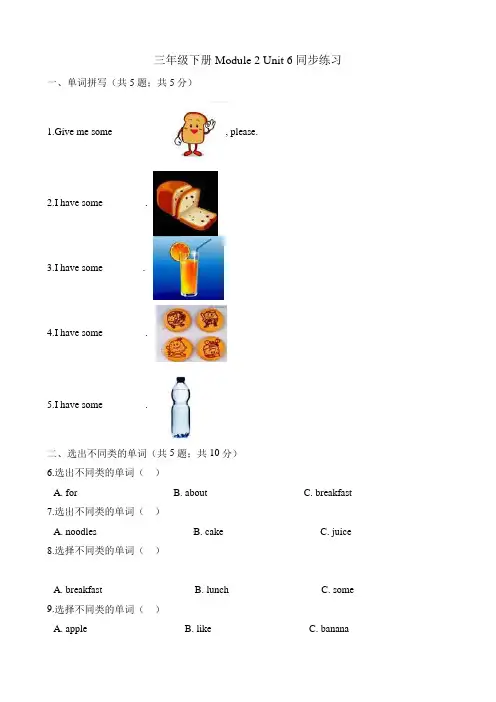
三年级下册Module 2 Unit 6同步练习一、单词拼写(共5题;共5分)1.Give me some________ , please.2.I have some ________.3.I have some________.4.I have some ________.5.I have some ________.二、选出不同类的单词(共5题;共10分)6.选出不同类的单词()A. forB. aboutC. breakfast7.选出不同类的单词()A. noodlesB. cakeC. juice8.选择不同类的单词()A. breakfastB. lunchC. some9.选择不同类的单词()A. appleB. likeC. banana10.选择不同类的单词()A. favouriteB. waterC. milk三、单选题(共5题;共10分)11.I have some _____and _____.A. milk noodlesB. milks noodlesC. milks noodle12.I have some______.A. noodlesB. noodleC. milks13.What do you have _____ breakfast?A. aboutB. forC. to14.—I like noodles. What you? —I like fish.A. aboutB. areC. is15.—is the orange?—It's sweet.A. HowB. What四、判断题(共5题;共10分)16.—I'm thirsty.I want some water.—OK, let's go to the shop now.17.—Taste the egg, Sally. It's very yummy.—Thank you, Sam.18.—What do you have, Amy?—I have some cakes.19.—What do you have, Peter?—I have an egg.20.—What do you have, Joe?—I have some orange juice.五、情景交际(共1题;共6分)21.句子搭配。
Unit-1-Food-for-thought-Listening-and-speaking-课件
Thanks
Have a balanced diet
Be too picky about food
……
……
Work in pairs. Act out the conversation to persuade a customer to buy a new mixed fruit drink.
Student A: Turn to Page 105. Student B: Turn to Page 108.
• a lot of sugar, 1. fat
and
salad with dressing
unhealthy 2. chemicals .
fruit juice
• just a small 3. amount of real fruit in it • has as much sugar as 4.soft drinks .
Healthy eating
When you give advice, it’s usual to give your opinion within your first sentence. This makes the listener more interested in what you are saying. Here are some examples:
How can we eat healthily?
Listen to a song and take down useful tips.
What should we do?
What shouldn’t we do?
How can we eat healthily?
Have a discussion and take down useful tips.
Unit+6+单元知识点课件+2022-2023学年人教版英语七年级下册

I wish I could fly like a bird. n. (C) 祝福 Best wishes to sb. for + 节日 make a wish 许愿
any other + n.(单) 除某个以外其他的任何一个 杰克看上去像其他和他同龄的孩子一样。 Jack is like any other boy of his age.
1) another + n. (单) 另一,又一 (商店用语) another + 基数词+ n. = 基数词+ more + n. 又多… 再多三个小时 anther three hours = three more hours
Any child will love them. 任何时间都可以。
Any time is OK.
1.There isn't __a_n_y__ milk in the fridge. 2.Ican see __so_m__e_ cars, but I can't see __a_n_y__
buses. 3. Were there __a_n_y__ trees on the farm? 4. Would you like __s_o_m__e tea? No,I’d not like ___a_n_y_ tea, but I’d like _s_o_m__e_
3. This cake is delicious! Can I have__B_____ piece, please?
A. other B. another C. others D. the other
unit7Foodsanddrinks
Unit 7 Foods and drinks一、重点单词短语1. foods and drinksfood指食物的总称时用作不可数名词;指不同种类的食物时用作可数名词。
e.g. I must buy some food for supper.We have a lot of foods. Fish, meat, chicken, which one would like?2. 表示“某国人”的名词的复数变化:a Chinese→two Chinese 中国人a Japanese→three Japanese 日本人a Swiss→four Swiss 瑞士人an Englishman→two Englishm e n 英国人a Frenchman→two Frenchm e n 法国人an American→two American s美国人an Australian→two Australian s澳大利亚人an European→two European s 欧洲人a German→two German s 德国人中国、日本和瑞士,复数不需加-s;英国、法国、荷兰人,要把man改成men;-an,-ian各国人,后边直接加-s;German德国人变复数加-s。
3. popular 受欢迎的;流行的be popular with受到……的欢迎e.g. popular songsJay Chou’s songs are popular with young men.4. have a great time 玩得开心(=have a good time/enjoy oneself)e.g. We all had a great time in the park yesterday.=We all enjoyed ourselves in the park yesterday. 我们昨天在公园玩的很开心。
剑桥(join-in)版六年级英语下册全册全套ppt课件
You could be …
你可以成为……
But I don’t want to be … 但是我不想成
为 I w…an…t to be …
我想成为……
I don’t really know.
我真的不知道。
I really have to go.
我真的得走了。
2. Listen to the poem.
What I want to be
2. Listen to the poem.
Listen and answer questions.
doctor teacher
pilot clown sheriff cowboy
boss
2. Listen to the poem.
Listen and answer questions.
tiger pony train spacecraft elephant supersonic planes
2. Listen to the poem.
Listen and learn.
What do you want to be in ten years’ time from now?
十年后你想成为什么?
cheese
3. Circle the food words.
Circle and read.
4. Look and answer questions.
Review
询问人物信息的句型: Where are you from? How old are you? Who’s your friend? What do you like? What do you often do? When did you get up yesterday? ……
Unit 6 Food and drinks(Period 1)教学设计
Unit 6 Food and drinks(Period 1)教学设计作者:宋远悦来源:《中国信息技术教育》2016年第04期创新整合点课前采用“微课程”及“习本”教学模式,引导学生自主预习,完成课前习案,并采用电子白板的“探照灯”技术,让学生在轻松的氛围中学习单词;课中创设情境型微课展开教学,解决学生课前自主学习的疑难点,让学生真正地接触生活中的情境,并学以致用。
教材分析本课是上海牛津英语三年级下册第6单元的内容,Look and learn是每个单元的词汇学习部分。
Look and say是各个单元的核心部分,展开相关句型的学习。
Ask and answer给学生提供了一个操练所学句型的对话样板。
Say and act 是基于情境的语言练习,帮助学生在真实或模拟的语境中使用所学的单词和句型。
各单元组成部分:Enjoy a story提供与单元主题相关的小故事,故事内容涉及了此单元中的核心词汇和句型。
Listen and enjoy提供与单元主题有关的儿歌或者歌曲,让学生在学习英语的过程中体会乐趣。
Play a game提供相应的游戏,让学生在游戏中巩固新学的语言知识,进一步发展语言技能。
Learn the sounds学习辅音字母的发音,结合学生已学单词,在单词中对辅音字母的发音加以巩固操练。
学情分析三年级的学生已具备了一定的英语基础,大部分学生学习英语的兴趣比较高,学习主动性较强。
教学目标知识与技能目标:①会读以下食物词语:biscuit/bread/egg/juice/milk/water。
②运用表示食物的新单词进行句型的操练:What do you have for…?I have some…过程与方法目标:①能够运用表示食物的新单词进行对话。
②辨识生活中哪些食物属于健康食物,哪些属于不健康食物。
③尝试为家人、朋友制定健康食谱。
情感态度与价值观目标:①激发参与积极性,提高表达能力。
②能认识健康饮食的重要性,养成良好的饮食习惯。
高教社中职英语基础模块一Unit6 Food and Drinks单元知识清单
Unit 6单元知识清单重点单词1. stand v. 站、位于、忍受、经得起2. restaurant n. 餐馆3. cuisine n. 美食4. sour adj. 酸的5. spicy adj. 辣的6. order n. & v. 点菜、命令;n.顺序7. rare adj. (肉)三分熟的;希有的8. medium adj. (肉)五分熟的;中等的9. well-done adj. (肉)全熟的;做得好10. recommend v. 推荐11. price n. 价格12. location n. 位置13. decoration n. 装饰14. specialty n. 特色菜;特色15. mushroom n. 蘑菇16. variety n. 不同种类17. general n. 普通的、大体的18. consider v. 考虑、认为19. factor n. 因素20. within prep. 在……之内21. distance n. 距离22. quality n. 质量23. famous adj. 著名的24. various adj. 各种不同的25. proper adj. 合适的26. unwise adj. 不明智的27. experience n. 经验、经历28. ruin v. 毁坏29. environment n. 环境30. cozy adj. 温暖舒适的31. dining n. 用餐32. wisely adv. 聪明地33. safety n. 安全34. flavor n. 滋味、风味35. option n. 选择权、选项重点短语1. main course主菜2. mineral water矿泉水3. eat out外出就餐4. tend to往往会5. make a decision作决定6. apart from除了……7. within walking distance步行可到达的距离8. be able to能够9. pay attention to注意10. price range价格范围11. contribute to为……做贡献、有助于12. serve with配上重点句型1. I’m a big chicken lover.2. I can’t stand chicken.3. Can I take your order now?4. What would you like to have?5. How would you like your steak cooked, rare, medium or well-done?6. What do you recommend?7. Would you like to try the chicken? It’s our specialty.8. I’ll have the mushroom soup, vegetable salad and the chicken.9. Before eating out, people tend to use apps to choose a restaurant.10. On weekdays, we usually choose a restaurant within walking distance.11. Apart from a general rating of 4 or 5 stars, we may also consider factors like these.12. Apart from the quality of the food, we also pay attention to the cooking style.13. There are eight famous cuisines in China, offering various choices.14. Spending too much money on eating is unwise.15. People with different backgrounds may like different tastes.16. Sichuan Cuisine is famous for its colorful appearance and for using various cooking methods.17. Eat and drink regularly, and live regularly.18. Give me a glass of mineral water.翻译:1、我是鸡肉爱好者。