
二副三副面试内容
二副三副面试内容 Document serial number【UU89WT-UU98YT-UU8CB-UUUT-UUT108】 二副: (内贸和远洋共同部分) 业务知识: 1. 二副在船上的职责主要有哪些(1.在船长、大副的领导下履行航行和停泊值班职责,主管驾驶设备包括通导设备和图书资料、旗号;2.开航前按照船长指示备好图书资料、旗号等,制定航次计划、设计航线;3.船舶靠泊或移泊的时候在船尾按照船长的指示指挥工作。) 画航线时,在海图上你会标注哪些内容罗经航向、计划航向、距离、转向点经纬度等 2. 谈谈如何进行航线设计要注意哪些问题,知道航行计划应该泊位到泊位吗 3. 你知道平行避险线吗 4. 最低富裕水深是怎么计算出来的(富余水深=最小安全水深-最大吃水(出发港)-咸淡水差-船体下沉量-横倾增加吃水-半波高+路上油水消耗)(富余水深=在计算最低富裕水深时,要考虑船舶航行时会“下座”(SQUAT),你知道它与哪些因素有关,能定量地计算出来吗(船长L、船宽B、吃水d、排水量D、航道水深H、船舶航速V、船舶方形系数Cb、船舶纵向吃水差t、水深傅汝德系数Frh=V/√gH。 5. 谈谈你是如何对海图图书进行改正的T&P通告如何处理 6. 测试过雷达应答器(SART)吗在哪个雷达上可以显示出来(X波段雷达)显示什么样的东西(12个亮点,大约距离是8海里,每两个亮点的距离大约是海里,当SART距离在一海里的时候,亮点会变成宽弧,如果更近甚至变成同心圆。当搜救船看见以上图像是应当减速) 7. VDR有哪些功能IMO对VDR提供信息的要求有哪些(采集船位、航速、航向、驾驶台声音、通信声音、雷达图像、水深、主报警、舵操作和响应、主机操作和响应、船体开口状态、水密门防火门状态、加速度和船体应力和风速、风向(绿色字体内容SVDR不强制要求) 8. 如何消除磁罗经气泡(磁罗经液体的成份是45%的医用纯酒精和55%的二次蒸馏水的混合液体。如果磁罗经出现气泡,我们在船上可自行配制磁罗经液体,利用针筒之类的东西把液体注入磁罗经侧面一个螺丝开口直至气泡消除为止)。 9. MF/HF DSC测试多长时间要求测试一次(每周测试一次,每次测试都应该记录在《GMDSS船舶电台工作日志》和通信设备养护、维修记录簿上面)怎么测试(呼叫海岸电台或她船船台)这个要求根据哪个规则(无线电规则、SOLAS公约还有QSMS文件) 10.什么时候通知船长上驾驶台(能见度不良、密集渔区、狭窄航段、交通复杂航段、各种紧急情况以及任何驾驶员没有把握的情况下、或是交管规定的航道) 11.航行当班时看到本船一位水手从第一货舱的左边掉入海里了,你会怎么做(1、马上报告船长并抛下救生圈或自发烟雾信号,夜间应该抛下带自亮灯浮的救生圈。2、采取操落水者方向满舵走法避开落水者,让船尾尽量甩开,以免螺旋桨伤到。3、通知机舱备车,采取适当的方式接近落水者位置,做好放下救助艇准备。4、派专人携带望远镜了望,不断报告落水者的位置和大概距离。5、在下风舷放救助艇,在上风舷接近落水者。) 12.航行中主机/舵机/电机/电螺经突然故障时,你该怎么做(按照公司体系要求的应急反应程序来执行) 13.航行/靠泊/锚泊值班和交接班的注意事项有哪些(航行时:船位、航速、航向,各种助航仪器使用情况,罗经差、风流压差、水深,海面及天气情况,船长交代的注意事项及有关航行通告,来往船舶动态等;靠泊时,装卸情况、货物质量、首尾吃水、与港方联系情况及存在问题,气象、潮汐、系缆、锚链受力情况等,锚链长度等,船舶周围情况,富裕水深等,燃料、淡水、压载水、污水等操作情况;修理工程情况及本船人员上下船情况等等) 14.你如何看待航行值班时在驾驶台使用手机(不应该做与航行值班安全无关的事情,除非船长指定有通讯需要的情况除外) 15.如何协助大副做好货物装卸工作 16.在码头边值停泊班时,你主要做哪些工作,你一般会呆在哪个位置码头停泊值班时,一般都会在梯口值班,监控人员上下、货物装卸情况及周边船舶来往是否会对我轮产生潜在危险。 17.在卸货时发现货舱里梯子被码头工人的抓斗撞坏了,你该怎么办(报告大副或船长,做好损坏事实记录,取证) 18.在船上,你业余时间怎么度过能否自我评价一下你的性格特点,外向型还是内向型你身体健康吗 (外贸二副适用) 19.你知道保安分为几个等级吗三个等级 如何控制进入船舶的通道正常情况下,船舶保安等级1,船舶到港之时,除了梯口通道畅通以外,其他通道一律关闭。 20.你去过澳大利亚吗你会发AUSREP报吗在哪一本图书上可以找到报告的求和格式 21.你发过美国AMVER报吗在哪一本图书上可以找到报告的要求和格式 22.你的英语水平如何是否通过四/六级考试 23.你是如何管理船上的药房/病房的 二、英语 action do you take when you receive the Distress alert(HF上收到报警的情况,要根据遇险船所在海区通知有关的救助协调中心或海岸电台,如果遇险船仍在用DSC报警,又确定遇险船在本船附近,在与一个救助协调中心或者海岸电台协商后可以发出DSC遇险收妥,以终止这个遇险呼叫,然后与遇险船保持联系以便提供救援。或者上收到遇险报警,任何船台都无法转发遇险报警。如果不在遇险船或者遇险人员附近,其他船舶或者艇筏处于更好的救助为止,应避免干扰救助行动的通信,详情应记录在无线电日志中,船舶与遇险船应该建立通信,以提供所需的救助。 the major Navigation Publications should be referred to while making the Passage Plan(中版或英版航海图书总目录,航路指南,灯标与雾号表,航标表,无线电信号表,航海通告,航海通告年度摘要,潮汐表,进港指南,世界港口资料,海员手册,国际信号规则,VTS指南,里程表等等。) you know how to calculate the UKC(unker keel clearance)富裕水深 factors will affect the Squat下沉量 you aware of the requirement with regard to the testing of MF/HF DSC How to do the testing do you check before taking over the water at sea is the meaning of “Good Lookout”每一船舶在任何时候都应使用视觉、听觉以及适合当时情况的一切有效手段保持正规的了望,以便对局面和碰撞危险作出充分的估计。 you know how to send the Australia reporting system(AUSREP)澳大利亚船位报告系统是外国籍船舶自进入澳大利亚第一个港口至最后一个港口时以及在澳大利亚海域航行时必须报告的系统,船舶可以通过电话、传真、电邮、VHF及C-站发送报文给澳大利亚RCC。 to correct the charts which cases will you call master to come on bridge do you monitor when pilot is on board docking if walkie-talkies fail what mode of communications will you use an OOW,What do you do in case of man overboard you know how to manage the medical chamber onboard do you if E/R asks for propeller clearance to try out M/E when alongside 各船面试内容: 503 二副所管理的设备,直流电源供应的设备有哪些MF/HF,VHF通导设备哪些有应急电源 1. 船上的GMDSS设备有哪些如何管理 (VHF,MF/HF,C站、F站) 2. 新海图是否马上就能使用为什么如何改正(不能,要核查一下是否改正到最新,首先登记到海图登记卡上,核对航海通告上是否有新改正。) 3. 你开始参加工作的时间,二副的资历 4. 熟悉中国沿海航线的特点吗(中国沿海船舶众多,尤其是渔船数量更多,老铁山、成山角、长三角、宁波虾峙门外、闽浙沿海需要特别谨慎驾驶。) 5. DSC多久测试EPIRP一般需要检查哪些项目 6. 航行过程中,什么时候请船长上驾驶台(能见度不良、密集渔区、狭窄航段、交通复杂航段、各种紧急情况以及任何驾驶员没有把握的情况下、或是交管规定的航道) 7. 对船上各设备建立操作规程,是否有信心 8. 开航前应做哪些检查和准备工作(作为二副开航前应检查测试各助航仪器是否工作正常,航线设计是否完成) 10.应对哪些设备作定期检查,以确保它们的正常工作 11.对值班驾驶员在掌握和试验船上的安全和航行设备方面有何要求 12.你所要任职的岗位有哪些主要职责(二副职责,航行值班,全面负责驾驶台通讯及各种助航设备的维护保养、航线设计、靠离及移泊时在船尾按船长要求指挥工作。)
13.大风浪中作大舵角快速转向容易使船舶倾覆的原因是什么如何防止(大舵角快速转向操纵船舶会产生横倾,大风浪航行,如果正好的转向过程中横倾方向与大风浪中产生的横向谐摇效果叠加,会造成严重后果。)(大风浪中调头:1.等待海面较为平静的时候,一般海浪是有规律的,三四个大浪之后就会接着七八个小浪,船舶要选择海面较为平静的时候调头2.开始时使用慢车中舵(15°左右),调头过程中可以快车满舵转向,这样做可以使前冲惯性小,减小船舶转向过程中的横倾角,同时保证舵效,缩短调头时间。) 14.驾驶台值班人员在信息沟通方面有哪些要求 15.干出高度”是指什么(干出高度是指船舶的最高点至船舶吃水线的高度) 16.接新船的主要工作。你跟船厂对接项目有哪些 17.你如何做好所负责的无线电航海仪器的维护管理。 505轮 资历核对 有跑过国内吗 冬防注意事项(设备,防滑、防冻、防工伤), 中国沿海航区特点
二副面试题参考
第三章二副面试问题及参考答案1。
what are your responsibilities as a second officer?The second officer is the navigational officer and sometimes also medical officer on board. Besides,the second officer shall assist the chief officer。
His duties may include the following:(1)navigation watch keeping (from 1200 to 1600,and from 0000 to 0400);(2)chart and navigational publication corrections;(3)passage plan making;(4)usually working as the designated communications officer;(5)maintenance of communication equipment,instruments and spare parts on board the ship;(6)care of all the basic navigation equipment and instruments, including magnetic compasses,gyrocompasses, gyro repeaters,time changes, depth sounders and course recorder。
(7)Maitenance of inventories of the stationery;(8)Medical duties, and other duties designated by the master or chief officer.(9)Some other work designated by master or chief officer。
二副面试问题及答案
二副面试问题How do you do,I’m liangchao very glad to meet you ,sir!you tell me about your education background and working experienceMorning sir! My name is Liangchao . I am from a seaside city Yantai in Shandong province. I was born in 1975 and I am nearly 30 years old now. I am married , now I have one son..In 1999, after studing four years, I graduated from Dalian maritime university with a bachelor degree in ocean-going navigation.From 1999 till now, I have worked on about 4 vessels. and I have worked as a second officer for 2 ships,2 years .with experience of such types of vessel as bulk carriers and container vessel. I have worked for not only Chinese shipping companies including international Yantai marine shipping company, but also some foreign companies from HK OOCL, and Taiwan WANHAI. Most of the vessels I have worked on ,are nearly 10,000 tons in gross tonnage. Now I have all the necessary certificates for bulk carriers and general cargo carrier .this is all for my introduction. Thank you!2. Can you tell me your last vessel3. What are your responsibilities as a second officerthe second officer is the navigational officer and sometimes also medical officer on board .besides, the second officer shall assist the chief officer. His duties may include the following:(1)navigation watch keeping from 1200 to 1600 and from 0000 to 0400(2)chart and navigational publication corrections(3)passage plan making(4)usually working as the designated communications officer(5)maintenance of communication equipment , instruments and spare parts on board thisship(6)Take care of all the basic navigational equipment and instruments including magneticcompass, gyrocompass ,gyro repeaters, time changes, depth sounders ,course recorder, GPS receivers, and so on.(7)Maintenance of inventories of the stationery(8)Medical duties.(9)Some other works designated by master or chief officer.4. Please briefly describe the procedure of dealing with navigational warnings.Firstly I shall register the navigational warnings in the register book and record the warning number in the card.Secondly I shall select the charts that are affected by the warnings. Then I shall use pens, scissors and glues to fix permanent notice. I shall also use pencils to fix temporary and preliminary notices. The charts are to be corrected according to all the concerned warnings. When I correct the chart ,I shall frequently consult the geographical index.5. can you describe the charts correction proceduresfirstly, the second officer has to make sure that he has received the latest notice to mariner and that he has to write the notice request on time. The master shall make emergency request if the lasted is not received.Secondly, the second officer has to record the notice to mariner on the correction logs on time according to the chronological order.Thirdly, when correcting the chart, he has to make sure that the last small correction has been made on the chart.Erasure should never be made when deleting information crossed through .instead ,seryes of short double strokes should be used while correction fluid should not be used. And allways insert information before you delete any information.6. Who should draft the passage plan on board What are included in passage plan When you make the passage plan, what information do you needUsually,the passage plan should be prepared by the second officer and approved by the master. during passage ,when an error or mistake is found about the passage plan, it should be report to the master first and corrected afterwards by the second officer .but during voyage the passage plan cannot be changed without the master’s approval.The passage plan should include such information as way points, the distance between way points, courses, current, tide, weather conditions and means of communications, means of fixing position and interval and so on.Besides, the following information and publications are necessary in making the passage plan: sailing directions, pilot book, port entry guidance, tide table, local area warning, warning from the NAVAREA areas, list of light and radio signals, admiralty notice to mariner, sea chart and catalogue of admiralty charts and other publications.7. What is the scope the passage plan cover If you miss one or two big or small scale charts for next voyage, can the ship give sea going or notThe passage plan should cover the sailing route from berth to berth. Lack of information for some areas may lead to some serious accidents. The ship cans not departure if one or two charts are not available.8. if the signal of three red lights vertically aligned is found on board a ship during night voyage,what do you think is wrong with the ship If a motor ship is moving under the way ,but not under command ,what kind of signals should she use on what occasion do you display two black balls during the dayThe vessel is constrained by her draught ,it is very hard for her to maneuver. Our vessel should give a wide berth and take actions to keep away from her.The motor ship should use not-under-command lights,. two red lights vertically aligned during night time,and two black balls vertically aligned during day time.We shall display two black balls when our vessel cannot get out the way for others.describe how do you take care of the magnetic compassThe liquid magnetic compass should be regulary checked for air bubbles and it should always be covered when it is not in use .the deviation of the compass should be checked and observed during every watch.do you set and adjust gyro compassThe second officer should frequently check the gyrocompass’error. Actually,gyrocompass accuracy should be checked at least once a day at sea and at anchor, and for each course steered. During the watch, the simultaneous check should be made at least hourly. If there is any significant deviation error, the second officer should report it to the master and record in the compass record book and deck logbook. The electronic devices should be kept away from the compass in a reasonable distance. The chief officer or other designated officers should test the error in the morning or evening.are your responsibilities as the second officer while the vessel is in portMy responsibilities are to keep good watch,to ensure the safety of life,the ship and the cargo and to maintain good working orders on the vessel.During my watch I should be aware of the draft, under keel clearance, the state of ship,the moring conditions so as to avoid dangerous listing,trim or hull stress during cargo operation. I should also make sure that de-ballasting causes no marine pollution. I should watch and supervise the loading process and report any incident or accident to the chief officer.tell me the difference between the great circle line and rhomb lineIn theory, the great circle line is the shortest distance between two places,while the rhomb line is longer than the great circle line .however ,it is very hard for a vessel just to take the great circle line or rhomb line.cargo loading , if you find cargo damages in holds, what should you doI shall record them in writing or even photograph the damages and report the situation to the chief officer immediately. The chief officer should report it to the tallyman and ask them to replace the cargo , if possible. At the same time, the officer on duty should make the on-the-spot record.If the damages are really very serious, we should report to the master and ask for his instructions.you usually do the chart work When you are keeping watch, can you do the chart work Whenever I receive the notice to mariner, I will do the correction and drawing as soon as possible.Generally ,I should not do the chart work when am keeping watch. Doing chart work during watch keeping can give rise to some potential danger to the maneuvering of the vessel.is the maximum blood alcohol concentration (BAC) rate on boardAccording to the STCW95 Code ,the maximum blood alcohol concentration shall not be more than % by weight at any time when being tested. But the code of federal regulations requires the blood alcohol concentration to be no more than %. watch keepers are not allowed to drink any alcoholic beverage 4 hours before their watch . besides ,when bunkering ,loading and unloading, moring and unmoring,4 hours before and after port all, the sailor on board cannot have any alcoholic drinks.tell me your duties as the medical officer.I am responsible for maintaining the medical inventory. I should keep a good record of the use of different medicines and make sure that the aide bags are at proper locations. I should also be careful with the madicine locker. The expired medicines should be replaced on time. When some important medicines are out of stock, I should report to the master and make requisition for supply.do you call the master to the bridgeIn the following situations , according to the SMS manual, I will have to call the master to the bridge:(1)when the visibility is lower than the one mentioned in the master’s standing order.(2)Breakdown of the main engine , steering gear ,gyrocompass or any other critical equipmentrelated to the safety of the vessel.(3)When the ship’s possition and sounding are unusual or strange(4)When the navigational marks or sounding do not appear as expected(5)When heavy weather is encountered(6)When the ship is behaving in an unusual way(7)When marine pollution is seen or suspected(8)When distress message is received or accident observed(9)Any other situation when the officer are in doubt(10)W henever the ship is in dangerradar and arpar are in use, do they relieve your duty of lookout as a watch-keeperNo, these apparatuses do not relieve the watch officer of his duty to maintain a proper lookout at all times . this is very important to the maneuvering of the vessel . accidents often arise because of the officers’ complete dependence on the RADAR,ARPAR,GPS and other equipment, especially in hazardous areas, such as the coast and port areas,low visibility area,restricted areas and heavy weather regions. All in all, the rules and regulation of the COLREG 1972 must be strictly obeyed.do you know about EC and ECDISEC means electronic chart, and ECDIS means electronic chart and information system.. this system uses the computer technology to provide chart details on a visual display unit, combined with an automatic indication of ship’s position , and possibly a radar image, and a navigation kind of chart needs basic computer operation skills and automation knowledge.you tell me the main contents of a typical admiralty notice to mariner How did you get the notice to mariner on your last vesselThe admiralty notice to mariner is a maritime publication issued by the hydrographic department of the unitec kingdom . they include admiralty notices, australian and new zealand notices. They are published on a weekly basis .there is also an annual summary version.The admiralty notice to mariner includes 6 sections . section one, explanatory notes and indexes to section two .section two , admiralty notices to mariners-corrections to charts. Section three , reprints of radio navigational four , corrections to admiralty sailing five,corrections to admiralty list of lights and fog signals .section six , corrections to admiralty list of radio signals.On my last ship, the ship owner provided us with the notice to mariner in every major port .if they failed to give us the notice . we will send them a reqrest for this by e-mail.is very important to get rid of the outdated charts and other SMS documents on board . whyIt is very important to keep the lasted revised charts also some other ISM documents on board in the deck ang engine room . and keep away those out-of-dated charts because after a period of time, you will not be able to know what documents are the newest ones. The mixture of the old and new documents on board can easily give rise to some problems for the safety of the vessel . so it is very important to do away with the obsolete documents as soon as possible.do you maintain the clocksI am responsible for the vessel clocks expect for those in the engine room. Before getting underway , clocks shall be compared and synchronized , and the synchronization record shall be entered into the deck logbook.what situations do you call the engine room when you are on duty(1)whenever it is necessary to make sure that engine room and bridge clocks are synchronized(2)at least one hour before starting or endding a sea passage(3)as soon as it appears that engine operation maneuvers may be required, with one hour’snotice if possible(4)whenever the ship machinery operation may be affected by weather or other conditionchanges , such as shallow water approach, concentration of marine life or seaweed, ice in water ,or change of trim or draft due to ballasting shifting.(5)One hour before inert gas system operation is required (for tanker)(6)One hour before steam is required on deck(7)Whenever the temperature fall to 2 degree centigrade to prevent damage to equipment(8)At least one hour before the standby generator is required(9)Whenever the cargo pumps are used(10)O ne hour prior to getting underwayshould you do first after you jion a vesselFirstly, I shall familiarize myself with the familisrization booklet, the muster lists and emergency card in my cabin.Secondly , I shall report to the master and get familiar with other officers and crew on board the vessel .Thirdly , with accompaniment of the relieved second officer , I shall have an inspection of those items he was responsible for . I shall discuss immediately with the master on any unsatisfactory conditions, including equipment malfunctions. I shall also take over all the documents the second officer should take care of . a good handover with the relieved second officer is the most important job for me.do you have to change from the automatic steering to manual steeringThe steering mode should be changed from automatic to manual mode under the following circumstances:(1)in any emergency situation(2)in diminishing and restricted visibility, as defined by the master(3)when the ship’s steering in shallow water(4)when the master or duty officer think it is necessarywhen the steering mode is changed , the watch officers shall supervise the process.ship collision happens when you are on duty , what procedure should you followI shall carry out the emergency checklistFirstly, I will sound the alarm for emergency. Secondly, I will inform the master immediately. Thirdly, I will inform the engine room and prepare engine standby; after ship collision , all the tanks should be sounded and the ship owner, manager should be informed of the accident. The accident report should also be sent to the all concerned parties and the coast country. And all the above actions, ship’s position, times,etc . should be recorded properly.the ship sails to a new port , if you do not have one or two necessary charts, what should you possibly doIf possible , I will ask for help from the master . if the master cannot help, I may ask for help from the vessels sailing in the same area. Anyway I will try to solve the problem before the vessel sails to the port.is safety speed during sailing What factors should you consider in deciding the speed of a vessel during sailing in the seaThe safe speed is the speed at which the vessel can take proper and effective actions to be stopped in a safe distance. The following factors should be taken into account to achieve safe speed : visibility,number of ships in the area, the ship’s maneuverability ,wind force, sea tideand current , background lights, draught and available depth of water, proximity of navugational hazards, standard and operation of technical equipment on board, ice condition and so on. navigating in a crossing situation , as master or duty officer ,what anti-collision measures should be taken When the vessels are proceed on head-on condition,what anti-collision rule should be observed When a power-driven ship and sailing meet in the sea, what anti-collision rule should be observedWhen two power-driven ships are crossing , the ship which has the other ship on her own starboard side shall keep out of way. To do this ,this ship can either alter course to starboard side or slow down her speed in order to avoid collision.When two power –driven ships are meeting head-on situation or near head-on situation , each ship shall alter course to starboard so that they can jpsaa on the port side of each other at a safe distance.When a ship sails at a higher speed overtakes another ship , the ship shall sails at higher speed or shall alter its course to avoid collision.A power-driven ship shall out of the way of a sailing ship,this can be done either altering its course or speed up to avoid collision.are the watch officer at anchor on an 8000-tons ship which is about 400 feet long, if the weather becomes foggy and foggy , what jprecautions should you takeI would station a man forward with orders to ring the ship’s bell rapidly for 5 seconds every minutes and another man aft to sound the gong likewise. Ship’s whistle or siren would be ready for use in case of necessity to give warning of my position to a vessel approaching. The signals for this warning shall be 3 blasts in successionshould a turnover (handover) of watch be deferred or postponedUsually , under the following situations , the turnover can be deferred or even postponed: (1)if the officer on watch has reason to believe that the relieving officer is obviously not ableto carry out his duties effectively(2)when bridge maneuver is taking place, turnover of watch must be deferred until theaction is completed and the ship is in a safe condition for the relief of the watch to take place.what conditions should you as officer on watch change the ship’s speedThe officer on watch should not hesitate to use engine to reduce the speed for safety . some examples are :(1)when the ship meets testricted visibility(2)when the ship is in heavy traffic area(3)when the ship is in a close quarter situationactions should be taken when restricted visibility is encountered or expected(1)call or notify the master (2) switch on the navigational lights (3) switch on and sound fogsignals (4) switch on ARPAR and RADAR (5) shift to manual steering for maneuver (6) post additional lookout (7) inform and advise engine room for any emergency maneuvers precautionary measures are to be done 12 hours before arrival at or departure from any portI shall test the following before entering or getting underway:(1)primary and secondary steering gear(2)internal control communications and control alarm(3)standby and emergency generator(4)storage batteries for emergency lighting(5)main propulsion ahead and asternshould you do in case of steering failureWhen there is a steering failure , I shall report to the master immediately, so that he may take whatever actions are required . at the same time , provided no further incidents occur , hoist the signals for a vessel not under command .at the same time , inform the engine room and ditermine the time necessary for repairs , if possible , so that the necessary preparations can be made on the bridge.is great circle sailing most advantageous Pls explain brieflythe shortest distance between two meridians is the arc of the great circle contained between these two points . the advantges of using the great circle sailing are most obvious in high latitudes, where there is a large difference of longitude between the points of departure and destination.do you do the chart workThe chart work must be so detailed that the master or relieving officer can easily and quickly find out the ship’s last known position and from that they can determine its present chart work includes course line ,DR position marked with time and distance,observed position with time and distance plus the position fixing method.Special notes like when the master should be informed and when to slow down .etc. are also needed in some dangerous areas.a man is overboard , what actions should you take immediatelyI should throw him a lifebuoy and follow the emergency procedure .that is to say I should to sound the alarm, inform the master and the engine room ,make williamson turn and keep constant lookout.is confine water what factor should you take into account when you make passage plan in the confined watersConfined waters means an area of the sea where the width of the safely navigable waterway is not more than about 2 miles, such as a strait , considering the draft of the vessel and water depth .For navigation in confined waters, I shall consider the following matters in planning a passage.(1)presence/absence of special navigational rules and items to report.(2)In formation on the sailing directions , coast pilot , and so on.(3)The draft of the vessel and the navigable area of the sea.(4)The effect of sinkage of the hull (squat) and keeping enough under keel clearance.(5)Tides , and a tidal current.(6)Weather conditions and counter-measures against restricted visibility.(7)Use of navigation aids to give a sign, and setting of parallel index (line for avoiding danger)(8)Passing time of danger points(daylight/night-time)(9)The degree of congested water-traffic, crowed area with fishing boats , andcounter-measures for the above mentioned.(10)T he vessel’s maneuvering ability.(11)N ecessity/lack of necessity for adjustment of the vessel’s speed.is ISM Code How many chapters are there in ISM Code now what is DOC and SMCISM means international management code for the safe operation of ships and for pollution is made by the IMO.The ISM code includes 16 chapters falling into two parts: the part one is implementation , the part two is verification and certification. The 16 chapters are : general, safety and environment protection policy, company responsibilities and authority , designated person , master’s responsibilities and authority , resources and personnel , development of plans for shipboard operation , emergency preparedness , reports and analysis of non-conformity , accidents and hazardous occurrences , maintenance of the ship and equipment , documentation , company verification and periodical verification , verification , interim certification , and forms of cercificates .the last four chapters are newly added in the new version of ISM Code.SMS means safety management system , and this system is made based on the 16 elements of ISM code , which is a compulsory part SOLAS 74. the ship-owner or manager cannot get document of compliance (DOC) and SMC without audited safety management certificate (SMC) by class designate by the flag registry country administration.case of loss of bridge control , what immediate actions do you takeIn case of the vessel fall into loss of bridge control result from trouble in the main engine , steering gear, etc. the officer on duty shall immediately take the following measures:(1)stopping engine in case trouble of steering engine(2)alerting other vessels sailing nearby by means of lights for not under command ,whistle orVHF(3)reporting to the master /chief engineer(4)confirming the vessel position(5)estimating the drifting direction and speed.you name some publications on board the shipThank you very much for your kindness in taking time to interview me ,I am realy very interested in the jobs and your good company. I wish I could meet your satisfication, thank you sir!Expanation 说明Gnomonic chart大圆海图macro circle chartyou tell me about your education background and working experienceyou tell me your last vesslare your responsibilities as a second officerbriefly describe the procedure of dealing with navigational warnings.you describe the charts correction proceduresshould draft the passage plan on board What are included in passage plan When you make the passage plan ,what information do you needis the scope the passage plan cover if you miss one or two big or small scale charts for next voyage, can the ship give sea going or notthe signal of three red lights vertically aligned is found on board a ship during night voyage,what do you think is wrong with the ship If a motor ship is moving under the way ,but not under command ,what kind of signals should she use on what occasion do you display two black balls during the daydescribe how do you take care of the magnetic compassdo you set and adjust gyrocompassare your responsibilities as the second officer while the vessel is in porttell me the difference between the great circle line and rhomb linecargo loading , if you find cargo damages in holds, what should you doyou usually do the chart work When you are keeping watch, can you do the chart workis the maximum blood alcohol concentration (BAC) rate on boardtell me your duties as the medical officer.do you call the maste r to the bridgeradar and arpar are in use, do they relieve your duty of lookout as a watch-keeperdo you know about EC and ECDISyou tell me the main contents of a typical admiralty notice to mariner How did you get the notice to mariner on your last vesselis very important to get rid of the outdated charts and other SMS documents on board . whydo you maintain the clockswhat situations do you call the engine room when you are on dutyshould you do first after you jion a vesseldo you have to change from the automatic steering to manual steeringship collision happens when you are on duty , what procedure should you followthe ship sails to a new port , if you do not have one or two necessary charts, what should you possibly dois safety speed during sailing What factors should you consider in deciding the speed of a vessel during sailing in the seanavigating in a crossing situation , as master or duty officer ,what anti-collision measures should be taken When the vessels are proceed on head-on condition,what anti-collision rule should be observed When a power-driven ship and sailing meet in the sea, what anti-collision rule should be observedare the watch officer at anchor on an 8000-tons ship which is about 400 feet long, if the weather becomes foggy and foggy , what jprecautions should you takeshould a turnover (handover) of watch be deferred or postponedwhat conditions should you as officer on watch change the ship’s speedactions should be taken when restricted visibility is encountered or expectedprecautionary measures are to be done 12 hours before arrival at or departure from any port should you do in case of steering failureis great circle sailing most advantageous Pls explain brieflydo you do the chart worka man is overboard , what actions should you take immediatelyis confine water what factor should you take into account when you make passage plan in the confined watersis ISM Code How many chapters are there in ISM Code now what is DOC and SMCcase of loss of bridge control , what immediate actions do you takeyou name some publications on board the ship船长面试问题is a classification society What is the purpose of classification survey Please list some famous classification societies in the world.A classification society is usually an independent organization that carries out classification surveys, statutory surveys ,surveys related to notarial matters for ship , offshore installations ,marine freight containers, materials and marine equipment . it also provides safety management certification services to shipping companies and their ships . the purpose of classification survey is to evaluate the situation of a ship and the management of a company and its ship.Some of the famous classification societies are:NK(japanese 日本海事协会) ,CCS(chinese),ABS(american),DNV(norwegian),SL(british lloyd 英国劳氏),GL(german llord 德国劳氏),KR(korean),RINA(意大利船级社)。
2021年二副英文面试问题和答案
If you are more persistent than others, you will create miracles.整合汇编简单易用(WORD文档/A4打印/可编辑/页眉可删)二副英文面试问题和答案1、”What are your goals for the future?” or “Where do you see yourself in five years?”Don’t discuss your goals for returning to school or having a family, they are not relevant and could knock you out of contention for the job. Rather, you want to connect your answer to the job you are applying for.最佳答案:-My long-term goals involve growing with a company where I can continue to learn, take on additional responsibilities, and contribute as much of value as I can.-I see myself as a top performing employee in awell-established organization, like this one. I plan on enhancing my skills and continuing my involvement in (related) professional associations.-Once I gain additional experience, I would like to move on from a technical position to management.-In the XYZ Corporation, what is a typical career path for someone with my skills and experiences?2、Tell me about yourself/ How would you describe yourself?You walk into the interview room, shake hands with your interviewer and sit down with your best interviewing smile on. Guess what their first question is? “Tell me about yourself.” Your interviewer is not looking for a 10-minute dissertation here. Instead, offer a razor sharp sentence or two that sets the stage for further discussion and sets you apart from your competitors.Your Unique Selling Proposition (USP)说出你的卖点Give them “your synopsis about you” answer, specifically your Unique Selling Proposition. Known as a personal branding or a value-added statement, the USP is a succinct, one-sentence description of who you are, your biggest strength and the major benefit that a company will derive from this strength. Here is an example of a Unique Selling Proposition: “I’m a seasoned Retail Manager strong in developing training programs and loss prevention techniques that have resulted in revenue savings of over$2.3Million for (employer’s name) during the past 11 years.”What a difference you’ve made with this statement. Your interviewer is now sitting forward in her chair giving you her full attention. At this point, you might add the following sentence: “I’d like to discuss how I might be able to do something like that for you.” The ball is now back in her court and you have the beginnings of a real discussion and not an interrogation process.“My background to date has been centered around preparing myself to become the very best financial consultant I can become. Let me tell you specifically how I’ve prepared myself. I am an undergraduate student in finance and accounting at _________ University. My past experiences has been in retail and higher education. Both aspects have prepared me well for this career.”首先要明确他们想了解的是哪方面的内容Do they want to know about your career so far, about your hobbies or family life? If in doubt, ASK them to clarify what they wish you to talk about. Then give a short factual answer, ending with “is there anything else you’d like to know about me?”How would you describe yourself?这个问题的答案应该是和他们的'招聘广告上对于雇员的要求的基本一致,所以,看看你有哪些特质满足了他们的要求吧。
二副面试需要知道的
二副面试需要知道的1.船东是谁?公司规模有多大?CLASS是哪一家?管理证书是谁签发的?您在船期间船舶到过哪些国家,哪些港口,装过哪些货物?有没有到过美国,澳大利亚,南美国家,非洲国家,欧洲?有没有碰到USCG, AMSA检查?如有,请简述当时检查过程和内容,检查结果时什么样的。
2. GMDSS设备船上配备了哪些?平时发报常用的是什么设备? 3. GMDSS LOG 记录哪些内容?4. NAVTEX是什么设备?应如何测试?5. AIS是什么设备?如何使用?使用注意事项及平时应作哪些更新?6. GMDSS应急电源(蓄电池)是如何保养的?充放电应注意什么?充足电后一般要达到多少伏电压?液体比重多长时间测量一次?比重一般为多少?7. INMARSAT-C可不可打电话?可进行几种通讯方式通讯?PV TEST 如何进行?8. NBDP是一种什么设备?船上是否常用?可不可以发EMAIL?可不可以打电话?简述用NBDP发送TELEX的过程?如何断线?9.何种设备上有DSC功能?简述各设备DSC测试方法?10.万一发生DSC误报警,应如何处理?(VHF/DSC, MF/DSC,HF/DSC) 11.万一发生卫星船站误报警,应如何处理? 12.万一发生SSAS误报警,应如何处理?13. EPIRB是什么设备?平时如何保养?一般多长时间测试一次?万一发生误报警,应如何处理?14. SART是什么设备?存放何处?平时如何保养?15.简述雷达设备的局限性?一般而言,雷达调谐上不去,造成雷达图像差,主要是什么原因?16.简述VHF在船舶避让方面的局限性?17. GRYO COMPASS多长时间要OVERHAUL一次?18. MAGNETIC COMPASS平时作哪些保养?罗经差多长时间测定一次?磁罗经差曲线图有效期多长时间?19.船上气压计多长时间需校正一次?如何校正? 20.在港内时,船上的NAVTEX和WEATHER FACSIMILE 接收机是否要保持关闭? 21.船上是否配备计算机?WORD 和EXCEL各有什么功能?22.是否有个人计算机?是否会计算机操作?是否有个人E-MAIL地址? 23.平时对计算机要进行哪些维护保养?24.使用过数码相机吗?USB接口是什么意思?如何把数码照片COPY到计算机中?25.三副做了几年?救生艇钢丝更换和调头年限?救生艇内有哪些物品?TPA是什么?英文全称为何?26.弃船演习时,对救生衣应检查哪些内容?要否带IMMERSION SUIT?27.驾驶台上必须配备哪些求生信号?哪些号型?号锣、号钟船上是否必备?一般存放何处?28. EEBD是什么设备?如何使用?英文全称?平时如何检查? 29.国际通岸接头英文怎么说?存放在船上什么位置?30. FIRE CONTROL PLAN船上至少有几张?分别存放在什么位置?置于梯口存放FIRE CONTROL PLAN水密容器内,还有其它数据吗?31.船上是怎样进行培训和演习的?救生艇LAUNCHING至少多长时间进行一次?32.二副在消防、救生和溢油时的职责是什么?消防员装备的组成和消防服穿着步骤?33.假定舵机间着火应如何探火? 34.二副的基本职责是什么?35.二副移交时要移交哪些内容?您在船做二副要完成哪些报表?感谢您的阅读,祝您生活愉快。
二副面试问题与答案
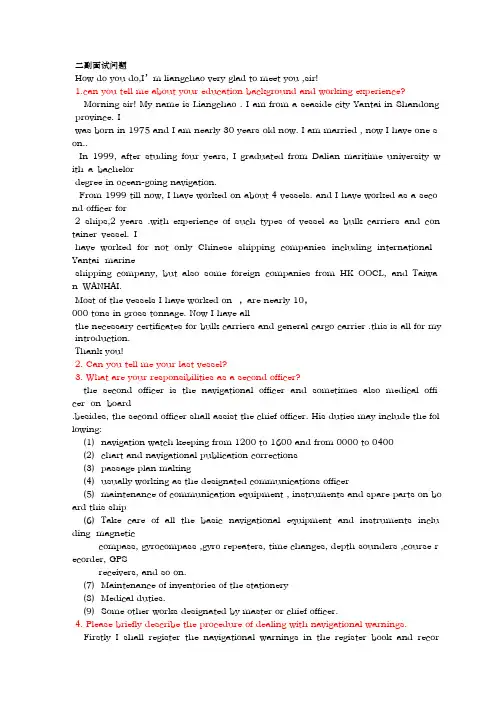
二副面试问题How do you do,I’m liangchao very glad to meet you ,sir!1.can you tell me about your education background and working experience?Morning sir! My name is Liangchao . I am from a seaside city Yantai in Shandong province. Iwas born in 1975 and I am nearly 30 years old now. I am married , now I have one s on..In1999,after studing four years,I graduated from Dalian maritime university w ith a bachelordegree in ocean-going navigation.From 1999 till now, I have worked on about 4 vessels. and I have worked as a seco nd officer for2ships,2years.with experience of such types of vessel as bulk carriers and con tainer vessel.Ihave worked for not only Chinese shipping companies including international Yantai marineshipping company,but also some foreign companies from HK OOCL,and Taiwa n WANHAI.Most of the vessels I have worked on,are nearly 10,000 tons in gross tonnage. Now I have allthe necessary certificates for bulk carriers and general cargo carrier .this is all for my introduction.Thank you!2.Can you tell me your last vessel?3.What are your responsibilities as a second officer?the second officer is the navigational officer and sometimes also medical offi cer on board.besides, the second officer shall assist the chief officer. His duties may include the fol lowing:(1)navigation watch keeping from 1200 to 1600 and from 0000 to 0400(2)chart and navigational publication corrections(3)passage plan making(4)usually working as the designated communications officer(5)maintenance of communication equipment , instruments and spare parts on bo ard this ship(6)Take care of all the basic navigational equipment and instruments inclu ding magneticcompass, gyrocompass ,gyro repeaters, time changes, depth sounders ,course r ecorder, GPSreceivers, and so on.(7)Maintenance of inventories of the stationery(8)Medical duties.(9)Some other works designated by master or chief officer.4.Please briefly describe the procedure of dealing with navigational warnings.Firstly I shall register the navigational warnings in the register book and record the warningnumber in the card.Secondly I shall select the charts that are affected by the warnings.Then I shall use pens,scissors and glues to fix permanent notice.I shall also use pencils to fix temporary andpreliminary notices. The charts are to be corrected according to all the concerned wa rnings. WhenI correct the chart ,I shall frequently consult the geographical index.5.can you describe the charts correction procedures?firstly, the second officer has to make sure that he has received the latest notice to m ariner and thathe has to write the notice request on time. The master shall make emergency reque st if the lastedis not received.Secondly,the second officer has to record the notice to mariner on the correctio n logs on timeaccording to the chronological order.Thirdly,when correcting the chart,he has to make sure that the last small corr ection has beenmade on the chart.Erasure should never be made when deleting information crossed through .instead , seryes of shortdouble strokes should be used while correction fluid should not be used.And allways insertinformation before you delete any information.6.Who should draft the passage plan on board?What are included in passage p lan?When youmake the passage plan,what information do you need?Usually,the passage plan should be prepared by the second officer and approved b y the master.during passage ,when an error or mistake is found about the passage plan, it should be report to themaster first and corrected afterwards by the second officer.but during voyage th e passage plancannot be changed without the master’s approval.The passage plan should include such information as way points,the distanc e between waypoints, courses, current, tide, weather conditions and means of communications, means of fixingposition and interval and so on.Besides,the following information and publications are necessary in making the passage plan:sailing directions, pilot book, port entry guidance, tide table, local area warning, war ning from theNAVAREA areas,list of light and radio signals,admiralty notice to mariner, sea chart andcatalogue of admiralty charts and other publications.7.What is the scope the passage plan cover?If you miss one or two big or small sc ale charts fornext voyage,can the ship give sea going or not?The passage plan should cover the sailing route from berth to ck of i nformation forsome areas may lead to some serious accidents. The ship cans not departure if one or two chartsare not available.8.if the signal of three red lights vertically aligned is found on board a shi p during nightvoyage,what do you think is wrong with the ship?If a motor ship is moving under the way,butnot under command,what kind of signals should she use?on what occasion do yo u display twoblack balls during the day?The vessel is constrained by her draught ,it is very hard for her to maneuver. Our vessel shouldgive a wide berth and take actions to keep away from her.The motor ship should use not-under-command lights,i.e.two red lights ver tically alignedduring night time,and two black balls vertically aligned during day time.We shall display two black balls when our vessel cannot get out the way for others.9.please describe how do you take care of the magnetic compass?The liquid magnetic compass should be regulary checked for air bubbles and it sho uld always becovered when it is not in use .the deviation of the compass should be checked and o bserved duringevery watch.10.how do you set and adjust gyro compass?The second officer should frequently check the gyrocompass’error.Actuall y,gyrocompassaccuracy should be checked at least once a day at sea and at anchor, and for each course steered.During the watch,the simultaneous check should be made at least hourly. If there is anysignificant deviation error,the second officer should report it to the master an d record in thecompass record book and deck logbook.The electronic devices should be kept a way from thecompass in a reasonable distance.The chief officer or other designated officers s hould test theerror in the morning or evening.11.what are your responsibilities as the second officer while the vessel is in port?My responsibilities are to keep good watch,to ensure the safety of life,the ship and t he cargo andto maintain good working orders on the vessel.During my watch I should be aware of the draft,under keel clearance,the s tate of ship,themoring conditions so as to avoid dangerous listing,trim or hull stress during car go operation.Ishould also make sure that de-ballasting causes no marine pollution. I should watc h and supervisethe loading process and report any incident or accident to the chief officer.12.please tell me the difference between the great circle line and rhomb line?In theory, the great circle line is the shortest distance between two places,while the rhomb line islonger than the great circle line .however ,it is very hard for a vessel just to take t he great circleline or rhomb line.13.during cargo loading,if you find cargo damages in holds,what should you do?I shall record them in writing or even photograph the damages and report the situation to thechief officer immediately.The chief officer should report it to the tallyman and ask them toreplace the cargo , if possible. At the same time, the officer on duty should make th e on-the-spotrecord.If the damages are really very serious, we should report to the master and ask for hi s instructions.14.when you usually do the chart work?When you are keeping watch,can you do the chart work?Whenever I receive the notice to mariner,I will do the correction and drawi ng as soon aspossible.Generally,I should not do the chart work when am keeping watch.Doing cha rt work duringwatch keeping can give rise to some potential danger to the maneuvering of the vesse l.15.what is the maximum blood alcohol concentration(BAC)rate on board? According to the STCW95Code,the maximum blood alcohol concentration shall not be morethan 0.08% by weight at any time when being tested. But the code of federal regula tions requiresthe blood alcohol concentration to be no more than 0.04%. watch keepers are not all owed to drinkany alcoholic beverage4hours before their watch.besides,when bunkerin g,loading andunloading, moring and unmoring,4 hours before and after port all, the sailor on boa rd cannot haveany alcoholic drinks.16.pls tell me your duties as the medical officer.I am responsible for maintaining the medical inventory. I should keep a good record of the use ofdifferent medicines and make sure that the aide bags are at proper locations.I should also becareful with the madicine locker. The expired medicines should be replaced on time . When someimportant medicines are out of stock, I should report to the master and make requisi tion for supply.17.when do you call the master to the bridge?In the following situations , according to the SMS manual, I will have to call the master to thebridge:(1)when the visibility is lower than the one mentioned in the master’s standing o rder.(2)Breakdown of the main engine , steering gear ,gyrocompass or any other critic al equipmentrelated to the safety of the vessel.(3)When the ship’s possition and sounding are unusual or strange(4)When the navigational marks or sounding do not appear as expected(5)When heavy weather is encountered(6)When the ship is behaving in an unusual way(7)When marine pollution is seen or suspected(8)When distress message is received or accident observed(9)Any other situation when the officer are in doubt(10)Whenever the ship is in danger18.when radar and arpar are in use,do they relieve your duty of lookout as a watch-keeperNo, these apparatuses do not relieve the watch officer of his duty to maintain a p roper lookoutat all times . this is very important to the maneuvering of the vessel . accidents ofte n arise becauseof the officers’complete dependence on the RADAR,ARPAR,GPS and othe r equipment,especially in hazardous areas, such as the coast and port areas,low visibility area,r estricted areasand heavy weather regions.All in all,the rules and regulation of the COLREG 1972must bestrictly obeyed.19.what do you know about EC and ECDIS?EC means electronic chart,and ECDIS means electronic chart and informatio n system..thissystem uses the computer technology to provide chart details on a visual display u nit, combinedwith an automatic indication of ship’s position,and possibly a radar image, and a navigationaide.this kind of chart needs basic computer operation skills and automation knowle dge.20.can you tell me the main contents of a typical admiralty notice to mariner?How did you get thenotice to mariner on your last vessel?The admiralty notice to mariner is a maritime publication issued by the hydrograp hic departmentof the unitec kingdom . they include admiralty notices, australian and new zealand notices. Theyare published on a weekly basis .there is also an annual summary version.The admiralty notice to mariner includes 6 sections . section one, explanatory note s and indexesto section two.section two,admiralty notices to mariners-corrections to charts. Section three,reprints of radio navigational warnings.section four,corrections to a dmiralty sailingderections.section five,corrections to admiralty list of lights and fog signals .section six,corrections to admiralty list of radio signals.On my last ship, the ship owner provided us with the notice to mariner in every major port .ifthey failed to give us the notice . we will send them a reqrest for this by e-mail. 21.it is very important to get rid of the outdated charts and other SMS documents on board.why?It is very important to keep the lasted revised charts also some other ISM documen ts on board inthe deck ang engine room . and keep away those out-of-dated charts because after a period of time,you will not be able to know what documents are the newest ones. The mixture of th e old and newdocuments on board can easily give rise to some problems for the safety of the vessel . so it is veryimportant to do away with the obsolete documents as soon as possible.22.how do you maintain the clocks?I am responsible for the vessel clocks expect for those in the engine room. Before gettingunderway , clocks shall be compared and synchronized , and the synchronization r ecord shall beentered into the deck logbook.23.under what situations do you call the engine room when you are on duty?(1)whenever it is necessary to make sure that engine room and bridge clocks are s ynchronized(2)at least one hour before starting or endding a sea passage(3)as soon as it appears that engine operation maneuvers may be required, with one hour’snotice if possible(4)whenever the ship machinery operation may be affected by weather or o ther conditionchanges,such as shallow water approach,concentration of marine life or s eaweed,ice inwater ,or change of trim or draft due to ballasting shifting.(5)One hour before inert gas system operation is required (for tanker)(6)One hour before steam is required on deck(7)Whenever the temperature fall to 2 degree centigrade to prevent damage to equi pment(8)At least one hour before the standby generator is required(9)Whenever the cargo pumps are used(10)One hour prior to getting underway24.what should you do first after you jion a vessel?Firstly, I shall familiarize myself with the familisrization booklet, the muster lists an d emergencycard in my cabin.Secondly , I shall report to the master and get familiar with other officers and crew on board thevessel .Thirdly , with accompaniment of the relieved second officer , I shall have an inspec tion of thoseitems he was responsible for . I shall discuss immediately with the master on any unsatisfactoryconditions, including equipment malfunctions. I shall also take over all the docume nts the secondofficer should take care of . a good handover with the relieved second officer is the m ost importantjob for me.25.when do you have to change from the automatic steering to manual steering? The steering mode should be changed from automatic to manual mode unde r the followingcircumstances:(1)in any emergency situation(2)in diminishing and restricted visibility, as defined by the master(3)when the ship’s steering in shallow water(4)when the master or duty officer think it is necessarywhen the steering mode is changed , the watch officers shall supervise the process.26.if ship collision happens when you are on duty,what procedure should you foll ow?I shall carry out the emergency checklistFirstly, I will sound the alarm for emergency. Secondly, I will inform the master i mmediately.Thirdly, I will inform the engine room and prepare engine standby; after ship colli sion , all thetanks should be sounded and the ship owner, manager should be informed of the accident. Theaccident report should also be sent to the all concerned parties and the coast coun try. And all theabove actions, ship’s position, times,etc . should be recorded properly.27.before the ship sails to a new port,if you do not have one or two necessary charts,whatshould you possibly do?If possible , I will ask for help from the master . if the master cannot help, I may ask for helpfrom the vessels sailing in the same area.Anyway I will try to solve the probl em before thevessel sails to the port.28.what is safety speed during sailing?What factors should you consider in decid ing the speedof a vessel during sailing in the sea?The safe speed is the speed at which the vessel can take proper and effectiv e actions to bestopped in a safe distance.The following factors should be taken into account to achieve safespeed : visibility,number of ships in the area, the ship’s maneuverability ,wind for ce, sea tide andcurrent,background lights,draught and available depth of water,proximity of navugationalhazards, standard and operation of technical equipment on board, ice condition and so on.29.when navigating in a crossing situation,as master or duty officer,wh at anti-collisionmeasures should be taken?When the vessels are proceed on head-on cond ition,what anti-collision rule should be observed?When a power-driven ship and sailing meet in the sea,whatanti-collision rule should be observed?When two power-driven ships are crossing,the ship which has the other sh ip on her ownstarboard side shall keep out of way. To do this ,this ship can either alter course to starboard sideor slow down her speed in order to avoid collision.When two power –driven ships are meeting head-on situation or near head-on situation , eachship shall alter course to starboard so that they can jpsaa on the port side of eac h other at a safedistance.When a ship sails at a higher speed overtakes another ship , the ship shall sails at higher speedor shall alter its course to avoid collision.A power-driven ship shall out of the way of a sailing ship,this can be done eithe r altering itscourse or speed up to avoid collision.30.you are the watch officer at anchor on an8000-tons ship which is about400f eet long,if theweather becomes foggy and foggy,what jprecautions should you take?I would station a man forward with orders to ring the ship’s bell rapidly for 5 seconds everyminutes and another man aft to sound the gong likewise. Ship’s whistle or siren would be readyfor use in case of necessity to give warning of my position to a vessel approaching. The signalsfor this warning shall be 3 blasts in succession31.when should a turnover(handover)of watch be deferred or postponed?Usually , under the following situations , the turnover can be deferred or even post poned:(1)if the officer on watch has reason to believe that the relieving officer is obviou sly not ableto carry out his duties effectively(2)when bridge maneuver is taking place, turnover of watch must be deferred u ntil the actionis completed and the ship is in a safe condition for the relief of the watch to ta ke place.32.under what conditions should you as officer on watch change the ship’s spee d?The officer on watch should not hesitate to use engine to reduce the speed for safety . someexamples are :(1)when the ship meets testricted visibility(2)when the ship is in heavy traffic area(3)when the ship is in a close quarter situation33.what actions should be taken when restricted visibility is encountered or expect ed?(1)call or notify the master(2) switch on the navigational lights (3) switch on a nd sound fogsignals (4) switch on ARPAR and RADAR (5) shift to manual steering for man euver (6)post additional lookout (7) inform and advise engine room for any emergency m aneuvers34.what precautionary measures are to be done12hours before arrival at or depa rture from anyport?I shall test the following before entering or getting underway:(1)primary and secondary steering gear(2)internal control communications and control alarm(3)standby and emergency generator(4)storage batteries for emergency lighting(5)main propulsion ahead and astern35.what should you do in case of steering failure?When there is a steering failure , I shall report to the master immediately, so tha t he may takewhatever actions are required . at the same time , provided no further incidents oc cur , hoist thesignals for a vessel not under command .at the same time , inform the engine room and diterminethetime necessary for repairs , if possible , so that the necessary preparations ca n be made onthe bridge.36.when is great circle sailing most advantageous?Pls explain briefly?the shortest distance between two meridians is the arc of the great circle contained between thesetwo points.the advantges of using the great circle sailing are most obvious in high latitudes,where there is a large difference of longitude between the points of departure and de stination.37.how do you do the chart work?The chart work must be so detailed that the master or relieving officer can easily an d quickly findout the ship’s last known position and from that they can determine its present position.detailedchart work includes course line,DR position marked with time and distance,ob served positionwith time and distance plus the position fixing method.Special notes like when the master should be informed and when to slow dow n.etc.are alsoneeded in some dangerous areas.38.if a man is overboard,what actions should you take immediately?I should throw him a lifebuoy and follow the emergency procedure.that is to s ay I should tosound the alarm, inform the master and the engine room ,make williamson turn an d keep constantlookout.39.what is confine water?what factor should you take into account when you make passage planin the confined waters?Confined waters means an area of the sea where the width of the safely navigable w aterway is notmore than about 2 miles, such as a strait , considering the draft of the vessel and w ater depth .For navigation in confined waters, I shall consider the following matters in planninga passage.(1)presence/absence of special navigational rules and items to report.(2)In formation on the sailing directions , coast pilot , and so on.(3)The draft of the vessel and the navigable area of the sea.(4)The effect of sinkage of the hull (squat) and keeping enough under keel clearan ce.(5)Tides , and a tidal current.(6)Weather conditions and counter-measures against restricted visibility.(7)Use of navigation aids to give a sign, and setting of parallel index (line for avoidi ng danger)(8)Passing time of danger points(daylight/night-time)(9)The degree of congested water-traffic,crowed area with fishing boats, and counter-measures for the above mentioned.(10)The vessel’s maneuvering ability.(11)Necessity/lack of necessity for adjustment of the vessel’s speed.40.what is ISM Code?How many chapters are there in ISM Code now?what is DOC and SMC?ISM means international management code for the safe operation of ships an d for pollutionprevention.it is made by the IMO.The ISM code includes 16 chapters falling into two parts: the part one is implement ation , the parttwo is verification and certification.The16chapters are:general,safety a nd environmentprotection policy,company responsibilities and authority,designated per son,master’sresponsibilities and authority,resources and personnel,development of plan s for shipboardoperation,emergency preparedness,reports and analysis of non-conformity, accidents andhazardous occurrences,maintenance of the ship and equipment,document ation,companyverification and periodical verification,verification,interim certification, and forms ofcercificates .the last four chapters are newly added in the new version of ISM Code. SMS means safety management system , and this system is made based on the 16 elements ofISM code,which is a compulsory part SOLAS74.the ship-owner or mana ger cannot getdocument of compliance (DOC) and SMC without audited safety management certif icate (SMC)by class designate by the flag registry country administration.41.in case of loss Array of bridge control,what immediateactions do you take?In case of the vessel fall into loss of bridge control result from troublein the main engine , steeringgear, etc. the officer on duty shall immediately takethe following measures:(1)stopping engine in case trouble of steering engine(2)alerting other vessels sailingnearby by means of lights for notunder command,whistle or VHF(3)reporting to the master /chief engineer(4)confirming the vessel position(5)estimating the drifting direction and speed.42.can you name some publications on board the ship?Thank you verymuch for your kindness in takingtime to interviewme ,I am realy very interestedin the jobs and your good company. I wish I couldmeet your satisfication, thank you sir!Expanation说明Gnomonic chart 大圆海图 macro circle chart1.can you tell me about your education background and working experience?2.can you tell me your last vessl ?3.what are your responsibilities as a second officer ?4.please briefly describe the procedure of dealing with navigational warnings.5.can you describe the charts correction procedures ?6.who should draft the passage plan on board?What are included in passage plan?When youmake the passage plan ,what information do you need?7.what is the scope the passage plan cover?if you miss one or two big or small scale charts fornext voyage, can the ship give sea going or not?8.if the signal of three red lights vertically aligned is found on board a sh ip during nightvoyage,what do you think is wrong with the ship? If a motor ship is moving under the way ,butnot under command ,what kind of signals should she use ?on what occasion do y ou display twoblack balls during the day?9.please describe how do you take care of the magnetic compass?10.how do you set and adjust gyrocompass?11.what are your responsibilities as the second officer while the vessel is in port?12.please tell me the difference between the great circle line and rhomb line?13.during cargo loading , if you find cargo damages in holds, what should you do?14.when you usually do the chart work? When you are keeping watch, can you do the chart work?15.what is the maximum blood alcohol concentration (BAC) rate on board?16.pls tell me your duties as the medical officer.17.when do you call the maste r to the bridge?18.when radar and arpar are in use, do they relieve your duty of lookout as a watch-keeper19.what do you know about EC and ECDIS?20.can you tell me the main contents of a typical admiralty notice to mariner? How did you get thenotice to mariner on your last vessel?21.it is very important to get rid of the outdated charts and other SMS documents o n board . why?22.how do you maintain the clocks?23.under what situations do you call the engine room when you are on duty?24.what should you do first after you jion a vessel?25.when do you have to change from the automatic steering to manual steering?26.if ship collision happens when you are on duty , what procedure should you follo w?27.before the ship sails to a new port , if you do not have one or two necessary chart s, what shouldyou possibly do?28.what is safety speed during sailing?What factors should you consider in deciding the speedof a vessel during sailing in the sea?29.when navigating in a crossing situation,as master or duty officer,wh at anti-collisionmeasures should be taken?When the vessels are proceed on head-on cond ition,what anti-collision rule should be observed? When a power-driven ship and sailing meet in the sea, whatanti-collision rule should be observed?30.you are the watch officer at anchor on an 8000-tons ship which is about 400 f eet long, if theweather becomes foggy and foggy , what jprecautions should you take?31.when should a turnover(handover) of watch be deferred or postponed?32.under what conditions should you as officer on watch change the ship’s speed?33.what actions should be taken when restricted visibility is encountered or expect ed?。
二副面试题参考

第三章二副面试问题及参考答案1. what are your responsibilities as a second officer?The second officer is the navigational officer and sometimes also medical officer on board. Besides, the second officer shall assist the chief officer. His duties may include the following:(1)navigation watch keeping (from 1200 to 1600, and from 0000 to 0400);(2)chart and navigational publication corrections;(3)passage plan making;(4)usually working as the designated munications officer;(5)maintenance of munication equipment, instruments and spare parts on board the ship;(6)care of all the basic navigation equipment and instruments, including magnetic passes,gyropasses, gyro repeaters, time changes, depth sounders and course recorder.(7)Maitenance of inventories of the stationery;(8)Medical duties, and other duties designated by the master or chief officer.(9)Some other work designated by master or chief officer.4. please briefly describle the procedure of dealing with navigational warnings.Firstly, I shall register the navigational warnings in the register book and record the warning number in the card. Secondly, I shall select the charts that are affected by the warnings. Then I shall use pens, scissors and glues to fix permanent notices. I shall also use pencils to fix temporary and preliminary notices. The charts are to be corrected according to all the concerned warnings. When I correct the chart, I shall frequently consult the geographical index.5. can you describe the charts correction procedure?Please refer to the same question for the master.Firstly, the second officer has to make sure that he has received the latest Notice to Mariner and that he has to write the notice request on time. The master shall make emergency request if the latest is not received.Secondly, the second officer has to record the notice to mariner on the correction logs on time according to the chronogical order.Thirdly, when correcting the chart, he has to make sure that the last small correction has been made on the chart.Erasure should never be made when deleting in formation crossed throuth. Instead, series of short double strokes should be used while correction fluid should not be used.Always insert information before you delete any information.6. who should draft the passage plan on board? What are included in passage plan? When you make the passage plan, what information do you need?Usually,the passage plan should be prepared by the second officer and approved by the master. During passage, when an error or mistake is found about the passage plan, it should be reported to the master first and corrected afterwards by the second officer. But during voyage the passage plan cannot be changed without the master’s approved.The passageplan should include such information as way points, the distance between way point, courses, current, tide, weather conditions and means of munications, means of fixing position and interval and so on.Besides, the following information and publications are necessary in making the passage plan: s ailing directions, pilot book, port entry guidance, tide table’s local area warning, warning fromthe NAVAREA areas, list of light and radio signals, admiralty notice to mariner, sea chart and catalogue of admiralty charts and other publications.7.what is the scope the passage plan cover? If you miss one ore two big or small scale charts for next voyage, can the ship give sea going or not?The passage plan should cover the sailing route from berth to berth. Lack of information for some areas may lead to some serious accidents.The ship cannot go if one or two charts are not available.8. if the signal of “three red lights vertically aligned〞is found on board a ship during night voyage, what do you think is wrong with the ship? If a motor ship is mpving under the way, but not under mand, what kind of signals shoud she use? On what occasion do you display two black balls during the day?The vessel is constrained by her draught. It is very hard for her to maneuver. Our vessel should give a wide and take actions to keep away from her.The motor ship should use not-under-control lights, i.e., two red lights vertically aligned during night time, and two black balls vertically aligned during day time.We shall display two black balls when our vessel cannot get out the way of another.9. please describle how you take care of the magnetic pass.The liquid magnetic pass should be regularly checked for air bubbles and it shoud always be covered when it is not in use. The deviation of the pass should be checked and observed during every watch.10. how to you set and adjust gyropass?The second officer should frequently check the gyropass, error. Actually, gyropass accuracy should be checked at least once a day at sea and at anchor, and for each course steered. During the watch, the simultaneous check should be made at least hourly. If there is any significant deviation error, the second officer should report it to the master and record in the pass record book and deck logbook. The electronic devices should be kept away from the passes in a reasonable distance.The chief officer or other designated officers should test the error in the morning and evening.11.what are your responsibilities as the second officer while the vessel is in port?My responsibilities are to keep good watch, to ensure the safety of life, the ship and the cargo and to maintain good wooking orders on the vessel.During my watch I should be aware of the draft, under keel clearance, the state of ship, the mooring conditions so as to avoid dangerous listing, trim or hull stress during cargo operation. I should also make sure that de-ballasting causes no marine pollution. I should watch and supervise the loading process and report any incident or accident to the chief officer.12. please tell me the difference between the great circle line and rhomb line?In theory, the great circle line is the shortest distance between two places, while the rhomb line is longer than the great circle line. However, it is very hard for a vessel just to take the circle line or rhomb line.13. during cargo loading, if you find cargo damages in holds, what should you do?I should record them in writing or even photograph the damages and report the situations to the chiefofficer immediately. The chief officer should report it to the tallyman and ask them to replace the cargo, if possible. At the same time, the officer on duty should make the on-the-spot record.If the damages are realy very serous, we should report to the master and ask for his instructions.14. when you usually do the chart work? When you are keeping watch, can you do the chart work? Whenever I receive the notice to mariner, I will do the correction and drawing as soon as possible.Generally, I should not do the chart work when am keeping watch. Doing chart work during watch keeping can give rise to some potential danger to the maneuvering of the vessel. 15. what is the maximum blood alcohol concentraition (BAC) rate on board?According to the STCW code, the BAC shall not be more than 0.08% by weight at any time when being tested. Watch-keepers are not allowed to drink any alcoholic beverage 4 hours before their watch. Besides, when bunkering, loading and unloading, mooring and unmooring, 4 hours before and after port all, the sailor on board cannot have any alcoholic before and after port all, the sailor on board cannot have any alcoholic drinks.16. please tell me your duties as the medical officer.I am responsible for maintaining the medical inventory. I should keep a good record of the use ofdifferent medicines and make sure that the aide are at proper locations. I should also be careful with the medicine locker. The expired medicines should be replaced on time. When some important medicines are out of stock, I should report to the master and make requisition for supply.17. when do you call the master to the bridge?In the following situations, according to the SMS manual, I will have to call the master to the bridge:(1)when the visibility is lower than the one mentioned in the master,s standing order;(2)breakdown of the main engine, steering gear, gyro-pass or any other critical equipmentrelated to the safety of the vessel;(3)when the ship,s position and sounding are unusual or strange;(4)when the navigational marks or sounding do not appear as expected;(5)when heavy weather is encountered;(6)whenthe ship is behaving in an unusual way;(7)when marine pollution is seen or suspected;(8)when distress message is received or accident observed;(9)any other situation when the officers are in observed;(10)whenever the ship is in danger;18.when RADAR and ARPAR are in use, do they relieve your duty of lookout as a watch-keeper? No, these apparatuses do not relieve the watch officer of his duty to maintain a proper lookout at all times. This is very important to the manuvering of the vessel. Accidents often arise because of the officers’ ple te dependence on the RADAR,ARPAR, GPS and other equipment, especially in hazardous areas, such as the coast and port areas, low visibility area, restricted areas and heavy weather regions. All in all, the rules and regulation of the COLREG 1972 must be strictly obeyed.19. what do you know about EC and ECDIS ?EC means electrionic chart, and ECDIS means electronic chart and information system.This system usees the puter technology to provide chart details on a visual display unit, bined with an aut omatic indication of ship’s position, and possibly a radar image, and a navigation aide. This kind of chart needs basic puter operation skills and automation knowledge.20. can you tell me the main contents of a typical admiralty notice to mariner? How did you get thenotice to mariner on your last vessel?The admiralty notice to mariners is a maritime publication issued by the hydrographicdepartment of the united kingdom. They include admiralty nitices, Australian and new Zealand notices. They are published on a weekly basis. There is also an annual summary version.The admiralty noyice to mariner includes 6 sections. Section one, explanatory notes and indexes to section two. Admiralty notices to mariners-corrections to charts. Section three, reprints of radio navigational warnings. Section four, corrections to admiralty sailing directions.Section five, corrections to admiralty list of radio signals.On my last ship, the ship owner provided us with the notice to mariners in every major port. If they failed to give us the notice, we’ll send them a request for this.21.it is very important to get rid of the outated charts and other SMS documents on board. Why?It is very important to keep the latest revised charts(also some other ISM documents on board)in the deck and engine room, and keep away those out – of – dated charts because after a period of time, you will not be able to know what documents are the newest ones. The mixture of the old and new documents on board can easily give rise to some problems for the safety of he vessel.So it is very important to do away with the obsoletedocuments as soon as possible.22.how do you maintain the clocks?I am responsible for the vessel clocks except for those in the engine room. Before getting underway,clocks shall be pared and synchronized, and the synchronization record shall be entered into the deck logbook.23.under what situations do you call the engine room when you are on duty?(1)whenever it is necessary to make sure that engine room and bridge clocks are synchronized;(2)at least one hour before starting or ending a sea passage;(3)as soon as it appears that engine operation maneuvers may be required, with one hour’snotice if possible;(4)whenever the ship machinery operation may be affected by weather or other conditionchanges, such as shallow water approach, concentration of marine lifeor seaweed, ice in water, or change of trim or draft due to ballasting shifting;(5)one hour before inert gas system operation is required (for tanker);(6)one hour before steam is required on deck;(7)whenever the temperature falls to 2 degree centigrade to provent damage to equipment;(8)at least one hour before the standby generator is required;(9)whenever the gargo pumps are used;(10)one hour prior to getting underway.24.what should you do first after you join a vessel?Firstly, I shall familiarize myself with the familiarization booklet, the must lists and emergency card in my cabin. Second, I shall report to the master and get familiar with other officers and crew on board the vessel. Third, with acpaniment of the relieved second officer, I shall discuss immediately with the master on any unsatisfactions, including equipment malfunctions. I shall also take over all the documents the second officer should take care of. A good handover with the relieved second officer is the most important thing for me.25.when do you have to change from the automatic steering to manual steering?The steering mode should be change from automatic to manual mode under the following circumstances: (1) in any emergency situations; (2) in diminishing and restricted visibility, as defined by the master; (3) when the ship’s steering in shallow water; (4) when the master thinks necessary.When the steering mode is changed, the watch officers shall supervise the process.26.if ship collision happens when you are on duty, what procedure should you follow?I should follow the emergency checklist.Firstly, I will sound the alarm for emergency;Secondly, I will inform the master immediately;Thirdly, I will inform the engine room and propare engine standby;After ship collision, all the tanks should be sound be and the ship owner, manager should be informed of the accident. The accident report should also be sent to the all concerned parties and the coast country. And all the above actions, ship’s position, times, etc. should be recorded properly.27.before the ship sails to a new port, if you do not have one or two necessary charts, what shouldyou possibly do?If possible, I will ask for help from the master. If the master cannot help, I may ask for help from the vessels sailing in the same area. Anyway, I will try to solve the problem before the vessel sails to the port.28.what is safety speed during sailing? What factors should you consider in deciding the speed of avessel during sailing in the sea?The safe speed is the speed at which the vessel can take proper and effective actions to be stopped in a safe distance. The following factors should be taken into account to achieve safe speed: visibility, number of ships in the area, the ship’s maneuverability, wind force, sea tide and and current, background lights, draught and available depth of water, proximity of navigational hadards, standart and operation of technical equipment on board, ice conditon and so on.29.when navigation in a crossing situation, as master or duty officer, what anti-collision measuresshould be taken? When the vessels are proceed on head-on condition, what anti-collision rule should be observed? When a power-driven ship and sailing meet in the sea, what anti-collision rule should be observed?When to power-driven ships are crossing, the ship which has the other ship on her own starboard side shall keep out of way. To do this, this ship can either alter course to starboard side or slow down her speed in order to avoid collision.When to power-driven ships are meeting head-on situation or near head-on situation, each ship shall alter course to starboard so that they can pass on the port siode of each other at a safe distance.When a ship sails at a higher speed overtakes another ship, the ship shall sails at higher speed or shall alter its course to avoid collision.A power-driven ship shall keep out of the way of a sailing ship. This can be done eitheraltering its course or speed up to avoid collision.30.you are the watch officer at another on an 8000-ton ship which is about 400 feet long. If theweather bees foggy and foggy, what precautions should you take?I should station a man forward with orders to r ing the ship’s bell rapidly for about 5 secondsevery minutes and another man aft to sound the gong likewise. Ship’s whistle or siren would be ready for use in case of necessity to give warning of my position to a veseel approaching. The signals for this warning shall be 3 blasts in succession.31.when should a turnover(handover)of watch be deferred or postpond?Usually, under the following situations, the turnover can be deferred or even postond: (1) if the officer on watch has reasion to believe that the relieving officer is obiously not able to carry out his duties effectively; (2) when bridge maneuver us taking place, turnover of watch must be defeered until the action is pleted and the ship is in a safe condition for the relief of the watch to take place.32.under what conditions should you as officer on watch change the ship’s speed?Refer to the questions and reference answers for the chief officer.33.what actions should be taken when restricted visibility is encountered or expected?(1) call or notify the master; (2)switch on the navigational lights;(3) switch on and sound fog signal; (4)switch on ARPA and rdar; (5) shift to manual steering for maneuver; (6) post additional lookout;(7) inform and advise engine room for any emergency maneuvers.34.what precautionary measures are to be done 12 hours before arrival at or departure from anyport?I shall test the following before entering or getting underway: (1) primary and secondary steering gear;(2) internal control munications and control alarm; (3) standby and emergency generator; (4)storage batteries for emergency lighting; (5) main propulsion ahead and astern.35.what should you do in case of steering failure?When there is a steering failure, I shall report to the master immediately, so that be may take whatever actions are required. At the same time, provide no further incidents occur, hoist the signals for a vessel not under mand. At the same time, inform the engine room and determine the time necessary for repairs, if possible, so that the necessary preparations can be made on the bridge.36.when is great circle sailing most advantageous? Please explain briefly.Thye shortest distance between two meridians is the arc of the great circle contained between these two poits. The advantages of using the great circle sailing are most obvious in high latitudes, where there is a large difference of longitude between the points of departure and destination. 37.how do you do the chart work?The chart work must be so detailed that the master or relieving officer can easily and quikly find out the ship’s last known position and from that they can determine its present position. Detailed chart work includes course line, DR position marked with time and distance, observed position with time and distance plus the position fixing method.Special notes like when the master should be informed and when to slow down, etc. are also needed in some dangerous areas.38.if a man is overboard, what actions should you take immediately?I should throw him a lifebuoy and follow the emergency procedure. That is to say, I should sound thealarm, inform the master and the engine room, make the Williamson turn and keep constant lookout.39.what is confine waters? What factor should you take into account when you make passage plan inthe confined waters?Confined waters means an area of the sea where the width of the safely navigable waterway is not more than about 2 miles, such as a strait, considering the draft of the vessel and water depth.For navigation in confined waters, I shall consider the following maters in planning a passage:(1)presence/absence of special navigational rules and items to report.(2)Information on the sailing directions, coast pilot, and so on.(3)The draft of the vessel and the navigable of the sea.(4)The effect of sinkage of the hull (squat) and keeping enough under keel clearance.(5)Tides, and a tidal current.(6)Weather conditions and counter-measures against restricted visibility.(7)Use of navigation aids to give a sign, and setting of parallel index (line for avoiding danger).(8)Passing time of danger points (daylight/night-time)?(9)The degree of congested water-traffic, crowded area with fishing boats, andcounter-measures for the above mentioned.(10)The vessel’s maneuvering ability.(11)Necessary/lack of necessity for adjustment of the vessel’s speed.40.what is safety speed during sailing? What factors should you consider in deciding the speed of avessel during sailing in the sea?The safe speed is the speed at which the vessel can take proper and effective actions to be stopped ina safe distance. The following factors should be taken into account to achieve safe speed:visibility, number of ships in the area, the ship’s maneuverability, wind force, sea tide and current, background lights, draught and available depth of water, proximity of navigational hazards, standard and operation of technical equipment on board, ice condition and so on. 41.when navigating in a crossing situation, as master or duty officer, what anti-cillision measuresshould be taken? When the vessels are proceed on head-on condition, what anti-collision rule should be observed? When a power-driven ship and sailing meet in the sea, what anti-cillision rule should be observed?When two power-driven ships are crossing, the ship which has the other ship on own starboard side shall keep out of way. To do this, this ship can either alter course to starboard side or slow down her speed in order to avoid colloision.When two power-driven ships are meeting head-on situation or near head-on situation, each ship shall alter course to starboard so that they can pass on the port side of each other at a safe distance.When a ship sails at a higher alter its course to avoid collision.A power-driven ship shall keep out of the way of a sailing ship. This can be done eitheraltering its course or speed up to avoid collision.42.what is ISM code? How many chapters are there in ISM code now? what is DOC and SMC ?ISM means international management code for the safe operation of ships and for pollution prevention. It is made by the IMO.The ISM code (as amended) includes 16 chapters falling into two parts: implementation (part one ), and verification and certifiction (part two). The 16 chapters are: general, safety and environment protection policy, pany res ponsibilities and authority, designated person(s), master’s responsibilities and authorirty, resources and personel, development of plans for shipboard operation, emergency preparedness, reports and analysis of non-conformity, accidents and hazardous occurrences, mantenance of the ship and equipment, documentation, pany verification, review and evaluation, certification and verification, and forms of certificates. The last four chapters are newly added in the new version of ISM code.SMS means safety management system, and this system is made based on the 16 elements of ISM code, which is a pulsory part SOLAS74. the ship-owner or mangaer cannot get document of pliance (DOC) and SMC without audited safety management certificate (SMC) BYCLASS DESIGNATED BY THE FLAG REGISTRY ADMINISTRATION.43.in case of loss of bridge control, what immediate actions do you take?In case of the vessel fall into of bridge control result from trouble in the main engine, steering gear, etc., the officer of the watch shall immediately take the following measures:Stopping engine (in case trouble of steering engine);Alerting other vessels sailing nearly;(by me ans of lights for “not under mand〞, whistle or VHF);reporting to the master (chief engineer);confirming the vessel position;estimating the drifting direction and speed.44.can you name some publications on board the ship?。
三副
三副面试问题及参考答案1. Can you tell me about your educational background and working experience as a seaman?For example: I graduated from Dalian Maritime University in July 1999. Since April, 1999, I began my seamen career. I have worked on two ships. On the fist ship, I worked as a deck cadet for 10 months. On the second ship, I worked as a 3/0 for nearly a year.2. Can you tell me about your last vessel?My last ship was a general cargo sailing globally, but mainly from European ports to theUS and Canada port. I worked on that vessel for 13 months as third officer.3. What are your responsibilities as a Third Officer?(1)To perform sea watches and cargo watch, from 0800-1200 and 2000-2400 hours;(2) To assist the Chief Officer in supervising cargo handling operation(3) To measure the draft at the discretion of the Chief Officer or the Master;(4) To assist the Master on the bridge with anchoring and mooring and unmooring operation isunderway;(5) To inspect communication systems and important items related to the navigational systemand other department before leaving port or shifting anchorage;(6) To maintain the life-saving appliances and fire fighting equipment and make records in themaintenance log and inventory book;(7) To do some paper work and other jobs assigned by the Master4. When do you call the Master to the Bridge?If the master were not in the bridge room, according to some rules and my experience, Iwould call the master to the bridge under the following circumstances:When I do not know the correct actions to take;When the giving away vessel does not give away as a rule and cannot get into contactwith it;When navigational equipment fails to respond;When receiving the distress call;When navigational marks are missing or in the expected time, and did not see the marks;When the depth sounding do not have expected result;When entry into heavy traffic, low visibility areas;When main engine speed decreases or breakdown;When approaching the poor visibility areas;And when the vessel is in danger and I am not sure how to react.5. Who is responsible for the LSA and FFE equipment on board a ship?LSA means Life Saving Apparatus; FFE means Fire Fighting Equipment. The ThirdOfficer is responsible for the maintenance of all these apparatus. The maintenance records should be logged.6. How often and what do you inspect the lifeboats?Usually I inspect and test the important parts of the lifeboat on a weekly basis. Mychecking points include attachment to the hull, life-line, handrail, the condition of rudder, fuel oil tanks, fresh water, food and so on. After checking, I make records in the maintenance book and log book.7. What actions should you take while you find fire in the cabin?I should sound the fire alarm first, and then inform the bridge, the engine room and theMaster immediately. And I will use the portable fire extinguisher to put out the fire the soonest possible if the fire is not that serious. At the same time, I shall watch the fire carefully and wait for the fire-fighting team assistance. When the fire fighting team is in their respective position,I will come to my position on the Fire Muster List.8. What do you know about the ISM code? What are DOC and SMC?For answer to the first question, please refer to the Questions and Reference Answers for the Master.DOC means Document of Compliance. It is issued to a shipping company by a classification society or a maritime administration. SMC means Safety ManagementCertificate. It is issued to a ship by a classification society or a maritime administration.9. Why must you check the compass error between the gyro and magnetic during the watch?The duty officer should check the difference between the two compasses at least everyhour. If significant error between magnetic and gyro-compass is found, compasses must be adjusted and corrected immediately. If there the gyro-compass breaks down, I shallimmediately report it to the Master.10. How do you check the ship’s position when you keep the anchor watch and which way is thebest?I can use three ways i.e. Radar fixing, GPS fixing, landmark fixing to get the vessel’sposition and define the anchor position. But I think the best way is radar fixing because it is more precise and reliable. For the sake of safety, instead of using only one means, all the other ways available should be used. At the same time, lockout is still very important.11. What preparations should you make in anticipation of the PSC inspection on board the ship?I should check very carefully the FFE and LSA to make sure they function well. I shouldalso make sure that all the logs and records of the FFE and LSA and the drills are available for inspection.12. How do you check the CO2 System?The CO2 system is the fixed fire fighting system. I do the checks according to the checklist.First, the date of last service, CO2 pipelines and bottles should be checked. The air blow test should be carried out to make sure that the system works well enough. Certificates also need to be checked to make sure they are up-to-date. The weight of the CO2 in the bottles should be tested at regular interval.13. During cargo watch, what should the Third Officer on duty do?According to the cargo stowage plan, the Third Officer must ensure the safety of thepersonnel, the cargo and the ship. He should watch and supervise the loading operation and cargo stowing, and report the accident and abnormalities, if any, to the Chief Officer. The Third Officer should keep watch on the weather, the mooring conditions, sea and vicinity con dition, and check the draft regularly. All records should be made in the logbook.14. What is the maximum blood alcohol concentration (BAC) rate on board?According to some rules and regulations, the BAC shall not be more than 0.04% by weight of the blood any time when being tested. But watch-keepers are not allowed to drink any alcoholic beverage 4 hours before their watch. Anyway, I shall refer to the SMS manual of the company to get some more detailed regulation in this regard.15. When RADAR, ARPAR and other positioning systems are in use, does the use of theseapparatus relieve your duty of look-out as a watch-keeper?No, the working of these apparatus does not relieve the watch officer of his duty tomaintain a proper look-out at all time. You can not depend on the machines too much. Lock out(deck watch) is always very important, especially in some passages, inside the port and in some dangerous sailing areas. Delayed actions will possibly give rise to big accidents. 16. When the vessel departs the port, what preparation shall the Master do?(1) He shall make various principal calculations such as the ride, current and the time ofsun-rise and sun-set that are necessary for securing safety during port entry or departure.(2) Check to see that the disembarkation of the visitors and the embarkation or disembarkations of supernumeraries in accordance with the safety management records. (3) Check to see tha t the deck crew are on board. (4) Prepare and check signal flags, make sure that the Port Clearance and other formalities are well prepared. (5) make sure that the pilotage and tug service are prepared.17. How often do you check and correct the chronometer(天文钟)?I shall check and correct it on daily basis. The record of each correction shall be put intothe record book. Besides, the chronometer shall be sent ashore for cleaning during eachshipyard repair period.18. When working on the bridge, when do you call the engine room for information?(1) Whenever necessary to ascertain that engine room and bridge clocks are synchronized;(2) At least one hour before starting or ending a sea passage;(3) As soon as it appears that engine operation maneuvers may be required, with onehour's notice if possible;(4) Whenever the ship machinery operation may be affected by weather or other conditionchanges, such as shallow water approach, concentration of marine life or seaweed, ice in water, or change of trim or draft due to ballasting shifting;(5) One hour before inert gas system operation is required (for tanker);(6) One hour before steam is required on deck;(7) Whenever the temperature falls to 2 degree centigrade to prevent damage to equipment;(8) At least one hour before the standby generator is required;(9) As soon as an excessive some is to be turned;(10) Whenever the cargo pumps are used;(11) One hour prior to getting underway.19. When you join a vessel, what should you do first?First, I shall report to the master and familiarize myself with the Emergency Card in the cabin and the Muster Lists, and the crewmen including the master and other officers and seamen on board the vessel. Second, with accompaniment of the relieved the 3/O, I shall have an inspection of those items the 3/Ois responsible for. I shall discuss immediately with the master on any unsatisfactory conditions, including equipment malfunctions. I shall also take over all the documents the 2/O shall take care of. Lastly, I shall prepare for getting under way. I shall test the draft of the vessel and report the result to the C/O.A good handover with the relieved 3/O is the very important thing for me.20. Please tell some parts of a lifeboat in English.For instance, manrope, oars, ration, securing gears, launch tracks, slip gear, sea anchor,sea plug davit, roll, harbor pin, canvas roof, fresh water fishing gear, medicine, axe,provisions, sail makers lather palm, sail makers needle, grommet, serving boards, serving mal lets, round mallets, wood hand fids, hatch wedge, rat guards, lifejackets, lifejacket lights, life buoys, thermal protector, radar reflector, bailer, hatchets, sponges, lifeboat oil lamps, inflatable life jacket, immersion suit, matches, life-saving signal, survival manual, waterproof electrictorch, boathooks, and so on.以上词汇供参考,并不是要求大家把所有的词汇都能记下来。
三副面试问题
三副面试问题1. Please briefly introduce yourself to us/ Or tell us something about yourself.For example:Morning sir! My name is xxx . I am from xxx. I was born in (年份) and I am nearly (岁)years old now. I am married , now I have one son..In 1999, after studing four years, I graduated from xx university with a bachelor degree in ocean-going navigation.From 1999 till now, I have worked on about 4 vessels. and I have worked as a third officer for 1 ships,1 years .with experience of such types of vessel as bulk carriers and ….I have worked for not only Chinese shipping companies including international Yantai marine shipping company, but also some foreign companies from HK OOCL, and Taiwan WANHAI. Most of the vessels I have worked on ,are nearly 10,000 tons in gross tonnage.Now I have all the necessary certificates for bulk carriers and general cargo carrier .this is all for my introduction. Thank you!2. Please tell me what major you had in the marineuniversity/college/school?The main is The type for navigation3. What courses (subjects) have you learned during your studies there?Which courses do you like most? Why?4. Do you think that sailing is a very ideal job for you? Could your brother follow yourstep?Yes, I think the sailing is a very ideal job for me.For example:1. I can understand the local conditions and customs of the most countries.2. The salary for ship’s officer is higher.3. ……5. If Capt(CE) scold you? Will you fight back? Why?No. Because I know if they scold me, it mu st be that I didn’t do well my work.6. Do you have hobbies? What hobbies do you like best, why?7. Which country do you like best?8. what do you think is most important thing on-board ship? Second? Third? (safety) 9. If you work on board for one year, will you be very home sick? Do you get a seasick? 10. Please name some types of vessels in the world. What types ship do you like to join?11. Do your teachers talk English? Do they use English to have lesson? 12. What food do you like?13. What will you do in your spare / free time? What kind of leisure activities do you do? 14. If you are asked to do a lot of jobs on board, will you have some complaint? 15. As far as you know, what equipmentsare there in the bridge/ deck/ engine department? What positions are there on board?16.pls briefly introduce your obligation for third officer?17. Tell me the whole name of the following anonyms: IMO, STCW78/ 95, SOLA74, ARPA, RADAR, GMDSS, MARPOL 73/ 78, IOPP, GPS, ISM.18. Can you use English computer? Can you rend / write / listen English? How long haveyou learnt English?19.Why are you elder with third officer?20. How many kinds of Alarm do you know?21.Pls briefly introduce how to contact with the PortControl/VTS/Pilot Station., 22. What is the purpose of the ISM Code? What is DPA in ISM Code? ISM 规则的目的是什么,ISM规则中DPA是什么意思,, The purpose of this Code is to provide an international standardfor the safemanagement and operation of ship’s of ships and for pollution prevention. DPAstands for Designated person(s) Ashore. His responsibility includes monitoringsafety, pollution prevention aspects on behalf of the shipowner., ISM 规则的目的是提供针对船舶安全管理和操作以及防污染的一个国际标准。
GBLT interview三副英语面试材料
GBLT ship management CompanyKey Points for interviewing --------------------------- BY CAPT. LEITAO1. Instruction by yourself.My name is ****. I graduated from Jimei University of Chengyi college and my major is Navigation( Engine management). During the school years, I have passed the CET 4 and the Computer Grade Test Band Ⅱin Fujian Province. With an optimistic and outgoing character, I believe that I could be a cadet in your good company. So I hope you can give me thisopportunity. Thank you!2.Personality . optimistic乐观independent独立的out-going外向的active 活泼的disciplined 守纪律的able 有才干的,能干的;cooperative 有合作精神的;adaptable 适应性强的active 主动的,活跃的;aggressive 有进取心的ambitious 有雄心壮志的;amicable 友好的;faithful 守信的,忠诚的frank 直率的,真诚的;generous 宽宏大量的industrious 勤奋的steady 踏实的;realistic 实事求是的;easy-going 随和的 ; introvert 内向的.3. What’s your hobby (interest) in your leisure time (spare time)?e.g. playing football; hiking; take part in social activity; take part time job;study English; watch video; surfing on internet; etc.4. What course did you like mostly?College English; maritime English; maritime law; seamanship; navigation;cargo operation; stability; ship management; Main Engine; shipautomation; Auxiliary Engine; ship Electricity;5.how did you handle your challenge in your college life? Please specify one example.6.Do you have your plan in your future career?7. How did you know our company?8. Do you know anything about chemical tanker and gas carrier?9. Why did you wish to join our company? What is your strongest traits and greatest weakness?10. how about the team work onboard a ship? Give a example to specify the importance of “team work”.11. How can be a good seaman? Hardworking; obedience; learning and thinking; cooperating; helpful;General question:1. Please briefly introduce yourself (as a deck / engine cadet) to us. Or tell us something about yourself.2. Please tell me what major you had in the marine university/college/school?3. What courses (subjects) have you learned during your studies there? Which courses do you like most? Why?4. Why do you want to be a sailor? Are you willing work hard? How long do you want to be a sailor? Do you have any friend as a seaman? What do you know about seaman’s life?5. What other plans do you have for the coming 5 or 6 years?6. Do you think that sailing is a very ideal job for you? Could your brother follow your step?7. If Capt(CE) scold you? Will you fight back? Why?8. Have you got a girlfriend? If you have, will you miss your girlfriendwhen you work on board for a whole year?9. When do you want to get married?10. Do you have hobbies? What hobbies do you like best, why?11. Which country do you like best?12. what do you think is most important thing on-board ship? Second? Third? (safety)13. If you work on board for one year, will you be very home sick? Do you get a seasick?14. Please name some types of vessels in the world. What types ship do you like to join? Do you know Tanker? How much do you know Tanker?15. Do you teachers talk English? Do they use English to have lesson?16. If you have a leave, how long do you want to stay home?17. What food do you like? There no Chinese foods in board, how do you feel?18. What will you do in your spare / free time? What kind of leisure activilies do you do?19. If you are asked to do a lot of jobs on board, will you have some complaint?20. In your opinion, how can you get along well with other in the work team?21. Do you know our company? How do you know? What do you know?22. How many departments are there in a vessel, and what are they?23. As far as you know, what equipments are there in the bridge/ deck/ engine department? What positions are there on board?24. Tell me the whole name of the following anonyms: IMO, STCW78/ 95, SOLA74, ARPA, RADAR, GMDSS, MARPOL 73/ 78, IOPP, GPS, ISM.25. Have you ever worked on board the training vessel, and with whom did you work together on board the training vessel? How many people were there in your ship? What did you do there?26. Can you use English computer? Can you rend / write / listen English? How long have you learnt English?27. Why are you elder than your classmate? How do you think of your classmate?28.What is lifejacket? Lifeboat?29. Can you tell me where is bridge? Bow? Astern? Middle?30.How many kinds of Alarm do you know?31.What skills do you offer,that are most relevant in this job? / What skills would you like to develop in this job?32.What motivates you to do this job? /What interest you most about this job? What interests you less?Question for engine cadet:1. Why do you select to be engineer then not be officer? How many years do you plan to be Chief engineer?2. What is main engine? What are subsidiary engines? Tell me the name of some auxiliary engines.3. Tell me how the fresh water is produced through the fresh water generator?4. If you work as a 3rd engineer, what are your duty hours?5. What are the rough differences between the diesel oil and fuel oil?6. Tell me how about oily water separator and how to treat bilge water.7. Do you know Tanker? How much do you know Tanker? any different in engine room?Question for deck cadet:1. If you work as a 3rd officer, what is your duty hours every day?2. Please name some types of vessels in the world. What types ship do you like to join?3. Tell us some very important canals/ straits in the world.4. How do you get the weather information on board vessel?5. what is windless?6.Do you know what is latitude and longitude?7. What do you call 0℃?8.what do you learn in navigation?9. what is chat? Why do we use chat?10. what is radar?11.what is GMDSS? DCS? VHF?12. Do you know navigation light? Tell me about it. Which side is red? Which side is yellow? Could you tell me something about light or flag signal?13. Do you know navigation log? What is recorded in it?1. Duties of Cadet (deck and Engine).●Perform assigned duties under the supervision of supervisor.●Undergo training as per company training program and complete alltraining module within his contract.2. What is the responsibility of third officer?●To perform sea watch and cargo operation watch from 0800-1200and 2000-2400.●To maintain the GMDSS system and record in GMDSS logbook.●To maintain LSA and FFE as per maintainence plan.●To assist Master during entering or leaving port and other jobinstructed by Master and C/O.3.What is the responsibility of fourth engineer?●To perform sea watch from 0800-1200 and 2000-2400●To be in charge of deck machines, windlass, deck crane andincinerator ,OWS.●To be in charge of boiler and other pumps.●To be in charge of bilge and sludge oil.4. Convention and rules:●SOLAS●STCW78/95●ISM●MARPOL●ISPS。
二副业务面试
二副业务此前上船之前除履约培训之外,确实接受过哪些方面的培训?答:每次上船工作之前都由船队指导船长对我进行技能职责以及安全等方面的培训,除此之外还参加过公司组织的知识更新的课程,主要学习关于油船化学品方面的知识更新以及安全操作方面的内容,休假期间还接受过船队组织的业务知识学习的培训,主要针对三副二副的业务,操作,职责,安全等方面的学习和知识更新。
2、简述一下STCW公约中二副的职责,为哪一级别?答:在STCW公约中二副为操作级,二副的主要职责是在船长、大副的领导下履行规定的船舶航行值班职责,根据船长指令拟定航行计划并报告船长审批,并主管助航设备;装卸期间接大副的布置管理货物装卸;进出港口、靠离移泊时,在船尾按船长的指示指挥工作,并将现场情况和周围环境及时报告船长;另外负责管理驾驶台、海图室和所管库室的物品,张贴驾驶台规则、驾驶台与机舱联系制度及主要说明等;负责管理海图、航海书籍、航海参考资料、各种航行记录簿等,并及时登记改正;负责按要求填报航次报表;负责编制分管设备的维护保养计划。
负责分管设备的日常检查保养和检测;负责向新到任的驾驶人员介绍仪器设备的性能、误差以及正确的操作方法和注意事项;负责向大副提出分管设备、仪器的修理、更新、配置等申请,外来人员上船修理时应陪同并协助,并做好监修和验收工作。
3、何为“基本安全知识熟悉”,何为“特殊安全知识熟悉"?答:基本安全知识熟悉所要掌握关于消防,救生,防污染,应急方面的基本知识,比方说熟悉应急集合点,各信号,消防站位置,紧急出口等等,特殊安全知识是指包括交接班,航行值班,助航设备熟悉,货物装卸与管理,船舶作业与人员管理,以及GMDSS操作。
主要有以下内容:基本安全知识熟悉:熟悉各类应急及救生集合地点及程序熟悉并理解各种应急及弃船信号,对应的锣及汽笛(音响)信号等熟悉消防站的位置及程序熟悉船舶基本布置包括紧急出口;有开启或关闭通风孔,防火,防风雨及水密门的能力(除船体开口位置除外)熟悉下列消防设备的位置熟悉里本人最近的火警按钮,警铃,便携式灭火器,消防栓,太平斧和水龙带和紧急出口熟悉本人经常工作及生活场所最近的火警按钮,警铃,便携式灭火器,消防栓,太平斧和水龙带和紧急出口熟悉启动应急消防泵的程序及位置熟悉船上指定吸烟室的位置及要求熟悉消防员装备的穿着及存放地点熟悉固定是消防系统的启动释放位置及程序熟悉CO2钢瓶贮存室的位置及位于机舱,泵浦间,液货舱灭火控制阀的位置,熟悉操作规程;熟悉大型泡沫灭火柜存储室及机舱,货泵间灭火站内灭火控制阀的位置,熟悉操作规程熟悉应急逃生呼吸器的存放位置及使用方法熟悉燃油速闭阀的位置,作用,使用程序集注意事项能找到救生衣,浸水服,保温、衣,消防装具,并知悉其穿着方法熟悉防污染设备的存放位置,使用方法及程序熟悉货油泵的应急停止开关的位置及程序熟悉垃圾的分类,存放及处置的程序及存放的位置熟悉本人各项应急,救生,保安职责熟悉开启及关闭各处所通风的位置及程序熟悉船上的医疗应急设备的位置,使用方法及程序,包括担架,急救箱,氧气呼吸器熟悉各类安全标志,符号的含义熟悉机舱污水泵的应急停止程序的位置,报告及操作程序熟悉逃生路线前往几号救生艇,并熟悉救生艇,救生筏的操作程序熟悉火箭操作器的存放位置及使用方法熟悉各类遇险信号(火箭信号,红火信号和其他烟火信号)的数量,存放位置,使用方法及使用注意事项等熟悉并理解公司控制酒精,毒品政策熟悉船舶安全质量管理体系,知道公司指定人员,公司保安员及获得其联系方式得到位置特殊安全知识熟悉熟悉驾驶台助航设备的操作程序和维护熟悉驾驶台通讯导航设备的操作程序和维护货物的管理船舶设备的操作和维护4、航行值班期间,须考虑的环境因素有哪些?答:影响航行值班的环境因素包括船舶所处水域的自然条件,航道或水域条件,交通条件,比如通航条件密度,区域,气象条件海况以及能见度,设备的运转情况,障碍物以及水深。