
新生代英语高级教程2 Unit 4_电子教案
1 教 案 课程名称 新生代英语高级教程2 课 时 班 级 专 业 教 师 系 部 教 研 室 教 材 《新生代英语高级教程2》 2
教学计划 教 学 单 元 Unit 4 “I’d like to open an account.”
单 元 主 题 Opening a bank 课 时
安 排 8
教 学 内 容
Show Time “I’d like to open an account.” Reading How much do you love money? Chat Time
I have a problem. Writing
A description of a chart Grammar
Modals for deduction My Story
Places around town
教学目标 教学活动建议 Warm-up To get students to talk
about the main topic of this unit in a comfortable and relaxed manner
Explain to students that the focus of this unit is on money and finances. Ask students: Do you think you’re good at managing your money? Why (not)? Do you find it easy to save your money? Are you saving at the moment? Focus students’ attention on the statements about money management and read the rubric aloud. Give students several minutes to complete the task. Collect answers around the class. Ask 3
students to identify the statement which is closest to their views on money management. Vocabulary Builder A and B
To teach students new vocabulary related to bank
Have students listen and repeat the words and the expression, teaching the definition for each one. You can check their comprehension by asking questions, such as: What do you need to prove you can drive a car? (driver’s license) What word do we use to describe the least amount of something? (minimum) What word means “to take money out of the bank”? (withdraw) What is an international travel document? (passport) Once students seem comfortable with the new words and the expression, have them complete Exercise B and then switch books. Go through the answers, calling on different students each time. Correct any errors. If you want to, you can start each class with a short spelling test, which works quite well as a warm-up. C
To improve students’ listening and comprehension skills
Tell students they will hear a conversation in which a man opens an account at a bank. After previous exercises, students should be familiar with all the words used in the conversation. Play the audio, twice if necessary. Pause the audio so that students have time to fill in the blanks. Once they are finished, have them switch books and go through each answer, calling on different students each time. For variety, you can also choose confident students to write their answers on the blackboard. D
To improve students’ speaking and comprehension skills
Read the rubric aloud. Make sure that students understand the task. When students have completed the task, allow them to check their answers with a partner before conducting class feedback. Increase the challenge for fast finishers by asking them to think of some words which 4
collocate with the crossed-out ones. Show Time A To teach students speaking skills through the use of pictures
Tell students to look at the pictures and ask some basic comprehension questions, such as: Who are these people? Where are they? What are they doing? Ask students to guess what happened in this video and to match the pictures to the sentences according to their own understanding. Have students watch the video in its entirety. Ask them to check their answers with a partner. B, C and D
To improve students’ listening comprehension through the use of video
For Exercise B, ask students to fill in the form with the correct information. For Exercise C, play the video again. Have a pair of students read out the conversation with one student playing the role of Naomi and the other as Mr. Sanchez. For an extension activity, you can also have students rewrite the conversation, using the words and expressions learned in this unit. For Exercise D, have students read through each sentence and then put the sentences in order. Check the answers for Exercises B, C, and D. Students can exchange books and listen as you go through the answers. Reading A, B and C
To improve students’ reading comprehension
Exercise A Read the heading aloud and ask it to a couple of students. Encourage them to justify their answers with a reason. Tell students that they are going to do a questionnaire to find out their attitudes toward money. Ask students to complete the questionnaire. Be on hand to help students with any questions they don’t understand. Exercise B Get students to match the answers to the questions in the questionnaire. Make sure students realize that each of the questions
新一代大学英语提高篇综合教程二第四单元
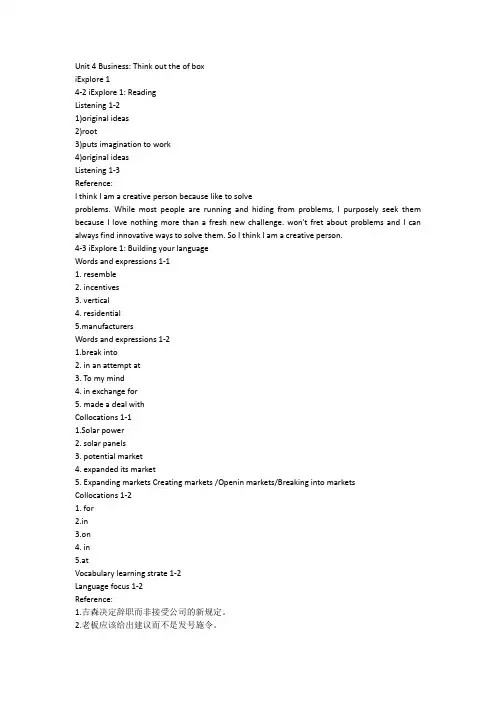
Unit 4 Business: Think out the of boxiExplore 14-2 iExplore 1: ReadingListening 1-21)original ideas2)root3)puts imagination to work4)original ideasListening 1-3Reference:I think I am a creative person because like to solveproblems. While most people are running and hiding from problems, I purposely seek them because I love nothing more than a fresh new challenge. won't fret about problems and I can always find innovative ways to solve them. So I think I am a creative person.4-3 iExplore 1: Building your languageWords and expressions 1-11. resemble2. incentives3. vertical4. residential5.manufacturersWords and expressions 1-21.break into2. in an attempt at3. To my mind4. in exchange for5. made a deal withCollocations 1-11.Solar power2. solar panels3. potential market4. expanded its market5. Expanding markets Creating markets /Openin markets/Breaking into marketsCollocations 1-21. for2.in3.on4. in5.atVocabulary learning strate 1-2Language focus 1-2Reference:1.吉森决定辞职而非接受公司的新规定。
新生代英语高级教程2 Unit 2_电子教案

教案课程名称新生代英语高级教程2 课时班级专业教师系部教研室教材《新生代英语高级教程2》12345678910补充教学资源Vocabulary Builder参考译文凯文:嗨,珍妮。
最近怎么样?珍妮:还是老样子。
你看到新款乐桃笔记本电脑(Peachbook)了吗?看起来棒极了。
凯文:嗯,我昨晚看到了。
你想要哪一款?珍妮:我想要13英寸的那一款。
它有16G的内存和万亿字节的存储空间。
凯文:听起来不错,但也很贵吧。
它们卖多少钱?珍妮:大约1,299美元。
凯文:1,299美元!太贵了。
我想我还是继续用我的旧特萨斯(Tasus)吧。
珍妮:那台老电脑!你真的需要买一台新的,凯文。
凯文:我知道,但我的特萨斯仍然能正常工作。
我认为现在买台新电脑是不合理的。
珍妮:好吧,我一定要买一台新款乐桃笔记本。
凯文:我想我宁愿把这笔钱用来度假。
珍妮:我不这样认为。
比起度假我更想买一台新电脑。
11Show Time参考译文桑切斯夫人:嗨,亲爱的。
你在干什么呢?桑切斯先生:刚刚我在看电脑广告。
桑切斯夫人:电脑广告?看它做什么?桑切斯先生:我想给赫克托买台电脑。
他上学能用得着。
桑切斯夫人:真有这个必要吗?桑切斯先生:现在跟以前不一样了,亲爱的。
有台电脑就像有纸有笔一样常见。
桑切斯夫人:好吧,也许你是对的。
但买台电脑会不会太贵了?你确定我们可以负担得起吗?桑切斯先生:当然,我们能够负担得起。
我们有一些积蓄。
而且现在有些活动很划算。
桑切斯夫人:真的吗?桑切斯先生:来,你看这儿。
这是一台笔记本电脑,非常轻而且便于携带。
桑切斯夫人:是的,笔记本电脑确实又薄又轻。
桑切斯先生:没错。
这就是重点。
对比一下笔记本电脑跟台式电脑。
桑切斯夫人:比起笔记本电脑,台式电脑要大得多、沉得多。
桑切斯先生:是的,但台式电脑更便宜。
桑切斯夫人:也就是说。
笔记本比台式电脑要小巧,但同时也比台式电脑贵很多。
桑切斯先生:是的。
桑切斯夫人:哪种电脑的内存最大?12桑切斯先生:笔记本电脑的内存比台式电脑要大。
新一代大学英语(发展篇)综合教程2-unit4
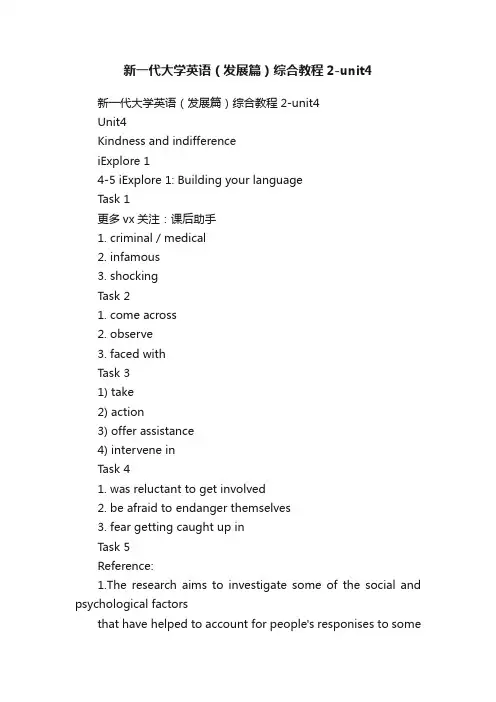
新一代大学英语(发展篇)综合教程2-unit4新一代大学英语(发展篇)综合教程2-unit4Unit4Kindness and indifferenceiExplore 14-5 iExplore 1: Building your languageTask 1更多vx关注:课后助手1. criminal / medical2. infamous3. shockingTask 21. come across2. observe3. faced withTask 31) take2) action3) offer assistance4) intervene inTask 41. was reluctant to get involved2. be afraid to endanger themselves3. fear getting caught up inTask 5Reference:1.The research aims to investigate some of the social and psychological factorsthat have helped to account for people's responises to someemergencies.2. Bill isalikable guy and a good father who would endanger himself in protecting his son.3. To deliberately get involved in a situation that does not concern you may be annoying to others.4. Awareness of the fact that the child was in danger impelled the police to take action immediately.5. The nation was outraged by the news of the assassination of the president.6. Changing the way we interpret an event can change the way that we experience it.iExplore 24-7 iExplore 2: Building your languageTask 11 benefits2. gain3. pay offTask 21. acts of kindness2. out of good wil3. a selfless act4. the goodness of my heartTask 31. the fear of criticism2. impose a fine3. comes at a cost4. lend a hand to5. promote altruism6. motives to helpTask4D E A C BiProduce4-8 Unit project4-8 Unit project 1-3Reference:K indness? Indifference?A woman named Kitty Genovese was brutally murdered in 1964 in New York. Thirty-eight neighbors heard her desperate cries for help, but no one offered to help or called the police, which outraged the nation. We couldn't help wondering "What's wrong with those bystanders?" "Isn't kindness our human nature?"It is beyond doubt that helping strangers out of good will is in our human nature. Psychologists have found out that kids as young as 18 months old spontaneously help others without being told to do so, e.g. picking up the dropped items or opening doors for the experimenter. What's more, wehelp others out of the goodness of our hearts.As Abraham Lincoln said, "When I do good, I feel good. When I do bad, I feel bad. That's my religion." We will feel better about ourselves when we help others and worse when we do not. Finally, we get a "warm glow" when we help others, which. is an experience registering in our brain's pleasure centers. The kindness of strangers indicates that humans are altruistic and willing to help others even when there is no immediate gain or indeed there is no reward in the future. Since helping others out of good will is in our human nature, why don't we offer assistance in. emergencies? Psychologists have found out that the bystander effect is the result of a complex set of psychological factors. Onc factor is "social affirmation," which means peopletend to do what everybody else is doing. They are afraid to stand out and be different. For instance, if a fire alarm goes off in a building and no oneelse. seems concerned, most people will tend to do nothing . because other people are doing nothing. Another factor is the level of ambiguity involved in the situation. Many times lovers do quarrel, sometimes violently. So people are afraid to look foolish if they intervene in the situation and take the wrong action. A third factor is the principle of moral diffusion, which means the larger a crowd, the less likely people will get involved. Everyone thinks that someone else will help. When an old man collapses in front of a group of people, the result is few people will offer help and most of them choose to wait for others to take action.So what shall we do to encourage people to help? First of all, we should educate people about the bystander effect. Once we know about the phenomenon, we are more likely to escape it, and take action. Besides, we can pass a law to protect those helpers in emergencies. When protected by law, people will not be afraid to be caught up in legal proceedings or get themselves into trouble.To sum up, it's in our human nature to help strangers out of good will, but sometimes people may do nothing when faced with emergencies. It's not that we are cold or indifferent, but rather, a complex set of psychological factors prevent people from taking actionis. Now that we have learned about all those factors, hopefully weiAssess4-10 Unit testPart I1. collaboration2. intervene3. consistent4. likelihood5. desperate更多vx关注:课后助手6. dismiss7. ambiguity8. spontaneouslyPart IID A C B APartIII 1-1Reference;社交媒体充斥着美国青少年的生活,以至于上网就几乎等同于在社交网站上出现。
新生代英语入门教程(第二版)课件unit4

•E
• Write.
EXAMPLE
You have a blouse. (blouse)
he has shoes./ He has a pair of shoes. (shoes)
1. She ___h_a_s_a__d_re_s_s______. (dress) 2. They __h_a_v_e__c_o_a_ts________. (coats) 3. I __h_a_v_e__so_c_k_s_./_I_h_a_v_e_a__p_a_ir_o__f _so_c_k_s_. (socks) 4. We __h_a_v_e_s_w_e_a_t_e_r_s_____. (sweaters) 5. You _h_a_v_e__p_a_n_ts_._/_h_a_v_e_a__p_a_ir_o_f_p_a_n_t_s_. (pants) 6. He __h__a_s _a_s_h_ir_t_________. (shirt)
Father: OK, let me get changed. I need Maybe you’re right.
to find my shorts.
Conversation 8
Conversation 6
Husband: Is this a formal dinner we are
Son: Can you buy some socks when you going to?
Conversation 3 Man 1: This shirt is way too big for me. I really need to be more careful when I go shopping. Man 2: That’s why I ask my wife to buy shirts for me. She is a much better shopper than me. Conversation 4 Woman 1: It is so cold out. I wish I brought my coat. Woman2: You’re right. Let’s get inside as soon as possible.
全新版大学英语综合教程2第二版Unit4电子
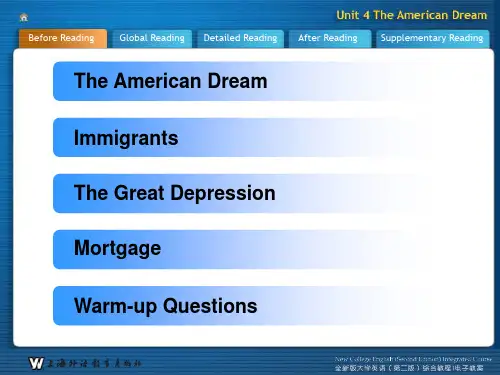
The first immigrants to America came almost from western Europe. During the first decades of the 17th century, settlers from England colonized Virginia and New England. Immigration to New England began in 1620 when English Puritans established Plymouth Colony in present-day Massachusetts. The values of these Puritan settlers strongly influenced the culture of the American colonies and later of the United States.
Before Reading
Global Reading Detailed Reading After Reading Supplementary Reading
Immigrants Introduction
First Immigrants
Before Reading
Global Reading Detailed Reading After Reading Supplementary Reading
Before Βιβλιοθήκη eadingGlobal Reading Detailed Reading After Reading Supplementary Reading
The American Dream
Immigrants The Great Depression
大学英语(全新版)第二册Unit 4 A Virtual Life 教学课件

vt.1)私占,侵吞,挪用
e.g. He was accused of appropriating club funds. 2)拨出(款项等)拱专用
e.g. The government was forced to appropriate extra funds for the new airport.
• I find that everyone on my mailing list is indifferent and I believe that they have forgotten that some people who read it might be hurt by their bitter remarks.
• 8. remark: n. 言辞,话语,谈论,评论
e.g. They exchanged a few remarks in a low voice.
vt. 说,评论说
e.g. The editor remarked that the article was well written.
vi. (on)评论,谈论
• - I begin to feel as if my machines and I are inseparable, I receive and then send the data as if I am another link on the net.
• 5. critic: n. 评论家;对…持批评态度的人 e.g. I’m my own most severe critic. • criticize: v.批评,批判,评价
全新版大学英语(第二版)听说教程2-Unit4电子教案
1. Do you like music? What type of music do you like best? Traditional Chinese music or Western music? Classical or popular? 2. Who is your favorite singer / composer? 3. Do you play any musical instrument? If you do, what is it? How long have you played it? If not, what instrument would you like to learn to play? 4. What do you think is the value of music?
Unit 4 Music
Listening Strategy
The signal words in the passages you have heard may perform the following functions: a. leading towards a statement that is a contrast or an opposite to what has been said b. summarizing what has been said c. setting out the stages of the talk d. suggesting cause and effect _____________ 1. However; a 2. _____________ Because; d _________________________ 3. Firstly, then, finally; c 4. _____________ In short; b
高级英语第二册unit 4
Unit 4John Fitzgerald Kennedy (1917-1963) 35th president of the United States⏹Family Background Kennedy’s ancestors came from Ireland and he was the first RomanCatholic to become president of the U.S. He was born on May 29, 1917 in Brookline, Massachusetts, where his grandfather had been elected to many offices. His father Joseph P. Kennedy became the youngest bank president of the country at the age of 25.On September 12, 1953, Kennedy and Jacqueline Bouvier were married. They had three children.He wrote "Profiles in Courage",《勇敢者传略》which won a Pulitzer prize.↗1947-1952 served as representative in the congress 1952 elected to the senate ↗1960 won the Democratic nomination for president and defeated Richard Nixon, RepublicanAssassination His assassination at Dallas in November 1963 was a shock from which the U.S. has found it hard to recover and the murder is still a riddle. In 1963, Kennedy journeyed to Texas for a speech-making tour. on November 22, he and his wife were cheered as their open car passed through the streets. Suddenly, at 12:30 in the afternoon, an assassin fired several shots, striking the president twice in the base of the neck and the head. Kennedy was rushed to Hospital, where he was pronounced dead about a half hour later. Within two hours, Vice president Johnson took the oath as president.⏹Contributions1. His most important act was his successful demand on Oct.22, 1962 that the Soviet Union dismantle its missile bases in Cuba.2. He established a quarantine(隔离检疫期) of arms shipments to Cuba3. He defied Soviet attempts to force the Allies out of Berlin.4. He made the steel industry rescind(废除) a price rise.5. He backed: civil rights movements; a mental health program; arbitration of railroad disputes; expanded medical care for the aged; astronaut flights and satellite orbiting Lincoln and Kennedy⏹Abraham Lincoln was elected to Congress in 1846. John F. Kennedy was elected to Congressin 1946.⏹Abraham Lincoln was elected President in 1860. John F. Kennedy was elected Presidentin 1960.⏹The names Lincoln and Kennedy each contain seven letters.⏹Both were particularly concerned with civil rights.⏹Both wives lost their children while living in the White House.⏹Both Presidents were shot on a Friday.shot in the head.⏹Lincoln’s secretary was named Kennedy. Kennedy’s secretary was named Lincoln.⏹Both were assassinated by Southerners. Both were succeeded by Southerners.⏹Both successors were named Johnson.⏹Andrew Johnson, who succeeded Lincoln, was born in 1808.⏹Lyndon Johnson, who succeeded Kennedy, was born in 1908.⏹John Wilkes Booth, accused of assassinating Lincoln, was born in 1839.⏹Lee Harvey Oswald, accused of assassinating Kennedy, was born in 1939.⏹Both names comprise fifteen lettersInauguration Day On April 30,1789, George Washington stepped onto a balcony of Federal Hall in New York City, placed his hand on a Bible and swore to “preserve, protest and defend the constitution of the United States”. He then read an earnest speech, callingfor“united and effective government”. Thus began a unique American institution—Inauguration Day—those dramatic hours when a new president faces the people for the first time. He must tell the people what he’s going to do as president.The Inauguration Day has been on January 20 since 1937.⏹Inaugural Address Memorable words have been uttered in inaugural address. It is aspeech, lecture officially made by a person on taking office.⏹General Analysis of a Political SpeechThe purpose of a political speech is to explain, convince and persuade the people that what he is saying and planning to do best represents their interests so they should support him.1. He must try every possible means to arouse the feelings of audience. What he says represents the interests of the whole people. successful appeal to the emotion of the audience2. specific policy The speech must contain high-sounding words and empty promises3. The speech must be concise and short4. clever-choice of words to convey different meanings/tones.5. the use of biblical style to make it formal/ rigid.6. the use of a lot of rhetorical devices to make his address as powerful/ impressive as possibleAs President of the United States, Kennedy has to address a worldwide audience. He has to appeal not only to the American people but also to the different groups of nations in the international community⏹Social Background Kennedy became President in 1960’sCold war marks the situation in 1960’s. The world is mainly divided into two hostile camps.1)socialist camp— headed by the Soviet Union 2) capitalist camp—headed by the U.S. Kennedy was an eloquent speaker. He is specially trained. This speech is very powerful and wonderful. He lays his emphasis on the successful appeal to the emotion of the listeners. In fact, most Americans regard his inaugural address as one of the best delivery by an American President.Section I (paras.1-5)Introduction, the general statement of the basic policy of the USSection II (paras.6-10) He addresses different groups of allied nations and would-be allied nations; friends and would-be friends.Section III (paras.11-20) His specific policy toward the enemy.1. point out the danger2. point out he position of strength3. point out the situation and need.Both sides feel uneasy. a) Both sides are overburdened with the cost of modern weapons.b) Both sides are anxious with the wide spread arms.c) Both try to change the uncertain balance of military power.⏹Proposals: 1. control arms 2 . use science for peace purpose 3. enjoy human rights Object: to make a new world orderSection IV (paras.21-27) conclusionHe calls on the Americans to support him and to sacrifice their lives for their country. He calls on the people of the whole world to unit and work for the freedom of men Detailed Study of the TextPara.1: Kennedy is emphasizing the importance of his election as president. It is not simply a victory of the Democratic Party over the Republican Party. It celebrates the freedom of people to elect freely their own head of state. It symbolizes the end of one presidential term (that of Eisenhower) and the beginning of a new term (that of Kennedy). The presidency or the office of president is renewed.1.freedom: We celebrate freedom. People in the US are free to choose their president.2.end: the end of Eisenhower’s presidential term3.beginning: the beginning of Kennedy’s presidential term4.renewal: the continuation of presidency and office of president5.change: the change from Eisenhower to Kennedy6.solemn oath: refer to an extremely formal and inspiring religious ritual. veryserious.7. a century and three-quarters ago: The first presidential oath taken by Washingtonon April 30, 1789⏹Para.2: the general situation of this worldQuestion: In what way is the world different?The world is different in the way of science and technology. People have modern and advanced science and technology.☐power: the power of science and technologyScience can be used to get rid of poverty. Science can be used to destroy all human beings Eg. Slavery was abolished in the US in the 19th century.☐Man has made great progress in science and technology so he has the power (scientific farming, speedy transportation, mass production, etc.) to abolish poverty, but he also has the power (missiles, bombs, nuclear weapons, etc.) to destroy human life. Hence the world is different now.revolutionary belief: it refers to a passage in the American Declaration of Independence: “We hold these truths to be self-evident, that all men are created equal, that they are endowed by their Creator with certain unalienable Rights, that among these are Life, Liberty and the pursuit of HappinessAnd yet the same... around the globe:Our ancestors fought a revolutionary war to maintain that all men were created equal and God had given them certain unalienable rights which no state or ruler could take away from them. But today this issue has not yet been decided in many countries around the world.⏹Para.3: general policy of the US☐People in the US must keep and defend human rights not only in the US but also in the world as well.We dare not... first revolution: We dare not forget that we are the descendants of those who fought the war of independence. Hence we must always bear in mind the beliefs and ideals our ancestors fought and died for. We must be prepared, if necessary, to fight and die for them today.torch: metaphor. Its original reference is to the Olympic Games before which a torch is carried from runner to runner. Here it refers to “inspirations and ideals”.temper: v. to cause to become firm 使变坚韧tempered by war: The Americans of the 20th century fought two world wars, so they are well tempereddisciplined: received training that developed self control and character hard and bitter peace: peace but cold war, hence “hard and bitter’’to witness or permit the slow undoing:to see or allow the gradual abolishing of⏹Para.4: strong determination. Kennedy puts the US in the position of the world leader,and he says in order to keep human rights, “we shall pay any price, bear any burden, ...”.☐The address is to both friends and foes. It promises to support any friend and to oppose any foe.The phrases “pay any price, bear any burden and meet any hardship”are intended to shore up the waning confidence of her allies as much as to warn any prospective foe.⏹Para.5: transition A one sentence paragraph that functions as a transition from thegeneral to the specific. In the following paragraphs he will be addressing different specific groups of nations.⏹Para.6: the specific policy toward his friends and would-be friendsTo those old allies…split asunder:In this paragraph Kennedy addresses the white European countries in general but his words are specifically directed to the English-speaking Anglo-Saxon countries, such as Britain, Canada, Australia, and New Zealand, with whom the United States shares a common cultural and spiritual heritage.ally:n. a country that has a treaty or an agreement to help and support another country, allied: ad. the Allied and Associated Powers (World War I)cultural and spiritual origins:Greek, Roman and Nordic mythology, literature, art, music etc. Later these nations were linked closer by the spiritual tie of Christianity.United, there is little we cannot do in a host of co-operative ventures: United and working togetherwe can accomplish a lot of things in a great number of joint undertakings.United we can do everything. Divided we can do nothingpowerful challenge: a strong, powerful threat posed by the socialist camp.If we are quarreling and split apart, we can not compete with the strong, powerful enemy in front of usThose two have been at odds with one another for ages. 那两个人合不来已经很久了。
高教版基础英语第二册教案——Unit 4 Healthy Lifestyles
Unit 4 Healthy LifestylesThe First PeriodTeaching aims:1.To talk about what are associated with healthy lifestyles.2.To be able to describe the relationship between sleep and health.3.Master the important phrases.Key points:To learn what are associated with healthy lifestyles.Difficult points:When do you get up in the morning?I get up at… o’clock.I go to bed at … o’clock.I have a nap for… hour(s).…is good for your health.Teaching Methods:1. Listening and saying2. Pair work and group workTeaching aids:tape recorderProcedures:Step 1 Greetings and Lead-inGreet the whole class.Ask Ss to do Warm-up.1.Encourage Ss to think about as many healthy lifestyles as possible and help themto match the pictures with the related terms.2.Introduce more fashionable western lifestyles to Ss.3.Check the Warm-up with the whole class.Step 2 Listening 11.Learn the new words of this part.Notes:nutritious adj. 有营养成分的,有营养的fast adj. 快速的swim v. (swam, swum) 游泳travel v. 旅行nap n. (白天)小睡,打盹at noon 在中午2. Ask Ss to look at the pictures, and then prepare doing listening.3. Play the tape. Ask Ss to do the match.4.Play the tape again, and then check the answers with the whole class.Script of listening:1. Swimming is good for your health.2. Smoking is bad for your health.3. Getting up early is good for your health.4. Eating fast food is bad for your health.5. Traveling is good for your health.6. Staying up late is bad for your health. Step 3 Dialogue 11.Explain some important words and useful sentences. Encourage Ss to make somesentences.2.Explain the important phrases and divide the students into 3 groups to discuss andcomplete the dialogue with the words given below.3.Play the tape and ask Ss to read after it, and then ask Ss to play the dialogue.4.Let Ss guess where the dialogue takes place and the relation between them.Ask Ss to talk about their own experience about sleep.5.Remember the following important phrases:When do you get up in the morning?I get up at… o’clock.I go to bed at … o’clock.I have a nap for… hour(s).…is good for your health.Step 4 Role Play 11.Practise the important phrases and words.2.Ask Ss to practise the dialogue as Dialogue 1. Ask some Ss to play the dialogue infront of the class.3.Ask Ss to practise more about this pattern.Step 5 Homework1.Make a dialogue in pairs with the knowledge learnt today.2.Copy the new words three times.3.Recite the dialogue 1 on page51.The Second PeriodTeaching aims:1.To learn the relationship between food and health and learn to talk aboutpreference on food.2.To complete the dialogue with the words given in the box.3.To master some words and phrases.Key points:How to talk about eating healthy food.Difficult points:What kind of food are you keen on?I’m keen on…How about you?I east a lot of…Teaching Methods:1. Listening and saying2. Pair work and group workTeaching aids:tape recorderProcedures:Step 1 Greetings and Lead-inGreet the whole class.Review the important phrases learned last period.Step 2 Listening 21.Learn the new words of this part.Notes:dislike v. 讨厌;不喜欢junk n. 垃圾sweet adj. 甜的salad n. 色拉,沙拉vegetable n. 蔬菜chips n. 碎片cake n. 蛋糕;饼chocolate n. 巧克力;巧克力糖keen adj. 热心的;渴望的unhealthy adj. 不健康的,对健康有害的fatten v. 使肥胖;使肥沃resist v. 抵抗,反抗junk food 垃圾食品,无营养食品keen on 喜爱2.Play the tape, and ask Ss to do the match.3.Play the tape again, and then check the answers with the whole class.Script of listening:Gina is very keen on junk food and sweet things. She eats a lot of hamburgers and chips, and she loves cakes and chocolates. She doesn’t like to eat much fruit and she’s not very keen on salads and vegetables. I don’t think her diet is very healthy.Step 3 Dialogue 21.Encourage Ss to name the food they’ve learnt.2.Explain some important words and useful sentences. Encourage Ss to make somesentences.3.Play the tape and Ss read after it. Then ask some Ss to play the dialogue.4.Remember the following important phrases:What kind of food are you keen on?I’m keen on…How about you?I east a lot of…Step 4 Role Play 21.Practise the important phrases and words.2.Ask Ss to practise the dialogue as Dialogue 2.3.Master how to talk about the preference on food.Step 5 Homework1.Make a dialogue in pairs with the knowledge learnt today.2.Copy the new words three times.3.Recite the dialogue on page 52.The Third PeriodTeaching aims:1.To learn about the importance of doing exercise2.To learn to describe how to keep healthy.3.To master some words and phrases.Key points:Talk about doing exercise and hurts.Difficult points:There’s little we can do for…I think it would be good for you to…Just follow the directions.You’d better do it twice a day.Teaching Methods:1. Listening and saying2. Pair work and group workTeaching aids:tape recorderProcedures:Step 1 Greetings and Lead-inGreet the whole class.Review the important phrases learned last period.Step 2 Listening 31.Learn the new words of this part.Notes:badminton n. 羽毛球gym n. 体育馆;体操booklet n. 小册子backache n. 背痛hurt v. (hurt, hurt)刺痛,伤害ow int. 表示突然疼痛所发出之声2.Ask Ss to look at the pictures, and ask them to guess what they are going to listen.3.Play the tape, and ask Ss to match the answers.4.Play the tape again, and then check the answers with the whole class.Script of Listening 31. Ada plays tennis three or four times a week.2. Dora goes to the gym twice a week.3. Ellen often plays badminton after school.4. Lily always goes swimming at weekends.Step 3 Dialogue 31.Explain some important words and useful sentences. Encourage Ss to make somesentences.2.Have the students work in groups and fill in the blanks with the words given.3.Play the tape and Ss read after it. Then ask some Ss to play the dialogue.4.Teach Ss how to describe hurts.5.Remember the following important phrases:There’s little we can do for…I think it would be good for you to…Just follow the directions.You’d better do it twice a day.Step 4 Role Play 31.Explain the important words and phrases, and then practise them.2.Ask Ss to practise the dialogue as Dialogue3.3.Ask Ss to make a dialogue to talk about what their teachers look like.Step 5 Homework1.Make a dialogue in pairs with the knowledge learnt today.2.Copy the new words three times.3.Recite the dialogue on page 54.The Fourth PeriodTeaching aims:1.To talk about what makes a rich man.2.To learn the difference between income, money and wealth.3.To master some words and phrases.Key points:Talking about wealth.Difficult points:Real estateMiddle classTeaching Methods:1. Listening and saying2. Pair work and group workTeaching aids:tape recorderProcedures:Step 1 Greetings and Lead-inGreet the whole class.Review the dialogue 3 learned last period.Step 2 Pre-reading Activities1.Learn the new words of this part.Notes:wise adj. 英明的,明智的wealth n. 财富;财产salary n. 薪水asset n. 资产,有用的东西middle class 中产阶级2.Ask Ss to refer dictionaries and find out the differences in definition betweensalary and wage.3.Introduce different points of views towards money and wealth.Step 3 Text1.Explain some important words and useful sentences. Encourage Ss to make somesentences.2.Play the tape and Ss read after it. Then ask some Ss to read the text.3.Ask Ss to finish the comprehension exercises, then check answers with the wholeclass, and ask Ss to correct the sentences.4.Grammar: Gerund. Ask Ss to find the related sentences from the text.Step 4 Writing1.Share the secrets of keeping healthy with the classmates.2.Ask Ss to finish the Writing, give them some instructions if possible:sleeping hours: __________ working hours: ___________favorite food: __________ favorite sports: ___________Step 5 Grammar(1) 动名词用作主语动名词在句中可用作主语,其逻辑主语泛指人们,如:Seeing is believing.百闻不如一见。
新大学进阶英语2unit4教案
课时:2课时教学目标:1. 知识目标:学生能够掌握本单元的词汇和语法知识,提高英语听说读写能力。
2. 能力目标:学生能够运用所学知识进行日常交流,提高实际应用能力。
3. 情感目标:激发学生学习英语的兴趣,培养学生良好的学习习惯。
教学重点:1. 词汇:掌握本单元的生词和短语。
2. 语法:学习过去进行时态的构成和使用。
教学难点:1. 过去进行时态的构成和使用。
2. 生词和短语的运用。
教学准备:1. 多媒体课件2. 生词卡片3. 语法练习题4. 学生作业教学过程:第一课时一、导入1. 老师与学生用英语进行简单的日常问候。
2. 回顾上一节课的内容,检查学生对知识的掌握情况。
二、新课导入1. 引导学生阅读课文,了解文章大意。
2. 分析文章结构,讲解本单元的语法和词汇。
三、词汇教学1. 教师展示生词卡片,引导学生朗读并拼写。
2. 通过例句,讲解生词在语境中的用法。
3. 学生分组练习,运用生词进行对话。
四、语法教学1. 讲解过去进行时态的构成:主语 + was/were + 动词的ing形式。
2. 通过例句,讲解过去进行时态的用法。
3. 学生练习语法,完成相关练习题。
五、阅读教学1. 学生阅读课文,理解文章内容。
2. 老师提问,检查学生对文章的理解。
3. 学生分组讨论,分享自己的观点。
六、总结1. 老师对本节课的内容进行总结,强调重点和难点。
2. 学生复述本节课所学知识。
第二课时一、复习导入1. 学生用英语进行简单的日常问候。
2. 回顾上一节课的内容,检查学生对知识的掌握情况。
二、听力训练1. 学生听录音,回答相关问题。
2. 老师讲解听力技巧,提高学生的听力水平。
三、口语训练1. 学生分组进行角色扮演,运用所学知识进行对话。
2. 老师巡回指导,纠正学生的发音和语法错误。
四、写作训练1. 学生根据本单元的主题,写一篇短文。
2. 老师批改学生的作文,给予指导和建议。
五、总结1. 老师对本节课的内容进行总结,强调重点和难点。