
英语修辞格的形式、作用及其意义分析
英语常用修辞法22种
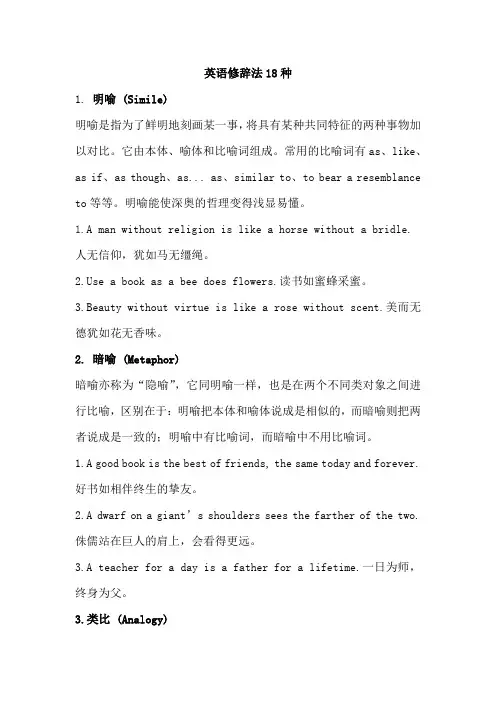
英语修辞法18种1. 明喻 (Simile)明喻是指为了鲜明地刻画某一事,将具有某种共同特征的两种事物加以对比。
它由本体、喻体和比喻词组成。
常用的比喻词有as、like、as if、as though、as... as、similar to、to bear a resemblance to等等。
明喻能使深奥的哲理变得浅显易懂。
1.A man without religion is like a horse without a bridle. 人无信仰,犹如马无缰绳。
e a book as a bee does flowers.读书如蜜蜂采蜜。
3.Beauty without virtue is like a rose without scent.美而无德犹如花无香味。
2. 暗喻 (Metaphor)暗喻亦称为“隐喻”,它同明喻一样,也是在两个不同类对象之间进行比喻,区别在于:明喻把本体和喻体说成是相似的,而暗喻则把两者说成是一致的;明喻中有比喻词,而暗喻中不用比喻词。
1.A good book is the best of friends, the same today and forever. 好书如相伴终生的挚友。
2.A dwarf on a giant’s shoulders sees the farther of the two.侏儒站在巨人的肩上,会看得更远。
3.A teacher for a day is a father for a lifetime.一日为师,终身为父。
3.类比 (Analogy)类比是一种阐述事理的修辞格,即用人们熟悉的事例说明较深的道理,或通过具体形象阐明抽象的概念。
它主要是把两种本质上不同的事物之间的共同点加以比较。
1.Judicious praise is to children what the sun is to flowers. 明智的赞扬对于孩子的作用,就像阳光对于花朵的作用一样。
英语常见修辞手法的语用功能分析

英语常见修辞手法的语用功能分析自古以来,英语语言就是一种富有表现力的语言,其得以表达复杂意义的重要原因在于它大量使用修辞手法。
修辞犹如英语语言的香料,不仅能够使原来山寒水凉的句式鲜活起来,更能在语言上带来莫大的修饰和艺术效果,为读者带来极大的思想感受。
本文旨在从语用功能的角度,分析英语中常见的几种修辞手法,为人们理解和掌握英语修辞提供一定的参考价值。
首先,比喻是英语修辞中最常用的一种手法,它通过将不同的概念或事物比作彼此,使语言更加形象生动,更有感染力。
比如,莎士比亚剧作《威尼斯商人》中出现的“All the world’s a stage”(全世界是一个舞台)这句话,将世界与舞台比作起来,形象地表达了人生的短暂,蕴含着深刻的哲理,因而受到广大人们的喜爱。
其次,拟人手法也是英语修辞中非常常见的一类手法,它通过借用物的形状、动作等与人的品质、思想相结合,使语言得以更有可读性和可记忆性,也更容易得到人们的理解和接受。
英国作家DH劳伦斯为了表现大自然之美,在他的作品《海的女儿》中,通过拟人法把女孩和海浪比作起来,使原本单调的描写变得更加生动传神:“The little mermaid tossed her head and stamped her tiny foot”(小美人鱼摇摇头,跺了跺小脚),使读者如临其境,觉得海之女儿正在翩翩起舞,令人回味无穷。
此外,引用也是英语修辞手法比较常见的一种,它通过引用名人名言和历史事件等,既可以丰富语言,同时也能增加文章的说服力、可信度和认知价值。
例如,美国首位总统华盛顿在就职演说中曾说道:“Observe good faith and justice towards all nations. Cultivate peace and harmony with all”(对所有国家秉持公义正义,与所有人和平共处),这一著名的话语体现了华盛顿不断追求的文明价值观,使其获得了国内外广大读者的赞赏和尊重。
英汉语修辞格形式的作用和认知意义
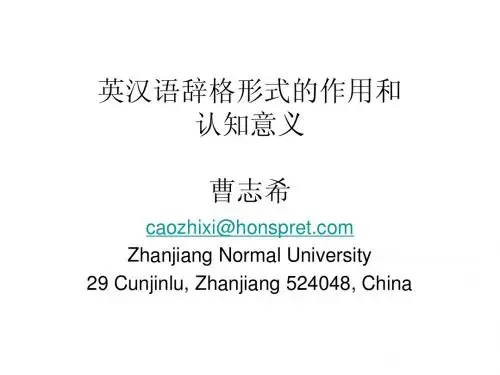
• 修辞对语言的表达效果具有独特的作用。 所以,其重要性不亚于语法和逻辑:语法 是对语言的结构规则而言的;逻辑是对思 维的形式及其规律而言的;修辞是对语言 表达的质量而言。因此,对于语言学生而 言,了解和掌握英语修辞方法(或修辞格) 有助于完善自己的英语语言素质、培养自 己的英语表达能力、提高自己的英语口语 和笔语水平、改善自己的英语思维方法和 表达方式从而达到最佳的语言表达效果、 实现语言交际的最终目的。
3 英汉辞格的形式、作用及其意义分析 • 英汉修辞虽有差异,但辞格的共同点更多。修辞 格(Figures of Speech)到底有多少?阿瑟.翟格 尔(Arthur Zeiger)1978年编写的《英语百科全书》 中归纳出了77种;日本早稻田大学英文教授增田藤 之助所著的《英语修辞学讲义》共收50种;中国著 名学者陈望道所著并于1984年在上海外语教育出版 社出版的《修辞学发凡》共收38种。其实如果认真 细致地总结,可能找到一百多种修辞格甚至上千种。 本文根据学生在学习英语修辞格时片面重视其形式、 忽视其作用和意义的问题,收集和利用了教材和其 他有关资料(见末尾“参考文献”)和对英、汉语 的修辞格形式、作用和意义之对比,重点对代表性 最强的43种英语修辞格的形式、作用及其意义作如 下的分析,以此作为英语修辞格的总结,一为初学 者之用,二为求得too often profaned For me to profane it, One feeling too falsely disdained For thee to disdain it. --Percy Bysshe Shelley: TO──
[有一个被人亵渎太多的词, 我无心再来亵渎; 有一份被人鄙薄太假的情, 你也不会再鄙薄。 --雪莱:《致───》】
3.1.3 半韵(Assonance) 英语中的“半韵”(根据《牛津现代高级英汉双 解词典》)是指两个或两个以上的单词中只有重 读的元音相同,而其后的辅音不相同。这种修辞 格有利于求得声音的悦耳效果。例如: (1) I arise from dreams of thee In the first sweet sleep of night. --Percy Bysshe Shelley: The Indian Serenade 值得说明的是,在英诗中可见诗行末尾有两词以 上的尾音(包括词尾的辅音在内)彼此相同(如: say, day, play 同韵;measure, pleasure 同韵; puff, rough 同韵)。这种情况在英语中常被称为 rhyme,我想在汉语中应该叫做“全韵”,这样 正好与刚才提到的“半韵”(assonance)对应 起来。下面可见这种“全韵”在诗中的应用:
英语18种重要修辞手法

18种重要修辞手法一、语义修辞1明喻(simile)俗称直喻,是依据比喻和被比喻两种不同事物的相似关系而构成的修辞格。
例如:1.The snow was like a white blanket drawn over the field.2.He was like a cock who thought the sun had risen to hear him crow.认真观察以上各例,我们会发现它们的特点,由(as)... as, like等引导,这些引导词被称作比喻词(acknowledging word),它们是辨别明喻的最显著的特征,明喻较为直白,比喻物和被比喻物之间相似点较为明显,所以明喻是一种比较好判断的修辞手法。
2暗喻(metaphor)也称隐喻,是依据比喻和被比喻两种不同事物的相似或相关关系而构成的修辞格。
例如:1.His friend has become a thorn in his side.(他的朋友已变成眼中钉肉中刺。
)2.You are your mother’s glass.(你是你母亲的翻版。
)3.Hope is a good br eakfast, but it’s a bad supper.由以上各例可知,暗喻没有引导词,这是明喻和暗喻在形式上的最大区别。
换句话说,有为明喻,没有为暗喻。
如:He has a heart of stone. He has a heart like stone.很显然,前句是暗喻,后句是明喻。
暗喻时,比喻物和被比喻物之间的相似点较为含蓄,猛一看它们毫无关系,实际却有着某种内在联系。
谈到暗喻,有必要说说它的两种变体(variety):博喻(sustained metaphor)和延喻(extended metaphor),它们是英语比喻中的特殊类型。
(1)博喻连续使用多个喻体去比喻主体的方法就叫做博喻。
比如:There again came out the second flash, with the spring of a serpe nt and the shout of a fiend, looked green as an emerald, and the reverber ation was stunning.(爆发了第二次闪电,她像蛇一样蜿蜒,如魔鬼般嘶叫,像翠玉般碧绿,轰隆隆震耳欲聋。
英语中的修辞手法及英英释义
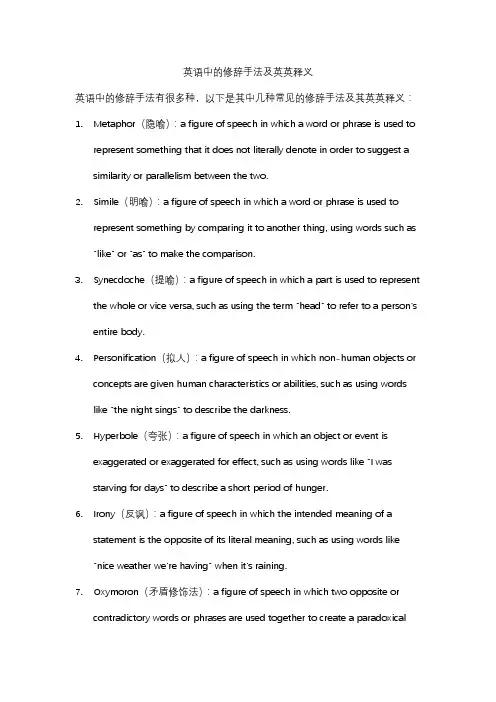
英语中的修辞手法及英英释义英语中的修辞手法有很多种,以下是其中几种常见的修辞手法及其英英释义:1.Metaphor(隐喻):a figure of speech in which a word or phrase is used torepresent something that it does not literally denote in order to suggest a similarity or parallelism between the two.2.Simile(明喻):a figure of speech in which a word or phrase is used torepresent something by comparing it to another thing, using words such as "like" or "as" to make the comparison.3.Synecdoche(提喻):a figure of speech in which a part is used to representthe whole or vice versa, such as using the term "head" to refer to a person's entire body.4.Personification(拟人):a figure of speech in which non-human objects orconcepts are given human characteristics or abilities, such as using words like "the night sings" to describe the darkness.5.Hyperbole(夸张):a figure of speech in which an object or event isexaggerated or exaggerated for effect, such as using words like "I wasstarving for days" to describe a short period of hunger.6.Irony(反讽):a figure of speech in which the intended meaning of astatement is the opposite of its literal meaning, such as using words like"nice weather we're having" when it's raining.7.Oxymoron(矛盾修饰法):a figure of speech in which two opposite orcontradictory words or phrases are used together to create a paradoxicaleffect, such as using words like "bittersweet" to describe a mixed feeling of happiness and sadness.这些修辞手法都可以增强语言的表达力,帮助传达更深刻的意义。
英语中所有26种修辞手法的全部解释和例句
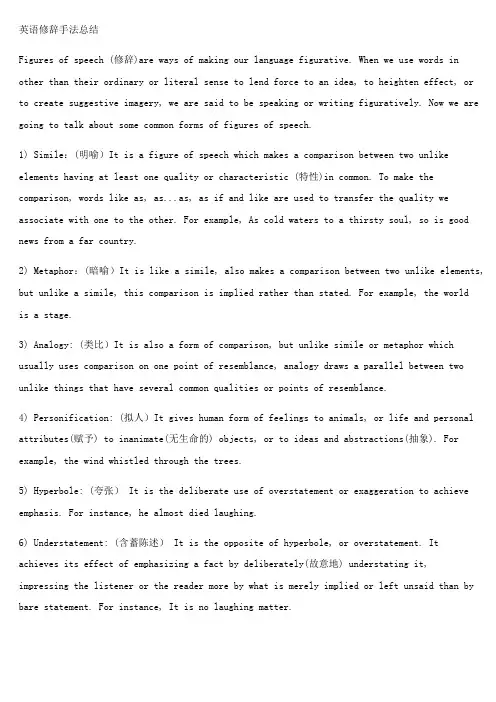
英语修辞手法总结Figures of speech (修辞)are ways of making our language figurative. When we use words in other than their ordinary or literal sense to lend force to an idea, to heighten effect, orto create suggestive imagery, we are said to be speaking or writing figuratively. Now we are going to talk about some common forms of figures of speech.1) Simile:(明喻)It is a figure of speech which makes a comparison between two unlike elements having at least one quality or characteristic (特性)in common. To make the comparison, words like as, as...as, as if and like are used to transfer the quality we associate with one to the other. For example, As cold waters to a thirsty soul, so is good news from a far country.2) Metaphor:(暗喻)It is like a simile, also makes a comparison between two unlike elements, but unlike a simile, this comparison is implied rather than stated. For example, the worldis a stage.3) Analogy: (类比)It is also a form of comparison, but unlike simile or metaphor which usually uses comparison on one point of resemblance, analogy draws a parallel between two unlike things that have several common qualities or points of resemblance.4) Personification: (拟人)It gives human form of feelings to animals, or life and personal attributes(赋予) to inanimate(无生命的) objects, or to ideas and abstractions(抽象). For example, the wind whistled through the trees.5) Hyperbole: (夸张) It is the deliberate use of overstatement or exaggeration to achieve emphasis. For instance, he almost died laughing.6) Understatement: (含蓄陈述) It is the opposite of hyperbole, or overstatement. Itachieves its effect of emphasizing a fact by deliberately(故意地) understating it,impressing the listener or the reader more by what is merely implied or left unsaid than by bare statement. For instance, It is no laughing matter.7) Euphemism: (委婉) It is the substitution of an agreeable or inoffensive(无冒犯) expression for one that may offend or suggest something unpleasant. For instance, we refer to "die" as " pass away".8) Metonymy (转喻)It is a figure of speech that has to do with the substitution of the mane of one thing for that of another. For instance, the pen (words) is mightier than the sword (forces).9) Synecdoche (提喻) It is involves the substitution of the part for the whole, or thewhole for the part. For instance, they say there's bread and work for all. She was dressedin silks.10) Antonomasia (换喻)It has also to do with substitution. It is not often mentioned now, though it is still in frequent use. For example, Solomon for a wise man. Daniel for a wise and fair judge. Judas for a traitor.11) Pun: (双关语) It is a play on words, or rather a play on the form and meaning of words. For instance, a cannon-ball took off his legs, so he laid down his arms. (Here "arms" has two meanings: a person's body; weapons carried by a soldier.)12) Syllepsis: (一语双叙) It has two connotations.In the first case, it is a figure by which a word, or a particular form or inflection of a word, refers to two or more words in the same sentence, while properly applying to or agreeing with only on of them in grammar or syntax(句法). For example, He addressed you and me, and desired us to follow him. (Here us is used to refer to you and me.)In the second case, it a word may refer to two or more words in the same sentence. For example, while he was fighting , and losing limb and mind, and dying, others stayed behind to pursue education and career. (Here to losing one's limbs in literal; to lose one's mindis figurative, and means to go mad.)13) Zeugma: (轭式搭配) It is a single word which is made to modify or to govern two or more words in the same sentence, wither properly applying in sense to only one of them, orapplying to them in different senses. For example, The sun shall not burn you by day, nor the moon by night. (Here noon is not strong enough to burn)14) Irony: (反语) It is a figure of speech that achieves emphasis by saying the opposite of what is meant, the intended meaning of the words being the opposite of their usual sense. For instance, we are lucky, what you said makes me feel real good.15) Innuendo: (暗讽) It is a mild form of irony, hinting in a rather roundabout (曲折)way at something disparaging(不一致) or uncomplimentary(不赞美) to the person or subject mentioned. For example, the weatherman said it would be worm. He must take his readings in a bathroom.16) Sarcasm: (讽刺) It Sarcasm is a strong form of irony. It attacks in a taunting and bitter manner, and its aim is to disparage, ridicule and wound the feelings of the subject attacked. For example, laws are like cobwebs, which may catch small flies, but let wasps break through.17) Paradox: (似非而是的隽语) It is a figure of speech consisting of a statement or proposition which on the face of it seems self-contradictory, absurd or contrary to established fact or practice, but which on further thinking and study may prove to be true, well-founded, and even to contain a succinct point. For example more haste, less speed.18) Oxymoron: (矛盾修饰) It is a compressed paradox, formed by the conjoining(结合) of two contrasting, contradictory or incongruous(不协调) terms as in bitter-sweet memories, orderly chaos(混乱) and proud humility(侮辱).19) Antithesis: (对照) It is the deliberate arrangement of contrasting words or ideas in balanced structural forms to achieve emphasis. For example, speech is silver; silence is golden.20) Epigram: (警句) It states a simple truth pithily(有利地) and pungently(强烈地). It is usually terse and arouses interest and surprise by its deep insight into certain aspects of human behavior or feeling. For instance, Few, save the poor, feel for the poor.21) Climax: (渐进) It is derived from the Greek word for "ladder" and implies the progression of thought at a uniform or almost uniform rate of significance or intensity,like the steps of a ladder ascending evenly. For example, I came, I saw, I conquered.22) Anti-climax or bathos: (突降)It is the opposite of Climax. It involves stating one's thoughts in a descending order of significance or intensity, from strong to weak, from weighty to light or frivolous. For instance, But thousands die, without or this or that, die, and endow(赋予) a college, or a cat.23) Apostrophe: (顿呼) In this figure of speech, a thing, place, idea or person (dead or absent) is addressed as if present, listening and understanding what is being said. For instance, England! awake! awake! awake!24) Transferred Epithet: (转类形容词) It is a figure of speech where an epithet (anadjective or descriptive phrase) is transferred from the noun it should rightly modify(修饰) to another to which it does not really apply or belong. For instance, I spent sleeplessnights on my project.25) Alliteration: (头韵) It has to do with the sound rather than the sense of words for effect. It is a device that repeats the same sound at frequent intervals(间隔) and since the sound repeated is usually the initial consonant sound, it is also called "front rhyme". For instance, the fair breeze blew, the white foam flew, the furrow followed free.26) Onomatopoeia: (拟声) It is a device that uses words which imitate the sounds made by an object (animate or inanimate), or which are associated with or suggestive(提示的) of some action or movementExplanation version1一、什么是修辞格修辞格(figures of speech)是提高语言表达效果的语言艺术。
浅析英语修辞格的运用及翻译
浅析英语修辞格的运用及翻译浅析英语修辞格的运用及翻译语言是表达思想的工具,修辞则是语言表达的艺术。
使用修辞格的目的是为了使语言更加生动形象、鲜明突出;或者使语言更加整齐匀称,音调铿锵,加强语言表现力和感染力,引起读者丰富联想的效果。
英语和汉语都有悠久的历史,也都具有非常丰富的修辞方式。
由于东、西方民族文化背景的不同,英汉语言在修辞格式上显然存在着既相一致又有区别的特点。
认识并了解英汉两种语言修辞格式的异同,找出二者各自的特点,有助于我们在英汉语言转换过程中正确理解原文的修辞手法,并在译文中正确使用,从而忠实地表达原文的思想和风格。
以下举例浅谈英语修辞格在翻译方面的基本原则及方法:一、直译法对于英汉两种语言中相类似的常用修辞格,~I1:simile(明喻),metaphor(隐喻),metonym(借代),personification(拟人),hyperbole(夸张),irony(反语),pun(双关),rhetoricquestion(设问)等。
在翻译中当然应当尽可能采用直译的方法,即在用词和修辞结构上都与原文保持一致,做到形神皆似。
举例如下:In his dream he saw the tiny figure fall as a fly(simile)在他的梦中他看见那小小的人影像苍蝇一般地落了下来。
Life is an isthmus between two eternities.(Metaphor)生活是永恒的生死两端之间的峡道。
Sometimes the pen may be mightier than the sword.(Metonymy)有时文人比武士更有力量。
The sun smiled down on the green meadows(Personificatian)太阳向着绿茵茵的草地俯首微笑。
The ancient wilderness dreamed,stretched itself all open to the sun,and seemed to sigh with immeasurable content.(Personification)古老的荒野做着梦,直挺挺地躺在太阳下,好像无限满足地叹了口气。
浅谈英语中几种常见的修辞格
对于⼀个具有⼀定英语⽔平的⼈来说,谙熟其修辞⽅式,不仅有助于辨别该语⾔的各种修辞现象,了解修辞运⽤的规律,从⽽提⾼分析语⾔表现技巧的能⼒,⽽且还可以有⼒提⾼准确、有效地运⽤语⾔的能⼒。
为此,本⽂想就英语中⼏种常见的修辞格粗略地谈谈⾃⼰的看法。
⼀、⽐喻(the figures of speech) ⽐喻是语⾔艺术的升华,是最富有诗意的语⾔形式之⼀,是语⾔的信息功能和美学功能的有机结合。
英语中常见的⽐喻有三类:明喻、隐喻和转喻。
1.明喻(the simile) 明喻通常是把被⽐喻的“本体”和⽤以⽐喻的“喻体”同时说出,说明本体事物象喻体事物,⽤介词like ,连词as,as if,as…so,动词seem等以及句型A …to B as C…to D等等表⽰“好像”意思的⽐喻说法就叫明喻。
⼈们往往有这样的错觉,认为⽐喻修辞只适⽤于⽂学类的各种⽂体,⽽⾮⽂学类论著,如科技之类应⽤⽂体,为了表达的正确性、严密性与科学性,是排斥⽐喻的。
事实上,在英语的科技类的论著中,为了把描象的事物说得具体化、形象化,把深奥的道理说得通俗、浅显、明⽩,也经常使⽤⽐喻。
例如: (1)Bacteria are so small that a single round one of acommon type is about 1/25,000 of an in ch across when thesebacteria are magnified 1,000 times, they look only aslarge as apencil point. 细菌是这样⼩,⼀种普通类型的圆形细菌直径⼤约只有1/25,000英⼨。
这种细菌放⼤⼀千倍看起来也只有铅笔尖那么⼤。
(2)There now exists a kind of glass so sensitive to light that,like photographic film,it wil l record pictures and designs. 现在有⼀种对光⼗分敏感的玻璃,它像胶卷⼀样能记录图像和图案。
英语常见修辞格及其使用
英语常见修辞格及其使用英语中常见修辞格及其使用Figurative expressions are pictorial and full of images. They are rich in English and have added much beauty, vividness and strength to the language. As figurative expressions present ideas in a new relationship either b comparison or by association, we sometimes find it rather hard to understand a figure. This is no wonder, since people‘s knowledge and experience are different, and each culture has its own special way of thinking. Generally, a non-native speaker can hardly use a figurative expression properly unless he is able to interpret it correctly in a literal way. Therefore, a transformational study of the common figures of speech is by no means unnecessary. Besides, such a study is very helpful to our study of the western culture and to an improved appreciation of English and American literature.I. 使用语音手段的修辞格:1. 头韵(Alliteration): It refers to the appearance of the same initial consonant sound in tw o or more words, such as ―as proud as peacock‖ and ―as blind as a bat‖. It is often used to give emphasis to words that are related in meaning.):在词的开头重复相同的元音或辅音.例如:T ime and t ide wait for no man.S uddenly the s ky turned gray,The day, which had been bitter and chill, grew s oft and s till.… as the fastest train in the world s lipped to a s top in Hiroshima Station. (1.2)And ever since then they have been t esting and t reating me.1.2)The Russian danger… fighting for his h earth and h ome. (1.5)I se e also the d ull, d rilled, d ocile Brutish masses…(1.5)It was s splendid population –for all the s low, s leepy, s luggish-brained s loths s tayed at home. (1.9)It was that population … and rushing them through with a magnificent d ash andd aring and a recklessness of c ost or c onsequences. (1.9)⑴ Even with the most educated and the most lit erate, the King‘s English s lips and s lides in conversation. (2.3)⑵ Let the word go forth from this time and place, to f riend and f oe alike, that … (2.4)2. 拟声(Onomatopoeia): It refers to the fact of words containing sounds similar to the noises they describe, for example hiss; the use of words like this in a piece of writing are onomatopoeic words) makes use of imitation of sounds for effect. It is a device used in poetry and prose to add vividness or vitality to description or narration. There are two types of onomatopoeia: primary and secondary.Primary onomatopoeia usually imitates sounds made by a person, animal, thing or associated with some action or movement. For example, meow, bow-bow, hiss and baa are respectively imitative of the cries or calls of cows, cats, dogs, snakes, lions and sheep. Examples of imitation of things like the toot of trains, the bang of doors, the rattle of windows and the crackles of fire and the clang of machines.Secondary onomatopoeia refers to the association between a certain sound and asymbolic meaning.We also call it sound symbolism. Sounds have sensory qualities, which suggest certain impression. Even though sounds in themselves have not meaning, and even though the associations between sounds and meanings inlanguage are arbitrary and conventions, there are ways of using sounds to complement meaning. Sound is the shell of meaning. Sound and meaning are closely associated with each other.The stylistic effect of onomatopoeia in a variety of texts (Read P 47-54 of English Stylistics by Ju Yumei):a. Onomatopoeia can create vividness and vitality. Slide, glide, slipb. Onomatopoeia can also be employed to describe concrete objects to make the language be full of sound and color, dramatic and more impressive. Tinkling bells, burblingc. Onomatopoeia plays an important part in playing up certain circumstances and conveying the feelings of characters. Creak, zigzagd. Onomatopoeia helps to achieve rhythm and beauty in music. Rhyme and rhythm are the major features of poetry. By employing onomatopoeia it can effectively produce a kind of musical beauty.): 以相似的声音描摹非语言的声音.例如:She brought me into touch with everything that could be reached or felt-sunlight, the rustling(沙沙声、瑟瑟声) of silk, the noises of insects, the creaking(咯吱声、吱嘎声) of a door, the voice of a loved one.You see, life is made up sobs(哭泣声),sniffles(抽鼻子声) and smiles-but mainly of sniffles.Little donkeys with harmoniously tinkling bells thread their way among the throngs of people entering and leaving the bazaar. (1.1)Ancient girders creak and groan, ropes tighten and then a trickle of oil oozes downa stone runnel into a used petrol can. (1.1)… taut and protesting, its creaks blending with the squeakingand rumbling of the grinding wheels and the occasional grunts and sighs of the camels. (1.1)…four or five thousand men in all, winding up the road with a clumping of boots and a clatter of iron wheels. (2.2)II. 使用词汇手段的修辞格:1. 明喻(simile) It is a figure of speech, which makes a comparison between two unlike elements having at least one quality or characteristic in common. The comparison is purely imaginative, that is, the resemblance between the two unlike things in one particular aspect which exists in our minds and in our ―inward‖ eyes and not in the nature of the things themselves. To make the comparison, words like as, as…so and like are used to transfer the quality we associate one to the other. A simile is made up of three parts, namely:1) the tenor (the thing described), 2) the vehicle (the thing compared to), and 3) words such as ?as‘, ?like‘, ?than‘, ?as if‘ used to show the relationships of comparison.: 用另一种事物比喻所要说明的事物,通常用like或as 连用.例如:He had no more idea of art than a cow.The moon is like a silver plateHe is as stubborn as a mule.It (The hair) fell about her, rippling and shining like a brown waterfall.It (The lion) is as big as a very large dog. More examples from the texts:The yard is like an extended living room. (1.4)Maggie‘s hand is as limp as a fish.(1.4)I am the way my daughter would want me to be …. My skin like an uncooked barley pancake (1.4)―Maggie‘s brain is like an elephant‘s,‖Wangero said. (1.4)The children went from adult to adult like buckets in a fire brigade. (2.1)⑴and blowndown power lines coiled like back spaghetti over the roads. (2.1)⑵The wind sounded like the roar of a train passing a few yards away. (2.1)⑶all of them were mummified with age and the sun. (2.2)⑷The Elizabethans blew on it as on a dandelion clock, and its seeds multiplied, andfloated to the ends of the earth. (2.3)⑸My brain was as powerful as a dynamo, as precise as a chemist‘s scales, aspenetrating as a scalpel. (And hyperbole, 2.5)⑹That did it. I leaped to m y feet, bellowing like a bull. (2.5)⑺I cited instances, pointed out flaws, kept hammering away without let-up. It waslike digging a tunnel. (2.5)⑻One blinked before them as one blinks before a man with his face shot away. (2.7)⑼The church was set like a dormer-window on the side of a bare leprous hill. (2.7)⑽These abominable houses cover the bare hillsides, like gravestones in some gigantic and decaying cemetery. (2.7)2. 隐喻(metaphor)A metaphor states that one thing is something else. It is a comparison, but it does NOT use like or as to make the comparison. Metaphor makes a comparison between two elements and this comparison is implied rather than stated like a simile. So a metaphor is, in a sense, a condensed simile. It is a higher form and requires great ability on the part of the reader to perceive the hidden association, the insight intoperson, things or ideas that is implied.不用like或as隐藏的比喻.例如:They are birds of a feather.He said, "A foreign language is a weapon in the struggle of life."Hope is the poor man's bread. More from the texts:You pass from the heat and glare of a big, open square into a cool, dark cavern w hich extends as far as the eye can see,… (1.1)I had a lump in my throat (1.2)At last this intermezzo came to an end... (1.2)Her sister has held life always in the palm of one hand. (1.4) …my case would snowball into one of the most famous trials in U.S history. (1.10) ? ―We can batten down and ride it out‖, he said. (2.1)Wind and rain now whipped the house. (2.1)⑴ Strips of clothi ng festooned the standing trees. (2.1)⑵ Camille, meanwhile, had raked its way northward across Mississippi,… (2.1)⑶and no one has any idea where it will go as it meanders or leaps and sparkles orjust glows. (2.2)⑷They did not delve into each other‘s lives or the recesses of their thoughts andfeelings. (2.3)⑸ The conversation is on the wings. (2.3)⑹ The glow of the conversation burst into flames. (2.3)⑺ But this peaceful revolution of hope cannot become the prey of hostile powers.(2.4)⑻ And if a beachhead of co-operation my push back thejungle of suspicion, let bothsides join in creating a ne w endeavor,… (2.4)⑼ In the past, those who foolishly sought power by riding the back of the tiger ended up inside. (2.4)⑽ And let ever other power know t hat this hemisphere intends to remain the master of its own house. (2.4)There follows an inform al essay that ventures even beyond Lamb‘s frontier. (2.5)My brain, that precision instrument, slipped into high gear.(2.5)In other words, if you were out the picture, the field would be open. (2.5)Maybe somewhere in the extinct crater of her mind, a few embers still smoldered. Maybe somehow I could fan them into flame. (2.5)On their low sides they bury themselves swinishly in the mud.(2.7)And one and all they are streaked in grime, with dead and eczematous patches of paint peeping through the streaks. (2.7) The effect is that of a fat woman with a black eye. It is that ofa Presbyterian grinning.(2.7)That would forever prevent us from retreating behind the artificial walls of a provincial morality or the geographical protection of our two bordering oceans.(2.10)…until the crash of the world economic structure at the end of the decade called the party to a halt and… (2.10)The war acted merely as a catalytic agent in this breakdown of the Victorian social structure. (2.10)They ―wanted to get into the fun before the whole thing turned belly up‖. (2.10)Their very homes were often uncomfortable to them; they had outgrown town and families.Younger brothers and sisters of the war generation,… now began to imitate the manners of their elders and play with the toys of vulgar rebellion.The important book rather grandiosely entitled Civilization in the United States,…was the rallying point of sensitive persons disgusted with America.3.借代(metonymy)In Latin, meta means change while onyma means name, so metonymy means the change of name. Metonymy is a figure of speech that has to do with the substitution of the name of one thing for that of another. This substituted name may be an attribute of that other thing or be closely associated with it. In other words, it involves a change of name. (借代:不相类似的甲事物同乙事物之间有着不可分离的关系,利用这种关系以乙事物的名称来代替甲事物):...little old Japan adrift amid beige concrete skyscrapers...struggle between kimono and the miniskirtI thought that Hiroshima still felt the impactMetonymy can be derived from various sources:a. Names of persons e.g.: Uncle Sam: the USAb. Animals e.g.: a fight between the bear and the dragon (the bear: the Soviet Union; the dragon: the Chinese)c. Parts of the body e.g.:heart: feelings and emotionshead, brain: wisdom, intelligence, reasongray hair: old aged. Professione.g.:the press: newspapers, reporters etc.He met the press yesterday evening at the Grand Hotel.the bar: the legal professione. Location of government, business etc.Downing Street: the British Governmentthe White House: the US president and his governmentthe Capital Hill: US CongressWall Street: US financial circlesHollywood: American filmmaking industry. More examples: In the country the revolutionaries set fire to the noble's castle and burnt them to the ground. (划线部分代封建制度)I saw that a little further up the traffic lights had turned red. (用红灯代stop)When the light turned green, I said to him, "Don't be stupid in future..." (用绿灯代start)Hank couldn't believe his ears. (用ears代所说的话)f. container for the thing containedThe kettle is boiling.?The hearth burns brightly.g: the instrument for the agent The pen is mightier than the sword.h: the sign for the thing signifiedWhat is learned in the cradle is carried to the grave.Grey hair should be respected.I: others (organs for functions and authors for woks) He has a ready tongue.Have you ever read Shakespeare?More examples from the texts:The rather arresting spectacle of little old Japan adrift amidbeige concrete skyscrapers is the very symbol of the incessant struggle between the kimono and the miniskirt. (1.2)but for making money, his pen would prove mightier than his pickax. (1.9)The Washin gton Post, in an editorial captioned ―Keep Your Old Webster‘s. (1.11)?After all, surgeons have X-rays to guide them during an operation, lawyers have briefs to guide them during a grail,… (2.5), but I was not one to let my heart rule my head.Otherwise you have committed a Dicto Simpliciter. (2.5)You are guilty of Post Hoc if you blame Eula Becker for the rain. (2.5)Our young men began to enlist under foreign flags.Since the country was blind and deaf to everything save the glint and ring of the dollar, there was little remedy for… (And Personification, 2.10)⑴After the war, it was only natural that hopeful young writers, their minds and pensinflamed against war, Babbittry, and ―Puritanical‖ gentility, should flock to t he traditional artistic center. (2.10)⑵Before long the movement had become officially recognized by the pulpit whichdenounced it. (2.10)⑶You are guilty of Post Hoc if you blame Eula Becker for the rain. (2.5)4.提喻(synecdoche):The simplest case of metonymy is the so-called synecdoche. It means a word of phrase in which a part of something is used to represent a whole , or a whole is used to represent a part of something. 以部分代替整体,单个代替类别,具体代表抽象,或反过来,以全体代替部分,类别代替单个,抽象代替具体.例如:①There are about a hundred hands there.②Great minds think alike.③The world is still ignorant of the fact.④Once Lu Xun spoke to the youth about the study of foreign language.[youth不只是抽象名词表"年轻、青春(状态或阶段)",在古英语中就已经可以作集合名词指"青年人"这一整体。
英语常见修辞格分类总结
英语常见修辞格分类总结**《英语常见修辞格分类总结工作总结(一)》**在英语学习和使用中,修辞格的运用就像是给语言穿上了华丽的衣服,让表达变得更加生动有趣。
**一、明喻(Simile)让表达更加形象**我觉得明喻这个修辞格就像一个放大镜,能把事物的特点放大,让人们看得更清楚。
就像莎士比亚在他的作品中经常使用明喻,“Shall I compare thee to a summer's day?(我能否将你比作夏日?)”他把心爱的人比作夏天,夏天有着美好的阳光、温暖的气息,这样一比喻,我们就能深刻感受到他对爱人那种热烈的喜爱之情。
我自己在写英语作文或者描述事物的时候,也试着用明喻。
比如说描述一个很害羞的女孩,我会写“S he is like a timid little rabbit.(她就像一只胆小的小兔子)”。
这一下就能让读者在脑海中勾勒出这个女孩害羞的模样。
每次我用明喻的时候,就感觉像是在给读者画一幅画,把我看到的、感受到的,用一种很直观的方式传递给他们。
**二、隐喻(Metaphor)蕴含更深的含义**隐喻啊,它有点像一个神秘的宝藏盒。
表面上看只是普通的一句话,但里面却藏着很深的意义。
拿马丁·路德·金来说,他的演讲中就有很多隐喻。
他说“I have a dream that one da y this nation will rise up and live out the true meaning of its creed: 'We hold these truths to beself - evident, that all men are created equal.'(我有一个梦想,有一天这个国家会站起来,实现其信条的真正含义:我们认为这些真理是不言而喻的,即人人生而平等。
)”这里把美国这个国家的发展隐喻为一个人的“站起来”,暗示着国家走向平等和正义。