
仁爱版七年级英语上册优质课件 Unit4__Topic1__SectionB__
S8: (Clap) …
… S20: (Clap) …
The student who breaks the rule will be out!
Look and learn.
20 twenty 60 sixty
30 thirty 40 forty 50 fifty
70 seventy 80 eighty 90 ninety
forty-six seven hundred (and) thirty-two
¥56 ¥79
A: How much is this cap? B: It’s fifty-six yuan.
A: How much is that T-shirt? B: It’s seventy-nine yuan.
¥¥3?75
¥¥12?5
How much is it/are they? (≤ ¥500) It’s … / They’re …
¥¥1?29
¥?458
¥688?!! I’ll think about it!
考虑
¥688
服装店
Look, listen and say. 动画1a
A----Q1: Does the boy buy anything? B----Q2: How does Michael like this pair of pants? C----Q3: How much is the blue skirt?
4. Are you kidding? 你在开玩笑吧?
5. Thank you all the same. =Thanks all the same.
仍然感谢你。
What can I do for you? / May/Can I help you? Can I try it on? What do you think of …? How much is it/are they? It’s … / They’re … We’ll take it. / I’ll think about it. Thank you all the same. …
1b
I’m just looking, thanks
too long 280
你在开玩笑吗
1. What do you think of …? =How do you like …?
你认为……怎么样?
2. I like it/them very much.
3. I don’t like it/them at all.
T: This pen is 2 yuan. It’s Li Yuchun’s pen. If you want it, how much do you want to give?
S1: 3 yuan. S2: 5 yuan. S3: 10 yuan. T: 10 yuan! 10 yuan! Any more? OK. Come and
1. Make a dialogue about shopping according to Section A&B.
2. Preview Section C.
Listen and write down the price.
¥7.00
¥18.00
¥25.00
¥5.00
¥100.00
¥108.00
¥139.00
¥180.00
Make a shopping list.
Suppose Maria’s parents only have 300 yuan with them. what can they buy? Help them make a shopping plan.
A: How much are these pants? B: They are ninety-nine yuan.
¥99
A: How much are these shoes?
B: They’re two hundred (and)
.
How much is it/are they? (≤ ¥500) It’s … / They’re …
take it!
1. What do you think of …? =How do you like …?
I like it/them very much. I don’t like it/them at all.
2. Why not try on that pair?
3. How/What about the blue one? 4. Are you kidding? 5. I’ll think about it. 6. Thank you. / Thanks all the same.
¥7.00 ¥18.00 ¥25.00 ¥60.00 ¥100.00 ¥108.00 ¥139.00 ¥180.00
Shopping Plan
______________ ______________ ______________ ______________
S1: What do you think of …? / How do you like …? 你认为……怎么样?
S2: It is/They are nice/too long. S1: Why not …?
How much is/are …? …
Make a family shopping plan.
I: _ru_l_e_r _¥_3_,_c_a_p_¥__2_5_, …______ My father: _____________ My mother: _____________
Unit 4 Topic 1 What can I do for you?
Section B
Look at the picture and play this numbers game with the following rule.
S1: One S2: Two S3: Three S4: (Clap) S5: Five …
七年级英语上册 Unit4 Topic1(What can I do f_1
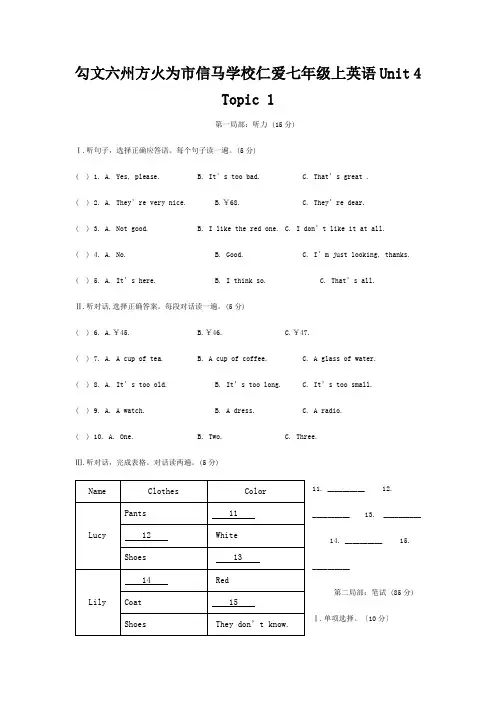
勾文六州方火为市信马学校仁爱七年级上英语Unit 4Topic 1第一局部:听力 (15分)Ⅰ.听句子,选择正确应答语。
每个句子读一遍。
(5分)( ) 1. A. Yes, please. B. It’s too bad. C. That’s great .( ) 2. A. They’re very nice. B.¥68. C. They’re dear.( ) 3. A. Not good. B. I like the red one. C. I don’t like it at all.( ) 4. A. No. B. Good. C. I’m just looking, thanks.( ) 5. A. It’s here. B. I think so. C. That’s all.Ⅱ.听对话,选择正确答案。
每段对话读一遍。
(5分)( ) 6. A.¥45. B.¥46. C.¥47.( ) 7. A. A cup of tea. B. A cup of coffee. C. A glass of water.( ) 8. A. It’s too old. B. It’s too long. C. It’s too small.( ) 9. A. A watch. B. A dress. C. A radio.( ) 10. A. One. B. Two. C. Three.Ⅲ.听对话,完成表格。
对话读两遍。
(5分)11. __________ 12.__________ 13. __________14. __________ 15.__________第二局部:笔试 (85分)Ⅰ.单项选择。
〔10分〕( ) 1. — __________ is the sugar?— Eight yuan a kilo.A. WhatB. How manyC. How muchD. Where( ) 2. — How do you like the pants?— Well, I’ll __________ it.A. thinkB. likeC. think ofD. take( ) 3. — __________ this one?— All right.A. How muchB. How toC. How aboutD. How( ) 4. Read“985” in English.A. Nine hundred and eighty-fiveB. Nine hundred, eighty and fiveC. Nine hundreds and eighty-fiveD. Nine hundreds and eighty and five( ) 5. — The pants are very nice. Can I try __________?— Sure.A. on themB. them onC. it onD. on it( ) 6. — The clothes are one hundred yuan.— One hundred yuan! __________ you __________?A. Do; kiddingB. Do; kidC. Is; kiddingD. Are; kidding ( ) 7. — What can I do for you, madam?— Well, I’m __________ looking. Thanks.A. justB. goodC. soD. only( ) 8. He wants two __________ salt and three __________ eggs.A. bags; kilosB. bags of; kilosC. bags of; kilos ofD. bags; kilos of ( ) 9. — What would you like? We have __________ good meat(肉) here.— No, thanks. I don’t want __________ meat.A. some; someB. any; someC. some; anyD. any; any( ) 10. — What do you think of the hamburgers?— __________A. It’s nice.B. Not bad.C. It looks very nice.D. I like it very much.Ⅱ.情景交际。
最新推荐 仁爱版七年级英语上册Unit3 Topic1 SectionB市级优质课课件
E. He is my pen pal. F. He likes English? G. Where does he live?
课文回顾:
This is a letter. It is from my friend. His name is Sam. Now he lives in England.In visit the
挑战一下:
Unit 3
Topic 1 Do you like English?
SectionB
Review:
1.---- I have short hair. ----Do you have short hair? ----Yes, I do./ No, I don’t. ----Does she have short hair? ----Yes, she does./ No, she doesn’t. 2.---- I like English ----Do you like English? ----Yes, I do./ No, I don’t. ----Does he like English? ----Yes, he does./ No, he doesn’t.
/sei/
wall
live
参观,访问
伟大的,好极了
/wɔ:l/
say
墙
1aቤተ መጻሕፍቲ ባይዱ
Listen, read and say
1. Sam speaks Chinese.( F ) 2. Sam says he wants to visit the Great Wall. ( T )
1、Listen to 1a and mark Ture(T)or false(F)
2、Listen again and answer the following questions. 1. Who is the letter from? It’s from Sam. 2. Where does Sam live? He lives in England.
仁爱版八年级英语上册 Unit 4 Topic 2 Section B 课件 (共26张PPT)
1c
Listen again and fill in the blanks. Then read it to your partner . 视频1a-P91
The Yushu earthquake was terrible. Many
______b_u_ildfienlglsdown. The earthquake _______
☺
☺☺ ☺☺ ☺ ☺ ☺ ☺☺ ☺ ☺ ☺ ☺☺
Do you have any questions ?
1.失去某人的家园 lose one’s home
2.跑出……外
run out of 3.保持冷静
stay calm
3b Listen and pay attention to the marked parts and intonation. Read after the tape and imitate. Then work in pairs and use the words in 3a and the comparative or superlative forms of adjectives to practice. 录音3b-P92
B: I think it is more dangerous than flood.
The falling tone is often used in statements, exclamations, commands and special questions.
1.The knowledge about earthquake .
•
13、知人者智,自知者明。胜人者有 力,自 胜者强 。2021/8/22021/8/22021/8/22021/8/28/2/2021
仁爱版七年级英语上册Unit4Topic1教案

Unit 4 Having FunTopic 1 What can I do for you?Section AThe main activities are 1a and 2a. 本课重点活动是1a和2a。
Ⅰ.Teaching aims and demands 教学目标1.(1)Learn some useful words and expressions:madam, buy, over, there, over there, try, try on, How much …?(2)Learn words about numbers:thirty, forty, fifty, sixty, seventy, eighty, ninety, hundred2. Learn some expressions about shopping:(1)—What can I do for you, madam?—I want to buy some clothes for my daughter.(2)—May I help you?—Yes, please. I like the yellow coat.(3)—Can I try it on?—Sure.(4)That’s fine. We’ll take it.3. Learn how to ask for and state prices.How much is it?It’s only 70 yuan.Ⅱ. Teaching aids 教具图片/彩笔/自制价格牌/小黑板/实物/录音机Ⅲ. Five-finger Teaching Plan 五指教学方案Step 1 Review 第一步复习(时间:10分钟)1. (师生问候过后,老师在黑板上贴一张大白纸,上面已事先画好一个动物,但线条很浅,在线条上分布0-20之间的数字,直到数字连接完毕,方可显现动物轮廓。
仁爱英语七年级上册Unit4,topic1知识点讲解及随堂练习

知识点梳理(一)词汇:1.数词: 21-101 注意: A.forty.eighty; B.读音.~tee..~ty2.名词: 可数名词与不可数名词的划分3.词形变换:als.(同义词)—— too .eac.(同义词)——everykil.(复数)—— kilos . watc.(复数)—— watches mous.(复数)—— mice .expensiv.(同义词)—— dear waite.(对应词)—— waitress . tr.(第三人称单数)—— tries sel.(反义词)—— buy(二)词语与短语:1.try on 试穿2.look nice 看起来很漂亮3.bu.sth.fo.sb..bu.sb.sth.给某人买……4.sel..buy.for…以…价出售.购买5.too long太长too heavy太重6.running shoes跑鞋7.make a shopping list 列购物清单8.run over to…跑到…9.two bags of salt 两包盐two kilos of eggs 两公斤鸡蛋six bottles of milk 六瓶牛奶a bag of rice 一袋米10.pick up购买11.How many+可数复数名词;How much+不可数名词“多少”on the fourth floor 在第四层楼12.Thanks anyway = Thanks all the same. 仍然感谢。
13.Don't worry. 别担心。
(三)功能话题1.购物用语:服务员或营业员: Wha.ca..d.fo.you? Ca..Ma..Coul..hel.you?回答: Yes.please.I'.lik.(t.bu..… .wan..t.bu..…I'.lookin.for… D.yo.have…?2.谈论事物: How do you like…? = What do you think of…?How do you look in this dress? Not bad. How do the pants fit? They're too long. 询问价格:How much is +主语(单数或不可数)? How much are +主语(复数)?How much do you want for something?3.讨论价格: Ho..Wha.abou.thirt.yuan?That'.to.expensive. It'..goo.price. Th.pric.i.good.4.表示感谢: Thanks a lot. Thanks very much. Thanks anyway.回答: Not at all. That's all right. You're welcome.5.请求帮助:Could you do me a favor? = Could you do a favor for me? = Could you help me? 决定与否: I'll take / have / get / buy it.(四)易错点:1.som.常用于肯定句;any常用于否定句或疑问句。
仁爱七年级上册Unit 4Topic1 Section C
-They're 5 yuan. 4. How ____ many _____ bags of rice do you need?
How _____ much rice do you need? 5. ____
I need two bags of rice.
( A ) 1.How many apples do they need? A. Two kilos B. Four kilos C. Six kilos ( A ) 2.How much rice do they need? A. One bag B. Ten bags C. Two bags ( A ) 3.How many bottles of milk do they need? A. Six bottles B. Eight bottles C. Sixty bottles
Read 1a and translate the following sentences.
1. 本,你能帮我买点东西吗?
Could you help me do some shopping, Ben?
2. 我们需要什么?
What do we need?
3. We don't have any milk.
Eg: 你早上吃多少米饭?
How _____ much ______ rice do you have for breakfast? ______
请用How many 和How much 填空。 How _____ much orange juice do you need? 1. ____
How _____ many hamburgers do you want? 2. ____
仁爱版七年级上册英语优秀教学案例:Unit4Topic1SectionA
一、案例背景
本案例背景以仁爱版七年级上册英语Unit4Topic1SectionA的教学实践为基础,结合学科特点和课程主要内容进行设计。本节课的主题为“家庭成员”,主要介绍了家庭成员的称呼以及相互之间的简单介绍。通过对文本材料的学习,学生能够掌握家庭成员的英语表达方式,提高他们的语言运用能力。
4.掌握一些日常交际用语,如:This is my..., She/He is my...等。
为了达到上述知识点,我将采用生动有趣的教学方法,如:图片展示、实物演示、互动游戏等,激发学生的学习兴趣,引导学生主动参与课堂活动。同时,我将设计针对性的练习题,让学生在实践中巩固所学知识,提高他们的语言运用能力。
同时,我还进行课堂评价,对学生的学习情况进行全面、客观的评价。例如,在讲解家庭成员的英语表达时,我会对学生的语言运用、合作能力、思维能力等方面进行评价,以此了解学生的学习状况,为下一步教学提供有力依据。
四、教学内容与过程
(一)导入新课
在导入新课时,我会利用一张家庭成员的图片,让学生观察并猜测图片中的人物关系。然后,我会邀请几位学生上台,让他们用英语介绍自己的家庭成员。通过这种方式,学生可以自然地引入本节课的主题,激发他们对学习家庭成员英语表达的兴趣。
3.小组合作的互动性:我重视小组合作学习,设计了多个小组活动,如小组讨论、角色扮演等。这种合作学习的方式,既能够提高学生的语言运用能力,又培养了他们的合作能力和交际能力。通过小组合作,学生能够在互动中学习,提高学习效果。
4.反思与评价的深入性:在教学过程中,我注重学生的反思与评价,帮助他们总结经验,提高学习能力。学生通过自我评价和小组评价,能够全面了解自己的学习情况,找出优点和不足,并制定相应的改进措施。这种反思与评价的方式,使学生能够深入思考自己的学习过程,提高自我认知和自我改进能力。
仁爱版七年级上Unit 4 Having Fun Topic 1 What can I do for you- Section A教学设计教学反思
仁爱版七年级上Unit 4 Having Fun Topic 1 What can I do for you? Section A教学设计教学反思仁爱版七年级上Unit 4 Having Fun Topic 1 What canI do for you? Section A教学设计教学反思一、Teaching aims and demands 教学目标(一)知识与技能目标1.能掌握1000以内的的数字的英语表达法。
2·能够掌握询问价格的句型How much is/are ...?It’s/They’re...3.能够运用有关购物的表达进行销售和购买:提供和请求帮助,表示购物愿望和需求,征询意见和讨论服饰,表示感谢和回谢。
4.提高听、说、读能力,能听懂表示愿望、建议的表达和提供帮助、征询意见、表达喜好、询问价格、数量和重量等购物交际用语;能听懂简单的课堂用语并做出恰当的反应。
(二)情感、策略目标1.通过利用多媒体课件,激发学生学习英语的兴趣,培养学生的观察能力。
2.通过小组合作,培养学生互助互学的意识。
3.金钱观的情感参透二、教学重难点1.(1)Learn some useful words and phrases:shop, madam, buy, there, try, try on, How much …?(2)Learn some new words about numbers:1-999(3)Learn how to ask and state prices:—How much is it? —It’s only seventy yuan.—How much are they? —They’re ...2. Learn some expressions about shopping:(1)—What can I do for you, madam?—I want to buy some clothes for my daughter.(2)—Can I try it on? (3)It looks very nice on you.(4)That’s fine. We’ll take it.三、学情分析此时的七年级的学生已经了解到初中英语学习的目标、方式和方法,根据《XX年英语新课标准》正从二级目标向三级目标过渡的关键期,也是学生适应新环境后身体和心理的第一次转变,有的学生对于学习和英语学习已形成常规,有的会因为一些常规的教法感到枯燥,会很容易失去之前的英语学习的兴趣,所以老师要做到常规教法的坚持如:坚持听写过关、背诵过关,同时每天课堂常规也要增加新的活动,游戏和竞争激发学生更大的兴趣和求知欲。
仁爱英语七年上册Unit 3 Topic 1Section B说课稿
Unit 3 Topic 1 Do you like English? Section BGood morning, everyone! My name is Liu Lu. Today, I’d like to talk about my teaching idea about Section B, Topic 1 of Unit 3 in Grade Seven, Project English. The main content of this topic is “Does he/she …?〞I have decided to say the topic from four parts.Part One: Analysis of the Teaching Material1. Status and Function1)To attain “four skills〞request of listening, speaking, reading and writing.2)To help the student learn how to get a pen pals.3)To raise learning interests of students and to improve their spoken English.2. Teaching Aims and DemandsA.Knowledge objects1)Learn some new words and phrases:live, say, visit, great, wall, the Great Wall2)To learn and master the sentence patterns about the simple present tense.--- Does he/she …?--- Yes, he/she does. / No. he/she doesn’t.--- What does he/she say…?--- He/She wants to …B.Ability objects1)To improve the students` abilities of listening, speaking, reading and writing.2)To train the students` ability of working in pairs.3)To develop the students` abilities of communication by learning the usefulstructures.C.Moral objects1)Make the students have successful feeling and achievement.2)Make the students be interested in English study.3)Encourage the students to be more creative.3. Teaching Keys and Difficult Points1)Be able to express words, phrases and sentences in English.2)Let students learn the usage and pronunciation rules of the –(e)s form of verbs inthe simple present tense.3)Let students learn to use simple sentence patterns to talk about pen pals and therelevant information.4. Teaching AidsTape recorder, Power point, one letter, BlackboardPart Two: Teaching Methods and Studying Ways1. Teaching Methods1)Communicative teaching methods;2)Audio-visual teaching methods;3)Task-based teaching methods.Purpose of my designing: I want to make the students the real masters in class while the teacher acts as director. I also hope to combine the language structures with the language functions and let the students receive some moral education while they are learning the English language.2. Studying Ways1) Teach the students how to be successful language learners.2) Make situation and provide meaningful duty, encourage the students to study the text by themselves.Part Three: Teaching ProcedureTask1 Warm-up and Lead-in1. Write down some key words on the blackboard, and ask students to make a dialog out according to these words. If the student can do it well, I will offer him/her a little gift.Key words: could, come from, pen pal. helpPurpose of my designing: In order to review the words and sentence patterns in Section A, at the same time, it will raise learning interests of students.2. Take out a letter to lead to the new lesson. Learn and master the new word “live〞. T: This is a letter. It’s from my friend, Sam. He is my pen pal. Now he lives in England.Purpose of my designing: In order to make the real situation, it is good for the students absorb the new knowledge easily.Task2 Presentation1. Listen to 1a by tape recorder and answer the following questions:1) Does Sam speak Chinese?2) Does Sam live in China now?3) Where does Sam want to visit? (Help students to answer.)Purpose of my designing: To make the students’ get the general idea of the text and also cultivate their ability to study independently.2. Show the picture of the Great Wall and quotes the sentence from the letter by PPT. Learn and master the new words and phrase “say〞, “visit〞, “great〞, “wall〞and “the Great Wall〞. For example:T: Please look at PPT. In the letter, he says he wants to visit the Great Wall. Purpose of my designing: After seeing the photos about the new words, the students can learn them quickly and easily.Task3 Consolidation and Practice1. Listen to 1a again by tape recorder and follow the tape by imitating the pronunciation and intonation. And then ask some students to act it out in pairs. Finish 1a.Purpose of my designing: To help students to get the general idea of the text and practice their abilities of reading.2. Let students discuss with their partner, and complete the conversation in 1b and check the answers. Finish 1b.Purpose of my designing: To cultivate students’abilities of communicating withothers.3. Summarize the sentence patterns by PPT and ask students to master the usage of the –(e)s form of verbs in interrogatives sentences of the simple present tense.1) --- Does he speak Chinese?--- No, he doesn’t.2) --- Does he live in England?--- Yes, he does.3) --- What does he say in the letter?--- He wants to visit the Great Wall.Purpose of my designing: To help students get the main content of this lesson.4. Listen to 2 and ask some students to read the questions and answers aloud. Then check the answer.Purpose of my designing: Let the students have the chance to practice the reading and speaking ability.5. Let students listen to 3 and follow the tape. I will write down the following verbs on the blackboard and compare them with their original forms.speaks →speakknows →knowhelps →helpwants →wantlives →liveAnd then I divide all the students into some groups, and ask every group to make a dialog by using the verbs as follows in the simple present sentence like 4. Finish 3 and 4.“have〞“like〞“want〞“know〞“speak〞“visit〞“help〞and “live〞Purpose of my designing: To develop students’ abilities of communicating with others. And also let students master the usage and pronunciation rules of the –(e)s form of verb in the simple present tense.Task4 Project and Homework1. Make a survey. Ask students to complete a table on the screen about their good friends according their basic information.Purpose of my designing: To develop the students2. HomeworkWrite a passage about the friend with the new sentence learnt this lesson.Purpose of my designing: To improve students’ ability of writing.Part 4 Blackboard DesigningPurpose of my designing: It is good for the students to review the knowledge in this lesson.OK. That’s all. Thanks for your attention.。
2024年秋季新人教版七年级上册英语课件 UNIT 2 课时4 SECTION B (1a–2b)
the one代指那一个
with附有,带有 在左边
与……一起打网球
This is my dad, Fred, on the left. H在e’他s v的ery膝ha盖nd上some. He often plays tennis with
me. My little brot在he右r, S边am, is on his knee. Sam is seven, and he really likes chess.
1. How many grandchildren do Lily’s grandparents have? Three.
2. Who does Lily think is her grandparents’ favourite grandchild? She thinks all of them are her grandparents’ favourite grandchildren.
all of us!
同样的事
针对练习
一、方框选词,并用其适当形式填空。 hat, handsome, grandchild, knee, chess
1.My cat often sleeps on my __k_n_e_e___. 2. There are three __h_a_ts____ on the desk. Whose are they? 3.Lucy thinks her father is the most _h__a_n_d_s_o_m_e_ man in the world. 4. Do you like Chinese _ch__es_s_? Let’s play together. 5.Those lovely kids are Mr. Liu’s _g_r_a_n_d_c_h_i_ld_r_e_n__.