
高中英语 语法复习讲义+训练 动词不定式
高中英语语法复习讲义——动词不定式一.相关知识点精讲:1. 不定式作补语1) 有些有动词+宾语+不定式的结构。
例如:advise allow cause challengeco mmand compeldrive驱使enable encourageforbid force impelinduce instruct invite like/loveorder permitmake let have want get warnpersuaderequest send tell train urge例如;Father will not allow us to play on the street. 父亲不让我们在街上玩耍。
The officer ordered his men to fire. 长官命令士兵开火。
注意:有些动词如make,have,get,want等可用不定式作做宾补,也可用分词作宾补。
现在分词表达主动,也表达正在进行,过去分词表达被动。
2) 有些有动词+宾语+不定式的结构,不定式的动词往往是be,不定式一般可以省去。
例如:considerfind believe think declare appointguess fancy(设想)guess judge imagine know例如:We believe him to be guilty. 我们相信他是有罪的。
We know him to be a fool. 我们知道他是个笨蛋。
(to be不能省去)典型例题Charles Babbage is generally considered___ the first computer.A. to inventB. inventingC. to have inventedD. having invented答案:C. 一般没有consider+宾语+be以外不定式的结构,也没有consider+宾语+doing的结构,排除A、B、D。
consider用动词be以外的不定式作宾补时,一般要求用不定式的完成式,故选C。
3) 有些动词可以跟there +to be的结构。
例如:believe expect intend like lovemeanprefer want wish understand例如:We didn't expect there to be so many people there. 我们没料到会有那么多人在那里。
You wouldn’t want there to be another war. 你不至于想让另外一场战争发生吧。
2. 不定式作主语不定式作主语,往往用it作形式主语,真正的主语不定式放至句子的后面。
例如:It's so nice to hear your voice. 听到你的声音真高兴。
It's necessary for you to lock the car when you do not use it. 不用车的时候,锁车是有必要的。
It's very kind of you to help us.他帮助我们,他真好。
It see med selfish of him not to give them anything.他不给他们任何东西,这显得太自私了。
但是,用不定式作主语的句子中还有一个不定式作表语时,不能用It is… to…的句型。
另外,这样的句子,不能用动名词作表语。
3. It's for sb.和 It's of sb.这样的句子中,由于表语形容词性质的不同,导致了不定式逻辑主语标志用for或of的区别。
1)for sb. 句型中的形容词一般为表示事物的特征特点,表示客观形式的形容词,如easy, hard,difficult, interesting, impossible等:例如:It's very hard for him to study two languages. 对他来说学两门外语是很难的。
2)of sb句型中的形容词一般为表示性格,品德,心智能力,表示主观感情或态度的形容词,如good,kind, nice, clever, foolish, right。
例如:It's very nice of you to help me. 你来帮助我,你真是太好了。
用for还是用of 的另一种辨别方法:用介词for或of后面的逻辑主语作句子的主语,用介词前边的形容词作表语,造个句子。
如果通顺用of,不通则用for。
例如:You are nice.(通顺,所以应用of)。
He is hard. (非所表达的意思,不通,因此用for。
)4. 不定式作表语不定式可放在be动词后面,形成表语。
例如:My work is to clean the room every day. 我的工作是每天清扫房间。
His dream is to be a doctor. 他的梦想是成为一名医生。
5. 不定式作定语不定式做定语通常要放在被修饰的词后,往往表示未发生的动作。
例如:I have a lot of work to do.我有许多事要做。
There was nothing to bring home that morning. 那天早上(他回家时)两手空空。
6. 不定式作状语1)目的状语常用结构为to do , onl y to do(仅仅为了), in order to do,so as to do,s o(such)… as to…(如此…以便…)。
例如:He ran so fast as to catch the first bus.他飞快地跑以便赶上第一班车。
I come here only to say good-b ye to you.我来仅仅是向你告别。
2)作结果状语,可以表示没有预料到的或事与愿违的结果,不定式要放在句子后面。
I awoke to find my truck gone. 我醒来发现箱子不见了。
He searched the room only to find nothing. 他搜索了房间,没发现什么。
3) 表原因I'm glad to see you. 见到你很高兴。
She wept to see the sight. 她一看到这情形就哭了。
4)表示理由和条件He must be a fool to say so.You will do well to speak more carefully.7.用作介词的toto 可以用作介词,也可用作不定式的标示。
下面的to 都用作介词:admit to object tobeaccustomed tobe usedtosticktoturn to开始look forward tobedevoted topayattention tocontribute toapologize todevoteoneself to8. 省去to 的动词不定式1) 情态动词 ( 除ought 外) 后。
2) 使役动词 let, have, make后,感官动词 see, watch, look at, notice , observe, hea r, listento, smell, feel, find 等后。
注意:被动语态中不能省去to。
例如:I saw him dance. 我看见他跳舞。
He was seen to dance.The boss made them work the whole night. 老板让他们整夜干活。
They were made to wor k the whole night.3) would rather,had better句型后4) Why… / why no…句型后5) help 后可带to,也可不带to, help sb (to) do sth:6) but和except后。
but前是实义动词do时,后面出现的不定式不带to。
比较:He wants to do nothing but go out. 他只想出去玩。
He wants to believe anything but to take the medicine. 除了吃这药,他什么都信。
7) 由and, or和than连接的两个不定式,第二个to 可以省去:8) 通常在discover, imagine, suppose, think等词后作宾补时,可以省去to be。
例如:He is supposed (to be) nice.他应该是个好人。
9.动词不定式的否定式在不定式标志to前加上not。
例如:Tell him not to shut the window。
让他别关窗。
She pr etended not to see me when I p assed by. 我走过的时候,她假装没看见。
10.不定式的特殊句型too…to…1)too…to太…以至于…。
例如:He is too excited to speak. 他太激动了,说不出话来。
---- Can I help you ? 需要我帮忙吗?---- Well, I'm afraid the box is too heavy for you to carry it, but thank you all the same.不用了。
这箱子太重,恐怕你搬不动。
谢谢。
2) 如在too前有否定词,则整个句子用否定词表达肯定,too 后那个词表达一种委婉含义,意为"不太"。
例如:It's nev er too late to mend.改过不嫌晚。
(谚语)3) 当too 前面有only, all, but时,意思是:非常… 等于very。
例如:I'm only too pleased to be able to help you. 能帮助你我非常高兴。
He was but too eager to get home. 他非常想回家。
11. 不定式的特殊句型so as to1) 表示目的;它的否定式是so as not to do。
例如:Tom kept quiet about the accident so as not to lose his job.汤姆对事故保持沉默是为了不丢掉他的工作。
Go in quietly so as not to wake the baby.轻点进去,别惊醒了婴儿。
2)表示结果。
例如:Would you be so kind as to tell me the time? 劳驾,现在几点了。
第11讲 非谓语动词:动词不定式(讲义)(学生版) 2025年高考英语一轮复习讲练测(新教材新高考)
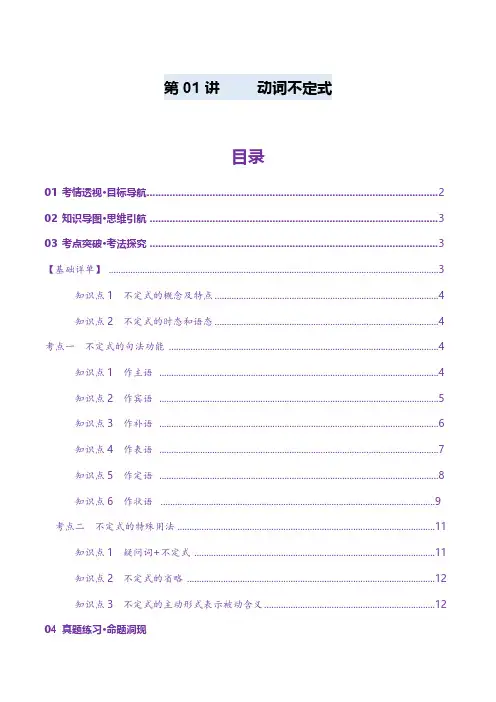
第01讲动词不定式目录01 考情透视.目标导航 (2)02 知识导图.思维引航 (3)03 考点突破.考法探究 (3)【基础详单】 (3)知识点1 不定式的概念及特点 (4)知识点2 不定式的时态和语态 (4)考点一不定式的句法功能 (4)知识点1 作主语 (4)知识点2 作宾语 (5)知识点3 作补语 (6)知识点4 作表语 (7)知识点5 作定语 (8)知识点6 作状语 (9)考点二不定式的特殊用法 (11)知识点1 疑问词+不定式 (11)知识点2 不定式的省略 (12)知识点3 不定式的主动形式表示被动含义 (12)04 真题练习·命题洞现1.真题实战 (13)2.命题演练 (14)三年真题考点分布【基础详单】知识点1 不定式的概念及特点非谓语动词指不能单独作谓语,但保留动词的某些特征的动词形式。
包括动词不定式、动名词和分词(现在分词和过去分词)三类,它们没有人称和数的变化,但根据发生的时间、状态及主被动关系有形式上的变化,还可以有自己的宾语和状语。
动词不定式的基本构成形式:“to+动词原形”。
知识点2 不定式的时态和语态考点一不定式的句法功能知识点1 作主语【名师提醒】 1.不定式作主语时,相当于名词或代词,谓语动词用单数形式。
2. “赞扬,责备”的形容词通常用of sb作逻辑主语:wrong, right, kind, nice, brave, careful, careless, greedy, honest, lazy, modest, selfish, thoughtful, impolite, polite, clever, foolish, silly, stupid, cruel, rude, generous,considerable等。
3. 以下形容词通常用for sb作逻辑主语:easy, hard, difficult, important, necessary, impossible, possible, safe, dangerous, unusual, wonderful等用for sb作逻辑主语。
高中英语语法讲义:动词不定式考点详析与练习

动词不定式由“to + 动词原形”构成,可以在句子中充当除谓语之外的任何成分。动词 不定式具有动词的性质,可以带宾语和状语,且有完成式、完成进行式、进行式、被动式 和否定形式等变化。
考点详析 一、 不定式的基本形式 由“to + 动词原形”构成;其否定形式是“not to + 动词原形”,若加强语气可用“never to + 动词原形”。 She promised never to tell a lie again. 她承诺再也不撒谎了。 二、 不定式的时态和语态 不定式一般有时态和语态的变化,通常有下表中的几种形式(下面以 do 为例): 1. 不定式的时态 (1) 不定式所表达的动作与谓语动词同时发生或在谓语动词之后發生时,不定式用 一般式。 They planned to employ some skilled workers. 他们打算雇几个有技术的工人。 (2) 不定式所表达的动作与谓语动词同时发生,并强调动作正在进行或一直在持续, 不定式用进行式。 He pretended to be reading when I came in. 当我进来的时候,他假装在看书。 (3) 不定式的动作发生在谓语动词表示的动作之前,不定式用完成式。 The disabled man is said to have translated several novels into French. 据说这个残 疾人已将几本小说翻译成法语。 (4) 如果强调不定式所表示的动作从过去某一时刻起一直持续到某一时刻,不定式 用完成进行式,此时,强调动作的持续性,不强调结果。 She seems to have been reading the novel for three hours. 好像她已经看了 3 个小时 的小说了。 2. 不定式的语态
动词不定式(二)讲义-高三英语一轮复习

III作补足语1、不定式作补足语不定式作补足语表示将要做、还未做的事情。
He wants me to join them. 他想要我加入他们。
I told him not to give in. 我告诉他不要屈服。
在感官动词和使役动词引导的补足语中的to会省略掉。
至于说为什么,大家可以这样去理解:感官动词是人直接可以观察到的,是已经发生的,此时就不需要不定式表示这种将要做、还未做的状态。
使役动词表示是表示使、令、让、帮、叫等意义,表达一种立刻就要进行的动作,也因此就不需要不定式表示这种将要做、还未做的状态。
I saw him walk across the road.我看见他穿过马路。
Pains make us grow up. 痛苦使我们成长。
而在感官动词和使役动词的被动语态中是会恢复省略的to 的. He was seen by me to walk across the road.我看见他穿过马路。
We was made by pains to grow up. 痛苦使我们成长。
2、现在分词作补足语现在分词作补足语表示动作正在进行,并且宾语和补足语之间存在主动关系。
I saw him walking across the road at that time.当时我看见他正穿过马路。
3、过去分词作补足语过去分词作补足语表示动作已经完成,并且宾语和补足语之间存在被动关系。
I saw him hit by the truck when he was crossing the road.我看见他在过马路时被卡车撞了。
IV作状语1、时间状语从句2、原因状语从句3、条件状语从句4、让步状语从句状语从句 5、目的状语从句6、结果状语从句7、地点状语从句8、比较状语从句9、方式状语从句1、现在分词作状语在状语从句的简化章节中我们知道,现在分词作状语可以作为:时间状语、原因状语、条件状语以及让步状语;在并列复合句的简化中我们知道现在分词可以作为伴随状语;在非限制性定语从句的简化中我们知道现在分词可以作为结果状语。
高中英语语法复习动词不定式的用法

⾼中英语语法复习动词不定式的⽤法动词不定式专题复习动词不定式的形式:动词不定式的⽤法1.不定式作主语⑴原则上,可⽤动词不定式直接作句⼦的主语,通常⽤it作句⼦的形式主语,⽽把不定式移到后⾯,形成“It + 谓语… + 动词不定式…”的句型。
如:To catch the 5:00 bus early in the morning is not a good idea.It is not a good idea to catch the 5:00 bus early in the morning.To learn a foreign language well takes painstaking efforts.It takes painstaking efforts to learn a foreign language well.⑵若要说明不定式的动作的执⾏者,可以在不定式前⾯加上“for + 名词或代词”结构,或是“of + 名词或代词”结构。
It is a great pleasure for me to talk with him. It is very kind of you to help me .⑶可⽤于“of + 名词/代词 + 动词不定式”结构中作主语补⾜语的形容词是指那些可以表⽰⼈或事物的性质或品质的好坏的形容词。
这些词如:careful, cruel, foolish, bold, brave, good, honest, kind, rude,polite, nice,stupid, selfish,silly, wicked, wise, thoughtful, wrong等。
2.不定式作宾语不定式作宾语有两种情况:⼀是及物动词后直接跟带to的不定式,⼆是“动词+疑问词+带to的不定式”。
⑴“动词+带to的不定式”结构:常见的以不定式作宾语的动词有afford, appear, agree, ask, believe,decide, demand,desire, fail, hope, intend,learn, mean, offer, promise,refuse, wish等。
2019高考必备语法——动词不定式的讲解及练习课件(共29张)

动词不定式的句法功能
作宾语
• 1.不定式短语作宾语时,如果还带有宾语补足语,往往把不定 式宾语放在宾语补足语之后,而用it作形式宾语。如: • He wanted to go. • I find it interesting to study history. • 2.有些动词后只能用动词不定式作宾语,必须跟动名词。如: decide,plan,desire,expect,hope, wish,pretend,promise, refuse,afford,agree,ask,fail,tend,pretend,manage。
2.动词不定式的时态和语态
不定式
主动语态
被动语态
一般式
进行式
to do
to be doing
to be done
__________
完成式
完成进行式
to have done
to have been doing
to have been done
动词不定式的时态和语态
• 1. They pretended not to see us. .(一般式表示与谓语的动作(状态)同时(或几乎同时)发生, 或是在它之后发生 ) • 2. When his mother came in , he pretended to be sleeping. (谓语表示的动作(情况)发生时,不定式表示的动作正进行, 这时不定式就要用进行式) • 3.She pretended to have known it before. •.(完成式的动作发生于谓语动词动作之前)
动词不定式的用法
ONTENTS
目 录
1 2
动词不定式的结构
动词不定式的时态及语态
新教材2025版高中英语语法精讲1动词不定式作主语和表语学案牛津译林版选择性必修第一册

语法精讲①动词不定式作主语和表语12.动词不定式作主语动词不定式作主语时,一般表示详细的或一次性的动作。
作主语的不定式有时态和语态的改变,且谓语动词通常用单数。
To finish this job in one day is impossible.要在一天之内完成这项工作是不行能的。
(表示详细的状况)动词不定式作主语时,有以下两种形式:(1)把不定式置于句首❶To get there by bike will take us half an hour.我们骑自行车到那儿须要半个小时。
(2)用it作形式主语,把作真正主语的不定式(短语)后置,常用于以下结构中:①It +be+名词+to do sth.❷It's our duty to take good care of the old.照看好老人是我们的责任。
②It takes sb.+some time+to do sth.❸How long did it take you to finish the work?你花了多长时间来完成这项工作?③It+be+形容词+for sb.+to do sth.❹It is difficult for us to finish writing the composition in a quarter of an hour.在十五分钟内完成这个作文对我们来说太难了。
④It+be+形容词+of sb.+to do sth.❺It is stupid of you to write down everything the teacher says.你将老师所说的话全部登记来是一种很笨的方法。
[特殊留意] 动名词(短语)作主语多表示一般性的、抽象的、重复性的动作或状态。
Reading poems gives me much pleasure.读诗给我带来许多乐趣。
3.动词不定式作表语动词不定式(短语)作表语通常用来说明主语的详细内容(职业、职责或性质等),也可以表示目的、愿望等。
2024届高三英语语法一轮复习考点动词不定式用法注意点与语法结构 讲义素材
2024届高三英语高考一轮复习语法考点动词不定式用法注意点与语法结构(讲义)动词不定式特征:动词不定式具有名词、副词和形容词的性质。
动词不定式作用:动词不定式在句子中可充当主语、宾语、宾语补足语、表语、定语和状语。
动词不定式九大注意点01使役动词和感官动词的宾语补足语,省略t o(注意:被动语态“t o”加回)。
S h e s a w h e r d au ght e r e nt e r t h e r oom.(H e r d au gh t er wa s s e en t o en t er t h e ro om.)她看见女儿进了房间。
I h e a r d hi m s i n g h ap pi l y j u s t n ow.(H e w as h e a rd t o s i n g h ap pi l y j u s t n ow.)我刚才听到他快乐地唱歌。
02w o ul d r at he r, h ad be t t e r(b e st)等习惯用法之后,省略t o。
I w o u l d r at h e r(not)st a y a t h om e.我宁愿(不)呆在家里。
Y o u h ad b et t e r e at m o re fi sh, l e s s m e at.你最好多吃鱼少吃肉。
03不定式作表语时,它的前面出现d o的各种形式时,省略t o。
T h e on l y t h i n g I c a n do i s w a i t.我唯一能做的事就是等着。
A l l t he y n e e d t o do n ow i s t a k e a b r e ak.现在他们需要的是好好休息。
04“W h y n o t do st h.?” 和“W h y d o n't yo u d o s t h.?”句型中,省略t o。
W h y n o t t r y i t a ga i n?= W h y d o n't yo u t ry i t a ga i n?为什么不再试一下呢?05在w h en, i f, w ha t,as等从句中与l i k e, w a nt, wi s h连用时,省略t o。
高考英语语法动词不定式讲义
高考英语语法动词不定式讲义语法动词不定式讲义动词不定式的定义:动词不定式是非谓语动词的一种,它没有人称和数的变化,在句子中不能独立作谓语,但它仍保持动词的特点,既可以有自己的宾语和状语动词不定式的用法:动词不定式具有名词、形容词和副词的特征。
因此在句中可以做主语、表语、宾语、宾语补足语、定语和状语。
动词不定式的基本形式:一般形式to do一般式表示的动作或状态,发生在谓语动词表示的动作或状态的同时或之后否定形式not to do被动形式to be done进行形式to be doing进行式表示的动作或状态,与谓语动词表示的动作或状态同时发生完成形式to have done完成式表示动作或状态,发生在谓语动词表示的动作或状态之前一、不定式做主语:1、不定式做主语一般表示具体的某次动作。
e.g: To finish the building in a month is difficult work.To do such things is foolish.注: 1 不定式作主语时,谓语用单数2、当主语较长,谓语较短时,常用it做形式主语,而将不定式放到谓语的后面。
it做形式主语,不定式放在谓语动词之后常用于下列结构中:(1) It is/was +adj.+of sb. to do…注意:在此句型中,adj. 只能用可以修饰人物的形容词。
例如: kind nice good brave clever wise stupid foolish honest careless cruel generouseg: It is brave of him to save the girl in the waterIt was careless of her to make such a mistake(2) It is +adj.+for sb.+to do…注意:这里的adj. 不能表示人的性质,只能表示某事或某物的性质。
高考英语语法专题复习:非谓语动词讲义(不定式、动名词
高中英语语法专题复习03 非谓语动词(不定式、动名词&现在分词、过去分词)非谓语动词谓语动词在句子中有三种作用:1. 表示动作的时间,tense (时)2. 表示动作的状态,aspect (体)3. 表示动作的语气,mood (气)谓语动词的“时体气”,通过动词变位实现。
例如,The rabbit ate a carrot.The rabbit is eating a carrot.The rabbit has eaten a carrot.谓语动词在句子中受到主语的限制,随之出现了时态和人称的变化,成为一种被限定了的动词,所以也被称为限定性动词(finite verb)。
与之相对的,不受主语限制的动词,称为非限定性动词(non-finite verb),也就是非谓语动词。
非谓语动词不具备表达时态和人称的作用。
例如,I like to eat carrot.I liked eating carrot.The rabbit likes minced carrot.非谓语动词有四种形式:1. 不定式 infinitive2. 动名词 gerund3. 现在分词 present participle4. 过去分词 past participle谓语动词是简单句的核心动词,非谓语动词只可能出现在其他的句子成分中。
1. 主语例:Swimming makes us hale and hearty.2. 宾语例:Janet suddenly stopped talking.3. 表语/主语补语例:Her wish is to become a doctor in the future.4. 宾语补语例:I invited him to come here.5. 定语例:Don't disturb the sleeping dog.6. 状语例:He went to the supermarket to buy a pen.不定式、动名词句子的核心动词只能由谓语动词充当,而非谓语动词可以充当句子的其他成分。
高考英语之动词不定式讲义
动词不定式1.形式:to do(有时to可省略);否定形式:not to do2.时态和语态主动语态被动语态意义一般时to do to be done 表示动作与谓语动作同时发生或发生在谓语动作之后1.I’m so glad to hear from you.2.The meeting is able to be held.完成时to have done to havebeen done表示动作发生在谓语动作之前1.I’m glad to have invited you to attend myparty.2.I’m glad to have been invited to attendyour party.进行时to be doing 表示谓语动作发生时,不定式的动作正在进行He seems to be eating something.完成进行时to have beendoing表示动作发生在谓语动作之前且一直持续到谓语动作发生时,仍在进行She is said to have been teaching English forover twenty years.3.作用功能:作主语:主谓一致:1)单个不定式作主语,谓语用单数To improve English is the most urgent thing for me now.2)大于等于两个不定式作主语,但语义一致或基本一致、或不定式作为一个整体时,谓语用单数To love and to be loved is sweet to us.3)大于等于连个不定式作主语,但语义不一致,谓语用复数To improve people’s lives and to speed up socialize construction are two important tasks today.it做形式主语:1)It+be+adj.+for sb to do:(用for sb时,形容词修饰to do sth ,形容词常用修饰事或物的词,如easy, difficult, hard, important, possible, impossible, comfortable,)It’s difficult for him to give up smoking= To give up smoking is difficult for him.It+be +adj.+of sb to do(用of sb时,形容词修饰sb,形容词常用修饰人品质的词,如nice, stupid, rude, clever, foolish, thoughtful, thoughtless, brave, considerate, silly) It’s kind of you to help me.=You are kind to help me2)It+is/was+名词+to do:It's our duty to take good care of the old.=To take good care of the old Is our duty3)It takes/took sb+some time+to do:It takes me an hour to do homework everyday.=To do homework takes me an hour everyday.作表语:放在系动词后面,表示将来的动作或解释说明主语的内容主语常是wish, idea, task, purpose, duty, aim,hope,mistake等表示意向、打算、计划的词My aim is to point out the difficulties of the matter.作状语: 目的状语:I come here to see you.常用:in order to,so as to,so(such)…as to…(如此……以便……)结果状语:表事先没有预料到的,出乎意料的结果,常放在句子末尾He arrived at the station ,only to find that the train had left.常用:enough to, only to. . . ,too. . . to原因状语:常放在表情绪或心理活动的形容词之后I’m glad to see you.(glad的原因是see you)作宾语:1)跟在某些及物动词的后面, 常见的有:agree, ask, decide, hope, fail, manage, pretend, refuse等。