
冀教版九年级1-3单元知识点总结
2. The average blue whale is about four times as big as the biggest elephant. 一般的蓝鲸大约是最大的大象的四倍。 常见的表示倍数增加的句型: (1) A is n times as great (long,much,...) as B. (2) A is n times greater (longer, more,...) than B.
2. Please run as fast as you can. A. as fast as possible C. so fast as you can B. fast than you D. as fastly as possible
3. Zhuang Yong began swimming when she was 8. A. begin to swim C. starts swim B. begins to swim D. started swimming
一. 选出与划线部分意思相同或相近的选项。 1. The students stopped talking when the teacher came in. A. went on talking C. talked and talked B. stopped to talk D. didn’t talk any more
(2)词语拓展 in the end = at last 最后 endless adj. 无止境的 end v. 结束 2. He said that I should always try hard, and never give up. 他说我应该一直努力 ,永不放弃。 give up 意为“放弃”,后跟名词或v-ing 形式。例如: The doctor told the old man to give up smoking. 医生要那位老人戒烟。 词汇拓展: give in 屈服;让步;投降 give away 赠送 give out 用完;耗尽
特殊疑问词+to do
例2:I don’t know what to say. 我不知道该说什么。
特别注意,两个问题
a. 顺序问题,可以总结为 宾从陈序 (即宾语从句,陈述句语序)
例3: Could you tell me where the bus stop is? 你能告诉我汽车站在哪吗? b. 时态问题,若主句用一般现在时,从句可以用任意时态,具体的要根据从句 中的时间状语来决定;若主句用一般过去时,从句要用表示过去的某个时态 (一般过去时/过去进行时/过去完成时/过去将来时)例如: 例4:The teacher said (that) we would have a special lesson next week. 老师说过下个星期我们将有一节特殊的课。
5. There are trees and flowers on _____ side of the street.
A. each B. every C. both D. all
6. Are you good at _____?
A. swim
B. swimming
C. swims
D. swimming
practise (U.S. practise ) v. 意为“练习” ,后跟名词或v-ing 形式。 例如:
He is practicing playing football. 他正在练习踢足球。 7. 关于fill 和 full .
fill 有两个短语: fill…with “用……把……装满,主语是人,强调动作的过程。 Be filled wit语是物,强调状态。例如:
三. 单项选择。
1. Zhuang Yong won China’s _____ gold medal _____ swimming. A. one ; in B. one ; for C. first ; in D. first ; for
2. Twenty of us like swimming, _____ like shooting . A. others B. the others C. other D. the other
①The boy filled the glass with water. 小男孩把玻璃杯里装满了水。
②The bottle is full of milk. 瓶子里装满了牛奶。
③He is filled with /full of confidence. 他充满了自信。
8. I asked him what I should do. 我问他我应该做什么。 在这里 what I should do 是一个宾语从句,等于what to do。在宾语从句中, 疑问词+主语+should + v.原形 = 疑问词 + to do 不定式 ,这是宾语从句的一种表 达法。 例如:
4. up 和down up 可以指“向上;调大;向……的较远处去;沿……而去”;down 是up的 反义词,意为“向下;调小;沿着(向下,回来的方向)”。例如:
例1:It’s too noisy, please turn down the radio. 收音机声音太吵了,请关小一 点。
例2:He is going up the tree. 他正向着那棵树走去。
10. I don’t know if my parents _____ free. If they ____ free tomorrow, we _____ for a picnic. A. are ; are ; go B. are; will be ; go C. will; are ; will go D. will be ; are ; will go
例3:Can you swim down the pool? 你能沿着游泳池游回来吗?
5. He did his best, but he kept falling off the pizzas. 他尽了力,但还是不断地从 “比萨饼”上掉下来。 keep (on) doing sth. “继续做某事;重复做某事”,on 可以省略。例如: 例1:You can keep (on) doing your homework. 你可以继续做你的家庭作业。 keep sb. from doing sth. “ 阻止某人做某事”,其中from不可以省略。例如: 例2:The bells kept me from sleeping. 铃响得我睡不着觉。 6. If he practices walking on pizzas, he’ll do better next time! 如果他能在“比萨饼” 上做行走练习,下次他会做的更好。
例1: Could you tell me where I should go next? 你能告诉我下一步该去哪了 吗?
=Could you tell me where to go next? 指点迷津 宾语从句的类型有以下几种: (1)由that引导(其中that可以省略)。 I don’t know he is a Japanese. 我不知道他是个日本人。 (2)由特殊疑问词引导包括两种: 特殊疑问词+陈述句 例1:I don’t know what I should say. 我不知道该说什么。 (同上)
重点、难点解析及词语辨析: 1. At the end , we asked questions. 在谈话的最后,我们问了问题。 At the end 在这是 at the end of the talking 的省略。顺便谈谈end 的用法。
at the end of„ 到„„ 的尽头或在„„结束时。 (可表时间,也可表地点) 例如:At the end of the road , there is a building . 在这条路的尽头,有一座大楼。 (1) At the end of this term , we will have an exam. 在本学期末,我们将有一场考试。 by the end of„ 直到„„结束时( 指时间) 例如:By the end of this year ,we have learned 2500 words. 到本学期结束时,我 们已经学了 2500 个单词。
3. We believe in you! 我们信任你。 believe in 指“信任,信赖” 。后跟名词,代词或v-ing 形式。例如: 例1 : I firmly believe in doing morning exercises everyday. 我坚信每天做早操 有好处。 例2: Do you believe in that new invention? 你相信那个新发明吗? 而believe 指“相信”。 后跟从句。例如: 例3: I believed what he said. 我相信他所说的。
1. I have been standing on one foo t for more than three minutes. 我独脚站立已有三分多钟了。
more than 意为“超过、多余”,相当于over。如: I ha ve more than one hundred books. 我有一百多本 书。
C. watch
B. catch up with
D. go after
二. 用括号内所给单词的适当形式填空。
1. She jumped the ______( far ) of all. farthest going 2. What about ______( go ) boating tomorrow? 3. Please try two ______( many ) times. I’m sure you can make it. more 4. He left the room without saying say ) goodbye. ______( 5. Well ______( do )! Congratulations. done
冀教版九年级单元知识点
冀教版九年级单元知识点九年级是初中最后一个学年,也是学生们面临中考压力的一年。
为了帮助同学们更好地应对考试,梳理和掌握九年级教材中的各单元知识点是非常必要的。
本文将对冀教版九年级上册各单元的知识点进行总结和归纳。
第一单元:回归自然1. 生物多样性:了解不同生物种类和数量的多样性,懂得保护自然环境,维护生物多样性的重要性。
2. 生态系统:认识到生物与环境之间相互依存的关系,明白生态平衡的重要性。
第二单元:人生感悟1. 成长故事:了解一些成功人士成长的故事,激励自己努力学习和进取。
2. 健康与快乐:认识到身心健康对快乐生活的重要性,学会保持积极的心态。
第三单元:生活在网络时代1. 网络安全:了解网络世界存在的风险和安全问题,学会正确使用网络,并保护个人信息的安全。
2. 网络文化:认识到网络对传播文化和交流的重要性,培养正确的网络行为和文化素养。
第四单元:科技改变生活1. 科技发展史:了解人类科技发展的历史和趋势,思考科技对社会生活的影响。
2. 人工智能:认识到人工智能对社会生活的重要性,体验和掌握一些基本的人工智能技术。
第五单元:传统文化的魅力1. 中华文化:了解中华传统文化的历史和价值,培养对中华文化的自豪感和归属感。
2. 传统节日:认识到传统节日对文化传承的重要性,学习传统节日的习俗和意义。
第六单元:重要问题1. 环境污染:了解环境污染的成因和危害,掌握环境保护的基本知识和方法。
2. 青少年问题:认识到青少年面临的成长问题,学会正确处理身边的困惑和挑战。
第七单元:当代作家1. 现代文学作品:了解当代作家及其作品,培养对文学的欣赏和理解能力。
2. 阅读与写作:提升阅读和写作能力,培养对文字的审美和表达能力。
第八单元:科学探究1. 科学实验与观察:了解科学实验和观察的基本原理和步骤,培养科学精神和实践能力。
2. 科学发现:认识到科学发现对人类社会进步的重要性,解决问题的能力。
第九单元:数学的奥妙1. 数学基础:掌握九年级数学的基本概念、公式和计算方法。
冀教版九年级英语上学期1-3单元知识点
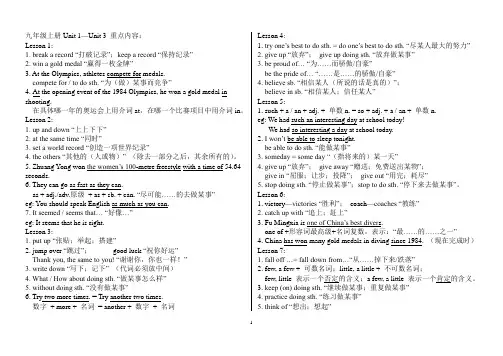
九年级上册Unit 1—Unit 3 重点内容:Lesson 1:1. break a record “打破记录”;keep a record “保持纪录”2. win a gold medal “赢得一枚金牌”3. At the Olympics, athletes compete for medals.compete for / to do sth. “为(做)某事而竞争”4. At the opening event of the 1984 Olympics, he won a gold medal in shooting.在具体哪一年的奥运会上用介词at,在哪一个比赛项目中用介词in。
Lesson 2:1. up and down “上上下下”2. at the same time “同时”3. set a world record “创造一项世界纪录”4. the others “其他的(人或物)” (除去一部分之后,其余所有的)。
5. Zhuang Yong won the women’s 100-metre freestyle with a time of 54.64 seconds.6. They can go as fast as they can.as + adj./adv.原级+ as + sb. + can. “尽可能……的去做某事”eg: You should speak English as much as you can.7. It seemed / seems that… “好像…”eg: It seems that he is right.Lesson 3:1. put up “张贴;举起;搭建”2. jump over “跳过”;good luck “祝你好运”Thank you, the same to you! “谢谢你,你也一样!”3. write down “写下;记下”(代词必须放中间)4. What / How about doing sth. “做某事怎么样”5. without doing sth. “没有做某事”6. Try two more times. = Try another two times.数字+ more + 名词= another + 数字+ 名词Lesson 4:1. try one’s best to do sth. = do one’s best to do sth. “尽某人最大的努力”2. give up “放弃”;give up doing sth. “放弃做某事”3. be proud of… “为……而骄傲/自豪”be the pride of… “……是……的骄傲/自豪”4. believe sb. “相信某人(所说的话是真的)”;believe in sb. “相信某人;信任某人”Lesson 5:1. such + a / an + adj. + 单数n. = so + adj. + a / an + 单数n.eg: We had such an interesting day at school today!We had so interesting a day at school today.2. I won’t be able to sleep tonight.be able to do sth. “能做某事”3. someday = some day “(指将来的)某一天”4. give up “放弃”;give away “赠送;免费送出某物”;give in “屈服;让步;投降”;give out “用完;耗尽”5. stop doing sth. “停止做某事”;stop to do sth. “停下来去做某事”。
冀教版英语初三各单元知识点总结

冀教版英语初三各单元知识点总结冀教版英语初三共分为八个单元,以下是每个单元的知识点总结:1. Unit 1: Greetings and Introductions- Greetings: hello, hi, good morning/afternoon/evening, how are you?- Introductions: What's your name? My name is..., How old are you? I'm ..., Where are you from? I'm from..., etc.- Personal pronouns: I, you, he, she, it, we, they.- Basic conversation skills: asking and answering basic questions, introducing oneself and others.2. Unit 2: School Life- School subjects: English, math, science, history, geography, etc. - School facilities: classrooms, library, laboratory, playground, etc.- School activities: attending classes, doing homework, participating in sports, etc.- School supplies: books, pens, pencils, notebooks, etc.3. Unit 3: Daily Routine- Daily activities: wake up, get dressed, havebreakfast/lunch/dinner, go to school, do homework, go to bed, etc. - Time expressions: in the morning/afternoon/evening, at 8o'clock, etc.- Adverbs of frequency: always, often, sometimes, rarely, never, etc.4. Unit 4: Hobbies and Interests- Hobbies: dancing, singing, painting, swimming, playing music instruments, etc.- Likes and dislikes: I like..., I don't like..., etc.- Expressing preferences: I prefer..., I enjoy..., etc.- Activities related to hobbies: practicing, performing, joining clubs, etc.5. Unit 5: Shopping- Vocabulary related to shopping: clothes, shoes, groceries, etc. - Expressions for asking and answering about prices, sizes, and colors.- Giving directions and following instructions: go straight, turn left/right, etc.- Bargaining and negotiating: Can I get a discount? etc.6. Unit 6: Food and Drink- Vocabulary related to food: fruits, vegetables, meat, drinks, etc. - Expressions for ordering food and drinks: I'd like..., Can I have..., etc.- Table manners and etiquette: using utensils, saying thank you, etc.- Describing taste and preferences: sweet, sour, spicy, etc.7. Unit 7: Travel- Means of transportation: car, bus, train, plane, etc.- Vocabulary related to travel: tickets, passport, suitcase, etc.- Expressions for asking and giving directions: How can I get to...? etc.- Talking about past travel experiences: I've been to..., etc.8. Unit 8: Health and Safety- Vocabulary related to health: medicine, doctor, hospital, etc.- Expressions for describing symptoms: I have a headache, I feel sick, etc.- Giving advice and suggestions: You should..., etc.- Safety rules and precautions: wearing helmets, crossing theroad safely, etc.以上是冀教版英语初三各单元的知识点总结,希望对你有帮助!。
冀教版九年级英语全册知识点总结
冀教版九年级英语全册知识点总结9th Grade English Unit 1 Knowledge Points Summary1.Break a world record: to surpass a us achievement and set a new record.2.Get a gold medal: to win the top XXX.3.With a time of。
: indicating the amount of time it took to complete a task or event.4.At the same time: XXX.5.Up and down: moving in a vertical n.6.Set a world record: to XXX.7.As fast as possible: as quickly as can be achieved.8.XXX sb: XXX's abilities。
XXX sb: XXX.9.Make sb proud: to cause someone to feel a sense of pride.10.Give up: XXX.11.Be able to do sth: to have the ability to do something。
be unable to do: to lack the ability to do something.12.At the age of。
: indicating the age at which something occurred.13.Catch up with: to reach the same level as someone or something else.14.None of: indicating the absence of any of something.15.Fall off: to drop or separate from a surface or object.16.Do one's best: to put XXX.17.XXX: XXX.9th Grade English Unit 2 Knowledge Points Summary1.XXX: XXX.2.Hold a world record: to maintain a current record.3.XXX。
冀教版英语初三各单元知识点总结
冀教版英语初三各单元知识点总结以下是冀教版英语初三各单元的知识点总结,帮助学生复习和巩固所学的内容。
Unit1:Hello,everyone!-问候与介绍:如Hello!How are you?What's your name?Nice to meet you 等。
-国家与国籍:如China,America,Chinese,American等。
-人称代词:主格、宾格、物主代词的用法。
Unit2:It’s the tallest animal in the world.-描述动物:外貌特征、生活习性、栖息地等。
-形容词的比较级和最高级:规则和不规则形式的构成及用法。
-物体的位置:如in front of,behind,on,under等表示位置的介词短语。
Unit3:I’m more outgoing than my sister.-描述个人特点:如外向、友好、有耐心等。
-形容词的比较级和最高级的运用:描述人物特点和能力。
-比较句型:如Ais+形容词比较级+than+B。
Unit4:My family and friends-家庭成员:爸爸、妈妈、兄弟姐妹等。
-家庭关系:如father,mother,brother,sister等词汇及表达方式。
-描述家人:年龄、外貌特征、兴趣爱好等。
Unit5:Do you have a soccer ball?-物品的所有权:如have,has的用法。
-物品的数量:如some,any,many,much等表示数量的词汇。
-物品的种类和用途:如soccer ball,basketball,computer等。
Unit6:I’m going to study computer science.-将来计划与打算:如be going to+动词原形。
-职业和专业:如doctor,teacher,engineer,musician等。
-描述未来发展和兴趣:如study,work,play,learn等动词。
冀教版冀教版九年级地理全册知识点归纳

冀教版冀教版九年级地理全册知识点归纳
地理是一门研究地球及其上的人类社会、自然环境,以及二者之间相互作用的学科。
九年级的地理教材通过不同的章节和单元,介绍了许多重要的地理知识点。
以下是《冀教版九年级地理全册》中的知识点的归纳:
第一章:地理学的研究对象和研究方法
- 地理学的定义和研究对象
- 地理学的研究方法和研究手段
第二章:地球的内部
- 地球的构造和地壳运动
- 地壳的结构和板块构造理论
第三章:地球的外部
- 陆地的形成和变化
- 气候和水资源的分布
第四章:人口与城市
- 人口与人口问题
- 城市化和城市规划
第五章:农业与农村
- 农业的类型和发展
- 农村经济和农民生活
第六章:工业与城市
- 工业的类型和布局
- 工业化对城市的影响
第七章:交通与通信
- 交通方式和交通网络
- 信息技术和通信网络的发展
第八章:能源与矿产资源- 能源资源的开采和利用
- 矿产资源的分布和开发
第九章:环境与保护
- 环境问题和环境保护
- 可持续发展和节约资源
以上是《冀教版九年级地理全册》中的知识点归纳。
通过学习这些内容,我们可以更好地了解地球的构造、人口与城市、农业与农村、工业与城市、交通与通信、能源与矿产资源以及环境与保护等方面的知识。
希望这份归纳对你的学习有所帮助!。
冀教版英语九年级全一册 Unit 1:Lesson 3 Good Food,Good Health.
eg. A balanced diet and regular exercise are both important for health. on a diet (为减肥)节食 设计意图: 教师引导学生找出本课的重点短语和句型,使学生明确学习目标和学习内
Step 6 课堂练习 I. 根据句意及汉语提示,填写单词。
1. WouldΒιβλιοθήκη you like some(玉米)?
2. Do you know that
(豆子) have a lot of protein?
3. I guess the family over there are from an
(亚洲的) country.
容,激发学习的热情
Step 3 Practice and Play
1.Divide the class into groups to complete the exercise.
2.Show Let’s Do It!No.2 on PPT.
Match each word with its definition.Then complete the passage using the four words.
【 Keys 】 1.They are made from gains. 2.Vitamins,minerals and fibre. 3.Fish,eggs,beans,tofu,other bean products and soy milk. 4.Make our bones and teeth strong.
Language Points 1. be made of 和 be made from 的区别是:
冀教版九年级上册英语unit1知识点
冀教版九年级上册英语unit1知识点冀教版九年级上册英语Unit 1知识点Unit 1是九年级上册英语课本的第一单元,主要讲解学生如何自我介绍和介绍他人。
在这个单元中,学生将学习如何用英语表达自己的姓名、年龄、国籍和兴趣爱好,并且学会询问别人的个人信息。
以下是Unit 1的知识点总结。
1. 介绍个人信息在英语中,当我们要介绍自己时,通常会使用以下句型:- My name is...- I am...- I come from...- I am interested in...例如,当我们要介绍自己时,可以说"My name is Lisa. I am 14 years old." 当我们想介绍他人时,我们可以使用类似的句型:"His name is Tom. He is from England."2. 提问个人信息当我们想询问别人的个人信息时,我们可以使用以下句型:- What is your name?- How old are you?- Where do you come from?- What are you interested in?例如,如果我们想问别人的名字,可以说"What is your name?" 如果我们想问别人喜欢什么,可以说"What are you interested in?"3. 询问和回答年龄在英语中,当我们询问别人的年龄时,可以使用以下句型:- How old are you?- What is your age?回答时,可以使用以下句型:- I am... years old.例如,如果别人问你"How old are you?",你可以回答"I am 14 years old."或者"My age is 14."4. 询问和回答国籍当我们想了解别人的国籍时,可以使用以下句型:- Where do you come from?- What is your nationality?回答时,可以简单回答国家名称,例如China或者America。
冀教版九年级1-3单元知识点总结
4. What he did surprised everyone. A. surprising B. amazing C. amazed D. surprise
5. Just follow me and I will show you where the library is. A. look after C. watch B. catch up with D. go after
10. I don’t know if my parents _____ free. If they ____ free tomorrow, we _____ for a picnic. A. are ; are ; go B. are; will be ; go C. will; are ; will go D. will be ; are ; will go
3. We believe in you! 我们信任你。 believe in 指“信任,信赖” 。后跟名词,代词或v-ing 形式。例如: 例1 : I firmly believe in doing morning exercises everyday. 我坚信每天做早操 有好处。 例2: Do you believe in that new invention? 你相信那个新发明吗? 而believe 指“相信”。 后跟从句。例如: 例3: I believed what he said. 我相信他所说的。
2. Please run as fast as you can. A. as fast as possible C. so fast as you can B. fast than you D. as fastly as possible
3. Zhuang Yong began swimming when she was 8. A. begin to swim C. starts swim B. begins to swim D. started swimming
冀教版九年级历史各单元必考知识点汇编
冀教版九年级历史各单元必考知识点汇编本文档整理了冀教版九年级历史教材各单元的必考知识点,供同学们备考使用。
第一单元:秦汉时期的中国- 秦始皇统一中国- 秦朝的政治制度- 郡县制的建立- 秦朝的法律制度- 秦朝的军事力量- 秦朝对外的开疆辟土- 秦朝的经济状况第二单元:中国古代的文明- 中国古代的四大发明- 铁器的使用与发展- 科举制度的实施- 古代建筑的发展与特点- 经典文化的传承与影响- 中国古代的书法艺术- 四大名著的创作与意义第三单元:东汉时期的中国- 东汉末年的动乱与分裂- 三国时期的政治格局- 三国鼎立的战争与军事- 三国时期的文化与艺术- 三国时期的经济状况- 东汉末年的灾害与社会动荡第四单元:隋唐时期的中国- 隋朝的政治制度与变革- 隋文帝与隋炀帝的治理政策- 隋朝的军事力量与对外扩张- 唐朝的政治制度与疆域变迁- 开元盛世与盛唐文化- 唐朝的科技发展与外交交往- 唐朝的经济繁荣与贸易第五单元:唐宋时期的中国- 宋朝的政治制度与内忧外患- 北宋时期的政治改革- 五代十国的政治格局- 宋朝的军事力量与战争- 宋代的科技与文化成就- 南宋的经济繁荣与外交交往- 宋代社会的发展与变革第六单元:元明时期的中国- 元朝的政治制度与南北政权的冲突- 元朝的军事力量与对外扩张- 明朝的政治制度与改革- 明朝的海上禁止与航海活动- 明朝的科技与文化成就- 明朝的经济发展与社会变革- 明朝的陶瓷和杂剧文化第七单元:明清时期的中国- 清朝的开国与政治制度- 清朝的军事力量与对外侵略- 清朝的政治改革与变革- 清朝的科技与文化发展- 清朝的经济状况与贸易- 明清时期的社会俗与风俗- 明清时期的大规模移民和边疆建设以上是九年级历史教材各单元的必考知识点汇编,希望对同学们的备考有所帮助。
祝大家取得好成绩!。