
人教版七年级英语上册知识点总结
人教版七年级英语上册知识点总结导读:我根据大家的需要整理了一份关于《人教版七年级英语上册知识点总结》的内容,具体内容:初中阶段是初中生英语学习的关键阶段,下面是由我分享的,希望对你有用。
(一)1 (see 、hear 、notice 、find 、feel 、listen to 、 l...初中阶段是初中生英语学习的关键阶段,下面是由我分享的,希望对你有用。
(一)1 (see 、hear 、notice 、find 、feel 、listen to 、 look at (感官动词)+do eg:I like watching monkeys jump2 (比较级 and 比较级) 表示越来越怎么样3 a piece of cake =easy 小菜一碟(容易)4 agree with sb 赞成某人5 all kinds of 各种各样 a kind of 一样6 all over the world = the whole world 整个世界7 along with同......一道,伴随...... eg : I will go along with you我将和你一起去the students planted trees along with their teachers 学生同老师们一起种树8 As soon as 一怎么样就怎么样 9 as you can see 你是知道的10 ask for ......求助向...要...(直接接想要的东西) eg : ask youfor my book11 ask sb for sth 向某人什么12 ask sb to do sth 询问某人某事 ask sb not to do 叫某人不要做某事13 at the age of 在......岁时 eg:I am sixteen I am at the age of sixteen14 at the beginning of ...... ......的起初;......的开始15 at the end of +地点/+时间最后;尽头;末尾 eg : At the end of the day16 at this time of year 在每年的这个时候17 be /feel confident of sth /that clause +从句感觉/对什么有信心,自信eg : I am / feel confident of my spoken English I feel that I can pass the test18 be + doing 表:1 现在进行时 2 将来时19 be able to (+ v 原) = can (+ v 原) 能够...... eg : She is able to sing She can sing20 be able to do sth 能够干什么 eg :she is able to sing21 be afraid to do (of sth 恐惧,害怕...... eg : Im afraed to go out at night Im afraid of dog22 be allowed to do 被允许做什么eg: Im allowed to watch TV 我被允许看电视 I should be allowed towatch TV 我应该被允许看电视23 be angry with sb 生某人的气 eg : Dont be angry with me24 be angry with(at) sb for doing sth 为什么而生某人的气(二)25 be as...原级...as 和什么一样 eg : She is as tall as me 她和我一样高26 be ashamed to 27 be away from 远离 28 be away from 从......离开29 be bad for 对什么有害 eg : Reading books in the sun is bad for your eyes 在太阳下看书对你的眼睛不好30 be born 出生于 31 be busy doing sth 忙于做什么事 be busy with sth 忙于......32 be careful 当心;小心 33 be different from...... 和什么不一样34 be famous for 以......著名 35 be friendly to sb 对某人友好 36 be from = come from 来自 eg :He is from Bejing He comes from Bejing Is he from Bejing ? Does he come from Bejing ?37 be full of 装满......的 be filled with 充满 eg: the glass is full of water the glass is filled with water38 be glad+to+do/从句 39 be going to + v(原) 将来时40 be good at(+doing) = do well in 在某方面善长, 善于......41 be good for 对什么有好处 eg : Reading aloud is good for yourEnglish42 be happy to do 很高兴做某事43 be helpful to sb 对某人有好处eg : Reading aloud is helpful to you 大声朗读对你有好处Exercising is helpful to your bady 锻炼对你的身体有好处44 be in good health 身体健康45 be in trouble 处于困难中 eg : She is in trouble They are in tronble46 be interested in 对某方面感兴趣47 be late for = come late to 迟到 eg: Be late for class 上课迟到48 be like 像...... eg : Im like my mother49 be mad at 生某人的气50 be made from 由......制成(制成以后看不见原材料)51 be made of 由......制成(制成以后还看得见原材料) 52 be not sure 表不确定53 be on a visit to 参观 54 be popular with sb 受某人欢迎55 be quiet 安静 56 be short for 表**的缩写 eg: 陶 is short for 陶俊杰57 be sick in bed 生病在床 58 be sorry to do sth be sorry for sb eg : I am sorry for you59 be sorry to hear that 60 be sorry to trouble sb eg : I am sorryto trouble you61 be strict in doing sth 严于做某事 eg : Hes strict in obeying noles62 be strict with sb 对某人要求严格 eg: Some students are not strict with them selves 这些学生对自己不严格63 be strict with sb in sth 某方面对某人严格 64 be supposed to do 被要求干什么65 be sure 表确定 66 be sure of doing sth 对做某事有信心 eg: He is sure of winning I am sure of learning English well67 be sure of sth 对做某事有信心 eg: Im sure of my head (my teacher 我相信我的大脑(老师)68 be sure that sth 对做某事有信心 eg: Im suer that he can pass the test 我相信他能通过考试69 be sure to do sth一定会做某事eg: We are sure to pass the test 我们一定会通过这次考试 We are sure to learn English well 我们一定能学好英语70 be terrified of + 名/动doing 害怕...... 71 be terrified to do sth 害怕做某事72 be the same as ... 和什么一样 73 be used to doing sth 习惯做某事eg: My father is used to getting up early 我爸爸习惯早He is used to sleeping in class 他习惯上课睡觉74 be worth doing 值得做什么 75 be(feel) afraid to do sth 害怕做某事be afraid of sth 害怕某物 be afraid that 丛句76 because+句子 because of +短语eg : He was late because he had a headache He was late because of his headache77 begin to do = start to do 开始做某事start...with...=begin...with... 以什么开始什么eg : Lets begin the game with the song I begin to go home78 between...and... 两者之间79 borrow sth from sb 向......借...... lend sth to sb ( lend sb sth 借给......什么东西eg : I borrowed a pen from him he lent a pen to me ( he lent mea pen80 both = the same(as) = not different(from) 表相同81 bother 打扰 bother sb to do stheg : Im sorry to bother you ,but can you tell me to way to the station我十分道歉打扰你,但是你能告诉我怎么去车站the problem has been bothering me for weeks 这个问题困扰了我几个周了Hes bothering me to lend him money82 by the end of 到......为止 83 call sb sth eg : We call him oldwang84 care 关心 eg : Dont you care about this countrys future ?你为什么不关心国家的未来85 catch up with sb 赶上某人 86 chat with sb 和某人闲谈 take sb to + 地点带某人去某地87 come in 进88 come over to 过来89 come up with 提出 eg: Can you come up with a good idea 你能想出一个好办法吗?90 communicate with sb 和某人交流。
英语人教版七年级上册知识点

英语人教版七年级上册知识点一、词汇。
1. 问候语:hello, hi。
2. 人称代词:I, you, he, she, it, we, they。
3. 指示代词:this, that。
4. 数字:zero 到 nine。
5. 颜色:red, yellow, green, blue, black, white, purple, brown, pink, orange。
6. 家庭成员:father, mother, parent, sister, brother, grandmother, grandfather, grandparent。
7. 学习用品:pencil, pen, book, eraser, ruler, schoolbag, dictionary。
二、语法。
1. 一般现在时:主语 + be 动词(am/is/are) + 其他。
- I am a student.- You are nice.- He/She is my friend.2. 指示代词 this/that 的用法。
- This is a pen. That is a book.3. 名词的单复数。
- 一般在名词后加 -s 表示复数,如:book - books。
- 以 s, x, ch, sh 结尾的名词加 -es,如:box - boxes。
- 不规则变化,如:man - men, woman - women。
4. 形容词性物主代词。
- my(我的),your(你的/你们的),his(他的),her(她的),its(它的),our(我们的),their(他们的/她们的)三、句型。
1. 打招呼和自我介绍。
- -Hello! I'm Mary.- -Hi! My name is Tom.2. 询问物品。
- -What's this/that in English?- -It's a/an...3. 确认物品所属。
人教版初中英语七年级上册语法知识点
have表示“有”时,其否定形式有两种:在其后直接加not,但常用于非正式用语中;利用助动词do加not。
②如果句子的谓语是实义动词,在谓语动词前加don't,doesn't,didn't。
③no,never,seldom,hardly,nobody,little,few,nothing等否定词也可以构成否定形式。
1.表示经常性或习惯性发生的动作2.表示现在存在的状态或情况3.表示正在发生的动作或存在的状态4.表示客观事实、真理和自然现象5.用于表示较固定的、按计划、规定将要发生的动作,但只限于begin,come,go,leave,arrive,stop,return,close,open,take,start,take,place等少数动作,6.用于if,unless,once,even if(即使)等引导的条件状语从句,when,before,until,as soon as,the moment(一……就)等引导的时间状语从句,no matter+wh-/-how-或wh-ever/however等引导的让步状语从句中,代替一般将来时
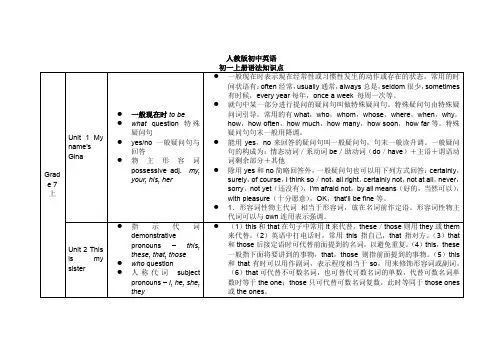
人教版初中英语
初一上册语法知识点
Grade 7
上
Unit 1 My name’s Gina
人教版英语七年级知识点汇总
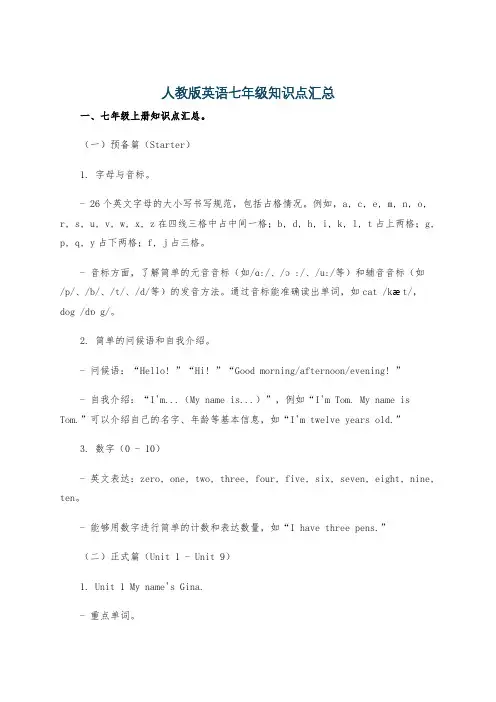
人教版英语七年级知识点汇总一、七年级上册知识点汇总。
(一)预备篇(Starter)1. 字母与音标。
- 26个英文字母的大小写书写规范,包括占格情况。
例如,a, c, e, m, n, o, r, s, u, v, w, x, z在四线三格中占中间一格;b, d, h, i, k, l, t占上两格;g, p, q, y占下两格;f, j占三格。
- 音标方面,了解简单的元音音标(如/ɑ:/、/ɔ:/、/u:/等)和辅音音标(如/p/、/b/、/t/、/d/等)的发音方法。
通过音标能准确读出单词,如cat /kæt/,dog /dɒg/。
2. 简单的问候语和自我介绍。
- 问候语:“Hello! ”“Hi! ”“Good morning/afternoon/evening! ”- 自我介绍:“I'm...(My name is...)”,例如“I'm Tom. My name is Tom.”可以介绍自己的名字、年龄等基本信息,如“I'm twelve years old.”3. 数字(0 - 10)- 英文表达:zero, one, two, three, four, five, six, seven, eight, nine, ten。
- 能够用数字进行简单的计数和表达数量,如“I have three pens.”(二)正式篇(Unit 1 - Unit 9)1. Unit 1 My name's Gina.- 重点单词。
- name(名字),nice(美好的),to(不定式符号,无实义),meet(遇见),too(也),your(你的;你们的),his(他的),her(她的)。
- 重点句型。
- “What's your name? ”“My name's...(I'm...)”用于询问和回答名字。
- “Nice to meet you. ”“Nice to meet you, too.”用于初次见面时的问候。
人教版七年级上册英语知识点总结

人教版七年级上册英语知识点总结人教版七年级上册英语知识1【重点单词】banana /b?'na:n?/ n. 香蕉hamburger /'h?mb?:g?/ n. 汉堡包tomato /t?'ma:t?u/ n. 西红柿ice-cream /ais'kri:m/ n. 冰激凌salad /'s?l?d/ n. 沙拉strawberry /'str?:b?ri/ n. 草莓pear /pe?/ n. 梨milk /milk/ n. 牛奶bread /bred/ n. 面包birthday /'b?:θdai/ n. 生日dinner /'din?/ n. (中午或晚上吃的)正餐week /wi:k/ n. 周;星期think about 思考;思索food /fu:d/ n. 食物sure /?u?/ adv. 当然;肯定;一定How about...? (提出建议)......怎么样? burger /'b?:g?/ n. (=hamburger)汉堡包vegetable /'ved?t?bl/ n. 蔬菜fruit /fru:t/ n. 水果right /rait/ adj. 正确的;适当的apple /'?pl/ n. 苹果then /?en/ adv. 那么egg /eg/ n. 蛋;鸡蛋carrot /'k?r?t/ n. 胡萝卜rice /rais/ n. 大米;米饭chicken /'t?ikin/ n. 鸡肉so /s?u/ conj. (引出评论或问题)那么breakfast /'brekf?st/ n. 早餐;早饭lunch /l?nt?/ n. 午餐star /sta:/ n. 明星;星星eat /i:t/ v. 吃well /wel/ adv. 好;令人满意地habit /'h?bit/ n. 习惯healthy /'helθi/ adj. 健康的really /'ri:?li/ adv. 真正地question /'kwest??n/ n. 问题want /w?nt/ v. 需要;想要be /bi:/ v. 变成fat /f?t/ adj. 肥的;肥胖的一.短语归纳1.John’s birthdaydinner 约翰的生日晚餐2.next week 下周3.think about 思考、考虑4.how about 怎么样5.some fruit 一些水果6.his birthday 他的生日7.sport star 体育明星 8.eating habits 饮食习惯9.for breakfast 作为早餐 10.for dinner 作为晚餐11.one lastquestion 最后一个问题 12.healthy food 健康的食品二.重点句型:1.have sth 吃……2.—Do you like…? 你喜欢…吗?—Yes, I do / No, I don’t. 是的,我喜欢/不,我不喜欢。
人教版七年级上册英语重点知识点

人教版七年级上册英语重点知识点一、英语字母和发音英语字母共有26个,包括五个元音字母a、e、i、o、u和21个辅音字母。
每个字母都有自己的发音,需要正确掌握。
二、日常用语和问候1. 问候语(Greetings): Good morning!(早上好!)Good afternoon!(下午好!)Good evening!(晚上好!)Hi!(嗨!)Hello!(你好!)2. 自我介绍(Introductions):My name is…(我叫……)I am…years old.(我……岁了。
)3. 询问他人身份(Asking about someone):What's your name?(你叫什么名字?)How old are you?(你多大了?)三、数字和时间表达1. 数字(Numbers):英语中使用阿拉伯数字表示数字,例如:0、1、2、3等。
2. 时间表达(Time expressions):What time is it?(现在几点了?)It's ______ o'clock.(现在是几点。
)表示差几点,用英语表述多少点前或多少点后。
四、日常用语及对话1. 询问和回答(Asking and answering):- What’s this in English?(这个用英语怎么说?)- It’s a/an _______.(这是一个……。
)2. 问路(Asking for directions):- Excuse me, where is the _______?(请问,_______在哪里?)- Go straight and turn left/right.(一直直走然后左转/右转。
)五、课堂用语及对话1. 请假(Asking for leave):- Can I go to the toilet, please?(我可以去洗手间吗?)- May I leave the classroom?(我可以离开教室吗?)2. 求救(Asking for help):- Help me, please!(请帮帮我!)- Can you help me?(你能帮助我吗?)六、家庭成员1. 父亲(Father):father/dad/daddy2. 母亲(Mother):mother/mom/mummy3. 儿子(Son):son4. 女儿(Daughter):daughter5. 兄弟(Brother):brother6. 姐妹(Sister):sister七、日常动词1. 是(be):am/is/are2. 有(have):have/has3. 去(go):go/goes4. 学习(study):study/studies5. 做(do):do/does6. 看(watch):watch/watches7. 喜欢(like):like/likes8. 在(in):in9. 玩(play):play/plays10. 坐(sit):sit/sits以上是人教版七年级上册英语的部分重点知识点,希望对你的学习有所帮助。
2024年人教版英语七年级上册
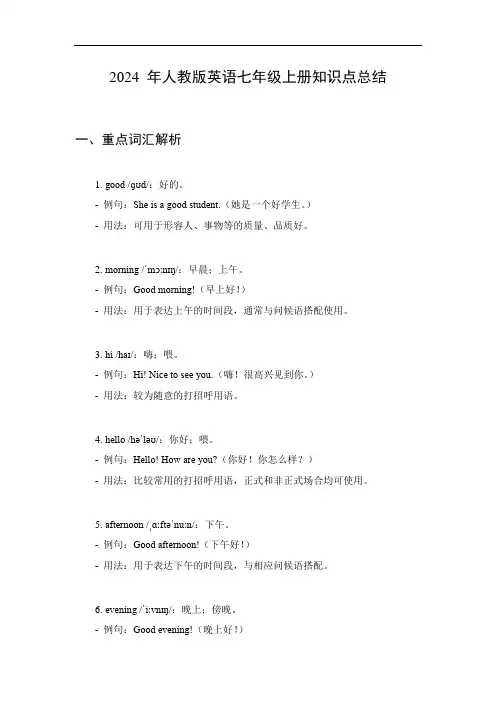
2024 年人教版英语七年级上册知识点总结一、重点词汇解析1.good /ɡʊd/:好的。
-例句:She is a good student.(她是一个好学生。
)-用法:可用于形容人、事物等的质量、品质好。
2.morning /ˈmɔːnɪŋ/:早晨;上午。
-例句:Good morning!(早上好!)-用法:用于表达上午的时间段,通常与问候语搭配使用。
3.hi /haɪ/:嗨;喂。
-例句:Hi! Nice to see you.(嗨!很高兴见到你。
)-用法:较为随意的打招呼用语。
4.hello /həˈləʊ/:你好;喂。
-例句:Hello! How are you?(你好!你怎么样?)-用法:比较常用的打招呼用语,正式和非正式场合均可使用。
5.afternoon /ˌɑːftəˈnuːn/:下午。
-例句:Good afternoon!(下午好!)-用法:用于表达下午的时间段,与相应问候语搭配。
6.evening /ˈiːvnɪŋ/:晚上;傍晚。
-例句:Good evening!(晚上好!)-用法:用于晚上的时间段,作为问候语的一部分。
7.how /haʊ/:怎样;如何。
-例句:How are you?(你怎么样?)-用法:用于询问方式、情况等。
8.are /ɑː(r); ə(r)/:是。
-例句:You are a good boy.(你是一个好男孩。
)-用法:与主语搭配表示“是”的状态。
9.you /juː/:你;你们。
-例句:How are you?(你怎么样?)-用法:第二人称代词,可单指“你”,也可表示“你们”。
10.fine /faɪn/:健康的;美好的。
-例句:I'm fine. Thank you.(我很好。
谢谢你。
)-用法:通常用于回答“How are you?”,表示身体状况良好或情况不错。
二、重点短语1.good morning:早上好。
-例句:Good morning, everyone!(大家早上好!)-用法:早上见面时的问候语。
人教版七年级英语上册-重要知识点笔记归纳
人教版七年级英语上册-重要知识点笔记归纳一、词汇1.1 常用动词:•be 动词:am, is, are•have 动词:have, has•动词原形:like, want, study, play, watch, do, speak, listen, read, write, run, swim, dance, sing, eat, drink, etc.1.2 重点名词:•人称代词:I, you, he, she, it, we, you, they•形容词:beautiful, big, small, good, bad, tall, short, long, etc.•名词:book, desk, computer, bag, teacher, student, friend, family, etc.1.3 常用介词:•in, on, at, with, of, for, to, from二、语法2.1 to be 动词的用法:•表示身份:My name is John. I am a student.•表示国籍:I am Chinese. He is Japanese.•表示外貌特征:She is tall and beautiful.•表示年龄:I am thirteen years old.•表示情感状态:I am happy. He is sad.•表示位置:The cat is on the table.2.2 一般现在时的用法:•表示经常性的动作:I usually get up at six o’clock.•表示客观事实:The earth goes around the sun.•表示通用真理:Water boils at 100 degrees Celsius.•表示当前情况:He is reading a book now.2.3 词性转换:•名词变形为形容词:happy - happy + ness = happiness•动词变形为名词:read - read + er = reader•形容词变形为副词:quick - quick + ly = quickly三、基础句型3.1 be 动词句型:•肯定句:I am a student. / He is my friend.•否定句:I am not a teacher. / She is not tall.•疑问句:Are you Chinese? / Is he a doctor?3.2 一般现在时句型:•肯定句:I usually go to school by bus.•否定句:I don’t like sports.•疑问句:Do you like pizza? / Does she speak English?3.3 祈使句:•意义:表示命令、请求、建议等。
新版人教版七年级英语上册各单元知识点
空间
form Monday to Friday 从周一到周五
form Beijing to Shanghai 从北京到上海
6.finish的用法
finish作不及物动词时,意为“完成;做好”
They start work early and finish late every day.他们每天开工早收工晚。
作及物动词,后接动词时,要用动名词形式,即finish doing sth. 表示“做完某事,
完成某事”
Jim usually finishes doing his homework before 8:00.吉姆通常在8点前做完作业。
7.thank sb for的用法:
thank sb for意为“因……而感谢某人”,for是介词,后接名词、代词或动名词,表感
谢的原因或内容。
Thank him for telling me. 谢谢他告诉我。
Thank you for helping with my English.多谢你帮我学英语。
8.for two hours的用法:
“for+一段时间”是介词短语,意为“……时间”,表示某事持续多长时间。
对其提问要用
how long
—How long will you stay in Beijing 你将在北京待多长时间?
—For about three days. 大约三天。
人教版初一英语知识点总结归纳上册
人教版初一英语知识点总结归纳上册一、词汇知识
掌握课本中所有单词和词组的拼写、发音和中文意思。
了解一些常用词汇的拓展词汇和固定搭配。
学习使用英语词典查找生词和词组。
二、语法知识
名词:可数名词和不可数名词,名词所有格。
代词:人称代词、物主代词、反身代词。
冠词:不定冠词a/an,定冠词the。
数词:基数词和序数词。
动词:动词时态(现在时、过去时)、动词短语。
形容词和副词:比较级和最高级。
介词:常用介词及其搭配。
连词:并列连词和从属连词。
句子类型:陈述句、疑问句、祈使句、感叹句。
句子结构:简单句、并列句、复合句。
三、听力技能
听懂与课文内容相关的对话和短文。
能根据所听内容回答问题或完成相关任务。
了解听力材料中的关键信息和细节。
四、口语技能
能模仿课文中的对话进行简单交流。
能用所学词汇和语法知识表达自己的观点和想法。
了解并遵守英语口语交际的基本礼仪。
五、阅读技能
能读懂与课文内容相关的短文和对话。
能根据所读内容回答问题或完成相关任务。
了解阅读材料中的关键信息和细节,提高阅读理解能力。
六、写作技能
能模仿课文中的例句进行简单写作。
能用所学词汇和语法知识写出简单的句子和段落。
了解并遵守英语写作的基本规范,如书写工整、标点符号使用正确等。
2024 人教版七年级英语上册知识点
2024人教版七年级英语上册知识点1.Starter Unit1Good morning!(1)重点短语:∙Good morning!(早上好!)∙Good afternoon!(下午好!)∙Good evening!(晚上好!)∙How are you?(你好吗?)∙I'm fine,thanks.(我很好,谢谢。
)(2)例句:∙Good morning,Miss Li!(早上好,李老师!)∙Good afternoon!Nice to see you.(下午好!很高兴见到你。
)∙Good evening!What are you doing?(晚上好!你在做什么?)∙How are you today?(你今天怎么样?)∙I'm fine,thanks.And you?(我很好,谢谢。
你呢?)(3)重点语法:∙字母的读音和书写:掌握26个英文字母的大小写形式、读音及基本书写规范,这是学习英语的基础。
∙音标基础:初步接触一些简单的音标,为后续学习单词的正确发音做准备,比如元音音标/æ/、/e/、/ɪ/等和一些简单的辅音音标/p/、/b/、/t/等。
∙Be动词的简单用法:学习Be动词am、is、are的最基本用法。
在这个单元中,主要让学生了解I搭配am,you搭配are,这是最基础的Be动词搭配形式。
2.Starter Unit2What's this in English?:(1)重点单词:map(地图)cup(杯子)ruler(尺子)pen(钢笔)orange(橙子)jacket(夹克衫)key(钥匙)quilt(被子)what(什么)in(在……里)English(英语;英文)。
(2)重点短语:∙询问物品:What's this in English?(这个用英语怎么说?)、What's that inEnglish?(那个用英语怎么说?)∙回答方式:It's a/an...(它是一个……)。