
(人教版)八年级英语上册教案:Unit 2 Section B 1a-1e
1.《 回条本 》听读P96 1c和1d 听力材料及P13 2b 3遍给家长听,家长签名。
2.《高分》Period 2
二、自主感知
1.1a Match the words with the pictures.
2.1bAsk and answer questions. Use the words from 1a.
nguage points: 1)be good for对……有好处
2) want sb.to do sth.
Unit2How often do you exercise?(第三课时)教案
课题
Unit 2 Section B 1a-1e
课型
听说课
学习目标
To learn to talk about how often do things
To practice the listening and speaking skills
学习重难点
能熟练的运用频率副词谈论多久做某事
学习过程
个人修改
一、Free talk
1.According to the pictures, get the students to talkabout how oftenthepeople do things.
2. How can we be healthy? What is the healthy or unhealthy food?
5. My uncle will come backin two days.
5. She always does some cooking at the weekend. (变为完全否定句)
She ________ does _________ cooking at the weekend.
翻译句子
Whose lifestyle is better / healthier? Why?
Is your lifestyle the same as Tina’s or Bill’s?
Is your lifestyle healthy or unhealthy?
五、成果展示
Tina has ________ habits. She does exercise ___________ and she __________ every day, too. She also has enough sleep and she sleeps _______ hours every night. In order to keep healthy, she drink milk___________ and she _________drinks coffee. She likes _____________ but she only eats _________________.
Bill doesn’t have good habits. He ___________exercises. He never eats _________ordrinks_____________.He eat _____________ three or four times a week and he drinks coffee _____________.But he has a good habit.He sleeps __________ every night.
六、达标检测
句型转换
1.Isometimesread storybooks.
2. She goes to the moviesthree times a month.
3. I went to Guangzhoutwice.
4. She spenttwo hourshelping with housework.
三、听力训练
1c.Listen tothe interview about eatinghabits. Circle your answer to each question.
1d.Listen again. Fill in the blanks int eating habits? Why?
1、你也许是对的。
2、他可能有个手机。
3、他几乎不上网冲浪。
4.我一周做一次运动,而我的妈妈每周至少做两次运动。
5.我每周帮做两三次家务。
6.他和孩子们相处得好。
7.我们的老师对我们很友好。
8.吃健康的蔬菜对我们的健康有好处。
9.吃得健康睡得好对我们的学习是重要的。
10.家长们总是想要我们取得好成绩。
人教版英语八年级上册Unit2 SectionB(1a-1e)优质课教案
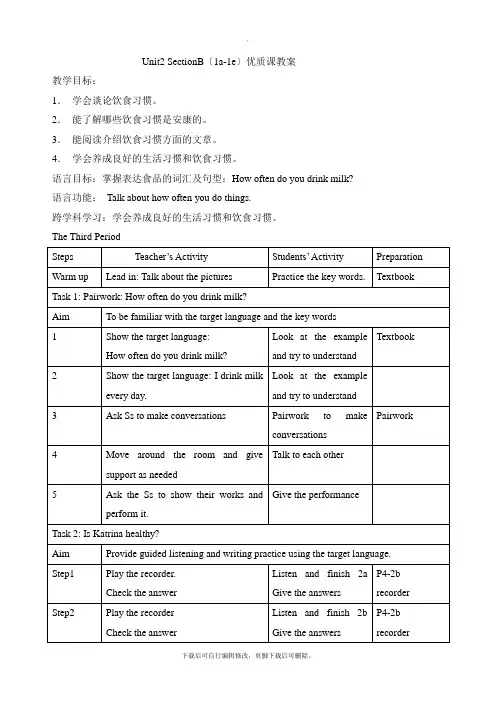
P4-2b recorder
Step2
Play the recorder
Check the answer
Listen and finish2b Give the answers
P4-2b recorder
Step3
Show the target language :
to others.
Pairwork
Step5
Move around the room and give
support as needed.
Talk to each other
Step6
Ask pair of Ss to show their works.
Pairs of Ss show
their work
How often do you exercise?
Use the target language, and talk
to others.
Pairwork
Step4
Show the target language:
I exercise everyday.
Use the target language, and talk
Textbook
Task 1: Pairwork:How often do you drink milk?
Aim
To be familiar with the target language and the key words
1
Show the target language:
How often do you drink milk?
人教版(浙江)八年级上册英语课件: Unit2 Section B (1a-1e)(共16张PPT)
本节课主要练习了听力,学习了单词,短语 be good for的用法。
1.熟记本课时的词汇 2.完成本课时的课后作业
9、春去春又回,新桃换旧符。在那桃花盛开的地方,在这醉人芬芳的季节,愿你生活像春天一样阳光,心情像桃花一样美丽,日子像桃子一样甜蜜。21.3.22 1.3.2Tuesday, March 02, 2021
Tina
1.How often do you exercise? every day
2.How often do you eat fruit? e_v_e_r_y_d__a_y
3.How many hours do you sleep __n_i_n_e__
every night?
Bill _h_a_r_d_l_y_e_v_e_r
He is very good with children.
善于应付……的 他对孩子很有一套。
be good at 擅长于……的
I'm good at playing chess. 我擅长下国际象棋。
讲解来自《点拨》
典例 Reading in the sun is not good_____A____ your eyes. (永州)
Tina: Every day. Bill: Hardly ever. Interviewer: How often do you eat vegetables and fruit? Tina: I eat vegetables and fruit every day. Bill: I sometimes eat vegetables. But I never eat fruit. Interviewer: OK. How many hours do you sleep every night?
Section B 1a—1e 初中八年级上册英语教案教学设计课后反思

Unit 4 What’s the best movie theater?(Section B 1a—1e)Huizhi Middle SchoolLin ShirongⅠAnalyzing the teaching materialThe material is from Go For it Book II A Unit 4 What’s the best movie theater? Section B (1a-1e). It is a listening and speaking material.ⅡAnalyzing the studentsThe students are Junior Two students and they take a great interest in learning English.ⅢTeaching objectives----Knowledge aims:1.Get the students to learn new words and phrases: creative, performer, upside down, etc.2.Get the students to learn something about talent shows.3.Get the students to use the superlatives in their expression.----Ability aims:1.Develop the students’ listening skills: guess before listen, listen with a purpose and so on.2.Get the students to share their opinions bravely in class.----Emotional aims:1.Get the students to know everyone is good at something and try to make their dreams come true.2. Get the students to try to be a talented and confident person.ⅣTeaching key points1.Get the students to grasp the key words and key phrases.2.Get the students to develop the listening skills and try to express their ideas by using the superlatives.ⅤTeaching Difficult pointsGet the students to use superlatives in practice and try to be a talented and confident person in their daily life.ⅥTeaching methods1.Tasked-based teaching and learning method.municative teaching metho d.3. Audio visual teaching method.ⅦTeaching aidsMultimedia facilities, blackboard , PPT.ⅧTeaching proceduresStep one: Lead-in1. Greetings and free talk.2. Choose the Huizhi Talent for this year. Watch the videos of students’ talent shows. And then ask the students to work in pairs andchoose the best talent show and give their reasons.【Design purpose:The talent show videos are chosen from the students in our school. It is designed as the lead-in part due to the following three functions: 1. Situational function: students can imagine themselves as judges for the talent shows, which can arouse their interests immediately. 2. Practical function:by using the material they are familiar with, students are supposed to use the superlatives they have learnt in practice. 3. Cooperation function: through the pair work, students can learn to cooperate with each other.】Step Two:Presentation and ProductionActivity 1: Exercise of 1a.Write these words and phrases next to their opposites in the chart.【Design purpose: Through this exercise, students are expected to review the changing rules of the superlatives learnt in previous classes.】Activity 2: Games1. Say it quickly. Show the adjectives on the balloons. Ask all the students to stand up and say the superlatives of the adjectives as quickly as they can.2. The magic hand. Say the opposite forms of the superlatives. Encourage all the students to take part in the games.【Design purpose: Games can not only make the atmosphere alive,but also help the students to consolidate what they have learnt in a way they are interested in.】Activity 3: Listening1. Pre-listening activity1) Prediction: Show pictures of different talent shows together and ask the students to guess the main idea of the passage.【Design purpose:Prediction is a good listening skill. It reduces the difficulties and paves way for later tasks.】2) Talk about the pictures: Look at the pictures and talk about the talent shows in each picture.【Design purpose: Through the process, students are expected to learn the new words they are going to hear in the listening material, which reduces the obstacles in the following activities.】2. While-listening activity1) Listen and match.(1c) Listen to people talking about a school talent show. Match the pictures with the performers.【Design purpose:Students are supposed to match the people and their talent shows, which help them to have a further understanding of the listening material.】2) Listen and choose.Question 1: Why did they think Dennis was the worst?A. He kept dropping the balls.B. His performance was not interesting.C. He could not sing very well.Question 2: Vera was the most creative because _______.A. She was very funny.B. She played the guitar upside down.C. She was an excellent piano performer.【Design purpose:It is a process of careful listening. Students are required to pay special attention to the superlatives used for certain people, which makes the later exercise of 1d more easy.】3) Listen and fill.(1d) Listen and fill in the chart with the adjectives you hear.【Design purpose: In this part, students are required to take notes by paying attention to the superlatives and adjectives while listening. 】4) Listen and role playFill in the blanks with the correct answers and then role play the conversation.【Design purpose:It helps students to consolidate what they have listened and then improve their spoken English through role play.】3. Post-listening activity : Who’s the most talented in our class?After listening to the material, divide the students into group of four. Ask them to choose the most talented students in our class for the next Huizhi Talent.【Design purpose:On the one hand, it helps students to learn to cooperate with each other through group discussion; on the other hand, the topic they discussed echoes the lead-in part of this lesson.】。
人教版八年级英语上册Unit2SectionB(1a-1e)教案设计

Unit2 Section B(1a-1e)优质课课件(安徽省)人教英语八年级上Unit2 Section b1a-1e教学设计来安县水口中学杨成扣一、教学日标:1、能够掌握课标要求的“四会”词汇:junk,coffee,health。
2、学会谈论饮食习惯,了解哪些饮食习惯是健康的。
3、能阅读关于介绍饮食习惯方面的文章。
学会养成良好的生活习惯和饮食习惯。
4、培养学生的逻辑表述能力,激发学生的积极思维,并使学生互相了解,增进友谊。
二、学情分析:对于本单元的一般现在时态,学生掌握较好,部分学生在本章节的听力部分略有不足,建议多听多练练。
三、重点和难点:1、区分how many/how much,health/healthy,different/difference2、掌握以下重点句子How often do you eat fruit?How many hours do you sleep every night?How often do you eat junk food?How often do you drink coffee?四、教学过程Step 1 Lead-in(导入)Greeting & free talkStep 2 Match the pictures(1a)Let students pay attention to the pictures. Say something about the pictures. Match the words with the pictures. Check the answers and then practice reading.Step 3 Ask and answer(1b)Pair workT: Now look at the conversation in lB, ask two students to read it o the class.Work with your partner. Please make your own conversations using the words in la. Forexample:A: How often do you eat vegetables?B: I eat vegetables every day.A: Do you like it?B: No. But my mother wants me to eat it. She says it is good for my health. Then ask some pairs to present their conversations to the class.Explanation:Pay attention to the conversation in the box on the right. Read it to the class. Explain the phrases “be good for” means “有益于,,;对,有好处”Work in pairs. Choose a new partner. Use the words in la to make conversations Share the student’s conversations.Step 4 listening (&c 1d)1cT:Now you will hear a reporter interviewing two people. Tina and Bill. Read the two names for the students. In lc, we’ll know who is health, Bill or Tina? Read the questions in lc. Listen to the tape carefully twice.Circle “Yes” or “I don’t know” in the chart.1d1. Before we check the answers in Ic ll we read through the questions in ld. Pay attention to Tsnaand Bills answers.2. Play the tape again. This time, if we have heard one question, we will have a pause. Make sure Tsnaand Bills answers.3. From the answers in ld, ask the questions: Who is healthy, Bill or Tina?Step 5 Pair work(le)Student a is the reporter. Student b is Tina or Bill. Ask and answerquestions. Then change roles.Step6 Summary (课堂小结)Tell the students the difference of how many & how much,heath & healthy1. Fill in the blanks with how many or how much①—______ is the book?—It’s $10.②—______ students are there in the classroom?—______10.2. Fill in the blanks with health or healthy①Fruit and vegetables are ______ food.②Exercise is good for ______.Step7 Exercise(练习)单项选择1. I like English very much, so I ______ listen to the tape in morning.A. usuallyB. hardly everC. neverD. hardly2. What does your father do in the evening?—He usually ______.A. watch TVB. exercisesC. read booksD. go for a walk3. ______ do you go skating?—Every day.A. How oftenB. How manyC. WhenD. What time4. ______ does he do sports every day?—He does sports for two hours every day.A. How manyB. How oftenC. How longD. How soon5. ______ give up,then you can be successful.A. AlwaysB. SometimesC. NeverD. Usually6. ______ do you go to the bookshop?Once a week.A. How longB. How manC. How oftenD. How much7. Everyone knows girls ______ sweets.A. usually likesB. likes usually.C. usually1ikeD. like usually8. He too busy. He hardly ______ watches TV.A. oftenB. usuallyC. neverD. ever9. She ever y strict,but ______ kind to us some times.A. sometimesB. some timesC. some timeD. some times10. Jim never late for school, ______?A. is heB. is sheC. does heD. he doesStep8 Homework(作业)Writing:My Eating Habit。
英语人教版八年级上册unit2Section B 1a-1e教案
八上Unit2 How often do you exercise?Section B 1a-1eI.学习目标1、Knowledge Objects Function:1)To train students’ listening, speaking and writing skills.2)Key V ocabulary: junk, junk food, coffee, health, healthy, healthily3)Target Language: ---How often do you drink milk, Liu Fang?---I drink milk everyday--- Do you like it ?---No, but my mother wants me to drink it . She says it’s goodfor my health4)Structure: be good for, want sb. to do sth., How many hours do you sleep every night?2、Ability Objects:To train students’ abilities of comprehension, speaking, listening and writing.3、Moral Objects:To help students form healthy habits and get rid of the bad ones. II. 重点难点1.Teaching Key Points:Key vocabulary and target language in this period2.Teaching Difficult Points:Improve students’ listening and writing. Make conversations freely.III.教学过程【导入】Greeting and lead inStep1. Greet the studentsStep2. Lead inLet students compare two kinds of breakfast and choose one for the teacher. At the same time, explain“health, healthy, healthily, junk food”. Let students talk about some other junk food in their daily life.【讲授】PresentationStep31aShow some pictures on the screen and explain some of them .Match the words with the pictures.After finishing the activity, ask someone to share the answer.And then, check the answer.Step41bShow the conversation in 1b. Choose two students to read the example, then have stud ents talk about their own eating habbits each other like this .Students share their dialogues.Step51c-1d1.First, intruduce Tina and Bill to the students, tell them they will hear a reporter inter view Tina and Bill .Ask students to read the sentences in the chart together and explai n some key words to make sure they understand each sentence.2.Listen to the recording and fill in the blanks in the survey about how often Tina and Bill do the things .Then check answers .3.After that, let students say who has good habits.【活动】Play a gameStep61ePlay a game. Let students use one sentence to talk about their own lifestyles. Show so me structures on the screen.Step7 Tell students the importance of health and how they can live a healthy life. 【练习】PracticeStep 8 Exercise1.I hardly exercise so I think I'm kind of _____.A. healthyB. healthC. unhealthyD. unhealth2.My sister likes fruits_____ she doesn't like vegetables.A. andB. butC. orD. also3.Jim's parents want him ______ fruit.A. eatingB. eatC. to eatD. eats4.---What does your father do in the evening?---He usually _______A. watch TVB. exerciseC. reads books5.---_______ students in your class are fromBeijing?____Only one.A.How oftenB. How manyC. How much【测试】Test1.--你多久喝一次牛奶?--我每天都喝。
【人教版】八年级英语上册 Unit 2 全单元英文教案
Unit 2 How often do you exercise?Language Goal 【语言目标】Talk about how often you do things:in this unit,students learn to talk about what things they do and how often they do these things.Knowledge Goals 【知识目标】Key Wordshousework,hardly,ever,once twice,full,maybe,least,junk,coffee,health,percent,online,although,through,mind,body,such,together,die,writer,dentist,magazine,however,than,almost,less,pointKey Phraseshow often,on weekends,go to the movies,hardlyever,twice a week,three times a week,be goodfor,at least,such as,less than,more than Key Sentences1. How often do you exercise?2.What do you usually do on weekends?Key Grammar1. The use of adverbs of frequency.2.“How often” cause of special questions andanswers.Ability Goals 【能力目标】1. Through the learning to gain the ability to talk about how often people do things.2.Write a report about how often people do things.Moral Goals 【情感目标】1. Keep a diary every day.2.Do more exercise and develop good habits to keep healthy.Teaching Time 【课时】Five periodsPeriod 1 Section A(1a-2d)Period 2 Section A(Grammar Focus-3c)Period 3 Section B(1a-1e)Period 4 Section B (2a-2e)Period 5 Section B (3a-Self Check)本单元的教学内容围绕“多久做一次运动”这一话题展开。
英语人教版八年级上册Unit2-Section-B-1a-1e教学设计
(3)将单词和图画配对
学习1b对话,谈论某人做某事的频率
1、个人迅速朗读对话,注意语音、语调、句群停顿。
2、再次朗读对话,准确理解意思
3、两人一组练习对话,向全班展示
4、用1a的单词,模仿1b编对话,并在组内交流
A: How often do you drink milk ,Liu Fang ?
help sb. (to) do sth.帮助某人做某事
(2) be good/bad for对----有好/坏处
be good for…表示“对……有益(有好处)”
其反义为:be bad for…对……有害/无益
It’s good for us to do more reading.多读书对我们有好处。
及时练
1、选择
1)__________do you drink coffe? -----Twice a day.
A.How many B.How long C. How soon D. How often
2)My teacher wants me _________ hard.
A.study B. studying C. to study D. studies
( )l. When does Mrs Green go to buy some fruit?
A. Saturday' B. Monday. C. Thursday.
’ )2. Where does Mrs Green buy fruit?
A. ln the shop near her house. B. In the town. C. Near the shop
B: I drink milk every day.
【人教版】八年级英语上册 Unit 2 全英文公开课教案
Unit 2 How often do you exercise?Language Goal 【语言目标】Talk about how often you do things:in this unit,students learn to talk about what things they do and how often they do these things.Knowledge Goals 【知识目标】Key Wordshousework,hardly,ever,once twice,full,maybe,least,junk,coffee,health,percent,online,although,through,mind,body,such,together,die,writer,dentist,magazine,however,than,almost,less,pointKey Phraseshow often,on weekends,go to the movies,hardlyever,twice a week,three times a week,be goodfor,at least,such as,less than,more than Key Sentences1. How often do you exercise?2.What do you usually do on weekends?Key Grammar1. The use of adverbs of frequency.2.“How often” cause of special questions andanswers.Ability Goals 【能力目标】1. Through the learning to gain the ability to talk about how often people do things.2.Write a report about how often people do things.Moral Goals 【情感目标】1. Keep a diary every day.2.Do more exercise and develop good habits to keep healthy.Teaching Time 【课时】Five periodsPeriod 1 Section A(1a-2d)Period 2 Section A(Grammar Focus-3c)Period 3 Section B(1a-1e)Period 4 Section B (2a-2e)Period 5 Section B (3a-Self Check)本单元的教学内容围绕“多久做一次运动”这一话题展开。
人教版八年级英语上册Unit2SectionB(1a1e)教学设计
5.课后作业:
-布置与课程内容相关的作业,如写一篇关于自己良好习惯的短文,巩固词汇和语法知识。
-鼓励学生进行课外阅读,了解更多成功人士的故事,拓宽视野。
四、教学内容与过程
(一)导入新课
1.教师通过多媒体展示一些国内外知名成功人士的图片和简介,如Bill Gates、马云等,引导学生思考:“What makes these people successful?”
- What good habits do you want to develop in the future?
5.视频观看:推荐学生观看一部关于成功人士故事的英文纪录片,如《The Story of Steve Jobs》。观看过程中,关注成功人士的良好习惯及其对事业的影响,激发学生的学习兴趣。
请学生在完成作业的过程中,注意以下几点:
3.能够理解并运用一般疑问句和否定疑问句,如:“Do you always/usually/sometimes/never do something?”, “You don't always do something, do you?”
4.提高听力理解能力,能够听懂并获取课文中的关键信息。
5.提高阅读理解能力,通过阅读课文,了解成功人士的良好习惯,并从中受到启发。
-语法方面,重点在于让学生掌握一般现在时态的用法,能够用它来描述习惯性的动作或状态。
2.听力和阅读理解:提高学生在听力材料和阅读材料中获取信息的能力是另一个教学重点。学生需要能够通过听力练习和阅读课文,理解成功人士的习惯,并从中获取启发。
3.语言运用:在教学过程中,鼓励学生将所学知识运用到实际交流中,提高他们的语言表达能力,这是教学的难点。
Unit2SectionB1a-1e课件人教版八年级英语上册
As for junk
food times a week times a week All in all, we should keep a
Drink coffee
never four times a dheaaylthy habits like Tina. It can
help us live better.
Presentation
fruit and vegetables every day
How often do you eat fruit and vegetables?
I eat fruit and vegetables every day. For me
Very good! It’s good for your health.
Know about the healthy living or eating habits(饮食习惯) and write an article about their own habits.
Improve the awareness(意识) of healthy life.
Lead in
[ˈstʌməkeɪk] I had a stomachache(胃疼) this summer vacation. The doctor told me I was ill(生病的) because of my unhealthy habits. And he asked me some questions about my habits. Let’s have a look my eating habits together.
ourselves well.
Bill’s lifestyle(生活方式) isn’t healthy, right? Can you give some advice(建议) for him? He should: