
高二英语 Unit1 Living with technology Reading1课件 牛津译林版选修7
6. … it was not until 1938 that the first colour TV programme was broadcast. The first colour TV programme _______________________________.
7. Technology is now changing faster than most people can keep pace with. Most people _____________________.
• 2. New words. • P4 D
• 1e, 2d, 3h, 4c, 5f, 6a, 7b
Reading strategies 1
What do you think is the best way to get the most important information in such a long passage? Follow the chronological order. P4 C2
Write a summary
Can you briefly introduce the evolution of video and sound devices?
Homework
1. Read the passage. 2. Write a summary. 3. Underline difficult sentences and important phrases.
Reading strategies 2
• How is so much information organized? • Take a close look at the structure of the passage and you’ll find out: • Subtitles are helpful!
Lead-in
• Where is this piece of writing taken from? • What is it about?
• Checking preview
• 1. P2 A • John Logie Baird. • Two minutes Thomas Edison. • The Portable cassette players.
• 1887—Emile Berliner invented a record player that used discs to record on. • 1925—The first public TV broadcasts were made, in the USA. • 1929—Regular public broadcasting began in London . • 1938—The first colour TV programme was broadcast. • 1962—Satellites were used to broadcast TV. • 1967—Regular colour TV broadcasts began in the UK. • 1982—The first CDs were made available. • 1993—The VCD was born. • 1995—The DVD was invented.
Reading for details
P4 C1 1. F 2. T 3. F 4. F 5. T 6. T
Understanding difficult sentences
• 1. Regular public broadcasting followed shortly after, first beginning on 11 May 1928 in New York. • Regular public broadcasting followed shortly after. • Regular public broadcasting first ____ on 11 May 1928 in New York.
Unit
1
Reading 1
The evolution of video and sound devices
Unit 1
课件描述:
这是Reading 板块的第一课时,侧重阅 读理解, 主要关注提升学生的阅读理解能力 和思维能力。涉及到的阅读微技能有:把握 文体风格,理解中心思想,按照时间线索查 找细节信息,了解行文结构和信息组织方式, 通过阅读标题了解特定信息,对长句和难句 的y of the principles first discovered by Fransworth. • …adopt many of the principles ____ ____ ____ ____by Fransworth. • 5. … and so satellite dishes can often be seen distributed throughout the countryside and the remote areas. • … and so you can often see ____ ____ ____ throughout the countryside and the remote areas.
2. Satellites were used to broadcast TV beginning in 1962. Satellites were used to broadcast TV and this ____ in 1962. 3. … broadcast the signals they get from satellite receivers to the population living nearby. … broadcast the signals they get from satellite receivers to the population ____ ____ nearby.
【保持】高中英语Unit1Livingwithtechnologyreading2教案牛津译林版选修
【关键字】保持M7-U1 Living with technologyPeriod 2 Reading 3 Language pointsI. Teaching aims:1. Make students master some important language points.2. Improve students’ ability in solving problems.II. Teaching important point:How to keep them in mind.III. Teaching difficult point:How to make all the Ss grasp the uses of some important words and expressions.IV. Procedures:Step 1: GreetingStep 2: Language points1. delay vt. &vi. (使)推迟,延迟n. 延误,延迟①They decided to delay going on their holiday till next week. 他们决定将假期延至下周进行。
②On witnessing the accident, they reported it to the police without delay.目睹了这起事故,他们马上报告给了警察。
【归纳】delay doing sth. ____________without delay ____________delay in doing sth. ____________2. accessible adj. 可使用的;可接触到的;可到达的;易理解的(1)be accessible to 容易接近的,容易进入的(2)access n.通道;通路;入径vt.到达;进入;使用give access to 接近;准许进入have/gain /get/obtain access to 接近;获得;有使用……的机会3. distribute vt. 使分布,分散;分发,分配;分销(1)distribute sth. to/among . . . 把某物分配给……/在……之间分配某物distribute sth. over. . . 使某物分布于(2)distribution n. 分配,分布;分发,分送4. obvious adj. 显然的,显而易见的①It was quite o bvious that her parents didn’t like her boyfriend.很显然她的父母不喜欢她的男朋友。
2019_2020学年高中英语Unit1LivingwithtechnologySectionⅠWelcometotheunit (1)
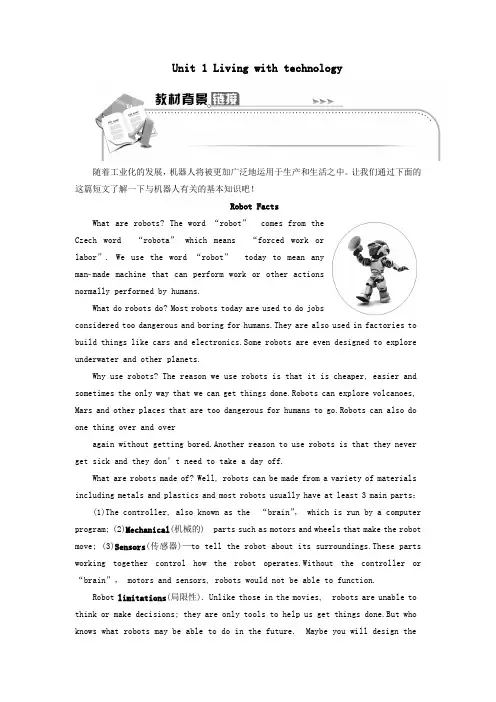
Unit 1 Living with technology随着工业化的发展,机器人将被更加广泛地运用于生产和生活之中。
让我们通过下面的这篇短文了解一下与机器人有关的基本知识吧!Robot FactsWhat are robots? The word “robot” comes f rom theCzech word “robota” which means “forced work orlabor”. We use the word “robot” today to mean anymanmade machine that can perform work or other actionsnormally performed by humans.What do robots do? Most robots today are used to do jobsconsidered too dangerous and boring for humans.They are also used in factories to build things like cars and electronics.Some robots are even designed to explore underwater and other planets.Why use robots? The reason we use robots is that it is cheaper, easier and sometimes the only way that we can get things done.Robots can explore volcanoes, Mars and other places that are too dangerous for humans to go.Robots can also do one thing over and overagain without getting bored.Another reason to use robots is that they never get sick and they don’t need to take a day off.What are robots made of? Well, robots can be made from a variety of materials including metals and plastics and most robots usually have at least 3 main parts:(1)The controller, also known as the “brain”, which is run by a computer program; (2)Mechanical(机械的) parts such as motors and wheels that make the robot move; (3)Sensors(传感器)—to tell the robot about its surroundings.These parts working together control how the robot operates.Without the controller or “brain”, motors and sensors, robots would not be able to function.Robot limitations(局限性). Unlike those in the movies, robots are unable to think or make decisions; they are only tools to help us get things done.But who knows what robots may be able to do in the future. Maybe you will design the“Super Robot” of tomorrow.Section ⅠWelcome to the unit & Reading—Warming Up[基础词汇]1.evolution n.演变,发展;进化2.drawback n. 缺点,缺陷;不利条件3.principle n. 原理,法则;道德原则,行为准则4.percentage n. 百分率,百分比5.component n. 组成部分,成分,部件6.portable adj. 便携式的,轻便的7.digital adj. 数字信息系统的,数码的,数字式的[拓展词汇]8.construct vt. 制造;修筑,建造→construction n. 建造,修筑9.accessible adj. 可使用的;可接触到的;可到达的;易理解的→access n. 享用权,通道10.distribute vt. 使分布,分散;分发,分配;分销→distribution n. 分发,分配11.eventually adv. 最后,终于→eventual adj.最终的;可能的12.adaptation n. 适应;改编本,改写本→adapt v. 适应,改编→adaptable adj. 能适应的13.sceptical adj. 怀疑的→sceptically adv.怀疑性地1.keep in touch with 与……保持联系2.contribute to 导致;有助于,对……贡献3.in the development of ... 在……的发展过程中4.in color 彩色的5.benefit from 从……获益6.wind up 上发条7.along with 和……一起,随着;除……以外8.keep pace with 与……齐步前进1.not until的强调句型John Logie Baird constructed the first colour TV in 1928, but it was not until 1938 that the first colour TV programme was broadcast.约翰·洛吉·贝尔德于1928年制造出第一台彩色电视机,但直到1938年第一个彩色电视节目才播出。
高中英语《Unit1 Living with technology》Reading 新人教版选修7

5. p_e_r_c_e_n_t_a_g_e_
6r.ec_e_i_v_e_r_______
7. E_v_e_n_t_u_a_l_l_y_
Language Points
1. (P1) Technology has seen some amazing developments in the last few deciandetsh.e last few decades
1995 The DVD was invented.
If you could own only one electrical or electronic device, what would you choose? Why?
Keys to Part D:
1. _e___ 2.d ____ h3.
1962 Satellites were used to broadcast TV.
Regular colour TV broadcasts 1967 began in the UK.
Year
Event
1982 The first CDs were made available.
1993 The VCD was born.
RPeaardtthCe1:article carefully and finish Part
FC11. aCnodlPoaurrt TCV2 (bPe4c)a.me popular within just
a few years after it was invented.
F 2. People without satellite dishes do
electromagnetic oven electric rice cooker
高中英语Unit1LivingwithtechnologySectionⅡWelcometothe

[巧学活用]——完成句子 (1)互联网是世界上最大的信息资源库,只要通过一台电脑就可 以访问。(access) The Internet is the biggest source of information in the world, and you can ___h_a_v_e_a_c_c_e_s_s_to__i_t __ through a computer. (2)药品不应放在孩子们拿得到的地方。 (accessible) Medicine should not be kept where i_t_i_s_a_c_c_e_s_si_b_l_e_t_o_c_h_i_ld_r_e_n_.
(1)distribute sth.to sb. distribute sth.among sb. be distributed+介词 (2)distribution n. distributor n.
把某物分发给某人 在某人中分配某物 分布于 分配,分发 经销商;批发商
①She took the food to the slums and distributed it to street children. 她把食品拿到贫民窟分给了街上的孩子们。 ②They distributed the lands _a_m_o_n_g_ the peasants. 他们把土地分给了农民。 ③This species of butterfly is widely __d_i_s_tr_i_b_u_t_e_d_ (distribute) over our country. 这种蝴蝶在我国分布很广。 ④At present, the __d_i_s_tr_i_b_u_t_io_n__ (distribute) of profits cannot satisfy most of the people. 目前利润的分配未能满足大多数人。
高中英语-Unit-1-Living-with-technology-reading-1教案-牛津译
M7-U1 Living with technologyPeriod 2 Reading 1I. Tea ching aims:1. Develop students’ ability in reading.2. Make students know the history of TV and audio devices.II. T eaching important point:Get Ss to grasp the m ain idea of the textIII. Teaching difficult point:How to get the a brief understanding of the text.He lp students to finish the exercises on page4-5.IV. Procedures:Step1. GreetingStep 2: Lead-inBegin the class with a questionnaire.Do yo u know “High tech”?Questions:What are the differences between tape recorders, CD p layers, MD players and MP3 players? What functions do you need in an audio device other than palying music?If you were an audio device designer, what would your audio device look like?Step 3:Learning reading strategy: understanding subtitlesSubtitles appear after titles and give you more information about the text than the titles. T V (In order of time)Audio devices( By types of equipm ent)●This reading passage is mainly organized in chronological order.●Make a timeline. Use Part C2 as a referencesStep 4: Reading1.Fast readingRead the text quickly and answer questions2. Ca reful readingRead the passage again and complete Parts C1 and C2.3.TasksAsk students to finish Part D and E.Step 5: Discussion1.More and more people are using computers for information and entertainment. Do you think we will still need books and TVs in the future? Why or why not?2.What are the possible disadvantages of having a lot of technology in our lives?Step 6: Homework1. Finish A1, A2 on P 102.2. Preview word power.V. Design of writing on blackboard:VI. Record after teaching:2。
高中英语 Unit 1 Living with technology 精品课件 译林选修7

即学活练 (4)对这种书的需求增加了。 (5)他要求被告知有关这件事的情况.(用2种方式 翻译) ① ②
There is an increased demand for the book.
He demanded to be told about the matter.
He demanded he should be told about the
as
pointed
out
up to you
3.人们发现,使用手机的人头部一侧接触话机患脑 瘤的可能性是不使用手机者的两倍半。 It was found that people who used mobile phones were likely to have a brain tumour on the side of the head where they held their phones people who did not use them.
To what degree
has the degree
to a certain degree
3.delight n.快乐,高兴;vt.使欣喜 挑战自我 (1)令他很高兴的是,他的小说得到了公众的认 可。 ,his novel was accepted by the public. (2)我高兴地读了你的信。 I have read your letter . (3)这个消息使全国一片沸腾。 The news the whole nation.
before
to
when
4.This study was conducted with 200 mice, half of were exposed to radiation the other half did not receive any radiation. 5.Previous this,scientific experiments did not show a definite link between mobile phone use and cancer. 6.Why is there no definite scientific evidence available now the effects of mobile phones people’s health?
高二英语 Unit1 Living with technology Reading1教学设计 牛津译林版选修7
Unit1 Living with technology Reading1教学设计单元:Unit1 Living with technology板块:Reading 1Thoughts on design:这是Reading 板块第一课时。
第一课时侧重阅读理解,主要关注提升学生的阅读理解能力和思维能力。
涉及到的阅读技能有:把握文体风格,理解中心思想,按照时间线索查找细节信息,了解行文结构和信息组织方式, 通过阅读标题了解特定信息,对长句和难句的理解等等。
涉及到的思维能力是:进行信息重组再加工,学习运用所学知识和技能进行创造等。
Teaching aims:1.students will be able to read an article from a book about the evolution of videoand sound devices;2.students will be able to know the reading strategy—understanding headings;Teaching procedures:Step 1 Lead-inWhere is this piece of writing taken from?What is it about?(Explan ation)在阅读导入环节,提出两个问题,提示学生关注本文的文体特点,目标读者和中心内容,对提高他们的阅读理解能力和思维能力都会有所帮助。
从应试的角度来看,这些也是常见题型,平时可以因地制宜地进行这种训练。
Step 2 Checking preview1. P2 AJohn Logie Baird.Two minutesThomas Edison.The Portable cassette players.2. New words.P4 D1e, 2d, 3h, 4c, 5f, 6a, 7bStep 3 Reading strategies 1What do you think is the best way to get the most important information in such a long passage?Follow the chronological order.P4 C2•1887—Emile Berliner invented a record player that used discs to record on.•1925—The first public TV broadcasts were made, in the USA.•1929—Regular public broadcasting began in London.•1938—The first colour TV programme was broadcast.•1962—Satellites were used to broadcast TV.•1967—Regular colour TV broadcasts began in the UK.•1982—The first CDs were made available.•1993—The VCD was born.•1995—The DVD was invented.(Explanation)本文为科技类的说明文,信息量很大,时间跨度很长,但其中内容多为客观事实,从语言学习的角度,学生只需了解即可。
高中英语Unit1LivingwithtechnologySectionⅤReadingⅡProj
14
第三步 研读——能力升华 接轨高考 根据 P14-15 教材课文,在空白处填入 1 个适当的单词或括号内单 词的正确形式。 The Amish are famous because they drive carriages instead of cars and do not have 1._p_e_r_so_n_a_l_ (person) telephones.2._In_ truth,whenever a new technology 3._i_s__in_t_r_o_d_u_ce_d__ (introduce),the Amish meet and discuss 4._it_s_ (it) advantages and disadvantages.The telephone 5._is_ (be)
H.vt.摆脱;去除;丢弃
( )9.sacrifice
I.adj.肤浅的,浅薄的;浅的
( )10.rid
J.vt.牺牲,献出
n.牺牲,舍弃;祭品 [答案] 1-5 CABED 6-10 GFIJH
6
Ⅱ.选择下列句中词组的汉语意思 A.集中精力于…… B.大体上 C.额外 D.使……摆脱…… E.而不是 F.专注于……
看看远处,要保护好眼睛哦~站起来动一动,久坐对身体不 好哦~
结束
语 同学们,你们要相信梦想是价值的源泉,相信成功
的信念比成功本身更重要,相信人生有挫折没有失 败,相信生命的质量来自决不妥协的信念,考试加 油。
10
第二步 细读——把控文章关键信息 细读 P14-15 教材课文,选择最佳答案 1.Why do the Amish refuse to use modern facilities? A.Because they have religious reasons for their many rules. B.Because they always reject new things. C.Because they do not think them necessary after their discussion. D.Because they like living close together.
高二英语 Unit1 Living with Technology
得夺市安庆阳光实验学校高二英语 Unit1 Living with Technology知识点罗列Key words:less worried尺寸/长度知识点归纳1. apply for sth. to sb.向某人申请某事 apply A to B.把A应用到B上 apply oneself to (doing) sth.致力于,集中精力做某事 = apply one’s mind to sth.他努力干好新工作。
_________________________________________这种不适用于孩子。
_________________________________________他专思考这个问题。
_________________________________________ Key: He applied himself to his new job. The rule doesn’t apply to children.He applied himself / his mind to the problem.2. demand 常用结构meet / satisfy one’s demands满足某人的需求in demand需求量大;有需求demand to do sth.要求去做某事demand sb. of sth.要求某人某理damand that sb. (should) do sth.要求make the demand that…(should) doMy demand is that…It is demanded that…3. delight n. & vt.with deligth高兴地,乐意地to one’s delight令某人高兴的是be in high delight非常高兴地take delight to do / in doing sth. 高兴地做某事be delighted to do 高兴地做某事be delighted at因…而高兴be delighted with sth.由于某事而高兴1)令他高兴的是,他的小说得到了公众的认可。
高中英语Unit1LivingwithtechnologySectionⅠReading(Ⅰ)(Welcometotheunit
( )4.ቤተ መጻሕፍቲ ባይዱind
D.n.无线电接收机;听筒,受话器;
接受者
( )5.construct E.vt.& vi.上发条;缠绕;蜿蜒,曲折
( )6.portable F.n.专利权;专利证书
( )7.digital
( )8.storage ( )9.patent ( )10.relay
[阅读障碍词] 1.unprecedented adj. 2.overshadow vt. 3.aggravate vt. 4.optimize vt. 5.deter vt. 6.alleviate vt.
前所未有的 遮挡 使严重 充分利用 制止 缓解
[诱思导读] 1.What does atomic technology bring us according to the passage?
_It_c_a_n_l_et_p_e_o_p_le__m_a_k_e_f_u_ll_u_s_e_o_f_th_e_c_u_r_re_n_t_e_n_e_rg_y_s_o_u_r_ce_s_b_u_t_i_t _ _al_s_o_h_e_lp_s_m__an_u_f_a_ct_u_re__d_ea_d_l_y_w_e_a_p_o_n_s.____________________
Unit 1 Living with technology
Technology Creates or Solves Problems? 人类文明受技术的影响从未像今天这样强烈,卫星、克隆和互联 网都是很好的例子。当然,技术也带来了一些新的问题,关键是让技 术通过自身发展克服它们。
It seems that human civilization has never been as fueled by technology as it is today.Satellites,Cloning and Internet are all examples of technology that has reshaped our life to an unprecedented degree.What matters most nowadays is that the power of technology must be ensured to overshadow the curses it brings about.